
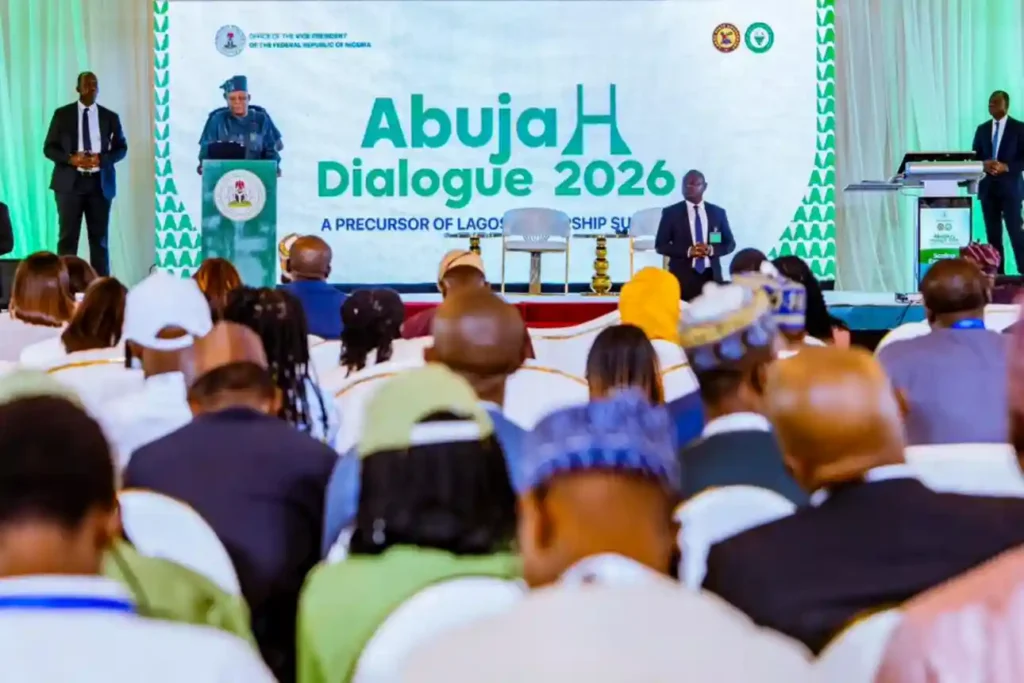
Vice President Kashim Shettima has called for a deliberate national framework to prepare young Nigerians for leadership, warning that the country’s large youth population will become meaningless without structured institutional investment to develop future leaders.
 Follow us on Google News
Speaking on Monday at the Abuja Dialogue 2026, organised by the Office of the Vice President in collaboration with the Lateef Jakande Leadership Academy, Shettima said Nigeria can no longer treat its youthful demographic advantage as a symbolic talking point, but must begin to translate it into concrete leadership development policies.
According to him, Nigeria’s status as one of the youngest countries in the world places a responsibility on government at all levels to create systems that identify, train, mentor and integrate young people into positions of responsibility.
Youth population must become a strategic asset
The Vice President said demographic strength alone cannot guarantee national progress unless backed by institutions that deliberately prepare younger generations for governance, public service and nation-building.
“We are one of the youngest nations on earth. That fact should not be treated as a line for conferences or a statistic for brochures. It is a national condition with profound consequences,” Shettima said.
He noted that the country’s future will depend less on rhetoric and more on whether Nigeria builds sustainable systems for leadership succession across both public and private institutions.
Shettima stressed that leadership development must no longer happen by chance or political accident, especially at a time when governments globally are responding to rapid changes in technology, economics and public expectations.
Leadership should not be left to chance
At the centre of his message was a call for a structured approach to youth inclusion in leadership, which he said must move beyond ceremonial recognition of young people.
According to him, youth leadership is not simply about waiting for older generations to step aside, but about intentionally preparing younger Nigerians to assume responsibility in a gradual and accountable way.
“Youth leadership must be understood with clarity. It is not a ceremonial handover waiting for age to perform its arithmetic. It is a structured process through which young men and women are prepared, trusted, integrated, and supported within the institutions that shape our future,” he said.
He added that leadership capacity grows when young people are given real opportunities to make decisions, learn from mistakes and remain accountable for outcomes.
“Leadership grows when young people are given room to learn, to contribute, to make decisions, and to be held accountable for results. Responsibility is the workshop where capacity is refined,” he added.
Call for reforms in education and public institutions
The Vice President said Nigeria must now redesign its education, civic and enterprise institutions to support this leadership transition.
He argued that slogans about youth empowerment are no longer sufficient unless they are backed by policies that create clear pathways into governance, innovation and economic participation.
For Shettima, leadership renewal requires reforms that embed young Nigerians into the structures where national decisions are made, rather than keeping them at the margins of policy conversations.
Addressing Nigerian youths directly, he said leadership is ultimately defined by readiness to bear consequences and act in the national interest.
“Leadership is not defined by age. It is defined by readiness to bear consequences, to choose the long view over easy applause, and to place the common good above private comfort,” he said.
Lagos pushes youth leadership ecosystem model
Also speaking at the event, Lagos State Governor Babajide Sanwo-Olu said youth leadership development must be treated as a strategic national investment rather than a social programme.
He said the Lateef Jakande Leadership Academy, which hosted the dialogue alongside the Federal Government, was created to serve as a talent incubator for future Nigerian leaders through direct immersion in governance and policy processes.
Sanwo-Olu explained that the academy gives young Nigerians exposure to public sector operations, mentorship from experienced leaders, and opportunities to execute practical projects addressing societal challenges.
He added that the academy is part of a wider Lagos youth development ecosystem that includes the IBILE Youth Academy, Lagos State Employment Trust Fund, digital literacy programmes, entrepreneurship support schemes and MSME-focused interventions.
According to him, unlocking youth potential will require stronger policy frameworks, consistent funding and political will capable of turning leadership promises into working institutions.
Federal Government signals broader youth policy alignment
The event also drew support from other senior government officials, who aligned with the Vice President’s position that youth leadership must become central to national planning.
Deputy Chief of Staff to the President, Senator Ibrahim Hassan Hadejia, said youth leadership should not be approached as symbolism, but as a deliberate governance strategy tied to institutional strength and long-term development.
Minister of Youth Development Ayodele Olawande described the dialogue as timely, stating that Nigerian youths are prepared and willing to take on greater responsibilities in shaping the country’s future.
He added that the administration of President Bola Tinubu remains committed to creating enabling platforms for young Nigerians to occupy leadership positions across government and the economy.
Why this matters
Shettima’s remarks reflect a growing recognition within government that Nigeria’s demographic advantage could become a liability if young people are excluded from leadership pipelines.
With more than half of Nigeria’s population under the age of 30, the debate is shifting from youth inclusion as advocacy language to youth leadership as an economic and governance necessity.
The Abuja Dialogue 2026 has now positioned youth leadership development as a central national policy issue, with growing pressure on both federal and state governments to convert public commitments into measurable institutional reforms.