
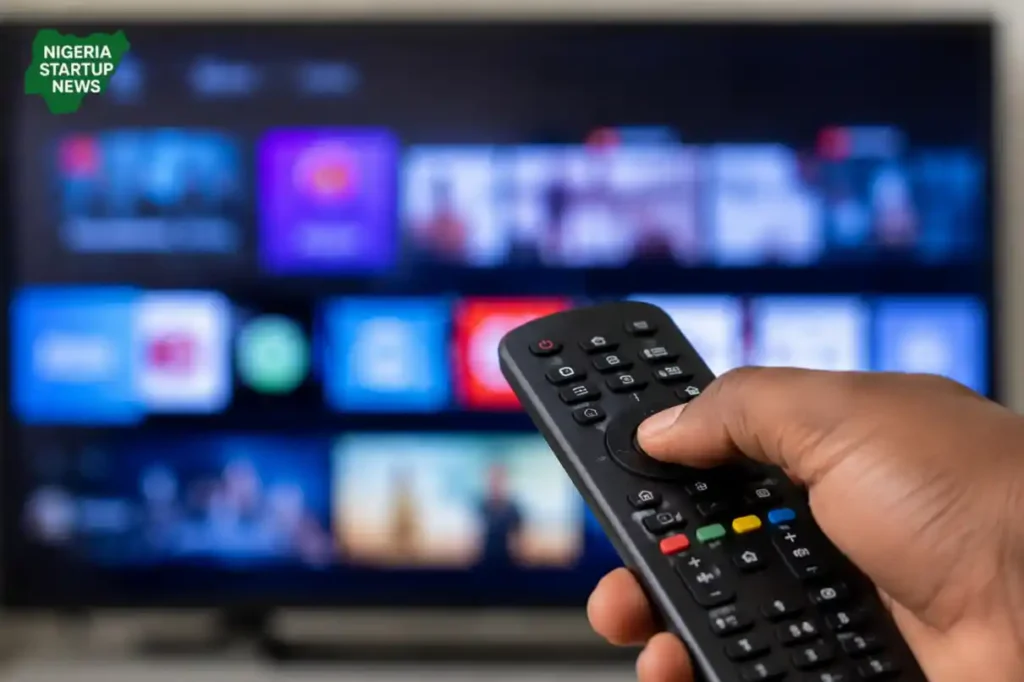


The Federal Government has announced that Nigeria’s long-awaited Digital Switch Over (DSO) project is now fully ready for nationwide launch, marking a major step in the country’s transition from analogue to digital television broadcasting.
Minister of Information and National Orientation, Mohammed Idris, disclosed this during a tour of facilities at the Nigerian Communications Satellite (NIGCOMSAT) headquarters located at the Obasanjo Space Centre alongside the Director-General of the National Broadcasting Commission (NBC), Charles Ebuebu, and the Managing Director/Chief Executive Officer of NIGCOMSAT, Jane Egerton-Idehen.
According to a statement issued on Wednesday by Rabiu Ibrahim, Special Assistant, Media, to the Minister, the DSO platform will be officially commissioned on June 17, 2026, after years of delays and incomplete rollout efforts across different parts of the country.
Speaking during the visit, Idris described the development as a major breakthrough for Nigeria’s broadcasting industry and part of President Bola Ahmed Tinubu’s wider reform agenda aimed at modernising critical sectors of the economy.
“I think this is a new dawn for our country. The promise that President Tinubu made to reform all sectors is now being seen in action in the broadcast industry,” the Minister said.
Nigeria’s Digital Switch Over project was introduced to migrate television broadcasting from analogue signals to digital transmission, a move expected to improve picture quality, increase channel availability, and create more opportunities for broadcasters, advertisers, and content creators.
The Minister explained that the new digital broadcasting ecosystem would provide accurate audience measurement and viewing analytics, allowing broadcasters and advertisers to better understand viewer behaviour and make informed business decisions.
“This is going to bring a lot of advantages to broadcasters, viewers, and advertisers. If you are viewing any particular station, you know who is viewing, what they are watching, and how many people are watching,” he stated.
According to him, the transition will also deepen competition within the broadcasting sector, end existing market dominance, and encourage the growth of local television content across Nigeria and Sub-Saharan Africa.
“The monopoly has been broken. Everybody is going to compete. Content is going to grow, viewership will grow, and Nigeria is now moving from SD to HD broadcasting,” Idris added.
He further noted that Nigerians would enjoy cleaner television signals through satellite broadcasting and mobile applications powered by NIGCOMSAT technology.
The Director-General of the NBC, Charles Ebuebu, said the upgraded DSO framework was designed to meet modern viewing habits and emerging technology demands. He explained that the new system uses satellite broadcasting and mobile-based access to extend coverage beyond the cities that participated in earlier pilot phases of the project.
“We’re going to have 100 channels by the day of launch and even more because more content producers are talking to us. We want to create one market and one platform for Nigeria,” Ebuebu said.
He also revealed that regional production studios and multilingual customer support centres are being established across the country to support the rollout and improve accessibility for viewers in different regions.
For Nigeria’s media and creative industries, the project is expected to create fresh opportunities for local content producers, television stations, technology providers, and advertising agencies as digital broadcasting expands nationwide.
NIGCOMSAT Managing Director and Chief Executive Officer, Jane Egerton-Idehen, described the partnership between NIGCOMSAT and NBC as a strategic collaboration that has improved service delivery standards within Nigeria’s digital broadcasting space.
According to her, ongoing investments and satellite expansion plans under the current administration would ensure stable and continuous service delivery for users.
“The work has only just started. The work has only just begun,” she said.
Also present during the facility tour were the Director-General of the Nigerian Television Authority (NTA), Salihu Abdullahi Dembos; Director-General of the Voice of Nigeria (VON), Jibrin Baba Ndace; Director-General of the Federal Radio Corporation of Nigeria (FRCN), Mohammed Bulama; and Director-General of the National Orientation Agency (NOA), Lanre Issa-Onilu, alongside other senior government officials.