
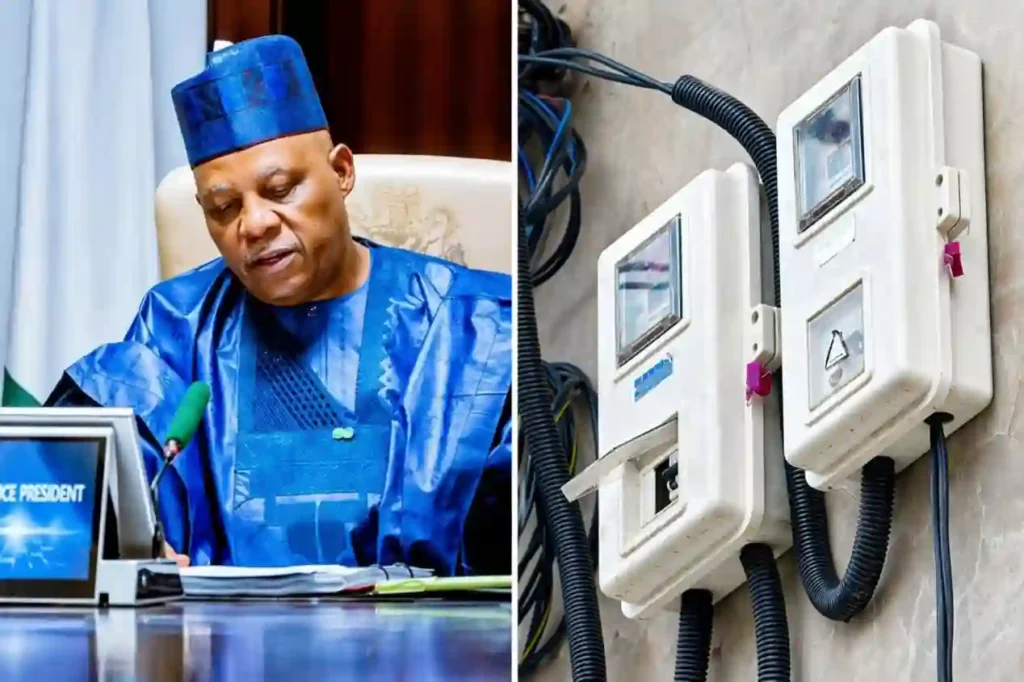


About 3.22 million Nigerian households are set to receive prepaid electricity meters under a Federal Government-backed programme aimed at reducing the country’s long-standing metering gap, even as authorities acknowledge the intervention will not completely eliminate the deficit.
The rollout forms part of a broader distribution sector recovery programme supported by the World Bank, with a financing envelope of $500 million, and is being implemented across the country’s electricity distribution companies (DISCOs). The initiative targets a metering gap currently estimated at about 5.6 million, meaning the new installations will significantly narrow the shortfall but still leave millions of customers on estimated billing.
Speaking on developments tied to the programme, Director General of the Bureau of Public Enterprises (BPE), Mr Ayodeji Ariyo Gbeleyi, said contracts have already been signed for 1,437,000 meters, with deployment underway nationwide. According to him, nearly 400,000 units have been installed across the 11 DISCOs, marking early progress in the phased implementation.
“As of today, we have signed a contract for 1,437,000 metres that have already been deployed in the country. As we speak, almost 400,000 of those metres have been installed across the 11 DISCOs within the country,” he said.
He added that the metering effort is central to ongoing reforms in the power sector, particularly in addressing estimated billing, which has remained a major concern for consumers and regulators alike.
“These are all efforts geared towards ensuring that we can have stable power supply in the country and also ensuring that the era of estimated billing is a thing of the past, as promised by His Excellency Mr President,” Gbeleyi stated.
The update comes as the Federal Government reiterates its commitment to unlocking the full value of national assets and attracting global capital through structured reforms and privatisation strategies. At the centre of this policy direction is an increased reliance on public-private partnerships (PPPs) to drive investment and infrastructure development.
Vice President Senator Kashim Shettima, who chairs the National Council on Privatisation (NCP), emphasised this position during the Council’s first meeting of 2026 held at the Presidential Villa in Abuja. He said the administration is focused on creating an investment-friendly environment while ensuring that capital inflows align with national development priorities.
“The task before us is not only to ensure that Nigeria emerges as a safe destination for private investment, but to align that investment with the governing purpose of this administration and the larger destiny of our nation,” Shettima said.
He stressed that Nigeria’s ambition of becoming a trillion-dollar economy would require a deliberate balance between public sector oversight and private sector participation, noting that economic growth must be intentionally designed and supported by strong institutions.
“Prosperity does not happen by accident. It is designed, negotiated, protected, and sustained by institutions that understand that national assets must be deployed in the service of the people,” he said.
The Vice President pointed to recent progress across key sectors including mining, agriculture, and energy, citing the sale of Eko Electricity Distribution Company (Eko DISCO) as an indication of renewed investor confidence in Nigeria’s power sector reforms.
According to him, policy consistency and clarity remain critical in sustaining investor interest, warning that rhetoric alone is insufficient to attract long-term capital.
“Investors do not respond to rhetoric alone. They respond to coherence, to clarity, and to the evidence that a country knows where it is going and has the courage to stay the course,” he added.
Shettima also highlighted improvements in governance within the privatisation process, particularly around audit compliance and institutional discipline, describing these as necessary steps in rebuilding trust with both domestic and international investors.
He urged the Council to accelerate efforts in developing a pipeline of bankable projects while deepening the use of PPPs as a tool for economic expansion.
“We must accelerate the work of building a pipeline of bankable projects and of executing more public-private partnership transactions to support our economic targets,” he said.
Beyond project execution, the Vice President called for stricter post-privatisation monitoring to ensure that assets transferred to private operators deliver on agreed performance benchmarks and contribute to national development objectives.
He also cautioned against policy inconsistencies within government institutions, noting that overlapping mandates and unclear regulatory roles could undermine reform efforts and weaken investor confidence.
“Policy confusion is expensive. Overlapping mandates unsettle the market. If we are to speak convincingly to investors, government must speak with one voice,” Shettima said.
Further details from the NCP meeting indicate that efforts are being made to align institutional processes with global best practices. Gbeleyi disclosed that the BPE has cleared a backlog of audited financial statements, bringing its accounts up to date in compliance with the Public Enterprises Act 1999.
“We inherited a situation where the audited financial statement of the BPE has been outstanding for three years. In less than nine months, we brought all of those audited financial statements up to date in line with the requirements of the Public Enterprises Act 1999,” he said.
He added that the Bureau has maintained a consistent record of timely financial reporting, with its 2025 audited accounts already presented, a move he said reflects improved institutional discipline.
“In our tradition of keeping to best practises, we also ensured that the account for 2024 were presented to Council in the first quarter of 2025. In terms of our consistent best practises, we presented today, the audited financial statement of the Bureau for the year ended 31st December 2025. Not so many agencies could have achieved that feat,” Gbeleyi noted.
At a separate media briefing, he revealed that the NCP approved N157 million as repatriation allowances for 830 former staff of NICON, addressing obligations that have remained outstanding for about two decades.
He also confirmed the Council’s approval for the lease of four coal blocks to a special purpose vehicle (SPV) established by the Enugu State Government, subject to the necessary licensing from the Mining Cadastral Office.
Taken together, the approvals and updates signal a continued push by the Federal Government to strengthen institutional frameworks, close infrastructure gaps, and leverage both public and private capital in pursuit of long-term economic growth, with the prepaid metering initiative standing out as a key intervention in improving transparency and efficiency within Nigeria’s power sector.