

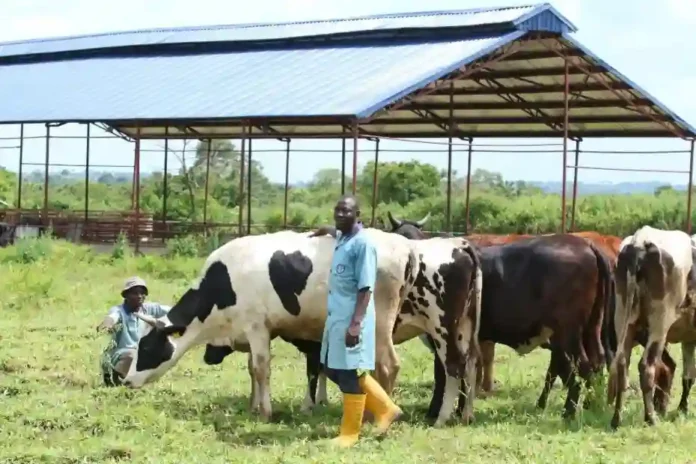
The Jigawa State Government has launched a large-scale alfalfa production initiative aimed at growing the grass on 100,000 hectares of farmland to produce quality livestock feed, improve livestock productivity, create jobs, support exports and reduce farmer–herder conflicts.
The Commissioner for Livestock Development, Prof. Salem Abduraman, disclosed the initiative while speaking with journalists, explaining that the programme is designed to tackle the long-standing shortage of high-quality animal feed across the state and Nigeria at large.
According to him, the initiative follows a Memorandum of Understanding signed in December 2025 between the Jigawa State Government and Elmina Farms for the cultivation and processing of alfalfa grass for both domestic use and export markets.
“The goal is to produce high-quality forage that will support livestock productivity while positioning Jigawa State as a major supplier of animal feed in both local and international markets,” Abduraman said.
He explained that the project would operate through a Special Purpose Vehicle structure that brings together the state government, private investors and host communities.
Under the arrangement, the Jigawa State Government will hold a 35 per cent equity stake, private investors will control 45 per cent, while host communities will hold 15 per cent. Other stakeholders will own the remaining shares.
To ensure community participation and benefits, Abduraman said an additional 200 hectares of farmland would be reserved during the pilot phase specifically for surrounding communities.
He added that corporate social responsibility initiatives would also be implemented to support women and young people in the host communities.
The commissioner described feed as one of the most important components of livestock production, noting that the government is prioritising pasture development to improve animal nutrition and productivity.
“Feed remains one of the most critical inputs in animal production after improved genetics,” he said.
He revealed that preliminary research conducted at Matura Agro Farms with support from PropCom+ showed that alfalfa grass grown in Jigawa can contain up to 24 per cent protein, a level he described as highly competitive by global standards.
According to him, the state’s soil type and water resources make it suitable for both rain-fed and irrigation-based alfalfa cultivation.
He identified Gumel, Gagarawa and Sule Tankarkar as areas suitable for rain-fed production, while Hadejia, Malam Madori and parts of the southern axis of the state would support irrigation farming.
The project will begin with a 1,000-hectare pilot phase that will utilise 20 pivot irrigation systems, each covering 50 hectares of farmland.
Abduraman said soil evaluation is currently ongoing ahead of land preparation and cultivation.
He explained that teams of soil scientists from the Centre for Dryland Agriculture are conducting soil and water assessments, while irrigation specialists from the centre are expected to provide additional technical evaluations.
Technology will also play a role in monitoring and protecting the project.
The National Information Technology Development Agency has deployed digital monitoring systems and security infrastructure to support the initiative.
Abduraman said land clearing will commence once soil testing is completed, while full-scale production is expected to begin by November.
He stressed that the initiative would generate thousands of jobs across the state while strengthening the livestock value chain.
“With reliable access to nutrient-rich forage, livestock farmers will be able to improve milk production and overall animal productivity,” he said.
The commissioner added that improved availability of quality feed would reduce open grazing pressure on farmland, helping to minimise tensions between farmers and pastoralists.
“Providing adequate forage will discourage cattle from grazing on cultivated crops and will significantly reduce farmer–herder conflicts,” he said.
He also revealed plans to train selected youths from the state in Argentina through a partnership with the government of Córdoba to build technical expertise in forage production and livestock development.
According to him, the state government is also working with experts to establish specialised processing centres that will support dairy and poultry value addition within Jigawa.

