
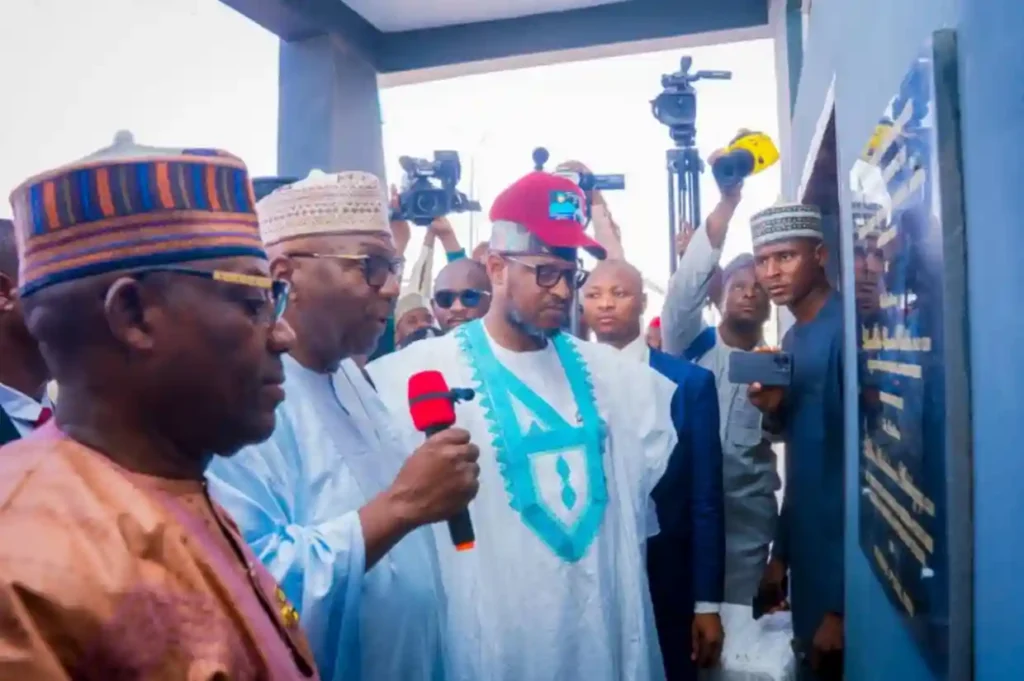


Kwara State Governor and Chairman of the Nigerian Governors’ Forum (NGF), Abdulrahman Abdulrazaq, has commissioned the Radda Model Secondary School in Katsina State, marking a significant step in the state’s ongoing education reform drive under Governor Dikko Umaru Radda.
The project, delivered under Radda’s “Building Your Future” agenda, is positioned as a strategic investment in modern, technology-driven education designed to prepare students for emerging global realities.
Speaking during the inauguration, Governor Radda said the concept of smart schools in Katsina had been in consideration for over three decades but is only now being fully realised through deliberate policy direction and sustained investment.
“This initiative is a fulfilment of a long-standing vision to provide our children with the kind of education that prepares them not just for today, but for the future,” he said.
Radda explained that the idea of establishing model schools across the state is closely tied to his personal academic journey, noting that access to quality education remains one of the strongest drivers of excellence, innovation, and leadership.
He described the Radda Model Secondary School as a defining milestone for his administration, adding that the project goes beyond physical infrastructure to reflect a deeper commitment to human capital development.
“This school is not just about buildings; it is about shaping minds, nurturing talents, and preparing a generation that will compete globally and drive innovation,” the governor stated.
He also referenced Katsina State’s historical reputation as a centre of learning, stressing that his administration is building on that legacy by investing in science, technology, and innovation-focused education.
According to him, admission into the school was conducted strictly on merit through competitive examinations held across all 34 local government areas in the state. About 1,000 students were selected through the process, which he said was designed to ensure fairness, equity, and inclusiveness.
Governor Radda disclosed that the school is fully equipped with modern facilities, including well-furnished science laboratories, advanced ICT infrastructure, digital learning tools, 24-hour internet connectivity, reliable electricity, standard libraries, sports facilities, and residential hostels for both students and teachers.
He added that the institution has been carefully designed to expose students to global trends such as artificial intelligence, robotics, coding, digital governance, and other technology-driven disciplines.
“Our goal is to produce innovators, problem-solvers, and future leaders who can compete effectively on the global stage,” he said.
The governor further noted that the initiative is aimed at addressing inequality in access to quality education, especially for talented students from disadvantaged backgrounds across the state.
Providing an overview of his administration’s broader education interventions, Radda said over 7,325 teachers have been recruited, while more than 18,000 teachers have undergone training. He added that over 20,000 teachers have received laptops to support digital learning delivery.
He also disclosed that scholarships worth over ₦7 billion have been awarded to students within and outside Nigeria, as part of efforts to strengthen access to higher education and specialised training.
In addition, more than 75 secondary schools have been completed across the state, with over 30 others currently under construction. Hundreds of classrooms have also been rehabilitated and furnished.
“These interventions reflect our sustained commitment to repositioning the education sector and ensuring that no child is left behind,” he said.
Governor Radda revealed that the Radda Model Secondary School is the first of three planned model schools across the state’s education zones. He assured that the programme would be expanded to ensure that more students have access to world-class learning facilities.
He called on development partners and private sector stakeholders to support the initiative through scholarships, infrastructure partnerships, and teacher development programmes, emphasising that education development requires collective effort.
The governor also reaffirmed his administration’s commitment to improving teachers’ welfare, acknowledging existing challenges while promising continued efforts to enhance working conditions and professional dignity.
He urged students of the new school to remain disciplined, focused, and committed to academic excellence, noting that the opportunity before them is rare and must be fully utilised.
In his remarks, Abdulrazaq described the project as a landmark achievement that reflects purposeful leadership and long-term planning.
He said the school represents more than a physical structure, noting that it is a deliberate investment in the future, equipped with modern classrooms, digital learning systems, functional laboratories, and a standard boarding facility.
According to him, infrastructure alone is not enough, stressing the importance of effective teaching, continuous teacher training, and functional learning systems in achieving meaningful education outcomes.
He commended the initiative for aligning with broader national efforts to position education as a key driver of economic growth and social development, particularly through improved access, quality, accountability, and inclusiveness.
Abdulrazaq also called on parents, community leaders, and other stakeholders to take ownership of the facility, emphasising the need for proper maintenance and community support to sustain its impact.
He encouraged students to maximise the opportunity provided by the school, stating that their success would justify the investment and inspire similar initiatives across the country.
The NGF Chairman further commended President Bola Ahmed Tinubu for ongoing economic reforms, which he said have created room for increased investment in critical sectors such as education.
He also praised Governor Radda for prudent resource management and suggested the introduction of student exchange programmes among northern states to promote exposure, unity, and inclusiveness.
Similarly, the Honourable Minister of Education, Maruf Olatunji Alausa, described education as the most powerful investment any government can make.
“This institution is not just infrastructure; it is a symbol of hope, opportunity, and empowerment for young people,” he said.
Alausa noted that the project aligns with the Federal Government’s education reform agenda under President Tinubu, which focuses on expanding access, improving quality, strengthening technical and vocational education, and enhancing digital learning systems.
He assured the Katsina State Government of continued federal support and described the Radda Model Secondary School as a model for education transformation in Nigeria.
Earlier, the Honourable Commissioner for Education, Hon. Yusuf Suleiman Jibia, described the project as a major milestone in the state’s education reform programme.
He said the initiative goes beyond infrastructure, focusing on equipping students with relevant, future-ready skills while reinforcing education as a foundation for sustainable development.
Also speaking, the Lead Consultant of Hallmark Educational Consultancy Services, Hajiya Zainab Bugaje Jika, described the commissioning as a historic achievement and a reflection of shared commitment to building a world-class education system.
She disclosed that recruitment of staff was conducted strictly on merit through a transparent process involving Computer-Based Tests, oral interviews, and micro-teaching assessments.
According to her, a total of 213 academic staff and 38 non-academic staff were engaged for the school, while student admission was carried out fairly across all 34 local government areas.
She added that the institution is designed to prepare students for future opportunities in areas such as artificial intelligence, robotics, coding, entrepreneurship, and vocational skills, supported by modern classrooms, science laboratories, and ICT-enabled learning systems.
The commissioning event was attended by senior government officials, members of the State Executive Council, lawmakers, traditional rulers, development partners, and key stakeholders in the education sector, reflecting broad support for the initiative.