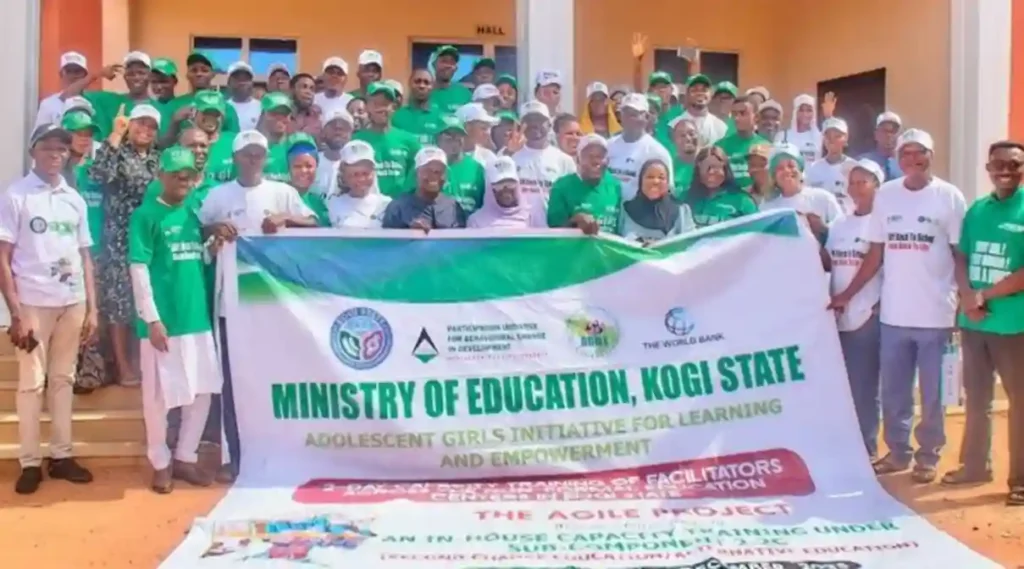
The Kogi State Ministry of Education, through the Adolescent Girls Initiative for Learning and Empowerment (AGILE) Project, has trained 130 facilitators drawn from non-formal education centres across the three senatorial districts of the state to strengthen the delivery of second-chance and alternative education programmes.
 Follow us on Google News
The two-day capacity-building training was held under AGILE Sub-Component 2.2C (Second Chance/Alternative Education) in partnership with the Participation Initiative for Behavioural Change in Development (PIBCID). It focused on improving facilitators’ understanding of post-literacy manuals, harmonising instructional methods, and promoting participatory and adult learning techniques.
Speaking at the opening, the State Project Coordinator (SPC), Alhaji Ahmed Tijani Oricha, described the training as “a strategic intervention aimed at improving access, quality, and equity in education delivery.” He said non-formal education remains critical to reaching adolescents and young people excluded from the formal system and noted that well-trained facilitators are central to achieving the objectives of the AGILE Project at the grassroots.
Oricha urged participants to apply learner-centred approaches in their centres, stressing that their commitment and professionalism would directly influence learning outcomes and the overall success of the Second Chance Education programme.
The Component Lead, Hajia Mariam Bello, said the training was designed to ensure uniformity and consistency in content delivery across all non-formal education centres in Kogi State. She explained that facilitators were guided through structured sessions to deepen their understanding of lesson sequencing, integrated teaching approaches, and effective classroom engagement for adult and adolescent learners.
According to her, adopting participatory methods would help create inclusive learning environments that respond to learners’ realities while advancing AGILE’s goal of improved literacy, numeracy, and life skills acquisition.
Also speaking, the Executive Director of PIBCID, Mrs. Racheal Akande, reaffirmed the organisation’s commitment to supporting capacity development and behaviour-change interventions that strengthen teaching quality within the non-formal education sector.
The training featured technical sessions in English Language, Mathematics, Civic Literacy, and Basic Science, facilitated by resource persons and reinforced through interactive discussions. Participants described the programme as impactful and pledged to deploy the skills acquired to improve learning outcomes across non-formal education centres in Kogi State.