

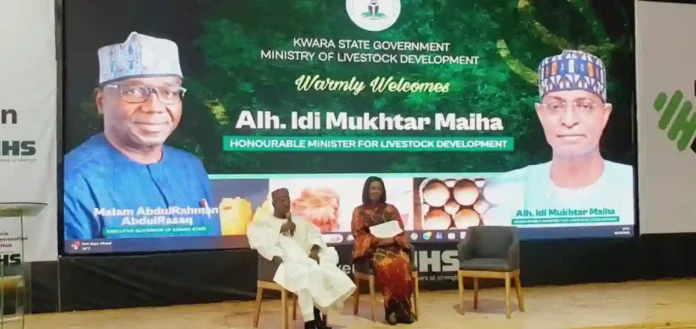
Kwara State is set to pilot Nigeria’s national ranching policy as the federal government moves to modernise the livestock sector, improve productivity, and reduce recurring farmers-herders conflicts across the country.
The Minister for Livestock Development, Idi Mukhtar Maiha, disclosed this on Tuesday during a high-level stakeholders’ engagement held in Ilorin, the Kwara State capital. He said the choice of Kwara was deliberate, given its land availability, farming culture, and readiness to support reforms in livestock production.
Maiha urged Nigerians to move away from the belief that ranching requires huge capital to begin. “Forget about the idea that you can’t do ranching. Start with two goats, cows, sheep, or pigs; they reproduce,” he said. According to him, even small-scale efforts can grow into profitable ventures over time.
He explained that fodder production alone presents major economic opportunities for farmers and young entrepreneurs. “Think of fodder. It’s just growing grass. Imagine wide lands in Kwara where varieties of grass can be planted. In Qatar, UAE, and Saudi Arabia, they all want to import grass from Nigeria. These are huge opportunities if we explore them,” Maiha said.
The minister noted that the federal, state, and local governments are already creating an enabling environment to support investors and farmers in the livestock value chain. He revealed that discussions were ongoing with the Kwara State Government on the establishment of feedlots to support livestock owners. “We have to establish feedlots where young boys and girls can bring their bulls, sheep, and pigs. The arrangement will be structured to improve productivity,” he said.
Announcing Kwara as the pilot state for the national ranching policy, Maiha said the programme would demonstrate that settled ranching is possible and effective. “We are going to show that nomadic people can be settled, infrastructure can be built for them to remain in one place, improve productivity, and address farmers-herders conflicts. This solution will come from us, and Kwara State will be the pilot for this programme,” he stated.
Speaking on broader sector reforms, the minister lamented that nearly half a billion poultry businesses currently operate outside the formal economy, limiting growth and access to support. He stressed that livestock remains Nigeria’s most important source of animal protein and said the creation of the Ministry of Livestock Development would help the sector become vibrant, resilient, sustainable, and globally competitive.
Maiha also highlighted untapped opportunities within the livestock sub-sector, citing honey production as an example. “By 2022, Nigeria imported N800 billion worth of honey. As I moved around some farms in Ilorin, I saw forested honey and its huge potential in Kwara State,” he said.
He encouraged farmers to adopt technology-driven practices and strong biosecurity systems, referencing Brazil’s model where large processors support small-scale farmers with chicks, feed, and veterinary services. “We are in a digital era where Gen Z are tech-savvy. If I were young again, I would not look for a government job or go into oil and gas; I would go into agriculture, particularly livestock,” he added.
Reacting, Kwara State Governor AbdulRahman AbdulRazaq, represented by the Commissioner for Agriculture and Rural Development, Afeez Alabi, assured stakeholders of sustained government support. “Poultry production is not just an agricultural activity; it is a strategic pillar of food security, job creation for youth and women, and economic growth,” he said, adding that livestock remains central to the state’s development agenda.
Earlier, the Commissioner for Livestock Development in Kwara State, Oloruntoyosi Thomas, said the initiative prioritises youth empowerment and productivity. “There is no room for Nigerian students to graduate unemployed. Livestock is positioned to achieve that in Kwara,” she said, noting that the engagement was designed to shift attention from conflict to production. “We are going to turn machine guns into milking machines and armoured tanks into tractors,” she added.

