Home Blog Page 138

JAMB warns matriculated students to declare status for 2026 UTME, DE

0

The Joint Admissions and Matriculation Board (JAMB) has clarified that candidates already enrolled in tertiary institutions are allowed to register for the 2026 Unified Tertiary Matriculation Examination and Direct Entry, provided they disclose their matriculation status, warning that failure to do so could lead to the forfeiture of both admissions.

The clarification was contained in a statement issued on Wednesday and signed by the Board’s Public Communication Adviser, Dr Fabian Benjamin, following what he described as misrepresentation of the Board’s directives by some “self-styled education advocates”.

“The attention of the Joint Admissions and Matriculation Board has been drawn to a misleading and unfortunate distortion of a portion of the Board’s clear directives to candidates registering for the 2026 UTME/DE, as contained in the 2026 UTME/DE advertisement,” Benjamin said.

He added that, “This deliberate misrepresentation is being propagated by some unscrupulous self-styled education advocates for parochial interests.”

Benjamin explained that such individuals usually emerge at the start of every registration exercise, spreading inaccurate information that confuses candidates and parents.

“Many of them do not take the time to read or properly understand the guidelines, yet hastily rush to the public space with false narratives aimed solely at attracting traffic to their social media platforms,” he said.

According to him, it is not against the law for a candidate to register for the UTME or Direct Entry while still enrolled in a tertiary institution, as long as the required disclosure is made.

“For the avoidance of doubt and for record purposes, and in line with its statutory mandate to prevent multiple matriculations, the Board directed that all candidates registering for the 2026 UTME/DE must disclose their matriculation status, where applicable,” he said.

Benjamin clarified that disclosure does not mean a candidate can hold two admissions at the same time.

“It is not an offence for a candidate to register for the UTME/DE while still enrolled in an institution. However, failure to disclose such status constitutes an offence,” he said.

He added, “Disclosure simply means that once a candidate secures admission through the latest registration, the former admission automatically ceases to subsist. The law is explicit that no candidate is permitted to hold two admissions concurrently.”

The adviser revealed that recent findings showed that some already matriculated students were being used as professional examination takers.

“Mandatory disclosure, therefore, expedites appropriate action whenever such candidates are apprehended,” he said.

Benjamin noted that although the Board’s system can detect prior matriculation, candidates who fail to disclose risk losing both opportunities.

The Board said candidates should follow instructions throughout the registration process.

As part of efforts to protect examination integrity, JAMB earlier announced that registration for the 2026 UTME officially commenced on January 26.

It also ruled that any Computer-Based Test centre whose registration activities cannot be monitored remotely would not be allowed to participate.

According to the Board, the policy tagged “No Vision, No Registration, No UTME,” is aimed at curbing registration infractions and restoring confidence in its examination processes.

Advertisement

UNICEF equips 100,000 youths with digital and vocational skills in Borno

0

The United Nations Children’s Fund (UNICEF) Chief of Maiduguri Field Office, Francis Butichi, has disclosed that the organisation equipped about 100,000 young people with digital and vocational skills across Borno State in 2025. He made this known on Tuesday during an event organised to commemorate the 2026 International Day of Education in Maiduguri, the state capital.

Butichi explained that the beneficiaries included graduates, undergraduates and other young people drawn from different communities across the state. He was represented at the event by UNICEF’s Resilience Manager, Atthawoot Sangkharat, who said the intervention aligns with the Federal Government’s vision of supporting young people to transition from learning to earning.

According to him, UNICEF has worked with academic institutions to expand access to learning opportunities while building practical experience for youths. “Through UNICEF’s partnership with the University of Maiduguri, young people, including undergraduate and graduate students, are working as educators in non-formal learning centres, helping thousands of out-of-school children return to learning,” he said.

“At the same time, these young educators are gaining real-world experience, skills and confidence, fully aligned with the Generation Unlimited agenda,” he added.

Butichi also noted that vocational skills development remains a major focus of UNICEF’s support in the state. He said that through vocational programmes, UNICEF, in partnership with the Borno State Ministry of Education, supported over 4,600 youths with starter packs across Bama, Dikwa, Monguno and Maiduguri.

According to him, the support enables beneficiaries to convert their skills into sustainable livelihoods and also helps them support the education of their children or siblings. “Overall, approximately 100,000 young people were equipped with diverse skills in 2025 across Borno State,” he said.

He further stated that beyond formal learning spaces, UNICEF is supporting youths to acquire digital skills through platforms and programmes such as the Nigeria Passport Learning Initiative, Foundation Literacy and Numeracy Skills for Work and Self-Reliance.

Butichi added that youth leadership in education is being promoted through initiatives including technology-driven spelling bees and mathematics quizzes, where learners apply innovation, teamwork and technology to strengthen literacy and numeracy within communities.

Speaking on the theme of this year’s celebration, “The Power of Youth in Co-creating Education,” Butichi said it highlights the importance of involving young people in innovation and development. “The theme reflects a simple truth: education works best when young people are not just learners, but partners, innovators and leaders in the learning process,” he said.

He urged youths to take responsibility for shaping their future rather than waiting for change. “To the young people here today, you are not waiting for change, you are creating it. Your ideas, energy and leadership are essential to building education systems that truly work,” he said.

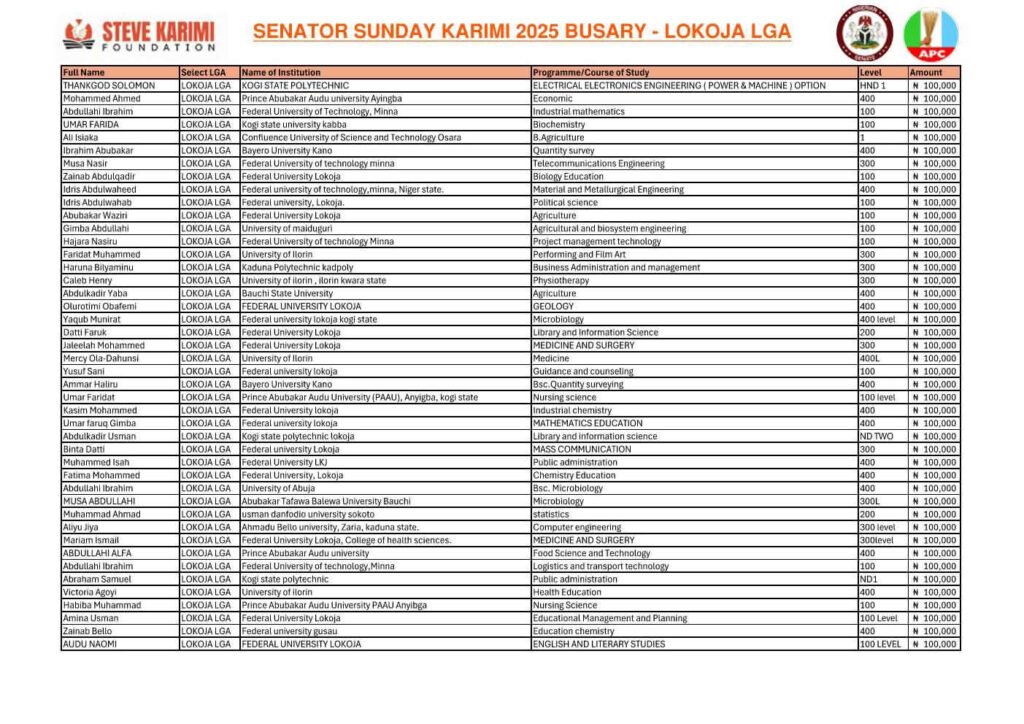
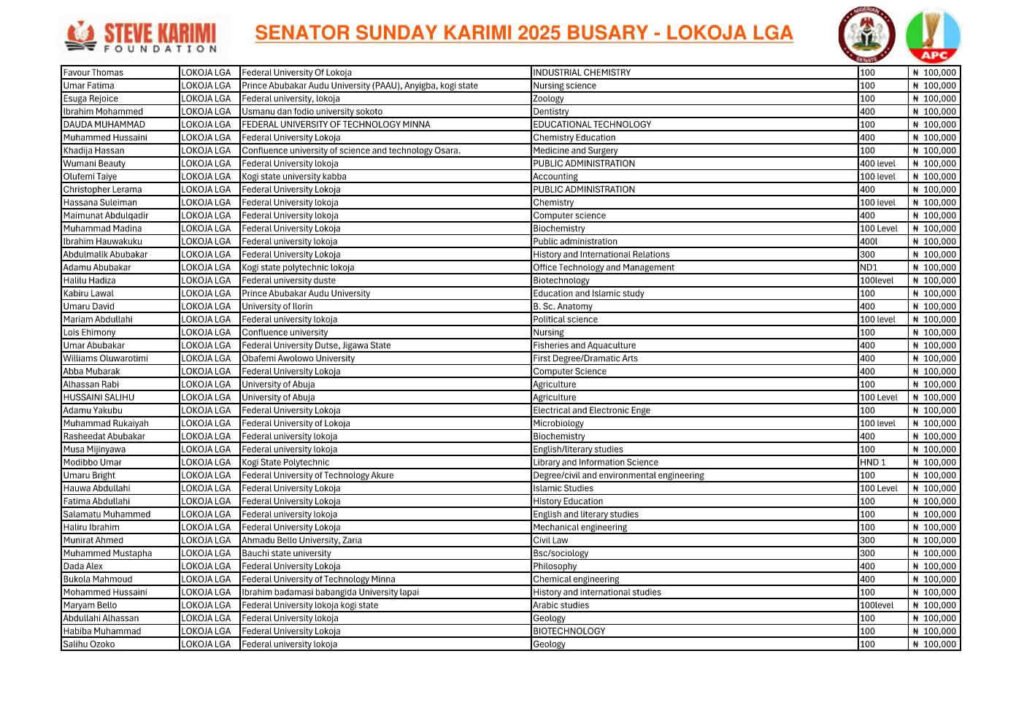
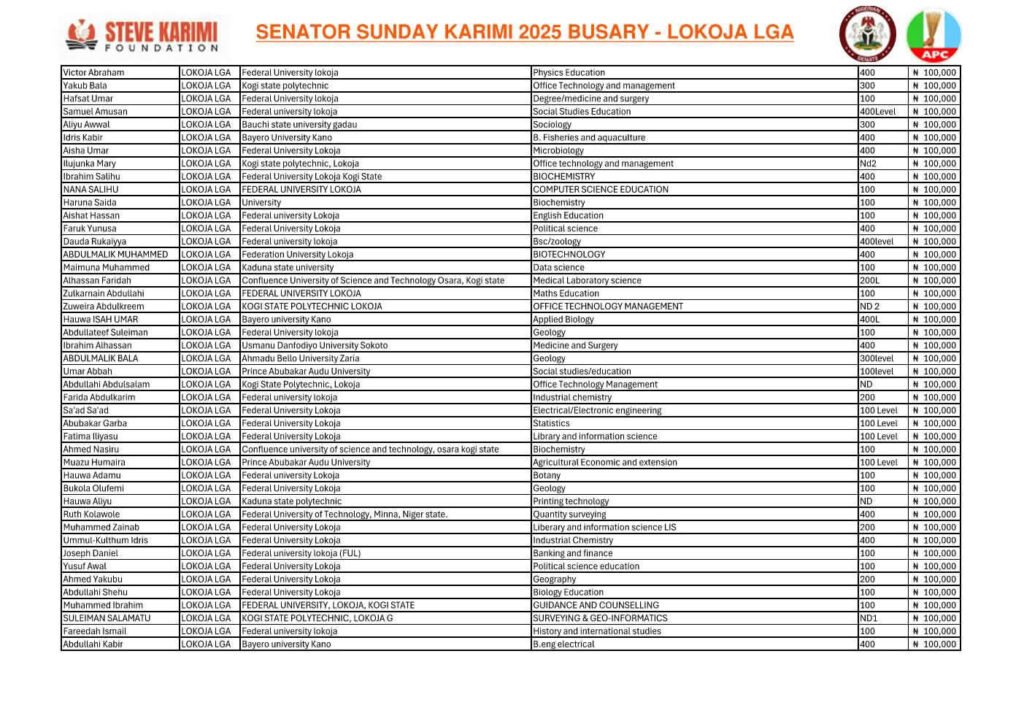
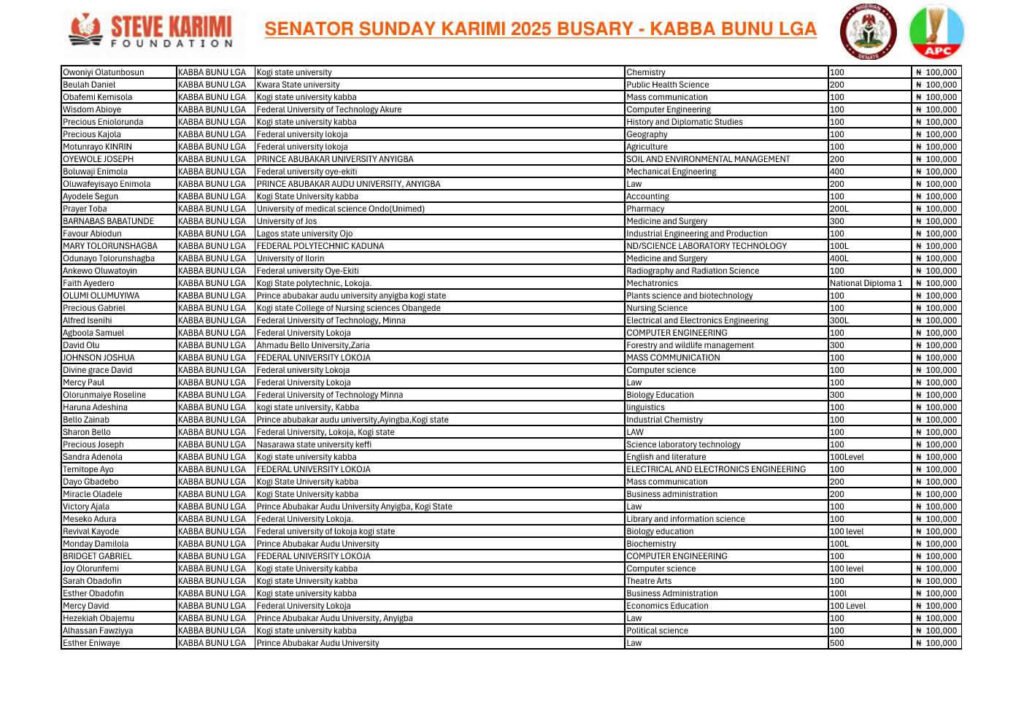
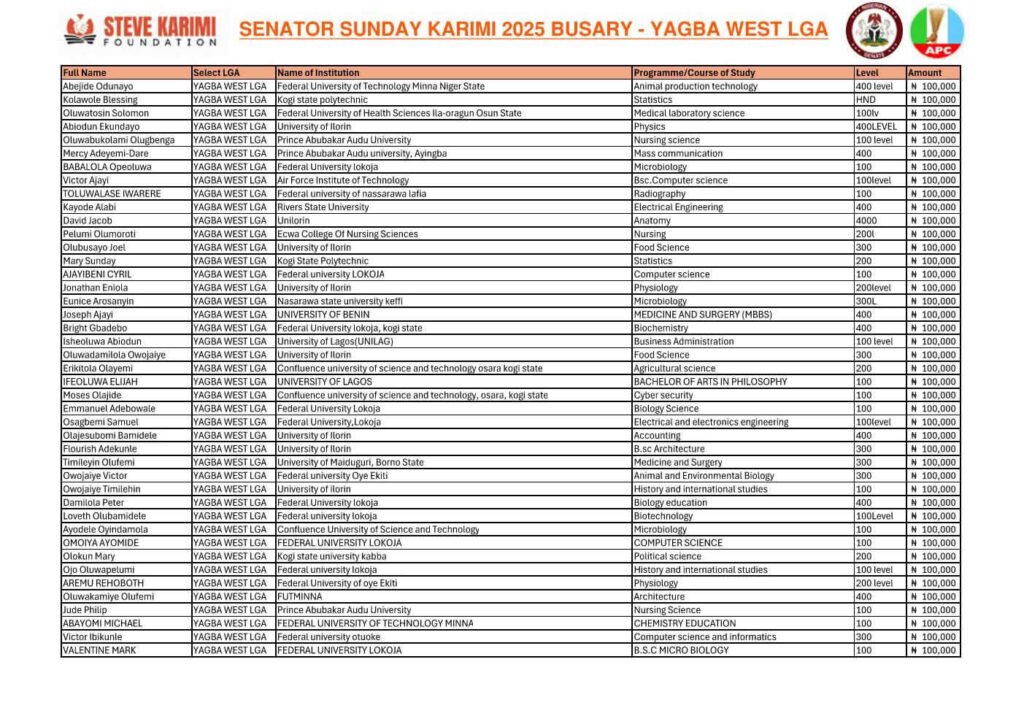
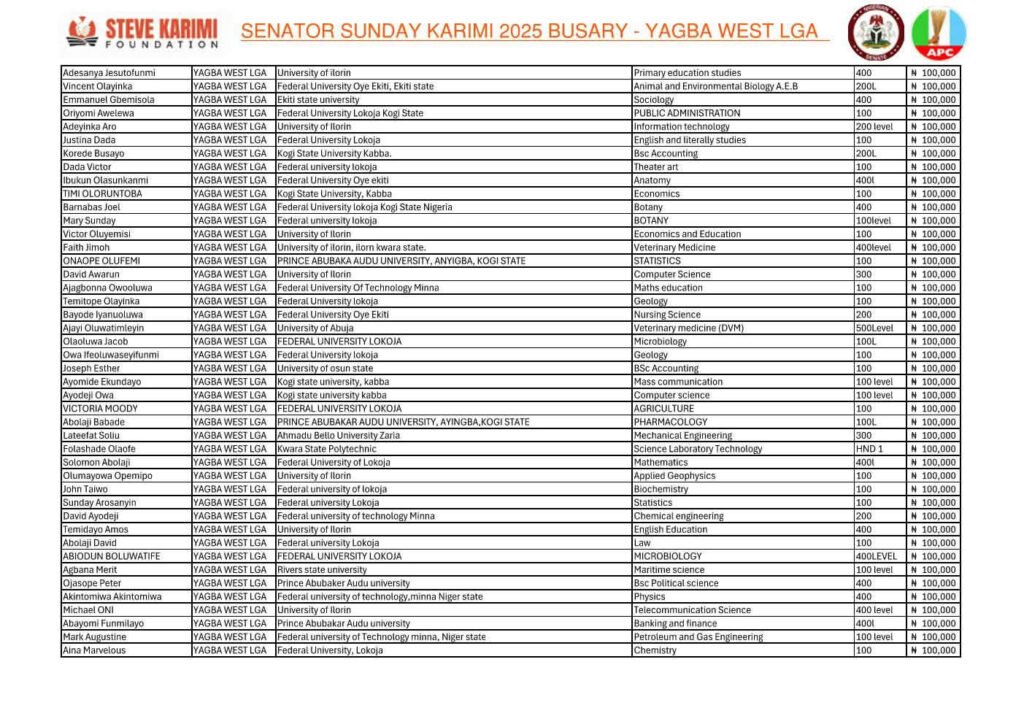
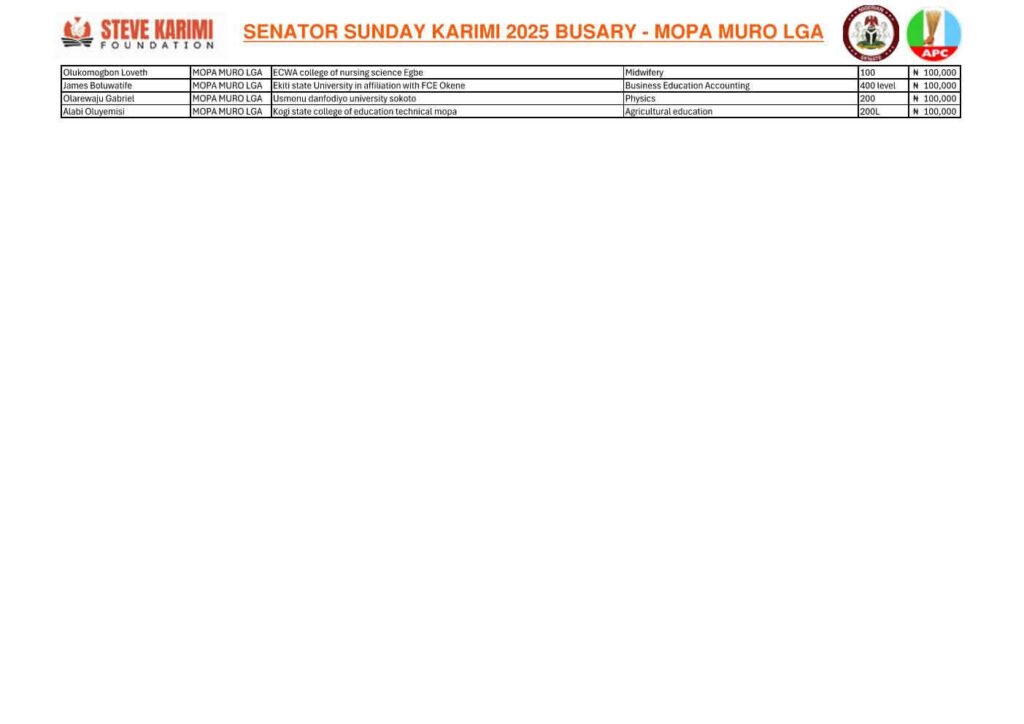
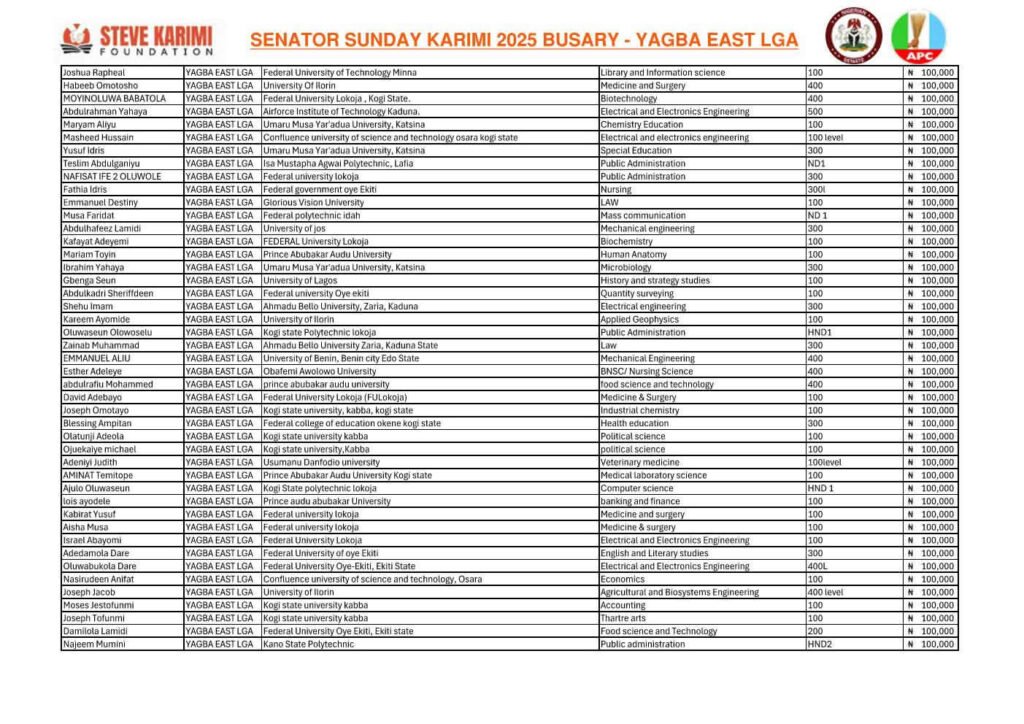
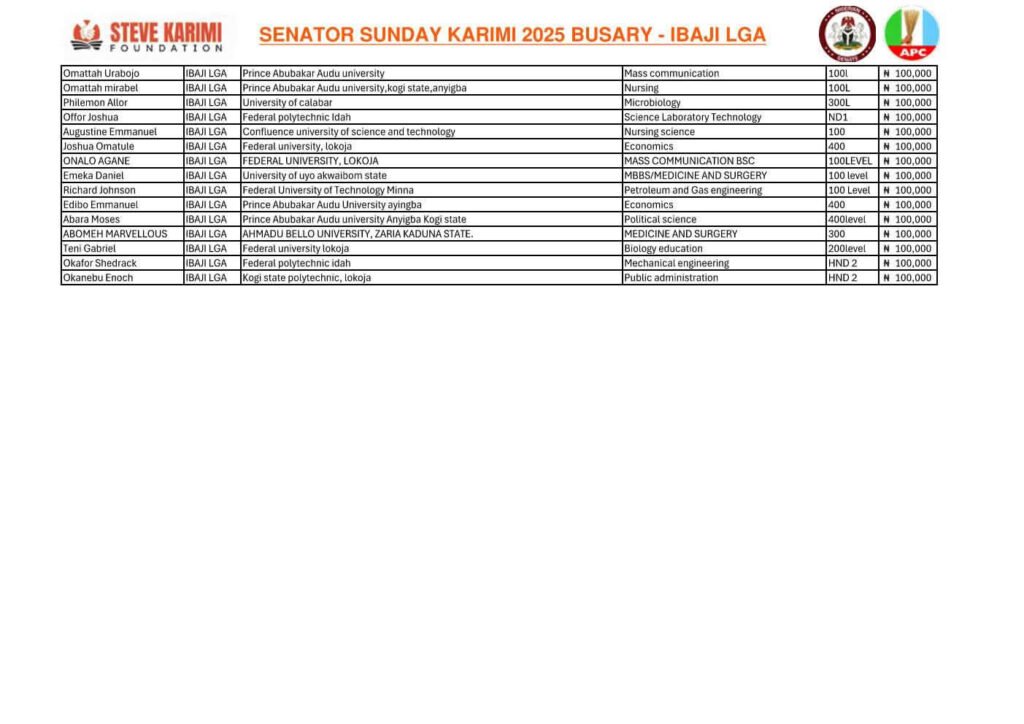
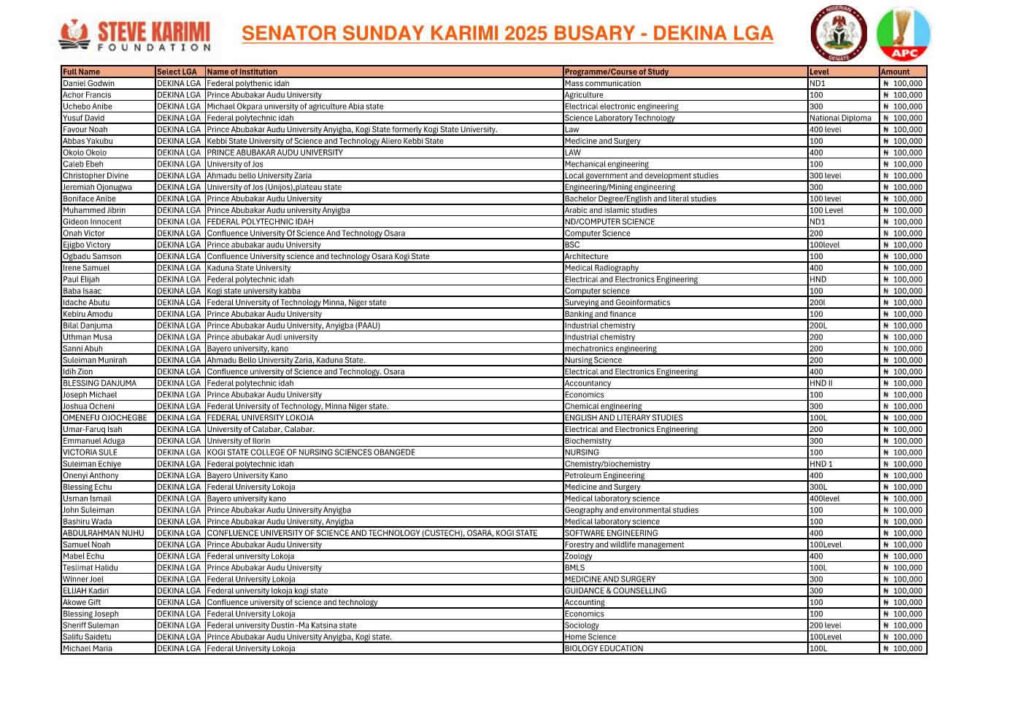
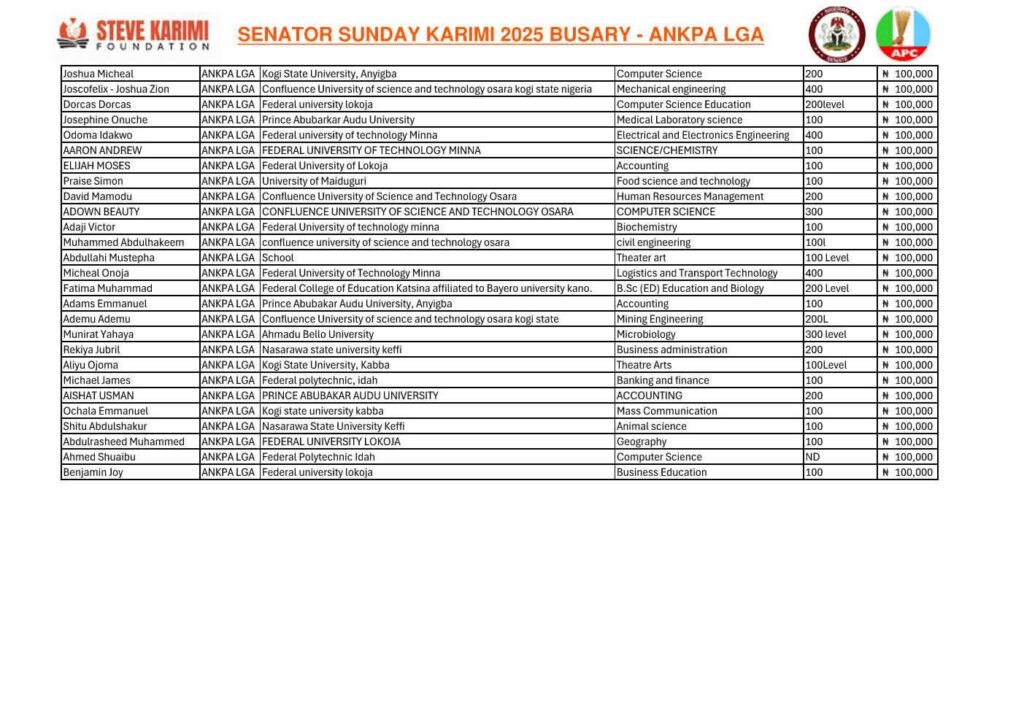
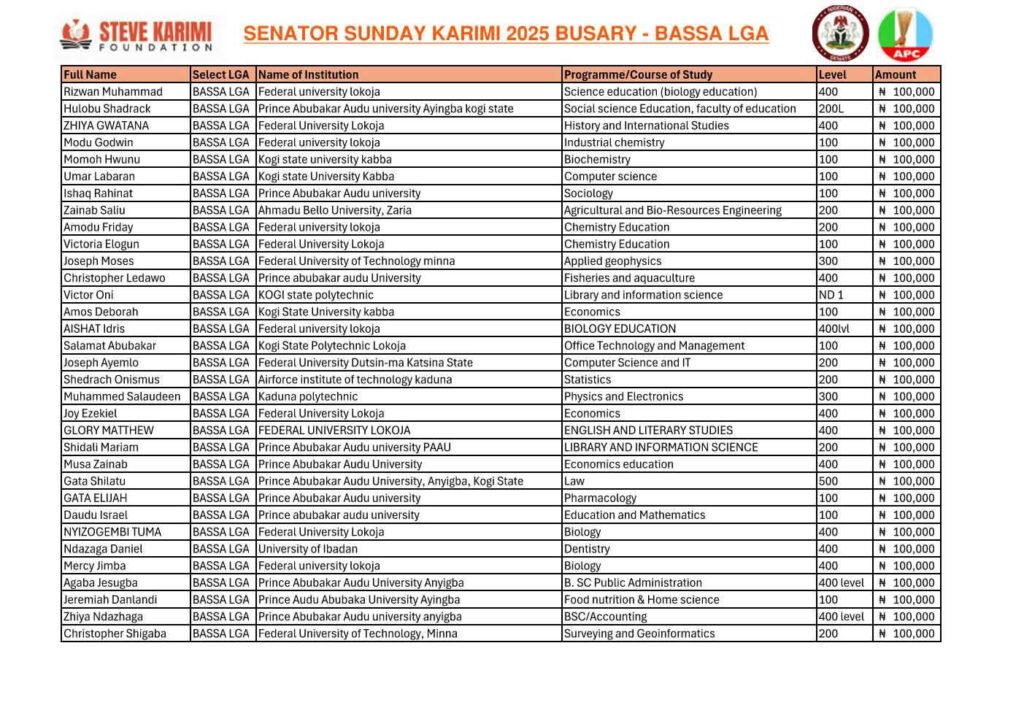
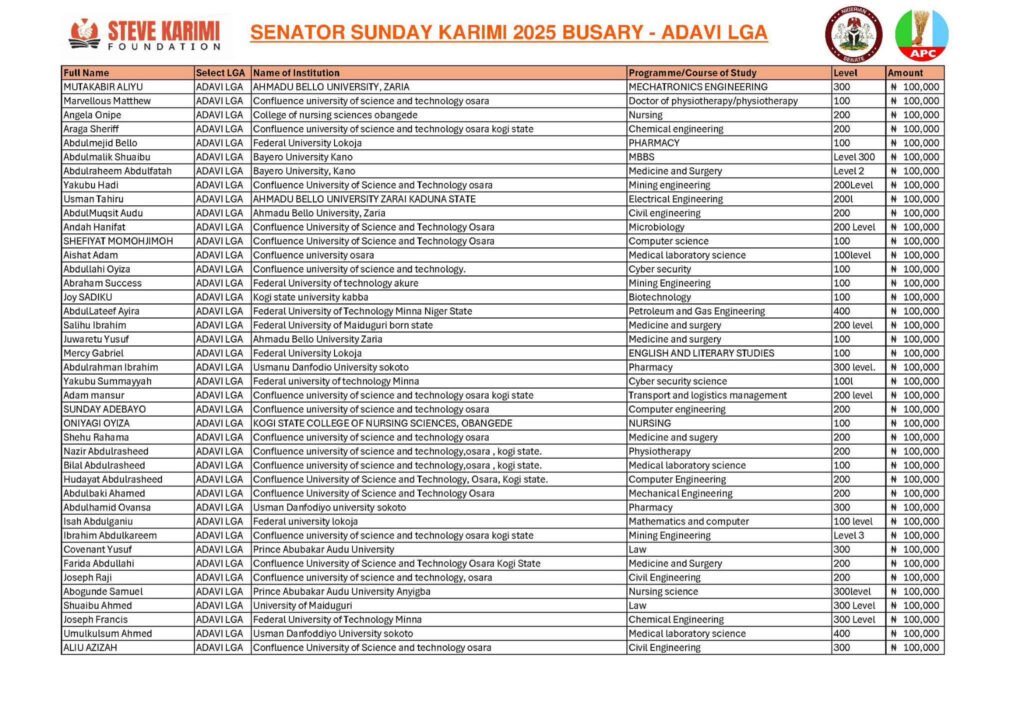
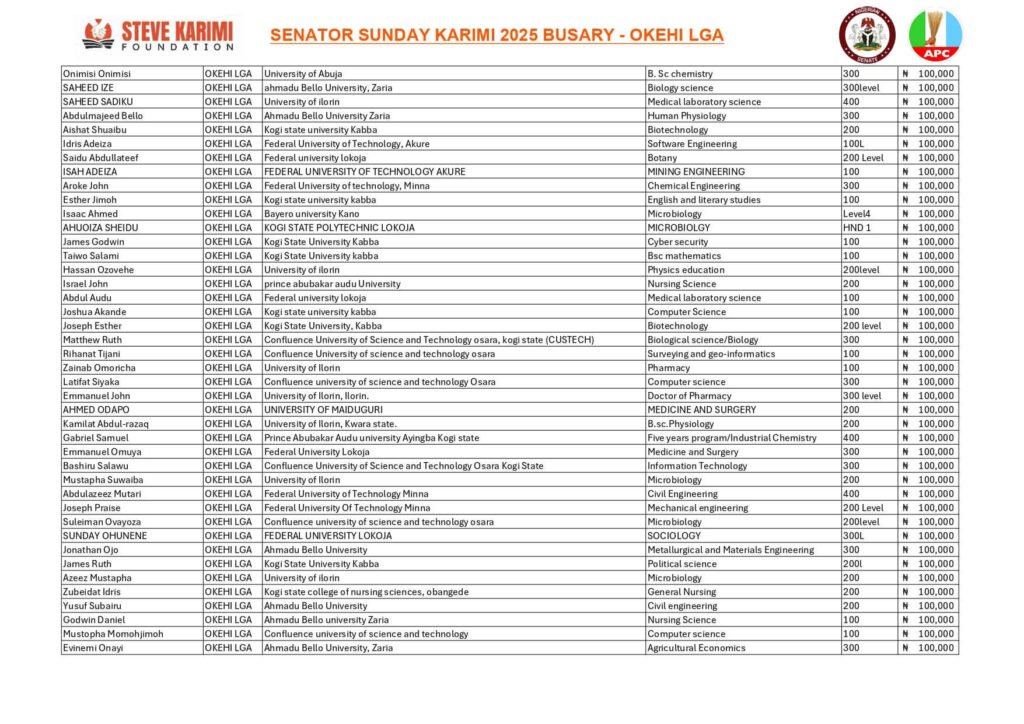
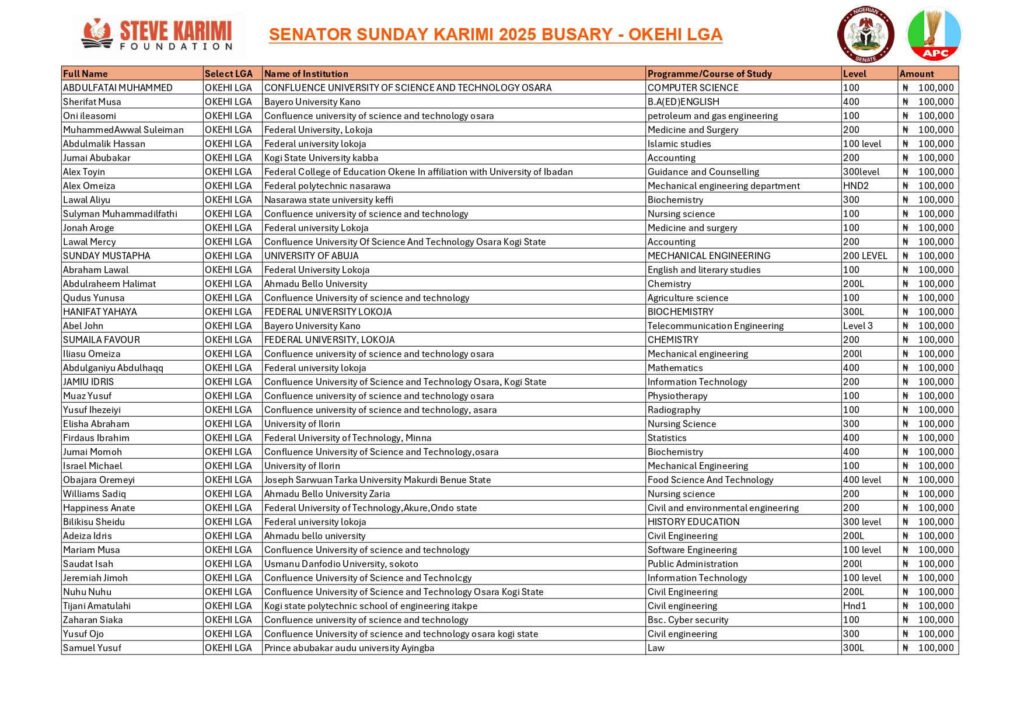
Senator Karimi Foundation Releases List of 2025 Bursary Beneficiaries

0

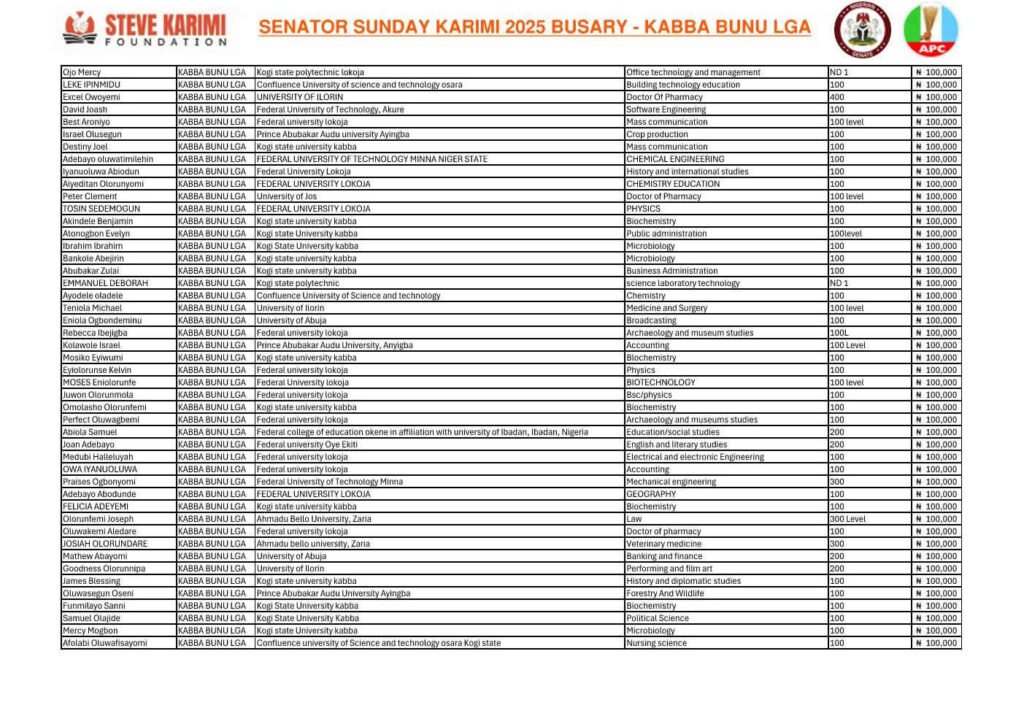
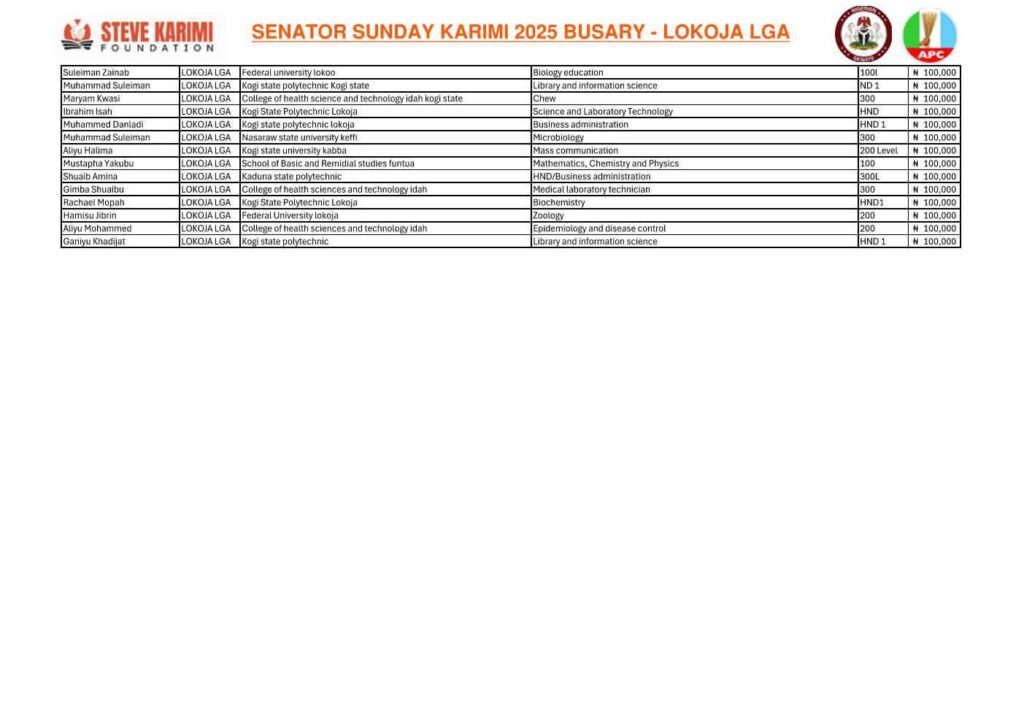
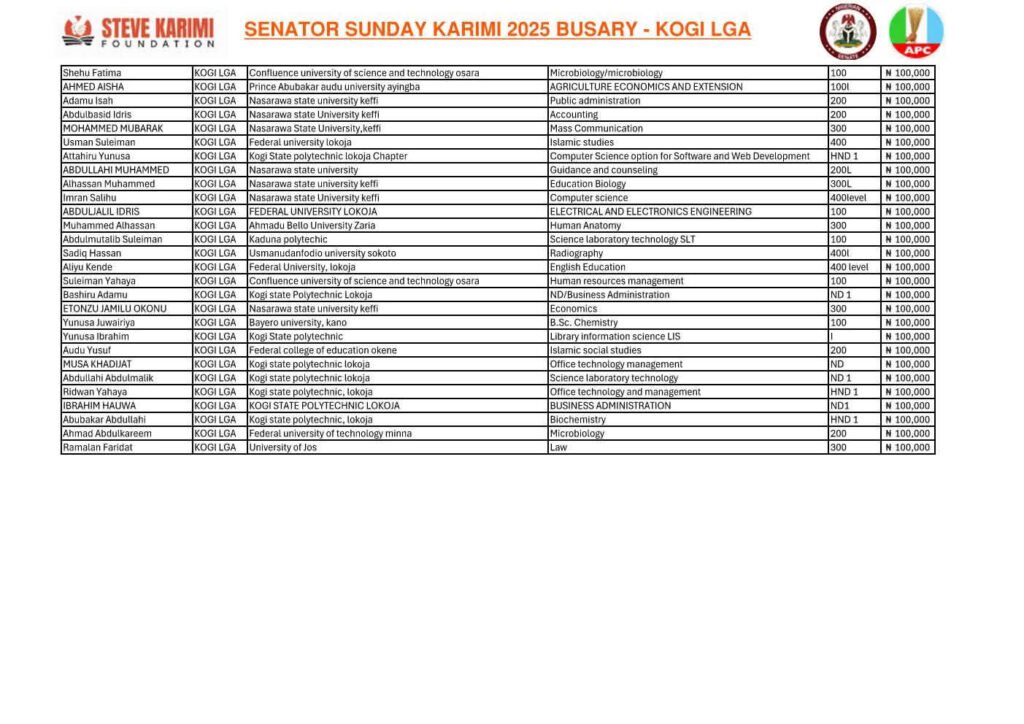
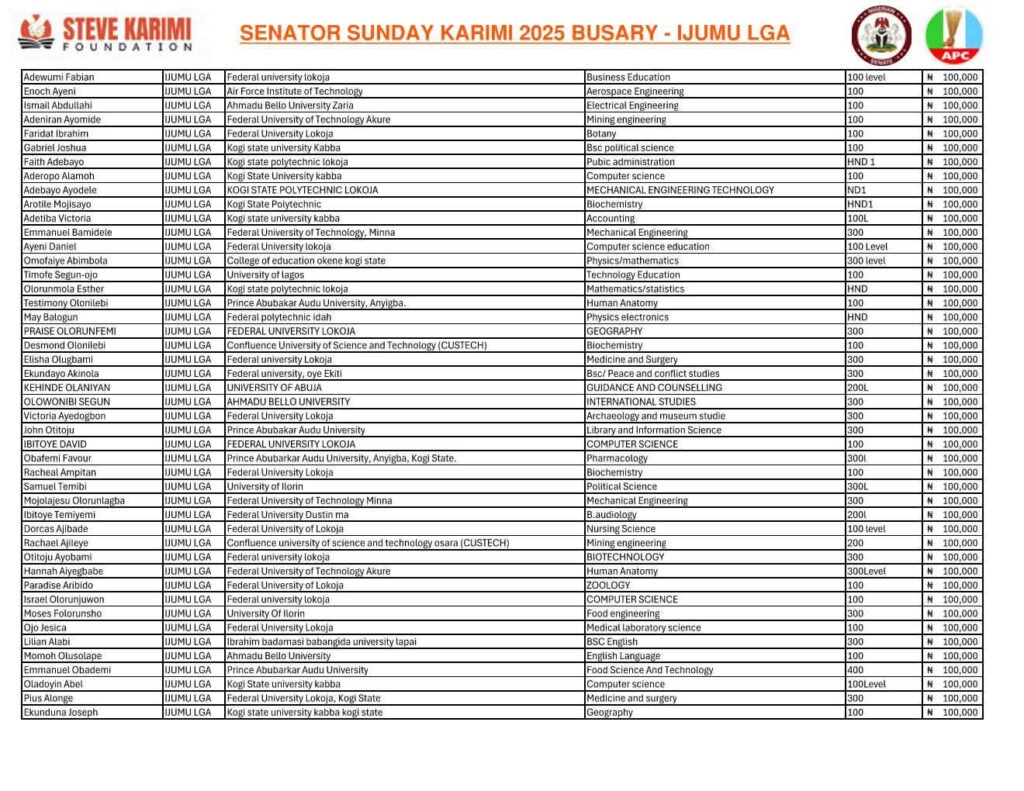
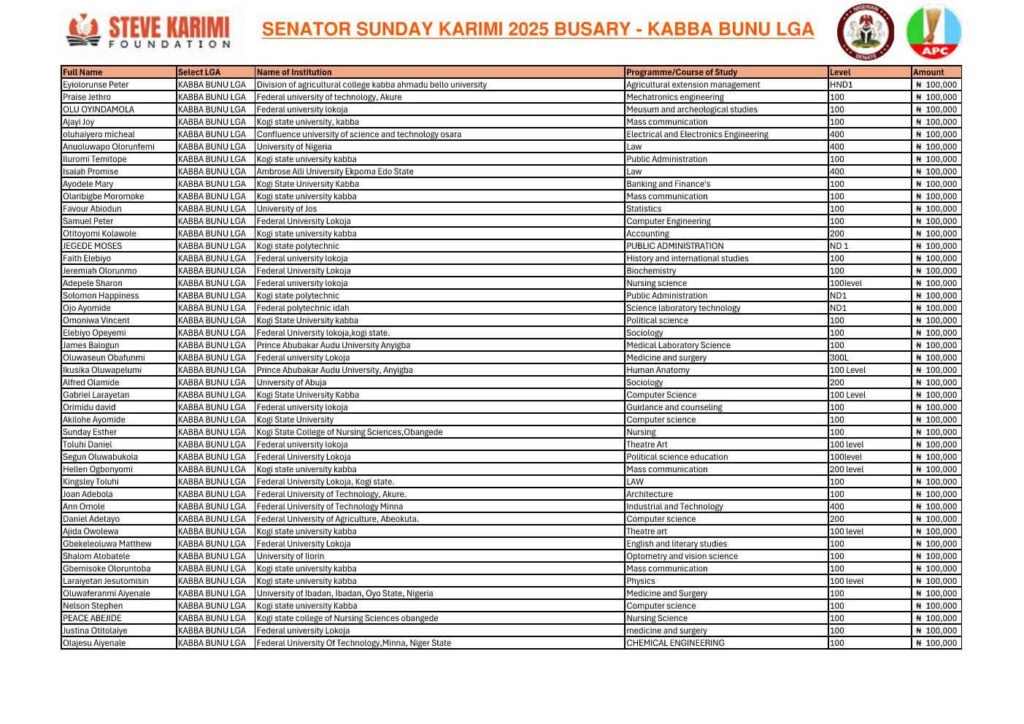
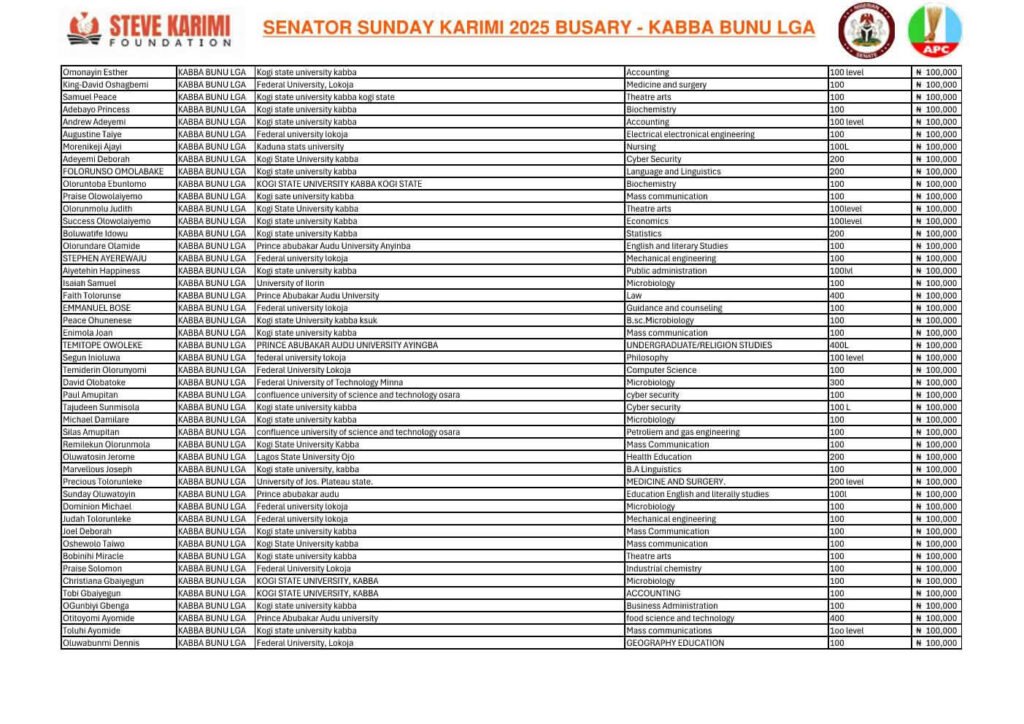
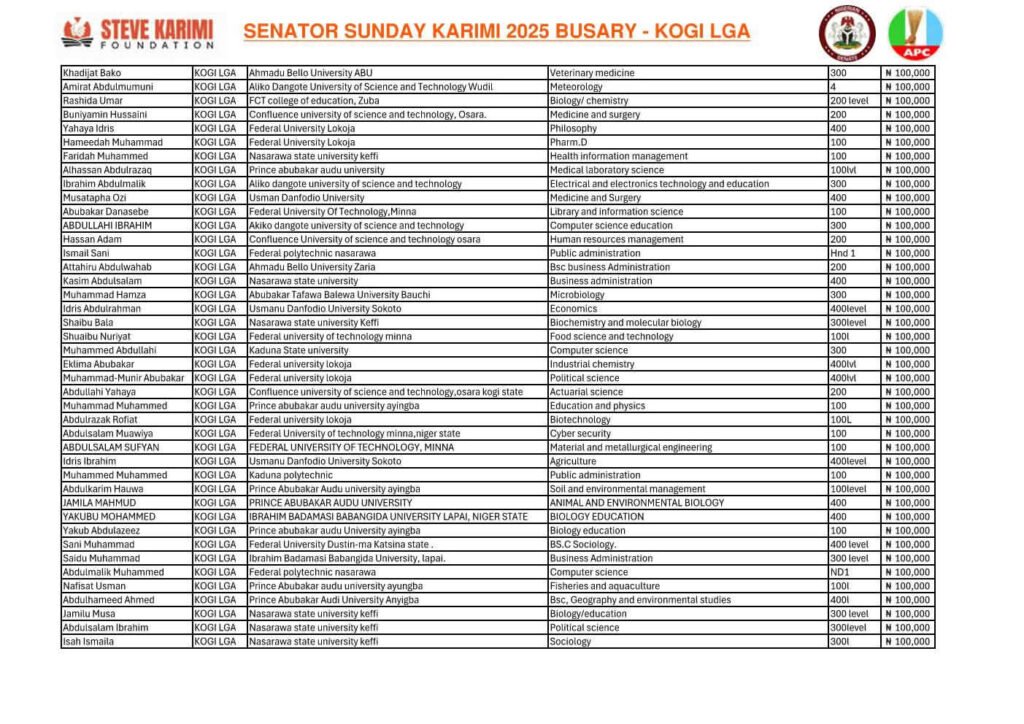
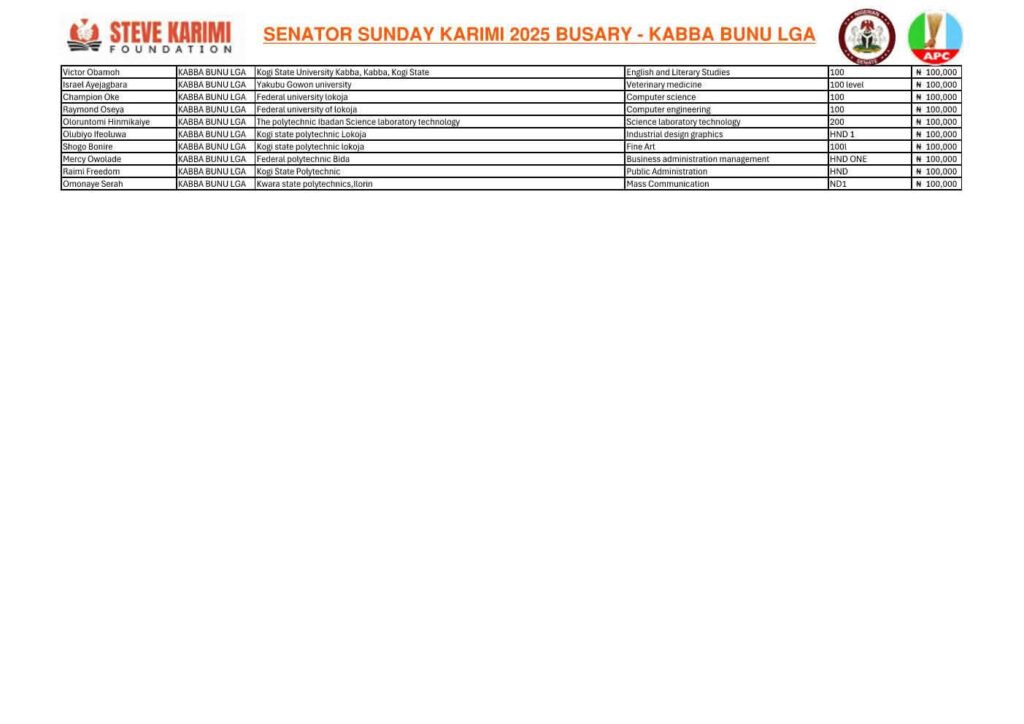
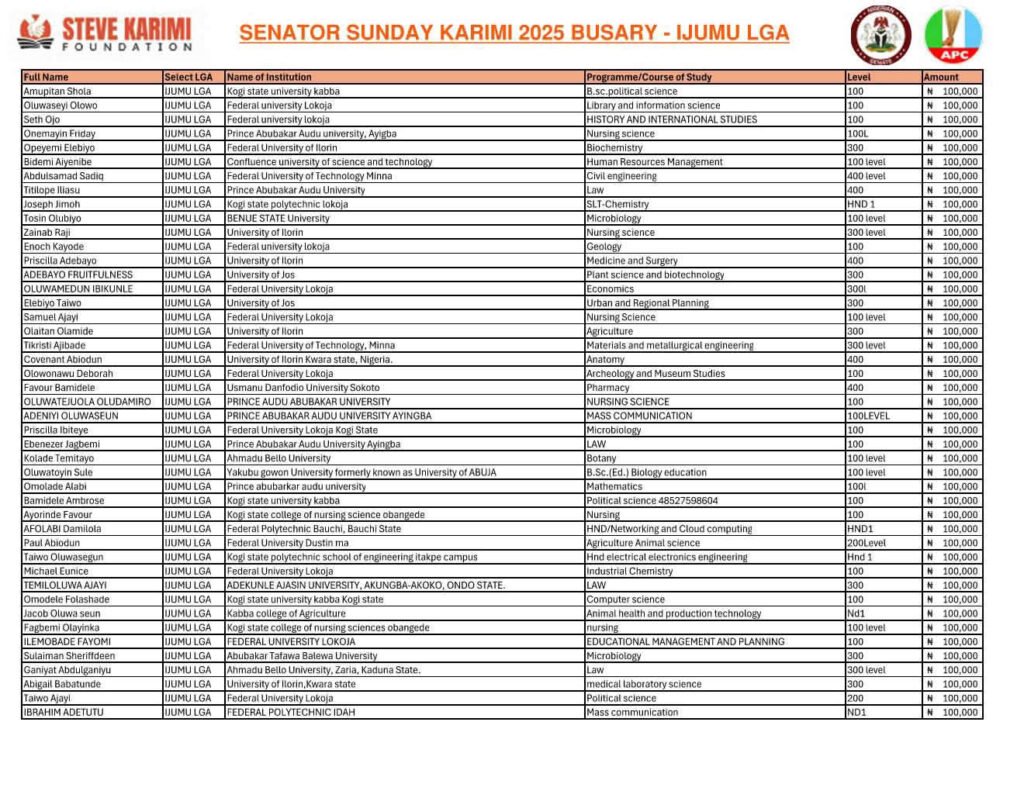
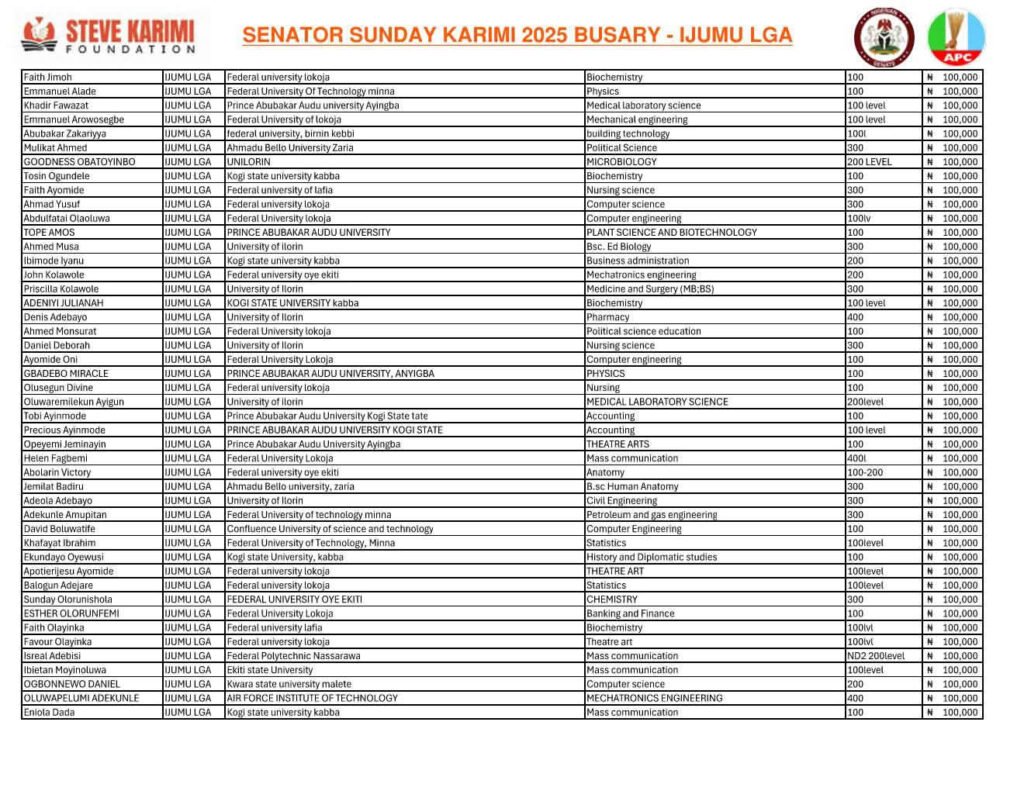
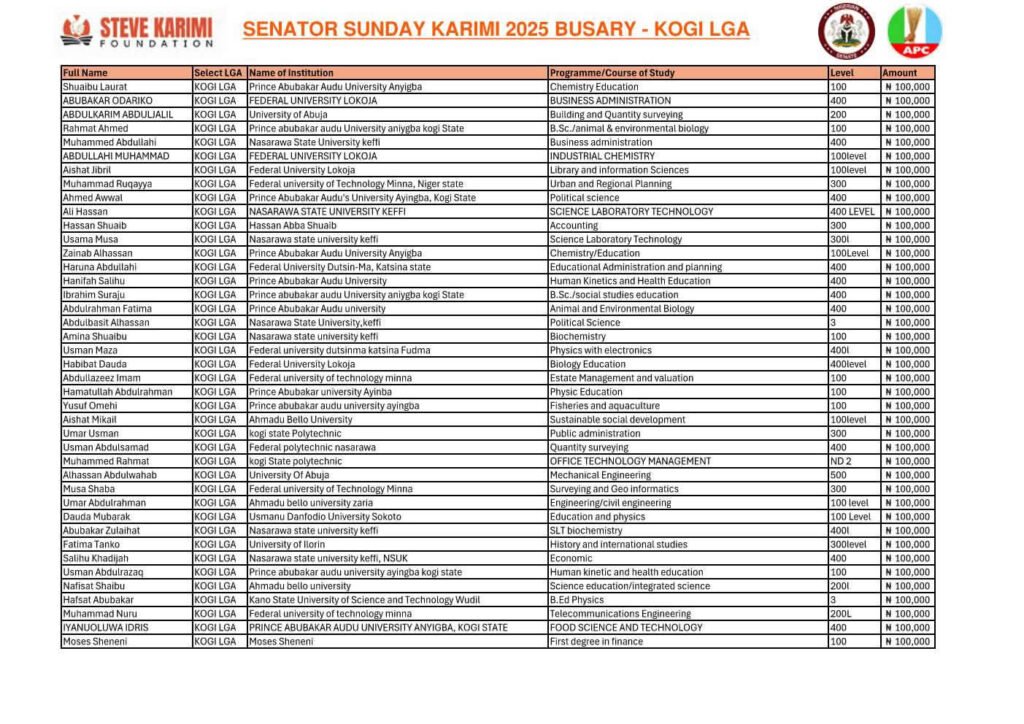
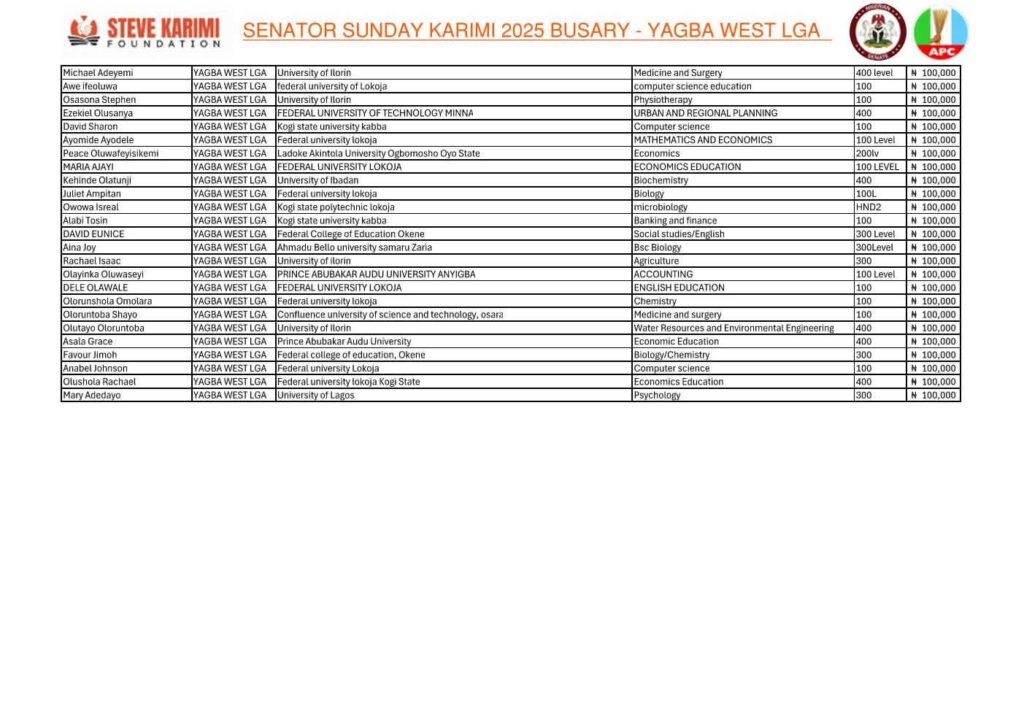
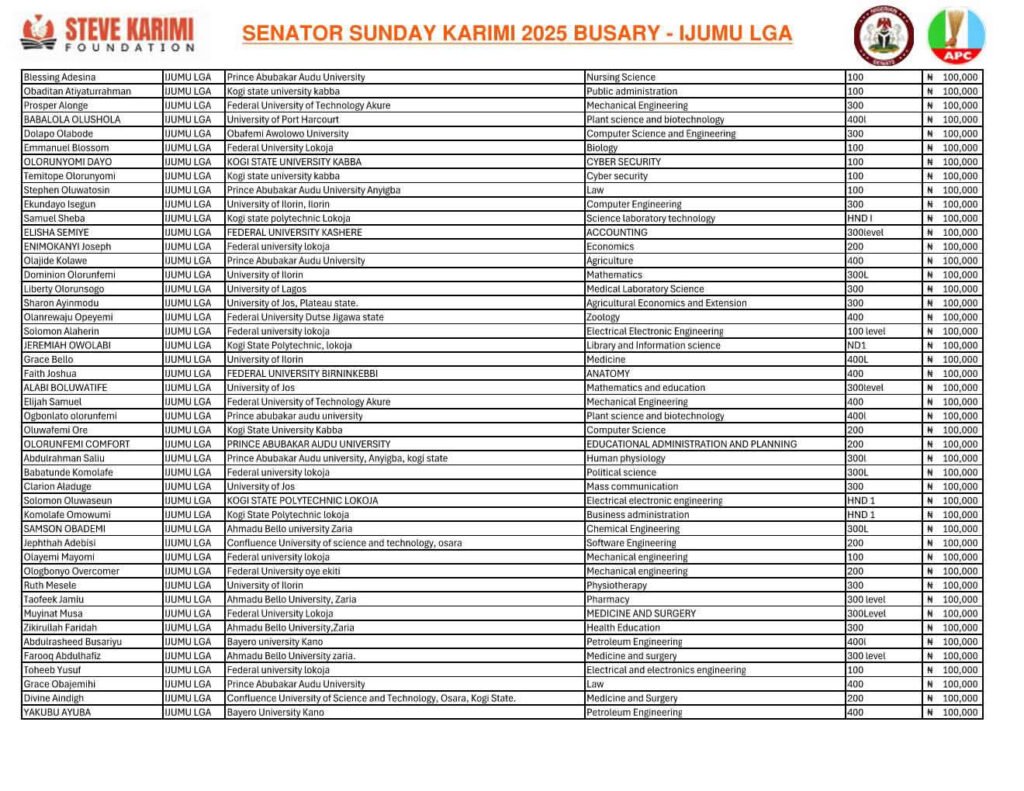
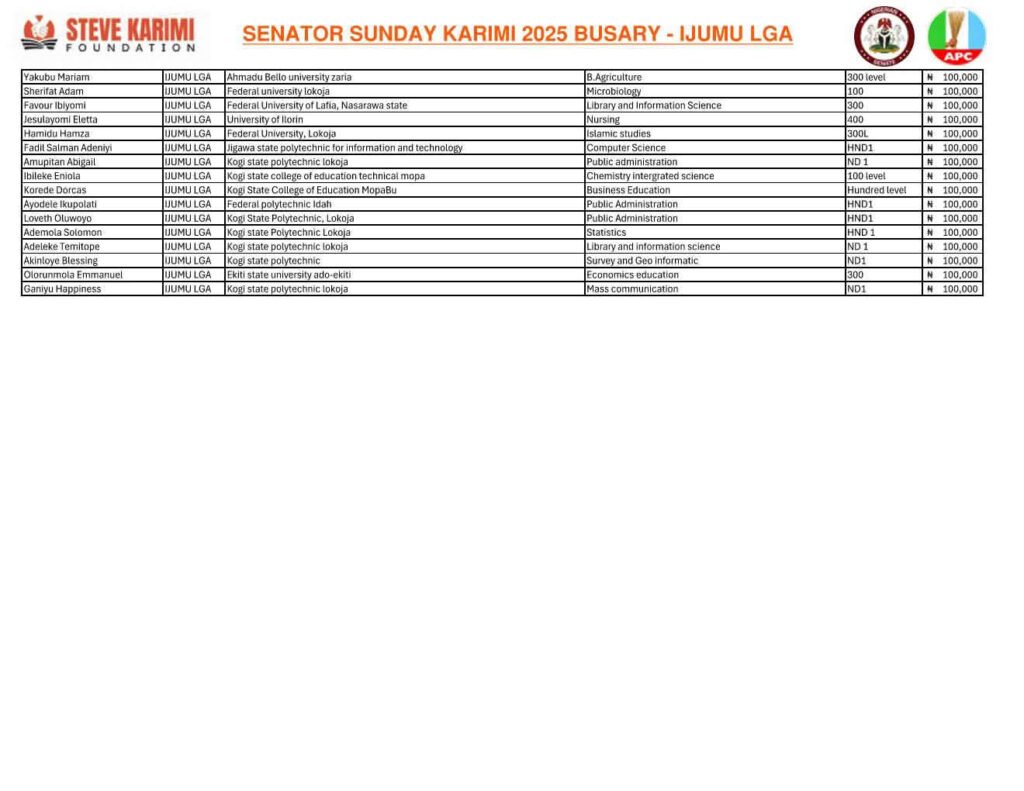
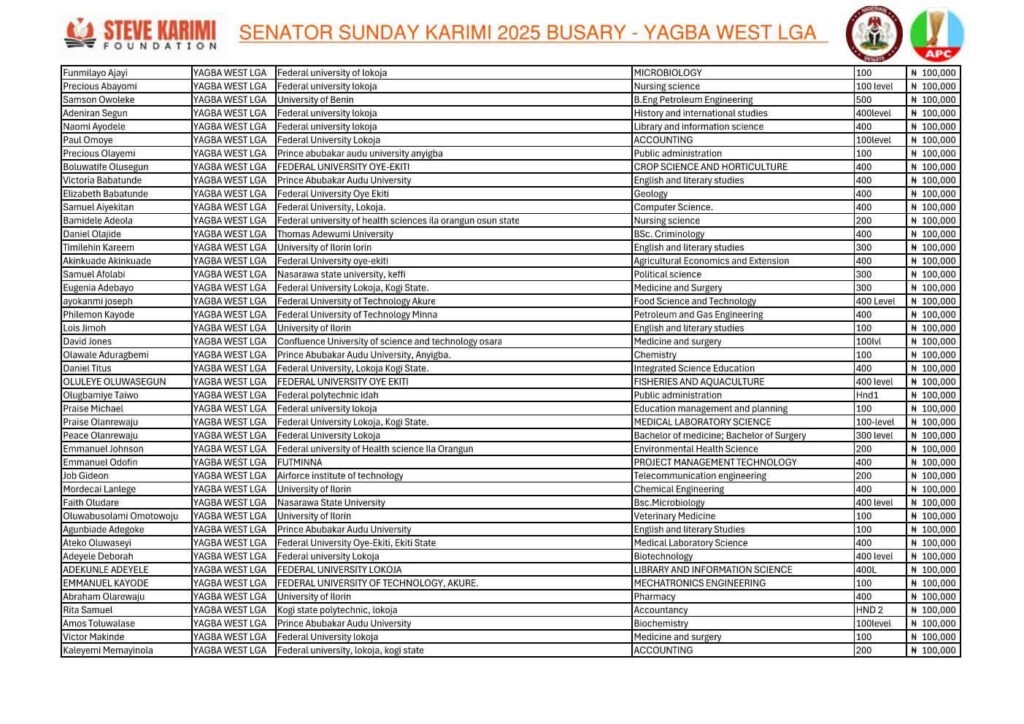
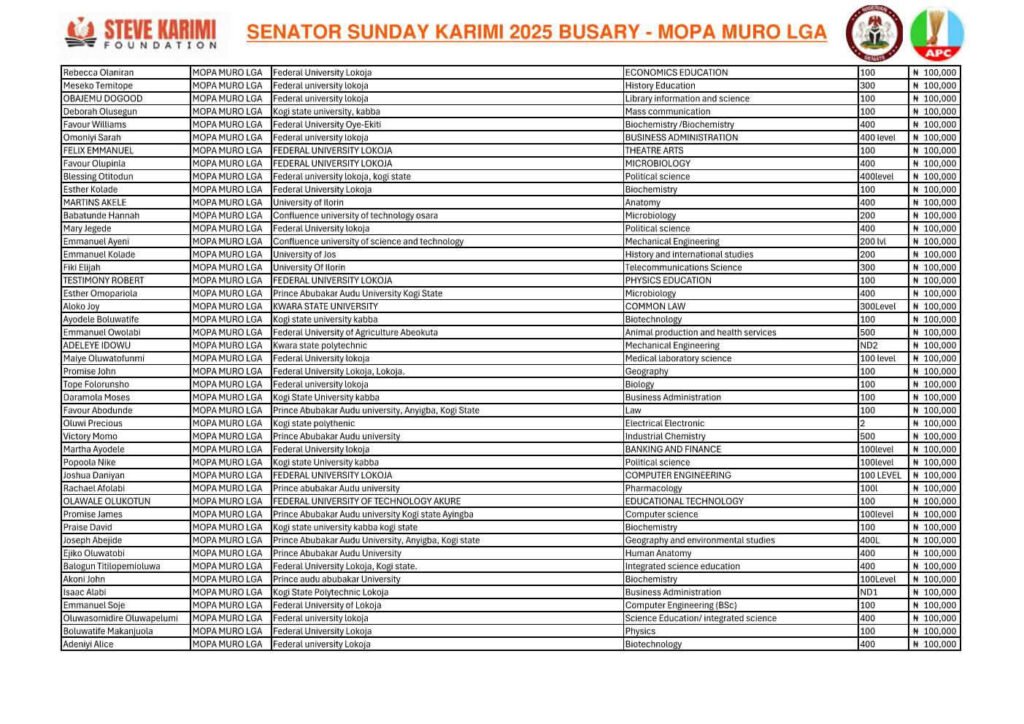
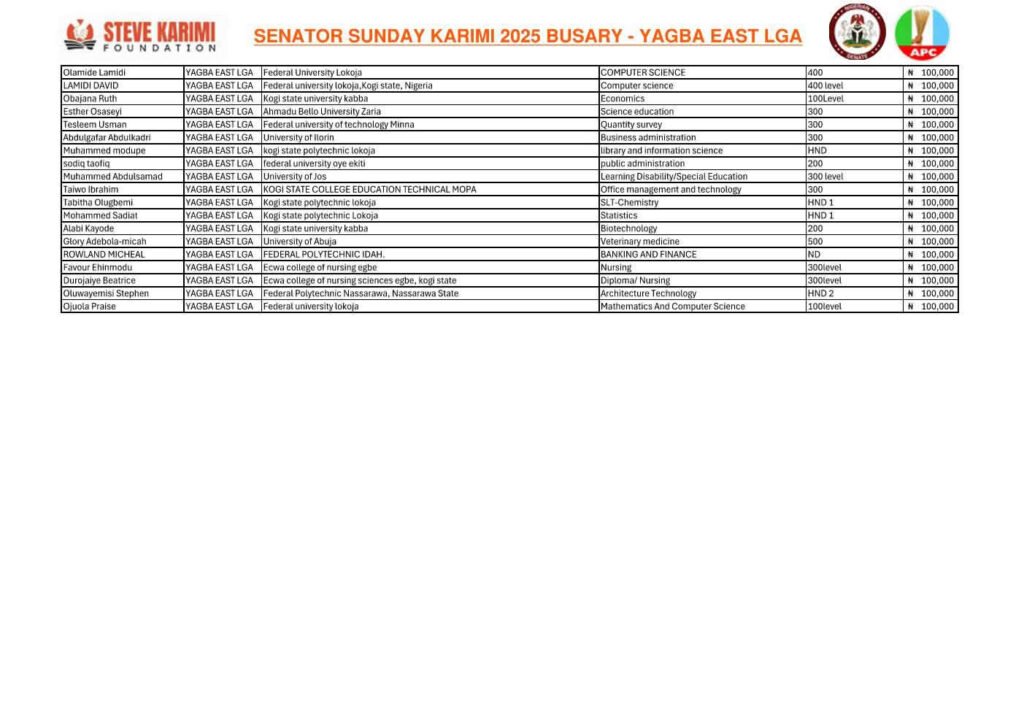
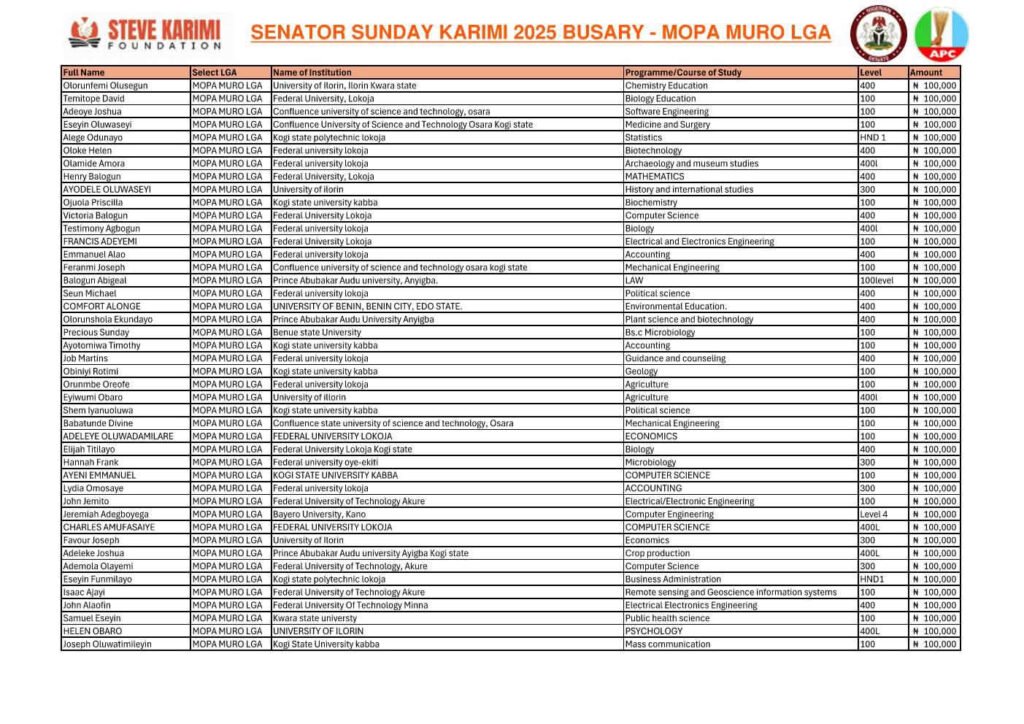
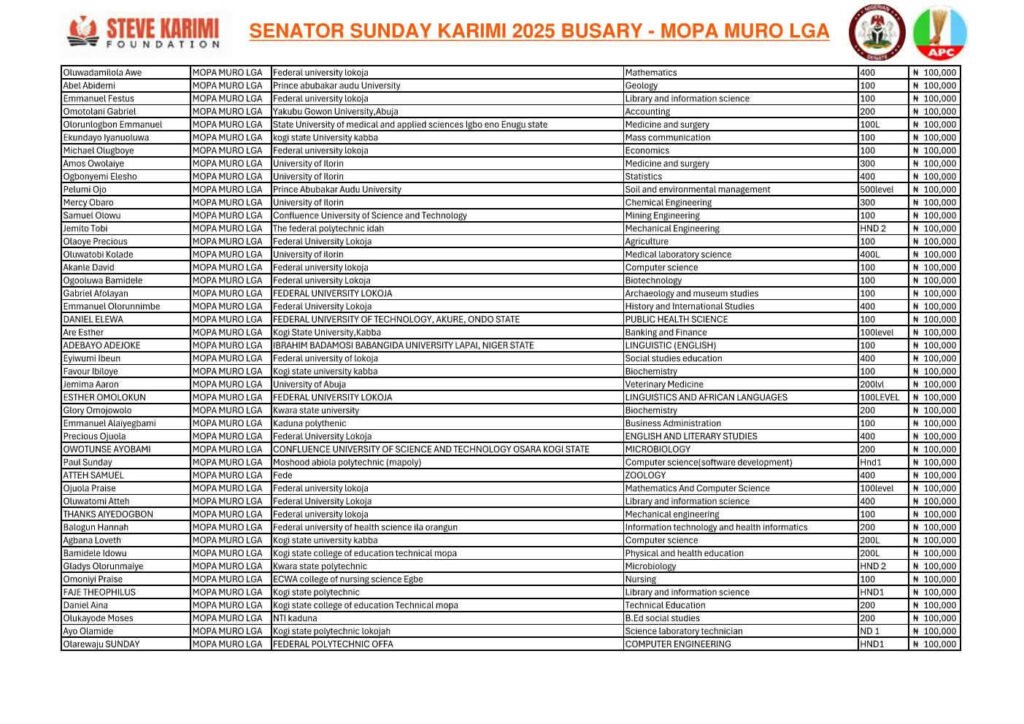
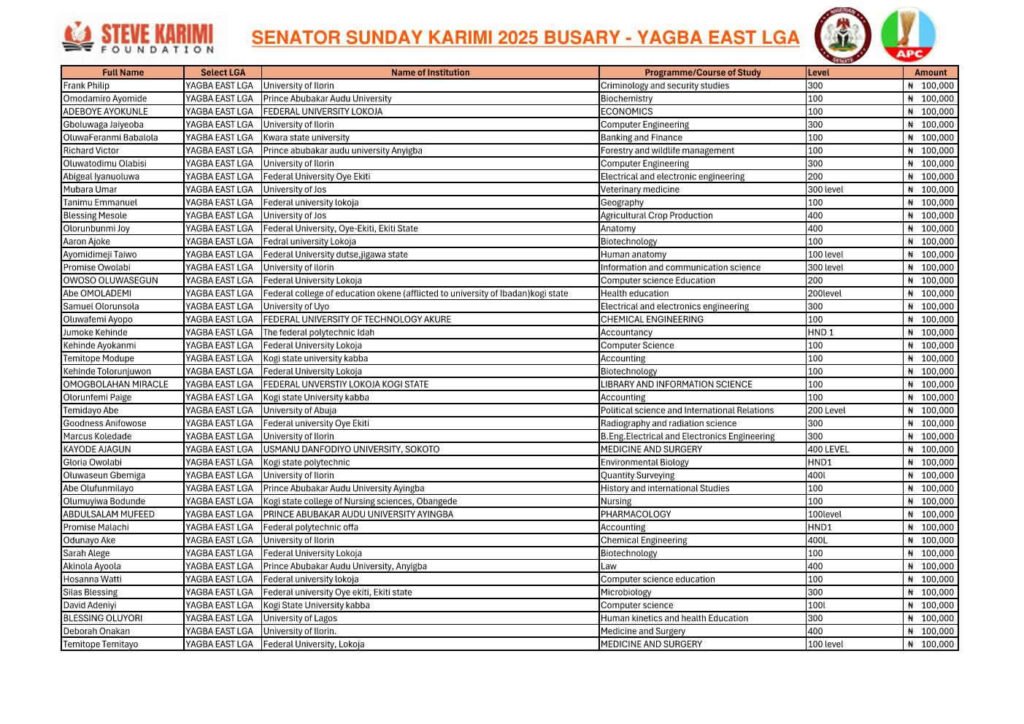
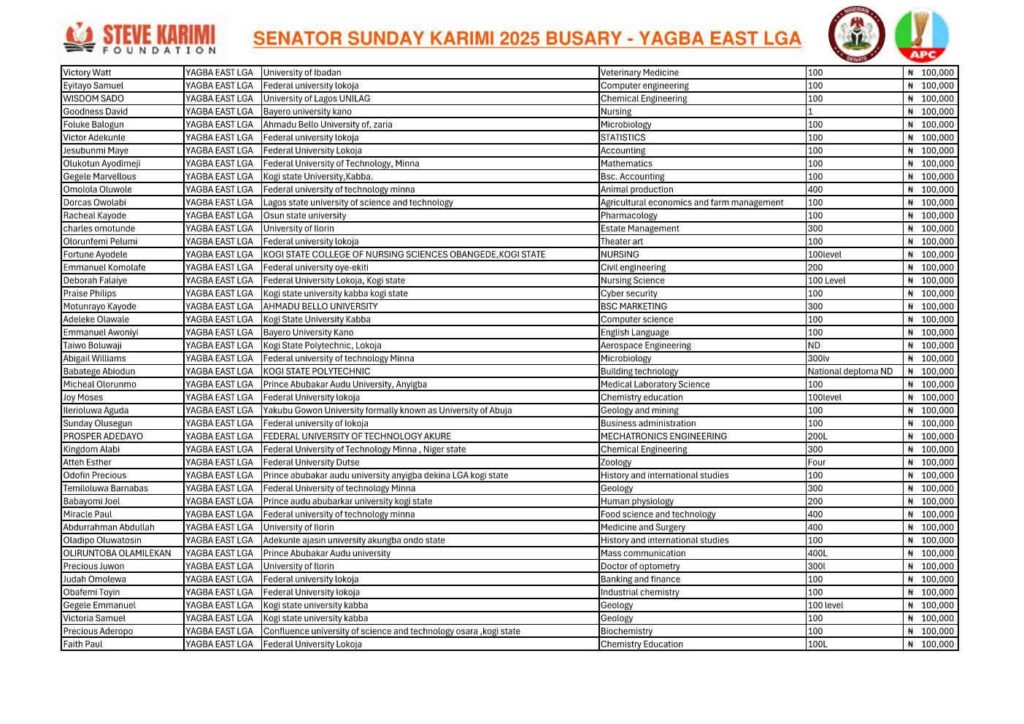
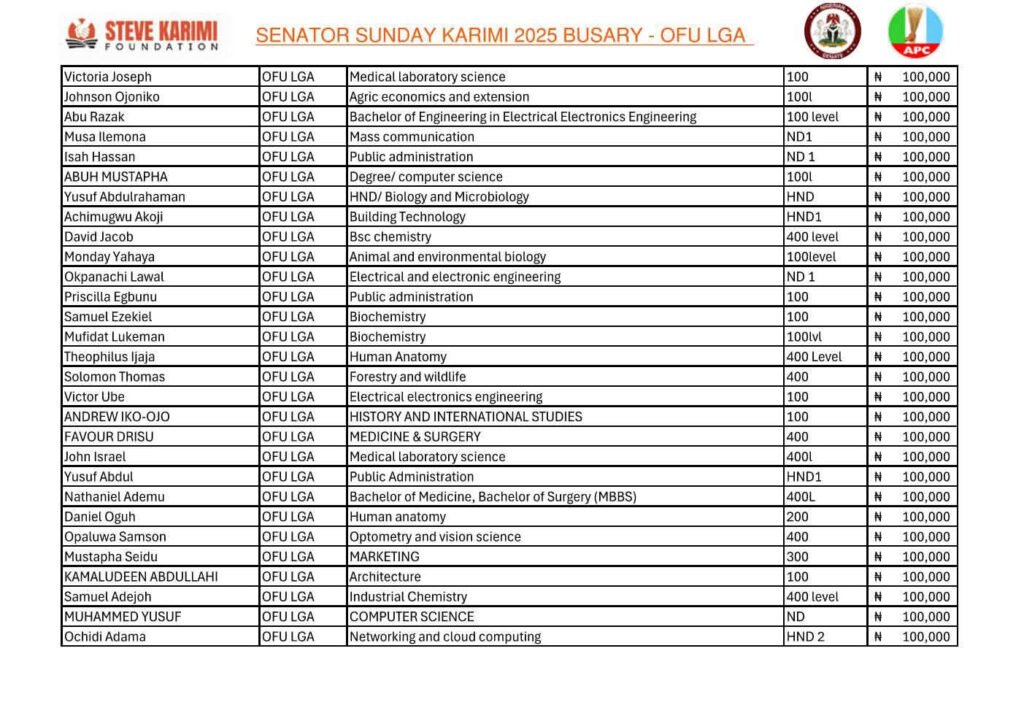
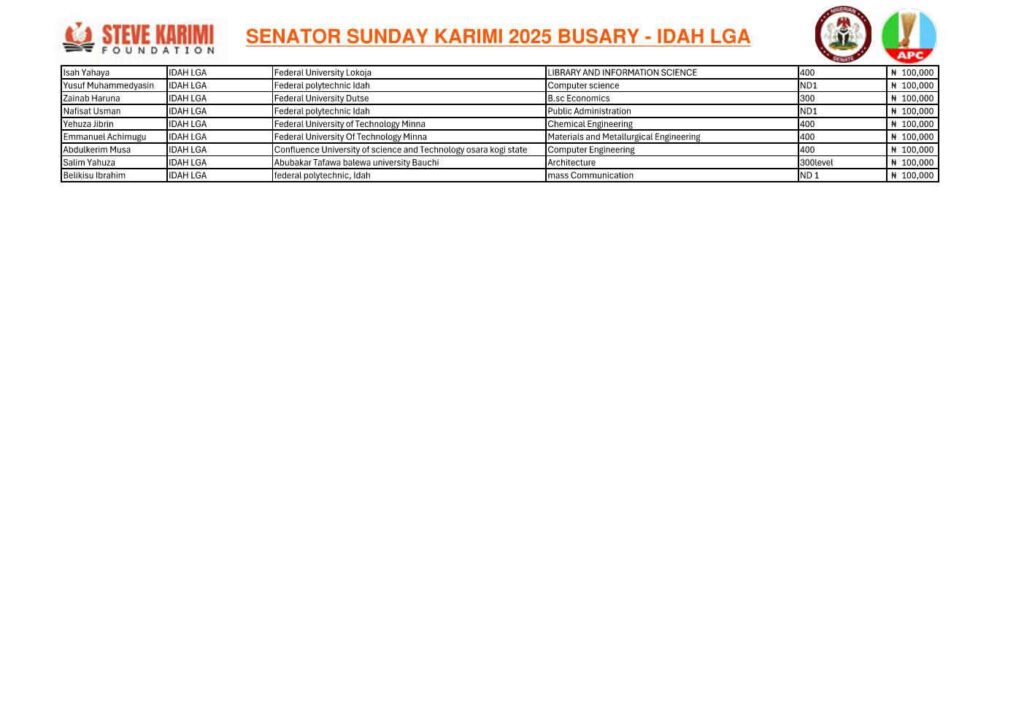
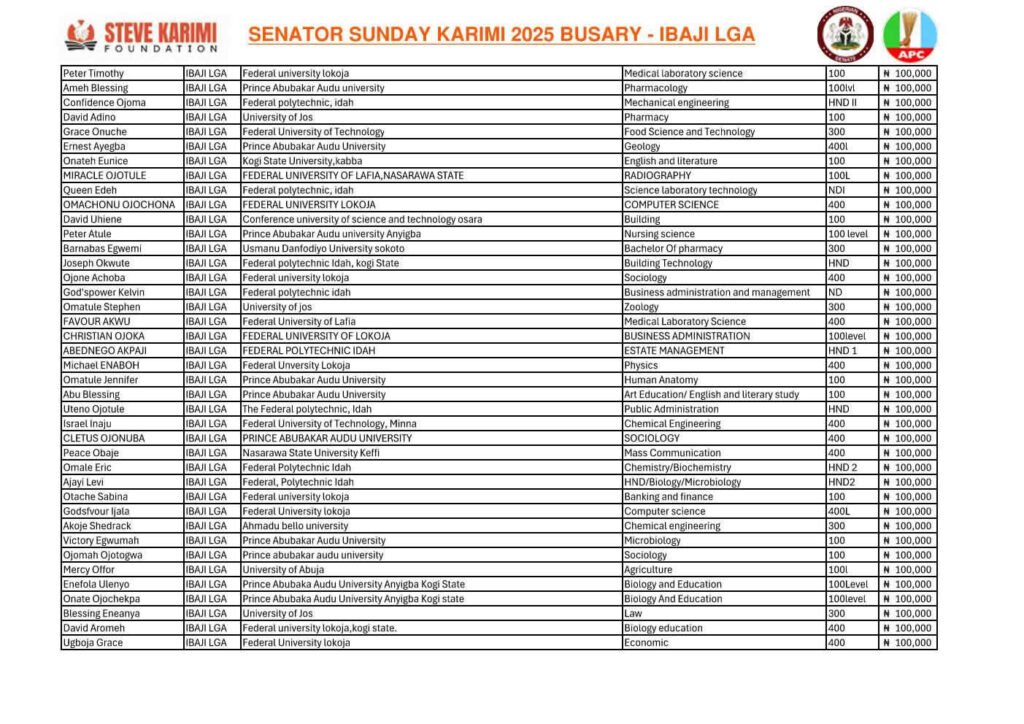
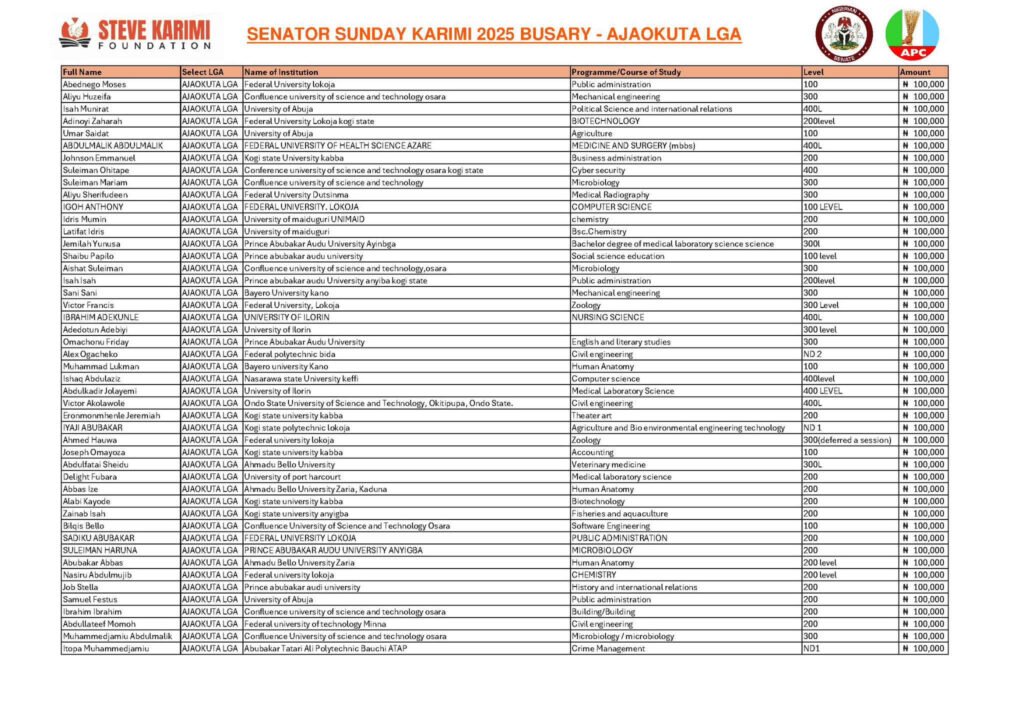
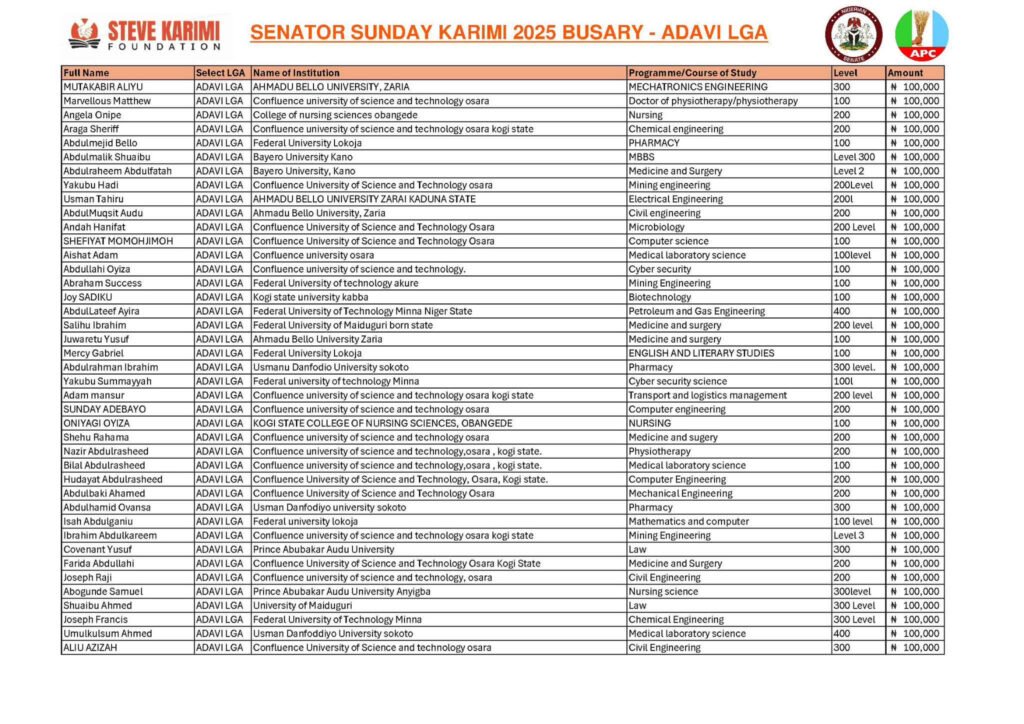
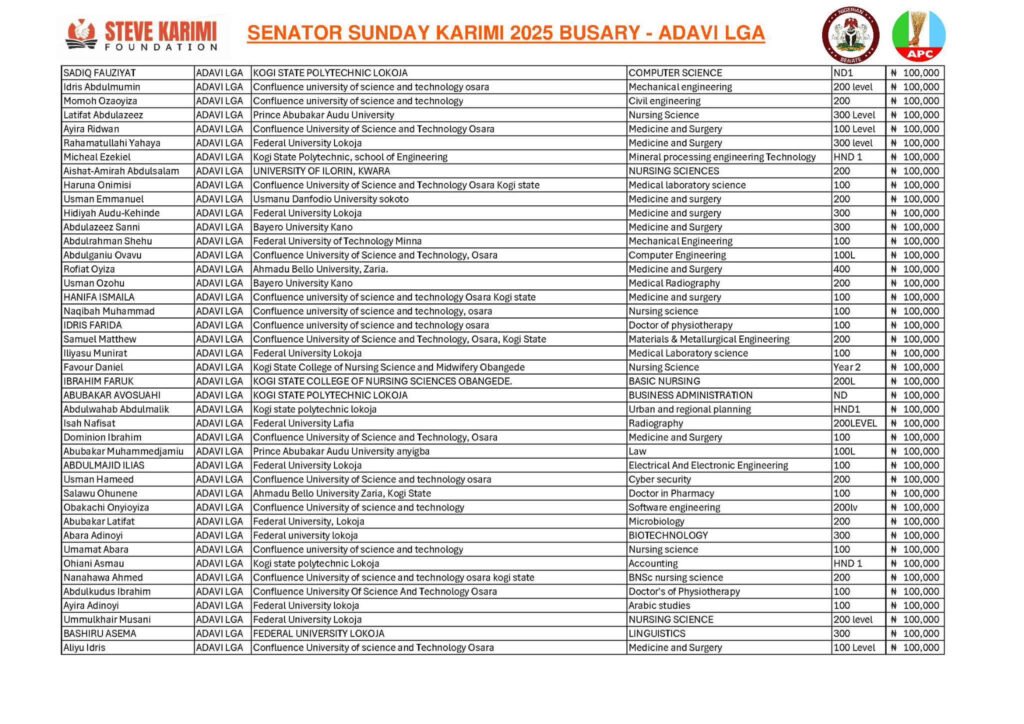
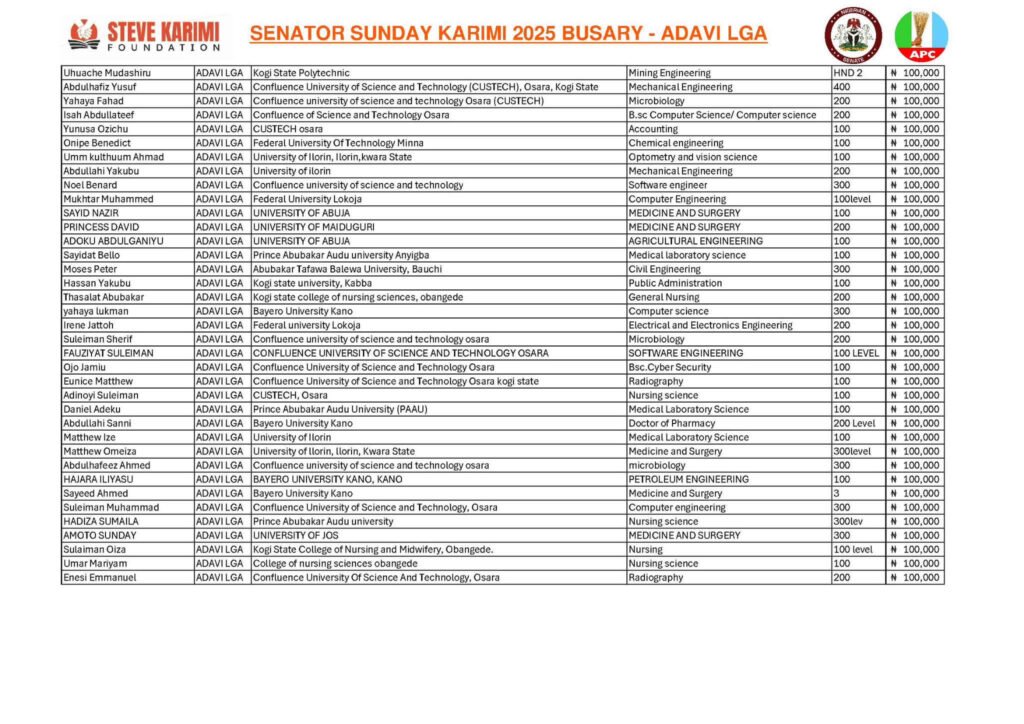
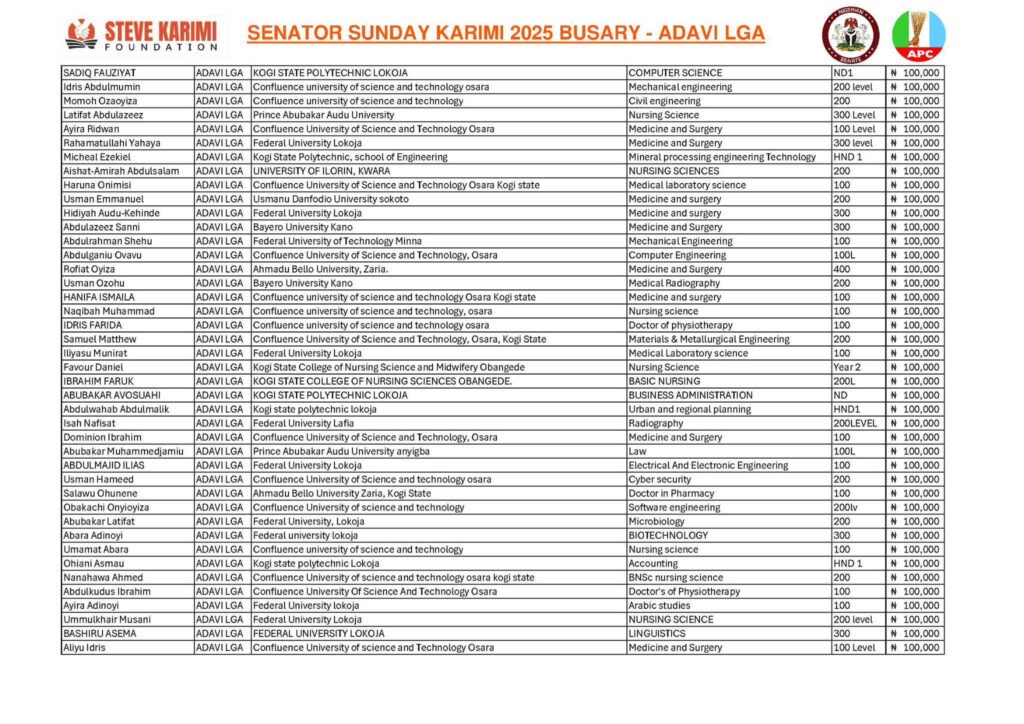
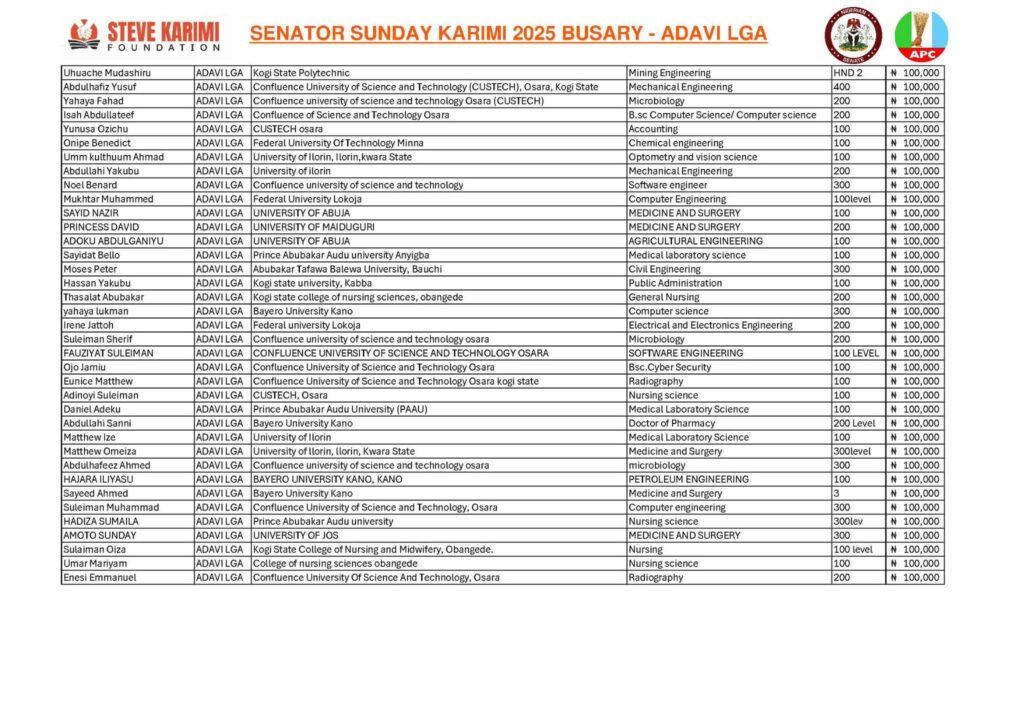
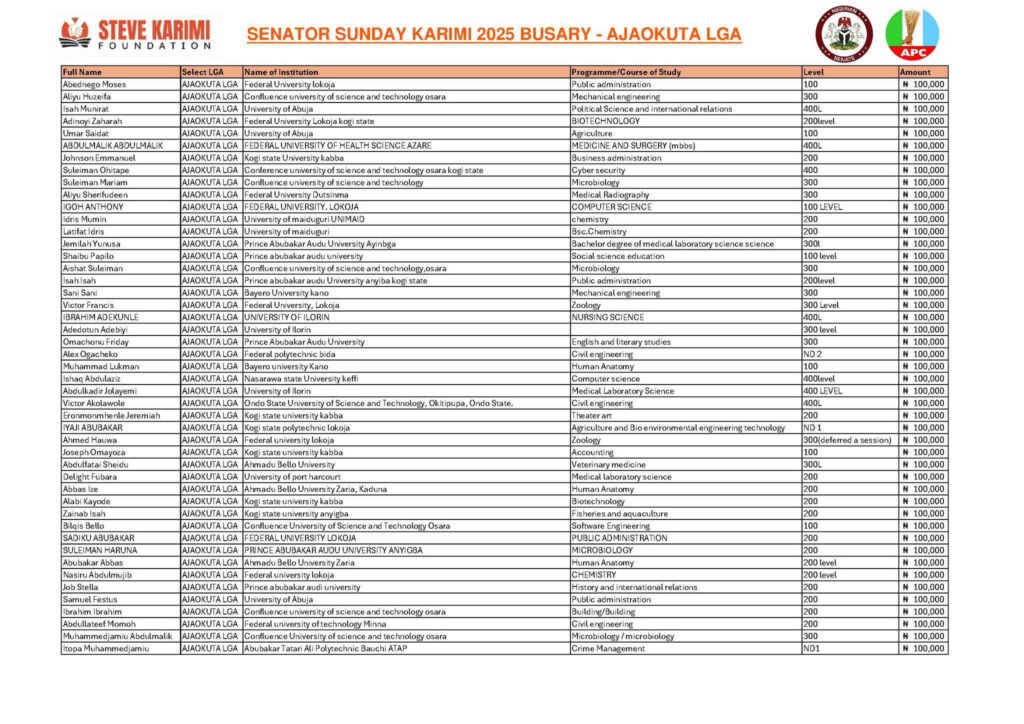
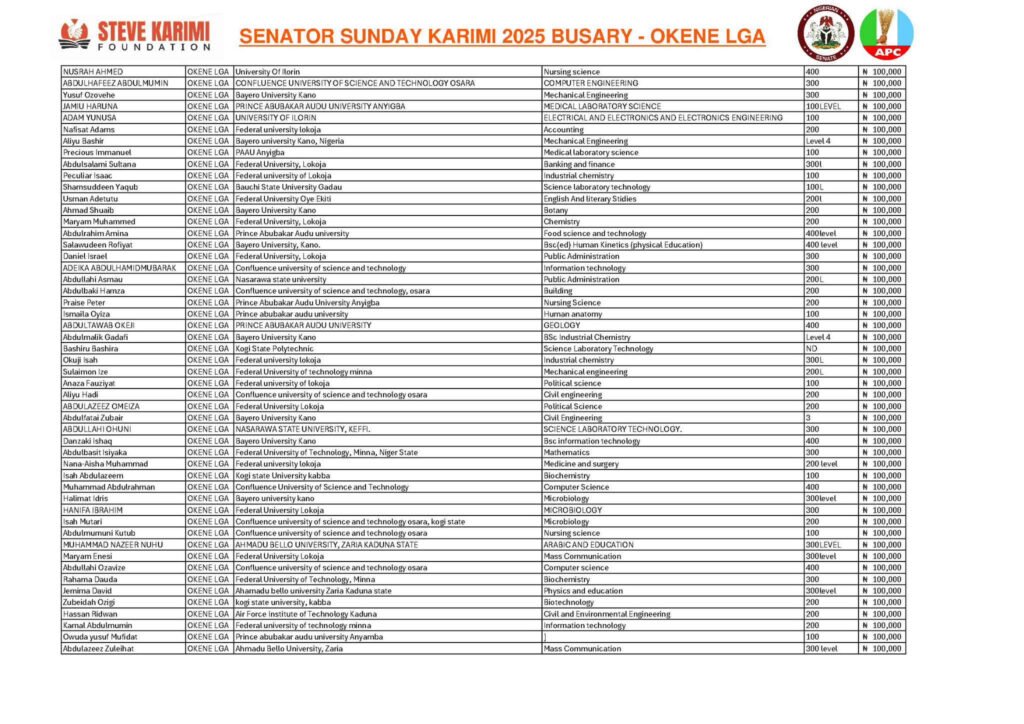
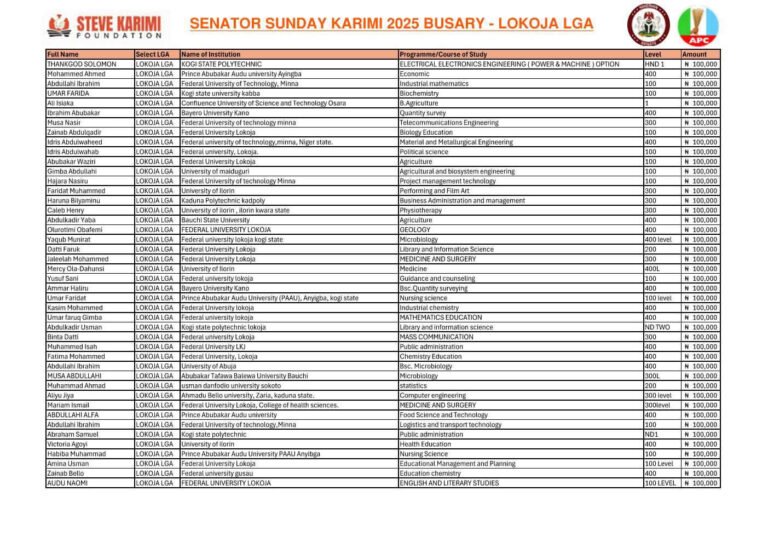
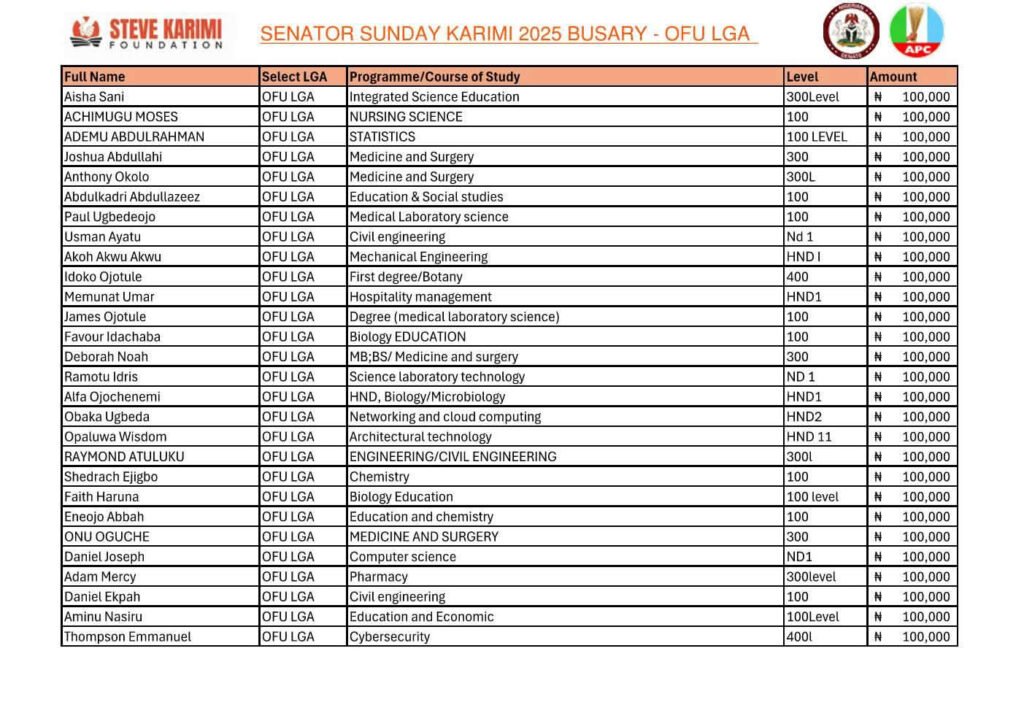
The Steve Karimi Foundation has released the official list of shortlisted beneficiaries for the Senator Sunday Karimi 2025 Bursary. This update confirms that the selection covers applicants across Kogi West, Kogi East and Kogi Central Senatorial District.

The bursary is part of ongoing efforts to support students and ease the cost of education within the district. Beneficiaries were selected from all eligible local government areas in Kogi West after due consideration.

Congratulations to all successful beneficiaries.

Below is the list of Kogi West beneficiaries from Ijumu, Kabba/Bunu, Kogi, Lokoja, Mopa-Muro, Yagba East, and Yagba West.

Below is the list of Kogi East beneficiaries from Olamaboro, Omala, Ankpa and Bassa LGAs.

Below is the list of Kogi East beneficiaries from Olamaboro, Omala, Ankpa and Bassa LGAs.

Below is the list of Kogi Central beneficiaries from Adavi, Ajaokuta, Ogori magongo, Okene, and Okehi LGAs.

Cross River Govt to Empower 20,000 Youths in YES Scheme

0

The Cross River State government is set to empower at least 20,000 youths through empowerment schemes being developed under the state Youth Empowerment Scheme (YES).

The Chairman of the scheme, Dr Kalita Aruku, disclosed this in an interview with newsmen in Calabar on Tuesday, noting that the initiative is structured to align youth empowerment with strengths and practical needs across the state.

According to Aruku, the scheme is built around seven thematic areas where beneficiaries will be productively engaged and supported. He listed the areas as the creative industry, agriculture, sports, transport, skills acquisition, small-scale businesses, and education.

Explaining the agricultural component, Aruku said young people will be trained and empowered with agricultural products and linked with off-takers to ensure sustainability. He said poultry, piggery, fishery, and crop cultivation will be the major focus areas under agriculture.

He stated that beneficiaries in the fishery segment will receive fingerlings and funds to begin operations after completing training, while those in poultry will also be provided with birds and financial support.

“Perhaps I need to add here that the beneficiaries of the fishery part will also be provided with artificial ponds and feeds,” he said.

Aruku further explained that crop cultivation will focus mainly on cassava and maize due to their high demand. He said improved, high-yield cassava stems will be distributed to beneficiaries, adding that the same approach will apply to maize production.

“Same applies to maize, in addition to engaging a flour mill, which will be the offtaker in this regard,” he noted.

On the creative industry, Aruku said youths will be trained in cinematography, directing, producing, scriptwriting, and acting. He explained that the goal is not only to empower young people but also to position Calabar as a destination for film production.

“We can’t be a hub for tourism without adding this aspect of the creative industry to it. Music is also part of this,” he said.

Speaking on small-scale businesses, Aruku said beneficiaries will be equipped with tools and equipment to help them expand operations.

On funding challenges, the chairman acknowledged constraints but expressed confidence in the commitment of Governor Bassey Otu to the programme.

“Of course, it may interest you to know that youth remain one of the central focuses of the governor’s people-first mantra,” he stated.

FG launches solar-powered electric tricycles for WOW women

The federal government, through the Minister of Youth Development, Mr Ayodele Olawande, has launched solar-powered electric tricycles for women as part of efforts to support youth empowerment and promote clean energy solutions.

Olawande disclosed this on Tuesday in Abuja during the launch and handover of electric tricycles to members of the Women of Wisdom (WOW) Multipurpose Cooperative Society Ltd. The event was held with the theme “Empowering Women, Building Futures”.

The minister, represented by the Senior Special Assistant on Gender Matters, Ms Kehinde Awujoola, said the initiative aligned with the Federal Government’s commitment to youth empowerment and climate-friendly innovation.

“We will continue to create the policies and partnerships that make green technology accessible to every young person in this country.

“What we are witnessing today is a perfect reflection of the Federal Government’s larger goals,” he said.

Olawande recalled that the ministry officially launched the Electric Tricycle Empowerment Initiative in November 2025 to promote clean and affordable transportation.

“Our goal was simple: to move away from expensive, polluting fuels and move toward affordable, clean energy that puts money back into the pockets of young Nigerians.

“Seeing the WOW Cooperative take up this mantle and deploy these electric tricycles shows that our seed is growing,” he said.

He added that House of Destiny Global Services further equipped the tricycles with solar panels, describing it as a demonstration of commitment to climate action and resilience.

Explaining the benefits, Olawande said the tricycles would reduce fuel costs, lower maintenance expenses and protect the environment.

“You no longer have to worry about rising petrol prices. You charge and you go.

“These tricycles have fewer moving parts than petrol engines, meaning less time at the mechanic and more time earning.

“You are also helping Nigeria breathe easier by reducing smoke and noise pollution,” he said.

The minister urged the beneficiaries to treat the tricycles as business assets, stressing that their success would validate community-driven partnerships.

“When government and cooperatives like WOW work together, the average Nigerian feels the impact directly,” Olawande said.

In her welcome address, the President of WOW, Ms Madonna Corosi, said progress was possible when people came together with shared vision, discipline and trust.

Corosi said transportation was a key source of livelihood for members, adding that access to productive assets like electric tricycles would ensure sustainable income.

“It also means reduced dependence on fossil fuels, lower operating costs and a cleaner future.

“By embracing electric mobility, WOW Cooperative is positioning its members for a future where innovation, sustainability and income generation go hand in hand,” she said.

Also speaking, the National President of the National Commercial Tricycle and Motorcycle Owners and Riders Association, Alhaji Usman Gwoza, said transportation remained the backbone of daily survival for many families.

Gwoza advised beneficiaries to be disciplined and protect the assets entrusted to them, noting that their success would encourage further empowerment initiatives. He said the initiative would benefit communities.

Ekiti AGILE Launches Safe Space Programme for Boys

0

The Ekiti State Adolescent Girls’ Initiative for Learning and Empowerment (AGILE) Project has launched a Safe Space programme for boys in selected public secondary schools across the state, expanding its focus on inclusive adolescent development and sustaining progress made through girls’ empowerment efforts.

The new programme builds on the Safe Space initiative for girls introduced in Ekiti in 2022. The girls’ programme was expanded from 101 schools to 202 schools by 2024 and reached about 50,000 adolescent girls with structured life skills, health education sessions delivered within school environments.

Speaking on the new intervention, the Ekiti State AGILE Project Coordinator, Mrs Yewande Adesua, said the introduction of Safe Spaces for boys showed the project’s commitment to a holistic and sustainable approach to gender equality in schools. She explained that empowering girls without engaging boys limited the long-term impact of gender-focused programmes.

“Our experience has shown that for girls to thrive, the environment around them must be supportive. By engaging boys through Safe Space sessions, we are shaping positive attitudes and behaviours that promote respect, responsibility and inclusive school environments,” Adesua said.

She added that the initiative aligned with AGILE’s mandate to improve school retention, wellbeing and learning outcomes, particularly for adolescent girls.

Also speaking, the Safe Space Component Lead, Mrs Gbenuola Ayedun, said the programme would begin with a pilot phase in 10 secondary schools across Ekiti State. Ayedun said that 20 facilitators, two per school, were trained between Jan. 12 and Jan. 16, 2026, to deliver the boys’ curriculum.

She explained that the curriculum mirrors the structure and standards of the girls’ Safe Space sessions. According to her, the pilot phase would generate evidence needed to guide scale-up of the programme across more schools.

“The Safe Space model has recorded strong acceptance and impact among girls. Extending the same quality of life skills education to boys will help address peer pressure, harmful stereotypes and behaviours that undermine girls’ empowerment,” Ayedun said.

On her part, Ms Racheal Olori, representing the New Initiative for Social Development (NSID), described the programme as a critical step toward achieving gender-transformative outcomes in the education sector. She said engaging boys deliberately positioned them as allies in promoting girls’ education and wellbeing.

“When boys are equipped with the right knowledge and life skills, they contribute to safer schools and respectful peer relationships,” Olori said.

A facilitator, Dr Kate Afolayan, said aligning Safe Space sessions for both girls and boys would help reduce gender-based bullying, challenge harmful norms and foster mutual respect among adolescents. She said the launch demonstrated AGILE’s commitment to inclusive education in Ekiti State.

Turkey Targets $5bn Trade With Nigeria

0

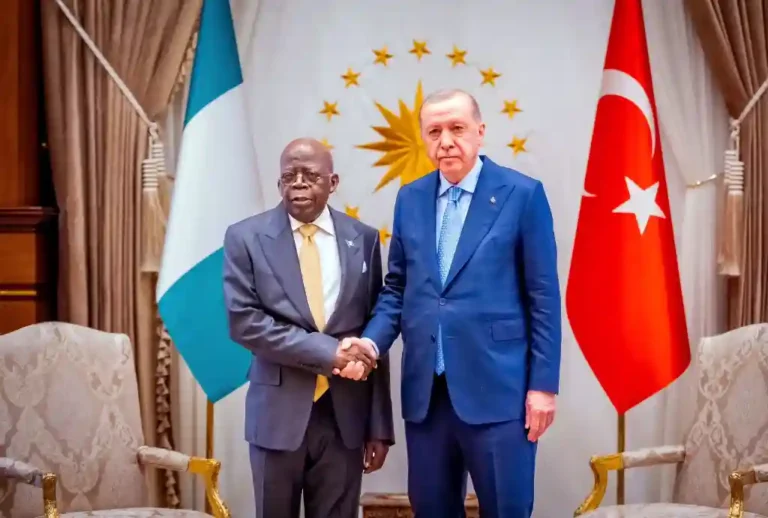
President Recep Tayyip Erdoğan of the Republic of Türkiye on Tuesday in Ankara said his country is targeting a $5 billion trade volume with Nigeria, noting that discussions to achieve this goal have begun.

Erdogan made the disclosure during a joint press briefing with President Bola Ahmed Tinubu during the Nigerian leader’s State Visit to Türkiye, where both countries reviewed existing ties and future cooperation and mutual economic growth going forward together.

At present, trade volume between the two nations is about $2 billion. Turkey exports planes, helicopters, machinery, iron and steel, and chemical products to Nigeria, while Nigeria exports crude oil and agricultural products to Türkiye.

President Erdogan said the planned establishment of a Joint Economy and Trade Committee would create opportunities to expand Turkish investments in Nigeria and help reach the trade target.

He praised President Tinubu’s commitment to national development and said the presence of Nigerian ministers and senior officials showed strong political will to deepen relations.

“Today, we conducted a comprehensive review of our relations with the esteemed President and his delegation in the fields of trade, investments, energy, education and defence industry,” Erdogan said.

“Firstly, we see that we have significant potential in the fields of trade and investment. In today’s meetings, our commitment is to the $5 billion trade volume target, and we discussed the steps needed.

“We also discussed opportunities to support our investments in Nigeria. We believe that the joint Economy and Trade Committee, which we agreed to establish today, will be instrumental in this regard.”

The Turkish leader hailed President Tinubu’s strides in Nigeria’s energy sector, noting that reforms have contributed to economic restructuring.

He expressed hope that cooperation between the Turkish Petroleum Corporation and Nigerian partners would deliver expected outcomes.

On security matters, President Erdogan pledged Türkiye’s support for Nigeria in its fight against insurgency and terrorism, citing his country’s experience.

“Terrorist organisations emerging, particularly in Africa’s Sahel region, unfortunately pose a threat to the peace of the entire continent. We stand by the friendly people of Nigeria in their fight against terrorism under the leadership of President Tinubu,” he said.

“In fact, today, we addressed opportunities for closer cooperation in the fields of military training and intelligence. We stated that we are ready to share our experience in combating terrorism.

“Also, I believe that we will soon see positive outcomes from the meetings that Nigerian officials will hold with our defence industry companies during this visit,” he added.

In his remarks, President Tinubu expressed appreciation to the Republic of Türkiye for its openness and willingness to collaborate in promoting global freedom, stability and prosperity.

He stressed the importance of building an inclusive economy that creates opportunities for all, especially vulnerable groups.

President Tinubu commended President Erdogan for being “willing to collaborate, willing to help, willing to work together to promote freedom, stability and prosperity, shared prosperity across the world.”

He said, “What is very important to the countries being discussed, trade, business, no restrictions, giving opportunity to those who are ready to learn to work and prosper. How do we build an inclusive economy together? How do we reform the economy and involve vulnerable people? How do we ensure peace in the world?”

President Tinubu reaffirmed Nigeria’s commitment to promoting peace and stability across Africa despite security challenges.

“We discussed efforts against terrorism. We discussed how to defeat agents of destabilisation,” he said.

The Nigerian leader also praised President Erdogan for his role in advancing global peace, particularly his efforts in Somalia.

At the conclusion of the bilateral meeting, officials from both countries signed nine agreements covering key areas of cooperation.

The agreements include Cooperation in the Field of Diaspora Policy, Defence Cooperation, a Joint Declaration Establishing the Economy and Trade Joint Committee, and Cooperation in the Field of Halal Quality Infrastructure.

Other agreements signed include cooperation in Higher Education, Media and Communication, Education, cooperation between the Republic of Türkiye Ministry of Foreign Affairs Diplomacy Academy and the Federal Republic of Nigeria Ministry of Foreign Affairs and Foreign Affairs Academy, as well as cooperation between the Republic of Türkiye Ministry of Social Services and the Federal Republic of Nigeria Ministry of Women Affairs and Social Development.

NYSC, BATNF renew agribusiness partnership to support Corps Members

The National Youth Service Corps and the British American Tobacco Nigeria Foundation have renewed their longstanding partnership to empower young Nigerians through agribusiness development following the signing of a Memorandum of Understanding in Abuja.

The agreement marks a renewal of a programme first established in 2019 under BATNF’s flagship Farmers for the Future project, an initiative designed to equip young Nigerian graduates with resources, skills, and mentorship to build sustainable agribusiness enterprises.

The renewed MoU will run for another three year cycle and reinforces the commitment of both institutions to sustaining youth focused agricultural entrepreneurship across Nigeria while advancing economic inclusion.

Speaking on the renewed partnership, Oludare Odusanya, general manager of BATNF, emphasised the importance of continuity, saying the MoU is a reaffirmation of a collaboration that began in 2019 and has continued to show how strategic partnerships can unlock youth potential in agriculture.

He explained that through the F4F project, the foundation is not only providing grants but also building a system of mentorship, structure, and support that enables corps members to see agribusiness as a serious enterprise pathway.

Since its inception, the partnership has leveraged NYSC’s national platform to introduce corps members to agribusiness as a viable option for enterprise development, job creation, and food security.

The 2026 MoU therefore represents not just the launch of another phase, but a strengthening and continuation of an impact driven collaboration that has already demonstrated measurable value for young Nigerians.

The initiative equips participating corps members with funding, mentorship, and structured support to help translate viable agribusiness ideas into sustainable ventures beyond the service year.

Beyond grant funding, the programme also serves as a national awareness platform, using NYSC’s reach to reposition agriculture in the minds of young graduates as a modern and scalable business opportunity capable of driving economic resilience and food security.

Under the renewed agreement, BATNF will commit up to N10 million in grant funding to support six NYSC corps members with viable agribusiness concepts through a competitive selection process.

The support will be structured as a blend of cash and non cash inputs to ensure effective execution of projects and long term sustainability.

The prize structure provides N3 million for the first place winner, N2 million each for two second place winners, and N1 million each for three third place winners.

Selected beneficiaries will participate in a structured development programme that includes an intensive boot camp, mentorship sessions with agribusiness experts, and ongoing project evaluation.

To ensure transparency and measurable impact, grant disbursement and oversight will be managed through an independent implementing partner.

The MoU was signed by Odusanya and Adetola Oniyelu, project manager of BATNF, on behalf of the foundation, while representing NYSC were Kehinde Aremu Cole, director of the Skills Acquisition and Entrepreneurship Development Department, and Christopher Ogar of the NYSC Legal Unit.

As part of the renewed collaboration, NYSC will continue to deploy its national platforms, including orientation camps and digital communication channels, to drive awareness and participation among corps members.

The scheme will also formally endorse the F4F project, collaborate on programme monitoring and evaluation, and participate in key milestones such as the programme launch and closing ceremonies.

Borno, Adamawa residents to receive ₦150k to ₦200k cash support

Residents of Borno and Adamawa states enrolled in a new social protection programme could receive between ₦150,000 and ₦200,000 on average as Action Against Hunger and its partners roll out a major cash-based intervention targeting vulnerable households affected by conflict and insecurity in Nigeria’s Northeast.

The programme, launched in Abuja on Tuesday, is being implemented by Action Against Hunger in partnership with the German Federal Ministry for Economic Cooperation and Development, the European Union, and the Deutsche Gesellschaft für Internationale Zusammenarbeit. It is designed to support about 1.4 million vulnerable people across the two states through a mix of cash assistance and institutional strengthening.

The project was unveiled during an opening ceremony attended by government officials, development partners, and members of the humanitarian community, marking the start of what organisers described as a coordinated effort to strengthen social protection systems while providing direct relief to affected communities.

Speaking at the event, the Country Director of Action Against Hunger, Nigeria, Thierno Diallo, represented by his Deputy, Andwalem Fekadu, said the initiative would focus on building the resilience of communities whose livelihoods have been severely disrupted by prolonged conflict and insecurity in the region.
According to Fekadu, the project will provide cash-based support to vulnerable households while working closely with state governments to reinforce existing social protection frameworks in line with Nigeria’s broader development objectives.

“As indicated earlier, the project is expected to benefit approximately 1.4 million people across both states. The primary focus of the project is on community members who have been affected by the protracted conflict and whose livelihoods have been severely disrupted by the ongoing security crisis. Therefore, the project will primarily target these members of the community,” he said.

He explained that the intervention is structured to complement government-led initiatives by strengthening the capacity of institutions responsible for social protection and ensuring that assistance reaches those most in need.

Fekadu disclosed that about €1 million has been earmarked specifically for the expansion of the Social Cash Transfer component of the programme, adding that accountability and transparency mechanisms have been built into the project’s design.

He said Action Against Hunger and other implementing agencies would work closely with state-level monitoring and evaluation departments, alongside their internal teams, to track progress and ensure that resources are delivered to intended beneficiaries.

“We will be working very closely with the state governments from the beginning of implementation to the end of the project to make sure we are aligned and on the same page,” Fekadu said.

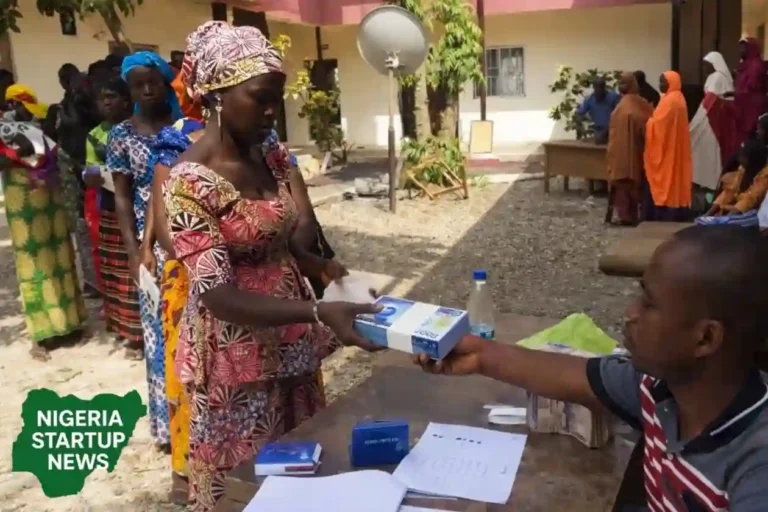
Providing clarity on expected individual benefits, the Action Against Hunger official said participants enrolled in the cash components of the programme could receive between ₦150,000 and ₦200,000 on average, depending on the specific component and phase of implementation.

“Regarding the specific question about the amount of resources that will go specifically to individuals, well, you know, the project has different components. So it has different stakes. So the amount of allocation is not uniform at all stages,” he said.

“Well, on average, I would say individuals will benefit around ₦150,000 to ₦200,000,” Fekadu added.

He noted that the programme is currently planned as a one-year intervention, with the possibility of expansion depending on the availability of additional funding from donors.

While acknowledging that several states across the Northeast, Northwest and North-Central regions are facing similar security and humanitarian challenges, Fekadu said funding limitations have made large-scale expansion difficult at this stage.

Despite these constraints, he expressed optimism that continued engagement with development partners would create opportunities to extend similar social protection programmes to other affected states in the future.

Fekadu also highlighted Action Against Hunger’s long-standing involvement in strengthening social protection systems in Nigeria, citing over a decade of engagement in states such as Jigawa and Kano, as well as previous interventions in Borno and Yobe.

Borno and Adamawa states have experienced years of conflict and insecurity, leaving millions of residents vulnerable and struggling to meet basic needs. Many households have lost stable sources of income, increasing dependence on humanitarian support.

The new programme aims to combine direct cash assistance with efforts to strengthen state social protection systems, helping affected communities rebuild resilience, stabilise livelihoods, and gradually recover from the impacts of prolonged insecurity.

Apply: Lagos State Neighbourhood Safety Corps (LNSC) Recruitment

0

The Lagos State Government has opened the Lagos State Neighbourhood Safety Corps (LNSC) recruitment portal for SSCE Cadre across all Local Government Areas in the state. The exercise is being carried out through the Lagos State Neighbourhood Safety Agency (LNSA) to recruit Neighbourhood Safety Officers under Group B.

The recruitment is aimed at engaging qualified youths to support community safety, security and civic responsibility at the grassroots to strengthen local vigilance and support safer neighbourhoods across Lagos State.

Applicants are required to have a minimum of SSCE, WAEC, NECO or GCE qualification and must be residents of Lagos State. Other conditions include being physically and medically fit, having good character with no criminal record, and the ability to read and write. Applicants age must be between 18 to 30 years.

The application process is free and strictly online. Applicants are to log in and fill the online form correctly and upload required documents, including SSCE results, passport photograph and other relevant details.

Review your information before submission and print or save the Acknowledgment Slip. Applicants are to keep their login details safe for future use.

There is currently no deadline on the portal, however early application is advised as late entries will not be accepted.

To apply for LNSC recruitment, interested applicants should visit and submit applications via the official portal https://lnsa.lg.gov.ng/career.