Home Blog Page 148

Rivers State urges youths to take advantage of Innovation Hub Centre

0

The Rivers State Commissioner for Health, Dr. Adaeze Chidinma Oreh, has urged adolescents and young people across the state to take advantage of the newly established Adolescents and Young People Innovation Hub Centre, saying it offers empowerment.

Dr. Oreh made the call on Tuesday while commissioning the Innovation Hub Centre located at Fimie-Ama Community in Port Harcourt Local Government Area, PHALGA.

She said the centre was designed to respond to the real needs of adolescents and young people, adding that access to relevant skills remains key to building confidence and stability.

According to her, the Hub is equipped with ICT and robotics rooms, app development and media studios, beauty and vocational training spaces, wellness and counselling services, as well as a food technology unit.

“This Hub reflects a deep understanding of the diverse needs of our adolescents and young people. It provides a supportive environment where skills, creativity and innovation can thrive,” Oreh said while unveiling the plaque.

She commended the United States Centers for Disease Control and Prevention, CDC, and the Institute of Human Virology Nigeria, IHVN, working in partnership with Project HOPE, for initiating the programme.

The Commissioner noted that the Rivers State Government views youth empowerment through skills acquisition, confidence building and access to opportunities as a foundation for development, social stability and economic growth.

She assured that the state government would continue to support programmes that empower young people, promote innovation, reduce vulnerability and drive socio-economic transformation.

Speaking earlier, the Chief Operating Officer and Managing Director of the Institute of Human Virology Nigeria, Dr. Charles Olalekan Mensah, said the Innovation Hub Centre was established to equip young people with relevant skills and create opportunities for growth.

He explained that the delivery of the Hub was made possible through strong leadership, strategic partnerships and collaboration among stakeholders.

In a goodwill message delivered virtually, the Country Director of the CDC in Nigeria, Dr. Meghna Desai, represented by the Deputy Director, Programmes, Dr. Jerry Gwamna, described the Hub as a safe space for the development of adolescents and young people.

She said the initiative would provide beneficiaries with critical entrepreneurial, technical and life skills that reduce vulnerability and promote economic independence, including support for young people living with HIV/AIDS.

Read also: EU Commits $14m to Assist Vulnerable Families in Sokoto State

Advertisement

EU Commits $14m to Assist Vulnerable Families in Sokoto State

The European Union has earmarked $14 million to support Sokoto State in building stronger and more inclusive systems for identifying and assisting vulnerable families, as part of efforts to improve social protection delivery.

The funding is being deployed under the EU’s Supporting Sustainable Social Protection Systems in Nigeria programme, known as SUSI. It will focus on strengthening social protection policy, improving public budgeting processes, and establishing a comprehensive social registry capable of accurately capturing households most in need.

The commitment was announced during a three-day mission to Sokoto State by officials of the European Union, the United Nations and international development partners. The mission was led by the EU Head of Cooperation to Nigeria, Massimo De Luca.

Members of the visiting delegation included representatives of UNICEF, UNFPA, the International Labour Organisation, as well as development partners such as Plan International Nigeria, Action Against Hunger Nigeria, CARE and the Danish Refugee Council.

According to the EU, the proposed social registry will prioritise children and families who are frequently excluded from formal support systems. These include households without birth registration or National Identification Numbers, out-of-school children, malnourished families and those with limited access to primary health care services.

“This visit has shown how critical it is to invest in systems that protect and empower people, especially children and young people. The EU remains committed to supporting Sokoto State to ensure inclusive development that leaves no one behind,” De Luca said.

In a statement, the partners said the mission reaffirmed their commitment to working closely with the Sokoto State government to improve services for children, women, adolescents and vulnerable families through long-term system reforms.

Governor Ahmed Aliyu, who received the delegation in Sokoto, said his administration was focused on sustaining development gains and delivering essential services in line with state priorities and the Federal Government’s Renewed Hope Agenda.

“Our administration is committed to practical solutions that uplift our people. We will continue to prioritise the well-being of women, children and vulnerable families and work with partners to sustain results,” the governor said.

During the visit, the delegation toured schools, primary health care centres, internally displaced persons camps and community service points across the state.

At education facilities, the team reviewed programmes aimed at improving safe learning environments, strengthening teacher support and increasing community participation to expand access to inclusive education for girls and boys.

In health facilities, partners assessed initiatives to make services more adolescent-friendly and gender-responsive.

UNICEF Deputy Representative for Programme, Rownak Khan, said EU-supported interventions in Sokoto are centred on education, primary health care and adolescent-focused services.

“This is about helping families withstand shocks through social protection so that children not only survive but thrive,” she said.

A highlight of the mission was the presentation of a tool to measure multiple dimensions of poverty. The tool will be integrated into Nigeria’s National Social Register to improve targeting, reduce exclusion errors and ensure limited resources reach households most in need.

The mission concluded with a pledge by the European Union, United Nations agencies and partner organisations to deepen collaboration with the Sokoto State government in advancing social protection reforms nationwide efforts.

Read also: WEF 2026: Shettima urges Africa to build prosperity through local production

Cross River Youth Loan: ₦13,000 Paid Before Full Conditions Disclosed

0

Documents have emerged showing that critical eligibility conditions for the Cross River State Youth Empowerment Scheme loan were not disclosed to applicants before ₦13,000 was collected from them, raising questions about transparency, accountability, and whether affected youths will be refunded.

The loan scheme, promoted under the banner of the Cross River State Youth Empowerment Scheme (CRS-YES), was presented as an accessible financing opportunity for young entrepreneurs in the state. Applicants were directed to process their requests through Zenith Bank and the Bank of Industry (BOI), with an upfront payment of ₦13,000 described as a fee for SEARCH processing and a customised ATM card. For many applicants, the payment was made with the understanding that meeting the listed requirements would make them eligible for the loan.

Questions were first raised publicly about the rationale for collecting the ₦13,000 from applicants who had no certainty of receiving the loan. The concern was not merely about the amount, but about whether full eligibility conditions had been disclosed before the money was taken. Those questions triggered a flurry of responses within private messaging platforms and, later, an official letter that has now put key details in writing.

In a message circulated shortly after the concerns were published, the chairman of the scheme, Kalita Joseph Aruku, appealed to members of a WhatsApp group to publicly defend him. “Please those of you that were there yesterday go and help me clarify that the money was paid to the bank and it was duely explained what it was about,” he wrote, adding that it had been announced applicants who scaled the screening would be reimbursed. In another message, he told the critic, Agba Jalingo, “You are not God… you can never be. Shalom!”

Supporters of the scheme also circulated claims that loans were already available for those who had paid the ₦13,000, while others alleged—without evidence—that the bank had threatened legal action against critics. These claims were later contradicted by subsequent developments, including admissions by scheme officials that the loan conditions were more restrictive than initially presented.

What applicants say they were told at the point of registration was straightforward. According to information circulated by CRS-YES mobilisers, prospective beneficiaries needed CAC registration documents, a BVN, NIN slip, a utility bill, one passport photograph, a TIN, at least six months of bank statements from any active account, and the ₦13,000 registration fee for SEARCH and an ATM card. On that basis, many young people paid the fee believing they had met the requirements.

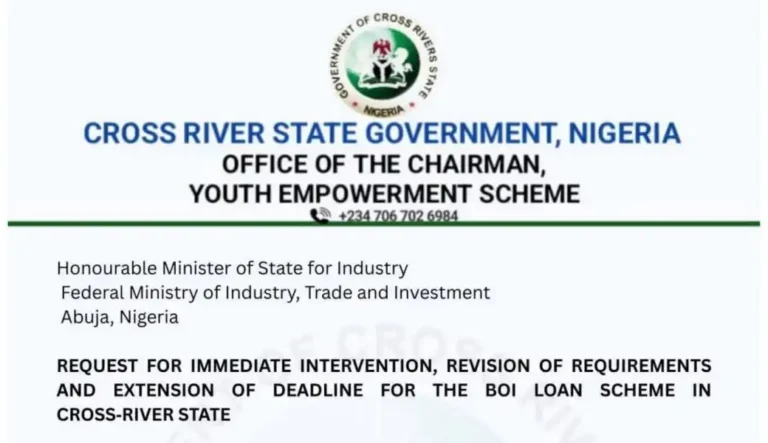
However, the letter now written by the chairman to the Minister of State for Industry paints a different picture. In that correspondence, he acknowledged conditions that were not part of the initial public communication but which substantially narrow eligibility. Among them are restrictions excluding newly registered businesses, requirements for applicants to deposit a percentage of the proposed loan before disbursement, the provision of collateral, and proof of repayment capacity based strictly on existing turnover and transaction history.

The letter further confirms that to access the maximum ₦5 million loan, an applicant must demonstrate an annual turnover of ₦30 million. For those below that threshold, the loan amount is calculated using a turnover-divided-by-six formula. These conditions mean that many of the youths who paid the ₦13,000—particularly start-ups and small enterprises—are unlikely to qualify.

The implications of these conditions are already being felt. Messages within applicant groups show frustration and confusion, with some lamenting that the rules appeared to be “changing every day.” In one message attributed to the chairman, he suggested that some of the conditions were not communicated to him when banks approached his office to mobilise applicants. “They didn’t give me this condition(s) when they approached my office to mobilize people to come benefit the loan,” he wrote, blaming the banks for shifting goalposts.

That claim has itself raised further questions. Loan negotiations between public schemes and development finance institutions typically involve detailed discussions of eligibility criteria, risk assessment, and disbursement terms. Critics argue that if such conditions were indeed unknown to the scheme’s leadership, it points to a troubling lack of due diligence. If they were known but not disclosed, it raises even more serious transparency concerns.

In an apparent effort at damage control, the chairman’s letter appeals for a review or cancellation of some of the conditions and seeks an extension of deadlines. While the appeal suggests recognition that the rules as they stand exclude many intended beneficiaries, it also implicitly confirms that the conditions exist and are currently operative.

Central to the controversy is the fate of the ₦13,000 already collected. Applicants paid the fee before learning of the stricter eligibility requirements. There has been no clear, publicly documented mechanism explaining whether those who fail to meet the undisclosed conditions will be refunded, when such refunds would occur, or who bears responsibility for returning the funds. Initial assurances that successful applicants would be reimbursed do not address the situation of those who are screened out.

The banks named in the process have not publicly clarified their role in collecting or holding the ₦13,000, nor have they issued statements detailing refund procedures. This silence has fuelled speculation and anxiety among applicants, many of whom are unemployed or operating micro-enterprises with limited capital.

The Cross River State Government has also been drawn into the controversy. Supporters of the scheme have argued that the initiative aligns with the administration’s youth empowerment agenda under Governor Bassey Otu. Critics counter that empowerment programmes must be built on clear rules and full disclosure, especially when they require upfront payments from vulnerable groups.

From a policy perspective, the episode highlights a recurring challenge in public-sector credit interventions: balancing access with risk management. Development finance institutions such as BOI are mandated to protect public funds, which explains stringent requirements. But when those requirements are not transparently communicated at the outset, the credibility of the entire programme suffers.

For applicants now caught in the middle, the debate is less about institutional mandates and more about fairness. Many say they would not have paid the ₦13,000 had they known that newly registered businesses were excluded or that collateral and significant turnover were prerequisites. Their demand is simple: clarity and, where appropriate, refunds.

As it stands, the official letter has shifted the discussion from allegation to documentation. It confirms that key conditions capable of disqualifying most applicants were not part of the initial public messaging. It also confirms that the scheme’s leadership is now seeking retrospective adjustments to rules that are already affecting applicants.

The unanswered questions remain stark. What happens to the ₦13,000 paid by applicants who cannot meet the undisclosed conditions? Who is responsible for refunding them—the banks, the scheme, or another party? And what safeguards will be put in place to ensure that future public empowerment programmes disclose all material conditions before collecting money from citizens?

Until those questions are answered with the same clarity now evident in the letter, the controversy surrounding the Cross River State Youth Empowerment Scheme loan is unlikely to fade.

Read also: GEEP Initiative Provides Interest-Free Loans for Nigerian MSMEs

Akwa Ibom Civil Service Begins Oral Interviews for Candidates

The Akwa Ibom State Civil Service has commenced the oral interview phase of its ongoing recruitment exercise. The interview officially begins on Monday, January 26, 2026, with 12,502 candidates expected to participate.

Candidates qualified for the oral interview must have scored at least 50 per cent in the Civil Service Computer-Based Test (CBT) conducted in December 2025.

Invitation letters for the oral interview have been sent to successful candidates via email. The interview notification reads in part:

“Interview Invitation
Dear (Candidate Name),
We hope this message finds you well. This is to inform you about a new event on your account.
You have been invited for the Akwa Ibom State Civil Service Recruitment – Oral Interview (Morning Session), scheduled for Monday, January 26, 2026. Please review the details and choose to accept or decline.

ACTION REQUIRED: Kindly log into your dashboard, review the details, and choose to accept or decline.”

Candidates are advised to regularly check their email addresses, including spam folders, for their interview notifications.

The Civil Service also disclosed that the invitations are being sent in batches. Candidates who have not yet received an email are advised to remain patient and continue to monitor their inbox.

Further updates will be communicated as the exercise progresses.

Read Also: Akwa Ibom Empowers 200 Farmers With Arise Grant

NASENI, AUST to Drive Innovation and Research Commercialisation

The National Agency for Science and Engineering Infrastructure (NASENI) and the African University of Science and Technology (AUST), Abuja, have signed a memorandum of understanding aimed at strengthening innovation, technology development, and the commercialisation of research outputs.

The agreement was signed at NASENI headquarters in Abuja by the Executive Vice Chairman and Chief Executive Officer of the Agency, Mr. Khalil Suleiman Halilu, alongside the leadership of AUST.

Halilu described the engagement as a positive step towards deepening institutional collaboration that delivers practical impact. He said the Agency remains focused on partnerships that move research beyond publications into real-world solutions.

“NASENI is focused on innovation that targets the right audience and produces tangible outcomes. Our Innovation Hub was established to ensure that promising ideas are nurtured, supported, and scaled into usable technologies that contribute to national development,” he said.

He further reaffirmed NASENI’s openness to working closely with universities and research institutions, stressing that collaboration is critical to bridging the gap between academia and industry. “This is your home, and we look forward to doing a lot of collaborations together,” Halilu added.

Responding, the President of the African University of Science and Technology, Prof. Peter Azikiwe Onwualu, highlighted the long-standing relationship between both institutions, recalling previous collaborations, postgraduate training programmes, and joint initiatives that had benefited NASENI staff and researchers.

The AUST delegation emphasised the need to renew and expand cooperation in line with emerging innovation priorities. Onwualu explained that the AUST Inspire Innovation Hub was created to address the persistent challenge of limited research commercialisation.

“We are changing the narrative from research done solely for academic promotion to research that ends in products, innovation, and real value,” he stated, citing ongoing agro-waste conversion projects supported under NASENI’s Delta-2 programme.

Both institutions agreed to deepen cooperation in innovation, technology transfer, and human capital development. AUST also invited NASENI to participate in its upcoming international conference on innovation scheduled for April, where NASENI’s leadership is expected to be recognised for contributions to advancing research commercialisation and innovation in Nigeria within the country.

Read Also: FG launches CVFF portal for $25m ship financing at 6.5% interest

Benue Fashion and ICT Hub Targets 48,000 Jobs at Full Capacity

The Benue State Fashion and ICT MSME Hub is projected to create up to 48,000 jobs annually when fully optimised, positioning it as one of the most ambitious skills and enterprise development projects in the state.

The hub, located in Makurdi, was established under the administration of Hyacinth Iormem Alia with support from the Federal Government led by Bola Ahmed Tinubu, as part of efforts to strengthen micro, small and medium enterprises and reduce youth unemployment.

At its commissioning in August 2024 by Vice President Kashim Shettima, the Federal Government described the facility as a critical platform for job creation, skills transfer and industrial productivity, noting that its full employment potential would be realised only when operations are fully scaled.

The Fashion and ICT Hub is equipped with more than 200 fashion production machines and over 100 ICT devices, designed to meet global standards and support large-scale training and production. It was conceived as more than an infrastructure project, but as a long-term investment in people, creativity and enterprise.

According to information released during the launch, the hub has the capacity to train young people in fashion design, digital design, ICT operations and equipment handling, while also providing a supportive environment for MSMEs to grow into sustainable businesses. The projected 48,000 jobs include both direct and indirect opportunities expected to emerge from training, production, supply chains and related services once the facility is operating at full capacity.

Since operations began, 96 beneficiaries have undergone training at the hub, with additional participants currently enrolled. Selection was structured to ensure statewide inclusion, with three beneficiaries drawn from each of Benue’s 23 local government areas.

Officials have consistently emphasised that the job figure remains a projection rather than a current outcome. While the hub is active and training is ongoing, there have been no official updates confirming that the facility has reached full optimisation or that the projected employment numbers have already been achieved.

The state government has, however, continued to highlight the hub as a cornerstone of its broader youth empowerment and economic development strategy. By combining skills acquisition with access to modern equipment and enterprise support, the Fashion and ICT Hub is expected to play a significant role in reducing unemployment and stimulating local production over time.

As implementation continues, stakeholders say sustained funding, expanded training cycles and stronger market linkages will be key to unlocking the hub’s full job-creation potential.

Read also: Edo Govt, FG Move to Launch Indigenous Airline From Benin Airport

Edo Govt, FG Move to Launch Indigenous Airline From Benin Airport

0

The Honourable Minister of Aviation and Aerospace Development, Festus Keyamo SAN, on Thursday received the Governor of Edo State, Senator Monday Okpebholo, who paid a strategic courtesy visit to advance discussions on the immediate activation of an indigenous airline for Edo State.

Governor Okpebholo arrived with key members of his cabinet and said the proposed airline would operate from Benin Airport. He described aviation as a critical driver for Edo State’s economic revival, investment inflow and job creation, stressing that improved connectivity would help reposition the state for business.

According to the governor, the Edo State Government is already exploring several partnership options to ensure a smooth take-off of operations. He disclosed that discussions are ongoing with South African investors who have pledged to provide aircraft to support the launch.

“If I have my way, I want this airline to kick off immediately — like tomorrow, even before the election. Edo State needs a strong aviation presence to open up our economy and reposition Benin as a major hub,” Okpebholo said.

In his response, the Honourable Minister, Festus Keyamo SAN, welcomed the initiative and described it as timely and visionary. He said the Federal Ministry of Aviation and Aerospace Development has also been engaging potential investors who have shown interest in Benin Airport.

Keyamo recalled the historical relevance of Benin Airport in Nigeria’s aviation ecosystem, noting that it once served as a major confluence point for the old Midwest region during the years of the defunct Okada Air.

“Benin Airport used to be a strong aviation hub during the glory days of Okada Air. There is no reason it cannot reclaim that status. The interest we are seeing today confirms that Benin is ready again,” the minister stated.

To fast-track the process, Keyamo announced the establishment of a technical committee to guide the project. He requested the governor to nominate a point person who will work directly with the Director of Air Transport Management at the ministry for coordination and compliance.

“This committee will report to me and you on a weekly basis for coordination. With collaboration, Benin Airport should be fully operational between the first and second quarters of this year,” Keyamo assured.

The meeting highlights the Federal Government’s commitment to strengthening connectivity and supporting state-led aviation development initiatives aligned with President Bola Ahmed Tinubu’s Renewed Hope Agenda nationally.

Read also: Enugu Sets March 21–30, 2026 Date for 37th International Trade Fair

Enugu Sets March 21–30, 2026 Date for 37th International Trade Fair

0

The 37th edition of the Enugu International Trade Fair has been scheduled to hold from March 21 to March 30, 2026, as preparations intensify for one of the region’s largest commercial gatherings. The announcement was made on Thursday by the outgoing president of the Enugu Chamber of Commerce, Industry, Mines and Agriculture, ECCIMA, Sir Odeiga Jideonwo, during the 52nd annual general meeting of the chamber held at the secretariat.

Jideonwo said the 10-day trade fair would be hosted under the theme “Empowering MSMEs for Global Competitiveness,” noting that detailed planning has already been completed to ensure a smooth and successful event. He explained that the fair has been structured to support micro, small and medium enterprises while creating opportunities for local and international business partnerships.

According to him, comprehensive strategies and a clear roadmap for the hosting of the fair have been developed, with implementation already underway. He added that marketing activities for the event began last year through both direct and indirect channels, a move he said has helped to attract growing interest from businesses and institutions within and outside Nigeria.

“The 37th Enugu International Trade Fair has been scheduled to hold from Saturday 21st to Monday, 30th March 2026 under the theme: Empowering MSMEs for Global Competitiveness,” Jideonwo said.

“Comprehensive strategies and a clear roadmap for the successful hosting of the Fair have been developed, and implementation is already in progress. Marketing activities commenced last year through both direct and indirect channels, and we are encouraged by the growing interest from both local and international organisations,” he added.

Jideonwo called on institutions, government agencies and international partners to actively participate in the fair, describing it as a landmark event designed to deliver value across all stakeholder groups. He said the fair would serve as a platform for innovation, networking and market expansion for exhibitors and participants.

Earlier in his address, the ECCIMA president commended the Enugu State Government for what he described as visible and sustainable commitment to urban renewal and infrastructure development across the Enugu metropolis and other parts of the state. He also praised the administration for major interventions in the education sector.

“Worthy of mention are your administration’s bold intervention in upgrading the education system through the construction of 260 Smart Schools, significant investment in road construction and transport infrastructure, as well as renewed focus on the tourism sector among other laudable initiatives,” he said.

Jideonwo further applauded the state government for improving the business environment, noting that Enugu State was ranked third in the 2025 Presidential Ease of Doing Business Ranking. He said the ranking reflected the government’s commitment to reforms, efficiency and service delivery, and positioned the state as a competitive and business-friendly destination.

Declaring the annual general meeting open, Governor Peter Mbah, who was represented by the Commissioner for Commerce, Investment and Industry, Hon. Sam Ogbu Nwobodo, urged ECCIMA and the business community to continue supporting the state government and development efforts.

Read Also: Soludo Says Anambra Has Empowered Over 36,000 Youths With Skills

Apply: 2026 YHA Media Internship Program (5th Cohort)

The Youth Hub Africa Media Internship Program (MIP) has opened applications for its 5th Cohort, offering young Nigerians the opportunity to build relevant digital media and employability skills needed in today’s fast-changing media space. The programme is organised by Youth Hub Africa and is designed to help young creatives move from learning to practical, real-world experience.

The Media Internship Programme combines hands-on digital media training with structured internship placements. Participants are equipped with practical skills, industry exposure, and professional competencies that align with current media and communication demands. The 2026 edition is focused on being more intentional, skill-driven, and impact-oriented.

About the Media Internship Programme

The YHA Media Internship Programme targets young graduates and creatives who are ready to level up their skills and build a strong foundation for careers in media and communication. The programme bridges the gap between interest and employability by combining training with workplace experience.

This 5th Cohort is open to young people interested in photography, videography, social media management, and content creation. It is structured to ensure participants gain both technical ability and confidence to work in professional media environments.

What to Expect

Participants selected for the programme will benefit from intensive learning and hands-on engagement designed for today’s digital media space.

  • Intensive, hands-on media training
  • Practical skills tailored to modern digital platforms
  • Internship placement after the training phase
  • Exposure to real media projects and workflows

Training Focus Areas

The programme covers key areas that are essential for media professionals and content creators.

  • Photography
  • Videography
  • Development Communication
  • Social Media Management
  • Content Curation

Training Mode and Requirements

The training is strictly in-person and targeted at participants living in Abuja. Applicants must meet specific requirements to be eligible.

  • Training is in-person for Abuja-based participants
  • Applicants must have a laptop
  • Participants must commit to attending the full one-week training

The training will run from March 11th to March 16th, 2026, with one of the sessions scheduled on a Saturday. Full participation throughout the training period is mandatory.

Who Should Apply

The programme is ideal for young graduates and creatives who are passionate about media, storytelling, and digital communication, and who are ready to gain hands-on experience in a professional setting.

How to Apply

Interested applicants are encouraged to apply early, as spaces are limited.

Deadline: 18 February 2026

Link to Apply: APPLY HERE

Your next chapter in media could start here.

Read also: YASIF Free Digital and Social Media Marketing Course

Soludo Says Anambra Has Empowered Over 36,000 Youths With Skills

The Anambra State Governor, Prof. Chukwuma Soludo, has said his administration has empowered more than 36,000 youths across the state with different skills, stressing that young people remain the greatest asset of any society. He said the focus of his government is to ensure that youths are equipped with practical abilities that will help them contribute meaningfully to economic growth, innovation and community development across Anambra.

Soludo said the approach is guided by Anambra Vision 2070, aimed at building a prosperous, inclusive and smart society that prioritises youth development, innovation, entrepreneurship and shared growth.

The governor made the remarks on Friday at the swearing-in and opening ceremony of the 2026 Batch ‘A’ Stream 1 National Youth Service Corps orientation programme held at the NYSC Permanent Orientation Camp, Nnamdi Azikiwe Unity Camp, Mbaukwu/Umuawulu, Awka South Local Government Area. He was represented at the event by the Commissioner for Youth Development, Mr Patrick Agha-Mba.

Addressing the corps members, Soludo urged them not to be passive observers during their service year but to fully immerse themselves in the Anambra experience. He encouraged them to learn, create, collaborate and contribute to the state’s development efforts, saying the service year offers a unique opportunity to gain real-life experience and make lasting impact in host communities.

He said, “Guided by Anambra Vision 2070, we are deliberately building a prosperous, inclusive and smart society where young people are empowered to thrive. Through initiatives such as the Solution Innovation District, Code Anambra, One Youth Two Skills Plus, and targeted agribusiness and entrepreneurship schemes, we continue to open doors for skills acquisition, innovation and wealth creation.”

Soludo said over 36,000 youths have already been empowered with digital skills, while the ongoing One Million Anambra Digital Tribe initiative is designed to equip one million Anambra youths with relevant digital competencies. He added that his administration has also empowered 13,300 youths with skills and grants amounting to N5.5bn for business start-up and expansion under the first and second phases of the One Youth Two Skills Plus programme.

He urged corps members to internalise the values taught during the orientation course, noting that discipline, teamwork and responsibility would determine their effectiveness during the service year and in their future careers. He reassured them of his administration’s commitment to the continuous improvement of camp facilities to ensure a safe, serene and enabling environment for all participants.

The governor also advised the corps members to respect local cultures, promote peace, avoid harmful behaviour and conduct themselves with dignity at all times. He said many former corps members had acquired digital skills, accessed grants, started businesses through youth empowerment programmes and even chosen Anambra as their long-term home.

Soludo said, “You are encouraged to fully participate in these programmes. As you undergo orientation, discipline must remain your watchword. Obey camp rules, respect constituted authority and participate actively in all programmes. Be solution-driven, identify challenges within your host communities and apply your knowledge creatively. True service is measured not by attendance but by impact.”

He commended the NYSC leadership at the national and state levels for their dedication and professionalism, adding that Anambra values its partnership with the scheme. According to him, the collaboration has continued to support grassroots development, public enlightenment, electoral support, health interventions and youth mentoring across the state.

Earlier, the Anambra State Coordinator of the NYSC, Mrs Pauline Ojisua, disclosed that a total of 1,500 prospective corps members successfully registered for the exercise. She said the figure comprised 616 males and 884 females, all of whom were expected to comply with camp rules and participate fully in the orientation activities nationwide efforts.

Ojisua urged the corps members to obey all extant laws, NYSC regulations and security directives, and to conduct themselves as responsible ambassadors of their families, institutions and the nation. She said, “Discipline remains the cornerstone of the scheme. Military drills, physical training and sporting activities will enhance physical fitness, mental alertness and team spirit.”

She added that the Skills Acquisition and Entrepreneurship Development Programme would equip corps members with practical skills for self-reliance beyond the service year. Ojisua said all camp officials, security agencies, medical teams and collaborating partners had been fully mobilised to ensure effective administration, welfare and security throughout the programme.

read also: FG Shifts Humanitarian Aid Focus With 2026 Needs and Response Plan