
Home Blog Page 149

Karimi begins disbursement of N300m bursary for 3,000 Kogi Students

0

The Sunday Steve Karimi Education Foundation (SSKEF) has commenced the disbursement of a N300 million bursary to students across Kogi State, working in partnership with the Tinubu Support Group (TSG), as the scheme expands beyond Kogi West to cover all three senatorial districts in the state.

The bursary programme is funded by Senator Sunday Steve Karimi, who represents Kogi West Senatorial District, and marks the second edition of the education support initiative. The foundation said the expansion reflects a broader commitment to supporting students across Kogi Central and Kogi East, in addition to Kogi West.

The maiden edition of the bursary scheme was held in 2024 and was largely limited to Kogi West Senatorial District. During that phase, N100 million was disbursed to 1,390 students drawn from the district’s seven local government areas. According to the foundation, the positive response and impact of the first edition informed the decision to scale up the programme.

In June 2025, SSKEF announced that the bursary scheme would be extended to include students from Kogi Central and Kogi East. Applications were subsequently opened to eligible students from the two districts, targeting 610 beneficiaries in Kogi Central and 1,000 beneficiaries in Kogi East. This brought the total number of intended beneficiaries across the state to 3,000 students.

Karimi’s media team, in a statement, said the 2026 disbursement officially began on Tuesday, 20 January, with each successful applicant receiving N100,000. The statement described the current phase as an improvement on the earlier edition, both in scope and coverage.

“This year’s edition of the bursary awards is an improvement on the maiden edition in 2024 when 1,000 students benefitted, limited to students from Kogi West alone. Originally, the Kogi West yearly scheme was designed to last the four-year tenure of the lawmaker in the 10th Senate,” the statement said.

According to the foundation, the bursary application portal opened on 1 August 2025 and closed on 31 August 2025. Eligibility was limited to undergraduates studying in public tertiary institutions, including universities, polytechnics, monotechnics and colleges of education.

It added that beneficiaries of the 2024 bursary scheme were excluded from the current edition, along with students of private institutions and those in their final year of study. The foundation stressed that strict adherence to the application guidelines was required.

“Any student who failed to upload or complete all required information in the application forms was not considered. Any student who applied before 1st August was automatically disqualified. Only those who applied online through the link provided were considered,” the statement said.

SSKEF also explained that all applicants were subjected to the same screening process, regardless of background or institution. However, it noted that recommendations from local government subcommittees were taken into account.

“However, those recommended by the local government subcommittee will all receive their payment. We have beneficiaries from the College of Education Technical, Mopa, who do not have JAMB numbers or registration,” the foundation said.

The statement further quoted Senator Karimi as saying that the bursary scheme reflects his commitment to education, fairness and transparency in public service.

“Senator Sunday Steve Karimi remains committed to empowering students through financial assistance, promoting academic excellence, and contributing to the overall development of Kogi State. The seamless disbursement of this year’s bursary fulfils Senator Karimi’s earlier promise of a transparent, fair, efficient, and equitable process for all applicants,” it said.

During a parley with the Nigeria Union of Journalists (NUJ) in Lokoja in June 2025, Senator Karimi had earlier disclosed plans to disburse N300 million as bursary support to students across the state.

“Last year (2024), I gave a bursary of N100m to Kogi West students, but today, with the 96 wards in Kogi East, I have concluded arrangements to give out N100m as bursary to them. In Kogi Central, where we have 57 wards, I will give N61m as bursary, while I will also give N139m to Kogi West students in the names of the Tinubu Support Group and Senator Sunday Steve Karimi Education Foundation. This amounts to a total of N300m. That is what we are going to do, and it has already started,” he said.

The foundation disclosed that more than 10,000 students applied for the bursary scheme, with only 3,000 meeting the eligibility criteria after screening. Distribution by senatorial district includes 610 beneficiaries in Kogi Central, 1,000 in Kogi East and 1,390 in Kogi West.

Several beneficiaries and parents have acknowledged receipt of the bursary, expressing appreciation for the support. Adebowale Ayobami Emmanuel, a student of Kogi State University, Lokoja, from Yagba West Local Government Area, said he received the alert and described the assistance as timely, referring to Senator Karimi as “Godsent”.

Another beneficiary, Hezekiiah Obajemu, said, “I just received an alert of N100,000 this evening after my lecture. God bless Senator Karimi abundantly. I am short of words. Thank you for this great opportunity and help shown to me.”

Atakolo Onalo, a lecturer at the Nigerian Defence Academy, Kaduna, thanked the foundation for the bursary awarded to his daughter, who is a student of Ahmadu Bello University, Zaria.

“This is the first major support from a political cycle in Kogi State, and my family and I do not take this for granted. Thank you, Distinguished Senator Sunday Karimi. We are grateful,” he said.

Kareem Enoch, whose son also benefited from the scheme, said, “May God continue to strengthen Honourable Karimi. May he continue to enjoy that office. Enemy within and enemy without will not prevail over him.”

Muhammad Munir, a student of Kogi State Polytechnic, Kotonkarfe, said the bursary eased immediate financial pressure. “To be honest, my landlord has been on my neck over rent, and I was already losing sleep, not knowing where the next solution would come from. This bursary lifted a heavy burden off my shoulders and gave me hope when things were overwhelming,” he said.

Another beneficiary, James Jibrin Nelson, a student of Ahmadu Bello University, Zaria, from Olamaboro Local Government Area, said the bursary would support his academic work. “My heart is full of gratitude to SSKEF for the generous financial support of N100,000 awarded to me. Thank you for having students at heart,” he said, adding that the funds would help him acquire a laptop for his research.

Read also: NELFUND Disburses N1.33bn Student Loan Funds to UNILAG for 2025/2026
Advertisement

NELFUND Disburses N1.33bn Student Loan Funds to UNILAG for 2025/2026
The Nigerian Education Loan Fund has confirmed the disbursement of N1.33bn to the University of Lagos for the 2025/2026 academic session, marking another step in the rollout of the federal student loan programme.

In a statement issued in Abuja on Friday by the Director of Strategic Communications at NELFUND, Oseyemi Oluwatuyi, the Fund said “a total sum of N1,326,550,000 was successfully disbursed to the University of Lagos on January 19, 2026, in line with the approved disbursement schedule for the 2025/2026 academic session.”

According to NELFUND, the funds are meant to cover tuition and related fees for 6,308 eligible students of the University of Lagos who met all requirements under the student loan programme.

The Fund explained that beneficiary lists were generated using verified institutional data submitted during the application and validation process, adding that the approach was designed to ensure accuracy and fairness.

NELFUND noted that once disbursement is made to an institution, students are expected to complete registration and access academic activities without delay, as the payment removes a major financial barrier.

The agency said it works closely with tertiary institutions to reconcile beneficiary lists, ensure the timely application of funds to students’ accounts, and provide clear communication to students in order to prevent misinformation and unnecessary distress.

Speaking on the development, the Managing Director and Chief Executive Officer of NELFUND, Akintunde Sawyerr, reaffirmed the Fund’s commitment to transparency and student welfare.

“NELFUND remains fully committed to ensuring that approved student loan funds are disbursed promptly and applied appropriately,” Sawyerr said. “We are working closely with all partner institutions to resolve any administrative gaps and to ensure that no eligible student is disadvantaged.”

The Fund urged students and other stakeholders to rely on official communications from NELFUND and their respective institutions, noting that speculation often creates confusion around payment timelines.

It assured the public that necessary steps were being taken to address any outstanding issues swiftly, adding that students seeking clarification should contact their institution’s bursary or student affairs office.

NELFUND also said it is continuing engagement with the University of Lagos to conclude the reconciliation process and ensure full alignment of records for the session.

The disbursement comes as the Federal Government continues to position education as a central pillar of national development under the Renewed Hope Agenda.

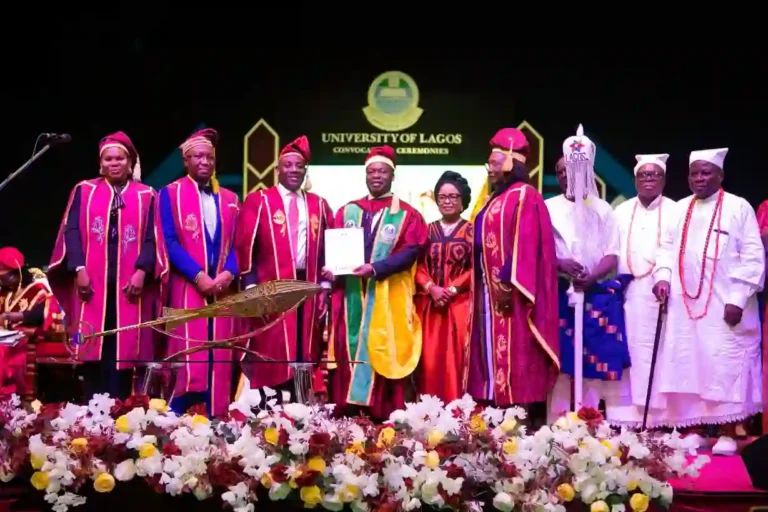
At the 56th Convocation Ceremony of the University of Lagos, the Minister of Education, Tunji Alausa, delivered an address on behalf of President Bola Ahmed Tinubu, GCFR, where he highlighted ongoing reforms and investments in the education sector.

Alausa said he was especially proud to return to his alma mater, UNILAG, noting that it was his second time addressing a convocation at the institution.

“I conveyed President Bola Ahmed Tinubu’s message that education remains the bedrock of Nigeria’s national renewal under the Renewed Hope Agenda,” he said.

The minister outlined key interventions already impacting the sector, including over N161.9 billion disbursed through NELFUND, strategic investments in medical schools, hostels, simulation laboratories and university infrastructure, as well as enhanced TETFund interventions.

He also spoke about student and staff focused initiatives such as the Student Venture Capital Grants, TISSF, and the Entrepreneurship, Innovation and Business Incubation Certification programme.

According to Alausa, the EIBIC programme will kick off this year across 18 selected universities nationwide, and has already commenced at the University of Lagos where the idea was conceived by a professor.

“This is proof that Nigerian professors and students are not lacking in ideas or brilliance, but need the right support to turn research into solutions, knowledge into enterprise, and innovation into national impact,” he said.

The minister further encouraged young Nigerians to believe more deeply in the country, speak positively about Nigeria, and take pride in contributing to national progress.

The ministry said these combined measures reflect ongoing efforts to improve access, stability, and outcomes across Nigeria’s tertiary education system during the academic cycle nationwide for students and institutions.

Read also: RISE Project to Create 8,000 Jobs for Women and Youth in Northern Nigeria

FG Shifts Humanitarian Aid Focus With 2026 Needs and Response Plan

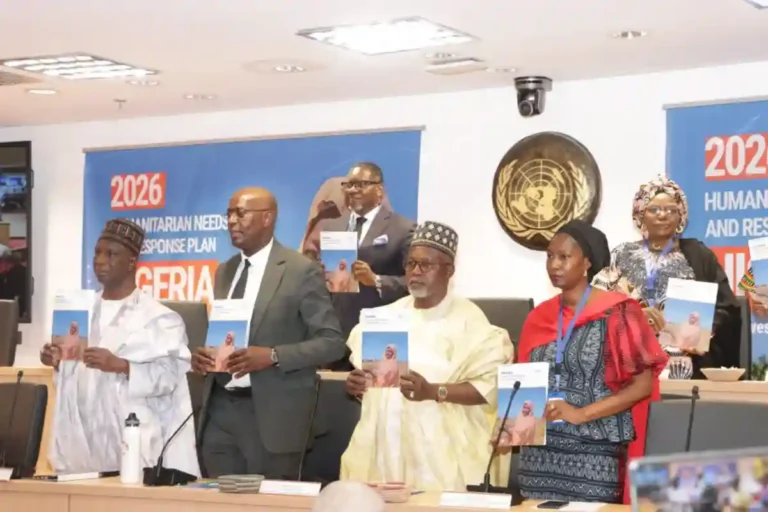
Millions of Nigerians affected by conflict, food insecurity and climate shocks could see a shift in how aid reaches them as the Federal Government unveiled the 2026 Nigeria Humanitarian Needs and Response Plan in Abuja, signalling a move away from repeated emergency interventions toward longer-term solutions.

The Government of Nigeria said it has taken full leadership and ownership of humanitarian coordination and response within the country, a decision that shaped the direction of the 2026 Nigeria Humanitarian Needs and Response Plan. The plan reflects a shared commitment to prioritise prevention, resilience, recovery and sustainable solutions in line with national policies and development objectives.

The Honourable Minister of Humanitarian Affairs and Poverty Reduction, Dr. Bernard M. Doro, made this known at the official launch of the 2026 plan at the UN House Auditorium in Abuja. He was represented at the event by the Honourable Minister of State in the ministry, Dr. Yusuf Tanko Sununu.

According to the minister, humanitarian action has continued to play a critical role in reducing the impact of conflict, climate shocks, displacement and food insecurity across the country, particularly in Borno, Adamawa and Yobe States, where communities remain highly vulnerable.

He explained that one of the major policy shifts under the Renewed Hope Agenda is the strong emphasis on prevention and preparedness. This, he said, requires Nigeria to address underlying risks, strengthen early warning systems, adopt risk-informed planning and take anticipatory action before crises escalate.

Dr. Doro noted that through the Federal Ministry of Humanitarian Affairs and Poverty Reduction, the government would continue to provide policy direction, coordination and leadership to ensure humanitarian efforts align with broader national reforms. These reforms, he said, are aimed at reducing poverty, strengthening human capital and building resilient communities.

He added that localisation remains a core priority of the government, stressing that Nigerian institutions, civil society organisations, community structures, as well as women-led and youth-led groups, are central to effective humanitarian response and lasting recovery.

Earlier, the United Nations Resident and Humanitarian Coordinator, Mr. Mohammed Malick Fall, described the 2026 plan as a collective commitment to address urgent humanitarian needs while strengthening coordination, accountability and overall impact.

Mr. Fall said insecurity across Nigeria continues to deepen vulnerability and restrict access to lifesaving assistance, noting that about two million people remain internally displaced and unable to return to their homes due to ongoing violence.

He further explained that widespread insecurity has disrupted agricultural activities, severely affecting livelihoods and contributing to rising food insecurity. Climate change, he added, is worsening humanitarian needs nationwide by intensifying floods, droughts and other shocks that disproportionately affect the most vulnerable communities.

The highlight of the event was the formal launch of the 2026 Nigeria Humanitarian Needs and Response Plan. Other dignitaries present included representatives of the Yobe and Adamawa State governors, the Executive Director of Sirri Care Foundation, the Director of the Nigeria INGO Forum, Mr. Ndubisi Anyanwu, and members of the press.

Read Also: Apply: Sakharov Fellowship Programme 2026

Apply: Sakharov Fellowship Programme 2026

0

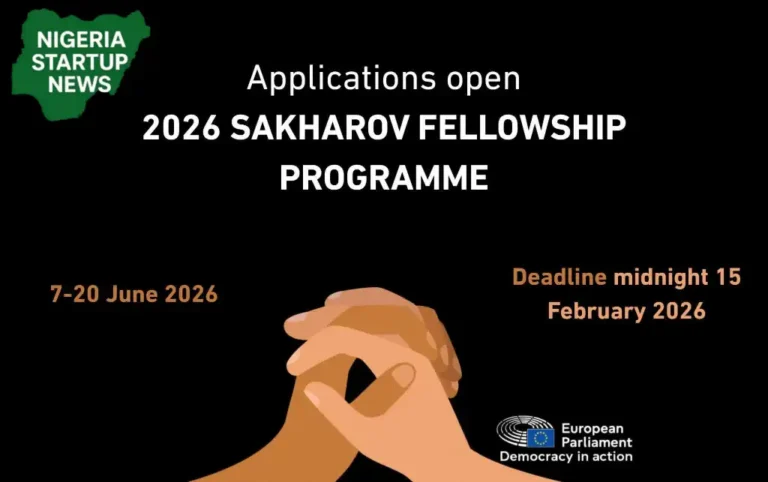
The Sakharov Fellowship 2026 is open to human rights defenders from non-EU countries, offering a unique opportunity to take part in a two-week intensive training programme in Europe. The fellowship is organised by the and is designed to strengthen the skills, networks, and impact of individuals working to promote and protect human rights in challenging environments.

The empowering programme has been organised annually since 2016, following an initiative taken by the Sakharov Prize Community at the 25th Anniversary Conference of the Sakharov Prize. Each year, up to 14 human rights defenders are selected to participate in the fellowship, which takes place in Brussels and at another location in an EU Member State.

About the Sakharov Fellowship

Unlike the Sakharov Prize, which recognises outstanding achievements in the field of human rights, the Sakharov Fellowship is not an award. Instead, it focuses on capacity development. The main objective of the fellowship is to equip human rights defenders with practical tools and knowledge that enable them to advocate more effectively and create positive, lasting change in their communities.

The programme is structured to address both professional and personal challenges faced by human rights defenders, especially those working under pressure or in restrictive environments.

Programme Structure and Learning Focus

The fellowship provides participants with an in-depth induction into EU policies and mechanisms that support human rights defenders globally. It also offers first-hand insight into how human rights work is carried out within the European Parliament and the broader European Union framework.

Key components of the programme include:

  • Meetings with Members of the European Parliament
  • Engagements with officials of EU institutions
  • Interaction with the Brussels-based human rights community
  • Workshops led by experienced human rights practitioners and experts

Training Areas

Throughout the two-week programme, fellows will take part in targeted workshops and sessions covering critical areas of human rights work, including:

  • Communication and advocacy
  • Security and safety
  • Disinformation
  • Resilience and well-being
  • Documentation of human rights violations
  • Individual advocacy, networking, and communication activities

These sessions are designed to provide practical skills that fellows can apply directly in their ongoing work.

Post-Fellowship Engagement

After completing the programme, fellows become part of the European Parliament’s Sakharov Community of human rights defenders. As members of this community, they are expected to maintain links with the European Parliament and continue liaising with EU Delegations in their respective countries. Beyond the training period, fellows are encouraged to act as multipliers by sharing best practices, supporting peers, and strengthening human rights networks at local and regional levels.

Selection Criteria

Candidate selection is based on clear criteria to ensure diversity and representation. The process prioritises gender balance and aims to reflect a broad range of human rights issues and geographical areas, in line with the political priorities of the European Parliament.

Applicants must:

  • Have a proven record of campaigning for human rights
  • Work within an NGO, organisation, or in an individual capacity
  • Possess a high level of English to actively follow and contribute to the programme

Fellowship Coverage and Timeline

The fellowship fully covers return travel from the country of residence, accommodation during the programme, and a daily living allowance.

Applications close at midnight on 15 February 2026 (CET). Successful candidates will be notified by email no later than 9 March 2026. Due to the high volume of applications, unsuccessful candidates will not receive individual feedback.

How to Apply

Interested candidates should complete the official application form using the link below.

Link to Apply: APPLY HERE

Read also: AGFUND Opens 2025 Prince Talal Human Development Prize with $1m Grant

YASIF Free Digital and Social Media Marketing Course

0

YASIF has opened the Skills Build Program registration for Phase 2, offering young people the opportunity to gain practical, in-demand digital skills needed for today’s job market. This program is designed to help participants improve employability, grow their careers, and prepare for real-world opportunities through structured learning and hands-on training.

About the Skills Build Program

The Skills Build Program focuses on equipping learners with relevant digital and professional skills that align with global workplace demands. The program is supported by reputable organizations committed to youth development, digital inclusion, and sustainable growth.

This phase places strong emphasis on digital and social media marketing, an area that continues to grow in relevance for businesses, organizations, and personal brands worldwide.

Program Partners

The Skills Build initiative is supported by established organizations working in skills development and global education.

  • International Association for Volunteer Effort
  • IBM SkillsBuild
  • Young Advocates for the Sustainable Development Goals

Course Overview

Participants enrolled in Phase 2 will receive training in digital and social media marketing, with a focus on practical application and real-world relevance. The course is structured to be beginner-friendly while still offering valuable insights for learners at different levels.

  • Free Digital & Social Media Marketing Course
  • Learn the fundamentals of digital marketing
  • Social media marketing strategies
  • Content creation techniques
  • Audience growth and engagement
  • Practical methods used to promote brands and businesses online

Key Benefits

The program offers several advantages to participants who complete the training successfully.

  • 100% free training
  • Practical and in-demand digital skills
  • Learning supported by global partners
  • Preparation for real-world opportunities
  • Globally recognized certificate upon completion

Who Can Apply

The program is open to individuals who are interested in building digital skills and advancing their career prospects. Applicants are advised to provide accurate information during registration to ensure smooth participation.

All interested participants must ensure they submit the registration form before starting their learning. Early registration is encouraged to avoid missing out on this opportunity.

How to Apply

Interested applicants should complete the official Skills Build Phase 2 Registration Form using the link below.

Link to Apply: APPLY HERE

Read also: PD Farms launches agribusiness, tech training via N1,000 empowerment promo

RISE Project to Create 8,000 Jobs for Women and Youth in Northern Nigeria

0

The Resilient and Inclusive Agri-Food Systems Empowering Women and Youth in Nigeria project, known as RISE, is expected to create 8,000 decent jobs across Northern Nigeria through agriculture-focused interventions over the next five years.

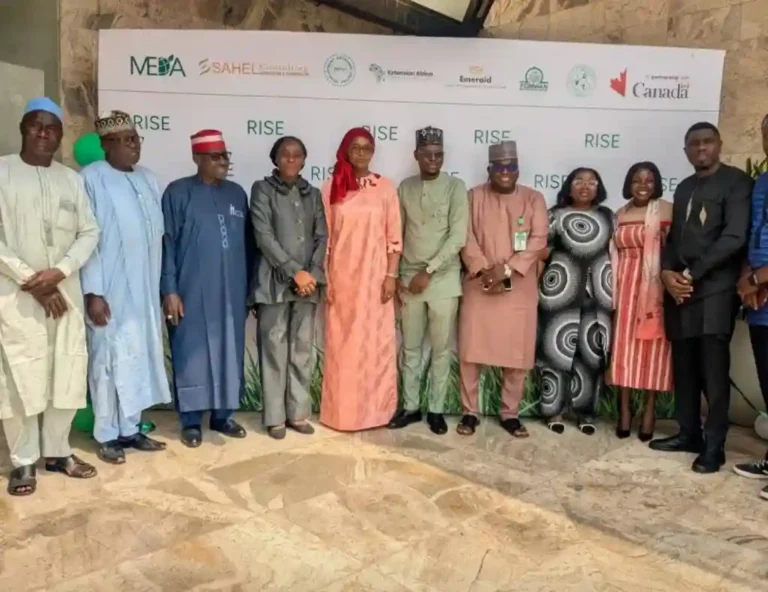
The initiative, supported by Global Affairs Canada, was launched in Abuja by Mennonite Economic Development Associates. A joint statement signed by Maxwell Olitsa, RISE Country Project Manager, and Elodie Yahaud, MEDA West and Central Africa Communication, said the project is designed to reduce barriers across key agricultural value chains.

The statement explained that RISE brings together government institutions, private sector players, financial institutions, women’s associations, and local cooperatives to strengthen rice, maize, groundnut, and soybean value chains.

Under the programme, 450 women- and youth-led enterprises will be strengthened, while 250 farmer cooperatives will receive support to improve productivity and business performance. Through these efforts, the project is expected to reach about 50,000 people across Northern Nigeria.

RISE will focus its activities in Bauchi, Kaduna, and Kano States, where it aims to strengthen agri-food systems and create new employment opportunities. The project will also support 12,500 smallholder farmers through improved access to finance, climate-smart agricultural practices, and market linkages.

The launch ceremony featured panel discussions moderated by experts from MEDA and Sahel Consulting, with Dr. Aishatu Bakari Usman representing women farmers and sharing practical perspectives from the field.

Speaking at the event, MEDA Regional Director for West and Central Africa, Diaka Diallo Sall, said the project would go beyond traditional interventions. “With RISE, we are moving further and deeper. The project will strengthen agri-food systems in Bauchi, Kaduna, and Kano States, improve resilience to climate and economic shocks, and expand opportunities for smallholder farmers, cooperatives, and agribusinesses,” she said.

She noted that women and youth would remain central to the approach. “Women and youth will remain at the center of this effort—not as beneficiaries, but as leaders and drivers of ecosystem transformation,” Sall added.

Global Affairs Canada is providing support for the project as part of its broader engagement in Nigeria’s agricultural sector. Speaking on Canada’s commitment, His Excellency Pasquale Salvaggio described agriculture as a key driver of development.

“Canada has been a long-standing and committed partner in Nigeria’s agricultural sector. We believe agriculture is not only a powerful engine for economic growth, but also a critical pathway to advancing gender equality and reducing poverty,” Salvaggio said.

He added that empowering women and youth would help build stronger communities. “By empowering women and youth across Nigeria’s agri-food systems, we are helping to create decent jobs, strengthen local economies, and build more resilient and sustainable food systems,” he said.

The project targets four value chains, rice, maize, groundnut, and soybean, using a three-pillar approach that focuses on increasing yields and incomes through climate-smart practices and services tailored to women and youth in cooperatives.

This model combines market systems expertise with agribusiness knowledge to help smallholder farmers, cooperatives, and micro, small, and medium enterprises access finance, technology, and markets needed to expand production and add value.

The launch was attended by Nigerian government officials and international partners, including the Minister of State at the Federal Ministry of Agriculture and Food Security, Senator Aliyu Sabi Abdullahi, who officially launched the project.

Beyond job creation, RISE aims to enhance the competitiveness of women- and youth-led agribusinesses by improving access to finance, technology, and market linkages, while addressing harmful social norms and promoting leadership through partnerships with government bodies and women’s rights organisations.

The RISE project is co-designed and implemented by MEDA in partnership with Sahel Consulting, Development Exchange Centre, Emeraid Capital, Extension Africa, Women in Business Forum, and the Federation of Muslim Women’s Associations in Nigeria.

The organisers said the initiative reflects growing cooperation between international partners and Nigerian institutions to support inclusive agriculture, enterprise growth, and long-term food security nationwide.

Read also: Ogun Registers 5,068 Fish Farmers, Subsidises Feed

Ogun Registers 5,068 Fish Farmers, Subsidises Feed

The Ogun State Government has stepped up efforts to grow its aquaculture sector, registering 5,068 fish farmers and rolling out wide-ranging support aimed at boosting local production, cutting imports, and improving livelihoods across the state.

The state said the farmers were captured under the Ogun State Farmers Information Management System, OGFIMS, a database designed to improve planning, transparency, and access to support programmes. In addition, 4,362 fish farmers benefited from free capacity-building programmes focused on improving productivity and access to finance.

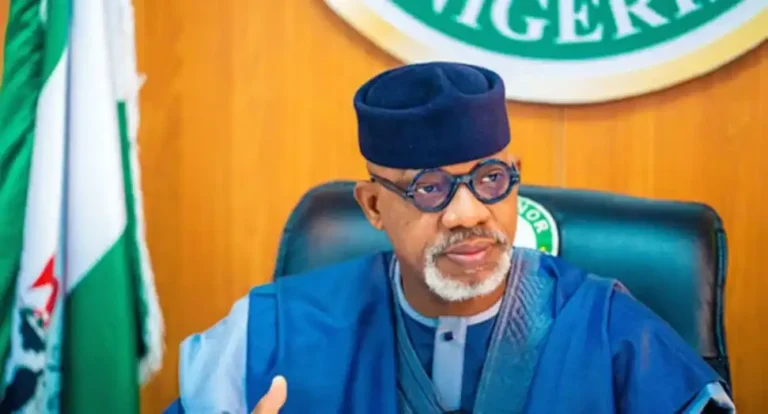
Governor Dapo Abiodun, CON, said the interventions were informed by Nigeria’s large supply gap in fish production. “Nigeria’s annual fish demand stands at about 3.6 million metric tons, while domestic production supplies only about 1.4 million metric tons, leaving a gap of over 2 million metric tons and resulting in an estimated $1.3 billion in foreign exchange outflow annually,” he said.

According to the governor, the state recognises the economic opportunity within the sector, alongside key challenges. He said these include limited access to finance, high production costs, and inadequate infrastructure, which have continued to constrain fish farmers nationwide.

Abiodun explained that under his administration, OGSTEP has served as a major driver of aquaculture reforms in Ogun State. “Under our farmer-friendly administration, and with OGSTEP as a key catalyst, we have taken deliberate steps over the past two years to strengthen aquaculture and support our fish farmers across Ogun State,” he said.

As part of these steps, the government subsidised 195,436 bags of fish feed at 30 per cent, at a cost of over ₦2.7 billion, to ease the burden of rising input costs. The governor said the intervention was designed to directly reduce production expenses and improve farmers’ profit margins.

The state has also established five fish clusters located in Eriwe, Ikangba/Agoro, Ikenne, Ado-Odo, and Ilashe. The clusters are equipped with shared infrastructure aimed at reducing post-harvest losses and improving market access.

“These facilities include cold rooms, blast freezers, smoking kilns, and processing plants,” Abiodun said, adding that the Eriwe Fish Cluster alone serves about 600 farmers. He noted that the site features a near-completed processing plant, lock-up shops and offices, a 5-ton solar-powered blast freezer, a 10-ton cold room, weighing scales, water tanks, and waste-processing systems.

The governor said the five clusters collectively serve 4,362 farmers and were designed to improve product quality, support value addition, and strengthen the aquaculture value chain.

He said the overall goal of the interventions is to reduce fish imports, create jobs, and sustainably improve farmers’ livelihoods. “Through these targeted interventions, we are working to reduce production costs, cut fish imports, minimise post-harvest losses, create jobs, and build a resilient and self-sufficient agricultural economy for Ogun State,” he said across the state.

Read also: Katsina households to receive 3,750 homes, ₦200,000 monthly farm income

AGFUND Opens 2025 Prince Talal Human Development Prize with $1m Grant

0

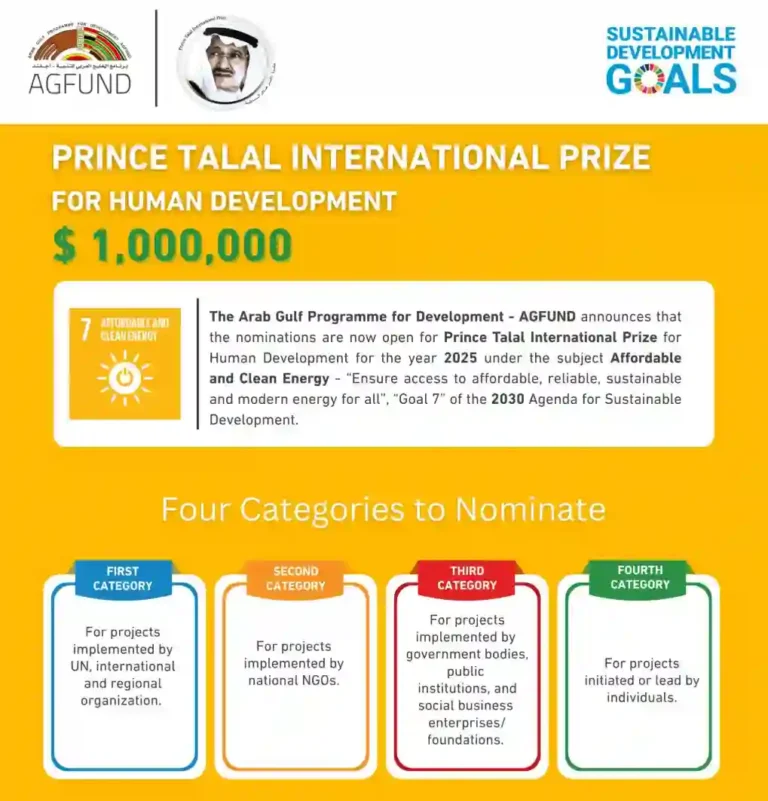
The Arab Gulf Programme for Development (AGFUND) has announced that nominations are now open for the Prince Talal International Prize for Human Development for the year 2025. The focus of the 2025 prize is Affordable and Clean Energy, aligned with Goal 7 of the 2030 Agenda for Sustainable Development, which seeks to ensure access to affordable, reliable, sustainable, and modern energy for all. The prize is designed to recognise impactful projects and initiatives that contribute meaningfully to human development through sustainable energy solutions.

About the Prize

The Prince Talal International Prize for Human Development carries a total financial reward of US$1,000,000 and is awarded annually by Arab Gulf Programme for Development (AGFUND). The prize aims to encourage innovation, creativity, and effective practices in human development by supporting projects that demonstrate measurable social impact.

The idea behind the prize stems from AGFUND’s long-standing approach to strengthening development performance and supporting key initiatives that promote sustainability and investment in people. Since its establishment in 1999, the award was originally known as the AGFUND International Prize for Pioneering Human Development Projects.

Following the passing of Prince Talal bin Abdul Aziz Al Saud, founder of AGFUND, in December 2018, the Board of Directors of AGFUND resolved to rename the prize in his honour. This change was made to commemorate his lifelong commitment to human development and poverty alleviation through AGFUND and other institutions he established. The award is now officially known as the Prince Talal International Prize for Human Development.

Prize Objectives

The Prince Talal International Prize for Human Development aims to achieve the following objectives:

  • Support outstanding efforts that promote and strengthen human development concepts.
  • Disseminate successful project experiences that can be replicated or scaled.
  • Highlight best practices that improve the living conditions of poor and disadvantaged populations, with particular focus on women and children.
  • Encourage the exchange of experiences and develop effective mechanisms to address poverty, marginalisation, and socioeconomic exclusion affecting vulnerable groups.

Prize and Categories

The Prince Talal International Prize for Human Development includes cash awards totalling US$1,000,000, along with certificates of recognition and trophies. The prize is distributed across four categories as follows:

  • First Category – US$400,000
    For projects implemented by United Nations agencies or international and regional non-governmental organisations.
  • Second Category – US$300,000
    For projects implemented by national non-governmental organisations.
  • Third Category – US$200,000
    For projects implemented by governmental bodies, including ministries and public institutions, or by social business enterprises.
  • Fourth Category – US$100,000
    For projects initiated, funded, and/or implemented by individuals.

How to Nominate

Nominations are invited for the 2025 prize under the theme Affordable and Clean Energy, reflecting Sustainable Development Goal 7. Eligible applicants are encouraged to submit projects that demonstrate innovation, sustainability, and positive human development outcomes.

THE DEADLINE FOR RECEIVING NOMINATIONS IS 30 JANUARY 2026

Link to Apply: APPLY HERE

Read also: World Bank approves $50m solar agriculture project for Nigeria, others

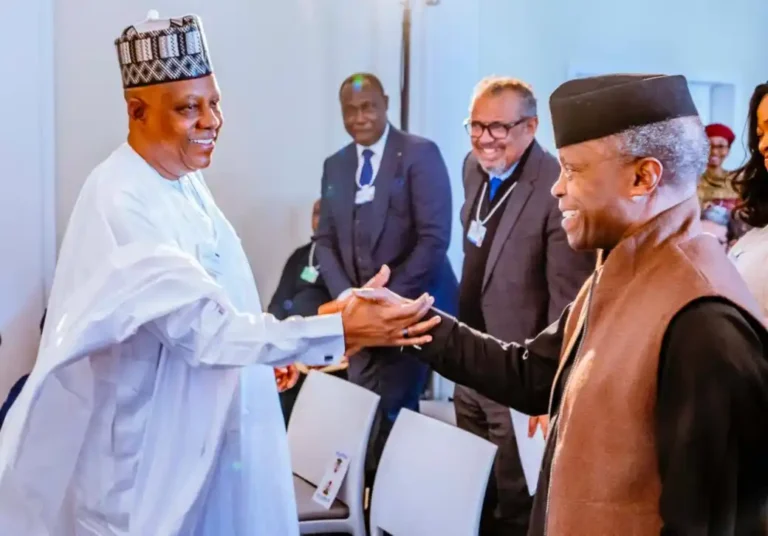
WEF 2026: Shettima urges Africa to build prosperity through local production

The Vice President, Senator Kashim Shettima, has called for homegrown solutions to Africa’s economic challenges, stressing that sustainable growth, development and prosperity on the continent must be driven by African innovation, production and policy choices rather than external dependence.

He said African nations could only turn their population strength and natural talents into lasting wealth by deliberately building domestic productive capacity, adding that prosperity cannot be delivered from outside but must be created internally through investment, skills and industry.

The Vice President made the remarks on Thursday at the High-level Accra Reset Initiative meeting, which was held on the margins of the ongoing 2026 World Economic Forum (WEF) Annual Meeting in Davos, Switzerland. He told participants that Africa was no longer on the margins of global affairs but had become central to the world’s demographic and economic future.

Using Nigeria as an example, Shettima pointed to the Dangote Refinery, which he said was gradually transforming the country into a major exporter of refined fuel. According to him, the project shows what is possible when African capital aligns with industrial ambition and supportive policy frameworks.

He said, “Africa cannot rise on applause alone. We rise when we build. After decades as a net importer of value, Nigeria is on the verge of becoming a net exporter of refined fuel, powered by Africa’s largest refinery in Lagos, Nigeria: the Dangote Refinery.

“This is what happens when African capital meets industrial ambition. This implies that nations move from price takers to value makers when production is matched with infrastructure and policy clarity. Even as manufacturing’s share of Africa’s GDP fell from 16 percent in 1980 to under 10 percent by 2016, we chose not to retreat but to leapfrog.”

The Vice President said Africa has an opportunity to industrialise faster in the twenty first century by embracing new technologies and flexible production models. He highlighted the advantages of modular factories, artificial intelligence and robotics, noting that these tools reduce entry barriers and shorten production cycles.

According to him, the era when Africa was known mainly for what it extracted from the ground or harvested from farms was gradually giving way to a new phase in which the continent would be recognised for what it builds and manufactures.

Shettima also spoke on the importance of human mobility and skills circulation, arguing that people, rather than raw materials alone, are the true drivers of prosperity in a modern economy. He said Africa’s future depended on allowing skills to travel, return and multiply across borders.

He recalled that “in 2024 alone, Africans abroad sent home about 95 billion dollars, more than 5 percent of our GDP and roughly equal to total foreign direct investment.” According to him, the scale of remittances shows the economic value of the African diaspora and the need to better integrate talent flows into development strategies.

He added, “That is not charity. This is why we are also championing free movement across Africa because mobility is a competitive advantage in a world where human capital is the most precious resource. Let skills and ideas flow as freely as goods and capital, and prosperity will follow.”

Drawing further from Nigeria’s experience, the Vice President said the country had learned a simple but critical lesson that prosperity is built, not imported. He described this as the prosperity paradox, where markets and talent may exist but resilience remains weak until demand is translated into domestic capability.

He explained that domestic capability means firms that can produce at scale, meet standards and compete globally. According to him, wealth that comes from outside is often fragile, while wealth created from within is more durable and sustainable over time.

Shettima said, “Nigeria’s own market of over 200 million people has taught us that latent demand means little unless we cultivate local supply. Only by building domestic productive capacity can we convert our population and natural endowments into real, resilient wealth. Prosperity cannot be parachuted in – it must be homegrown and earned.”

The Vice President welcomed the vision behind the Accra Reset Initiative, describing it as a bold attempt to rethink Africa’s shared future through African-led cooperation. He said the initiative was rooted in sovereignty, self-definition and collective responsibility.

On Nigeria’s contribution to the Accra Reset discussions, Shettima said the country was advancing health-industrial capability as part of its broader economic transformation agenda. He explained that Nigeria had begun to treat health security not just as a social obligation but as an industrial value chain.

According to him, this approach covers manufacturing, diagnostics, logistics, standards and procurement, and aims to reduce dependence on imported medical products while strengthening local systems.

He said, “Through the Presidential Initiative for Unlocking the Healthcare Value Chain (PUHVAC), inaugurated in October 2023, we are coordinating reforms and investment to expand local production and strengthen quality systems. This approach resonates with a broader African aspiration: building our own vaccine and medicine capacity to secure what I call health sovereignty.”

The Vice President described the Accra Reset Initiative as both a call to action and a call to reset the mindset of African countries. He said it was about shifting “from dependency to dignity, from aid to investment, from rhetoric to results.”

He expressed confidence that if African leaders respond decisively, the continent would experience a boom anchored on innovation, industry and interdependence rather than vulnerability to commodity price cycles.

Earlier, President John Mahama of Ghana praised the participation of Vice President Shettima and other leaders at the forum but criticised the current nature of Africa’s relationship with the global north. He said many bilateral engagements had become transactional and had failed to support Africa’s genuine transformation.

Mahama noted that many state and non-state actors pursue narrow national interests, leaving Africa trapped in cycles of conflict and multidimensional poverty and dependent on handouts and humanitarian assistance.

He said the Accra Reset Initiative, which was introduced at the last United Nations General Assembly in New York, was not another declaration or wish list but a practical response to questions young Africans are asking about the continent’s future in a changing global order.

Calling for stronger synergy among African leaders, Mahama said, “Though no specific name has been coined for the new global system that will emerge, Africa intends to be at the table in determining what that new global order will look like.”

Former President of Nigeria, Chief Olusegun Obasanjo, also spoke at the forum, focusing on what Africa must do to secure its place in the international system amid disruption, uncertainty and unpredictability.

He warned that as global supply chains are being reorganised and security and economics increasingly intertwined, countries that are not organised for negotiation and execution risk becoming bargaining chips rather than partners.

Obasanjo said, “The Accra Reset Initiative has come to inspire leaders to stop complaining about the system that has changed or is changing, and to build a way through it.”

On the issue of value addition and technology, he stressed that sovereignty goes beyond symbolism. According to him, sovereignty is about discipline, coordination and the ability to make and implement difficult choices at scale.

He said, “Sovereignty is also the ability to negotiate firmly, coordinate regionally, mobilise capital, incentivises, resources, and implement at a scale that will lead to sustainable development. If you cannot coordinate, you will be divided.”

In the same vein, former Vice President of Nigeria, Prof. Yemi Osinbajo, said the forum was designed to mobilise support for African governments to rethink economic strategies and confront the many challenges facing their citizens.

Read Also: EU allocates €557m Aid to Africa, North-West Nigeria included

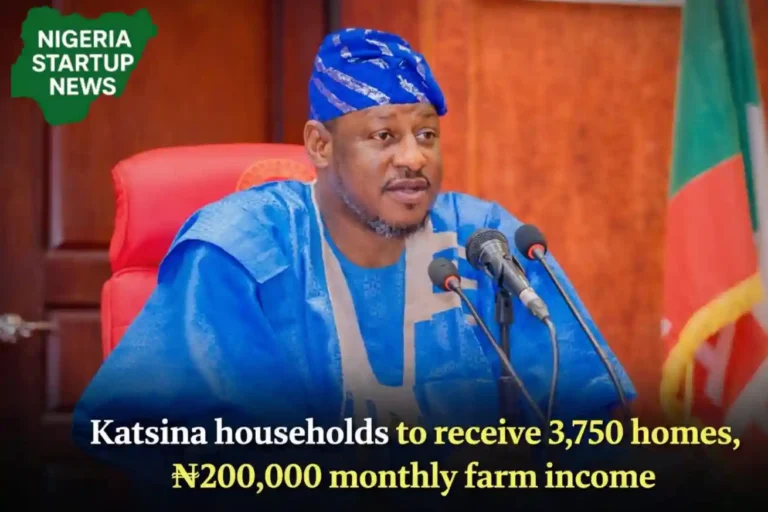
Katsina households to receive 3,750 homes, ₦200,000 monthly farm income

Each beneficiary household in Katsina State is set to receive a fully completed and furnished house, training in modern farming techniques, digital farm monitoring and access to international markets for their produce, with expected monthly earnings of up to ₦200,000, following a new agro-residential housing initiative by the state government.

Katsina State Governor, Malam Dikko Umaru Radda, made this known on Wednesday during the signing of a Memorandum of Understanding between the Katsina State Government and COSMOS Residential City Nigeria Limited, describing the agreement as a major milestone in the state’s push for mass housing delivery, food security, youth employment and inclusive economic development.

The governor said the partnership would deliver 3,750 housing units across Kankia and Radda Local Government Areas, with 2,500 units located in Kankia and 1,250 units in Radda, under an innovative agro-residential model valued at about ₦155 billion.

“This agreement is the product of careful planning, due diligence and mutual trust. We are determined to ensure that every obligation entered into by the Katsina State Government is fully honoured so that this partnership will stand the test of time and deliver real value to our people,” Radda said.

He explained that the project, which will be executed within a period of 16 months to two years, is designed to combine modern housing with backyard fish farming and vegetable gardens in every home, creating sustainable livelihoods for beneficiaries while boosting food production for local consumption and export.

According to the governor, the state government has already allocated land for the project in both Kankia and Radda and will also identify unemployed youths and low-income households as beneficiaries. He noted that the selection will include people without formal Western education but with practical farming and vocational skills.

“This programme is designed to empower our youths and small families. Each beneficiary household will receive a fully completed and furnished house, training in modern farming techniques, digital farm monitoring and access to international markets for their produce,” Radda said.

He added that beneficiaries are expected to earn up to ₦200,000 monthly from their farming activities, with a compulsory savings component of between ₦50,000 and ₦70,000. According to him, the savings will be used to gradually offset investors’ costs, after which the houses and farms will become the personal property of the beneficiaries within a period of three to five years.

The governor also disclosed that the project site has already been handed over to COSMOS Residential City Nigeria Limited, while the company has pledged to fully mobilise to site within 10 days for the immediate commencement of construction works.

Earlier, the Head of Service, Alhaji Falalu Bawale, said the initiative would deliver 3,750 agro-housing units with strong emphasis on youth empowerment, skills acquisition, food security and community development across the benefiting local government areas.

Also speaking at the ceremony, the Managing Director of COSMOS Residential City Nigeria Limited, Murtala Sani Ibrahim, said the project is being implemented in partnership with SuperEye USA Corporation. He assured that local contractors, artisans and suppliers in Kankia and Radda would be given first consideration during project execution.

Ibrahim added that the agro-residential scheme would be expanded to Katsina, Daura and Funtua in the second phase and called for the support and cooperation of all stakeholders to ensure successful implementation.

The ceremony was attended by the Chief of Staff to the Governor, Alhaji Abdulkadir Mamman Nasir; the Commissioner for Justice, Barrister Fadila Mohammed Dikko; the Managing Director of Housing Authority Katsina, Dr. Aliyu Rabi’u Kurfi; the Executive Secretary of KTDMB, Dr. Mustapha Shehu; the General Manager of KASAMA, Dr. Aminu; two Permanent Secretaries from the Government House, as well as members of the management team of COSMOS Residential City Nigeria Limited.

Read Also: World Bank approves $50m solar agriculture project for Nigeria, others