Home Blog Page 163

Edo Govt Employs Over 8,000 in One Year

The Edo State Head of Service (HOS), Dr Anthony Okungbowa, has revealed that over 8,000 civil and public servants have been employed within one year under the administration of Governor Monday Okpebholo.

He described the development as unprecedented and said it reflects a people-focused leadership approach by the current government.

Okungbowa made the disclosure while commending the governor for what he described as practical and inclusive governance that has directly improved the welfare of workers across the state.

According to him, since Governor Okpebholo was sworn in on November 12, 2024, Edo State has experienced visible changes across sectors through the steady implementation of the SHINE Agenda, with projects and reforms spread across all 18 local government areas.

The Head of Service said the civil and public service has recorded some of the most notable gains under the administration.

“Mr Governor has had a lot of achievements across various sectors in the State, but that of the civil and public service has been outstanding and phenomenal,” he said.

He added, “This administration came on board and hit the ground running and was in a hurry to bring development to the State and improve the lives of the people, especially civil and public servants.”

Okungbowa explained that one of the early policy steps taken by the governor was to strengthen the civil service by ensuring that core government responsibilities are handled by career officers rather than external consultants.

He said, “From November 12, he began to work very hard to raise the stake, insisting that the work of the civil and public servants must be done by them and not by consultants.”

He noted that workers’ welfare has remained a key priority, with the administration ensuring regular payment of salaries, payment of 13th-month salaries and the implementation of a new minimum wage.

“The Governor pays salaries regularly and embraces pragmatic governance. He increased the minimum wage on May 1, 2025, without any pressure from Edo workers,” Okungbowa stated.

The Head of Service also disclosed that the governor ended the outsourcing of cleaners and directed that funds previously paid to consultants be used to employ workers directly.

“Cleaners were outsourced and managed by consultants, but he insisted that the money used to outsource them was enough to employ 1,000 cleaners into the service, and he gave instructions to that effect,” he said.

“Today, they are employed on a full-time basis on the new minimum wage of ₦75,000, as against ₦18,000 to ₦25,000, and their jobs are now guaranteed.”

According to Okungbowa, the administration has also carried out large-scale recruitment across critical sectors of the state economy.

“In the health sector, we have employed over 2,000 workers. In the teaching sector, over 6,000 have been brought into the service,” he said.

He added that when combined with recruitments across ministries, departments and agencies, the total number of jobs created stands at over 8,000 within one year.

“I don’t think any government has done that in Edo State,” he added.

Okungbowa further noted that staff welfare continues to receive sustained attention under the current administration.

Read Also: Sokoto State Releases List of Selected Recruitment Candidates

Advertisement

UNICEF urges tailors to recycle textile waste into wealth

The Water Sanitation and Hygiene (WASH) Coordinator under the United Nations Children Fund (UNICEF) project, Mr. Williams Wakili, has urged tailors to recycle textile waste generated in their shops as a way of creating wealth and improving sanitation.

Wakili made the call on Friday during a WASH cleanup day campaign organised for the tailors’ association in Ganye Local Government Area of Adamawa State. He encouraged tailors to make better use of waste materials from clothes they sew, rather than discarding or burning them, while keeping their work environment clean.

“What we are trying to do is to begin to encourage tailors to reuse some of these materials, recycle them for better uses,” Wakili said.

“We have seen other people, who produce doorstep carpet and some put it together to make multiple color clothes and dusters among others,” he added.

He explained that recycling textile waste would help reduce dump sites in the community and support healthier living.

Also speaking, Mr. Jared Gangkuba, the WASH Coordinator in Ganye, said the campaign was important for the local government area and Adamawa State. He noted that waste generated from textiles has become a growing concern.

According to Gangkuba, the sensitisation campaign would help tackle challenges linked to waste management by promoting simple recycling practices among tailors and residents.

He called on community leaders and members of the tailors’ association to take advantage of the campaign, explore opportunities from recycling, and improve sanitation.

One of the participants, Faruk Audu, a tailor, commended the organisers for the sensitisation programme and promised to apply what he learned and share the knowledge with colleagues.

Audu recalled that before the training, many tailors burned waste materials instead of recycling them. He said the campaign had shown them ways to reuse waste, including making pillows, mats, moppers and items.

Gloria Ojojonah, a member of the National Youth Service Corps (NYSC), expressed optimism that campaigns would improve community waste management.

The campaign was organised by the Adamawa State Rural Water Sanitation and Hygiene Supply Agency, with support from UNICEF and funding from the Netherlands. The event also featured a sanitation exercise involving NYSC corps members and community residents.

Read Also: Aid cuts push 1.2 million in Northeast Nigeria into Hunger: WFP

Yabatech, Foundation Train Students in Job-Ready HVAC Skills

0

Yaba College of Technology has entered into a new industry partnership with the John Basil Mandilas Foundation to equip students with practical, job-ready technical skills, as concerns continue to grow over the employability gap facing many Nigerian graduates.

The collaboration was formalised through a memorandum of understanding between both parties and will deliver hands-on technical training to students through the newly launched Mandilas Academy. The academy is a no-cost skills development initiative designed to bridge the gap between academic learning and real-world industry practice, especially in technical and vocational fields where experience is increasingly valued.

The initiative reflects a growing recognition within Nigeria’s education and labour sectors that traditional qualifications alone are no longer enough in a labour market driven by demonstrable and measurable skills. Employers across multiple industries are placing greater emphasis on what graduates can practically do rather than the certificates they hold.

The first phase of the programme will focus on training students in heating, ventilation, and air conditioning, commonly known as HVAC. This skill area is seeing rising demand across Nigeria’s construction, manufacturing, and energy sectors, driven by urban development, industrial expansion, and the need for efficient cooling systems.

Under the arrangement, a total of 75 students will be trained in phases, starting with an initial cohort of 25 students who have already been selected through an interview process. Participants will undergo one month of intensive classroom-based instruction at Yabatech, followed by two months of industry attachment. The attachment phase will allow students to apply their technical knowledge in real work environments under professional supervision.

The structure of the programme aligns with Yabatech’s broader strategy of strengthening graduate employability by embedding practical skills into academic pathways. With a student population of over 36,000 enrolled across about 90 academic programmes, the institution has increasingly relied on industry partnerships to ensure its graduates are prepared for evolving workplace expectations.

According to Ibraheem Adedotun Abdul, Rector of Yaba College of Technology, the labour market has shifted away from paper qualifications toward proven ability.

“In today’s market, it is not about the certificates you carry, but about what you can do,” he said, explaining that the institution is prioritising field readiness and practical competence over theoretical knowledge alone.

Beyond technical instruction, the Mandilas Academy is structured to expose trainees to industry standards, modern tools, and current technologies within the HVAC space. The programme also integrates themes such as energy efficiency, sustainable cooling solutions, and environmentally responsible practices, reflecting global shifts toward greener engineering and infrastructure systems.

From the industry perspective, the Mandilas Group is positioning the academy as part of a longer-term investment in Nigeria’s technical workforce. Delivered through the John Basil Mandilas Foundation and overseen by Mandilas Trust Company Limited, the initiative forms part of the group’s legacy projects as it marks its 75th anniversary in Nigeria’s engineering services sector.

According to Ola Ayo-Adeloye, executive vice chairman of Mandilas Trust Company Limited, the academy is designed to complement academic instruction with hands-on exposure that better prepares students for the realities of the workplace.

“Education, when aligned with practical application, becomes one of the most powerful drivers of national development,” she said, adding that collaboration between industry and academia is essential for building future-ready talent.

Yabatech also plans to support the academy by aligning its curriculum with the requirements of the National Board for Technical Education and Nigeria’s National Skills Qualification Framework. This alignment would enable participants to earn certifications that assess practical competence rather than purely academic knowledge.

Such certifications are increasingly valued by employers both within Nigeria and internationally, particularly in technical and vocational fields where performance, safety, and compliance standards are critical.

According to Mosud Ajala, director of Yabatech’s Centre for Linkages and Partnership, this approach reflects a broader shift toward skills validation that improves labour mobility and employability.

“What the market now demands are competencies that can be tested and verified,” Ajala said. “Even a narrowly defined technical skill, if properly assessed, can significantly improve a graduate’s chances in the job market.”

The programme also incorporates elements of workplace ethics, attitude, and life skills, recognising that employability extends beyond technical know-how. In recent years, Yabatech has introduced courses focused on 21st-century skills to address gaps in communication, professionalism, and adaptability among graduates.

Welcoming the collaboration, Henrietta Adebola Badejo, registrar of Yaba College of Technology, described the partnership as a mutually beneficial model that supports both student development and industry needs.

“This is designed to be a symbiotic relationship,” she said, noting that the institution remains committed to supporting partners through curriculum development and technical expertise.

While the current phase focuses on HVAC training, both parties indicated that the programme could expand into mechanical, electrical, and other technical disciplines depending on outcomes. If successful, the initiative could provide a practical template for embedding industry-led training within Nigeria’s tertiary institutions to address persistent skills mismatches across sectors.

Read Also: Apply: Smedan Product Export Training For Business Owners

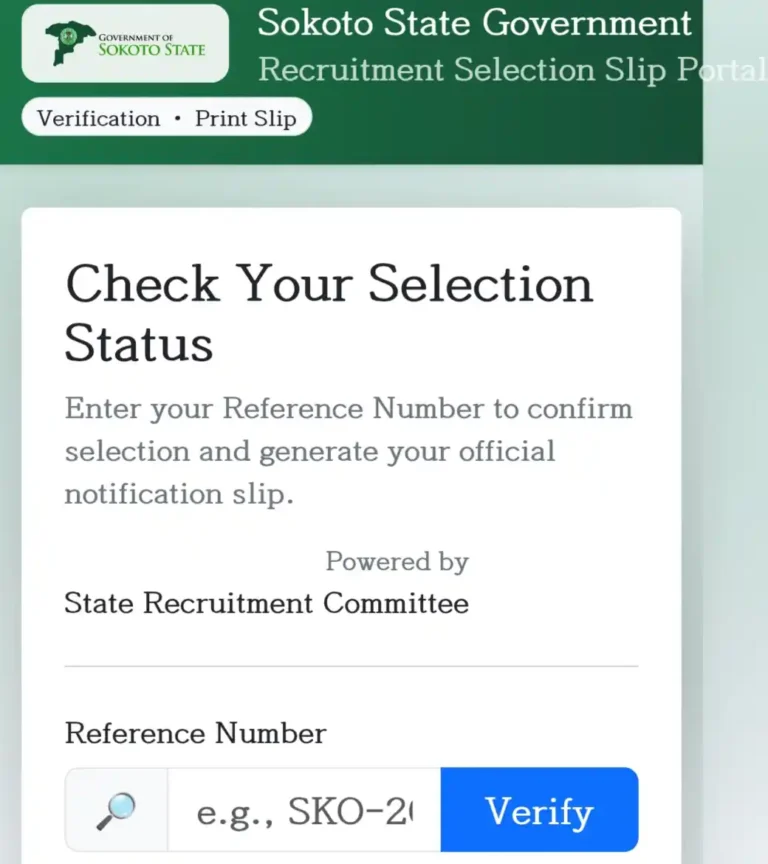
Sokoto State Releases List of Selected Recruitment Candidates

The Sokoto State Government has released the list of selected candidates following the recent interview. Candidates who attended the interview are advised to check their Sokoto recruitment status and print their selection forms.

The Committee has released the first batch of 1,000 successful applicants who met all the eligibility requirements.

Successful candidates are required to log in to the recruitment portal through which they applied and print their notification slips.

The printed slip should be presented at the Office of the State Head of Service, Usman Faruku Secretariat, along with: • Original credentials
• Generated slip

This serves as evidence of notification and invitation for the collection of appointment letters.

How to Check

To check your Sokoto selection status, visit the portal at https://employment.sokotostate.gov.ng and enter your Reference Number to confirm if your name has been selected.

Congratulations to all selected candidates!

Read Also: NHF Cohort 2.0 Begins Selection of Shortlisted Candidates

Apply: Theirworld Small Grants Programme 2026 for Nigerian Non-Profits

0

Theirworld is a global children’s charity committed to ending the global education crisis and unlocking the potential of the next generation. As part of this mission, the organisation has announced the opening of its Small Grants Programme for 2026. The programme is designed to provide targeted financial support to registered charities and non-profit organisations working to improve the lives of disadvantaged, vulnerable, and overlooked children and young people around the world, including in Nigeria.

The Small Grants Programme focuses on supporting practical, community-driven projects that can deliver measurable impact at the grassroots level. By providing flexible funding, Theirworld aims to help organisations strengthen existing interventions, pilot innovative ideas, and expand solutions that address key challenges facing young people globally.

Focus Areas

The Small Grants Programme supports projects that align with Theirworld’s core pillars. Eligible proposals must clearly fall under one or more of the following areas:

  • Education
    • Projects that promote access to quality education for children and young people
    • Initiatives that support early childhood development and learning readiness
    • Programmes aimed at improving learning outcomes in underserved communities
  • Health
    • Initiatives that improve the physical health of children and adolescents
    • Projects addressing mental health, emotional well-being, and psychosocial support
    • Community-based health interventions that directly benefit young people
  • Skills for the Future
    • Programmes that equip young people with digital, vocational, or technical skills
    • Initiatives focused on employability, entrepreneurship, and leadership development
    • Projects that prepare youth for future work and changing economic realities

Grant Information

Successful organisations under the Small Grants Programme will receive funding ranging from USD 1,000 to USD 10,000. These grants are intended to support:

  • The scaling of existing projects with proven community impact
  • Pilot programmes testing new approaches to education, health, or skills development
  • Grassroots initiatives that require flexible funding to meet urgent needs

The funding is designed to be catalytic, helping organisations strengthen delivery, reach more beneficiaries, and demonstrate results that can attract further support.

Eligibility and Participation

This call for proposals is open to legally registered non-profit organisations and charities operating globally. Organisations based in Nigeria are eligible to apply, provided they meet the programme requirements. Applicants are expected to demonstrate:

  • Legal registration as a charity or non-profit organisation
  • A strong understanding of the local community they serve
  • Proven experience working with disadvantaged or marginalised children and youth
  • A clear plan for how the grant will be used to achieve measurable impact

Projects must align clearly with at least one of the programme’s focus areas, and proposals should show how outcomes will be monitored and reported.

How to Apply

Interested organisations are advised to visit the official Theirworld website to review the full eligibility criteria and application guidelines before applying. All proposals must be submitted in English, and applicants should ensure that their organisational goals and proposed activities align strictly with the programme’s objectives.

Applications for the 2026 Small Grants Programme close on 16 February 2026.

Link to Apply: APPLY HERE

Read Also: Canada, Germany to fund 5,000 women-led businesses in Nigeria

FG Bans Sand Mining Near River Niger to Protect Niger Bridges

0

The Federal Government has announced a ban on sand mining within a 10-kilometre radius of the River Niger to safeguard the structural integrity of the First and Second Niger Bridges, which are critical transport assets.

The Minister of Works, David Umahi, disclosed this on Friday in Asaba during the commissioning of the Second Niger Bridge Closed-Circuit Television (CCTV) Cameras Monitoring Centre. He said the decision was approved by the Federal Executive Council as part of efforts to protect key federal infrastructure nationwide.

Umahi explained that the restriction was necessary to prevent environmental degradation that could pose risks to the stability of the bridges. He directed the Delta State Police Command to enforce the ban and arrest offenders involved in illegal sand mining within the prohibited area.

The minister also clarified that tolling on the Second Niger Bridge will not commence until all access and bypass roads on the Anambra and Delta sections are completed. He noted that although the tollgate is ready, the government will ensure smooth connectivity before introducing toll charges.

He added that the CCTV monitoring centre will enhance security along the federal highway. According to him, there will be no security checkpoints on the bridge, as security agencies will monitor activities remotely and respond to emergencies within five minutes.

In his remarks, the Asagba of Asaba, Prof. Epiphany Azinge, commended the Federal Government for completing the Second Niger Bridge and highlighted its socio-economic benefits.

Also speaking, the Chairman of the Anambra State Council of Traditional Rulers, the Igwe of Obosi, Chidubem Iweka, said the bridge has reduced congestion on the first Niger Bridge and improved traffic flow during the Yuletide. He expressed confidence that the security cameras would boost commuter safety and called for speedy completion of access roads. The project remains vital to regional mobility.

FG urges young Nigerians to use AI to solve socio-economic challenges

The Federal Government has urged young Nigerian innovators to take advantage of Artificial Intelligence, AI, in tackling the country’s socio-economic challenges, saying the technology presents fresh opportunities for growth, innovation and job creation.

The Minister of Communications, Innovation and Digital Economy, Bosun Tijani, made the call while speaking with journalists after delivering the Distinguished Personality Lecture Series at Obafemi Awolowo University, Ile-Ife.

Speaking on the theme, “ICT and Employment Generation: Strategies for Economic Growth,” Tijani encouraged tech-savvy Nigerians to change how they view the country’s challenges, urging them to focus more on the opportunities that technology and innovation can unlock.

He said young people must make deliberate efforts to understand how AI works and apply its potential to national development, adding that the future of Nigeria depends on innovators who are ready to build solutions to real problems.

“To young innovators: we live at a time that is totally different. Of course, there is so much more that we all desire for our society. We should switch our framing from a society that is filled with challenges to one that is filled with opportunities to build, because the future we require in Nigeria will require many people building new things,” Tijani said.

The minister explained that his message was shaped by personal experience, noting that he had taken similar steps earlier in his career by supporting innovation and entrepreneurship.

“I am not saying this only as a Minister, but as someone who took the same position. I worked with someone from this university to build the first known innovation hub in Nigeria. Today, it is known across Africa. We supported many people to build solutions to problems in Nigeria, and that is what every young Nigerian should be doing,” he added.

Tijani described AI as a critical tool for speeding up economic growth and improving productivity, stressing that the technology is meant to support human thinking rather than replace it.

“Artificial Intelligence is not about replacing critical thinking; it is about helping humans sieve through the multiple streams of information you have to deal with. The ability to use AI productively will still require you to apply your creative confidence. If you don’t have the ability to apply the knowledge or insight that AI gives you, it will not do the work for you,” he said.

According to the minister, countries like Nigeria, where productivity remains a major focus, can benefit significantly from AI by applying knowledge more efficiently and at a faster pace.

“For a country like Nigeria, where productivity is high on our agenda, AI is there to help us accelerate the growth of how we apply knowledge much faster,” Tijani said.

He also said the Federal Government would continue to work closely with institutions such as OAU that place strong emphasis on research, innovation and idea generation, noting that such partnerships are central to President Bola Tinubu’s Renewed Hope agenda.

“Technology gives you the ability to do what you have always been doing in better ways, and that would not be possible without new thinking, ideas, and technology,” the minister said.

He added that universities play a key role not only in generating new scientific knowledge but also in ensuring that such knowledge is applied to solve practical problems.

“Institutions like this help us not just to come up with new science, but also to apply that science and train people to do things better. If we want to improve agriculture, for example, we need people who understand how to use new technology,” Tijani said.

He said the quality and volume of ideas coming from OAU showed that the institution was focused on research and innovation, which informed the government’s decision to strengthen collaboration with the university.

Earlier, the Vice-Chancellor of OAU, Prof. Adebayo Simeon Bamire, said the minister’s visit demonstrated his ministry’s commitment to deeper collaboration with tertiary institutions in building a digitally empowered and innovation-driven nation.

Bamire also commended Tijani for the approval and establishment of the OAU Centre of Excellence in Telecommunications, granted in July 2023 by the Nigerian Communications Commission.

“The approval for the establishment of this centre in 2023 was warmly received by our university community, as it aligns perfectly with our strategic vision to be a leading hub for innovation, research and development in Information and Communication Technology in Nigeria and Africa at large,” the vice-chancellor said.

Read Also: Apply: NDPC Data Privacy Ambassadorship Program

SpendEase launches cross-border payments app across 4 African countries

0

, a new digital payments platform, has entered the African financial technology market, targeting cross-border transactions among Nigeria, Ghana, Kenya and South Africa.

The company announced that its mySpendEase application is now available on Google Play and Apple App Store after months of beta testing. It said the platform allows users to make and receive payments across participating African countries using local currencies.

According to the company, the service is designed for travellers, freelancers and business owners who regularly transact across borders. It aims to solve challenges linked to currency conversion, settlement delays and high transaction costs tied to cross-border payments within Africa.

“Our mission is simple: to make cross-border payments easy, affordable, and accessible for everyone,” the company said.

SpendEase said users can send, spend and receive money across Ghana, Kenya, South Africa and Nigeria while accessing real-time exchange rates and clear transaction records. Other features include instant remittances, cross-border transfers within supported markets and a 24-hour AI-integrated customer support desk. Virtual card services and crypto-to-fiat options were listed as upcoming additions.

The company described itself as pan-African, saying the platform was built around everyday financial realities on the continent and focused on improving connectivity between African markets.

Announcing the launch, founder said the product was created to reduce friction when transacting outside one’s home country. “It’s time to stop worrying about how to transact in your local currency when you are outside your home country,” she said.

SpendEase joins a growing group of fintech firms expanding cross-border payment infrastructure in Africa, as trade, travel and digital services continue to increase across the continent. It said further country expansions would be announced as regulatory approvals and partnerships progress across additional African markets.

Read Also: Apply: Smedan Product Export Training For Business Owners

Apply: Smedan Product Export Training For Business Owners

The federal government through Small and Medium Enterprises Development Agency of Nigeria (SMEDAN) has opened applications for business owners to participate in its upcoming Product Export Seminar. The initiative is targeted at Nigerian entrepreneurs whose products have strong global demand but who face challenges understanding export processes, regulations, and market entry strategies.

The training is designed to bridge the knowledge gap that prevents many local businesses from competing effectively in international markets. The agency noted that while Nigeria produces exportable goods across different sectors, limited access to practical export knowledge remains a major barrier for many SMEs.

About Seminar

Are you ready to take your business beyond borders?

SMEDAN is hosting this free online session to help entrepreneurs, SMEs, youth, women, and relevant stakeholders understand how to access international markets and grow their businesses sustainably. The webinar is designed for business owners who are serious about expanding beyond the Nigerian market and positioning their products for global trade.

The training will take place under the theme Ready to Trade: Unlocking Export Opportunities and will be delivered as an online webinar scheduled for January 21, 2026

Benefits

Participants will gain practical and business-focused insights, including:

  • Understanding export readiness and how to assess if a product is export-ready
  • Guidance on export documentation and compliance requirements
  • Insights into accessing trade finance and export funding opportunities
  • Knowledge of international market entry strategies
  • Risk management and pricing considerations for export business
  • Tips on meeting international quality and packaging standards

Who is Eligible

The session is open to:

  • Entrepreneurs and business owners
  • Small and medium-scale enterprises
  • Youth-led businesses
  • Women-owned enterprises
  • Stakeholders interested in export and international trade

Date

21st January 2026

How to Apply

Interested business owners can register online by clicking the application link and completing the registration form provided by SMEDAN. Early registration is encouraged as participation is open to businesses across Nigeria.

Link to apply: APPLY HERE

Senator Empowers 1,000+ Lagos-West Residents

0

Senator Idiat Oluranti Adebule has empowered more than 1,000 residents of Lagos-West Senatorial District through her annual mega empowerment programme, reaffirming her focus on inclusion and economic support for constituents.

Speaking at the event held recently, Adebule said she derived “tremendous joy and satisfaction” from putting smiles on faces while renewing hope for shared prosperity. “This programme is an opportunity to engage with critical stakeholders, thank you for your support, and empower our youths and women,” she said.

She explained that the empowerment initiative aligns with President Bola Ahmed Tinubu’s renewed hope agenda, with emphasis on job creation and poverty alleviation. According to her, the programme is designed to equip people with skills and tools needed to earn income and build small businesses within their communities.

The senator highlighted her record since assuming office in June 2023, stating that she has sponsored 12 bills and co-sponsored six others in the 10th Senate. She added that legislative work has been supported by strong constituency interventions across Lagos-West.

These interventions include two primary healthcare centres in Ojo and Ifako-Ijaye, a multipurpose Youth Development Centre in Badagry, and more than a thousand solar streetlights installed across 42 streets. She also listed classroom blocks in four local government areas, six solar-powered boreholes, electricity transformers for seven communities, security training for traditional rulers, and support for physically challenged residents. “These projects will be completed soon, and our next focus will be on inner road construction to improve accessibility for our people,” she said.

Beneficiaries of the empowerment programme received training in six skills areas including ICT, hairdressing, catering and hospitality, barbing, tailoring, and cosmetology. Each participant was presented with equipment to help jump start businesses, alongside ₦200,000 cash as seed capital. Distributed items included small buses for commercial transport, sewing machines, laptops, hairdressing and catering kits, generators, and make-up kits.

In his welcome address, Rasaq Ajala, Director-General of the senator’s campaign office, described the programme as a “demonstration of purposeful leadership, people-centered representation, and genuine commitment to improving lives.” He urged beneficiaries to use the resources productively to become self-reliant and positively impact their communities.

Adebule thanked supporters including President Bola Ahmed Tinubu, Oluremi Tinubu, All Progressives Congress leaders in Lagos State, and Senator Solomon Olamilekan Adeola, while appreciating her team led by Ajala. She reaffirmed commitment to welfare, security, and prosperity, saying, “I remain passionate and motivated to mobilise resources for our people. Together with stakeholders and the grassroots, we can enhance living standards and create opportunities for all.” The event drew broad attendance from community leaders and beneficiaries present.

Read Also: Jerry Eze Foundation digital empowerment grant increased to $525,000