Home Blog Page 175

China, Africa to Host 600 People-to-People Exchange Activities in 2026

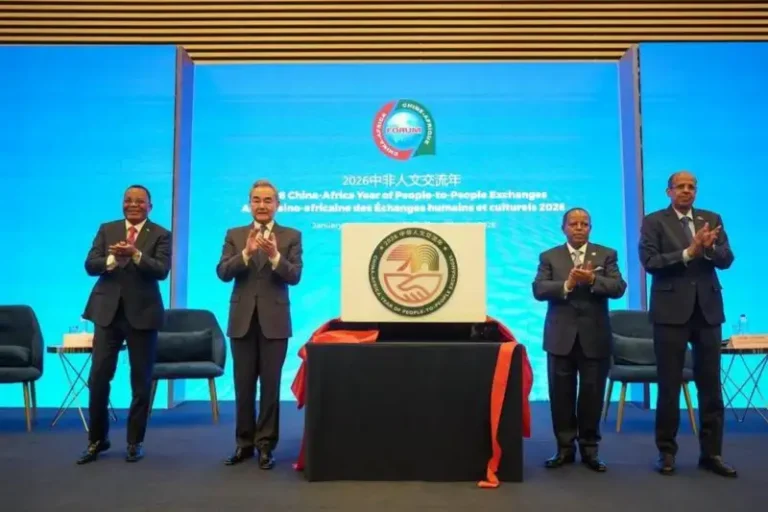
China and Africa are set to jointly host nearly 600 cultural and people-to-people exchange activities in 2026 aimed at strengthening ties between the two regions. The initiative seeks to promote deeper understanding, mutual learning, and stronger connections between the peoples of both sides, according to the Chinese Foreign Ministry spokesperson, Mao Ning.

Mao made the announcement during a regular news conference on Friday while giving details about the opening ceremony of the 2026 China-Africa Year of People-to-People Exchanges, which was held on Thursday at the African Union headquarters.

She explained that organizing the 2026 China-Africa Year of People-to-People Exchanges was an important decision made by leaders from both regions during the Forum on China-Africa Cooperation (FOCAC) Beijing Summit in 2024.

According to Mao, Chinese President Xi Jinping sent a congratulatory letter to the opening ceremony, calling on both sides to use the opportunity to strengthen traditional friendship and promote greater cooperation. “President Xi urged both sides to seize the year as an opportunity to carry forward traditional friendship, strengthen mutual learning among civilizations, expand people-to-people exchanges, especially among the youth, deepen exchanges of experience in governance, and jointly advance modernization,” she said.

Mao added that Chinese Foreign Minister Wang Yi attended the opening ceremony, commended achievements in China-Africa cultural exchanges, and jointly unveiled the official logo for the 2026 China-Africa Year of People-to-People Exchanges with African representatives.

Advertisement

YALD Project Launches Youth Agenda Data Collection

The Youth Action for Local Development (YALD) Project has commenced a major youth-focused data collection exercise in Katsina State, aimed at strengthening youth participation in local governance and development planning. The initiative is spearheaded by LEAP Africa with funding support from the Ford Foundation and the MacArthur Foundation.

According to LEAP Africa, the YALD Project is designed to empower young Nigerians by ensuring their voices and perspectives are fully integrated into decision-making processes at the grassroots level. The organisation said its core belief is that sustainable development can only be achieved when the priorities and needs of young people are clearly identified and addressed through evidence-based planning.

“This project aims to create a robust data repository that will inform policy, drive resource allocation, and foster youth-led solutions at the grassroots level,” LEAP Africa said. It added that the data gathered will help stakeholders better understand the realities facing young people across different communities.

As part of the initiative, LEAP Africa has launched a Youth Agenda Data Collection exercise covering all 34 Local Government Areas of Katsina State. The organisation described the exercise as more than a survey, noting that it is an opportunity for young people to directly influence the development direction of their local government areas.

“Your input is invaluable as it will provide empirical data on the specific priority needs, challenges, and opportunities that are most relevant to young people in your local government area,” the statement said. It explained that the information collected will serve as a foundation for designing targeted interventions, advocating for youth-friendly policies, and mobilising resources for impactful development projects.

The organisation encouraged all young people living in any of the 34 LGAs of Katsina State to take part in the exercise. It said students, entrepreneurs, community leaders, activists, and other engaged citizens are all expected to participate, stressing that every perspective matters.

“This is your opportunity to contribute to a comprehensive youth agenda that truly reflects the diverse realities and aspirations of Katsina’s young population,” LEAP Africa said.

To participate, interested youths are required to complete an online data collection template provided by the organisers. LEAP Africa advised respondents to answer carefully and honestly to ensure the information reflects the actual priority needs of their communities.

“Your thoughtful input will be instrumental in crafting a truly representative and actionable youth agenda for Katsina State,” the organisation stated. Participants were urged to submit their responses as soon as possible to ensure their voices are included in the process.

Link

Ebonyi Senator Backs Rubber, Cocoa Farming With Legislative Support

0

The Senator representing Ebonyi North, Onyekachi Nwebonyi, has pledged his support for the cultivation of rubber and cocoa through legislative backing, describing agriculture as critical to Nigeria’s economic recovery.

Senator Nwebonyi made the promise while receiving members of the Young Women Ebonyi Farmers (YWEF) at his residence in Mbeke, Ishieke, Ebonyi State.

He said Nigeria’s discovery of crude oil led to a decline in agriculture, which once sustained the nation’s economy, stressing the need to return to the development of economic crops.

The lawmaker noted that President Bola Ahmed Tinubu was prioritising policies aimed at reviving agriculture, particularly the cultivation of economic trees such as cocoa, rubber, and oil palm, to drive sustainable growth.

“Your mission is a very good one. It aligns with the mandate of the federal government,” Nwebonyi told the delegation.

“Development of economic trees was one of the reasons I travelled to Dubai, because Mr President is interested in reviving cocoa, rubber, palm trees and others that sustained our economy before oil,” he added.

He urged YWEF to intensify sensitisation across Ebonyi State on the benefits of investing in rubber and cocoa farming, assuring them of his continued support.

“In my next empowerment programme, I will bring you to the forefront,” he said. “I will provide land, and you will guide us on procuring seedlings, establishing nurseries, and developing the farms.”

The leader of Young Women Ebonyi Farmers, Mrs. Justina Nwofe, expressed appreciation for the senator’s commitment, saying the initiative would boost women’s participation in agriculture and promote economic empowerment in the state.

NGO Empowers Orphans With Skills to Tackle Insecurity in Kwara

0

The Abibakr As-Sidiq Philanthropic Home, a non-governmental organisation, has empowered dozens of orphaned and vulnerable children in Kwara State with vocational and life skills to tackle youth unemployment and rising insecurity in the state.

The initiative, tagged the Orphan Support Project, received funding support from the King Salman Humanitarian Aid and Relief Centre (KSrelief) and recently held its empowerment and vocational training close-out ceremony in Ilorin.

Speaking at the event on Monday, the Chief Operating Officer of Abibakr As-Sidiq Philanthropic Home and Project Manager of the programme, Farid Salman, warned that ignoring vulnerable children could pose serious security threats to society.

“If vulnerable children are neglected in society, there will be insecurity because an idle hand is the devil’s workshop,” he said. “They are easily recruited into criminal activities. This is why the foundation is intervening to address insecurity at its roots.”

Salman explained that the initiative, which began in March last year, was structured to move beyond short-term welfare support by prioritising long-term empowerment, self-reliance and sustainability.

He disclosed that the beneficiaries had successfully completed vocational training in tailoring, catering, ICT and computer hardware maintenance, tricycle riding and welding. He added that the graduating participants received certificates and empowerment tools to help them become economically independent immediately after training.

The project manager further revealed that training was ongoing in hairdressing, furniture and cabinet making, and electrical installation, with all the necessary equipment already procured and set to be handed over to participants upon completion.

He noted that the project also provided food supplies to orphanage homes and beneficiary households, while school fees covering two academic terms had already been paid. The final term fees and the remaining learning materials are scheduled for immediate disbursement.

“As of today, the Orphan Support Project has achieved about 95 per cent completion, with all activities aligned strictly with the approved proposal,” Salman said.

He commended the King Salman Humanitarian Aid and Relief Centre for its support and also acknowledged the President of Abibakr As-Sidiq Philanthropic Home, Mallam AbdulRazzaq Ibrahim Salman, for his leadership and commitment to improving the welfare of vulnerable children.

Earlier at the event, the Kwara State Commissioner for Social Development, Dr Mariam Nnafatima Imam, described the initiative as both timely and impactful. She said empowerment programmes targeted at orphans aligned with the state government’s focus on child protection and poverty reduction.

“By equipping these children with vocational skills, you are giving them hope, dignity and a future. The government alone cannot address all social challenges, and partnerships with faith-based organisations like this are vital,” she said.

Dr Imam also assured the foundation of the ministry’s readiness to partner on future initiatives, especially in areas such as skills acquisition, mentorship and psychosocial support for vulnerable children.

Speaking on behalf of the beneficiaries, Olori Muslimat Dawodu expressed appreciation to the foundation for its continuous support. She said the food supplies provided would enhance service delivery to about 80 orphans under her care.

“We are grateful to the foundation for the support; it will go a long way in helping us in our service to humanity,” she said.

Some of the equipment donated to the orphans by the Abibakr As-Sidiq Philanthropic Home at the vocational training close-out ceremony in Ilorin included tailoring machines, catering kits, computers, welding tools and tricycles.

The event, held in Ilorin on Monday, marked a key milestone in the foundation’s ongoing effort to empower orphans and vulnerable children in Kwara State.

Apply: SMEDAN GrowHer Accelerator Program Cohort 2

0

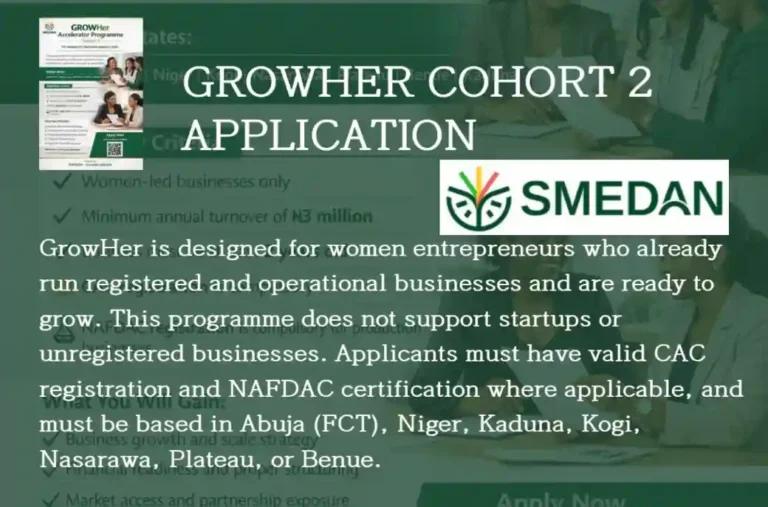
The Small and Medium Enterprises Development Agency of Nigeria (SMEDAN) has opened applications for the GrowHer Accelerator Program Cohort 2. GrowHer is designed for women entrepreneurs who run registered and operational businesses and are ready to scale.

SMEDAN successfully held the first edition of the GrowHer Accelerator Program last year and is pleased to announce that registration for the second cohort is now open.

About the GrowHer Programme

GrowHer is designed for women entrepreneurs who already run registered and operational businesses and are ready to grow. The programme does not support startups or unregistered businesses. Applicants must have valid CAC registration and NAFDAC certification where applicable, and must be based in Abuja (FCT), Niger, Kaduna, Kogi, Nasarawa, Plateau, or Benue.

What You Will Gain

  • Business growth and scaling strategies
  • Financial readiness and proper business structuring
  • Market access and partnership exposure
  • Mentorship and peer learning
  • Support for sustainable expansion

Who the Programme Benefits

This programme does not support startups or unregistered businesses. Applicants must:

  • Have valid CAC registration
  • Possess required certifications where applicable
  • Be based in Abuja (FCT), Niger, Kaduna, Kogi, Nasarawa, Plateau, or Benue States

Eligibility

Are you a woman entrepreneur? The GrowHer Accelerator Program Cohort 2 eligibility requirements include:

  • Women-led businesses only
  • Minimum annual turnover of four (4) million naira with proof
  • Business must be at least two (2) years old
  • CAC registration is compulsory
  • Necessary certification(s) where applicable
  • Business must be based in Abuja (FCT), Niger, Kaduna, Kogi, Nasarawa, Plateau, or Benue

How to Apply

If you are a woman entrepreneur in the listed states and meet the requirements, register now using the official link below.

Apply Here

IBM SkillsBuild Phase 2 Opens Free Climate and Sustainability Training

IBM has launched the second phase of its free learning initiative, IBM SkillsBuild, focusing on climate action, sustainability, and digital career readiness. The program aims to equip young people with practical, future-ready knowledge to tackle global environmental challenges and strengthen their career prospects.

“If you are passionate about climate action, sustainability, or building skills that matter globally, this is your chance,” the organizers said. They emphasized that climate change and sustainability are no longer optional topics but essential skills shaping careers, policies, and communities worldwide.

The IBM SkillsBuild Phase 2 program offers participants a 100 percent free and self-paced online training experience. Learners will earn a globally recognized IBM SkillsBuild certificate upon completion.

The initiative is implemented by Young Advocate for a Sustainable & Inclusive Future (YASIF) in partnership with the International Association for Volunteer Effort (IAVE) and IBM SkillsBuild. Organizers said the partnership ensures global standards, high-quality learning, and measurable impact.

According to the team, the program includes mentorship on CV development, employability skills, and access to post-training career pathways. “The Skills Build Program provides practical, in-demand training to help participants boost employability, grow their careers, and prepare for real-world opportunities,” the statement added.

Application link: bit.ly/44TW6jC

TechCrush Trains 17,000 African Youths in Digital Skills

An edutech platform, TechCrush, says it has trained over 17,000 young Africans in digital and technology skills as part of efforts to address the continent’s growing youth population and widening digital skills gap.

In a press statement available to Nigeria Startup News on Monday, the platform said Africa currently has over 60 per cent of its population under the age of 25, with more than 12 million young people entering the labour market every year, a trend experts warn could become a crisis without access to relevant and employable skills.

It added that studies linked to UNESCO indicate that about 75 per cent of youths in Sub-Saharan Africa graduate without foundational digital competencies, while only between 10 and 15 per cent have access to structured digital education aligned with the needs of today’s technology-driven economy.

Speaking on the vision behind the initiative, the founder and Chief Executive Officer of TechCrush, Joseph Ajayi, said the platform was created to move young Africans from theory to real-world impact.

“Africa does not lack talent; what we lack is access to practical, industry-relevant training and mentorship,” Ajayi said.

Ajayi maintained that the outcomes reflected TechCrush’s broader mission, stressing, “Our goal is not just to train students, but to raise innovators who can confidently compete globally while solving African problems locally,” as Africa’s digital economy continues to expand.

He noted that, unlike traditional learning models, TechCrush adopts a project-based approach that requires learners to work on real-life challenges, culminating in capstone projects that test both technical knowledge and problem-solving skills.

“To date, more than 50 capstone projects have been completed, ranging from applications that modernise transportation systems to tools that simplify tax management for freelancers.”

The impact of the programme is reflected in the experiences of learners across the continent.

A Ghanaian participant, Jennitter, who recently ventured into cybersecurity, described the training as transformative.

“For the first time, cybersecurity feels real, doable, and exciting. The practicals, the clarity, and the supportive community made me feel seen and capable,” she said.

In Kenya, Bill Kemboi said the programme helped him apply artificial intelligence to agriculture, noting, “I’m building solutions to help farmers in Kenya, and that gives meaning to everything I’m learning.”

Hassan Bangura from Sierra Leone said the training demystified coding for him, adding, “What once felt impossible now feels achievable, and I’m only getting started.”

Similarly, a Nigerian-based learner, Sayofunmi Modupe, said the training demanded discipline and resilience. “My capstone project stretched me, challenged me, and made me proud of the developer I’m becoming,” she said.

Since its launch, the platform has trained learners across 42 African countries, offering programmes in cybersecurity, data analytics, backend development, UI/UX design, artificial intelligence, digital marketing, virtual assistance and several other digital fields.

Ibom-LED: 1840 entrepreneurs trained, N1.1bn disbursed since 2023

The Ibom Leadership and Entrepreneurial Development Centre (Ibom-LED) says it has achieved key milestones in entrepreneurship development, training, and business support since its establishment in 2023. The centre said it has trained and mentored 1,840 new entrepreneurs under various programmes, including the Entrepreneurial Accelerator Programme (EAP) with 1,700 participants, the Startup Accelerator and Incubation Programme (SAIP) with 60, the Executive Management Programme (EMP) with 30, the Rising Leaders Programme (RLP) with 50, and the Business Mastery Programme (BMP) with 25 participants.

In a statement, the centre said the Arise Equipment Support Scheme (AESS) provided 10,000 pieces of equipment to 2,000 beneficiaries to strengthen small businesses across Akwa Ibom State. It also noted that N700 million was disbursed to government-sponsored EAP beneficiaries, while another N400 million in business support grants went to Micro, Small, and Medium Enterprises (MSMEs) to enhance their operations and competitiveness.

According to the report, Ibom-LED continues to offer mentorship to its alumni community, supporting about 1,400 business persons across the state. “Our mandate is clear: to build value-based, no-excuse, anti-fragile leaders and enterprises capable of delivering world-class outcomes within globally competitive markets,” the centre said.

Established as an initiative of the Akwa Ibom State Government, Ibom-LED said its programmes are designed to close critical gaps in leadership and entrepreneurial skills across both the public and private sectors. The statement added that the milestones reflect structured investments in people, enterprises, and systems through learning, mentorship, equipment, and funding.

It noted that these interventions are aligned with the state’s ARISE Agenda and global Sustainable Development Goals to promote inclusive growth, innovation, and enterprise sustainability.

Barau Jibrin to distribute tricycles, motorcycles in Kano North

0

The Deputy President of the Senate, Senator Barau Jibrin, has announced plans to begin the distribution of tricycles and motorcycles to students, headmasters, and other beneficiaries in Kano North Senatorial District on Tuesday as part of an empowerment programme aimed at improving access to education and livelihoods.

The initiative was disclosed during a press briefing on Monday by his Special Assistant on Media and Publicity, Shitu Madaki Kunchi. He explained that the programme includes the distribution of 1,300 tricycles specifically for students and 1,000 motorcycles for headmasters, teachers, and other residents across the district.

According to him, the scheme is designed to reduce transportation difficulties, improve school attendance, and support small income-generating ventures. “The empowerment programme also features a free capital support scheme of N100,000 each for 100 beneficiaries in every local government area of Kano North,” Kunchi said.

He added that the monthly support will begin in February 2026 and continue until December 2026, covering 1,300 beneficiaries each month and a total of 15,600 beneficiaries during the period.

Other parts of the programme, he noted, include the distribution of 130 vehicles to transport associations, 1,300 sewing machines for women, 1,300 noodle-making machines with bags of flour, and 1,300 deep freezers to support small-scale businesses.

In the area of sports development, Kunchi stated that each local government area will receive jerseys and footballs for 150 teams, making a total of 1,950 teams across the district.

He said the initiative is expected to benefit about 25,000 people, boost economic activities, enhance education, and promote grassroots sports, adding that similar empowerment programmes would later be extended to Kano Central and Kano South Senatorial Districts.

Osun launches Imole Business Empowerment scheme 1.0 for 2,000 beneficiaries

0

The Osun State Government has officially launched the Imole Business Empowerment Scheme 1.0, a major economic intervention aimed at strengthening small businesses and improving financial independence among women and youths across the state. The launch took place on Thursday at the Staff Development Centre, Abere, Osogbo, where 2,000 beneficiaries received Point of Sale terminals, Corporate Affairs Commission business registration certificates, and start-up grants.

The empowerment programme is being implemented by the Ministry of Cooperatives and Empowerment in partnership with First Bank Plc and Fidelity Bank Plc. It is designed to support entrepreneurship, create jobs, and expand access to financial services at the grassroots level.

Speaking at the official presentation of the PoS terminals, CAC certificates, and grants, Governor Ademola Adeleke described the launch of the Imole Business Empowerment Scheme 1.0 as a historic moment in his administration’s efforts to uplift citizens and strengthen the state’s economic base. According to him, the initiative reflects his commitment to moving empowerment beyond political slogans and delivering real tools that help people create wealth and sustainable livelihoods.

Adeleke said the scheme demonstrates his administration’s resolve to empower households by giving beneficiaries the means to start and grow businesses that can contribute to economic development and job creation. He explained that providing PoS terminals, formal business registration, and start-up capital would help young people and women participate more actively in the formal economy.

While reflecting on the creation of the Ministry of Cooperatives and Empowerment, which he described as “first of its kind in Nigeria,” the governor recalled that the ministry was initially met with skepticism. He noted that critics questioned the need for such a ministry, but added that the achievements recorded within a short period had justified the decision.

“The Ministry has become a hub of innovation, and its work has been recognised nationally, including at the National Cooperatives Awards and Exhibition on 17 November 2023,” Adeleke said. “Permit me to highlight a few of our giant strides: In January 2024, Osun State held its First Cooperative Summit and Awards, the first of its kind in the history of our state.”

He further stated that during the maiden summit, his administration announced a ₦1 billion Cooperative Revolving Loan, which was later increased to ₦3.450 billion in response to growing demand. Out of the total amount, he said ₦1.6 billion had already been released to beneficiaries across the state.

According to the governor, the Cooperative Revolving Disbursement Programme has been implemented in two phases. He explained that under the Ward-Based Cooperative Initiatives, coverage expanded from 332 wards to 401 wards, with 389 wards fully benefiting from the programme.

“So far, ₦736,050,000 in interest-free loans have been disbursed at the grassroots level, directly impacting over 20,000 households,” Adeleke said. He added that conventional cooperative unions and societies under the umbrella of FOSCOOP received ₦800,000,000, reaching over 250 cooperative unions and societies and benefiting 10,233 individual co-operators.

The governor also disclosed that the programme was extended to Osun indigenes living outside the state. He said ₦50,000,000 was disbursed to beneficiaries in Abuja and Northern Nigeria, bringing the total Cooperative Revolving Loan Disbursement to ₦1,586,000,000.00.

Adeleke noted that in September 2024, the state flagged off the New Working Capital of the MSMEDF Programme, laid the foundation for the Ultra-Modern Office Complex of the Osun Micro Credit Agency, and disbursed ₦250 million in MSMEDF cheques to prospective loan applicants.

He added that in May 2025, the ministry, in collaboration with Fidelity Bank, organised a Food Bank Initiative, during which over 3,000 residents received free foodstuffs to ease economic hardship.

The governor also announced plans to upgrade the Sen. Isiaka Adetunji Adeleke College of Cooperative Studies, Ode-Omu, into a Uniosun campus focused on cooperative and management studies. He said academic activities would commence in September 2025, with approved programmes in Taxation, Transport Management, Development Studies, and related fields.

“Our administration has empowered persons with disabilities, in partnership with Project Enable Africa, and has rehabilitated and upgraded structures at the Cooperative College in Ode-Omu,” Adeleke said. “Today’s flagship event, the Imole Business Empowerment Scheme 1.0, marks a turning point.”

He explained that the initiative targets 2,000 women and youths across the 30 Local Governments and the Area Office of Osun State. According to him, each beneficiary received a CAC Business Registration Certificate, a PoS terminal, and a start-up grant to begin their entrepreneurial journey, supported by capacity building and training for long-term business growth.

Earlier, the Commissioner for Cooperatives and Empowerment, Bayo Ogungbangbe, said the presentation of empowerment items reflects the administration’s commitment to sustainable development, youth empowerment, women’s inclusion, and inclusive economic growth.

Ogungbangbe recalled that the ministry, working with Project Enable Africa and Libra Philanthropies, recently empowered Persons With Disabilities with a combined fund of ₦4 million, alongside training, mentorship, and digital tools such as laptops for entrepreneurs in technology, design, and creative sectors.

Highlighting beneficiaries, he mentioned Miss Blessing Adeniran, a graduate of the Federal College of Education (Special), Oyo, who completed entrepreneurship training despite physical challenges. “She is full of dreams and determination, and with additional support, she can be a shining example of how disability is never inability,” he said.

The commissioner also identified Mr. Olawumi Olabode, a young man living with a disability who earns a living by driving a tricycle. “Sadly, he does not own the tricycle he drives daily, but he continues to work hard to sustain himself and his family,” Ogungbangbe said, while calling for additional support to help beneficiaries live more independent lives.

He urged recipients of the PoS terminals to use the opportunity wisely, grow their businesses diligently, and serve as worthy ambassadors of the initiative.