
Home Blog Page 185

VDM Challenges FG Claim on Morocco Scholarship Payments

0

VeryDarkMan has challenged a press release issued by the Federal Ministry of Education on Nigerian students in Morocco, arguing that while the government says no scholar was abandoned, its own admission that payments stopped at the 2024 budget year proves otherwise. Responding to the statement, VDM said the issue was being misrepresented and insisted that students on multi-year scholarship programmes were left without support once funding ended.

In the press release on Wednesday, the Federal Government said it had “firmly debunked misleading narratives” surrounding Nigerian scholarship students in Morocco, describing such claims as “false, unfounded, and deliberately crafted to misinform the public.” The statement said no Nigerian student on a valid Federal Government scholarship had been abandoned.

The Minister of Education, Dr Maruf Tunji Alausa CON, said, “All beneficiaries duly enrolled under the Bilateral Education Scholarship (BES) Programme prior to 2024 have received payments up to the 2024 budget year,” adding that “any temporary delays in outstanding payments are attributable to fiscal constraints.”

VDM, however, argued that the same statement contradicted itself. “The minister said what I posted was false, yet the same statement admits that payments were only made up to the 2024 budget year,” he said. According to him, scholarships are not one-year programmes and cannot simply stop because a budget cycle has ended.

He questioned how students admitted before 2024 were expected to survive afterward. “If a scholarship programme runs for five, six, or seven years, what happens to students after the budget year ends?” VDM added, “You cannot say students were not abandoned when you are also saying payments stopped at 2024.”

The government also stated that “no new bilateral scholarship awards were made in October 2025 or at any time thereafter,” describing documents suggesting otherwise as “fake” and “unauthenticated.” VDM rejected this claim, saying he had seen award letters dated September 2025. “There are documents showing scholarship award letters dated September 2025, despite claims that no new awards were made.”

VDM further cited official letters showing that allowances for existing students were reduced in July 2024 due to exchange rate pressures. He said monthly stipends were cut from 500 to 220, while other benefits were adjusted. “Allowance reductions were introduced in July 2024, but newer award letters still carried the old figures,” he said, arguing that this created room for students to be shortchanged.

He maintained that “this issue did not start in 2025; some students have been owed allowances since 2023,” VDM said, referencing government correspondence that acknowledged arrears for previous years.

According to VDM, “the problem is not limited to Morocco; students in other countries are also affected,” he said, citing earlier complaints by Nigerian students studying in countries such as Russia who reportedly went months without stipends.

He also referred to legislative attention on the matter, noting that the House of Representatives had previously invited officials for an investigative hearing over alleged failure to pay scholarship stipends. “If everything was properly handled, there would be no need for investigations by the House of Representatives,” he said.

In its statement, the Federal Government said it had discontinued government-funded bilateral scholarships abroad after a policy review, explaining that Nigeria now had sufficient capacity to deliver such programmes locally. It added that only scholarships fully funded by foreign governments would continue and that students already enrolled under previous arrangements would be supported until completion.

The ministry also offered affected students the option of returning to Nigeria. According to the statement, students who choose to discontinue their studies abroad may write to the Director of Scholarship Awards and will be reintegrated into tertiary institutions in Nigeria, with return travel costs covered.

VDM insisted that explanations were not enough and called for action. He said students abroad were struggling due to unpaid stipends and reduced allowances, stressing that the government should either fully fund the programmes or stop sending students overseas.

“You cannot keep issuing statements while students are stranded,” he said, adding that clearing outstanding payments was the only way to resolve the crisis.

Advertisement

Peter Obi condemns FG over reported ₦8tn NNPC debt write-off

Peter Obi has criticised the Federal Government over the reported write-off of about ₦8 trillion in debts owed by the Nigerian National Petroleum Company Limited (NNPC), describing the move as financially reckless and harmful to the country’s already strained public finances.

In a statement issued on Wednesday, Peter Obi expressed concern over what he described as a growing culture of fiscal indiscipline, especially at a time when many Nigerians are struggling with rising living costs and economic uncertainty.

“Financial recklessness is increasingly becoming normalized in our country. Just last week, it was alarmingly reported that the President approved the write-off of ₦5.57 trillion and $1.42 billion—approximately ₦8 trillion—in debts owed by NNPC, a company that recently announced profits and claimed it had turned a new leaf,” Obi said.

He noted that the same agency is currently facing serious audit inquiries over its failure to account for ₦210 trillion, an amount he said far exceeds the combined Federal budgets of Nigeria from 2023 to 2026. According to him, the Federal Government’s budgets stood at about ₦21.83 trillion in 2023, ₦43.56 trillion in 2024, ₦54.99 trillion in 2025, and an estimated ₦58.18 trillion for 2026, bringing the total for the four years to roughly ₦178.56 trillion.

“Nigerians are still waiting for the outcome of the National Assembly investigation into the missing trillions. This company is also under scrutiny for trillions spent on non-functional refineries. Yet, the President, who also serves as the Minister in charge, has approved the write-off of about ₦8 trillion in NNPC debts,” he stated.

Obi further linked the decision to the economic pressure faced by citizens following subsidy removals. “Nigerians, already enduring severe hardships due to the removal of petroleum and electricity subsidies—with no tangible improvements in their lives—are now confronted with this unexplained debt forgiveness. The nearly ₦8 trillion write-off will effectively replace revenue that the government is currently seeking through unfair taxation,” he said.

He stressed the need for transparency, saying the government must clearly explain the rationale behind the decision due to its potential impact on national development. “This almost ₦8 trillion write-off could have generated the revenue the government now seeks through these unfair taxes. The amount exceeds the 2025 combined Federal budget allocations for education, health, and agriculture, which total ₦7.1 trillion,” Obi said.

He added that the sum is nearly twice the 2025 Federal security budget of ₦4.9 trillion, even as insecurity persists nationwide. According to him, such resources could empower about eight million youths, create jobs across Nigeria’s 8,809 wards, and significantly reduce the number of people living in poverty.

“The President, who is also the Minister, owes the Nigerian people clear answers. The citizens deserve honesty, fiscal discipline, and governance that protects their interests—not the interests of mismanaged corporations or political elites,” Obi said, adding that the situation represents a betrayal that must be stopped.

Kwara Hospitals Management Board recruitment for nurses, midwives

0

Kwara State Hospitals Management Board has opened recruitment portal for qualified nurses and midwives to fill vacancies across government health facilities.

Vacant positions available include staff nurses and midwives in various general and cottage hospitals across Kwara State.

Requirements for application include a Registered Nurse (RN) qualification, registration with the Nursing and Midwifery Council of Nigeria (NMCN), a valid practising licence, good clinical competence and communication skills, and willingness to work in any assigned health facility within the state.

To apply for Kwara State Hospitals Management Board recruitment, interested candidates should submit a curriculum vitae (CV), copies of credentials (including NMCN licence), and an application letter addressed to:

The Chairman
Civil Service Commission
Ilorin, Kwara State

Applicants can also submit applications in hard copy or via WhatsApp by sending documents to +234 806 708 8343.

ALAT App Upgrade Set for January Launch

0

The digital banking arm of Wema Bank Plc, ALAT, is set for an upgrade this month, according to a statement released by the lender. The upgrade, tagged ALAT: The Evolution, will introduce new features designed to redefine the future of banking and set new standards in the industry.

Wema Bank explained that the update is “a thoughtful evolution of everything users already love about ALAT,” adding that it has been redesigned to feel “more intuitive, more responsive, and more personal.”

The bank said the new version of ALAT will deliver faster interactions and smarter understanding of user behavior, alongside the introduction of SAW, which stands for Smart ALAT by Wema, an AI assistant built into the app.

According to the statement, “the upgraded ALAT will show how far digital banking has come, and how much further it can go when innovation is intentional.”

ALAT by Wema first launched in 2017 and made history as Africa’s first fully digital bank, transforming how millions of people viewed and experienced banking. With this latest upgrade, Wema Bank reaffirmed its position as the most innovative financial institution in the banking industry.

Civil society flags alleged N8trn spending, budget secrecy breaches

Nigeria’s leading civil society groups have raised alarm over what they describe as serious constitutional breaches in the management of the 2024 and 2025 federal budgets, citing an alleged N8 trillion in spending without prior legislative approval, unlawful extensions of the 2024 budget beyond December 31, 2024, and the continued refusal by authorities to publish key budget documents for public scrutiny.

In a joint media statement, the organisations said, “We, the undersigned civil society organisations (ANEEJ, BudgIT, Centre for Social Justice (CSJ), Civil Society Legislative Advocacy Centre (CISLAC), Paradigm Leadership Support Initiative (PLSI), and PRIMORG Foundation), express grave concern about the recent constitutional breaches in the repeal and re-enactment of the 2024 and 2025 Appropriation Acts by a collaboration between President Bola Ahmed Tinubu and the National Assembly (‘NASS’).” They also expressed concern over what they described as opacity, lack of transparency, and poor public participation in the federal budgeting process.

According to the statement, eighteen days after the presentation of the federal executive budget, the Budget Office of the Federation (BOF) and the National Assembly had “failed, refused and neglected to upload the same to their websites,” limiting public access to key fiscal information. The groups added that the 2024 and 2025 Appropriation Acts (Repeal and Re-enactment) bills approved by the National Assembly were not available to Nigerians on any electronic portal.

They said the absence of publicly accessible documents meant that there was no opportunity for popular participation in the consideration and re-enactment of the budget bills. The organisations warned that these actions raised “fundamental questions about the management of public revenues and expenditure and the responsiveness of the executive and legislature” to existing fiscal laws.

The groups cited provisions of the Constitution of the Federal Republic of Nigeria 1999 as amended and the Fiscal Responsibility Act to support their position. They recalled that S.81 of the Constitution provides for the submission of expenditure proposals by the President to the National Assembly and requires legislative approval before public funds are spent. This, they noted, is further supported by S.80 (2), (3), and (4) of the Constitution, which allow for annual budget submissions and in-year amendments when necessary.

The statement argued that public expenditure must be based on prior legislative approval, not approval after spending has already occurred. The civil society organisations said the 2024 Appropriation Act should have expired on December 31, 2024, but was extended by the National Assembly first to June 2025 and later to December 2025.

They added that even during the extended period, the executive failed to implement the 2024 budget in line with its approved terms. After the expiration of the extended period, the President reportedly sought to repeal and re-enact the Act, increasing the total budget size from N35.05 trillion to N43.56 trillion.

Describing the move as unlawful, the groups stated, “This is a legal and constitutional impossibility and can only be possible in a country where the rule of law is continuously desecrated.” They said spending an extra N8 trillion without prior legislative approval was an affront to constitutional fiscal provisions, especially as Nigeria was not operating under any declared fiscal emergency.

The statement further alleged that legislative approval was sought only after the expenditure had occurred, with the National Assembly accused of acting as a “rubber-stamp.” On the issue of the 2025 federal budget, the groups explained that budget reviews are typically conducted mid-year in June, with outcomes reflected through amendments, not at the end of a budget’s life in December.

They recalled claims by NASS that repealing and re-enacting the 2024 and 2025 Appropriation Acts was meant to align Nigeria’s budgeting process with global best practices and improve transparency. However, the groups said Nigerian fiscal laws and international standards do not support that position, describing the process instead as mismanagement and abuse of due process.

Citing S.48 (1) of the Fiscal Responsibility Act, the organisations said the Federal Government is required to ensure transparency through full disclosure and wide publication of all transactions involving public revenues and expenditures. They described the refusal to make public the 2026 Appropriation Bill and the 2024 and 2025 re-enacted Acts as a gross violation of the law.

The groups noted that citizens cannot engage with budget documents they cannot access, recalling that the BOF previously released simplified citizens’ budgets, a practice they say has now been abandoned.

KASEDA Releases Beneficiaries shortlist for ₦50,000 Student Vendor Grants

0

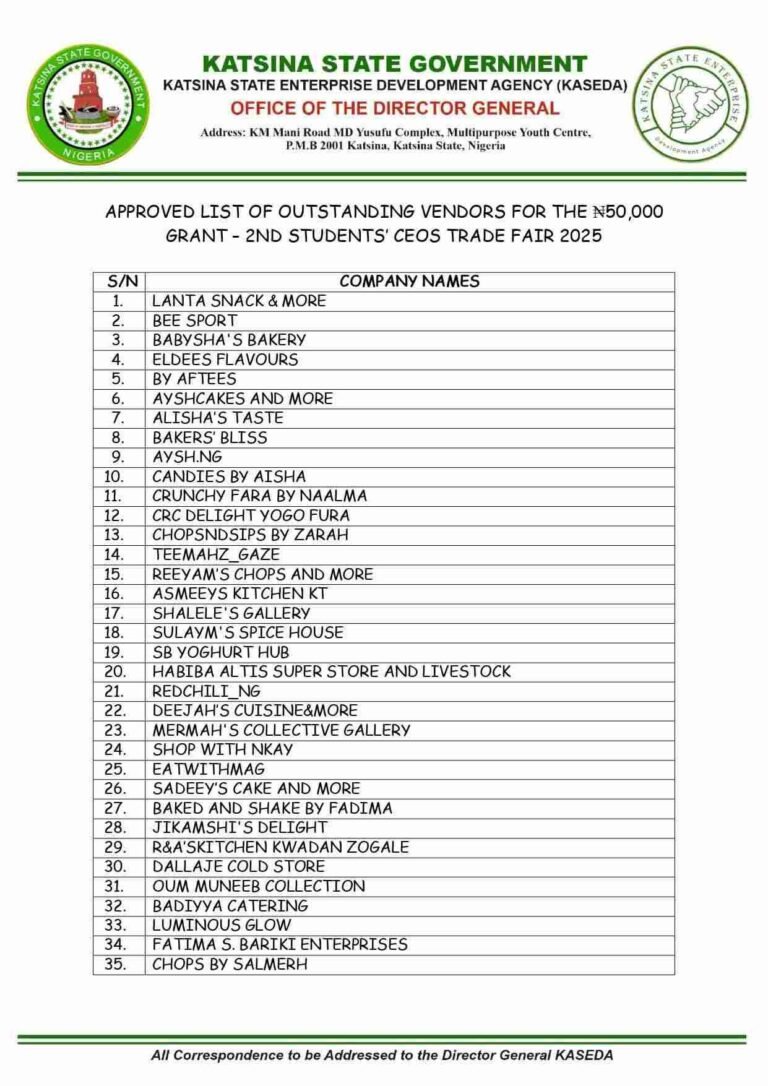
The Katsina State Enterprise Development Agency (KASEDA) has released the list of 70 beneficiaries for the disbursement of the ₦50,000 support grant to each outstanding student vendor, making a total of ₦3.5 million.

This development follows the successful 2nd Students’ CEOs Trade Fair, held on 20th November 2025, in commemoration of the International Students’ Day Celebration. KASEDA said the update is part of its commitment to fulfill the support pledged to outstanding student entrepreneurs who took part in the event.

The Trade Fair was organized under the Office of the Special Assistant to the Governor on Student Matters, Muhammad Nuhu Nagaske, in collaboration with other stakeholders. The event brought together vibrant student-led businesses from across Katsina State. KASEDA played an active role in the programme as part of its efforts to promote entrepreneurship, innovation, and youth-led enterprises.

As earlier announced during the event, KASEDA pledged a support grant of ₦50,000 to each of the 70 outstanding student vendors, totaling ₦3.5 million. According to the agency, “This support is aimed at strengthening student-owned businesses, encouraging innovation, and helping young entrepreneurs scale their ideas into sustainable ventures.”

KASEDA further stated, “We are pleased to inform the public that the list of the 70 beneficiaries has been finalized and released, and all selected vendors are advised to check their bank accounts accordingly.”

The agency added, “This intervention reflects the Katsina State Government’s continued commitment to empowering students and young entrepreneurs through practical support, not just encouragement.”

“KASEDA appreciates the collaboration with the Office of the SA on Student Matters and all partners who made the 2nd Students’ CEOs Trade Fair a success. We remain committed to supporting initiatives that create opportunities, build capacity, and drive inclusive economic growth across Katsina State.”

500 Zamfara recruited teachers to receive appointment letters

Zamfara State Governor, Dauda Lawal, will on Thursday, January 8, 2026, symbolically issue Letters of Appointment to selected beneficiaries from the 500 newly recruited teachers under the Teacher Recruitment and Deployment Guidelines (TRDG) Policy.

According to a signed statement on Wednesday by Aliyu Muhammad Tukur, Executive Secretary and Chairman of the Zamfara State Civil Service Commission, who also serves as Chairman of the Recruitment Committee, the event will mark a significant step in the administration’s ongoing efforts to strengthen the education sector.

The ceremony is scheduled to take place at 2:00 p.m., immediately after the State Executive Council Meeting, at the Grand Hall, Government House, Gusau.

Tukur said, “His Excellency, the Executive Governor of Zamfara State, has the honour to invite the following distinguished personalities to grace the occasion.”

Those invited include the Deputy Governor of Zamfara State, all Honourable Members of the Zamfara State House of Assembly, Members of the State Executive Council, the Chief Judge of Zamfara State and other Heads of the Judiciary, Honourable Commissioners, Honourable Special Advisers, the Secretary to the State Government, the Chief of Staff to the Executive Governor, and the Head of Service of Zamfara State.

Also invited are Permanent Secretaries, Secretaries of MDAs, Directors-General, Commanders and Heads of Security Agencies including the Nigerian Army, Police, DSS, NSCDC, Immigration, Correctional Service, and other sister agencies.

Others include the Chairman and Members of the Zamfara State Teaching Service Board, Executive Chairmen and Members of SUBEB and SSEB, Chairmen of Local Government Councils, Traditional Rulers led by the Chairman of the Zamfara State Council of Chiefs, representatives of Teachers’ Unions and Professional Bodies including TRCN and NUT, as well as education stakeholders, development partners, and invited guests.

“All invited guests are requested to be seated promptly, as proceedings will commence immediately after the State Executive Council meeting,” the statement added.

FG Plans Unified System for Humanitarian Aid and Poverty Reduction

The Federal Government, through the Honourable Minister of Humanitarian Affairs and Poverty Reduction, Dr. Bernard Doro, has said that the Ministry is working to create a system where humanitarian assistance is streamlined and impactful, with a clear entry and exit point for beneficiaries.

Dr. Doro made this known during a courtesy visit by a delegation from the Institute of Human Virology, Nigeria (IHVN), led by its Director-General, Dr. Patrick Dakum, who came to congratulate him on his appointment and to offer the Institute’s support in addressing healthcare challenges facing vulnerable groups.

The Minister welcomed the partnership and introduced his “One Humanitarian, One Poverty Reduction System” initiative, which is aimed at tracking interventions for informed policy-making. According to him, the initiative will help the Ministry monitor progress, identify gaps, and make data-driven decisions to improve humanitarian outcomes in the country.

“We want to help vulnerable people until they are self-reliant, engaging sub-nationals for synergy in humanitarian efforts,” Dr. Doro stated.

He further explained that the new system would strengthen collaboration between the Federal, State, and Local Governments, ensuring a unified and efficient approach to tackling poverty and humanitarian challenges in Nigeria.

Earlier, Dr. Patrick Dakum emphasized the importance of collaboration in addressing humanitarian issues and said the Institute looks forward to working with the Ministry and other stakeholders to leverage expertise and resources for improving the lives of Nigerians in need.

NASENI Portal for Inter-Agency Innovation Competition (N140m Prize)

The Federal Government, through the National Agency for Science and Engineering Infrastructure (NASENI), has opened a portal for the Inter-Agency Innovation Competition and Awards, inviting participating MDAs to register and compete for prizes of up to N140m.

The aim of the initiative is to harness innovation while promoting collaboration and creativity among Ministries, Departments, and Agencies (MDAs) of the Federal Government.

NASENI has the statutory mission “to develop and maintain a dynamic infrastructure to drive Nigeria’s indigenous industrialisation, job creation, and national progress.”

This specific initiative among MDAs seeks to harness innovative ideas capable of driving technological advancement and addressing pressing national challenges within the public service.

The competition invites all MDAs to propose innovative solutions across key sectors, including health, agriculture, education, and infrastructure, by leveraging science and technology to enhance public service delivery and improve the quality of life for Nigerians.

MDAs are to submit their entries through https://naseni.gov.ng/innovation and help unlock Nigeria’s potential through innovation in science and technology.