
Home Blog Page 187

Katsina presents appointment and admission letters for model schools

The Katsina State Ministry of Basic and Secondary Education on Tuesday, 6th January, 2026, formally presented Letters of Appointment to newly recruited Academic and Non-Academic staff, alongside Admission Letters to prospective students of the newly established Model Secondary Schools in Radda, Dumurkul, and Jikamshi. The event took place at the Radda Special School Assembly Hall and marked a significant step in the state government’s ongoing education reform programme aimed at strengthening secondary education delivery.

The ceremony was held under the administration of Malam Dikko Umaru Radda, with government officials describing the initiative as part of broader efforts to improve access, quality, and standards in public secondary schools across Katsina State. The programme brought together education stakeholders, traditional leaders, and representatives of host communities.

Performing the official presentation, the Honourable Commissioner for Basic and Secondary Education, Yusuf Sulaiman Jibia, congratulated the newly appointed staff and admitted students, describing the exercise as “a strategic investment in the future of Katsina State.” He urged the beneficiaries to approach their roles with dedication, professionalism, discipline, and teamwork, stressing that the recruitment process was strictly merit-based.

According to the Commissioner, the success of the Model Secondary Schools will depend largely on the commitment and competence of the staff deployed to them. He described the teachers and administrators as pioneers tasked with setting strong academic and administrative foundations. He explained that the schools were established to function as centres of excellence and serve as reference points for improving standards in other public secondary schools across the state.

Hon. Jibia further disclosed that students admitted into the Model Secondary Schools in Radda, Dumurkul, and Jikamshi were selected from public schools across all the 360 political wards of Katsina State. He said the wide spread of selections reflects the state government’s commitment to equity, fairness, and equal educational opportunities for children, regardless of location or background.

Reaffirming the vision of the present administration, the Commissioner reiterated the commitment of the Executive Governor to repositioning the education sector. He revealed that provisions have been made in the 2026 budget for the renovation of 74 Senior and Junior Secondary Schools across the state. He added that these plans also include other basic education interventions designed to improve infrastructure, enhance learning outcomes, and restore confidence in public education.

Earlier, in her welcome address, the Chief Consultant of Hallmark Consultancy Firm, Zainab Bugaje Jika, described the establishment of the model schools as a clear demonstration of the Governor’s vision for special schools tailored to meet diverse learning needs. She outlined the transparent and rigorous processes adopted in selecting students through competitive entrance examinations and recruiting teachers through public advertisements, an online application portal, Computer-Based Tests, and physical interviews.

Hajiya Zainab expressed confidence that a competent, committed, and well-qualified workforce had been assembled to drive the vision of the model schools and ensure sustainable success. She noted that strict adherence to merit and transparency guided every stage of the exercise.

Also speaking at the event, the Chairman of the Teachers Service Board, Sada Ibrahim, charged the newly employed teachers to give their best in meeting the educational aspirations of the present administration. He assured both Academic and Non-Academic staff of the Board’s continuous support, emphasizing its commitment to staff welfare and professional development.

On behalf of the host community, the Bare-Bari of Radda, Kabir Umar Bare-Bari, expressed appreciation to the Executive Governor for establishing a Model Secondary School in the area. He described the project as a source of pride for the community and called on teachers posted to Radda to see the town as their home and maintain cordial relations with residents.

In a vote of thanks, the Principal of Radda Model Special School, Lawal Shehu, described the occasion as a historic milestone in Katsina State’s civil service and education sector. He disclosed that over 250 staff received appointment letters to serve in the new model schools and stressed that the appointments carry responsibilities of discipline, hard work, and commitment to effective teaching and learning.

Dr. Lawal reaffirmed the resolve of the staff to justify the confidence placed in them and deliver measurable results. He commended the transparent and merit-based recruitment process, describing it as one of the most credible in the state’s history, and appreciated the support of the Ministry, Hallmark Education Consultant Services, AGILE Katsina, and other partners.

The event concluded with prayers for the success of the initiative and safe journeys for participants. Dignitaries present included the Special Adviser on Education, Nura Saleh Katsayal; the Permanent Secretary of the Ministry, Ummulkhair Ahmed Bawa Faskari; the Executive Chairman of SUBEB, Kabir Magaji Gafiya; the Chairman of Bindawa Local Government Council, Alhaji Badaru Musa Giremawa, representatives of ALGON, and Directors of the Ministry.

Read Also: Nigerian Army recruitment for DSSC 29/2026
Advertisement

Nigerian Army recruitment for DSSC 29/2026
The Nigerian Army has opened its recruitment portal for applications into the Direct Short Service Commission (DSSC) 29/2026. The DSSC application is open to both civilians and serving military personnel into the Nigerian Army Engineers, Nigerian Army Signals, Nigerian Army Medical Corps, Nigerian Army Electrical and Mechanical Engineers, and Nigerian Army Education Corps.

Candidates must be Nigerian males or females between the ages of 20 and 32 years by 30 March 2026 (medical consultants may be between 25 and 40 years of age). Applicants must be medically, mentally, and physically fit, and must be recommended and attested to for good character by at least two recognizable referees. These referees must be either a Local Government Chairman or Secretary, an officer of the Armed Forces not below the rank of Lieutenant Colonel or its equivalent, or an Assistant Commissioner of Police and above, and must hail from the applicant’s state of origin. Candidates must submit a letter of attestation from their former institutions. Height must be at least 1.68m for males and 1.65m for females. Applicants must not have been convicted by any court of law and must possess at least a first degree with not less than Second Class Upper Division, or an HND (where applicable) with not less than Upper Credit. Candidates must possess a valid, endorsed birth certificate and a valid state of origin certificate, and must have an NYSC discharge certificate or valid exemption certificate. Graduates with professional qualifications must be duly registered with the relevant regulating bodies. Only post-secondary academic credentials obtained from 2011 to date will be considered. Applicants must not have any bodily inscriptions or tattoos and must tender all original copies of educational certificates from primary to post-secondary level. Serving personnel must present valid military identity cards and a letter of recommendation from their Commanding Officers or Commanders, must have served for a period of not less than five years, and must not belong to any cult, society, or fraternity.

Applications are online and free of charge from 7 January to 4 February 2026.

All applicants must print out their online-generated slip or card upon completion of their application.

To apply for Nigerian Army recruitment, visit the NA portal at recruitment.army.mil.ng/military-secretary/dssc-application-form and submit your application.

Goodluck to all applicants.

LSETF opens applications for Lagos Innovates workspace voucher programme

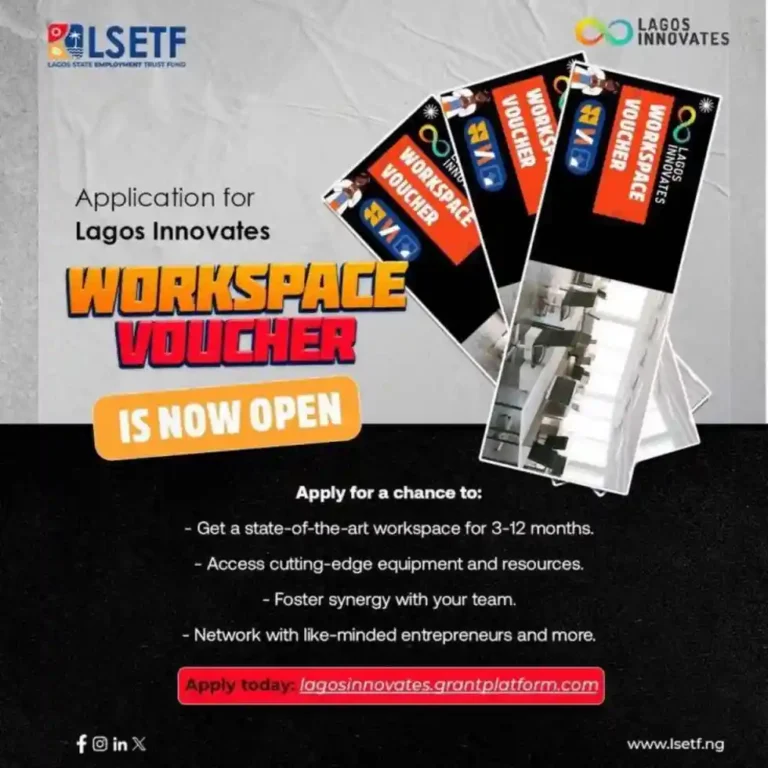
The (LSETF), through its platform, has opened applications for the Workspace Voucher Programme, offering eligible startups access to discounted workspaces across Lagos for periods ranging from three to twelve months.

The programme is designed to support early-stage, innovation-driven startups by reducing the cost of securing a functional workspace at a time when rising internet and operational expenses continue to place pressure on young businesses operating with lean budgets. LSETF said the initiative forms part of its broader efforts to strengthen the Lagos startup ecosystem and enable founders to focus on growth rather than overhead costs.

According to programme information, selected startups will receive vouchers that provide subsidised access to accredited coworking spaces across Lagos. These workspaces are equipped with reliable internet, power supply, and shared facilities that support day-to-day business operations. The initiative allows beneficiaries to operate from professional environments without bearing the full cost of private office rentals.

The Workspace Voucher Programme offers access to what the organisers describe as “state-of-the-art workspaces” for a defined period, alongside “cutting-edge equipment and resources” available at partner hubs. The programme also promotes collaboration, as startups are encouraged to work alongside other founders and teams within shared spaces. LSETF noted that this environment helps founders “foster synergy with their team” and “network with like-minded entrepreneurs.”

Eligibility for the programme is targeted at early-stage startups based in Lagos, particularly those at the ideation or early revenue phase. Applications are assessed on a competitive, merit-based process, with consideration given to the strength of the founding team, market opportunity, and progress achieved. The programme is not a cash grant, as support is provided through workspace subsidies rather than direct financial disbursements.

Lagos Innovates explained that the voucher system enables startups to redirect limited resources towards product development, customer acquisition, and business scaling. “Every naira counts for early-stage businesses, and reducing workspace costs can make a meaningful difference,” the programme stated.

Applications for the Workspace Voucher Programme are currently open on the Lagos Innovates grant platform via lagosinnovates.grantplatform.com. Interested startups are encouraged to apply within the application window to be considered for the current cohort, as selection is based on eligibility and assessment outcomes rather than order of submission.

UBA raises N157.84bn as rights issue records full subscription

United Bank for Africa has successfully raised N157.84bn to close its rights issue after the exercise was fully subscribed, the bank disclosed on Wednesday.

The rights issue offered 3,156,869,665 ordinary shares at N50 per share, on the basis of one new share for every thirteen existing shares held by shareholders on the register as of 16 July 2025.

At the close of the acceptance list on 19 September 2025, UBA initially received 6,404 applications for 4.13bn shares valued at N206.74bn. Following scaling adjustments by shareholders, the final allotment amounted to 3.16bn shares worth N157.84bn, representing 100 per cent subscription of the rights issue.

A breakdown of the subscriptions shows that 6,404 valid applications were received for 3.57bn shares valued at N178.3bn, while 568.7m shares valued at N28.43bn were deemed invalid. Full acceptances accounted for 453.58m shares, and partial acceptances totalled 135.27m shares, resulting in 190.93m shares partially renounced.

During the exercise, a total of 2,568,006,215 shares were renounced and reallocated. Applications for additional shares amounted to 2.98bn shares valued at N148.86bn, of which 2.57bn shares valued at N128.4bn were allotted, following a scale down by one shareholder.

The Securities and Exchange Commission cleared the basis of allotment. PAC Registrars and Investor Services Limited will credit the CSCS accounts of allottees by Friday, 16 January 2026, while surplus subscription monies will be returned by Tuesday, 13 January 2026. Shareholders without CSCS accounts will have shares credited using a Registrar Identification Number, in line with SEC directives on dematerialisation of share certificates.

The successful rights issue highlights strong investor confidence in UBA and provides additional capital to support the bank’s operations and expansion initiatives across Africa over the medium to long term.

LSETF Idea Hub 12.0 announces three startup winners

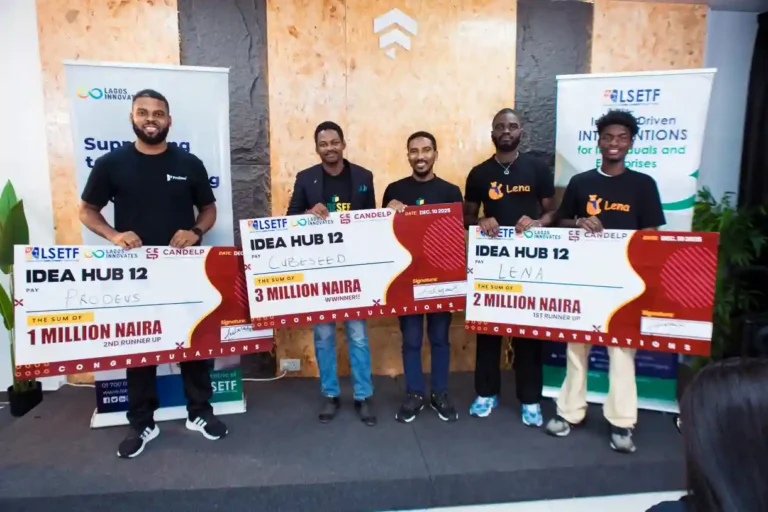
Three innovative startups have emerged as winners at the Lagos State Employment Trust Fund (LSETF) Lagos Innovate Idea Hub 12.0 after a rigorous competition that began with more than 1,000 applications from across Lagos State. The eight-week programme selected 20 startups for intensive business support before narrowing them to six finalists who pitched their ideas during Demo Day. The initiative focused on finding practical solutions to real challenges facing businesses and communities in Lagos.

Cubeseed Africa took the Gold Medal in the AgriTech category. In a market where middlemen often take a large portion of profits, farmers face delayed payments, and buyers struggle with poor-quality products and limited access to credit, Cubeseed Africa offers a digital solution. Partnering with Sterling Bank, the startup is creating a trusted digital marketplace for bulk protein supply. By connecting livestock farmers directly to bulk buyers such as restaurants, hotels, and cold room operators, Cubeseed ensures farmers receive instant payments and guaranteed markets. Buyers, in turn, enjoy reliable access to high-quality protein on credit. The company is not only simplifying meat trade but also contributing to food security by building transparency and trust in agricultural transactions.

The Silver award was given to Lena, an EdTech platform founded by Faruk Bilesanmi, Danny Ombeh, and Chris Ombeh. In Africa, where 9 out of 10 children struggle with basic literacy and numeracy despite attending school, Lena aims to redefine learning. The platform uses AI-driven games to transform math, literacy, and science lessons into engaging, story-based adventures aligned with the school curriculum. Its adaptive AI tutor personalizes learning by adjusting difficulty levels based on each student’s pace and challenges. The platform’s design is mobile-first and offline-friendly, allowing access even in areas with poor internet connectivity. Lena’s approach provides scalable one-on-one learning experiences and prepares children for future opportunities in the global AI economy.

Prodevs secured the Bronze award in the HR Tech category. Known for addressing the challenges of hiring skilled developers in Lagos, Prodevs provides a streamlined platform that helps companies find and manage technical talent efficiently. The startup allows businesses to reduce time spent on recruitment and focus on growth and innovation instead.

Speaking at the event, Ifeoluwa Martins of LSETF said, “Idea Hub 12.0 has showcased the immense talent in Lagos State. These startups represent the future of our economy, and we are proud to support their journey from idea to market.”

According to LSETF, all 20 startups in the programme received training on product development, market readiness, and business sustainability. The initiative forms part of Lagos State’s broader plan to support youth employment, innovation, and entrepreneurship.

The outcome of Idea Hub 12.0 reflects how targeted support and mentorship can transform promising local ideas into scalable businesses capable of driving economic growth and creating jobs in Lagos.

Nigeria draws nearly $14bn foreign investment in 9 months

Nigeria attracted nearly $14bn in combined foreign portfolio investment and foreign direct investment in the first nine months of 2025, driven by renewed investor confidence and wide-ranging economic and investment reforms, the Federal Government has stated. The disclosure was made on Tuesday by the Federal Ministry of Industry, Trade, and Investment, which said the inflows marked a significant improvement in capital movement into the country.

The ministry noted that the nearly $14bn combined FPI and FDI recorded between January and September 2025 surpassed the total inflows recorded throughout 2024. This performance was outlined in a document titled ‘2025: A Defining Year for Nigeria’s Industry, Trade and Investment,’ which reviewed developments across investment, trade, and industrial growth during the year.

According to the document, foreign portfolio investment led the recovery in capital inflows, rising sharply to $12.99bn within the period under review. Foreign direct investment, while smaller in absolute terms, was described as showing “promising, robust growth from a historically low base,” reflecting improved investor sentiment toward the Nigerian economy.

The ministry stated that FDI expanded by 700 per cent quarter-on-quarter in the third quarter of 2025 and reached $936m on a year-to-date basis. It said this trend signalled “renewed investor confidence in Nigeria’s reform trajectory,” following years of relatively weak foreign direct investment inflows.

It attributed the surge in capital inflows to macroeconomic and structural reforms implemented under the Renewed Hope Agenda of President Bola Tinubu. These reforms included foreign exchange liberalisation, the removal of fuel subsidies, monetary tightening, and stronger investor aftercare mechanisms designed to support both new and existing investors.

“As a result, combined foreign portfolio investment and foreign direct investment reached nearly $14bn in Q1–Q3 2025, surpassing total inflows in 2024,” the ministry stated. It added that the Nigerian Exchange ranked among the world’s top-performing stock markets during the year, further supporting investor interest.

The ministry also reported progress in converting investment commitments into live projects. It said four priority projects valued at $13.7bn advanced during the year, representing a conversion rate of over 25 per cent from the $50.8bn worth of signed Memoranda of Understanding. This, it noted, reflected a shift from passive investment promotion to an execution-driven model.

“In 2025, Nigeria significantly strengthened its investment facilitation architecture, transitioning from passive promotion to an active, systems-driven model that reduces information asymmetries, improves project visibility, and enhances the bankability of investment pipelines,” the document stated.

It added that structured deal origination helped to build a de-risked investment pipeline exceeding $5bn across priority sectors. This process was supported by curated deal rooms, targeted roadshows, and hands-on investor support aimed at closing viable investment deals.

The Federal Government further noted that investor confidence received an additional boost in June 2025 when President Tinubu hosted several West African leaders at the West Africa Economic Summit. At the event, a deal room generated over $400m in origin and showcased vetted investment opportunities.

The Minister of Industry, Trade and Investment, Dr Jumoke Oduwole, also led high-level bilateral engagements and trade missions to key economies. These included the United Kingdom, the United States, France, the United Arab Emirates, Saudi Arabia, Japan, China, and Brazil, with the aim of deepening investment pipelines and reshaping investor perceptions of Nigeria.

“These engagements have delivered tangible gains, enhancing investor confidence, improving deal flow quality, and positioning Nigeria as a credible, reform-driven destination for long-term capital,” the ministry said.

Alongside foreign investment efforts, the ministry highlighted steps taken to retain and expand domestic capital. It described Nigerian investors as “the first and most enduring vote of confidence in the economy,” noting their importance in sustaining growth during periods of global uncertainty.

It said Nigeria hosted its first Domestic Investors Summit in 2025, where 75 per cent of investor issues raised were resolved on the spot, while all issues were closed within five working days. This, the ministry said, marked a shift toward a repeatable execution model for resolving investment bottlenecks.

The statement added that Dr Oduwole carried out company visits across manufacturing, agro-processing, electric vehicles, and industrial clusters to resolve operational challenges and encourage reinvestment by local firms.

On trade and exports, the ministry reported strong performance driven by non-oil exports, which grew by 21 per cent to $12.8bn in the first half of 2025, almost double the $6.5bn target. It said this growth contributed to a N12tn trade surplus, while overall trade value expanded by 14 per cent due to improved trade facilitation, logistics reforms, and increased value addition.

Nigeria’s leading non-oil export products included cocoa and cocoa derivatives, sesame seeds, cashew nuts, shea butter, ginger, hibiscus flower, rubber, palm oil derivatives, fertilisers, cement, and liquefied natural gas.

The ministry said its collaboration with the Nigerian Export Promotion Council helped to train over 27,000 exporters, certify 200 micro, small, and medium enterprises for international trade, and support more than 3,000 farmers through improved seedlings. It added that Special Economic Zones generated over $500m in export revenues and created more than 20,000 direct jobs.

On continental trade, the ministry said Nigeria strengthened its leadership under the African Continental Free Trade Area by hosting key engagements on digital trade and earning appointment as Co-Champion of the AfCFTA Protocol on Digital Trade alongside Kenya and South Africa. Nigeria also gazetted its provisional tariff concession schedule, enabling duty-free trade on 90 per cent of goods across Africa, and became the first AfCFTA state party to publish a five-year implementation review.

Looking ahead, the ministry said it would build on the 2025 momentum by focusing on execution and measurable impact in 2026, with investor playbooks in sectors such as solid minerals, digital trade, the creative economy, and climate-smart industrialisation. “These results affirm that 2025 marked a decisive inflexion point for Nigeria, restoring investor confidence, strengthening competitiveness, expanding exports, and laying the foundation for sustained and inclusive growth,” the document stated.

Aptech Nigeria launches AI career programme

Aptech Computer Education Nigeria has announced the launch of a new all-in-one artificial intelligence career programme designed to equip Nigerian learners with job-ready technology skills, structured internship opportunities and clear international degree pathways.

The programme, called ADSE AI, integrates AI-powered training, practical projects and mentorship with options for eligible students to gain industry exposure through a structured, paid internship scheme. It also offers defined academic progression routes to international degree programmes, positioning it as a full classroom-to-career pathway for learners in the country.

According to a statement released on Tuesday, the programme embeds artificial intelligence across the entire learning journey, enabling students to learn, apply and showcase their skills through real-world projects and portfolio development. The curriculum combines future-focused content with hands-on delivery across Aptech centres nationwide, making it accessible to learners in different parts of Nigeria.

To enhance academic advancement, Aptech said eligible learners can progress to degree programmes through partnerships with leading institutions such as Middlesex University and Bangor University in the United Kingdom, Lincoln University College in Malaysia, NCC Education in the UK, and ISM Germany. These partnerships allow students to transition from advanced diploma stages to internationally recognised qualifications.

Aptech explained that the ADSE AI curriculum is powered by generative AI and focuses on applying artificial intelligence to real workflows. The learning process includes AI-integrated programming, prompt design, model-assisted coding and the responsible use of AI. Students are trained in Python, automation, data pipelines, data visualisation and cloud fundamentals using AI-enabled tools that align with modern industry environments.

The programme’s all-in-one structure combines technical skill training, internship exposure and academic progression. It follows an outcome-driven design that includes defined modules, capstone projects and continuous assessments mapped to entry-level and growth-focused roles. The skills gained are aligned with positions in software development, data operations, cloud support and digital product execution.

Core areas of learning under the ADSE AI programme include AI-integrated programming, data analytics, data visualisation, cloud foundations and modern software engineering practices enhanced by AI tools. Learners can also select electives such as full-stack development, .NET, Oracle, networking and ethical hacking, AI and machine learning, data science and the Internet of Things.

Internship placements, the company stated, will be facilitated through partner channels and will depend on eligibility, performance and availability. Aptech added that the process will be handled with transparency and full compliance.

Commenting on the launch, Executive Vice President, International Business at Aptech Limited, Kallol Mukherjee, said the initiative underscores the company’s commitment to employability.

“At Aptech, our mission is to make students employable with the latest skills and clear outcomes. This holistic programme brings GenAI into the heart of our proven ADSE pathway, adds structured internship opportunities for eligible students, and opens international degree routes so learners can build and succeed faster in the real world,” he said.

The programme targets school leavers, graduates and working professionals seeking to reskill into roles in software, data or cloud computing, as well as entrepreneurs and creators looking to apply AI for rapid prototyping and product development.

Training will be delivered through Aptech’s nationwide network of centres, including locations in Lagos, Abuja and other major cities. The learning model also includes mentoring, counselling and peer collaboration to support students throughout their journey. Admissions for the ADSE AI programme are now open across Aptech centres in Nigeria.

American Open University Nigeria opens 2025/2026 admissions

American Open University, Nigeria (A-Global) has announced the start of admissions for the 2025/2026 academic session, aiming to expand access to technology-driven higher education as demand for digital skills continues to grow across Nigeria and West Africa.

The university stated that applications are open for Bachelor of Science, top-up, and degree conversion programmes designed for students and professionals seeking qualifications that match the evolving labour market. The announcement comes as employers increasingly focus on skills in data analysis, cybersecurity, software development, and digital management.

According to the institution, eligibility covers direct entry and transfer students with NCE, ND, and NID qualifications. It also includes Higher National Diploma holders, third-class degree holders, and chartered professionals seeking to enhance their academic profiles. The university added that working professionals aiming to switch to technology-related fields can also apply.

Programmes available for the academic year span technology and business disciplines. Courses include Data Science, Cybersecurity, Software Engineering, and Information Technology, alongside Business Administration, Business Information Technology, Entrepreneurship, and Public Administration. The university explained that these programmes integrate digital tools and data-driven approaches increasingly needed in both public and private sectors.

“American Open University’s admission process includes the submission of a statement of purpose and a digital skills assessment,” the institution said, adding that this reflects its commitment to blended and technology-supported learning models in higher education. Candidates who fall short of the required digital proficiency may undergo preparatory training before full enrolment.

The university noted that applications are being received through its online portal. It added that the 2025/2026 admission exercise forms part of a broader effort to address Nigeria’s digital skills gap and meet the changing demands of the modern workforce.

Marcel Ngogbehei launches Community Scholarship Programme

Marcel Ngogbehei, a UK-based education and development advocate, has launched a Community Scholarship Programme aimed at identifying and supporting outstanding students within the community. The initiative is designed to expand access to quality education and reward academic excellence among young learners.

Speaking at the official unveiling of the programme, Ngogbehei, who is also the founder of the Ngogbehei Cancer Centre, described the scholarship as a strategic investment in the future of young people. He noted that while talent is widespread, opportunities for growth and advancement remain limited for many students.

He explained that the scholarship programme is built on structured teaching, discipline and fair competition, with a goal to discover academically gifted students and support them throughout their educational journey.

According to Ngogbehei, the initiative goes beyond examination success to focus on character development, confidence building and preparing students to contribute meaningfully to society.

“Education is more than passing exams. It shapes character and equips young people with the skills and mindset needed to become future leaders. By investing in our children today, we are securing the future of our community,” he said.

The Community Scholarship Programme is being implemented as an educational initiative of the Ngogbehei Cancer Centre, reflecting the organisation’s broader commitment to human development, well-being and empowerment beyond healthcare delivery.

Ngogbehei added that the centre’s involvement in education underscores the link between learning, social development and long-term community wellbeing.

The launch event attracted parents, teachers, community leaders and students, who called for collective support to ensure the sustainability and success of the programme.

Ngogbehei also expressed appreciation to educators and parents for their dedication to nurturing young minds and supporting the vision behind the scholarship.

He encouraged students to approach the opportunity with discipline, dedication and self-belief, describing the scholarship as both a reward for excellence and a challenge to achieve higher academic and personal standards.

Education stakeholders at the event described the initiative as timely, especially in communities where access to educational support remains limited. They said the scholarship programme could inspire students, improve academic performance and promote a culture of excellence among young people.

As the programme begins, organisers expressed optimism that it will grow and impact more lives, shaping a new generation of confident, disciplined and socially responsible leaders.

NCDMB, Olafrankies begin subsea engineering training

0

The Nigerian Content Development and Monitoring Board (NCDMB), in partnership with Olafrankies Integrated Ltd, has commenced a five-day training program on subsea engineering and production. The program, which began on January 5, 2026, in Lagos, is scheduled to end on January 9, 2026.

According to the organizers, the training is designed to equip participants with specialized knowledge and practical skills in subsea engineering and production, aimed at improving their contributions to the oil and gas industry.

A representative of the NCDMB stated that “this collaboration reflects our ongoing commitment to building local capacity and developing the technical capabilities of Nigerians in key areas of the energy sector.”

The program forms part of NCDMB’s broader goal to strengthen Nigerian content in the oil and gas industry. At the end of the training, participants will receive certificates recognizing their expertise in subsea engineering and production.