Home Blog Page 203

Grants for skill and entrepreneurship Nigerian can apply for

0

Grants for skills and entrepreneurship remain one of the most practical ways Nigerians can build businesses, gain employable skills, and access startup support ahead of 2026. While many programmes exist in name, only a limited number are verifiably active or officially rolling into 2026. Below are 9 major grants and grant-style funding opportunities Nigerians can apply for, covering youth, women, students, and early-stage entrepreneurs.

1. Youth Economic Intervention and De-Radicalization Programme (YEIDEP)

The Youth Economic Intervention and De-Radicalization Programme grant is a Federal Government initiative designed to support youth entrepreneurship while addressing unemployment and social instability. The programme provides business grants alongside training and mentorship to help young Nigerians start or grow small enterprises.

The current application window is YEIDEP Batch B, which is open. The programme targets Nigerians aged 18 to 35 who have valid NIN and BVN and either an existing business or a workable business idea. Beneficiaries are expected to participate in enterprise training and capacity-building activities.

Applications are completed online through the official portal at yeidep.org.

2. Student Venture Capital Grant (S-VCG)

The Student Venture Capital Grant is a Federal Government programme under the Ministry of Education. It provides equity-free funding of up to ₦50 million for student-led ventures with scalable innovations.

The grant focuses on helping students transform ideas into commercially viable businesses, particularly in STEMM-related fields.

Eligible applicants are full-time students in accredited Nigerian tertiary institutions, usually in 300 level and above, working individually or in teams.

S-VCG applications are submitted through svcg.education.gov.ng.

3. Nigeria for Women Project (NFWP)

The Nigeria for Women Project is a partnership between the Federal Government of Nigeria and the World Bank. It aims to improve women’s livelihoods through economic inclusion, skills development, and access to group-based enterprise support.

The programme operates through Women Affinity Groups and targets women aged 18 and above who are economically active, particularly in rural and semi-urban communities. Support includes training, savings facilitation, and income-generating opportunities rather than a single lump-sum grant.

Grant registration and programme intake are handled via https://nfwp.gov.ng. Here is a full NFWP grant application guide.

4. Conditional Grant Scheme (CGS) – SMEDAN

The Conditional Grant Scheme is implemented by SMEDAN to support nano and micro enterprises across Nigeria. It typically provides grants of about ₦50,000 to small business owners at the local government level.

The scheme focuses on job creation and sustainability, with beneficiaries often required to demonstrate the ability to employ at least one person. The programme runs on a rolling basis depending on local implementation.

Updates and application guidance are available at smedan.gov.ng.

5. FGN-ALAT Digital Skillnovation Programme

The FGN-ALAT Digital Skillnovation Programme is a Federal Government partnership with Wema Bank. It supports Nigerian youth and MSMEs through digital skills training, business incubation, and access to grant opportunities.

The programme targets early-stage startups and entrepreneurs in sectors such as agriculture, logistics, retail, clean energy, and technology. Applicants must have scalable ideas or businesses and be willing to undergo training and incubation.

Applications are managed through https://fg-skillnovation.alat.ng.

6. Tony Elumelu Foundation Entrepreneurship Programme

The Tony Elumelu Foundation Entrepreneurship Programme is one of Africa’s most prominent entrepreneurship funding programmes. It provides business training, mentorship, and seed capital of $5,000 to selected entrepreneurs, including Nigerians.

The programme is open to Africans with either business ideas or existing businesses and runs annually. Applicants are assessed based on feasibility, impact, and scalability. Applications are submitted through www.tonyelumelufoundation.org.

7. Deji Alli ARM Young Talent Award (DAAYTA) 2026

The Deji Alli ARM Young Talent Award supports young Nigerian entrepreneurs with innovative business ideas. The award offers up to ₦12 million in funding alongside business education, mentorship, and acceleration.

Eligible applicants are Nigerians between 18 and 35 with a registered company and a minimum viable product. The 2026 edition is open, with applications running into January 2026.

Details and application access are available via ARM’s official website at https://www.arm.com.ng.

8. SME Mall Women in Business Grant

The SME Mall Women in Business Grant focuses on supporting women-owned businesses through funding and business development support. The grant targets early-stage and growing enterprises seeking capital and mentorship.

Applicants must be women entrepreneurs operating registered businesses in Nigeria. The programme is periodically opened based on SME Mall’s funding cycles.

Information and application updates are published at https://thesmemall.com.

9. SMEDAN ₦5 Billion Student Entrepreneurs Grant

The SMEDAN ₦5 Billion Student Entrepreneurs Grant is a Federal Government-announced initiative aimed at promoting entrepreneurship among students. It supports student-led businesses through funding and structured enterprise development.

The programme targets students with viable business plans and growth potential. While rollout is ongoing, application updates and guidelines are expected through SMEDAN’s official channels.

Applicants are advised to monitor https://smedan.gov.ng for official instructions and portal announcements. Nigeria Startup News also provided a full application guide for SMEDAN student entrepreneurship grant.

Advertisement

FG to Fully Implement End-of-Life Vehicle Policy in 2026

The Federal Government has confirmed plans to fully implement Nigeria’s End-of-Life Vehicle (ELV) Policy in 2026 as part of efforts to tackle environmental pollution and reform the automotive sector.

The policy, which is being driven by the National Automotive Design and Development Council (NADDC), is designed to bring structure to vehicle disposal and recycling across the country, while modernising Nigeria’s largely informal auto recycling system. Authorities say the initiative will strengthen automotive waste management and unlock new economic opportunities within the transport and manufacturing value chain.

Details of the planned rollout are contained in an official NADDC policy document, which states that the 2026 timeline is intended to activate existing ELV and automotive waste recycling regulations nationwide. Under the framework, vehicle manufacturers, importers, owners and recycling operators will be subject to enforceable standards governing the handling, dismantling and disposal of decommissioned and abandoned vehicles.

According to the council, implementation will be anchored on nationwide awareness and sensitisation campaigns targeted at vehicle owners, mechanics, transport unions and the general public. These engagements are expected to highlight the environmental, safety and economic benefits of proper ELV recycling, particularly in reducing soil, air and water contamination caused by abandoned vehicles and poorly managed scrap yards.

In parallel, NADDC plans to roll out capacity-building programmes for recycling plant operators and auto technicians. The training will focus on safe, standardised and environmentally sound ELV dismantling practices, in line with global best practices adopted in mature automotive markets.

“The implementation of the End-of-Life Vehicle (ELV) Policy in 2026 will focus on putting the approved ELV and other automotive waste recycling regulations into full operation across Nigeria,” the document stated. “Overall, the 2026 implementation of the ELV Policy aims to reduce environmental pollution, improve automotive waste management, create jobs, generate revenue, and support the sustainable development of the Nigerian automotive sector.”

As part of enforcement measures, the council disclosed that licensing and certification of ELV collectors, dismantlers and recycling plants will be carried out in collaboration with the National Environmental Standards and Regulations Enforcement Agency (NESREA). Officials say this joint approach will strengthen compliance and ensure that recycling activities meet required environmental and safety standards.

A national data management system is also planned to track vehicles, certified recycling facilities and trained technicians. The platform is expected to support monitoring, regulatory compliance and long-term planning, while providing government with reliable data on the scale and flow of end-of-life vehicles across the country.

To further support implementation, NADDC said it would promote research and development in vehicle recycling technologies and establish a pilot ELV recycling plant. The pilot facility is expected to test the viability, safety and efficiency of large-scale ELV operations before wider replication across geopolitical zones.

The policy comes against the backdrop of a sharp rise in vehicle imports into Nigeria, particularly used passenger cars. Data show that passenger vehicle imports surged in 2025 despite exchange rate pressures and high inflation. In the third quarter of the year alone, imports climbed to N527 billion, more than double the N254.6 billion recorded in the first quarter and significantly above the N224.5 billion posted in the second quarter.

This brought total passenger vehicle imports to about N1 trillion in the first nine months of 2025, compared with N894 billion recorded over the same period in 2024. Used vehicles accounted for N234.7 billion of the imports, with vehicles sourced from the United States alone valued at about N184 billion.

Analysts note that Nigeria’s heavy dependence on imported used vehicles from the United States, Dubai and South Africa has increased the urgency for a structured ELV management system, to prevent the country from becoming a dumping ground for unroadworthy and near end-of-life automobiles.

In earlier briefings, the Director-General of NADDC, Mr Joseph Osanipin, explained that the ELV policy is designed to formalise Nigeria’s informal vehicle recycling market and reposition the automotive sector for sustainable growth. He disclosed that the programme, approved for implementation from 2026, could generate over N150 billion annually, create thousands of jobs across collection, dismantling and recycling segments, and convert abandoned vehicles into economic assets.

Mr Osanipin further noted that studies indicate more than 85 per cent of ELV components are reusable or recyclable, highlighting the sector’s potential contribution to a circular economy. He added that Nigeria would introduce mandatory pre-export certification for used vehicles from 2026 to curb the influx of unroadworthy and end-of-life vehicles into the country.

With the planned rollout of the ELV Policy, stakeholders say Nigeria is moving to align its automotive and environmental practices with international standards, while addressing the growing environmental and economic challenges posed by ageing vehicles on its roads.

PSC Cautions Police Applicants Over Browser Back Button Errors

The Police Service Commission (PSC) has issued an advisory to applicants participating in the ongoing Nigeria Police recruitment exercise, warning them against a common technical issue linked to the use of the browser’s back button that could affect their registration process.

According to the Commission, the issue has been noticed among candidates, especially those applying through cyber cafes or using one device for multiple applications. PSC explained that the problem is linked to the use of the Browser’s Back Button (BBB) during registration, which can result in mixed-up applicant records or incomplete submissions.

In a statement addressing the development, the Commission said, “As the ongoing police recruitment process continues, we have noticed a common technical issue that affects some candidates, particularly those using cyber cafe or sharing a single device for multiple applications. This issue is related to the use of the Browser’s Back Button (BBB) during the registration process, which can lead to mixing up of applicants records or incomplete submissions.”

To ensure smooth and error-free applications, PSC outlined several key recommendations. It advised that every new application should begin directly from the official homepage and applicants should use the provided link to access the page. The advisory further stated that candidates must not continue from a previous session or use the browser’s back button to navigate.

Applicants were also cautioned to check for previous sessions when using shared devices, especially in cyber cafes. Signs of such sessions may include partially filled forms or logged-in states from another applicant. The Commission further advised, “To prevent any mix-up of applicant records, completely close the browser (all windows and tabs) and then reopen it afresh before starting a new application. This clears the browser’s cached data and session state, ensuring your information remains separate and secure.”

PSC urged all candidates to adhere strictly to the instructions for a hassle-free registration process and directed them to the official recruitment portal or helpline for further inquiries.

FG Replaces Utility Bills With Local Government Proof of Address

The federal government has introduced the Local Government Proof of Address (POA) project to replace the long-standing use of utility bills as the main document for verifying citizens’ residential addresses across the country.

The initiative aims to create a more reliable and secure system for address verification that strengthens national security, enhances citizen identification, and improves service delivery.

The project, initiated by the Association of Local Governments of Nigeria (ALGON), received formal approval through a circular issued by the Office of the Secretary to the Government of the Federation (OSGF) dated October 29, 2025, with reference number 5964B/S,13/VBA/T.IIIA/704. According to the circular, the directive took effect from October 1, 2025.

Under the new framework, all federal and state Ministries, Departments and Agencies (MDAs), government-owned corporations, and public institutions are mandated to stop relying on electricity or water bills and adopt the standardized Proof of Address issued by local governments as the acceptable document for residency verification.

The POA initiative aligns with President Bola Ahmed Tinubu’s eight-point development agenda, particularly in the areas of governance reform, security enhancement, and institutional efficiency. It is domiciled in the Office of the Secretary to the Government of the Federation, with the Nigerian Postal Service (NIPOST) serving as the coordinating agency.

For years, the use of utility bills as proof of residence has created challenges. Many Nigerians either do not have utility bills in their names or rely on shared or outdated documents that do not reflect their current locations. The growth of prepaid and digital billing systems has also made paper-based proof of residence unreliable for national verification purposes.

While the National Identification Number (NIN) remains vital for personal identification, many NIN records lack accurate or updated address information. This limits their effectiveness for residency verification, security profiling, and planning. The new POA fills this gap by providing verified, location-based and current address data that is linked directly to local governments.

According to officials, anchoring the system at the grassroots will allow local authorities, who have better knowledge of their communities, to verify and issue credible Proof of Address documents. This approach is expected to boost community-level intelligence, improve crime prevention, strengthen emergency response, and enhance the accuracy of population data.

Beyond security, the initiative is expected to support fair resource allocation, disaster management, urban development, and social welfare targeting. Verified address data will also benefit financial inclusion, electoral planning, and statistical accuracy.

Implementation of the POA project is already ongoing across federal and state institutions, with state governments directed to lead public awareness campaigns in their areas. The OSGF, NIPOST, and ALGON will provide technical and institutional support to ensure nationwide adoption and long-term sustainability of the system.

Lagos Empowers 100 Elderly Persons With Disabilities, Caregivers

0

The Lagos State Government, through the Lagos State Office for Disability Affairs, has empowered about 100 elderly persons with disabilities and elderly caregivers of children with disabilities across the state.

This was disclosed in a statement released on the state government’s official X (formerly Twitter) handle on Monday. The empowerment was carried out under the agency’s annual programme tagged Cash Support and Medical Outreach to Elderly Persons with Disabilities and Elderly Caregivers, aimed at promoting inclusion, dignity and social protection for vulnerable groups.

The programme featured the disbursement of cash support alongside medical services for beneficiaries drawn from different parts of Lagos State.

Speaking at the event held on Tuesday, December 23, 2025, at the LASODA premises in Alausa, Ikeja, the General Manager of LASODA, Adenike Oyetunde-Lawal, said the initiative aligns with the vision of Governor Babajide Sanwo-Olu’s administration to ensure that no resident is left behind.

She described the financial assistance as part of the state’s commitment to inclusion and social welfare, particularly for senior citizens living with disabilities.

“In the past years, LASODA has implemented several impactful programmes that promote the independence, dignity and community engagement of persons with disabilities. At LASODA, inclusion is at the heart of everything we do. Our goal is to create a Lagos where every resident, including our senior citizens with disabilities, can participate fully and meaningfully in society,” Oyetunde-Lawal said.

According to her, the support provided is designed to help beneficiaries meet personal needs, access healthcare services, improve mobility and, in some cases, support small livelihood activities.

“The objective is simple yet powerful: to empower, not merely to give,” she said.

Oyetunde-Lawal also acknowledged the concerns of elderly parents about the future care of their children living with disabilities, assuring them of the government’s continued support.

She encouraged beneficiaries to remain resilient and maintain engagement with government agencies and relevant stakeholders to improve their quality of life.

“LASODA remains resolute in its commitment to protecting the rights of persons with disabilities and ensuring their full integration into society. We will continue to advocate for and implement initiatives that enable everyone to live fulfilling, productive and dignified lives,” she said.

Some of the beneficiaries expressed joy and gratitude, commending the Lagos State Government and LASODA for the support, noting that the intervention was timely, especially during the yuletide season.

Osun lawmaker distributes POS mobile shops, cash grants to 300 constituents

0

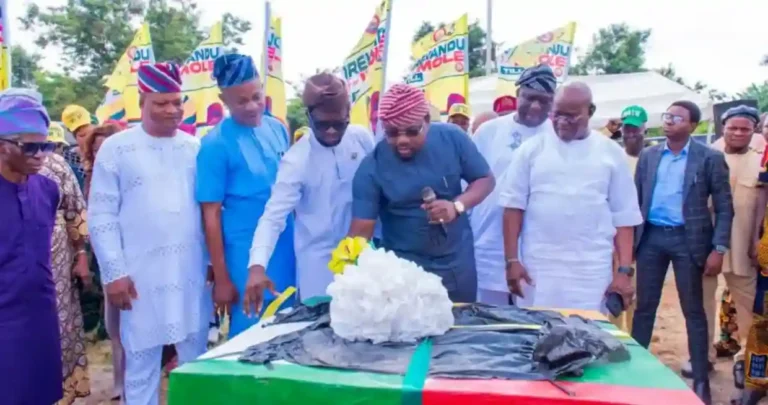
A member of the Osun State House of Assembly, Adewumi Adeyemi, on Sunday empowered residents of his constituency with work tools, cash support, and business equipment valued at over ₦100 million.

Mr Adeyemi, who represents the Obokun State Constituency, distributed multipurpose mobile shops fitted with point-of-sale POS machines and a start-up grant of ₦200,000 each to 10 Persons Living With Disabilities PLWD as part of the intervention.

The lawmaker also presented clippers and generators to barbers, hair dryers to hairdressers, sewing machines to fashion designers, grinding machines and deep freezers to traders, and motorcycle tyres to commercial riders. Cash gifts were equally given to support several small-scale businesses across the constituency.

He said the empowerment programme, which forms part of his annual constituency project, was designed to reach at least 300 beneficiaries and help them build sustainable sources of income.

Speaking during the distribution exercise in Obokun, Mr Adeyemi said the initiative was aimed at creating lasting economic opportunities for the people.

“I do this every year, not for politics, but because I know the pain of having skill without tools. This programme is not solely about providing financial assistance. It is serving as a lifeline for our people to regain their dignity,” he said.

He added, “When a father or mother takes home a grinding machine or a deep freezer today, he isn’t just taking home a tool; he is taking home the assurance that he can feed his family tomorrow.”

Mr Adeyemi said the project reflects his commitment to ensuring that governance delivers real benefits at the grassroots.

“This initiative aligns with the broader goal of empowering every citizen to access the dividends of democracy and experience the impact of governance,” he stated.

He further said, “This is not solely about providing financial assistance. This is my covenant with the people of Obokun, to serve with empathy and to ensure that governance touches the lowest among us.”

In addition to the empowerment programme, the lawmaker constructed a motor park in the Ibokun area of Obokun Local Government Area to improve transportation and commercial activities.

The Speaker of the Osun State House of Assembly, Adewale Egbedun, who inaugurated the motor park, commended Mr Adeyemi for the initiative and urged other lawmakers to emulate the gesture.

Mr Egbedun said the empowerment programme would have a lasting impact on beneficiaries and significantly improve their livelihoods across the constituency.

Awele Mega Empowerment Reaches Over 1000 Kwara Beneficiaries

0

The Deputy House Leader of the Kwara State House of Assembly and member representing Ejidongari/Lanwa Constituency, AbdulRaheem Medinat, has empowered over 1,000 constituents through a multi-million-naira intervention tagged Awele Mega Empowerment 2025.

The empowerment programme was held on Sunday at Pilot Secondary School, Bode-Saadu, Moro Local Government Area, and featured the distribution of cash and work tools aimed at boosting livelihoods and economic self-reliance among beneficiaries across the constituency.

Speaking at the event, Hon. Medinat urged beneficiaries to “put the items to good use to improve your standard of living and become financially independent.” She said the initiative was designed to support widows, youth entrepreneurs and skilled artisans.

She also called on residents to continue to support the administration of AbdulRahman AbdulRazaq, noting that “unity and collective responsibility remain key drivers of development in Kwara State.”

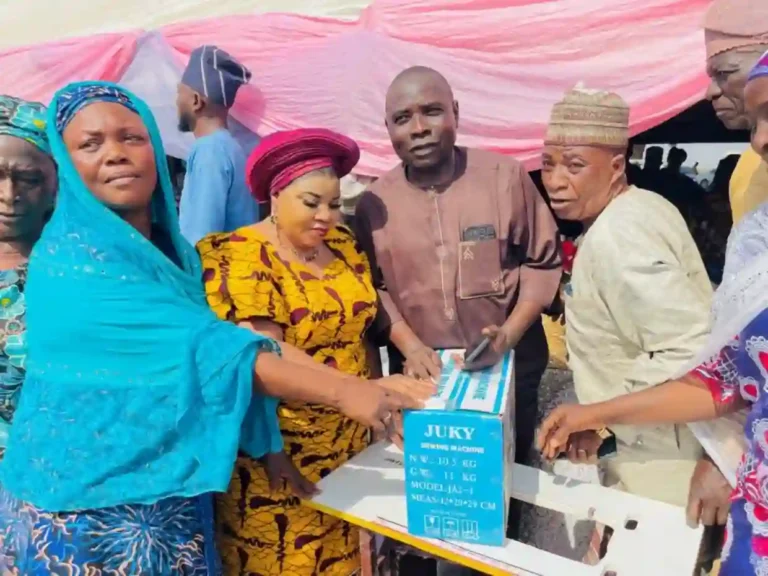
As part of the programme, over 500 beneficiaries received cash support ranging from ₦50,000, ₦30,000 and ₦20,000. Items distributed included freezers, sewing machines, grinding machines, generators and Point-of-Sale POS machines, alongside direct cash support to widows, youths and artisans.

Hon. Medinat expressed appreciation to Governor AbdulRahman AbdulRazaq for his support, as well as party members and stakeholders who ensured the success of the programme.

Several dignitaries graced the occasion, including the APC Kwara State Deputy Chairman, Abdullahi Sanmari; Chairman of Kwara SUBEB, AbdulRaheem Shehu Adaramaja; Special Adviser to the Governor on Party Affairs, Moshood Alaka; Chairman of Moro Local Government, AbdulWasiu Mariam; Commissioner for Education, Lawal Olohungbebe; and former Deputy Speaker of the Kwara State House of Assembly, Mathew Okedare Jebba.

Adamawa Govt Disburses N5bn Cash to 100,000 Residents

Adamawa State Government has flagged off a major poverty reduction initiative with the disbursement of N5 billion to beneficiaries under the Fintiri Business Wallet, a programme designed to support small businesses and improve household incomes across the state.

The programme, implemented through the poverty alleviation agency under the Ministry of Entrepreneurship, is set to empower 100,000 beneficiaries with 50,000 naira each across the 226 political wards of the 21 Local Government Areas of Adamawa State. The official flag off ceremony marked the beginning of what the government described as a deliberate intervention to strengthen small and medium scale enterprises and uplift livelihoods.

Speaking at the event, the Director General of the Poverty Alleviation and Wealth Creation Agency, PAWECA, Michael Zira, said the initiative goes beyond cash distribution. “Today we are merely disbursing funds. We are transforming lives and securing the economic future of Adamawa State,” he stated.

Stakeholders at the ceremony described the programme as a practical and timely response to economic hardship, noting that direct support to citizens helps sustain livelihoods and restore confidence in productive work at the grassroots.

The Deputy Governor of Adamawa State, Kaletapwa Farauta, who represented Governor Ahmadu Umaru Fintiri at the event, reaffirmed the administration’s commitment to people focused policies, stressing that poverty reduction remains central to the government’s agenda.

“About N5 billion as of today will be put into the economy of Adamawa State to ensure that the lives of our people are not only improved but that the economy of Adamawa continues to strive to bring Adamawa to the level of competing with other states across Nigeria,” she said.

Farauta also highlighted the social impact of the programme, noting that many beneficiaries previously lacked the means to start small businesses. “I also want to let us know that as we stand here today are people that have could not do a small business on their own and 100,000 of them will be empowered so that they can put their hands to a skill or to a small business to ensure that every household has something that they depend on,” she added. The programme targets inclusive growth statewide.

Registration Opens for March 2026 Diet ATSWA Examinations

0

Registration for the March 2026 Diet ATSWA Examinations has officially begun, marking another opportunity for aspiring Accounting Technicians to advance their professional journey. According to the Institute, “this is the perfect time for every aspiring Accounting Technician to take the next confident step toward a rewarding professional future.”

The examination is scheduled to take place from Tuesday, 24 March to Wednesday, 25 March 2026. Candidates are advised to register early and take note of the key dates. Registration opened on Monday, 8 December 2025, and will close on Thursday, 19 March 2026. The deadline for the change of exam centre is also Thursday, 19 March 2026, by 12 noon.

Candidates can download their exam dockets from Sunday, 22 March 2026, through the Institute’s official website at icanportal.org/ats/Examinations. For further enquiries, applicants are encouraged to contact the ATSWA exam team via telephone or email as provided on the official flier.

MDCN to Update Federal Housemanship Vacancies on Portal January 2

0

The Medical and Dental Council of Nigeria (MDCN) has announced that vacancies for housemanship placements in federal institutions will be updated on its portal on Tuesday, 2nd January 2026. The council advised all interested applicants who intend to serve in federal hospitals to regularly check the portal for available slots, as postings are handled through a centralized system.

According to the council, doctors and dental practitioners who receive their provisional registration certificates during induction ceremonies are required to create a profile on the MDCN Housemanship Portal at www.housemanship.mdcn.gov.ng. This registration grants applicants access to apply for housemanship positions across 46 federal training institutions nationwide that are managed under the MDCN framework.

MDCN warned applicants against directly contacting federal institutions or the council to seek placement, either personally or through proxies, including parents. It stated that such actions are considered a contravention of the Centralized Housemanship Placement System and may lead to denial of access to the portal. The council stressed that applications outside the approved process are not permitted under existing policies.

Providing further clarification, MDCN noted that portal updates apply strictly to the 46 federal hospitals approved for centralized housemanship placement. Each hospital has a specific number of slots allocated to it based on parameters required for effective training. The council emphasized that “there is never a time when the portal is ‘closed’ or ‘opened’,” explaining that hospitals only appear on the portal when vacancies exist.

Applicants were also informed that there are 70 non-federal hospitals where housemanship placements are available. For these institutions, MDCN advised candidates to directly approach the hospitals to inquire about available opportunities, as they are not covered under the centralized posting scheme.

The council added that the full list of approved hospitals under the centralized scheme, details on how the system works, and a comprehensive list of all accredited federal, state, private, and military housemanship training institutions are available on the MDCN website. MDCN reminded applicants that the opportunity is exclusive to Medical and Dental practitioners only. Applicants are encouraged to rely solely on official MDCN channels for updates.