Home Blog Page 211

Abia MoBSE directs teaching applicants to update applications

The Ministry of Basic and Secondary Education (MoBSE) has sent SMS to applicants who applied for teaching jobs to log in to their dashboard and update their application before December 30, 2025.

The message reads: “Dear Applicant,

You are hereby directed to update critical fields in your application before 30 Dec, ’25.

Step 1. Generate your Login Credentials for the MOBSE Portal.

Step 2. Using the Login Credentials generated, log in via the Returning Applicants on MOBSE Portal and update your application.”

To update required fields in your application and generate login credentials, applicants should visit the MOBSE portal for returning applicants jobsregister.mobse-abiastategov.ng/Login.aspx.

The notice applies to all teaching applicants.

Advertisement

Adamawa to Disburse N50,000 Fintiri Business Wallet to 100,000 Beneficiaries

0

The Adamawa State Government, through PAWECA under the Ministry of Entrepreneurship Development, has announced the 2025 last quarter disbursement of the Fintiri Business Wallet. The programme will distribute N50,000 to beneficiaries, mainly small-scale business owners.

The event holds on December 23, 2025, by 10:00am at Government House, Yola. “All able beneficiaries should attend punctually,” DG PAWECA, Dr Michael Zira, said. It is scheduled for the Banquet Hall venue tomorrow morning.

FG, IFAD create 12,000 permanent jobs through VCDP

0

The , in partnership with the , has created no fewer than 11,890 permanent jobs through the Value Chain Development Programme (VCDP), strengthening agribusiness development and improving rural livelihoods across Nigeria.

The VCDP, described as Nigeria’s flagship agricultural intervention, is currently being implemented in nine states: Anambra, Benue, Ebonyi, Niger, Ogun, Taraba, Kogi, Nasarawa and Enugu. The programme places strong emphasis on empowering women, youth and smallholder farmers along the rice and cassava value chains, while supporting inclusive economic growth in rural communities.

Speaking at a media roundtable, the National Programme Coordinator of IFAD/VCDP, Dr. Fatigue Aliyu, said the jobs created cut across different age groups and genders, with 3,128 women, 2,710 men and 6,052 youths now owning and managing various agribusiness enterprises under the programme.

“The intervention has helped to reduce rural-urban migration, particularly among young people, while also empowering vulnerable women through sustainable income-generating activities,” Dr. Aliyu stated.

She explained that the programme had improved the livelihoods of smallholder farmers by increasing productivity, expanding access to markets and investing in critical rural infrastructure in participating states, adding that the combined approach was helping farmers move from subsistence to more commercial operations.

According to her, over 5,248 youths had been gainfully engaged in agribusiness ventures such as seed production, mechanised equipment leasing, extension services, agro-input distribution and the marketing of processed farm produce.

“VCDP has fuelled unique income-generating opportunities for women and youth, enabling them to actively participate across the agricultural value chain,” she said.

Dr. Aliyu further disclosed that 1,987 women had been trained in the production of value-added food products from pro-vitamin A cassava and brown rice, an initiative aimed at improving household nutrition while increasing income opportunities for rural women.

To enhance rice self-sufficiency, she said the programme invested heavily in land development in collaboration with host communities, expanding access to farmland for landless women and youth.

“With over 2,250 hectares of land developed, VCDP has increased access to productive farmland for women and young people, and this success has encouraged strong state government buy-in and ownership of the programme,” she added.

Beyond job creation, Dr. Aliyu noted that the programme had significantly reduced post-harvest losses and improved product quality through investments in infrastructure, including the development of over 6,900 hectares for dry-season irrigation, exceeding initial targets set at inception.

She added that the construction and rehabilitation of rural feeder roads, markets, processing centres and storage facilities had helped farmers transport their produce more efficiently. Processors, particularly women, also benefited from modern equipment such as energy-efficient false-bottom rice parboilers, which improve product quality while lowering energy costs.

On capacity building, Dr. Aliyu said VCDP focused on strengthening farmer organisations and equipping beneficiaries with modern agricultural and business management skills.

“Thousands of farmer organisations have been registered and strengthened, improving their bargaining power, access to inputs and linkages to markets,” she said.

She added that women and youth had also received specialised training in value-added enterprises, including briquette production from agricultural waste, as well as access to digital tools for market information and agribusiness services.

Addressing climate challenges, Dr. Aliyu explained that the programme had mainstreamed climate-smart agricultural practices such as flood and drought-tolerant crop varieties, improved drainage systems and sustainable soil management techniques to boost resilience.

She also highlighted the Commodity Alliance Forum as a key innovation linking smallholder rice and cassava farmers with reliable buyers, financial services and quality inputs. “Through CAF, we are building inclusive and sustainable value chains that enhance productivity, improve incomes and strengthen national food security,” she said.

Earlier, the IFAD/VCDP Knowledge Management and Communication Advisor, Mrs. Vera Onyeaka-Onyilo, commended the media for its partnership with the programme, explaining that the roundtable was organised to promote idea-sharing, ensure visibility and guide accurate reportage of VCDP activities nationwide.

Katsina to commence recruitment for Radda Special Model Secondary School

The Katsina State Government has officially set up a committee to prepare and coordinate recruitment into the Special Model Secondary Schools, beginning with the Radda Special Model Secondary School.

The committee was inaugurated by the Honourable Commissioner, Ministry of Basic and Secondary Education, Katsina State, Honourable Yusuf Sulaiman Jibia, who said the move was part of efforts to ensure a smooth commissioning and academic take-off of the school.

The inauguration aligns with the “Building Your Future” agenda of the Executive Governor of Katsina State, Malam Dikko Umar Radda, PhD, CON, under which education has been identified as a major driver of sustainable development in the state.

The state government had earlier initiated the establishment of three Special Model Secondary Schools, with one school located in each of the three Senatorial Zones of Katsina State. Construction works and related activities across the schools have progressed significantly, with the Radda school reaching an advanced stage that makes it ready for commissioning.

Speaking at the inauguration, the Commissioner said the Special Model Schools were designed to serve as centres of excellence. According to him, “upon completion, the Special Model Schools are envisioned to serve as beacons of hope and centres of excellence, providing a safe, inclusive and supportive learning environment that promotes academic excellence, innovation, and social cohesion.”

He explained that the committee was constituted to oversee the commissioning process and supervise the initial operational phases of the school to ensure a smooth transition into full academic activities, in line with the state government’s education standards.

The committee is chaired by the Special Adviser on Education, Honourable Nura Saleh Katsayal, while the Permanent Secretary, Hajiya Ummulkhair Ahmed Bawa, serves as Co-Chairman. Other members include Dr. Kabir Magaji Gafiya, Executive Chairman of SUBEB; Alhaji Sada Ibrahim Sada, Chairman of TSB; and Professor Kabir Matazu, mni, Executive Secretary of STEB.

Additional members are Hajiya Raliya Yusuf Jiba, Director Schools Senior; Alhaji Kabir Dodo, Director Schools Junior; Q.S. Shamsuddeen Hassan, Director Works; and Sani Danjuma Suleiman, Public Relations Officer. The committee also includes representatives of Hallmark Consultancy Firm, Special Schools Project Consultants, and Dr. Mustapha Shehu, AGILE Coordinator.

Bashir Ya’u, Media Aide to His Excellency, is also a member, while Aminu Lawal Galadanchi, Assistant Director, Special Model Schools, MBASE, will serve as Secretary of the committee.

According to the terms of reference, the primary purpose of the committee is to kick-start operations at the Special Model Secondary School, Radda. This includes coordinating preparatory activities, addressing outstanding construction or setup issues, and facilitating the commencement of academic sessions.

The committee is expected to ensure that the school meets required standards of excellence, modern facilities, and smart learning environments. Its objectives include finalising outstanding infrastructure works through inspection and handover from contractors, developing an operational plan covering staffing, curriculum integration, and student enrolment, and identifying potential risks that could affect the school’s take-off.

The scope of work also covers conducting site inspections to confirm readiness of facilities, finalising recruitment and orientation of teaching and non-teaching staff, and ensuring timely procurement and installation of educational materials, technology, equipment, and facilities.

Other responsibilities include developing a detailed startup timeline, securing outstanding approvals, identifying pending procurements such as uniforms, beddings and utensils, issuing admissions through the CDP, coordinating the commissioning ceremony, testing installed systems, ensuring adequate publicity, and co-opting additional members where necessary.

The committee is to commence work immediately after inauguration and has been given two weeks to complete its assignment.

Kano PHC to begin recruitment of Community Health Workers

The Kano State Primary Health Care Management Board (KNSPHCMB) has announced plans to begin the screening and recruitment of Community-Based Health Workers (CBHWs) as part of efforts to strengthen healthcare delivery across the state.

In a move aimed at deepening primary healthcare and improving maternal, newborn, and child health outcomes, the Board convened a strategic planning meeting focused on the upcoming recruitment exercise. The initiative is part of the state’s wider health system strengthening agenda designed to expand access to quality, people-centered healthcare, especially at the community level.

The Director General of KSPHCMB, Professor Salisu Ahmad Ibrahim, was represented at the meeting by the Director of Environment and Public Health, Sani Abdu Ungogo. Ungogo reaffirmed the Board’s commitment to ensuring a skilled and accountable health workforce at the community level. He said, “A rigorous and transparent recruitment process is critical to sustaining health sector reforms and improving service delivery for underserved populations across the state.”

The planning meeting was supported by UNICEF and the UK Foreign, Commonwealth & Development Office (FCDO) under the Lafiya Programme, highlighting the continuous support and confidence of development partners in Kano State’s health reform efforts. The collaboration reflects a shared goal of improving human resources for health, boosting frontline service delivery, and aligning with global best practices in health management.

Discussions during the meeting centered on orienting state and Local Government Area (LGA) screening facilitators and supervisors on the CBHW and Skilled Birth Attendant (SBA) screening process under the MAMII framework. Participants also worked on harmonizing strategies, tools, and operational guidelines to ensure a credible and merit-based screening and recruitment exercise across all LGAs in the state.

Abia approves civil service jobs for 50 TechRise ICT graduates

The Abia State government has approved the employment of 50 outstanding graduates of the TechRise Information Communication Technology programme into the state civil service. Governor Alex Otti made the announcement during the TechRise Cohort 2 graduation ceremony held in Umuahia.

Otti directed the Head of Service to begin the documentation process, noting that the employment would follow due process and require valid credentials from the selected beneficiaries. He explained that the employment embargo in the state was temporarily lifted to accommodate the 50 graduates and would be reinstated immediately after the completion of the exercise.

The governor also announced that 849 graduates of the TechRise programme would receive laptops to support their professional growth. He added that the best-performing participants would receive an additional N100,000 cash reward for outstanding performance.

In the spirit of the festive season, Otti further approved a N50,000 Christmas support fund for each graduate and directed that transportation be provided to convey them to their respective local government headquarters. He said the TechRise initiative reflected his administration’s firm belief that the future of Abia State depended on the creativity and potential of its youth.

According to him, the graduation ceremony increased the total number of beneficiaries trained under the TechRise programme in the last 12 months to 1,359. The governor said the graduates would play key roles in providing critical manpower for the state’s ongoing digital transformation agenda.

Otti described TechRise as a strategic investment in human capital designed to promote innovation, job creation and efficient service delivery across Abia. He said the participants acquired advanced digital skills in full-stack development, cybersecurity, mobile app development, data analysis and Artificial Intelligence engineering.

He encouraged the graduates to keep improving their skills and to use their knowledge to advance Abia’s economy. The governor commended relevant ministries and the 17 local government councils for their collaboration, which he said contributed to the success of the programme.

The Commissioner for Local Government and Chieftaincy Affairs, Mr Uzor Nwachukwu, described TechRise as an advanced digital skills initiative for young people in the state. He said the project was implemented jointly by the state government and the local government councils in partnership with LearnFactory Nigeria.

The Commissioner for Science, Technology and Innovation, Mr David Kalu, advised the graduates to take advantage of policies such as the Abia Startup Law to promote innovation and entrepreneurship. “Yes, you are now qualified for good jobs, and I encourage you to pursue them, but I also challenge you to think bigger and think to start up something new,” Kalu said.

Similarly, the Commissioner for Sports and Youth Development, Mr Nwaobilor Ananaba, described the graduates as agents of change who should apply their skills to become job creators in the state and the nation.

The Chief Executive Officer of LearnFactory Nigeria, Mr Chibueze Ukegbu, who also serves as the TechRise coordinator, said the programme focused on building competence in skills, leadership and entrepreneurship. He expressed confidence that the initiative had refined the graduates into better individuals capable of making meaningful contributions to societal growth.

The event featured project presentations, certificate awards and a minute of silence in honour of a deceased participant, Princewill Ogbunna.

Bosun Tijani urges youths to leverage FG programmes for career growth

0

The Minister of Communications, Innovation and Digital Economy, , has urged Nigerian youths to pay close attention to government programmes and use them to build rewarding careers and contribute to national development.

Tijani said President consistently stresses that Nigeria, with an average age of 16.9 years and more than 60 per cent of its population under 30, cannot afford to ignore deliberate investment in young people. He noted, however, that such investments would not deliver results if young Nigerians failed to take advantage of the opportunities available to them.

The minister spoke at the close of a three-day end-of-year basketball competition tagged Tech Meets Basketball, organised by the Bosun Tijani Foundation at the Alake Sports Centre in Ijeja, Abeokuta, Ogun State. He said the programme combined sports, technology awareness and youth engagement to encourage young people to think beyond immediate challenges.

According to Tijani, the current generation of young Nigerians has access to information and opportunities that were not available in the past. While he acknowledged the right of youths to demand accountability from leaders, he stressed the need for them to also use existing resources to shape their future.

“We are living at a time when information is power, and that power should be used to build a glorious future for yourselves,” he said.

Sharing personal experiences, Tijani recalled that access to technology was limited during his early years. “When I was in secondary school in Abeokuta, I was desperate to learn computing, but there was no computer centre,” he said. “Things have changed now. Government has computer centres all over, including NCC centres. Some young people now live in Nigeria and work for foreign companies.”

He encouraged youths to take advantage of initiatives such as the Federal Government’s Three Million Technical Talent programme, which is designed to equip Nigerians with digital and technical skills for global opportunities. He also urged students to explore the Nigerian Education Loan Fund, describing it as a landmark effort to ensure that no Nigerian is denied tertiary education due to lack of funds.

“This has never happened before. Our youths must pay attention to what the government is doing, find ways to benefit, and become valuable to themselves, their families and the nation,” Tijani said.

Explaining why he sponsored the basketball tournament, the minister said it was part of his commitment to giving back to society and investing in young people. “If we truly care about Nigeria, we must invest in platforms that allow our youths to exhibit and hone their skills to become great in life,” he said. He added that the event also provided a space for young people to relax, socialise and celebrate at the end of the year, while disclosing plans to make the tournament an annual programme.

In his remarks, Ogun State Governor, , said the initiative aligned with his administration’s focus on youth empowerment, talent development and the use of sports to promote unity. Represented by his Chief of Staff, Toyin Taiwo, the governor commended Tijani’s approach to engaging young people.

“This tournament is more than a competition; it is a platform of hope, aspiration and purpose,” Abiodun said, noting that sports promote teamwork, discipline, resilience, leadership and respect. He urged youths not to allow their backgrounds to limit their ambitions but to remain focused and determined.

Recent Federal Government youth-focused initiatives include the 3MTT programme aimed at creating two million digital jobs by 2025, the distribution of over 2,000 CNG-powered tricycles, the establishment of the Nigerian Youth Academy to train seven million youths, and the creation of NELFUND to support access to tertiary education.

Shareholders approve N15bn recapitalisation plan for Guinea Insurance

0

Shareholders of Guinea Insurance Plc have approved a plan to raise up to N15 billion in additional equity as part of a comprehensive recapitalisation programme aimed at strengthening the company’s financial position.

The approval was granted during an Extraordinary General Meeting held virtually in Lagos on Monday, in line with the Business Facilitation (Miscellaneous Provisions) Act 2022 and the Companies and Allied Matters Act (CAMA) 2020.

As part of the resolutions, shareholders approved an increase in the company’s minimum issued share capital from N4 billion, comprising N8 billion ordinary shares of 50 kobo each, to N19 billion, comprising N38 billion ordinary shares of 50 kobo each. They also endorsed a plan to raise up to N15 billion in additional equity through a mix of rights issues and private placements.

Speaking at the meeting, the Chairman of the Board, Temitope Borishade, described the approval of the recapitalisation plan as a key milestone in the company’s transformation journey. He noted that the capital raise would strengthen the company’s balance sheet, restore its statutory capital position, enhance its underwriting capacity, and support its long-term growth strategies.

Mr Borishade said, “The overwhelming support of our shareholders reflects their confidence in the Board and Management’s strategy to rebuild Guinea Insurance Plc into a stronger, more resilient, and more competitive insurer. This recapitalisation plan is not only a regulatory requirement but also a strategic opportunity to create sustainable value for all our stakeholders.”

The board reaffirmed its commitment to transparency, strong governance, and the prudent use of the capital to be raised, stating that it would work closely with regulators and professional advisers throughout the process.

This development underscores the company’s dedication to building a forward-looking insurer capable of meeting the expectations of policyholders, investors, regulators, and partners, while supporting wider economic activity and ensuring sustainable returns to shareholders.

With all resolutions approved, Guinea Insurance Plc will now proceed with the required regulatory filings and steps to implement the rights issue and private placement.

Dangote Gboko launches empowerment programme for host communities

0

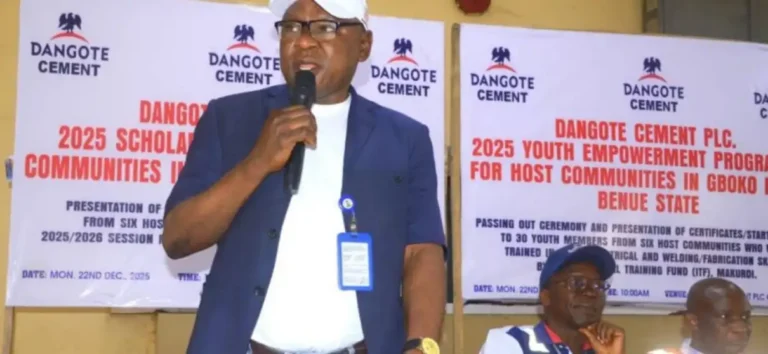
Dangote Cement Plc, Gboko Plant, has launched a wide-ranging social programme designed to promote sustainable economic empowerment across its host communities.

Speaking on Monday at the ceremony in Gboko, the Head of Social Performance of Dangote Cement Plc, Gboko Plant, Dr Johnson Kor, said the social initiatives were developed and executed in accordance with the provisions of the mutually agreed Community Development Agreement (CDA).

“In Dec. 2024, Dangote Group had a Community Development Agreement CDA with the six mining communities including the Mbayion Community who is the host community. Several projects were earmarked to cover the period of five years,” he said.

Dr Kor explained that the company had carried out several projects, while others were still ongoing. These include the Women Empowerment Programme, the Farmers Empowerment Programme, and the Youth Empowerment Programme.

As part of the event, the company presented certificates and starter packs to 30 graduands of the Youth Skill Development Programme. The gesture, according to him, was aimed at helping the beneficiaries to immediately apply their acquired skills and become self-reliant.

Other completed projects include the inauguration of motorized boreholes at Mbaswa, Agboghol, Mbatyu, and Pass Brothers communities, which were designed to improve access to clean water and enhance living conditions.

Also speaking at the event, the Plant Director of DCP Gboko, represented by the General Manager, Finance, Olusegun Orebanjo, said, “At Dangote Cement Plc, we do not see our host communities merely as neighbours, but as valued partners in progress. Our presence in Gboko is built on a strong belief that business success must go hand in hand with community wellbeing, and this philosophy continues to guide our operations and social investments. Today’s event is a clear expression of that shared journey.”

The Plant Director further assured that several CDA projects were currently ongoing. “While some projects are yet to commence due to technical complexities, we are actively addressing these challenges. We assure you that all outstanding projects will be executed in the coming year, alongside new initiatives aimed at deepening our social impact,” he added.