
Home Blog Page 228

PAP sends 4500 N’ Delta students on 2025–2026 scholarships within Nigeria

0

The Presidential Amnesty Programme has sent 4,500 students on scholarship to universities within Nigeria for the 2025–2026 academic session, as part of efforts to invest in the future of the Niger Delta. The Administrator of the Presidential Amnesty Programme, Dr Dennis Otuaro, said President Bola Tinubu is pleased with the achievements recorded by the agency in the region within about two years.

Otuaro spoke on Monday at the flag-off of the fourth batch of the two-day Leadership, Alternative Dispute Resolution, and Mediation Training for PAP stakeholders. The training was organised by the agency in collaboration with the Alumni Association of the National Defence College at the Nigerian Army Resource Centre, Abuja.

He recalled that the PAP successfully held similar capacity-building workshops for three batches of stakeholders in July and August 2025 at the same facility, noting that the exercise is part of a continuous peacebuilding process in the Niger Delta.

According to Otuaro, the President is delighted with the programme’s expanded scholarship scheme, inclusive engagement with stakeholders, and sustained peacebuilding efforts across the region. He urged stakeholders to continue playing active roles in promoting peace and development.

He said President Tinubu remains strongly supportive of the programme due to his desire for sustainable peace, stability, and development in the Niger Delta. Otuaro described the workshop as a vital component of the PAP peace process, stressing that all stakeholders are important partners.

He said participants are not only partners in peace efforts but also peace ambassadors of the President in their various communities. Otuaro also commended the National Security Adviser, Mallam Nuhu Ribadu, for providing strategic support that has strengthened the programme’s initiatives and helped it meet its objectives.

While declaring the workshop open, Otuaro said, “His Excellency, President Bola Ahmed Tinubu GCFR, is very happy with what we have achieved so far in one year and nine months. As stakeholders, you should continue to be key players in the peace and development of the Niger Delta, which His Excellency has been very supportive of and desirous of.”

He added, “The objective behind this training is to ensure that all of us are partners in every peace effort in the Niger Delta. This initiative is also to give you a sense of belonging.”

Otuaro said the agency had earlier assured stakeholders that more people would benefit from the training programmes. “When we organised this workshop in July and August this year, we assured stakeholders that more people would also participate in the training. We don’t want to do the PAP’s work alone. It is a process of putting our heads together to ensure that the region is peaceful and united. When we are united, Mr President will do more for the region,” he said.

He stressed that peace begins at the community level and described the participants as leaders in their own right. “We must also realise that peace starts from our communities; you all are leaders in your own rights. I know and acknowledge the support that the Office has received since we came on board. This leadership workshop is part of our peacebuilding process and is designed to ensure that peace is sustained in our region,” Otuaro stated.

Speaking on the scholarship programme, he said, “Since we came on board, we have redirected the Programme towards our people and for the next generation. We have achieved a lot. This 2025-2026 academic session, we have sent 4,500 students, our future leaders, on scholarships to universities within Nigeria. We are doing this to invest in the future of our region.”

Otuaro said his leadership would not be distracted by smear campaigns from what he described as anti-Niger Delta elements, adding that “nobody will hold the region to ransom.” He urged stakeholders not to allow themselves to be manipulated by political merchants and called on them to support President Tinubu’s 2027 re-election bid, citing the President’s clear agenda for the region.

He encouraged participants to engage actively in the workshop and apply the lessons learned to strengthen peace and development in their communities and across the Niger Delta. Otuaro also thanked the management of the Nigerian Army Resource Centre, the resource persons, and the President of AANDEC, Rear Admiral Ndidi Agholor (retd.), for partnering with the PAP to deepen the peace process.


Advertisement

NYSC Opens Portal for 2025 Batch C Remobilization Exercise

0

The National Youth Service Corps, NYSC, Management has announced the opening of the portal for the 2025 Batch ‘C’ Remobilization exercise. In a notice titled “Opening of Portal for Remobilization”, the scheme said the registration portal will be open from December 16 to December 23, 2025.

The notice stated that corps members who absconded during service and need to refund monthly allowances received should do so only on the dashboard.

It added that absconded corps members who registered during the 2025 Batch ‘B’ exercise but failed to document must register afresh. It was signed, “Management”. The statement thanked all concerned.

Sub-Saharan Africa to Create 230 Million Digital Jobs by 2030

By 2030, Sub-Saharan Africa is expected to generate 230 million digital jobs, driven by the rapid expansion of digital services, according to a World Bank report that places Africa’s youth at the center of the continent’s economic future. With about 60 percent of Africa’s population under the age of 25, the report says the region holds vast human potential that could be unlocked through inclusive digital transformation.

The report argues that Africa’s greatest wealth may not be its minerals, oil, or land, but its young people. It notes that millions of young Africans remain disconnected from the digital economy, not because they lack interest, but because they lack access, skills, and opportunities. In a global economy increasingly shaped by digital technologies and artificial intelligence (AI), this gap represents both a serious challenge and a major opportunity.

The World Bank describes the situation as a call to action. It says Africa is at a pivotal moment in its digital journey, with digital services expanding rapidly across the continent. If current efforts are strengthened and scaled, the expected 230 million digital jobs by 2030 could transform livelihoods, reduce poverty, and support long-term growth across Sub-Saharan Africa.

One of the central issues highlighted in the report is the digital divide. In 2024, internet penetration in Africa reached 40 percent, a sharp increase from just 3.2 percent in 2005. More than 600 million people now use mobile broadband internet. However, progress remains uneven. Over 900 million Africans are still offline, and about 76 percent face what the report calls a “usage gap.” These people live in areas with network coverage but cannot afford data, devices, or do not have the skills needed to use digital services. In rural areas, internet access drops to just 28 percent.

The report stresses that bridging the digital divide is both a social and economic priority. Digitalization is expanding access to education, healthcare, financial services, and markets. It helps reduce inequality, empowers communities, and supports job creation. The arrival of international submarine cables and mobile broadband has already increased labor force participation and incomes in several African countries. According to the World Bank, these changes also create spillover benefits for agriculture, industry, and tourism.

Local success stories show what is possible. In West and Central Africa, countries like Benin have made significant progress. In Benin, more than 250 public services are now available online. Fiber optic connections have reached 68 municipalities, and mobile network coverage now extends to 92 percent of the country’s territory. Community-based digital training programs have helped thousands of people gain new skills. The report highlights the example of Awa, a high school student who can now access online learning and mentorship platforms, opening new opportunities in education, entrepreneurship, and civic participation.

The World Bank notes that such successes should not be isolated cases. Despite growing network coverage, nearly 700 million Africans still do not use the internet. The report says this shows that access alone is not enough. Data must be affordable, digital services must be relevant to daily needs, and digital education must be strengthened to help people fully participate in the digital economy.

The report also points to a key moment ahead. Leaders, policymakers, private sector actors, and civil society groups are expected to meet in Cotonou, Benin, on November 17 and 18, 2025, for the Regional Summit on Digital Transformation in West and Central Africa. Discussions will focus on closing the usage gap, opportunities linked to AI, and building a single digital market for the region.

Africa’s AI market is estimated to be worth $2 billion by 2025, driven largely by startups and the use of optimization tools and consumer services. The World Bank says the goal should go beyond adoption to include adaptation and local creation. Ethical and locally relevant AI solutions are already emerging. In Benin, AI is being used in agriculture, health, education, and public services, including a Fon language speech recognition model designed to improve access for rural and elderly populations. Similar innovations are taking place across the continent.

To scale these efforts, the report calls for more investment in STEM education, basic digital infrastructure, and enabling regulatory frameworks. It highlights the African Union’s Digital Transformation Strategy (2020–2030) as a roadmap toward a harmonized digital marketplace. Africa’s e-commerce market, valued at more than $50 billion in 2024, is expected to grow by at least 10 percent each year. Achieving this growth will require better regional connectivity, cross-border data flows, interoperable platforms, and strong rules on cybersecurity and data protection.

The World Bank says the Cotonou summit will offer a chance to renew commitments to inclusive digital progress, digital job creation, and deeper regional integration. It notes that governments, the private sector, civil society, and development partners, including the World Bank itself, are working through new partnerships and digital compacts to mobilize investment.

The report adds that the summit will ensure “everyone has a voice,” with governments leading reforms, businesses investing in innovation, and youth contributing creativity and resilience.

Joint Revenue Board urges states to fast-track harmonized taxes, levies bill

0

Joint Revenue Board, JRB, has called on all states to expedite action in passing the Harmonized Taxes and Levies (Approved List for Collection) Bill into law, to ensure uniform application of taxes, rates, and levies at the sub-national level, in line with national objectives of ongoing tax reforms.

The call was contained in a communiqué issued at the end of the 158th meeting of the Joint Revenue Board held on December 9 and 10, 2025, at Transcorp Hilton, Abuja. The meeting focused on strengthening coordination across federal and state revenue systems.

According to the communiqué, the Board deliberated on its transition to the Joint Revenue Board and the implications for national and sub-national revenue administration. The meeting was held under the theme “Managing Transition: Driving Transformation, Building the Future of Tax Administration in Nigeria.”

The Board commended the Federal Government for what it described as “far-reaching fiscal policy and tax reforms,” noting that the reforms have strong potential to enhance revenue mobilization, promote economic competitiveness, improve ease of doing business, and deepen fiscal sustainability across the federation.

It also lauded the transition of the Joint Tax Board into the Joint Revenue Board, describing it as a bold step toward a more coordinated, efficient, and coherent national revenue administration framework. The communiqué noted that the JRB is expected to strengthen collaboration among revenue authorities, enhance information sharing, and improve tax compliance nationwide.

The Board further affirmed that the future of tax administration depends on accurate, comprehensive, and interoperable data. It resolved that strengthening data sharing frameworks and deploying analytics tools for revenue administration purposes will support streamlined processes and harmonization of revenue practices across all levels of government.

On enforcement challenges, the Board restated its commitment to eradicating non-state actors within the revenue administration value-chain. It called on the Office of the National Security Adviser, the Nigeria Police Force, and other relevant security agencies to take immediate steps to eliminate illegal roadblocks mounted along transport corridors for the collection of taxes, levies, rates, and charges.

The communiqué also re-emphasized the outright abolition of the design, production, issuance, and enforcement of road stickers and related instruments by both state and non-state actors. Nigerians were encouraged to resist such practices and report promoters of illegal stickers to security authorities for appropriate sanctions.

The communiqué was signed by Zacch Adedeji, PhD, Chairman of the Joint Revenue Board, and Olusegun Adesokan, Executive Secretary, Joint Revenue Board. The Board said the measures will support transparency, reduce duplication, and improve trust in Nigeria’s tax system nationwide today

FG Targets N160bn Wheat Output for 2025/2026 Dry Season

0

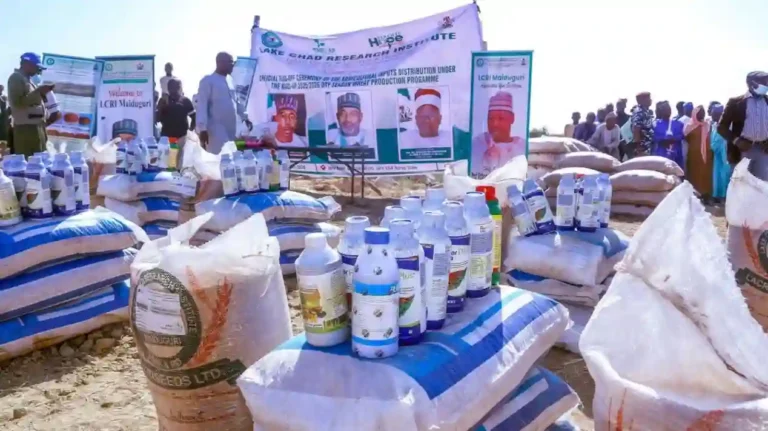
The federal government has announced plans to generate an output value of about N160 billion from wheat production during the 2025/2026 dry season, as part of efforts to strengthen food sovereignty and reduce reliance on imported grains.

The Minister of Agriculture and Food Security, Sen. Abubakar Kyari, disclosed this at the flag-off of the Subsidised Agricultural Inputs Distribution for the 2025/2026 dry season wheat production programme under the National Agricultural Growth and Agro Pocket Project, NAGS-AP, held in Jere Local Government Area of Borno State in Northeastern Nigeria.

Kyari explained that through the NAGS-AP programme, 40,000 hectares of land have been earmarked nationwide for dry season wheat production, while 80,000 farmers have been registered for the current season, with an expected output value of approximately ₦160 billion.

He said that of the total land set aside, 3,000 hectares were allocated to Borno State, with 6,000 registered wheat farmers expected to participate in the programme across the state.

Recalling achievements from previous seasons, the minister said, “Under the 2023/2024 dry season wheat production programme, a total of 107,429 registered farmers were supported with critical subsidised inputs, resulting in an output valued at ₦474,628,000 billion. During the 2024/2025 dry season, 279,297 registered farmers received support, with an output valued at ₦893,750,004 billion.”

He noted that “for the current 2025/2026 season, the programme is targeting 80,000 registered farmers with an expected output value of approximately ₦160 billion,” adding that the focus remains on improving productivity and farmer income.

Kyari stated that the NAGS-AP programme would deploy Agricultural Extension Agents to guide farmers on modern agronomic practices and provide continuous advisory services at the field level throughout the production cycle.

He added that “Fertiliser and Seed Quality Control Officers will be mobilised to ensure that all inputs delivered to farmers meet the required standards, thereby guaranteeing higher productivity and improved yields.”

According to the minister, “the wheat component of the NAGSAP programme covers sixteen states of the federation,” listing Adamawa, Bauchi, Borno, Cross River, Gombe, Kaduna, Kano, Kebbi, Niger, Plateau, Sokoto, Taraba, Yobe, and Zamfara.

He explained that the inclusion of Cross River State in the previous year marked the first expansion of wheat production into the southern region, strengthening national capacity to diversify production across different ecological zones.

Kyari further pointed out that the project was designed to promote inclusion, noting that women and young people were key beneficiaries of the programme’s training and agricultural opportunities.

“NAGS- AP is deliberately designed to leave no one behind. The programme ensures that farmers across communities, including women and young people who play vital roles in our agricultural workforce, have equitable access to inputs, training, and opportunities,” he said.

The minister stressed that input quality remained central to the success of the programme, stating that “the success of any agricultural season depends on the quality of inputs that reach our farmers.”

He said, “Without certified seeds, accurate fertiliser blends, and timely access to crop protection products, no level of effort in the field can deliver the yields we require as a nation.”

“This is why NAGS- AP places strong emphasis on input quality, traceability, and transparent delivery systems, ensuring that every farmer receives the right inputs at the right time to achieve higher productivity and better returns,” Kyari added.

In his remarks, the Governor of Borno State, Prof. Babagana Zulum, appreciated the federal government for its continued support for irrigation development and agricultural growth.

He stated that “Mr President’s commitment to food security and national productivity provides the foundation upon which programmes like this are built.”

Zulum noted that “Borno State, with its vast arable and irrigable land, especially within the Lake Chad Basin, remains one of Nigeria’s most promising agricultural frontiers.”

He said the event symbolised progress, adding, “Today is more than a ceremony; it is a celebration of hope, resilience, and our unwavering commitment to ensuring that no family in Borno State goes hungry and no farmer is left behind.”

Despite challenges such as displacement, insecurity, and climate shocks, the governor said the state remained committed to growing its own food and empowering farmers.

Zulum reaffirmed his administration’s commitment to sustaining all-season farming through the provision of infrastructure, logistics, modern machinery, improved seeds, fertilisers, agrochemicals, and other essential inputs.

He added that “Borno State has achieved remarkable milestones under our people-centred agricultural vision,” noting that input support programmes had reached thousands of smallholder farmers.

50 Women Empowered in Ukwo Ward Through Wrapper and Cash Support Initiative

No fewer than 50 women in Ukwo Ward benefited from an empowerment initiative held on December 14, 2025, where wrapper materials and cash support were distributed to improve welfare and strengthen economic resilience among beneficiaries.

The empowerment programme was facilitated by Hon. Abdulkarim Muhammad Danjuma, the Ward Special Assistant (WSA) appointed by Kogi State Governor, His Excellency, Alhaji Ahmed Usman Ododo. The initiative formed part of efforts to support grassroots development and promote community inclusion.

Speaking during the event, Hon. Danjuma described the exercise as a personal commitment to giving back to the people of Ukwo Ward. He said the programme reflects the administration’s people-centered approach to governance and its focus on directly impacting lives.

“I am grateful to Almighty Allāh for the opportunity and the success of this programme,” Danjuma said, noting that supporting women remains important to building families and economies.

He also commended Governor Ahmed Usman Ododo for providing him with the platform to serve, describing the governor as “a dynamic and pragmatic leader who empowers young people.”

Hon. Danjuma further acknowledged the support and mentorship of Engr. Abubakar Bashir Gegu, the Commissioner for Solid Minerals and Natural Resources, whom he described as his political mentor.

Special appreciation was extended to Hon. Bala Ette for attending the event, as well as members of the 4G networks, Ododo Youth Ambassadors (OYA), Ododo Vanguard, and other associations whose presence contributed to the success of the programme.

He thanked APC stakeholders for their support and reaffirmed his commitment to advancing the Tinubu/Ododo 2027 political agenda.

C’ River Gov approves REDI phase 2 to support 500 Civil Servants

0

Governor, Sen. Prince Bassey Otu, has approved the second phase implementation of the Retiree Entrepreneurship Development Initiative (REDI), set to benefit an additional 500 civil servants in Cross River State. The approval was disclosed during a courtesy visit by the management of the Cross River State Microfinance and Enterprise Development Agency (CRSMEDA) to the newly appointed Head of Service, Mr. Orok Okon, as part of efforts to strengthen engagement with civil servants.

In his opening remarks, the Director-General and Chief Executive Officer of CRSMEDA, Great Ogban, congratulated Mr. Okon on his appointment, describing him as an administrator with deep institutional knowledge. Ogban also acknowledged the Head of Service’s support for the Civil Service Technology Empowerment for Capacity and High Performance (CIVTECH) program, which focuses on equipping civil servants with essential ICT skills to improve efficiency and service delivery.

Ogban announced that Governor Otu had approved the second phase of REDI, explaining that it would target civil servants with less than two years of active service remaining. He said the programme would cover beneficiaries across the three Senatorial Districts of the state. According to him, the initiative is designed to prepare workers for life after retirement by providing entrepreneurship education and practical skills aimed at reducing post-retirement poverty.

Responding, the Head of Service, accompanied by the Permanent Secretary, Glory Odu Orji, commended CRSMEDA for its consistent commitment to enterprise development across the state. He highlighted the impact of REDI, including the grant of Five Hundred Thousand Naira to each of the 500 beneficiaries under the new phase.

Mr. Okon stated that his administration is driven by a three-pronged strategy of professionalism, digitization, and cultural change. He said this approach is intended to make the civil service more attractive, efficient, and results-driven while upholding high standards.

He added that the Federal Government, through the Federal Civil Service, plans to transition to paperless documentation by 2026, stressing importance of embracing the CIVTECH program.

NDDC to Create 38,250 Agripreneurs with Life-ND Programme

The Niger Delta Development Commission, NDDC, has pledged to strengthen and expand the Livelihood Improvement Family Enterprises – Niger Delta, LIFE-ND, project to create over 38,250 new agric entrepreneurs and increase youth participation across key agricultural value chains.

The assurance was given by the NDDC Managing Director, Dr Samuel Ogbuku, during a one-day workshop on Scaling Up Youth Agripreneurship for Food Systems Transformation held at the Tinubu International Conference Centre, Abuja. The workshop was hosted by the LIFE-ND project and focused on the theme, “Scaling Up Youth Agripreneurship in Nigeria for Food Systems Transformation.”

Ogbuku, who was represented by the Acting Director of the NDDC Liaison Office in Abuja, Mrs Mary Nwaeke, said the Niger Delta and Nigeria at large possess vast agricultural potential that can be harnessed to drive economic growth and food security. He, however, acknowledged existing challenges including food inflation, fragmented agricultural value chains, ageing farming populations, climate related vulnerabilities, and limited access to finance and modern technologies.

According to him, these challenges present opportunities to nurture a new generation of agripreneurs who can revitalise rural economies and transform Nigeria’s food systems through innovation and enterprise development.

He reaffirmed the Commission’s readiness to partner with all relevant stakeholders to create an enabling environment where youth led agribusinesses can grow and compete sustainably. “We are not just building farms; we are building futures. We are not just cultivating crops; we are cultivating prosperity,” Ogbuku said.

The NDDC Chief Executive Officer further reiterated the Commission’s strong commitment to scaling up the Livelihood Improvement Family Enterprises – Niger Delta, LIFE-ND, project, describing it as a transformative platform capable of unlocking economic opportunities for thousands of young people across the Niger Delta.

He noted that the NDDC’s US$30 million counterpart funding demonstrates the Commission’s support for youth agripreneurship and economic growth in the region.

Earlier in his welcome address, the Permanent Secretary of the Federal Ministry of Agriculture and Food Security, Dr Marcus Ogunbiyi, restated the Federal Government’s commitment to strengthening food security nationwide. He urged stakeholders to deepen collaboration with development partners to ensure an effective food supply system across the country.

In his remarks, the Minister of Agriculture and Food Security, Senator Abubakar Kyari, expressed appreciation to the NDDC, LIFE-ND, and other partners for supporting government initiatives aimed at achieving national food security. He also commended the National Project Coordinator of the LIFE-ND project for ensuring the programme’s sustainability.

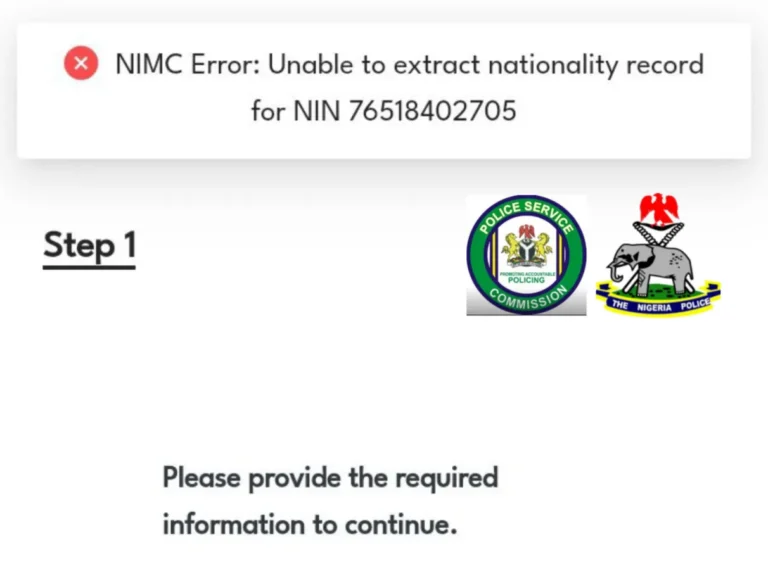
PSC Portal NIMC Error: unable to extract nationality record for NIN

Some applicants are unable to proceed with Nigeria Police Force recruitment on the PSC portal due to “NIMC Error: Unable to extract nationality record for NIN”.

The error is likely due to network glitch as thousands of applicants are actively on the PSC portal. Affected applicants are to keep retrying.

If that fails, the solution is to visit your NIMC office for NIN validation. Applicants do not have to worry about the recruitment portal, as it will close on January 25, 2026. That is a long time from today. So, whenever you have the time, proceed to the nearest office or an authorized NIN agent to correct the error, then continue with Police Service registration.

The PSC portal is not based on first come, first served, but on who is most qualified, especially meeting the age requirement.

After validation, input the NIN and other details in provided fields on the portal to obtain your bio-data information. Upon validation, you will be allowed to proceed into the Application Form.

NPF 2025 Candidate Application Status Says ‘Previously Applied’

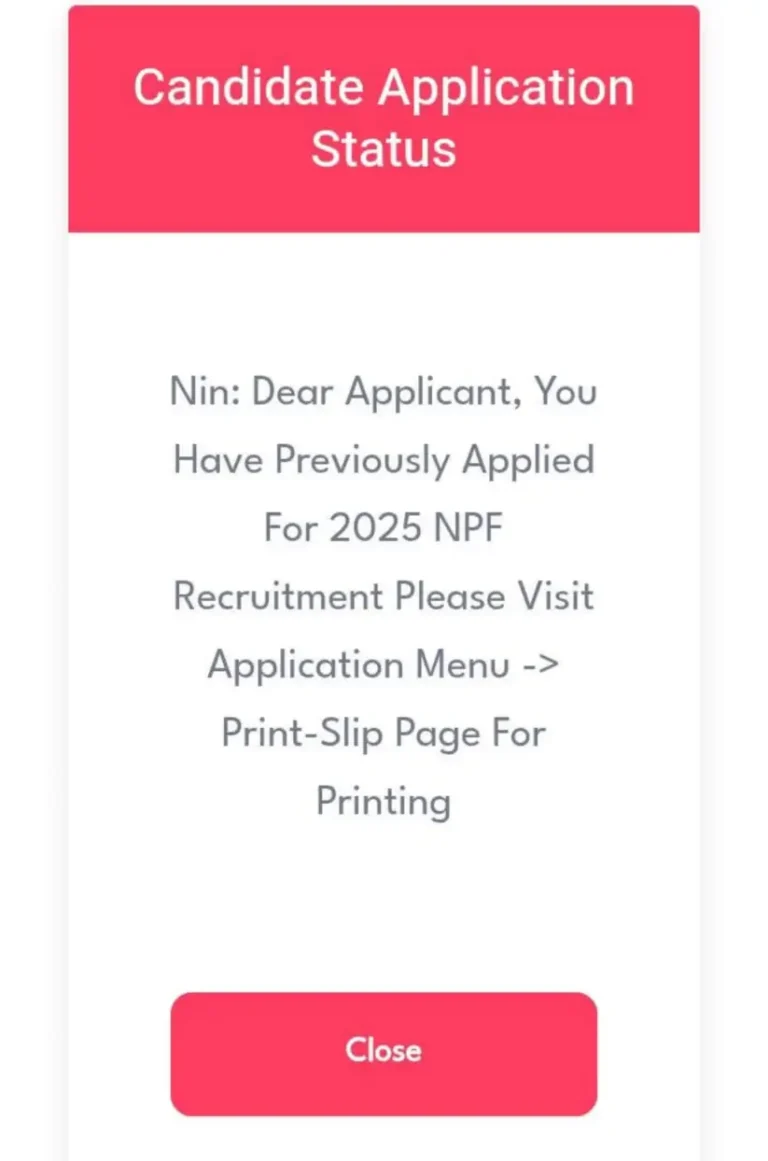
When applicants attempt to register for the Nigerian Police recruitment, they are notified if an existing application from a previous recruitment already exists. Applicants are then asked to print their slip, and the application may be accepted or rejected based on the age requirement.

The notification reads: “Candidate Application Status”.

It further states: “Nin: Dear Applicant, You Have Previously Applied For 2025 NPF Recruitment Please Visit Application Menu -> Print-Slip Page For Printing”.

On the 2025 Nigeria Police Force recruitment application confirmation slip, applicants may see “Failed Recruitment Application”.

The slip explains: “Age Requirement Failure: Nigeria Police Force recruitment for General Duty required candidate between 18-25years, but you are 31 years (Over Age) old according to NIMC Record”.

Following this notice, the Application Status becomes “Disqualified” for the selected Candidate Role, such as General Duty – Constable (SSCE) official notice.

Those yet to apply can do so Here.