Home Blog Page 243

FG, Plateau Push Innovation, Youth Empowerment in Digital Economy

0

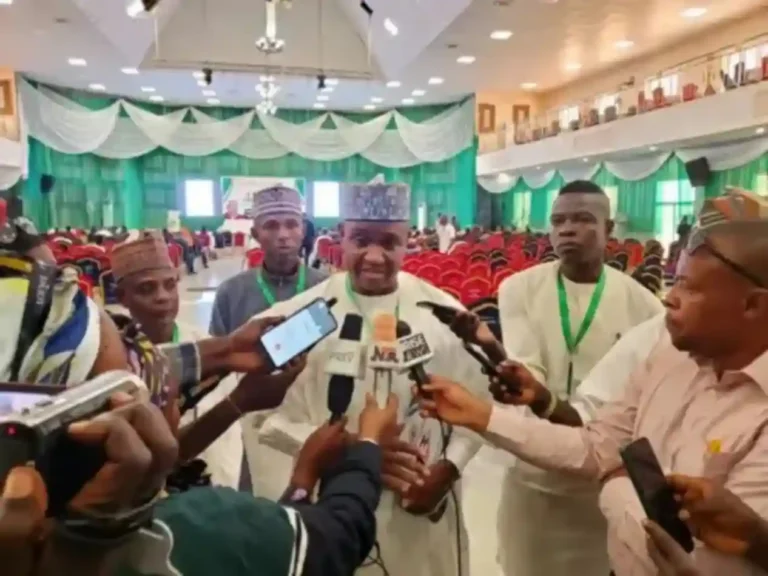
The Federal Ministry of Communications, Innovation and Digital Economy, working with the Plateau State Government, has opened the 13th Regular Meeting of the National Council on Communications, Innovation and Digital Economy in Jos with a strong call to close gaps between connected and underserved communities, support innovation, empower young people and strengthen the national digital economy through sustainable strategies. The proposals under review at the meeting focus on sustainability, job creation and mandatory training to deepen Nigeria’s digital economy.

The five-day meeting is taking place at Crispan Suites and Event Centre in Jos and brings together federal and state officials, regulators and industry leaders. The theme, Accelerating Inclusive Digital Transformation: Bridging Gaps and Fostering Sustainable Growth Through Innovation, sets the tone for discussions on how to improve Nigeria’s digital ecosystem.

Welcoming delegates, the Permanent Secretary of the Plateau State Ministry of Science, Technology and Innovation, Lamba Peter Bot, said Plateau State was proud to host the gathering. He described the meeting as “a renewed commitment to shaping Nigeria’s future through technology and inclusive digital progress.” He added that the theme serves as a call to action, urging participants to close digital gaps, empower young people and strengthen the digital economy using sustainable approaches.

In his remarks, the Permanent Secretary of the Federal Ministry, Nadungu Gagare, said the theme reflected an urgent need to push inclusive digital transformation across the country. He explained that technology now drives major sectors and must be deliberately used to guide Nigeria’s economic direction. He stressed that bridging digital gaps remained central to the Ministry’s work, noting the importance of broadband expansion, digital literacy and regulatory systems that protect citizens while allowing innovation. He reaffirmed the Ministry’s commitment to supporting startups, improving e-government services and positioning Nigeria as a strong hub for digital services.

Declaring the technical session open on behalf of Governor Caleb Mutfwang, the Plateau State Commissioner for Science, Technology and Innovation, Cletus Bako Shurkuk, welcomed participants and highlighted the need to ensure fair access to digital opportunities. He said Plateau State was committed to strengthening innovation, supporting startups and partnering with global organisations to build inclusive digital solutions.

The Director-General of PICTDA, Datong Dominic Gwanman, said hosting the council showed the state’s dedication to digital progress. He noted that PICTDA had already digitised school management processes and was expanding data-driven systems across sectors to support development.

The Permanent Secretary of the Kano State Ministry of Science, Technology and Innovation, Abba Guguwa, said the meeting would help produce strong memoranda to guide institutional reforms and boost national development. Dr Garba Gandu of NERDC said the meeting aimed to equip Nigeria with the frameworks needed to stay competitive in a fast-changing technological world and stressed the need for digital skills, global standards and targeted training.

Gagare ended the session with a review of memoranda on expanding rural telecommunications and improving data privacy, saying the proposals focused on sustainability and job creation.

Advertisement

FG Launches Ene Obi Development Centre to Boost Women’s Empowerment

The Federal Government on Tuesday reaffirmed its commitment to strengthening programmes that support women’s empowerment, families, and vulnerable groups as the Ene Obi Development Centre was officially inaugurated in Abuja. The Minister of Women Affairs and Social Development, Mrs. Imaan Sulaiman-Ibrahim, described the centre as a transformative space designed to equip women and girls with the skills, knowledge, and opportunities needed to thrive. She commended the initiative as a beacon of hope and an important driver of gender equality and socioeconomic growth for disadvantaged groups.

“With its focus on training, skills acquisition and support services, this centre reflects the power of education and resilience in driving positive change,” she said. She added that the Federal Government remains committed to programmes that uplift women, strengthen families and support vulnerable Nigerians. According to her, the centre will play a significant role in advancing collective efforts toward gender equality and women’s development. Sulaiman-Ibrahim also noted that the Ministry is open to partnerships, stressing that collaboration is essential for creating long-term impact.

The Executive Director of the African Centre for Leadership, Strategy and Development, Dr. Otive Igbuzor, urged the government to protect civic freedoms, uphold human rights and expand platforms for public participation. He called on the National Assembly to fast-track the Reserved Seats Bill and encouraged civil society organisations to stay united in amplifying the struggles of everyday Nigerians.

“Silence is no longer an option,” he said. “Women and young people must raise their voices and take their rightful place in leadership. Development partners should also invest in institutions like EODC that drive community transformation and social justice.”

Former First Lady of Imo State, Mrs. Ngozi Okorocha, praised the founder, Mrs. Ene Obi, describing her as a patriotic and passionate leader dedicated to advancing the rights of women. She said Nigeria’s global relevance continues to grow because of individuals who are committed to championing change. ActionAid Nigeria’s Country Representative, Dr. Andrew Mamedu, also commended Obi, describing her as bold, compassionate and fearless in speaking truth to power.

He reaffirmed the organisation’s readiness to collaborate with the centre as it works toward lifting five million Nigerians out of poverty over the next nine years. “There is no way we can meet our targets without partnering with institutions like EODC,” he said.

The Founder of EODC, Mrs. Ene Obi, said the launch of the centre marked the completion of a journey that started many years ago. She explained that her work with women and young people exposed her to the resilience and potential that often remain untapped because of systemic barriers. “These barriers keep young people from reaching their full potential, perpetuate gender inequality, weaken communities, and silence the vulnerable,” she said.

She noted that the centre was created to address these challenges by promoting gender equality, strengthening governance and human rights, supporting youth leadership and ensuring that marginalised groups are not left behind. Obi encouraged collaboration from government, development partners, academia and the private sector and urged stakeholders to hold the centre accountable as it works toward its mission.

Nigeria Opens Auction for 2030 and 2032 FGN Bond Re-openings

0

The Debt Management Office has released a new offer circular announcing that it is opening subscriptions for two Federal Government of Nigeria bonds through an auction process. The circular states that the offers are made “on behalf of the Federal Government of Nigeria” and are backed by existing laws, including the Debt Management Office Act 2003 and the Local Loans Act. According to the notice, the DMO is authorized to receive applications for ₦230,000,000,000.00 at 17.945 percent for the FGN AUG 2030 5-year re-opening and another ₦230,000,000,000.00 at 17.95 percent for the FGN JUNE 2032 7-year re-opening. The auction is scheduled for December 15, 2025, while settlement will take place on December 17, 2025.

The issuer is listed as the Federal Government of Nigeria, with each unit priced at ₦1,000. The circular explains that buyers must subscribe to at least ₦50,001,000 and continue in multiples of ₦1,000. It adds that for re-openings of previously issued bonds where the coupon is already fixed, bidders will pay a price that matches the yield-to-maturity that clears the auction plus any accrued interest. Payments to investors will be made semi-annually, and the bonds will be redeemed through bullet repayment on maturity.

The document highlights that the bonds qualify as securities trustees can invest in under the Trustee Investment Act. It also notes that they are classified as Government securities under CITA and PITA, which allows tax exemptions for pension funds and some other investors. The bonds are listed on both the Nigerian Exchange Limited and the FMDQ OTC Securities Exchange. All FGN bonds qualify as liquid assets for banks during liquidity ratio calculations.

According to the DMO, the bonds are supported by “the full faith and credit of the Federal Government of Nigeria” and are charged upon the country’s general assets. Interested investors are directed to contact Primary Dealer Market Makers such as Access Bank, Citibank Nigeria, Coronation Merchant Bank, Ecobank Nigeria, FBNQuest, First Bank, FCMB, FSDH Merchant Bank, Rand Merchant Bank, Guaranty Trust Bank, Stanbic IBTC, Standard Chartered Bank, UBA, and Zenith Bank. The circular adds that the DMO reserves the right to allot the bonds at its discretion.

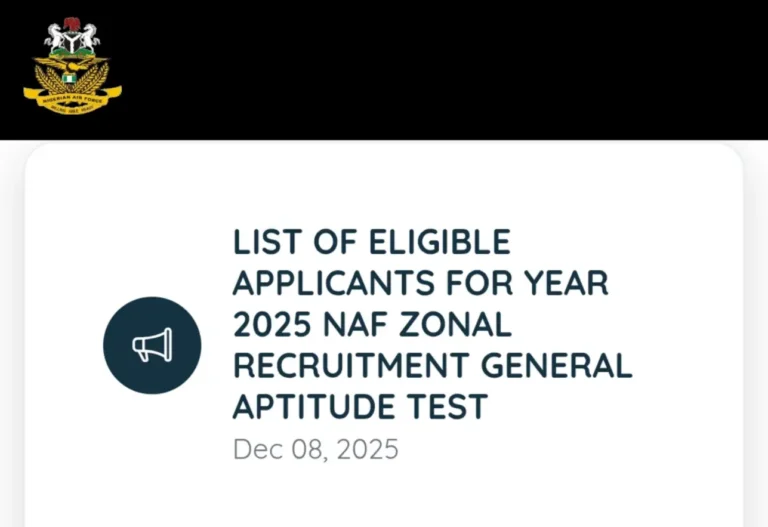
Check Nigerian Air Force Shortlisted Candidates for Trades, Non-Tradesmen/women

Nigerian Air Force has released the list of shortlisted candidates for Trades and Non-Tradesmen/women. The list of successful applicants is for those eligible for the Year 2025 NAF zonal recruitment general aptitude test. The underlisted applicants are invited to attend the Year 2025 Nigerian Air Force Trades and Non-Tradesmen/women Zonal General Aptitude Test on 13 December 2025 by 7.00am.

The associated centres are Bauchi, Benin, Enugu, Ikeja, Ilorin, Ipetu-Ijesha, Jos, Kaduna, Kano, Maiduguri, Makurdi, Minna, Port Harcourt, Sokoto and Yola. Applicants are to report with a pencil, an eraser, the NAF Application Acknowledgment Card and two passport photographs duly signed by the applicant.

Nigerian Air Force enlistment processes are free of charge and no payment should be made at any point throughout the exercise.

To check list of Nigerian air force shortlisted candidates, applicants are to visit https://nafrecruitment.airforce.mil.ng/updates/, and click on the centre to download the PDF and check their names.

The notice was signed by CO Obiabaka, Air Vice Marshal, for Chief of the Air Staff.

Zulum Expands Support for Borno Students and Refugees in Cameroon

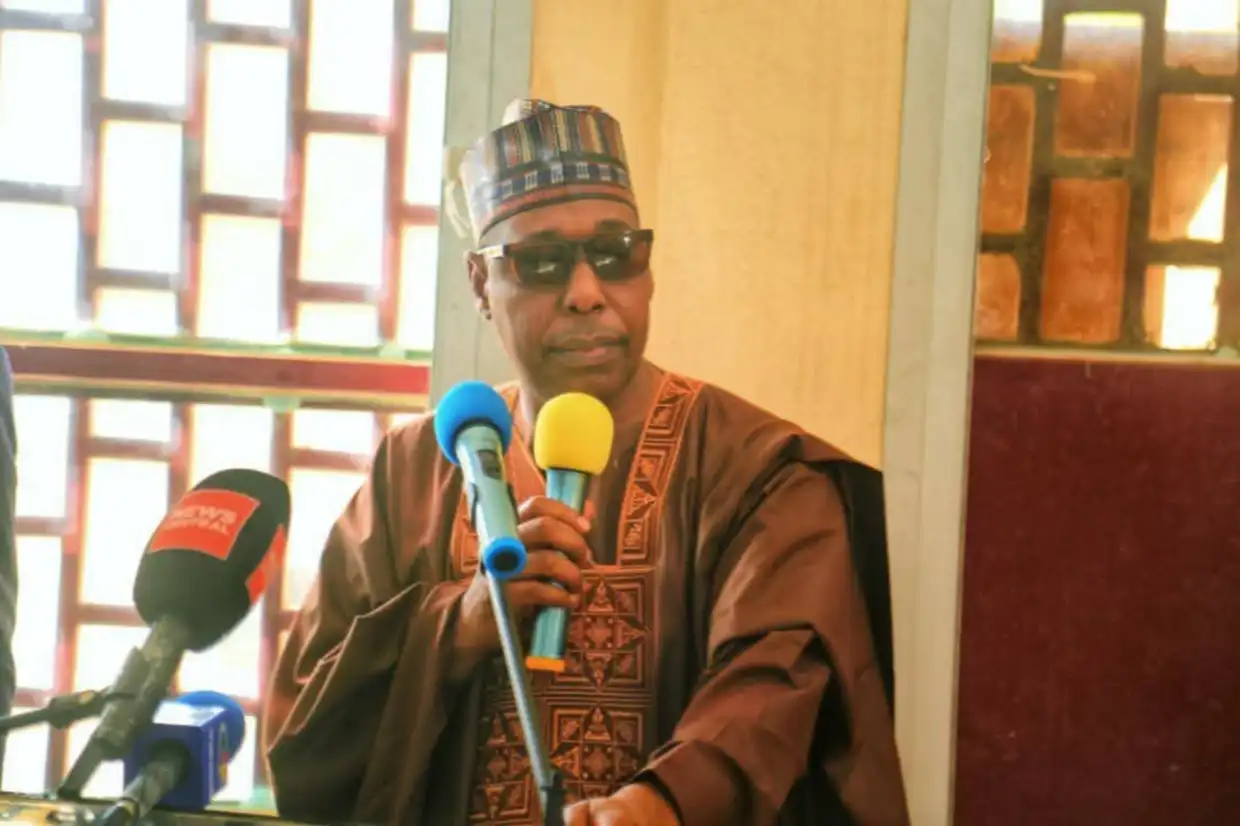
Borno State Governor, Professor Babagana Umara Zulum, has reaffirmed his administration’s commitment to widening learning opportunities for indigent students from Borno and for Nigerian refugees currently living in Cameroon. The Governor made this known during his visit to the University of Maroua in the Far North Region of Cameroon Republic as part of a two-day official tour focused on education and humanitarian support. During the visit, he also inspected a 500-seat lecture theatre under construction by the Borno State government.

Earlier, Governor Zulum visited Minawao camp as part of ongoing efforts to repatriate over 12,000 Nigerian refugees from Kirawa, Ngoshe, Ashigashiya and surrounding communities in Gwoza Local Government Area. Many of these individuals have lived in the camp for more than ten years due to the Boko Haram insurgency.

The lecture theatre, which is now nearing completion, is designed to serve both Nigerian nationals studying in Cameroon and refugee learners who fled violence during the peak of insurgency. Observers have described the project as a strong example of cross-border educational diplomacy and regional solidarity aimed at supporting young people displaced by conflict.

Governor Zulum, who has consistently placed education at the centre of Borno’s recovery plans, announced an expansion of scholarship opportunities for Borno indigenes and for refugees in Cameroon whose studies were disrupted. “No young person should be forced to abandon education simply because insurgency pushed them across international borders,” the Governor said. He explained that the government’s commitment goes beyond its territorial boundaries, especially when the welfare of its citizens is involved.

“I want to assure that we will look into the possibility of increasing the number of Borno students enrolled at the University of Maroua, because of the institution’s proven record of accommodating learners affected by Boko Haram conflict,” he added.

The Vice-Chancellor of the University of Maroua, Professor Idrissou Alloum, commended the Governor for what he described as an “unprecedented gesture,” noting that it strengthens educational access and deepens ties between communities along the Nigeria–Cameroon border. “Your Excellency, on behalf of the management of this university, we want to express our gratitude for the continued support to this institution,” he said. He added that the new lecture theatre and scholarship plans reflect a forward-thinking approach to humanitarian governance that focuses on empowerment.

Students who engaged with the Governor said his presence in Cameroon, where he listened to their concerns and assessed their learning environment, showed his leadership qualities and his recognition that their aspirations remain important despite the difficult circumstances that forced many of them to study outside Nigeria.

Governor Zulum was accompanied by the Governor of Cameroon’s Far North Region, Mijinyawa Bakari; Senator Mohammed Ali Ndume; and Honourable Abdullahi Buba Abatcha, member representing Gwoza State Constituency. Also in the delegation were several Borno State commissioners, the Chairman of Gwoza local government, and Cameroonian officials.

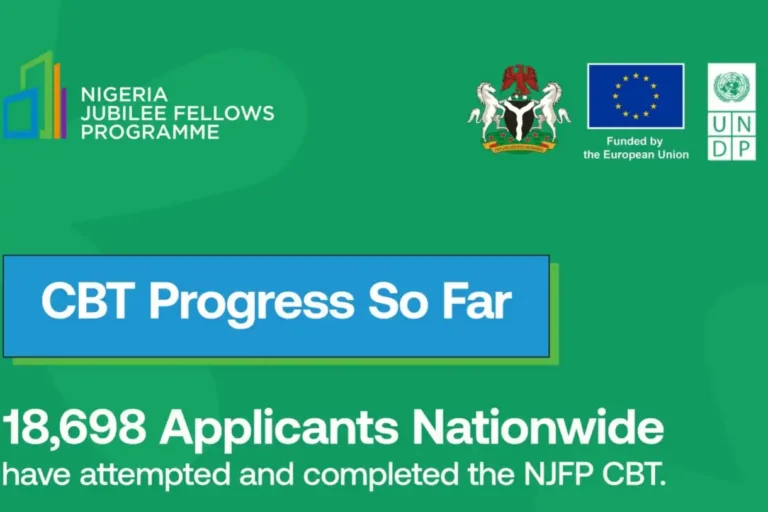
18,698 NJFP 2.0 Applicants Complete CBT Assessment

1

A total of 18,698 applicants nationwide have now attempted and completed the NJFP 2.0 CBT, marking a major milestone in the ongoing assessment phase of the Nigeria Jubilee Fellows Programme. According to UNDP in Nigeria, “thousands more are still participating in this transparent and merit-based assessment process, with additional tests ongoing nationwide.” The organisation also appreciated the patience of applicants, saying, “We appreciate the commitment and patience of all applicants as NJFP 2.0 moves forward.”

The CBT is a key stage in NJFP 2.0, which was officially flagged off on October 22, 2025, by the Federal Government, the European Union and UNDP. The new phase aims to scale up placements to over 23,000 fellows across the country as part of efforts to reduce youth unemployment and build what partners describe as a “national workforce for the future.”

In November 2025, verified applicants were directed to schedule their CBT and install required proctoring software. Organisers stressed that the test must be taken on a computer with a functional camera, noting that phones are not accepted.

They explained that this requirement helps ensure fairness and prevent fraud during remote assessments, making the CBT both a quality-control and anti-cheating measure. Applicants with CBT-related issues were advised to email help@njfp.ng.

FG Cuts 2025 Oil Licensing Signature Bonus to $3m–$7m

0

The Federal Government has lowered the signature bonus for the 2025 petroleum licensing round to between $3 million and $7 million. A signature bonus is a one-time payment that oil companies make when signing an agreement for the award of an exploration or production licence or lease. The Nigerian Upstream Petroleum Regulatory Commission announced the new range in a statement, warning that any bidder who submits an offer outside the approved amounts will be disqualified.

According to the commission, all bidders are expected to propose a signature bonus within “a range of $3 million and $7 million as approved by the minister of petroleum for the reduction of entry barriers.” The NUPRC added that all bids will be evaluated using a score-based system that considers different criteria aimed at ensuring transparency and competitiveness.

The commission listed the signature bonus, as long as it falls within the set limit, and the proposed work programme as key factors in the assessment. It also stated that the unit cost per barrel linked to the work programme would be reviewed during the evaluation. Other parameters include professionalism, human and technical capacity, percentage of bank guarantee provided, balance sheet strength, turnover, green story and decarbonisation efforts, as well as the corporate governance structure of each bidder.

On December 1, the NUPRC launched the 2025 Licensing Round and introduced a digital bid portal as part of ongoing efforts to boost investment and expand activity in the upstream sector. With presidential approval, the commission has placed 50 oil and gas blocks on offer across various terrains, including onshore, shallow water, frontier basins, and deepwater.

NUPRC Chief Executive Officer, Gbenga Komolafe, said the new licensing round is expected to draw about $10 billion in investments, add up to two billion barrels to national reserves within the next decade, and deliver about 400,000 barrels per day from fully developed assets. The commission also said the process will follow a two-stage procedure involving a qualification stage and a bidding stage.

Enugu Gov Warns Interest Rates Threaten Southeast Manufacturers

0

Governor Peter Mbah of Enugu State has called for an urgent review of Nigeria’s financing frameworks for the manufacturing sector, warning that current commercial interest rates of 30 to 37 percent are “completely incompatible with industrial growth and competitiveness.” Mbah, who was represented by Deputy Governor Barr. Ifeanyi Ossai at the 37th Annual General Meeting, Awards and Gala Night of the Manufacturers Association of Nigeria Southeast in Enugu, stated that manufacturers cannot survive under a credit system designed to “suffocate production rather than stimulate it.”

He explained that although single-digit intervention loans are available through development finance institutions like the Bank of Industry, many operators still struggle to access them. Mbah proposed the creation of additional regional offices for development banks to remove bottlenecks and bring affordable financing closer to manufacturers.

The governor also stressed the importance of strengthening research institutions and linking them directly to industry, noting that effective backward integration depends on strong research and development structures that can support local production.

Special guest of honour and senator representing Imo West Senatorial District, Osita Izunaso, supported Mbah’s concerns, describing Nigeria’s financing and forex systems as major obstacles facing manufacturers. He encouraged MAN to collaborate with state governments to conduct seismic studies on the Anambra trough, explaining that unlocking the region’s gas reserves would give industries access to reliable and cheaper energy.

Izunaso revealed that the National Assembly has passed a bill mandating manufacturers to use at least 30 percent local raw materials. He described the legislation as a major step toward deeper backward integration, saying it will take effect once it receives Presidential assent. “This is the direction the world is moving, and Nigeria cannot afford to lag behind,” he said.

MAN Southeast Chairman, Lady Ada Chukwudozie, said the AGM marked a decisive moment for repositioning regional industries during ongoing fiscal reforms. She highlighted MAN’s partnership with PwC on tax sensitization, which helped manufacturers reduce compliance risks in 2025. Chukwudozie also called for ending multiple taxation, expanding sustainable energy use, and investing in modern agriculture such as hydroponics, greenhouse farming and agro-processing to secure raw materials and boost rural industrial development.

Delivering the keynote, Prof. Nnanyelugo Ike-Muonso, Director General of the Raw Materials Research and Development Council, insisted that backward integration must become the default strategy for the country. “We cannot build a first-world manufacturing sector on a third-world import-dependence structure,” he warned, adding that import substitution is key to stabilizing prices and protecting the naira.

The royal father of the day, His Eminence Eze Eberechukwu Oji, Eze-Aro of Arochukwu, urged MAN to champion a regional plan to revive over 1,000 dormant industries in the Southeast. He reminded participants that every imported product represents an exported job.

The AGM, chaired by Chief Obinna Iyiegbu of Cubana Group, drew industrialists, policymakers, traditional rulers and business leaders from across Nigeria, with Awards of Excellence presented to distinguished manufacturers and institutions for their contributions to innovation, industrial growth and community development.

900 Million Africans Remain Offline Despite Rising Digital Opportunities

0

More than 900 million people in Nigeria and other African countries remain offline, a situation the World Bank says continues to slow down inclusive growth across the continent. Bridging this digital divide is increasingly seen as a way to democratize access to education, health, financial services, and markets. According to development experts, reducing digital exclusion can lower inequality, empower communities, and create millions of jobs in the coming years. The latest observations suggest that Africa’s digital future depends heavily on expanding both access and digital skills, especially for its fast-growing youth population.

The conversation around this shift starts with a simple question: What if Africa’s greatest wealth was not its minerals, oil, or land, but rather its youth? With 60 percent of its population under the age of 25, many see the continent as full of energy, creativity, and potential. Yet in a world increasingly shaped by digital technologies and artificial intelligence, millions of young Africans remain disconnected due to limited opportunities. Officials and researchers describe this as more than a missed opportunity, calling it a clear signal that immediate action is needed.

Current projections show that by 2030, Sub-Saharan Africa could create up to 230 million digital jobs as digital services continue expanding. Policymakers agree that the potential is huge, but the challenge lies in unlocking it across countries and regions.

In 2024, internet penetration in Africa reached 40 percent, rising significantly from 3.2 percent in 2005. Today, more than 600 million people use mobile broadband services. Even with this progress, the World Bank notes that more than 900 million people remain offline, and 76 percent of the population faces what experts call a usage gap. This means many people live in areas where the network is available but still lack the skills or financial means to use digital services. In rural areas, only 28 percent of residents have internet access.

Officials say bridging this digital divide is both a social and economic priority. They argue that digitalization is changing access to public services, helping more people reach education, health facilities, financial tools, and markets. Analysts point out that international submarine cables and wider mobile broadband coverage have already helped raise incomes and expand labor participation in several African countries. The broader effects on agriculture, industry, and tourism are expected to continue reshaping national economies.

Across West and Central Africa, several examples show how digital transformation can become a driver of development. In Benin, more than 250 public services are already available online, and 68 municipalities have been connected to fiber optics. Mobile coverage now reaches 92 percent of the country. Community-based training programs have also helped thousands of citizens gain digital skills. The World Bank highlighted the experience of Awa, a high school student who now accesses online learning and mentorship platforms. Her story shows how digital inclusion can open new paths in education, entrepreneurship, and civic participation.

Experts say these successes should not remain isolated stories. Nearly 700 million Africans still do not use the internet, even when coverage exists. As one analyst explained, “Access alone is not enough. Data must be affordable, services must be relevant, and digital education needs to be stronger.”

These issues will shape discussions at the Regional Summit on Digital Transformation in West and Central Africa, set for November 17–18, 2025, in Cotonou, Benin. Leaders, private sector players, and civil society groups will focus on the region’s usage gap, opportunities linked to AI, and the progress toward a single digital market.

The African AI market is currently valued at around $2 billion and is growing through startup activity and expanding consumer-focused digital services. However, stakeholders emphasize that true development goes beyond adoption. They argue that Africa must adapt and create its own ethical, locally relevant AI solutions. In Benin, AI is already being used in agriculture, health, education, and public administration. A notable example is a Fon language speech recognition model designed to improve access for rural and older populations. Similar innovations in other African countries show rising momentum in the digital space.

To support these trends, experts are calling for stronger investments in STEM education, infrastructure, and regulatory systems. The African Union’s Digital Transformation Strategy for 2020–2030 outlines a regional roadmap toward a unified digital marketplace that could expand e-commerce, cross-border payments, and digital trade. Africa’s e-commerce sector, already worth more than $50 billion in 2024, is expected to grow by at least 10 percent each year. Achieving this will require better regional connectivity, cross-border data flows, interoperable platforms, and strong cybersecurity and data protection rules.

The upcoming Cotonou summit is expected to renew commitments to digital inclusion, AI development, and job creation across West and Central Africa. Governments and partners, including the World Bank, are forming new partnerships and mobilizing investments through digital compacts. Organizers say the summit will ensure broad participation, allowing governments to lead reforms, the private sector to drive innovation, and young people to contribute ideas and creativity.