Home Blog Page 246

Lagos Tops 2025 PEBEC Ease of Doing Business Rankings

The Presidential Enabling Business Environment Council (PEBEC) has released the 2025 Subnational Ease of Doing Business (EoDB) Report, naming Lagos State as the best-performing state with a score of 85.6 per cent. The report, made public by the director-general of PEBEC, Zahrah Mustapha-Audu, placed Kaduna in second position with 65.1 per cent, while Oyo, FCT, and Ogun completed the top five with scores of 62.7 per cent, 61.0 per cent, and 59.9 per cent respectively.

Enugu ranked sixth with 56.2 per cent, followed by Plateau, which also scored 56.2 per cent. Ekiti recorded 55.8 per cent, Kano followed with 54.8 per cent, and Nasarawa secured the tenth position with 53.4 per cent. The EoDB report is described as a comprehensive data-driven assessment of how Nigeria’s 36 states and the FCT are shaping business competitiveness through regulation, infrastructure, and administrative efficiency.

It examines 16 indicators and 36 sub-metrics that reflect electricity access, infrastructure quality, digital connectivity, land administration, taxation, trade logistics, justice delivery, investor support, and availability of skilled labour.

According to Mustapha-Audu, the leading states distinguished themselves through reform momentum, improved digital systems, and more predictable regulatory frameworks. She stated, “The 2025 Report also highlights five priority interventions states can implement immediately. These include establishing investor aftercare systems, strengthening MSME credit enablement, harmonising interstate trade rules, upgrading commercial justice processes, and improving power reliability for industrial clusters.”

She added that PEBEC will continue supporting state-led reform adoption, especially through the $750 million State Action on Business Enabling Reforms (SABER) programme.

She explained that “the 2025 Subnational EoDB Report provides a critical foundation for policy action, investment decisions, and long-term competitiveness across Nigeria.” The DG also confirmed that the Subnational Ease of Doing Business Report is available for download at www.pebec.gov.ng/reports.

PEBEC had earlier published its 2025 Business Facilitation Act (BFA) Performance Report, which assesses the performance of Ministries, Departments, and Agencies (MDAs) between January and October. The evaluation forms part of the council’s effort to track federal MDAs’ compliance with BFA requirements on transparency and service efficiency for businesses.

The assessment covered 69 priority MDAs using monthly compliance submissions, mystery shopping, website reviews, ReportGov analytics, and targeted verification processes.

The Nigerian Content Development and Monitoring Board (NCDMB) topped the rankings with a score of 90.6 per cent, followed by the National Drug Law Enforcement Agency (NDLEA) with 89 per cent. The Nigeria Customs Service (NCS) ranked third at 86.6 per cent, while the Nigerian Communications Commission (NCC) and Nigerian Ports Authority (NPA) placed fourth and fifth with scores of 85.3 per cent and 84.2 per cent.

PEBEC, chaired by Vice President Kashim Shettima, was established in July 2016 to supervise reforms that ease business operations nationwide. The council was tasked with removing bureaucratic and legislative barriers as well as improving public perception of Nigeria’s business environment.

The 2025 subnational report gained wide media attention, reinforcing Lagos’ dominance with its 85.6 per cent score. Observers note that Lagos’ strong performance is partly linked to its growing tech ecosystem. The state reportedly attracted over US$6 billion in tech funding between 2019 and 2024 and now hosts about 80 per cent of Nigeria’s 2,000 active tech startups, positioning it as a major digital innovation hub.

In related national reform efforts, the federal government recently approved a ₦185 billion payment to settle gas debts owed to producers. The move is expected to stabilise electricity supply, a factor highlighted by PEBEC as vital for industrial clusters and improved competitiveness.

Experts believe this could support states in addressing infrastructure gaps mentioned in the EoDB report and contribute to stronger business performance outcomes across Nigeria.

Advertisement

Lagos 2025 Initiative Trains Students in Digital, Entrepreneurial Skills

0

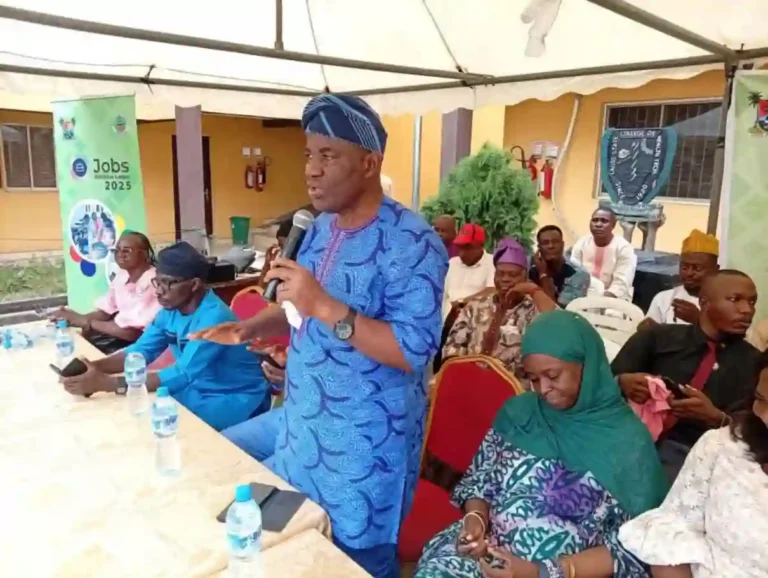
The Lagos State Government, through the Ministry of Tertiary Education, marked the successful conclusion of the 2025 Job Initiative Lagos Training Programme on Saturday with a grand finale at the Lagos State College of Health Technology in Yaba. The programme, which equipped hundreds of students from state-owned tertiary institutions with digital, entrepreneurial, and job-readiness skills, was described as an important step in driving Governor Babajide Sanwo-Olu’s T.H.E.M.E.S Plus Agenda on Education and Technology.

In his message at the event, the Commissioner for Tertiary Education, Tola Sule, described the Job Initiative Lagos as the government’s decisive response to the changing demands of the 21st century economy. He explained that the programme aims to shift the focus of students from certification to problem solving.

According to him, “For too long, our educational narrative has primarily focused on the pursuit and acquisition of certificates. The world no longer searches only for degree holders; it seeks solution providers, digital literates, agile innovators, and entrepreneurs who create value.” He added that the initiative was designed to bridge the skills gap between academic learning and industry needs.

The Permanent Secretary of the Ministry, Adeniran Kasali, stressed the need for global competitiveness among students trained in Lagos. He told the audience that the skills acquired through the initiative position graduates for relevance across markets beyond Nigeria.

Mr Kasali noted, “We must move beyond theoretical knowledge. By focusing on practical application in areas like digital technology and entrepreneurship, the Lagos State Government is proactively positioning our graduates to compete favourably with the best in the world. This training is the license to their future success.”

The heads of participating institutions also addressed the gathering, describing the initiative as an added value to academic development. In her welcome remarks, the Deputy Provost of Lagos College of Health Technology, Dr Islamiyat Agoro, expressed gratitude for the state government’s constant support.

“We are honoured to host the grand finale of this transformative program,” she stated. She explained that the college fully supports the inclusion of digital and entrepreneurial skills in student training because it complements their core learning.

Representing the universities, the Dean of Students Affairs at Lagos State University, Professor Abdufatai Abatan, applauded the dedication shown by students throughout the training. “This is the spirit of innovation and dedication we want to see in our students,” he remarked. He added that while the transition from student to professional is challenging, the programme ensures that graduates are now creators rather than mere consumers.

Also speaking, the Dean of Students Affairs at Lagos State University of Education, Dr Dawodu, highlighted the programme’s role in tackling unemployment. He said, “JIL is crucial because it promotes self-reliance. By instilling an entrepreneurial mindset, this programme is actively helping to reduce graduate unemployment. Every business idea nurtured here is a potential job for another Nigerian.”

The Senior Special Assistant to the Governor on Students’ Affairs, Hon Samuel Kapoo, encouraged participants to remain “skilled and adaptable,” reaffirming the government’s intention to produce the most prepared generation of youths the state has ever seen.

For three intensive weekends, students participated in two training streams, including Digital Literacy and Entrepreneurship, along with sessions on interview techniques and coding. The Lagos State Government described this as a vital investment in its students and youth population.

The programme aims to ensure that graduates from state-owned institutions are not only prepared for the labour market, but also capable of generating employment for others through innovation and enterprise.

Miners Association Rejects Governors’ Call for Nationwide Mining Ban

0

The Miners Association of Nigeria has said that banning mining activities in the country will not solve insecurity. The association made this known in a statement jointly signed by its national president, Dele Ayankale, and national secretary, Sulaiman Liman, on Monday.

Their reaction followed the recent call by the Northern States Governors’ Forum for a six-month suspension of mining activities after the abduction of school children and killings in some states. The governors had linked illegal mining to insecurity and said the suspension would give room for a review of mining licences with input from state governments.

However, the Miners Association of Nigeria insisted that legal mining is not responsible for insecurity, arguing that only illegal operators have been tied to terrorism and criminal networks. The group warned that the ban would punish legitimate miners and create more opportunities for illegal operators to thrive.

Mr Ayankale explained that Nigeria had tried similar measures in the past without success. He cited the 2019 ban on mining in Zamfara State as an example where “the negatives outweigh the positives,” noting that insecurity increased instead of reducing. According to him, banditry, kidnappings, and terrorism grew in Zamfara and later spread to Katsina, Kaduna, Niger, and Kebbi States.

“It is the disorderly, illegal mining that is conducted without licences and government regulations and control that practices money laundering and fuels insecurity. A clear distinction must be made between legal and illegal mining. Therefore, stigmatising mining as the cause of insecurity is a misnomer,” he said.

He added that the proposed ban would be unfair to legal miners and their workers and could worsen unemployment, poverty, and insecurity. The association argued that the true victims of such suspensions are genuine investors, while illegal miners linked to terrorist groups would still gain access to minerals due to weak enforcement capacity.

“Unfettered access of illegal miners to the mineral resources in a banned mining location offers incentives and empowerment to criminals as they exchange the minerals for arms and ammunition to improve their heinous activities,” he said.

The Miners Association warned that the suspension could also damage the Federal Government’s efforts to attract investments into the solid minerals sector. It said this would affect reforms that seek to reduce bottlenecks and improve Nigeria’s global competitiveness in mining.

Mr Ayankale said members of the association actively cooperate with security agencies to protect their mining areas, stressing that legal operators follow laid-down standards for safe and environmentally responsible mining.

According to him, MAN members help rural communities through the statutory Community Development Agreement, which supports infrastructure development and contributes to local economies.

“Therefore, the call by our northern governors and elders to ban mining activities, at a time when the nation has started welcoming pockets of investments, is not only unfortunate, but highly unpatriotic,” he stated.

He advised the governors to fund and strengthen the Mining Marshals and other official structures fighting illegal mining instead of pushing for a nationwide ban. He also said that calling for revalidation of mining licences sounded like a demand for resource control.

Mr Ayankale argued that this contradicted the Constitution, which places mineral resource management on the Exclusive Legislative List. He urged the president to consider that suspending mining could create more recruits for terrorist groups, as job losses and economic hardship might push more people into crime.

PenCom Accredits Agents to Recover N32.27bn Pension Debt

0

The National Pension Commission has moved to tighten Nigeria’s pension system by accrediting pension recovery agents as a key pillar in protecting workers’ retirement funds. The agents have been tasked with recovering N32.27 billion from defaulting employers, made up of N15.87 billion in unpaid pension contributions and N16.40 billion in penalties accumulated between June 2012 and September 2025.

In a statement by PenCom’s management, the Director General, Ms. Omolola Oloworaran, announced the development during a workshop in Lagos, where she declared a new phase of zero tolerance for pension defaulters. She reaffirmed the commission’s commitment to strict enforcement across the pension sector. Oloworaran, represented by the Commissioner in charge of Inspectorate PenCom, Samuel Chigozie Uwandu, addressed participants during an intensive training session for accredited recovery agents.

She said the training signals a renewed national compliance effort aimed at recovering pension debts from employers who continue to violate the Pension Reform Act 2014. The law mandates employers to remit pension contributions within seven working days after salary payments.

According to her, “The workshop outlined new strategic initiatives that will strengthen enforcement efforts, deepen inter-agency collaboration, and empower recovery agents to tackle non-remittance of pension contributions with greater precision and authority.”

She explained that PenCom is actively engaging recovery agents to audit defaulting companies, compute outstanding liabilities, issue formal demand notices, and push for the recovery of unremitted contributions. She noted that recovery agents have played a vital role since 2012, when the compliance drive began.

She added that the commission recorded notable gains in the third quarter of 2025 alone, recovering N2.06 billion comprising N775 million in principal contributions and N1.27 billion in penalties from 49 defaulting employers.

She stressed that while the Contributory Pension Scheme has grown over the years, persistent employer defaults weaken its core mission. “Every unremitted Naira represents a broken promise to a Nigerian worker as this Commission has moved from promoting voluntary compliance to mandating enforced compliance. The era of impunity is over,” she said.

Oloworaran also stated that the recovery agents were selected through a competitive and transparent process, reflecting the commission’s confidence in their capacity and professionalism. She reminded participants that they serve as the operational arm of PenCom’s enforcement mandate and are central to safeguarding workers’ retirement savings.

The Director General highlighted several reforms shaping PenCom’s expanded enforcement framework, including stronger partnerships with the Corporate Affairs Commission, the Federal Inland Revenue Service, and other regulatory bodies.

Under these alliances, employers’ compliance with the pension law will influence their regulatory standing. She warned that employers who default may face wider consequences, affecting business operations, access to government services, and other regulatory privileges as the drive for accountability intensifies nationwide.

Abia Rep Ogah Empowers Constituents With N1bn Items

0

The member representing Isuikwuato/Umunneochi federal constituency at the National Assembly, Hon. Amaobi Ogah, has empowered his constituents with items worth N1 billion. The event tagged “Constituency briefing/ uncommon mega empowerment” took place at Umuaku Uturu in Isuikwuato local government area. Abia State governor, Alex Otti, said the programme aligned with his development agenda for the state.

Represented by the secretary to the state government, Kenneth Kalu, he praised Ogah for embarking on the initiative, noting that it would positively impact the beneficiaries. His word, “What you’re doing is what leadership should be all about. That is what representation is all about. The Almighty God, who gave you the grace to do this will continue to sustain you.”

Also speaking, the member representing Bichi federal constituency in Kano State and House Committee chairman on Appropriation, Abubakar Kabir Abubakar, applauded Ogah for the gesture. Represented by his colleague for Uyo federal constituency, Akwa Ibom State, Kabir Abubakar said only a few politicians could carry out such empowerment and infrastructure commitments.

Their colleague from Isiala Ngwa North/Isiala Ngwa South federal constituency, Ginger Onwusibe, and the state Labour Party chairman, Emmanuel Otti, also commended Ogah for the programme.

In his speech, Ogah said the event formed part of activities marking his second anniversary at the National Assembly and allowed him to brief his constituents on his stewardship. He noted, “We must come in to work together to redefine the essence of governance by demanding accountability and transparency thereby, ensuring that public trust is not abused. I make a point to say that I have represented you with the greatest responsibility, honor, and integrity. I have facilitated tremendous infrastructure developments in the constituency.”

He assured that he would do more in the future through God’s grace and with the people’s support. He urged beneficiaries not to sell the empowerment items but to use them for their intended purposes.

In their separate responses, some beneficiaries, including Simeon Ndubuisi, Ugonma Nwachukwu, and Njideka Obasi, said the programme demonstrated Ogah’s quality representation. The items distributed include sienna cars, mini buses, tricycles, grinding and sewing machines, motorcycles, and refrigerators.

Nigeria Needs ISA 2025 to Hit $1tn Economy Target – GTI

0

The Group Managing Director of GTI Group, Abubakar Lawal, has warned that Nigeria’s goal of building a $1tn economy by 2030 may remain out of reach unless the Investments and Securities Act 2025 is enforced with strict discipline and strong coordination across the capital market. Lawal made this point at the 2025 annual conference of the Capital Market Correspondents Association of Nigeria in Lagos on Saturday.

Earlier this year, President Bola Tinubu signed the ISA 2025, expanding the instruments tradable in the capital market, including the recognition of digital assets and cryptocurrencies. Lawal, represented at the event by the Managing Director of GTI Capital, Kehinde Hassan, explained that clarity and synergy among regulators, operators, and market participants are necessary if the new law is to support Nigeria’s trillion-dollar ambition.

According to him, the country has reached a crucial stage where fragmented efforts can no longer be tolerated. He stated, “What Nigeria requires now is a unified roadmap, one that integrates ISA 2025 into the broader architecture of the nation’s economic vision.”

Lawal argued that with proper execution, collaboration across institutions, increased public education, and responsible innovation, Nigeria could meet and even surpass its $1tn target while delivering long-term socio-economic gains. Describing ISA 2025 as a transformational reform, he said the legislation provides structure, tools, and opportunities for national development rather than just regulatory guidelines. However, he cautioned that the best laws are meaningless without deliberate implementation.

He urged regulators to act with fairness and foresight, and encouraged operators to embrace innovation guided by responsibility. Lawal further stressed the need for broad investor education to unlock the full potential of the Act. He said awareness must spread nationwide so that investors understand their rights, entrepreneurs see new opportunities, and citizens recognise protections built into the regulatory system.

Highlighting areas covered in ISA 2025, he listed recognition of digital and virtual assets, classification of investment contracts as securities, expansion of eligible issuers, establishment of specialised exchanges, strengthening of commodities exchanges, broadening of non-interest instruments including sukuk, and enhanced regulatory powers for the Securities and Exchange Commission.

According to him, these reforms are directly tied to Nigeria’s economic agenda and support youth inclusion, especially through digital asset recognition. He emphasised that more than 60 per cent of the country’s population consists of young people, describing them as digital natives whose creativity and technological skill can drive future growth. He noted that ISA 2025 gives young Nigerians legitimacy and meaningful participation within the financial system.

Lawal concluded that if Nigeria approaches this reform period with unity and determination, the nation could transform its economy and inspire other African countries by showing what is possible when ambition aligns with decisive action.

Sahara Group Awards USD 130,000 to 20 African Innovators

1

The Sahara Group Foundation (SGF), the social impact arm of Sahara Group, has awarded over USD 130,000 to 20 outstanding African EXTRApreneurs under its Sahara Impact Fund (SIF) Cohort 4 and Making A Difference Around Africa (MADAA) initiatives. For nearly two decades, the Foundation has driven entrepreneurship, innovation, environmental action, and community development across the continent.

The 2025 editions of SIF and MADAA were redesigned after insights from earlier cycles showed a growing gap between early-stage innovation and market entry in Africa. By aligning both programmes, SGF created a structured pipeline that removes barriers for young entrepreneurs, strengthens capacity, and supports long-term sustainability.

“Our focus goes beyond disbursing grants,” said David Ayinde, Program Supervisor, Sahara Group Foundation, at the Awards and Gala Night. He added that the Foundation has created systems that equip young innovators with business intelligence, financial strategy, governance discipline, and commercial readiness needed to scale their solutions across African markets.

Director of the Foundation, Chidilim Menakaya, noted the organisation’s shift in strategy and impact goals. “By reinventing the Sahara Impact Fund and elevating the MADAA programme, we are closing the loop between discovery, support, and scale,” Menakaya said. According to him, these changes show a commitment to identifying high-potential innovators, providing them with skills, and giving them pathways to deliver measurable impact.

The Sahara Impact Fund drew over 2,000 applications across Africa, reflecting growing interest among young innovators. From this pool, about 300 were shortlisted for intensive capacity-building workshops, before the final 20 EXTRApreneurs emerged. The process highlighted how selective the programme has become and the depth of support provided.

In November, Sahara Group Foundation expanded its environmental footprint by commissioning its 16th Sahara Go-Recycling Hub. The new hub is the first in Lagos to include a solar-powered reverse vending machine, strengthening the group’s sustainability and community empowerment goals.

Through the refreshed MADAA initiative, the Foundation focused on connecting entrepreneurs to markets, advisory services, and technology solutions. This marks a strategic shift from simply offering grants to actively building scalable enterprises that can thrive beyond initial funding and contribute to Africa’s growth story.

TikTok Temporarily Bans Nigerians From Going Live at Night

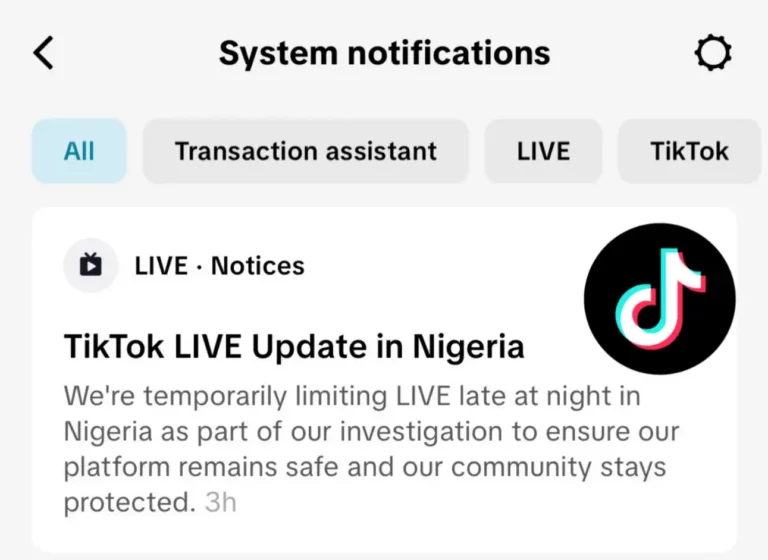
TikTok has temporarily banned Nigerians from going live at night, with reports showing the restriction runs from 11pm to 5am daily. Users say the ban does not only stop Nigerians from going live, it also blocks them from viewing live broadcasts from other countries. Many confirmed that all live activities have been limited, with the notice issued through TikTok’s system notifications.

“We’re temporarily limiting LIVE late at night in Nigeria as part of our investigation to ensure our platform remains safe and our community stays protected,” the notification stated.

One user said, “I woke up to an official system notification, and the LIVE button has disappeared completely.” Others also reported they could not stream live in other regions.

This night-time ban is believed to be connected to increasing reports of inappropriate activities on late-night live sessions.

As a result, timeline engagement becomes dull during those hours, affecting people who depend on the feature for income.

Some Nigerians reportedly misused the live function by hosting adult themed content while viewers watched and sent gifts. This raised safety and moderation concerns.

TikTok’s recent data highlights the scale of enforcement. In its Q1 2025 moderation report, the company said it removed over 3.6 million videos from Nigeria between January and March 2025 for breaking community rules.

In Q2 2025, TikTok banned 49,512 live sessions in Nigeria. Globally, it took action on more than 2.3 million live sessions and over 1 million creators for violating guidelines.

Thr federal government has also taken steps toward safer digital spaces. In November 2024, the National Information Technology Development Agency (NITDA) partnered with TikTok under the #SaferTogether campaign to educate parents, teachers, and youths on risks such as misinformation, cyberbullying, and harmful content.

In October 2025, NITDA Director-General Kashifu Inuwa Abdullahi said Nigeria must set its own TikTok rules and steer the platform toward “skill-building, innovation and productive digital engagement” instead of purely entertainment. This is a developing story.

NLC accuses FG of breaching labour agreements

0

The Nigeria Labour Congress has accused the Federal Government of repeatedly breaching labour agreements across major sectors and undermining workers’ rights, warning that employees are ready for decisive action if the trend continues. The accusation came at the National Executive Council meeting held in Lagos, where unresolved issues in education and health dominated discussions.

NLC president Joe Ajaero said unions have reached breaking point over what he called “a consistent culture of disregard” for agreements signed since 2009. “The government has been guilty of not obeying agreements,” Ajaero stated. He explained that the ongoing crisis with ASUU, NASU, SSANU and other unions stems from the refusal to honour signed commitments. According to him, even fresh renegotiations have stalled due to what he described as the government’s reluctance to return to the table.

He said the NLC is now considering solidarity actions across affected sectors “to ensure that the sanctity of agreements is respected at all times.” Ajaero added that the breakdown in trust has spread beyond education, pointing to the distress in the health sector. “The government is withdrawing because of the same agreement they don’t want to honour,” he said.

The NLC president also raised concerns over rising insecurity, saying workers are increasingly becoming victims of violent attacks, kidnappings and ransom demands. “Only God knows the number of workers kidnapped with outrageous ransom demands. We can no longer bear this. It’s getting out of hand,” he lamented. He disclosed that the labour body would soon announce a nationwide protest to demand accountability from security agencies and political authorities.

Ajaero questioned what he called “suspicious lapses” in recent security operations, citing the abduction of students at Government Girls’ College, Maga in Kebbi State. Reports, he noted, suggested that security personnel were withdrawn shortly before the attack. “Never again shall we watch while kidnappers and bandits take over,” he vowed. “The NEC will take a strong stand to know what is happening and demand answers.”

The Labour leader also criticised the state of the power sector, saying Nigerians had gained nothing from years of reforms. He noted the high cost of fuel and the shortage of compressed natural gas infrastructure. “A litre is almost N1,000 in some places. Where are the CNG stations?” he asked.

Human rights lawyer Femi Falana, who addressed the NEC, cautioned against calls for foreign military involvement, urging Nigerians to hold their government responsible for security failures. “We do not want foreign intervention,” Falana stressed. “We must mobilise and compel the government to defend Nigeria. And on unionisation, nobody is above the law, any employer stopping workers from joining unions is engaging in an illegal act.”

In March, the NLC led coordinated picketing of Central Bank offices in Abuja, Lagos, Kano and Port Harcourt over delayed wage payments, inflation linked allowances and “broken government promises.” The action disrupted operations across some branches as labour leaders warned of escalation unless agreements were honoured.

Unlocking women’s potential can add $12trn to global economy – IPEPM

0

President of the Institute of Professional Economists and Policy Management (IPEPM), Prof Kenneth Ife, has said that closing gender gaps and fully unlocking women’s economic potential could add 12 trillion dollars to the global economy. He warned that Nigeria cannot achieve inclusive or sustainable growth without prioritising women’s participation. Ife spoke during the launch of the Women in Economics and Development Foundation (WEDF), themed “A Catalyst for Inclusive Growth and Sustainable Development”, alongside the unveiling of the organisation’s empowerment programme in Abuja.

Meanwhile, Founder of WEDF, Dr Annette Mubarak, said the Foundation emerged from a burning desire to see women rise as catalysts for economic transformation and digital innovation. She noted that women’s contributions from classrooms, corporate offices, or ministries have often been undervalued.

Mubarak said the Foundation would focus on capacity development, mentorship, entrepreneurship, access to finance, and policy advocacy. She described the initiative as the beginning of a revolution of minds, opportunities, and transformation, adding that women are not waiting for change, but “they are the catalysts of change”.

Ife, a global economic analyst, observed that women contribute 43 per cent of agricultural labour and represent one in three businesses, yet they receive less than 10 per cent of available venture capital. He lamented that in Nigeria, women constitute roughly 49 per cent of the population but hold only 22 per cent of senior economic leadership positions. According to him, these structural inequities come at a high cost, saying closing the gender gap in economic participation could contribute an additional 12 trillion dollars to global economic output.

He stressed that improving gender parity could strengthen governance and national economic resilience. Ife explained that countries with more equitable participation of women in economic decision-making experience higher GDP growth and progress toward Sustainable Development Goals (SDGs), including poverty reduction, gender equality, decent work, and strong institutions. He urged policymakers, institutions, and private sector actors to create platforms and strategies that integrate women into key economic decision-making spaces.

According to him, unlocking women’s economic power is central to Nigeria’s growth and Africa’s development. He said: “The opportunity of unlocking women’s economic power allows you to boost GDP, give you stronger SMEs, create more resilient households, increase employment and also improve governance.”