Home Blog Page 260

Zamfara Govt Reaffirms Commitment to Nomadic Education Reform

0

The Zamfara State Government has reaffirmed its commitment to improving nomadic education and tackling the rising challenge of out-of-school children in the state. The pledge was made by the Secretary to the State Government, Malam Abubakar Mohammad Nakwada, on Wednesday while receiving the Zamfara State Agency for Nomadic Education in his office.

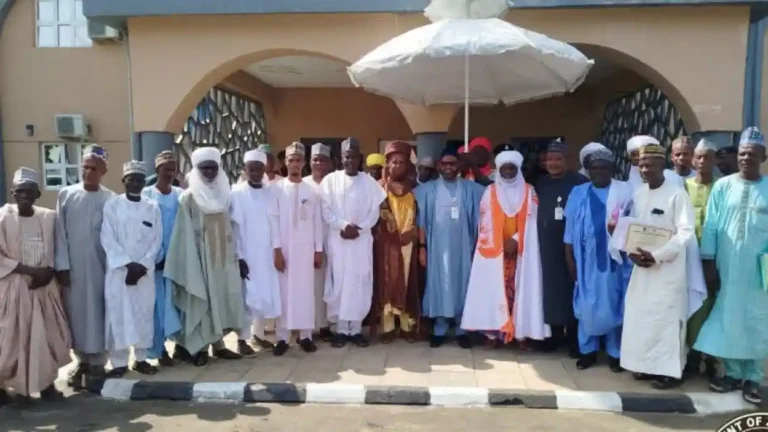
The agency delegation, led by the Honourable Commissioner for Education, Science and Technology, Malam Wadatau Madawaki, paid a courtesy visit to the SSG, during which awards of excellence were presented to 23 people who showed outstanding commitment and performance in supporting the agency’s goals.

The meeting was also attended by the Emir of Kaura Namoda, Alh Sanusi Ahmad Asha, the Emir of Bungudu, Alh Hassan Attahiru, and Fulani community leaders, alongside other key stakeholders. The agency is tasked with providing quality basic education to nomadic communities and currently oversees 108 Nomadic Schools across the state. Student enrolment stands at 6,412, with 2,017 of them being female, representing 31.5 percent.

According to the SSG, education remains an effective tool in preventing crime, which is why Governor Dauda Lawal declared a state of emergency in the education sector. He noted that “this move has already started yielding results,” stressing the importance of sustained action.

Malam Nakwada lamented that if previous administrations and stakeholders had taken education seriously, Zamfara would be in a better position today. He further expressed concern over the growing number of out-of-school children and called on the Ministry of Education to intensify efforts in addressing the urgent issue.

He added that the current government under Governor Lawal “will not rest on its oars until the education sector is fully revamped.”

Earlier, the agency’s Executive Secretary, Alh Bala Tafida, thanked the Governor for his “commitment to improving quality education and for all the support being given to the agency for the actualisation of its mandate.”

Advertisement

SEC warns Nigerians against Glorious Wealth Fund scam claims

1

The Securities and Exchange Commission Nigeria has warned Nigerians about an online investment platform called Glorious Wealth Fund, operating through gloriouswealthfund.com. According to the Commission, the operators claim to provide investment services in Nigerian stocks and other financial instruments, while falsely suggesting they are supervised by SEC.

In a statement issued to the public, SEC said Glorious Wealth Fund is not registered or licensed to conduct any form of capital market activity in Nigeria. The regulator declared that “any claim by GWF that it is supervised, licensed, or approved by the SEC is false, misleading, and fraudulent.”

The Commission also confirmed receiving complaints from people who invested on the platform but could not withdraw their funds. It noted that the activities of GWF show “clear characteristics of an illegal investment scheme designed to defraud unsuspecting Nigerians.”

SEC advised citizens to avoid dealing with the platform, warning that anyone who proceeds does so at their own risk. It reiterated that investing through unregulated or unregistered sources exposes people to financial losses, including fraud.

The Commission reminded Nigerians to always check whether a company offering investment services is registered. It urged the public to “VERIFY the registration status of companies and entities offering investment opportunities” using its official verification portal available on www.sec.gov.ng/cmos.

The warning forms part of the Commission’s continuous effort to protect investors in the Nigerian capital market and discourage illegal financial schemes disguised as investment opportunities.

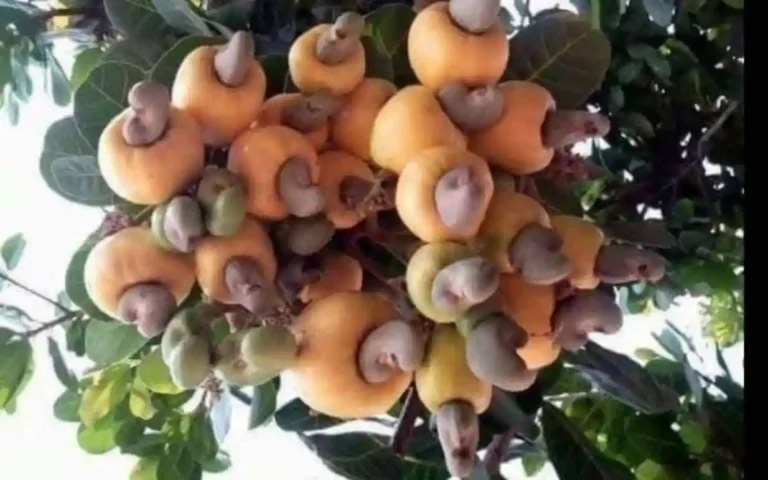
Stakeholders Warn Cashew Export Ban Will Trigger Job Loss

Stakeholders in Nigeria’s cashew industry have warned that the country risks massive job losses, collapsing farms, and a damaged export market if the Federal Government agrees to calls from the Cashew Processors and Packers Association of Nigeria to ban the export of raw cashew nuts. CAPPAN, through a statement issued by Air Vice Marshal Tunde Awoyoola (rtd.), who is also Managing Director of Nutslink Limited, argued that foreign buyers are dominating the farm gates and preventing local processors from accessing raw materials, a situation it believes justifies a proposed export ban.

But the Chairman of the Kogi Cashew Dealers and Stakeholders Association, Alhaji Makama Ademu, countered that Nigeria lacks the capacity to process even a small fraction of its yearly cashew output. He warned that the consequences of such a decision would be devastating. According to him, “If the government bans raw cashew export, 95 per cent of what we produce will be left to rot. We don’t have the processing capacity to handle even a fraction of Nigeria’s output. This will destroy the farmers, destroy the value chain and eliminate three major segments — sub-buyers, licensed buying agents and merchants.”

Ademu said the impact would be immediate and severe, particularly for rural communities that rely heavily on cashew earnings. He stated, “This value chain employs farmers, women, rural youth and thousands of workers who dry, bag and prepare cashew. Once exports stop, these jobs disappear overnight. A lot of businesses will be destroyed, and many farms will fold up because it will no longer be economical to farm cashew.” He also accused processors of pushing a narrow agenda, saying, “They want prices to crash so they can buy cheaply. How does a farmer survive on prices that do not even cover cost of production? Their agitation is selfish, short-term and myopic.”

Vice Chairman of the Kogi Cashew Dealers and Stakeholders Association, Dr. Idrisu Yakubu, also described the proposed ban as “enormous and dangerous.” He argued that the country’s processors cannot handle the current supply. He said, “All the cashew processing factories in Nigeria combined cannot process what Kogi State produces in just one day of cashew season. If they cannot handle one day’s output in a whole year, what happens to the remaining 364 days? Should farmers burn their harvest?”

Yakubu dismissed claims that processors are prepared to absorb local production. He said, “Some of the people calling themselves processors don’t even have factories. They are just politicians within the industry being sponsored to bring the business down. They want the federal government to peg prices so farmers can be shortchanged. We will not accept that.” He further warned that discouraging farmers could worsen insecurity. “In the current security situation, discouraging farmers from going to their farms can trigger new unrest. A ban on exports will have serious social and economic consequences.”

Also speaking, Board of Trustees Chairman of the Kogi Cashew Dealers Stakeholders Association, Alhaji Mohammed Demo, warned that processors’ demands threaten livelihoods. He argued that, “Because of their lateness or inability to establish viable factories, they now want to suffocate the entire industry. Farmers will suffer. We cannot allow people who don’t have functioning processing plants to dictate policies that will destroy a major economic hub.” He insisted that stakeholders in leading cashew states would resist such moves, adding that “We will disassociate ourselves publicly. If anything goes contrary, it could lead to tension, and with the security challenges in the country, this is not the time to provoke farmers.”

Stakeholders questioned why CAPPAN is singling out cashew when Nigeria also exports cocoa, sesame seed, ginger, soybean and other produce. Ademu asked, “Have they banned the export of cocoa? Have they banned sesame or coffee? Why cashew? It shows their agenda is not in the national interest.” Yakubu added that export activities built the industry. “Before exporters came into the market, cashew had no value. Farmers were burning it on their farms. Export revived the industry. Killing that market now will reverse all progress made.” He stressed support for industrialisation but warned against harming producers. “We support industrialisation. But not by destroying farmers and traders. You don’t build factories by killing the market,” Yakubu said.

Kogi Cashew Farmers Association spokesperson, Nuhu Adaji, assured that the group remains committed to transparency and accountability, explaining that ongoing reforms are meant to strengthen internal processes, improve service delivery and ensure timely information for stakeholders. He urged the public to stay calm, noting that further updates will be shared as developments unfold.

The group appealed to the Federal Government to ignore the recommendation and instead focus on investing in power, infrastructure and incentives to help processors expand capacity over time. They warned that adopting CAPPAN’s proposal would throw thousands into unemployment and crash a valuable export market that generates foreign exchange for the country.

NiYA Startup Pitch 2.0 Emails Shortlisted Applicants for N100m Grant

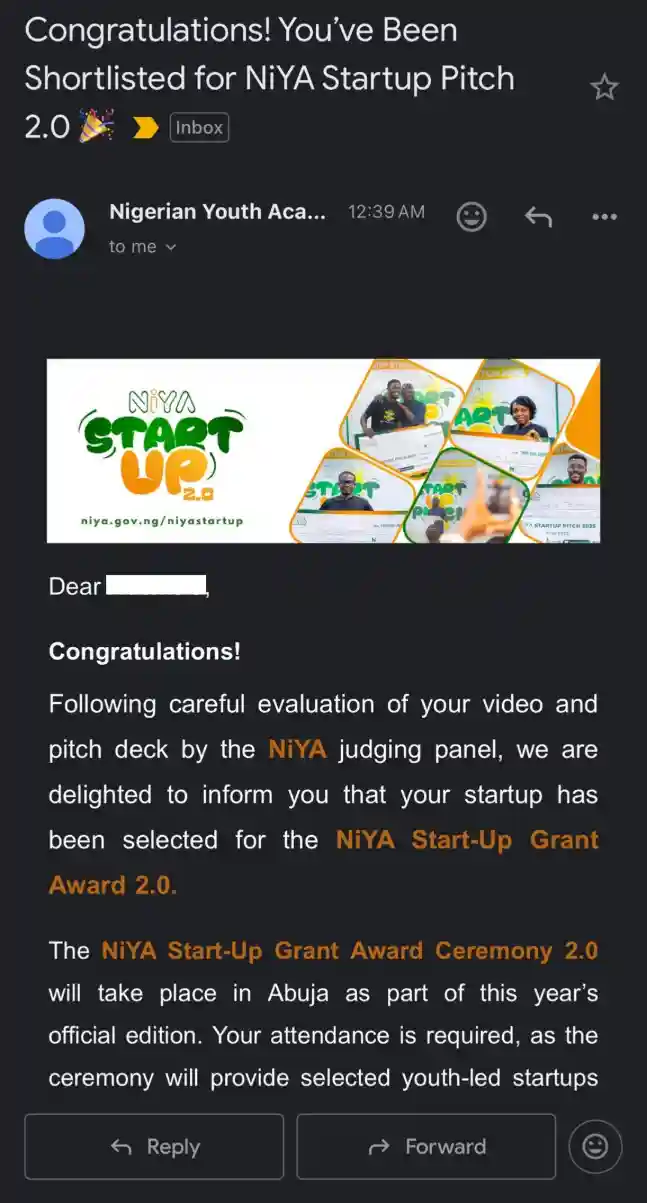
The Federal Ministry of Youth Development (FMYD) is sending emails to NiYA 2.0 shortlisted candidates. The subject of the email from the Nigerian Youth Academy to selected startups read, “Congratulations! You’ve Been Shortlisted for NiYA Startup Pitch 2.0.” NiYA Startup 2.0 brings a chance to be among 100 startups to win from a N100,000,000 grant.

The email reads, “Dear Candidate, Congratulations! Following careful evaluation of your video and pitch deck by the NiYA judging panel, we are delighted to inform you that your startup has been selected for the NiYA Start-Up Grant Award 2.0.”

The NiYA Start-Up Grant Award Ceremony 2.0 will take place in Abuja as part of this year’s official edition. Attendance is required, as the ceremony will provide selected youth-led startups a cash grant of ₦1 million each.

In total, 100 of Nigeria’s most innovative tech startups are being selected for mentorship, funding, enterprise support and national visibility. ₦100,000,000 is available for Nigerian tech startups, and only those shortlisted are being contacted via email with the next steps.

Plateau Business Carnival Showcases MSME Innovation and Local Products

The Made in Plateau Business Carnival 2025 entered its second day with a colourful and inspiring opening ceremony held yesterday at the Solomon Lar Amusement Park in Jos. The atmosphere was vibrant as exhibitors, investors, regulators, financial institutions, development partners and citizens gathered to celebrate the creativity and enterprise of Plateau’s MSME community. The event continued to attract attention from across different sectors, showing strong interest in locally made products and innovation.

The ceremony began with goodwill messages from key ministries, agencies and partners including the Ministry of Commerce and Industry, SMEDAN Plateau State Office, the Ministry of Information and Communication, the Plateau State One-Stop Investment Centre and GIZ. Each speaker praised the Carnival as a bold and timely initiative that strengthens Plateau State’s drive for economic expansion, increased local production, and sustainable enterprise growth. They highlighted the importance of supporting startups and small businesses to boost job creation and revenue.

In his remarks, the Director General of PLASMIDA, Hon. Bomkam Wuyep, expressed deep appreciation to His Excellency, Barr Caleb Mutfwang, described as the MSME friendly Governor, for ensuring the maiden edition of the Carnival became a reality. He stated that the Carnival reflects the Governor’s policy focus on economic rejuvenation, innovation and enterprise development. He acknowledged the contributions of the Technical Working Committee for their leadership, appreciated GIZ for its consistent technical support, and thanked all collaborating agencies for their roles. The DG reaffirmed PLASMIDA’s commitment to strengthening Plateau’s MSME ecosystem and unlocking new market opportunities for local businesses.

Representing the Governor, the Secretary to the Government of the State, Arch Samuel N Jatau, who also chairs the MSME council and the Ease of Doing Business Council, commended the DG PLASMIDA and his team for visionary leadership in hosting an event of such scale. He praised GIZ, partner agencies and other stakeholders for their continuous support, assuring that government remains committed to driving economic development in Plateau State. With optimism, he stated that next year’s Carnival will expand further to attract wider regional and national participation.

A key highlight was the unveiling of the “Made in Plateau Christmas Hamper,” a beautifully curated package containing only Made in Plateau products. The initiative celebrated the richness, quality and diversity of local offerings and demonstrated the state’s capacity to compete in larger markets. Stakeholders described the hamper as a symbol of renewed confidence in indigenous enterprise.

After the ceremony, the SGS undertook a guided tour of the exhibition grounds on behalf of the Governor. He interacted with exhibitors, inspected products across sectors, and expressed excitement at the innovation, craftsmanship and enterprise spirit displayed by Plateau MSMEs.

The event featured dignitaries including the Commissioner for Agriculture, the Commissioner for Livestock Development, Veterinary Services and Fisheries, the Commissioner for Youth and Sports Development, the Manager of PIPC, the Manager of Plateau Express Services, the General Manager of PRTVC, and other stakeholders whose presence highlighted the shared commitment to driving Plateau’s economic renaissance.

As the Carnival progresses, exhibitors continue to engage with investors, regulators, development partners and visitors, displaying impressive products from agro processing, crafts, textiles, manufacturing, technology and eco smart innovations. The Made in Plateau Business Carnival runs from December 2nd to 6th, 2025, opening daily at 8AM at Solomon Lar Amusement Park, encouraging the public to visit, explore, support local businesses and experience the creativity that defines the Plateau spirit.

JA Africa Competition to Train 200,000 Nigerian Youth Annually

0

Junior Achievement (JA) Africa has announced that more than 200,000 young Nigerians are expected to benefit every year from its youth entrepreneurship programmes, as the organisation hosts the 15th edition of the JA Africa Company of the Year (COY) Competition in Abuja. The continental business pitch event, described as Africa’s premier contest for secondary school students, runs from December 3 to 5, 2025. It brings together student entrepreneurs aged 14 to 17 from eight African countries, who will compete for a chance to showcase their ideas globally.

Speaking at a press conference in Abuja, JA Africa president and CEO, Simi Nwogugu, said the competition highlights the organisation’s commitment to grooming young innovators capable of driving development across the region. She explained that JA Africa now reaches 1.5 million young people annually in 23 African countries, while its Nigerian operations impact about 200,000 youths every year. According to her, 20,000 secondary school students in Nigeria received training this year through the Company Programme.

Nwogugu said this year’s theme, “Action for Climate Transformation (ACT!),” calls attention to the need for youth-led climate solutions and the power of innovation. “Africa’s greatest resource is the brilliance of its young people. Climate action is not only an environmental issue but a development imperative. Through COY, we see students transforming ideas into action and shaping a greener, more resilient Africa,” she stated. The programme aims to help students create solutions that align with sustainability and economic growth.

Participants from Eswatini, Ghana, Mauritius, Nigeria, Rwanda, South Africa, Uganda and Zambia will pitch their projects across six sectors: Innovation and Technology, Artificial Intelligence, Financial Technology, Digital Media and Creation, Renewable Energy, and Circular Economy and Sustainability. The winning team will represent Africa at the Ralph de la Vega Global Entrepreneurship Competition. Organisers say the competition gives young people access to mentorship, investment exposure, and real-world business experience.

Also speaking, president and CEO of JA Worldwide, Asheesh Advani, revealed that the organisation has deployed more than $1 billion globally over the past three years to support youth empowerment programmes. He said JA uses rigorous global standards to measure the long-term impact of its work. “We do three types of impact studies—predictive analytics, pre-and-post assessments, and alumni tracking. This allows us to monitor educational outcomes, entrepreneurial progress, and employment pathways. Our partners value transparency, and this data ensures accountability at every level,” Advani noted.

Advani added that JA is increasingly integrating AI literacy and digital skills into its curriculum through global partnerships, including collaborations with Microsoft. For this year’s competition, student teams are encouraged to embed AI solutions into their business concepts. “We believe African youth can leapfrog challenges and introduce innovations to the world, just like M-PESA did,” he stated. According to him, modern entrepreneurship demands technology awareness and the ability to solve problems with scalable solutions.

On inclusiveness, Nwogugu reaffirmed that JA Africa ensures that at least 5 to 10 percent of Nigerian participants are young persons with disabilities. She explained that the organisation works with specialist partners to provide accessible learning materials such as braille and sign-language-supported content. “We are committed to ensuring no young person is left behind,” she said. She further revealed that JA tracks its students through a digital dashboard and supports them with university scholarship guidance and leadership opportunities.

The Abuja event will end with the JA Africa Stakeholder Convening on December 5, themed “Unlocking Africa’s Youth Dividend: Radical Pathways for Inclusive Skills, Entrepreneurship, and Employment Systems.” The gathering will bring together policymakers, educators, private-sector leaders, philanthropists, and civil society representatives to strengthen support systems around entrepreneurship education.

The 15th COY is supported by headline sponsors FedEx, PMIEF, and First Bank Nigeria, along with development partners. Nwogugu said their contribution enables JA Africa to maintain an average programme cost of between $20 and $25 per student. “Running a year-long Company Programme is more expensive than shorter innovation camps, but the impact is significantly deeper,” she explained. JA Africa maintains that it will keep expanding its reach and improving its data-driven approach to youth empowerment. “When young people gain the confidence to innovate, they don’t just prepare for the future—they create it,” Nwogugu said.

FEC Approves $100m Youth Fund and $50m Agriculture Support

0

The federal executive council has approved a $100 million African Development Bank (AfDB) loan for the Nigeria Youth Investment Fund (NYIF). Wale Edun, minister of finance and coordinating minister of the economy, said the fund is designed to support entrepreneurs between the ages of 18 and 35, especially those managing small and medium-scale businesses. Edun spoke to journalists after the meeting held on Wednesday and presided over by President Bola Tinubu.

He added that “the council endorsed $50 million funding from the Islamic Development Bank for an integrated agricultural development project in Yobe state aimed at improving food security and rural livelihoods.” The minister explained that the government hopes this agricultural support will boost rural income and improve access to food. According to him, this aligns with the administration’s efforts to strengthen the economy across multiple sectors.

Edun noted that Tinubu commended the cabinet for its dedication to achieving the renewed hope agenda. He pointed to fresh economic indicators showing resilience, with the economy expanding by 3.89 percent in the third quarter of 2025. The minister said inflation has begun to decline, while agriculture and industry have continued to perform well.

However, he said the president maintained that the current growth rate is still below his seven percent target needed to lift millions out of poverty. Tinubu was reported to have directed ministries, departments, and agencies to focus capital spending on growth driven and job creating projects. He added that the economic management team will screen these priorities before seeking final approval from the president.

With the approval of these funds, the government signalled a stronger push for youth empowerment and economic inclusion. It also outlined a medium term fiscal roadmap under the 2026 to 2028 framework. Officials believe that if implementation goes as planned, the youth fund and agricultural financing could support sustainable growth and job creation nationwide.

Tinubu’s RHI Disburses N50m To 250 Persons With Disabilities In Niger

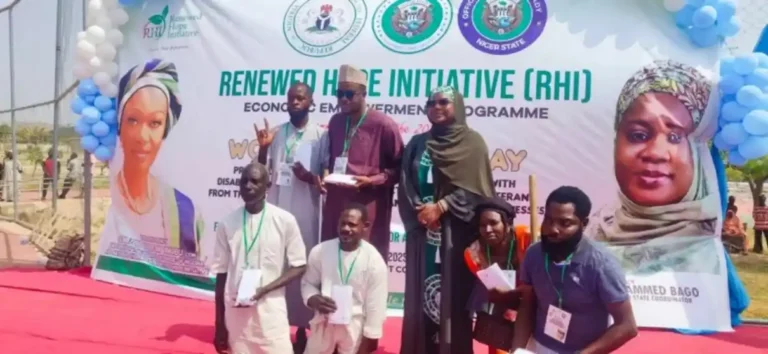
Sen. Oluremi Tinubu has disbursed N50 million to 250 persons with disabilities in Niger State as part of the Renewed Hope Initiative (RHI) Economic Empowerment Programme. The event held in Minna on Wednesday was organised to commemorate the 2025 International Day of Persons with Disabilities.

Tinubu, represented by Hajiya Fatima Bago, Wife of the Niger State Governor, said the intervention under the RHI Social Investment Programme was designed to foster inclusive growth and social progress. She explained that the scheme was being implemented simultaneously across all 36 states, the Federal Capital Territory (FCT), and through the Defence and Police Officers’ Wives Association (DEPOWA).

She said the initiative, themed Fostering Disability Inclusive Societies for Advancing Social Progress, was aimed at empowering every individual to contribute meaningfully to national development. The programme will provide N200,000 business recapitalisation grants to 250 persons with disabilities in each state and the FCT to help strengthen small business owners livelihoods.

According to her, each state and DEPOWA would receive N50 million for distribution to identified beneficiaries. This brings the total number of beneficiaries nationwide to 9,500 persons with an overall value of N1.9 billion. She stated that the programme aligns with President Bola Tinubu’s Renewed Hope Agenda which seeks inclusive growth and shared prosperity by ensuring no Nigerian is left behind.

Tinubu noted that in the past two years, RHI had supported over 100,000 women petty traders, small business owners and persons with disabilities through direct business grants. She added that the intervention complements existing social investment efforts in agriculture, education, health and welfare, including support for people affected by floods, communal clashes, disasters, widows, the elderly and children of fallen heroes.

In her remarks, Hajiya Fatima Bago described the initiative as noble and said it demonstrates the state’s commitment to inclusiveness, dignity and equal opportunity. Bago, who was represented by Mrs Mary Noel-Berje, Special Adviser to Gov. Umaru Bago on Women and Affirmative Action, said the commemoration was held on a low key in solidarity with families of abducted school children in Papiri, Agwara Local Government Area. She said the initiative reflects the administration’s commitment that every citizen, irrespective of physical condition, deserves access to empowerment and social protection.

Also speaking, Mrs Afiniki Dauda, Deputy Speaker of the Niger Assembly, commended the humanitarian spirit of the governor’s wife and urged women to emulate her exemplary life. She advised beneficiaries to use the grants wisely.

Abdulrahman Auwal, who spoke on behalf of persons with disabilities, thanked the First Lady and the governor’s wife for the support and pledged that the funds would be used to improve businesses and livelihoods.

AKSU VC urges students to access NELFUND loan

0

The Acting Vice-Chancellor of Akwa Ibom State University (AKSU), Professor Otoabasi Akpan, has urged students to fully embrace the Nigerian Education Loan Fund (NELFUND) introduced by the Federal Government. He made this call on Wednesday during the first Parents and Stakeholders’ Forum held at the university’s Main Campus in Ikot Akpaden, Mkpat Enin Local Government Area.

Speaking at the meeting, Prof. Akpan reflected on the steady development of the university and pointed out several achievements under his leadership, including the creation of four new faculties. He explained that the gathering was aimed at advancing the welfare of students, noting that NELFUND represents a major opportunity for young people who lack financial support to pursue higher education. According to him, NELFUND is designed to break financial barriers by offering loans and grants to eligible students and trainees.

He stated that these funds are made available to cover tuition, institutional charges, and upkeep for students in universities, polytechnics, colleges of education, and recognized vocational institutions. The Vice-Chancellor highlighted that the repayment model of the loan is flexible, explaining that graduates are granted a grace period after NYSC before repayment begins. He added that those who remain unemployed will have their repayment automatically deferred until they secure a job.

Prof. Akpan expressed appreciation to the Executive Governor of Akwa Ibom State, Pastor Umo Eno, describing him as a strong supporter of the university’s progress. He maintained that AKSU is committed to academic excellence, while working closely with the state government in line with its ARISE Agenda. He also announced that the Parents and Stakeholders’ Forum will now hold every year.

In their remarks, the Deputy Vice-Chancellor Academic, Prof. Iniobong Umotong, University Librarian, Prof. Nse E. Akwang, and Dean, Faculty of Physical Sciences, Prof. Usoro, praised the Acting Vice-Chancellor for organising the maiden edition of the forum. They stressed that NELFUND is strictly created for students and urged Deans, Heads of Departments, and all academic units to intensify awareness so that every eligible student benefits from it.

Parents, stakeholders, and members of the Students Union Executives at the event expressed strong support for Prof. Akpan’s leadership, describing the initiative as timely and commending the Federal Government for the opportunity. In her closing remarks, the Registrar and Secretary to Senate, Dr. Ebi G. Eno-Ibanga, thanked attendees and encouraged parents to motivate their children and wards to make good use of NELFUND and complete their registration.

In attendance were the Head of Campus, Obio Akpa, and Dean of the Faculty of Agricultural Sciences, Prof. Jemimah Ekanem, alongside other Deans, Heads of Departments, Directors, teaching and non-teaching staff, village heads, elders, and clergy.

FG Begins Last Round Payment of N20,000 NELFUND Upkeep

0

The federal government has commenced payment of N20,000 for the last round of Nigerian Education Loan Fund upkeep for students who collected loan last session. Students who benefited last academic year have started confirming credit alerts. If you have not received your November upkeep yet, just keep waiting, you will be credited soon.

The payment is also making rounds on social media, including Facebook, with beneficiaries making posts like “NELFUND upkeep is still dropping”.

The update on final round payment follows the August directive on upkeep disbursement that ties payments strictly to the academic session of each institution.

According to the Presidency, NELFUND emphasized that upkeep loans will only apply to the current academic year of a student. It noted that students shall only be entitled to upkeep allowance for their current academic session. After an institution’s academic year, upkeep payments stop for that session. This means students moving into a new academic year will no longer receive upkeep disbursements for the previous session.

Meanwhile, the 2025/26 application is still open. Students who want to collect upkeep for the next session are to apply now via the portal nelf.gov.ng. Interest in the loan scheme remains high, as over one million students have applied since its official launch on May 24, 2024.

NELFUND has also disbursed over N116 billion in student loans, covering both tuition fees and upkeep allowances for students across universities, polytechnics, and colleges of education in all 36 states and the FCT.

To be informed, NELFUND is seeking a partnership with NYSC to help track graduates and collect student loans, which are due for repayment two years after NYSC service. NYSC agreed to support the process and help sensitise Corps Members to ensure the loan scheme works effectively.