Home Blog Page 286

Akwa Ibom Governor Presents N1.39 Trillion Budget for 2026

0

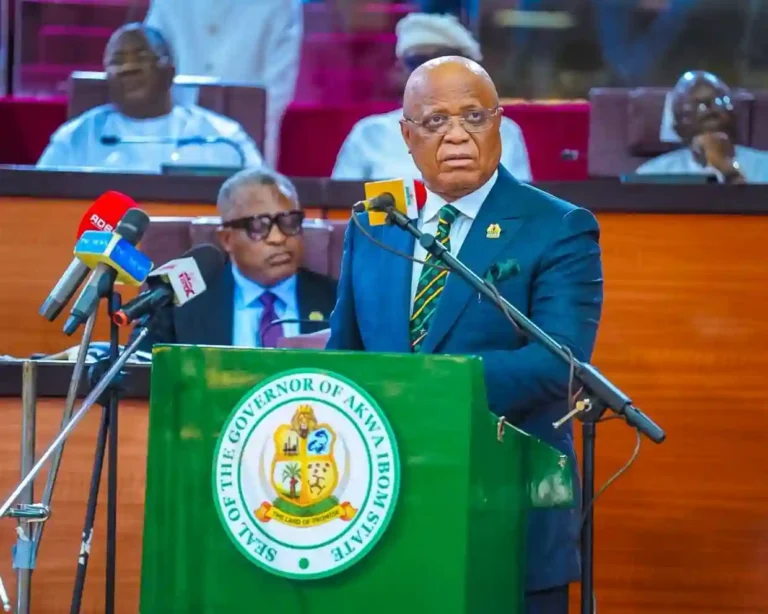
Akwa Ibom State Governor, Pastor Umo Eno, on Tuesday, November 25, 2025, presented a budget estimate of N1.39 trillion for the 2026 fiscal year to the State House of Assembly during a plenary session held at the Assembly Complex on Udo Udoma Avenue in Uyo. The budget is titled The People’s Budget of Expansion and Growth and is designed to focus on key areas of the ARISE Agenda that the administration has been implementing across the state.

Governor Eno explained that the 2026 appropriation is structured to address several fundamental needs in the state. He said the budget will strengthen food security and sufficiency, improve living conditions in rural communities, complete ongoing flagship infrastructure projects such as roads, bridges, aviation development and health facilities, and also begin new projects that will support connectivity, trade, investment and job creation. According to him, these priorities are essential to boosting long-term economic growth and improving the everyday life of citizens.

The Governor further stated that the fiscal plan aims to strengthen internal security architecture, enhance the quality, accessibility and relevance of education at all levels, and promote economic diversification with strong support for MSMEs. He added that the state will continue to invest in human capital development and social inclusion. Governor Eno also revealed that part of the budget focuses on renewable energy and waste-to-wealth initiatives. These projects, he noted, are intended to reduce greenhouse gas emissions, create green jobs and support environmental sustainability.

Giving a breakdown of the estimates, Governor Eno said the proposed expenditure for 2026 consists of N354.867 billion for recurrent spending, representing 25 percent of the total budget, while N1.035 trillion is allocated for capital expenditure, which makes up 75 percent. He explained that the high capital expenditure ratio is deliberate and is meant to accelerate economic activities in the state. He pointed out that the capital component includes N387.5 billion for roads and other infrastructure, N31.6 billion for education, and N136.1 billion for health, among other sectors.

The Governor acknowledged that the 2026 budget reflects a 16 percent decrease compared to the approved revised budget of N1.65 trillion for the 2025 fiscal year. He clarified that the state had initially approved N955 billion for the 2025 fiscal year before it was revised upward to N1.65 trillion, with N425.666 billion allocated to recurrent expenditure and N1.224 trillion to capital projects.

Providing an update on the 2025 financial performance, Governor Eno said that as of September 2025, the state had collected N897.144 billion in recurrent revenue, representing 108 percent of the approved provision for January to September. He added that N3.883 billion was generated from other capital receipts excluding recurrent surplus, which represents 15.5 percent of the approved projection for the period. According to him, N231.228 billion was spent on recurrent services within the same period, amounting to 77.1 percent of the approved provision, while N598.981 billion was spent on capital programs, representing 91.4 percent of the approved allocation.

Governor Eno expressed appreciation to President Bola Ahmed Tinubu for what he described as a bold decision to remove petroleum subsidy. He said the policy has increased the funds available to states, making it possible for Akwa Ibom to execute both recurrent and capital projects without borrowing.

According to him, “Today, from agriculture to rural development, from infrastructure to security and educational advancements, tourism to healthcare, promotion of SMEs to sports, housing, transport among other key sectors, we are undertaking bold and audacious projects without borrowing and have earmarked resources to complete all the projects we have initiated.” He added, “We thank the President again and assure him that to whom much is given, much is expected and we will deliver big for him come 2027.”

In his remarks, the Speaker of the Akwa Ibom State House of Assembly, Rt Hon Udeme Otong, commended Governor Eno for what he described as visionary leadership. He said the ARISE Agenda has moved beyond policy statements to actual results by touching communities, empowering households and strengthening the state’s economic foundation. Otong stated that one of the most commendable aspects of the Governor’s leadership is his commitment to bringing government closer to the grassroots.

He added that in reviewing the 2026 budget, the House is particularly interested in how the fiscal plan will reinforce priority areas of the ARISE Agenda, especially in sectors such as education, healthcare, tourism, creative industries and other areas that can help the state reduce its dependence on federal allocation.

Advertisement

ECOWAS, Partners Train 200 Anambra Youths in Fish Production

0

The Economic Community of West African States (ECOWAS), in partnership with the Taenprowiz Production Partnership Centre, Chukwuemeka Odumegwu Ojukwu University (COOU), select cooperatives and the Anambra State Government, has launched a youth empowerment initiative targeted at transforming the fish production business across West Africa.

The programme is designed to train 200 young people in Anambra State on the Taenprowiz Fish Production Business System and Technology. It was officially inaugurated during the induction ceremony of the ECOWAS Youth Employability Programme 2.0, which took place at the COOU ETF Auditorium in Igbariam, where participants, community members and senior officials gathered to witness the event.

Speaking at the ceremony, Mr. Emeka Iloghalu, Coordinator of the Taenprowiz Production Business System and Technology Partnership Centre in Anambra and Managing Director of the Fisheries and Aquaculture Business Development Agency (FABDA), praised the partnership between ECOWAS and the state government. He described the programme as a timely intervention that will help reduce youth restiveness, strengthen job creation and support the growth of aquaculture entrepreneurship in the state and the wider region. He said the initiative is designed to give young people practical skills that will enable them to play important roles in the expanding fish production industry.

Iloghalu explained that the Taenprowiz Fish Production Business System and Technology introduces an integrated and technology-enabled approach that is focused on improving yields, reducing losses and standardizing fish production processes for both small and large-scale farmers. According to him, the system uses modern aquaculture business science, data-driven management tools and automated monitoring solutions to tackle recurring problems such as high fish mortality, inconsistent feeding and poor water quality. He noted that these issues often weaken productivity and discourage young entrepreneurs from investing in aquaculture.

He added that the model places particular emphasis on capacity-building and sustainability through training that covers effective production techniques, standard operating procedures and environmentally friendly practices aimed at reducing waste and preventing disease outbreaks. He noted that the system also enhances the aquaculture value chain by improving post-harvest handling, processing and market access strategies for farmers. “With its focus on resilience and innovation, the Taenprowiz Fish Production Business System is becoming a transformative blueprint for food security and aquaculture entrepreneurship across emerging markets,” he said.

The 200 participants selected for the programme have already completed more than two months of preliminary engagement and will continue with hands-on training as the initiative progresses. According to Iloghalu, graduates of the programme will be equipped to contribute in three main ways: as professional workers in the aquaculture industry, as cooperative members with practical skills instead of beginner-level knowledge, and as informed investors who can assess viable fish production ventures. “You have a bright future. With the support of Anambra State and ECOWAS, you will have no limits,” he told the new inductees, encouraging them to take the training seriously.

Iloghalu also commended the team led by Prof. Jude Obi and the West African Secretariat of Ecological Organic Agriculture (WASEOA) for coordinating similar training sessions across Benin Republic, Togo, Senegal, Côte d’Ivoire, Liberia and Nigeria. He said the simultaneous rollouts highlight the regional importance of the initiative and its goal of strengthening youth participation in agriculture across West Africa.

Representing the Anambra State Commissioner for Youth Development, Hon. Patrick Aghamba, Mr. Kingsley Ezelagba encouraged the participants to stay committed to the training. He highlighted the efforts of Governor Chukwuma Soludo in youth development and recalled that the administration has empowered more than 8,000 young people under the One Youth, Two Skills scheme. He said the ECOWAS-Taenprowiz initiative adds another opportunity for youths to gain valuable skills that can improve their economic prospects.

The President of the ECOWAS Commission, Dr. Omar Alieu Toure, represented by Prof. Jude Obi, said the project is part of ECOWAS’s larger strategy to improve youth employment in agriculture, agro-forestry and fisheries. He expressed concern that more than 75 percent of young people in the region remain unemployed and said the initiative represents a meaningful step toward addressing the issue. He added that the ten best trainees among the 1,280 youths enrolled across six West African countries will receive special awards for excellence.

In her remarks, COOU Vice-Chancellor, Prof. Kate Omenugha, praised ECOWAS and Taenprowiz for investing in agricultural development and food security. She reaffirmed the university’s dedication to supporting the United Nations Sustainable Development Goal of Zero Hunger. She also highlighted the university’s Healthy Living Farm as a model for organic farming, sustainability and hands-on agricultural learning for young people.

Also speaking at the event, the Director of the Centre for Entrepreneurial Studies at COOU, Prof. Onyechi Uzoka, encouraged the youths to adopt innovative ideas, apply their new skills and make use of mentorship opportunities available through the programme. He said he is confident that the initiative will help position Anambra State as a major fish production centre in Nigeria and eventually in West Africa as more trained youths enter the sector.

The high point of the event was the formal induction of 200 youths into the Taenprowiz Fish Production Business System. The induction was conducted by the Coordinator of ECOWAS/WASEOA Nigeria, Mr. Gbadamosi R. Oyewole, who urged the participants to maximise the opportunity and commit to building successful careers in aquaculture.

Nigeria Unveils Youth Financial Literacy and Wealth Creation Programme

0

The Minister of Youth Development, Ayodele Olawande, on Tuesday in Abuja inaugurated the National Financial Literacy, Investment and Wealth Creation Training Programme, emphasising that financial knowledge has become essential for young people in today’s world. Speaking during the event, Olawande explained that the ministry, in partnership with Investonaire Academy, was unveiling a new initiative focused on equipping youths with practical financial skills. He stated that financial literacy was now key to survival and noted that young people must begin to adapt to changing economic realities.

According to him, financial literacy is not just an advantage but a necessity, especially for those seeking long-term stability. Olawande encouraged Nigerian youths to think beyond conventional paths and explore new opportunities for wealth creation. He said young people should focus on building ideas, creating value and pursuing financial freedom rather than relying only on government jobs. He added that he hoped to see fewer young people depending on government employment and more becoming entrepreneurs and employers.

Olawande said he had observed that many young people were eager to be employed, and the ministry aimed to support them through training and targeted initiatives. He explained that the programme targets more than 4,000 corps members every year, with a commitment to ensure they receive the support needed to succeed. He described the launch as a defining moment in the country’s journey toward prosperity, purpose and wider opportunities for young Nigerians.

He noted that many young people dream of becoming millionaires, but the first step is learning the basics of financial literacy. He said the ministry had already unveiled several initiatives for corps members and remained committed to sustaining this support. Olawande stressed that the period for motivational talks had passed, saying the focus was now on taking action. He revealed that before the end of the year, more than 200 startups would be empowered and urged young people to take advantage of the opportunity. According to him, Nigeria needs ideas, innovation and people ready to partner with the government to shape the nation’s future and empower its youth.

Also speaking at the event, Sebastien Sicre, Chief Operating Officer of Investonaire Academy, said the world had become a dynamic marketplace, with more than 8.5 trillion dollars traded daily in the global forex market alone.

Sicre explained that the market rewards productive and innovative individuals based on the value they create. He said higher value creation leads to higher rewards, noting that knowledge plays a central role in determining what individuals can offer. According to him, distinct and sophisticated knowledge enables people to command greater value in any marketplace.

Gombe Denies Viral Rumour on School Closure

0

Gombe State Ministry of Education has issued a notice warning the public about a fake message circulating online about the closure of public schools in the state. According to the Ministry, the viral piece did not come from its office. The statement explained, “the piece is not from the Ministry as currently students are writing their end of term examinations in all public schools across the state.”

Parents, guardians and the general public have been urged to ignore any earlier message suggesting that the state government had ordered schools to close. The Ministry noted that students will continue their examinations and, as usual, will proceed for holidays after completing their papers.

The Ministry added that it regrets any inconvenience caused by the false alert. The Gombe State government also assured residents of their safety and security at all times. The statement was e-signed by Saidu Bappa Malala, Special Assistant Media to the Commissioner of Education.

NBS Reports Drop in Prices of Food Items in September 2025

0

The National Bureau of Statistics has reported that the prices of beans, garri, maize, tomatoes, beef, rice, and several other key food items recorded a slight decline in September 2025. This update was contained in the agency’s Selected Food Prices Watch report for September 2025, released in Abuja on Tuesday.

According to the NBS, the average price of 1kg of brown beans dropped by 33.70 per cent on a year-on-year basis, moving from N2,738.59 in September 2024 to N1,815.76 in September 2025. The report stated, “On a month-on-month basis, beans also decreased by 1.74 per cent from the N1,847.82 recorded in August 2025.”

The report also showed that the average price of 1kg of white garri fell by 25.51 per cent on a year-on-year basis, dropping from N1,170.25 in September 2024 to N871.78 in September 2025. It added, “On a month-on-month basis, the price also fell by 6.52 per cent from the N932.53 recorded in August 2025.” The NBS noted a similar trend for maize, explaining that the average price of 1kg of white grain maize sold loose declined by 16.57 per cent on a year-on-year basis, falling from N1,065.14 in September 2024 to N888.68 in September 2025. It stated, “On a month-on-month basis, it decreased by 6.56 per cent from N951.04 recorded in August 2025.”

According to the breakdown, the average price of 1kg of tomato reduced by 10.56 per cent from N1,430.87 in September 2024 to N1,279.84 in September 2025. The bureau stated, “Also, on a month-on-month basis, the price decreased by 0.45 per cent from the N1,285.61 recorded in August 2025.” However, the average price of 1kg of local rice increased slightly by 1.99 per cent on a year-on-year basis from N1,914.77 in September 2024 to N1,952.94 in September 2025. The report added, “However, on a month-on-month basis, 1kg of local rice decreased by 0.56 per cent in September from the N1,963.87 recorded in August 2025.”

The NBS also confirmed that the average price of 1kg of boneless beef increased by 21.79 per cent year-on-year, rising from N5,633.60 in September 2024 to N6,861.25 in September 2025. It noted, “However, on a month-on-month basis, the price decreased by 0.02 per cent from the N6,860.07 recorded in August 2025.”

On state-by-state analysis, the report showed that Enugu State recorded the highest average price of 1kg of brown beans at N2,337.58, while Yobe recorded the lowest at N1,223.42. Ebonyi had the highest average price of 1kg of white garri at N1,297.22, while Taraba recorded the lowest at N450. The highest average price of 1kg of white maize was recorded in Imo at N1,488.5, with Yobe recording the lowest at N547.84. For tomatoes, Ebonyi had the highest price at N2,301.38, while Plateau recorded the lowest at N697.69. The report added that the highest price for 1kg of local rice was in Enugu at N2,385.73, while Lagos recorded the lowest at N1,963.87. It also stated that Imo recorded the highest average price of 1kg of boneless beef at N9,070.39, while Benue recorded the lowest at N6,860.07.

A breakdown by geopolitical zones showed that the average price of 1kg of brown beans was highest in the South-East at N2,241.48, followed by the South-West at N2,082.52, while the lowest price was recorded in the North-West at N1,397.97. The South-East and South-South recorded the highest average prices of 1kg of white garri at N1,223.77 and N977.56, while the lowest was in the North-Central at N640.68. For white maize, the South-East recorded the highest average price at N1,247.60, followed by the South-South at N1,113.41, while the North-East recorded the lowest at N607.93. The NBS added that the North-Central and South-East recorded the highest average prices of 1kg of local rice at N2,031.33 and N2,029.48, while the South-South recorded the lowest. It also noted that the South-East had the highest average price of 1kg of tomato at N2,004.88, followed by the South-South at N1,593.09, while the North-West recorded the lowest at N870.78.

In September, President Bola Tinubu directed a Federal Executive Council Committee to take further steps to reduce food prices by ensuring safe movement of food items across key routes in the country.

Nigeria’s VAT Drops Slightly to N2.06 Trillion in Q2 2025

The National Bureau of Statistics has reported that Nigeria’s aggregate value-added tax for the second quarter of 2025 stood at N2.06 trillion, showing what it described as a slight decrease of 0.03 per cent on a quarter-on-quarter basis compared to the N2.06 trillion recorded in the first quarter of the year. The VAT Q2 2025 report, released on Tuesday, explained the breakdown of the collections and the performance of different sectors during the period.

According to the bureau, local VAT payments in Q2 2025 were recorded at N1.09 trillion, while foreign VAT payments contributed N459.95 billion. Import VAT also added N508.55 billion to the total figure. In its analysis of sectoral growth, the NBS said real estate activities recorded the highest growth rate at 155.21 per cent on a quarter-on-quarter basis. This was followed by agriculture, forestry, and fishing at 23.64 per cent, and information and communication at 17.75 per cent.

The report also pointed out that some sectors saw much lower growth. It stated that “on the other hand, human health and social work activities had the lowest growth rate at 68.34 per cent, followed by electricity, gas, steam, and air conditioning supply, with 45.20 per cent.” It added that water supply, sewerage, waste management, and remediation activities recorded a growth rate of 29.36 per cent.

In terms of contributions to total VAT, the NBS said the top three performing sectors in Q2 2025 were manufacturing at 27.19 per cent, information and communication at 20.76 per cent, and mining and quarrying at 15.04 per cent. The report noted that “on the other hand, activities of households as employers and undifferentiated goods and services-producing activities of households for own use recorded the least share at 0.005 per cent.” It added that activities of extraterritorial organisations and bodies contributed 0.02 per cent, while water supply, sewerage, and waste management accounted for 0.03 per cent.

Despite the slight quarter-on-quarter drop, the NBS said VAT collections in Q2 2025 rose by 32.15 per cent on a year-on-year basis compared to Q2 2024. The report also provided a reminder of the Q1 2025 performance, where aggregate VAT stood at N2.06 trillion, marking a 6.02 per cent increase from the N1.95 trillion recorded in Q4 2024.

In the Q1 2025 breakdown, local VAT payments were N1.10 trillion, foreign payments were N454.76 billion, and import VAT contributed N507.00 billion. The bureau stated that electricity, gas, steam, and air conditioning supply recorded the highest growth rate in Q1 2025 at 136.71 per cent, followed by administrative and support service activities at 45.24 per cent, and professional, scientific, and technical activities at 39.00 per cent.

It added that “on the other hand, activities of extraterritorial organisations and bodies had the lowest growth rate at 35.70 per cent, followed by wholesale and retail trade, repair of motor vehicles and motorcycles, and real estate activities at 14.51 per cent and 11.54 per cent, respectively.”

The top contributors in Q1 2025 were manufacturing at 26.03 per cent, information and communication at 17.51 per cent, and mining and quarrying at 17.02 per cent. The bureau also noted that activities of households as employers had the least share at 0.004 per cent, followed by extraterritorial organisations at 0.02 per cent and water supply, sewerage, and waste management at 0.04 per cent.

5.5 Million Households Benefit from Cash Transfer Programme – FG

The Federal Ministry of Humanitarian Affairs and Poverty Reduction has announced that 5.5 million out of the 19.78 million vulnerable households listed in the verified National Social Register have so far benefitted from the government’s cash transfer programme. The Minister of Humanitarian Affairs and Poverty Reduction, Dr Bernard Doro, revealed this during the inauguration of the Act Naija Project National Steering Committee, a civil society platform created to strengthen social protection efforts in the country. The event took place on Tuesday in Abuja.

Dr Doro described the progress as one of the key steps in improving Nigeria’s social protection system and reaffirming the government’s commitment to reducing poverty under the Renewed Hope Agenda. He explained that the update was linked to ongoing social programmes such as the Conditional Cash Transfers, the Grant for Vulnerable Groups, N-Power and GEEP. He added that other initiatives include the Home-Grown School Feeding Programme and the National Social Safety-Net Coordination.

According to him, microcredit schemes have also played a major role, supporting more than 5 million Nigerians across all 774 local government areas. He noted that the beneficiaries include many women and young people. The minister further stated that consultations to review and update the National Social Protection Policy were ongoing to reflect current realities and harmonise interventions across government bodies. He said zonal consultations had already been concluded in the South-West, North-Central, North-West and North-East, while those for the South-East and South-South would be completed before the end of November.

Dr Doro also highlighted the government’s efforts to expand opportunities for young Nigerians. He said the ministry recently wrapped up the Skill-2-Wealth Programme for unemployed youths across all six geopolitical zones. The training covered solar panel installation and maintenance, agriculture including greenhouse farming, and automobile technology in partnership with GAC Motors.

He added that the ministry was working closely with development partners to improve Nigeria’s shock-responsive and adaptive social protection systems. He revealed that a draft Shock Responsive Social Protection Standard Operating Procedure, developed in partnership with the World Food Programme, was undergoing stakeholder review. Once approved, the document will guide coordinated national responses to emergencies such as pandemics, climate shocks, displacement and other crises.

The minister said the government remained committed to building what he described as a coordinated, accountable and resilient social protection system that supports vulnerable citizens and strengthens regional cooperation across West Africa. He stated that the Act Naija Project aligns with the Renewed Hope Agenda by focusing on empowering vulnerable households, ensuring transparency and achieving measurable impact.

He said, “This committee has a critical role in providing strategic guidance, harmonising efforts across government, civil society, donors and ensuring accountability and collaboration at all levels. I urge all members to serve with dedication, professionalism and integrity to improve lives and strengthen public trust.”

Speaking on behalf of the consortium partners of the Act Naija Project, the Executive Director of the African Network for Environmental and Economic Justice, David Ugolor, said the inauguration marked an important milestone in the country’s social protection landscape. He noted, “We recognise that social protection remains a key instrument for breaking the cycle of poverty, promoting human dignity and fostering inclusive growth. However, its success depends on effective coordination among all stakeholders: government, civil society, private sector and development partners.”

Also, the Deputy Executive Director of ANEEJ, Leo Atakpu, presented a baseline study on social intervention programmes. He explained that the study assessed existing interventions, institutional capacity, coordination structures and coverage of vulnerable groups across six states and the Federal Capital Territory. The states involved were Borno, Delta, Ekiti, Enugu, Kogi, Ondo and Osun. According to him, all the states shared similar challenges, including limited disaggregated data, low public awareness and insufficient digital targeting systems. He said the newly inaugurated committee would help improve government efforts.

The steering committee members were selected from the six states assessed. The consortium of partners includes Bread for the World in Germany, New Initiative for Sustainable Development and ANEEJ.

Customs Orders Mandatory Drug Testing for Recruits, Serving Officers

0

The Comptroller-General of Customs, Adewale Adeniyi, on Tuesday announced a new policy that introduces compulsory drug testing for all recruits and serving officers of the Nigeria Customs Service. He explained that the measure, which is now part of the ongoing recruitment process, is meant to ensure that individuals who are unfit or dependent on substances do not enter or remain in the Service.

Adeniyi said the agency can no longer risk situations where personnel with compromised judgment are responsible for border security, enforcement duties, and revenue collection. He made the remarks during the closing session of the CGC’s 2025 Conference in Abuja, according to a statement released by Customs spokesperson, Abdullahi Maiwada.

The statement read, “The Nigeria Customs Service has concluded arrangements to subject all incoming officers and men to a mandatory drug test as part of the ongoing recruitment exercise. A mandatory drug test would be carried out for all officers and men across all Zones, Commands and at the Headquarters. The Service would no longer tolerate a situation where personnel make sensitive decisions while under the influence of drugs.”

According to Adeniyi, the new policy will begin with fresh intakes but will also extend to all serving officers across Zones, Commands, and the Headquarters. He stated that the goal is to build what he described as “a fully drug-free institution.”

He added that the decision was influenced by previous experiences in some commands where cases of erratic behaviour and questionable decisions were later traced to substance abuse. He said, “There will be no compromise. We are going to ensure that every new officer is tested so that we do not begin to spend Service resources rehabilitating personnel.”

The Customs chief stressed that the Service will no longer tolerate lapses linked to drug use, especially from officers responsible for sensitive enforcement operations. He also encouraged personnel to take regular medical checks seriously, noting that both mental and physical fitness are important for effective service delivery.

The directive comes at a time when security agencies across the country are facing increased scrutiny over the conduct of their personnel. In recent years, other agencies such as the police, immigration, and correctional services have introduced random drug tests and psychological assessments following several incidents of misconduct linked to substance abuse.

The Customs’ new drug-testing policy also follows calls by the Chairman of the NDLEA, Brig. Gen. Buba Marwa (retd.), who earlier urged all security, law enforcement, and uniformed agencies to adopt mandatory drug tests for their staff. Marwa has repeatedly stated that Nigeria’s fight against drug abuse and trafficking cannot succeed if security agencies retain individuals struggling with substance dependency.

The renewed push by the Customs CG is viewed as part of broader reforms aimed at tightening discipline, reducing risks during operations, and strengthening public trust in the Service’s frontline officers.

Nigeria Moves to Unlock $300bn Dead Capital Through Land Reform

0

The Federal Government has announced plans to overhaul Nigeria’s land administration system as part of a major reform effort aimed at unlocking an estimated $300 billion in dead capital. The Minister of Housing and Urban Development, Ahmed Dangiwa, made this known in Kano at the opening of the 30th Conference of Directors of Lands in Federal and State Ministries, Departments and Agencies. The conference is themed Nigeria Land Titling, Registration and Documentation Programme (NLTRDP): Implementation Mission.

Dangiwa said the reform was designed to support economic development across the 36 states and the Federal Capital Territory. He explained that the government was shifting from long-standing discussions to real action, noting that effective land administration remained central to the national development agenda under President Bola Ahmed Tinubu’s Renewed Hope Agenda. He recalled that since his first meeting with land directors in Lagos in 2023, he had repeatedly stressed the need for deep reforms to improve housing delivery, agriculture, urban renewal and investment growth.

According to him, the introduction of the Nigeria Land Titling, Registration and Documentation Programme, also known as Land4Growth, represents a major step toward modernising land governance nationwide. He said the initiative was developed in partnership with state governments and the World Bank to deliver a harmonised approach to land registration, documentation and titling. Dangiwa described as unacceptable the reality that less than five per cent of land in Nigeria was formally registered. He said this situation had trapped millions of citizens in economic stagnation by preventing access to collateral, credit and secure property ownership.

He noted that Nigeria’s poor ranking on the World Bank’s Registering Property index was a direct consequence of outdated and cumbersome land processes, excessive bureaucracy and inconsistent regulations that discourage both local and foreign investment. Dangiwa said ongoing digitisation efforts in several states had already shown clear benefits. He mentioned AGIS in the FCT, KADGIS in Kaduna, KANGIS in Kano, EDOGIS in Edo and NAGIS in Nasarawa as systems that had improved efficiency, boosted revenue and restored public confidence.

The minister outlined the key pillars of the Land4Growth programme to include the standardisation of procedures nationwide, expansion of systematic land titling, digitisation of registries, strengthening of legal frameworks and unlocking land-based financing for states and citizens. He added that unlocking even a fraction of undocumented land would significantly increase Internally Generated Revenue, expand access to credit and boost growth in agriculture, housing, industry and infrastructure.

Dangiwa encouraged state governments to position themselves properly within the Land4Growth framework, explaining that states currently fall into three groups: front-runners, emerging reformers and lagging states. He said he hoped that the 2025 conference would serve as a strategic turning point. According to him, by the next edition, all states should be able to present measurable progress reports on land titling and how it contributes to their Internally Generated Revenue and the country’s Gross Domestic Product.

Speaking earlier, the Kano State Commissioner for Land and Physical Planning, Abduljabar Umar, said the state had recorded notable progress in land administration reforms under the leadership of Governor Abba Kabir Yusuf. Umar explained that the state embarked on comprehensive reforms to restore order, protect public land, modernise the system and place citizens at the centre of governance.

He stated that before 2023, land administration in Kano faced issues ranging from disorganised records and illegal layouts to double allocations and weak GIS infrastructure, which weakened public trust. He added that the reforms, tagged The Kano Experience, reflect improvements in institutional restructuring, digitisation, capacity building and legal reforms. Umar said the state also removed land speculators who had operated freely for decades and influenced documentation and decisions within the ministry.

50 Trainees Graduate From First Batch FG Forex Training Programme

0

Comrade Ayodele Olawande, the Minister for Youth Development, has announced the successful graduation of the first batch of 50 trainees under the partnership between the Federal Ministry of Youth Development and Investonaire Academy. The graduation, which took place on Tuesday, marks what he described as a major step in empowering young Nigerians with practical financial skills.

According to him, the participants were taught the basics of forex trading and were also supported with different amounts of capital, with the least being one thousand dollars, to start their trading journey.

Olawande said the initiative represents a new approach within the Ministry, one that ensures young people do not only learn but also receive the opportunity to apply their skills. He stated that “today marks another defining moment in our collective mission to build a financially intelligent generation.” He added that in the new system the Ministry is building, empowerment must include real opportunities that match skills with capital so young people can create sustainable income for themselves and their families.

He explained that the effort aligns with President Bola Ahmed Tinubu’s Renewed Hope Agenda and reflects the Ministry’s broader goal. “We are not just raising learners; we are raising wealth creators,” the Minister stated. He congratulated the new graduands and encouraged more young Nigerians to explore the various opportunities available through the Ministry.

Olawande also expressed appreciation to the Minister of Budget and National Planning, Atiku Bagudu, for his consistent support. He further thanked Investonaire Academy and Hantec for their partnership, noting that their involvement has created a new platform for young Nigerians to learn, contribute, and grow.

He called on more corporate organisations and development institutions to join the effort as the programme is scaled nationwide, emphasizing that when young people are empowered, the country benefits as a whole.