Home Blog Page 311

Jigawa Signs $1bn Rice Partnership With AfricaRice

0

The Jigawa State Government has entered a major agricultural partnership with the AfricaRice Centre to boost rice production and unlock over $1 billion in long-term farmer prosperity. The signing took place in Côte d’Ivoire, where Governor Umar Namadi led the state delegation to formalize the five-year Memorandum of Understanding at the AfricaRice headquarters in Abidjan. He was joined by the Jigawa State Attorney General and Commissioner for Justice, Abdulkadir Fanini, along with other senior officials who witnessed the agreement.

The state explained that the partnership aligns with its broader plan to strengthen food security, support farmer livelihoods, and position Jigawa as one of Nigeria’s top rice hubs. Speaking at the ceremony, Governor Namadi said the collaboration represents a new chapter for local farmers. He described the MoU as “a deliberate investment in the future of our farmers, ensuring they have access to superior seed varieties, modern technology, and the knowledge they need to succeed.”

Under the agreement, AfricaRice will supply high-quality, climate-resilient seeds to help farmers achieve strong yields despite challenging weather conditions. Jigawa farmers and extension workers will also receive training on climate-smart farming, including water-efficient methods designed to increase productivity and protect the environment.

The partnership further focuses on value addition, introducing advanced post-harvest technologies such as upgraded parboiling systems and training on more than 26 rice-based products, helping farmers increase income and reduce losses.

Advertisement

PTAD Disburses N3.9 Billion Pension Arrears

0

Pension Transitional Arrangement Directorate has on Friday confirmed the disbursement of N3.9 billion arrears to 91,146 eligible pensioners under the Defined Benefit Scheme. According to the agency, the payment follows the N32,000 pension increment approved by President Bola Ahmed Tinubu GCFR.

PTAD stated that N1.9 billion was released to 59,865 pensioners under the Parastatals Pension Department, while N830 million went to 12,976 pensioners under the Civil Service Pension Department. Another N620 million was paid to 9,689 pensioners under the Police Pension Department, and N551 million was disbursed to 8,616 pensioners under the Customs, Immigration, and Prisons Pension Department.

The Executive Secretary, Tolulope A. Odunaiya, said the Federal Government remains committed to clearing arrears and improving pension welfare, noting it aligns with the Renewed Hope Agenda. The statement was signed by Olugbenga Ajayi, Head of Corporate Communications, on 14th November 2025.

AUDA-NEPAD Opens 2026 Agribusiness Accelerator Applications

0

Applications have opened for the 2026 AUDA-NEPAD Home-Grown Solutions Agribusiness Accelerator Program, a regional initiative under COMESA designed to support African-owned and African-led growth-stage agribusiness companies. According to the organizers, the programme aims to scale innovative and impact-driven solutions that strengthen Africa’s agricultural value chain and boost economic development. The application deadline is December 14, 2025.

The Home-Grown Solutions Agribusiness Accelerator, known as HGSA-A, focuses on enterprises offering practical responses to food insecurity, climate challenges, and trade barriers. The programme team noted that it provides tailored advisory support to help businesses improve investment readiness, increase fundraising capacity, and expand regional trade opportunities under the AfCFTA. They stated that the initiative is meant to drive sustainable agribusiness growth across Africa and unlock long-term commercial value.

To qualify, applicants must be legally registered and operating within a COMESA member state. The programme also prioritises women-owned or women-led enterprises at 70 percent and youth-owned or youth-led enterprises between ages 18 and 35 at 30 percent. Organisers explained that eligible companies must be growth-stage firms that are African-owned or African-led, with a proven and innovative business model and an annual turnover close to USD 100,000 depending on the country. Businesses must also maintain audited financial accounts for at least the last three years and meet basic compliance requirements.

The programme supports companies in agribusiness sectors such as input supply, aggregation, processing, storage, logistics, distribution, market access, value addition, commercialisation, import substitution, and digital agriculture. It also targets enterprises offering climate-smart agricultural inputs and those demonstrating strong potential to scale into regional or international markets through export linkages, COMESA partnerships, or replicable expansion models.

HGSA-A emphasised inclusive participation by encouraging companies that actively engage youth, women, people with disabilities, and refugees. The organisers stated that the initiative aligns with wider development goals around food security, nutrition, and Africa’s economic stability. They added that participating companies must show commitment to green growth in line with the OECD Green Growth Strategy by adopting resource-efficient and sustainable agricultural practices.

Selected companies will receive context-specific advisory support, access to regional and global markets, investment readiness coaching, capital linkage opportunities, technical assistance from sector experts, and networking with peers, buyers, and investors. Interested applicants are encouraged to visit the official webpage of the Home-Grown Solutions Agribusiness Accelerator to submit their applications.

LAPO MFB Awards 451 Scholarships in 2025 to Beneficiaries

0

No fewer than 4,000 young Nigerians have benefited from the LAPO Microfinance Bank Scholarship Scheme, with an estimated investment of N650 million since the programme began in 2008. This was disclosed by the Managing Director of LAPO Microfinance Bank, Mrs Cynthia Ikponmwosa, during the 2025 scholarship award ceremony held in Benin yesterday. She stated that 451 students benefited from the scholarship this year alone, reflecting the bank’s continued commitment to education support, youth empowerment, financial inclusion and poverty alleviation.

Represented by the Head of Stakeholders Engagement, Mrs Amen Akenbor, Ikponmwosa explained that the 2025 scholarship covered a total of 451 beneficiaries, comprising 246 from secondary schools and 185 from vocational skill acquisition programmes. She said the initiative is designed to support talented but financially challenged young people across the country. According to her, “Through this initiative, we are building a generation of educated and empowered young people who will, in turn, uplift others.” She added that LAPO Microfinance Bank believes education and skills acquisition remain powerful tools for reducing poverty and improving long-term economic growth.

In his remarks, the Chairman of the event, Senator Matthew Uroghide, represented by Emwinghare Osa-Kindness, said the LAPO MFB education empowerment programme had contributed to better employment outcomes, reduced poverty, and stronger institutions across communities.

Also speaking, the Chairperson of the LAPO Scholarship Board, Prof. Christiana Okojie, said the scheme, which initially focused on secondary education, expanded in 2011 to include university scholarships to support students from low-income families who needed help to continue their education.

FG Restates Commitment to Skills Development for Industrial Growth

0

The Federal Government on Thursday restated its strong commitment to large-scale human capital development, describing it as the key driver of Nigeria’s industrial growth, economic transformation and long-term national prosperity. The declaration was made in Abuja during the Industrial Training Fund and Nigeria Employers’ Consultative Association Stakeholders’ Dialogue Forum and the 2023/2024 Outstanding Trainees’ Awards Ceremony, where the Minister of State for Finance, Doris Uzoka-Anite, emphasised that Nigeria’s greatest asset is its people.

Speaking at the event, the minister noted that Nigeria’s future depends on empowering its youthful population with practical and industry-ready skills that match the needs of the modern job market. She explained that the government is entering the second phase of economic reforms following President Bola Tinubu’s major policy changes, including the removal of subsidies on petroleum products and adjustments in the foreign exchange market. According to her, these reforms are expected to trigger an industrial boom that will push Nigeria closer to the president’s target of a one trillion-dollar economy.

Uzoka-Anite highlighted the crucial role of industrial and technical skills in this phase of economic recovery. She stated that the training programmes offered by the Industrial Training Fund remain vital to supporting Nigeria’s economic transformation and boosting productivity. In her words, “The true measure of a nation’s wealth lies not beneath the ground but in the minds, hands and hearts of its people. It is the skill, creativity and resilience of citizens that transform natural resources into real prosperity. The ability of a nation to train, equip and empower its people determines not only its productivity but also its capacity to innovate and compete globally to sustain inclusive growth.”

The minister described herself as a strong advocate for technical skills development, noting that the country must invest more in workforce upgrade so Nigeria can maximise new industrial opportunities across sectors such as manufacturing, technology, energy and construction. She explained that as Nigeria moves deeper into the reforms initiated by the current administration, industrial skills will be in high demand, making ITF’s interventions more essential than ever.

Uzoka-Anite praised the collaboration between the Industrial Training Fund and the Nigeria Employers’ Consultative Association, noting that their Technical Skills Development Project has become a model for how government and the private sector can work together to reduce unemployment, underemployment and the persistent gap between classroom learning and real workplace needs. She described the partnership as a shining example of strategic cooperation that benefits both industries and young Nigerians.

She repeated that in every successful economy, the most valuable resource is human capital. “In every economy, the most valuable asset is not mineral resources but human capital. The true measure of a nation’s wealth lies not beneath the ground but in the minds, hands and hearts of its people,” she said.

The minister, who previously served as the Minister of Industry, Trade and Investment before her current role, also used the forum to outline progress recorded under the Skill Up Artisans Programme, a national initiative launched in 2024 to modernise and certify millions of artisans. She revealed that more than 100,000 Nigerian youths have already been enrolled in the programme.

According to her, the beneficiaries are being trained in strategic areas such as construction, ICT, renewable energy, automotive services and manufacturing. She explained that SUPA is helping to transform Nigerian artisans into globally competitive professionals while providing them with opportunities for entrepreneurship and financial literacy. The programme, she added, ensures that participants gain not only employability but also the capacity to become job creators who contribute to President Tinubu’s economic targets through increased productivity and industrial expansion.

Commending the Director General of the Industrial Training Fund, Toyin Afiz, and NECA’s Director General, Adewale-Smatt Oyerinde, the minister’s representative said public-private partnerships remain crucial to the success of Nigeria’s economic reforms. She stated that the Ministry of Finance, working with other key ministries, is prioritising structured investment in human capital, private sector incentives for apprenticeship, funding for technical and vocational education, and entrepreneurship financing.

She noted that government alone cannot solve the employment challenge. “Government alone cannot solve the employment challenge. Every factory that trains an apprentice, every firm that mentors a young Nigerian, and every entrepreneur who invests in skills is helping to build the foundation of a more prosperous nation,” she said.

Uzoka-Anite also acknowledged the support of private-sector leaders and multinational companies that continue to invest in youth training and mentorship programmes. She explained that these initiatives complement government efforts to reduce unemployment and develop a highly skilled workforce that supports national competitiveness.

According to recent data from the National Bureau of Statistics, Nigeria’s unemployment rate stood at 5.2 per cent in the first quarter of 2025, with youths accounting for nearly two-thirds of the figure. Analysts have repeatedly linked the challenge to inadequate technical and vocational education that aligns with industry demand.

In response to this challenge, the ITF–NECA Technical Skills Development Project has been playing an important role. Launched in 2018, the project was designed to equip young Nigerians with hands-on skills required by industries while creating clear pathways to employment and entrepreneurship. Beneficiaries under the initiative receive training, mentorship and certification in fields including welding, ICT, mechatronics and industrial maintenance. Many participants, according to officials, secure immediate jobs or establish their own businesses after completing the programme.

The minister encouraged ITF and NECA to expand their activities to underserved communities to ensure that every part of the country benefits from technical training opportunities. She added that the achievements of both TSDP and SUPA prove that skill-based empowerment is one of the most reliable ways to reduce poverty, tackle joblessness and improve household income.

“For Nigeria, technical and vocational skills are not merely alternatives to formal education; they are pathways to dignity, productivity and national competitiveness,” she stated.

The Industrial Training Fund, created in 1971, remains Nigeria’s leading manpower development institution with a mandate to promote and encourage skills acquisition in commerce and industry. NECA, on its part, serves as the umbrella body for employers in the private sector and plays a major role in job creation, workforce development and labour policy engagement.

The two organisations have jointly trained 60,000 Nigerians through the TSDP initiative since its inception, with thousands getting absorbed into the workforce of partnering industries. Officials said that the collaboration continues to demonstrate how coordinated investment in skills can contribute to economic stability, increased employment and higher productivity.

Earlier in his remarks, the Director General of the ITF, Toyin Afiz-Ogun, emphasised that 60,000 young Nigerians have benefited from the Technical Skills Development Project over the past sixteen years. He described the TSDP as proof of the power of collaboration between government agencies and private sector organisations. According to him, the programme has nurtured creators, problem solvers and nation builders who continue to influence Nigeria’s industrial and economic landscape.

Afiz-Ogun stated that skills are the new currency of national development and explained that a skilled youthful population helps to attract investment, stimulate industries and support sustainable economic growth. On his part, the Director General of NECA said that beneficiaries of the programme were trained across thirty-five trade areas, resulting in upgrades to several federal education institutions.

He added that the Stakeholders’ Dialogue Forum was being held simultaneously across nine centres in the country as part of ongoing efforts to deepen the reach of the initiative. Stakeholders noted that the partnership between ITF and NECA, supported by the government’s SUPA scheme, is fast becoming a model for sustainable job creation, industry readiness and productivity-driven growth.


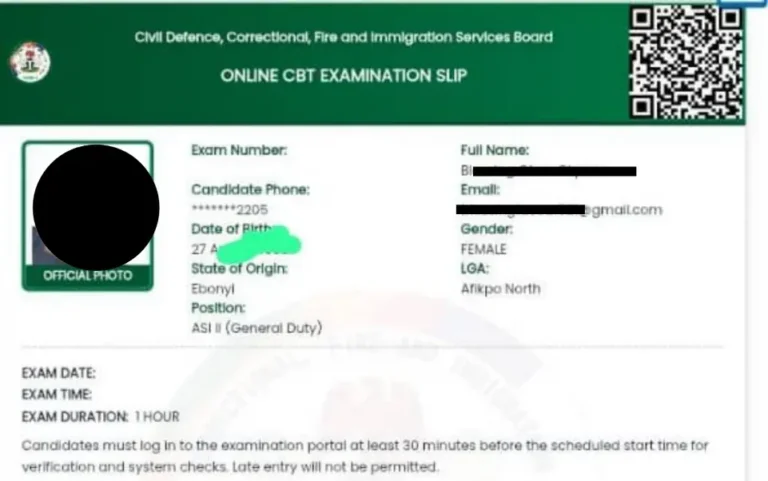
CDCFIB candidates not seeing exam number, CBT schedule on slip printout

1

CDCFIB candidates who are yet to write their CBT exams have raised new concerns online after many have discovered that their exam slip is not showing exam number, date or time. The issue became a major topic, where candidates expressed frustration over the missing schedule details and the closure of the CDCFIB exam reprint portal. Several applicants said they only noticed the problem after downloading their slips, long after the portal had stopped allowing access.

It would be recalled that the shortlist portal had earlier experienced server glitches that prevented some candidates from downloading their slip. There were also cases where similar registration numbers appeared on multiple slips, creating more confusion for applicants trying to confirm their CBT schedule. Many believe the missing CBT schedule problem is linked to a technical issue from the portal.

Amid the concerns, some candidates have suggested possible solutions. A candidate who claimed he already wrote the CBT explained that the application ID or reference number works as the exam number, saying, “Your application ID is your exam number.” Another applicant added that the format is the same as the one on the first registration slip and can still be used on the exam portal for verification.

Based on these explanations, affected candidates are advised to check their first registration document for the exam number since the details remain consistent. Unfortunately, reprinting the CDCFIB slip is no longer possible because the shortlist portal has closed and no new updates can be made. Applicants who remember the exact exam date and time they selected earlier can still attempt the test when the portal opens for that scheduled session.

As of now, the CDCFIB recruitment team has not released any official statement addressing the missing exam numbers or the printing errors, leaving applicants waiting for clarification.

Senate Moves to Ban Military Recruitment of Persons Under 18

0

The Senate has moved to stop the recruitment of anyone under 18 into the military as it passed the Armed Forces (Repeal and Re-enactment) Bill, 2025, for second reading. The proposed law focuses on legal compliance and aligns Nigeria’s defence system with the Child Rights Act, 2003, the United Nations Convention on the Rights of the Child, and the African Charter on the Rights and Welfare of the Child. Lawmakers said the update supports modern security services, youth protection, and responsible government reform.

Sponsored by Abdulaziz Yar’Adua of Katsina Central, the bill aims to repeal the Armed Forces Act, 2004, and replace it with a law that fits the constitution and today’s digital policy standards. While leading the debate, Yar’Adua said the reform was overdue because the current legislation came from a military decree that no longer reflects democratic needs or evolving national security realities.

“Our armed forces are a symbol of national unity and pride, but the laws guiding them have not evolved at the same pace as our democracy. This bill rebuilds the military’s legal foundation to reflect justice, professionalism, and respect for human rights,” he said.

The bill introduces wider reforms, including expanding the definition of military offences, applying proportionate punishments, and protecting courts-martial from interference by senior officers. Lawmakers said these steps will strengthen accountability, reduce abuse of power, and support a more transparent security structure.

Kano Governor Warns 590 Scholarship Beneficiaries to Uphold Discipline

Kano State Governor, Alhaji Abba Kabir Yusuf, has warned the 590 beneficiaries of the second batch of the 1,001 Postgraduate Foreign and Domestic Scholarship Programme to maintain discipline, moral integrity, and academic excellence as they begin their studies in Nigeria and abroad. Speaking at the flag-off ceremony in Kano, the Governor said the students were chosen strictly on academic merit and moral uprightness, which he stressed must guide their behaviour throughout their scholarship journey.

“You must not engage in anything that will bring shame to your state or your family. Shun drugs, hooliganism, protests, immorality, 419, or cybercrime,” Governor Yusuf cautioned while addressing the students, parents, and dignitaries. He added that the state expects the beneficiaries to uphold strong values as they represent Kano in different countries and institutions.

The Governor congratulated parents and guardians for their commitment and sacrifices, noting that their support played a key role in the students’ achievements. He urged the beneficiaries to act as responsible ambassadors of Kano State and Nigeria, promoting hard work, education investment, and integrity across their academic environments.

Governor Yusuf explained that the revived scholarship scheme aims to build a new generation of skilled professionals capable of driving innovation, strengthening economic development, and supporting national progress. He prayed for the students’ safety and success, reaffirming his administration’s commitment to sustaining major investment in education to secure opportunities for future generations.

FG Launches Women ICT Empowerment Programme in Ondo State

Federal and Ondo State Governments have jointly launched the Women ICT Training and Empowerment Programme under the Renewed Hope Initiative 2025, showing how collaborative governance can strengthen national development. The programme, organised with the National Information Technology Development Agency, is designed to equip 320 women with vital ICT skills to participate in Nigeria’s technology-driven economy and promote digital inclusion, economic empowerment, and gender equality.

The programme was officially flagged off by the wife of the President, Senator Mrs. Oluremi Tinubu, whose remarks were delivered by the Wife of the Governor of Ondo State, Her Excellency Mrs. Oluwaseun Aiyedatiwa, represented by Mrs. Bosede Fasua. She stated that the initiative reflects a shared vision to support women and create opportunities for meaningful participation in the digital sector. She explained that “this training shows our joint commitment to gender equality, digital inclusion, and economic empowerment.”

Training sessions will be held across Bauchi, Kaduna, Nasarawa, Imo, Edo, Ondo and the Federal Capital Territory, with 40 women selected in each state and 40 additional participants drawn from stakeholders to ensure nationwide coverage. The programme supports high demand skills and aligns with Nigeria’s digital economy goals.

Senator Tinubu commended NITDA Director-General Kashifu Inuwa Abdullahi for his role in bridging the digital divide, noting that the initiative supports President Bola Ahmed Tinubu’s Renewed Hope Agenda aimed at expanding industrialisation and digital transformation. She encouraged participants to take the programme seriously, describing it as “a pathway to empowerment and professional growth.”

Represented by Mr. Siyaka Etudaye, the NITDA DG said women remain central to national progress as innovators and creators. He also praised the First Lady of Nigeria and the Ondo State First Lady for their support in strengthening women empowerment and digital inclusion through technology skills development.

Adamawa Commission sets date to release shortlisted candidates list

Adamawa State Civil Service Commission has announced that it will release the list of successful candidates from the recent recruitment interview on Friday, 14 November 2025. This update was shared in a public notice signed by the Permanent Secretary of the Commission, Abubakar Umar Maiha, on behalf of the Chairman. The Commission stated that applicants should log into the official portal, csc.ad.gov.ng, to check their names and confirm their status.

According to the notice, successful candidates will also receive further information on when to collect their appointment letters, with the Commission assuring that this will happen soon. The statement added that, “successful candidates will be notified subsequently on when to collect their appointment letters,” stressing that the process is in its final stages.

The Commission congratulated successful applicants on behalf of the Adamawa State Government and welcomed them into the state civil service. It also wished them success as they begin their new roles in various Ministries, Departments and Agencies across the state, supporting public service growth and employment opportunities.