Home Blog Page 32

Youth Empowerment: NDDC to host Sports Festival 2026 with 3,000 athletes

0

The Niger Delta Development Commission, NDDC, is set to host the Niger Delta Sports Festival 2026, themed “Beyond Oil: Harnessing Talents,” bringing together 3,000 athletes and coaches from across the region.

The Chairman of the Niger Delta Sports Festival, Hon. Alabo Boma Iyaye, disclosed this during a press briefing held on Tuesday.

According to him, the championship will gather over 3,000 athletes and coaches in a grand celebration of sporting excellence, youth empowerment, and regional unity.

Activities will begin with the Opening Ceremony on the 20th, while the Closing Ceremony will take place on the 26th. Participants are scheduled to depart on the 27th.

He added that the state of readiness stands at 95 percent, with facilities, logistics, and game preparations fully on course to deliver a successful and memorable event.

Advertisement

NDDC CNG autogas conversion training: selected trainees Lucky

0

Selected trainees of the NDDC CNG autogas conversion training programme have been described as lucky to be part of a transformative initiative designed to build practical skills and long-term careers for young people in the Niger Delta.

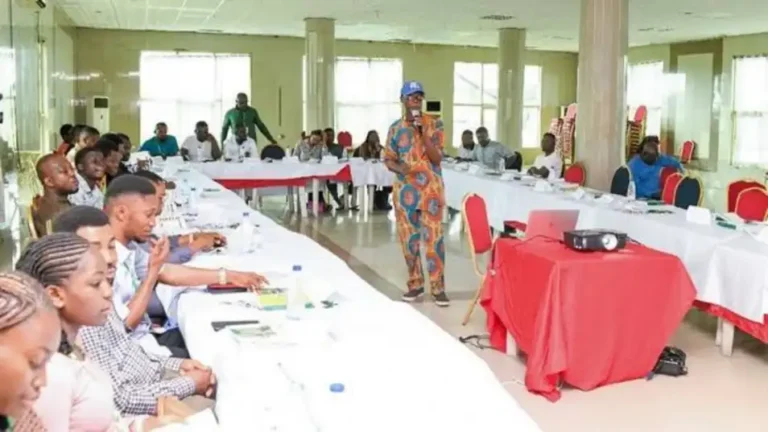
The 2026 training is part of the NDDC Training Of Niger Delta Youths in Compressed Natural GAS (CNG) Vehicle Conversion Programme Across the Nine States in the Region.

In line with its mandate to build human capacity and enhance Skills Development in the Niger Delta Region, the Niger Delta Development Commission (NDDC) has concluded arrangements to train youths on Compressed Natural Gas (CNG) Vehicle Conversion Programme.

Speaking on the initiative, Engr. Saidu Hamdullahi of Viedenburg Energy Resources, the Training Consultant, said, “Selected trainees are lucky to be part of this game changing program. Its about creating professionals who can think, diagnose, build, repair, manage, and lead.

“This opportunity offers lifetime jobs and entrepreneurship skills. CNG training aligns with Nigeria’s energy transition, economic resilience, and youth empowerment priorities. Practical approach will be on equipment handling, and safety culture. We produce not just technicians, but future employers.”

The Compressed Natural Gas (CNG) Vehicle Conversion Training Programme aligns with the mandate of the NDDC and is aimed at providing beneficiaries with veritable skills in Autogas Conversion Technology.

The programme is expected to contribute to the development of a more reliable and sustainable transportation sector. It will also stimulate economic growth through job creation and increased demand for Autogas specialists, while helping to reduce harmful emissions in line with NDDC’s commitment to environment conservation and sustainability.

Nigerian Army 2025/2026 fallen heroes children sponsorship screening and verification

0

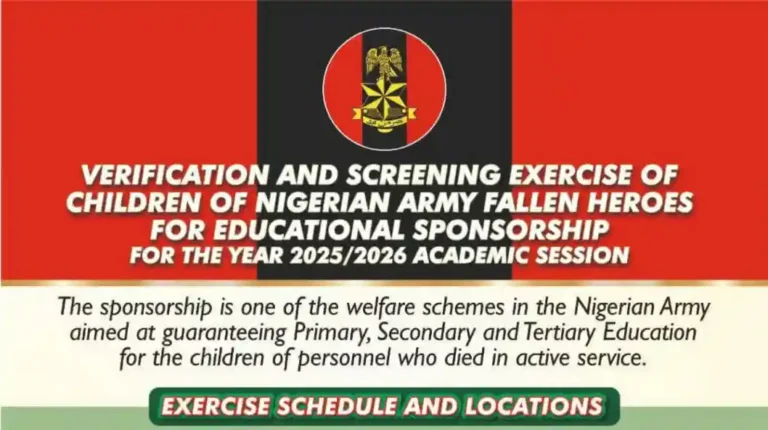
The Nigerian Army has announced the verification and screening exercise for children of fallen heroes for the 2025/2026 academic session.

This sponsorship programme is one of the welfare schemes of the Nigerian Army. It is designed to support the children of officers and soldiers who died in active service. The goal is to guarantee access to Primary, Secondary and Tertiary education for eligible beneficiaries.

If you are a parent, guardian, or beneficiary, it is important to take note of the schedule, locations, and required documents to avoid missing out.

EXERCISE SCHEDULE AND LOCATIONS

The screening will take place across the six geopolitical zones as follows:

South South
Date: 23–26 February 2026
Location: Headquarters 6 Division, Port Harcourt, Rivers State.

South East
Date: 28 February – 3 March 2026
Location: Headquarters 82 Division, Enugu, Enugu State.

South West
Date: 5 – 8 March 2026
Location: Headquarters 2 Division, Ibadan, Oyo State.

North East
Date: 11 – 14 March 2026
Location: Headquarters Nigerian Army Armour Corps, Bauchi, Bauchi State.

North West
Date: 16 – 20 March 2026
Location: Headquarters 1 Division Nigerian Army, Kaduna, Kaduna State.

North Central and Abuja
Date: 23 – 27 March 2026
Location: Army Headquarters Command Officers’ Mess, Asokoro, Abuja.

Beneficiaries are expected to attend the screening exercise at the designated centre for their geopolitical zone on the specified dates.

DOCUMENTS REQUIRED

Applicants must come along with the following documents for verification:

• Handwritten letter of application containing the names of the children.
• Admission letter, including JAMB admission letter for tertiary beneficiaries.
• Last school report card or result of the beneficiary.
• Letter of confirmation of pupil or studentship.
• Birth certificate of the children.
• Part II Orders of birth of the children.
• Death certificate of the deceased Nigerian Army personnel.
• Part II Order of death.
• Condolence letter.
• Notification of Casualty (NOTICAS).
• Two recent passport photographs each of the beneficiaries and the deceased officer or soldier.
• Account number details.
• Telephone number of the beneficiary.
• School fee receipt.
• Bank Verification Number (BVN).
• First page printout of statement of account showing account name and account number.

All documents should be properly arranged and presented for screening. Incomplete documentation may delay or affect the verification process.

This exercise is strictly for children of Nigerian Army personnel who lost their lives in active service. The screening is part of efforts to ensure transparency and proper documentation before educational sponsorship is granted for the 2025/2026 academic session.

Beneficiaries and guardians are advised to attend early and ensure that all required documents are complete and authentic.

Rockefeller Foundation, Partners launch clean cooking accelerator initiative

0

The Rockefeller Foundation, Global Energy Alliance for People and Planet Inc. (Global Energy Alliance), The Clean Cooking Alliance, and Energy Corps have launched the Clean Cooking Accelerator Initiative to expand access to modern cooking technologies in Africa.

The project was announced at the High-Level Dialogue on Advancing Energy Access and Cooking Solutions during the International Energy Agency (IEA) 2026 Ministerial. The session was chaired by IEA executive director Dr Fatih Birol, Kenya’s Minister of Energy and Petroleum James Opiyo Wandayi, U.S. secretary of Energy Christopher Wright, and Norway’s Minister of Energy Terje Lien Aasland.

The Initiative reflects what the organisations described as a renewed commitment to achieving universal access to clean cooking. They said the effort is aimed at improving health outcomes, saving lives, empowering women and children, creating local jobs, reducing forest degradation, and building economic opportunity across the continent.

According to available data, approximately one billion people in Africa still rely on traditional fuels such as wood and charcoal for cooking. The World Health Organisation associates household air pollution from these fuels with more than 810,000 premature deaths annually.

These fuels and cooking appliances significantly increase indoor air pollution in Sub-Saharan Africa, especially affecting women and children who spend more time near cooking areas. The health risks linked to this exposure include respiratory illnesses and other long-term conditions.

The IEA has identified clean cooking as a defining challenge for Africa’s prosperity. It estimates that closing the global clean cooking gap will require more than $2 billion per year in investment. Although progress has been made in some parts of the world, access remains uneven.

In Sub-Saharan Africa, population growth has outpaced improvements in clean cooking access. The gap continues to widen by an estimated 14 million people each year, as the number of those without clean cooking solutions increases.

Modern clean cooking solutions include electric stoves, biogas, bioethanol, liquid petroleum gas (LPG), and efficient biomass stoves. These technologies produce far fewer harmful particles compared to traditional fuels like wood or charcoal.

Expanding access to clean cooking is also considered an important part of Mission 300, an initiative led by the World Bank and African Development Bank, with support from The Rockefeller Foundation, Global Energy Alliance, Sustainable Energy for All, and others. Mission 300 aims to provide 300 million Africans with electricity by 2030.

The Clean Cooking Accelerator Initiative will initially start in about half a dozen countries, which are expected to be announced in the coming month. It plans to expand to additional Sub-Saharan African countries that request support and demonstrate readiness and momentum toward universal access to clean cooking.

The organisations said the overarching goal is to improve health, save lives, empower women and children, reduce forest degradation, create local jobs, and build economic opportunity across Africa.

The Initiative seeks to accelerate access to cleaner cooking methods by coordinating technical expertise, catalytic capital, and implementation support. While each participating organisation already has ongoing clean cooking programmes, the new Initiative is designed to bring them together around shared priorities and enable information sharing to maximise collective impact.

In countries that express interest and show readiness, the Initiative will support efforts to strengthen supply chains and invest in infrastructure needed to scale modern cooking solutions.

In select markets, The Rockefeller Foundation, through its Mission 300 Accelerator housed within RF Catalytic Capital, its charitable spin-off, and Energy Corps, are providing support to CoAction Global. The aim is to develop a cohort of Clean Cooking Fellows to strengthen institutional capacity and build investable project pipelines. CoAction Global, an independent nonprofit impact accelerator focused on innovation and investment in hard-to-reach places, manages the Mission 300 Fellowship programme.

Andrew Herscowitz, CEO of the Mission 300 Accelerator, RF Catalytic Capital, Inc., said, “The Rockefeller Foundation and its Mission 300 Accelerator are thrilled to be working with these organizations to take on an incredible development opportunity: expanding access to clean, modern cooking methods. There are smart, easy solutions that can prevent hundreds of thousands of people needlessly dying from indoor air pollution each year, and we are excited to try to drive investment into solving this problem.”

Dymphna van der Lans, CEO of the Clean Cooking Alliance, said the focus must now shift from commitments to delivery. “We’re seeing real momentum behind clean cooking across Africa, but momentum alone doesn’t deliver solutions to households, schools and institutions. What matters now is building the capacity, partnerships, and market foundations that allow countries to move from targets to implementation. This collaboration is an important step in making that shift possible,” she said.

Energy Corps, a nonprofit organisation working to end energy poverty by connecting local leadership with global energy expertise, philanthropy, and NGO organisation, said it will channel philanthropic capital to mobilise private-sector investment and industrial capacity. The organisation noted that the support will strengthen capacity building and boost investment in bankable projects aimed at addressing supply-chain and infrastructure bottlenecks.

Toby Rice, CEO and Founder of Energy Corps, said the Initiative is designed to move beyond pledges. “This Initiative is built to turn commitment into real projects, real infrastructure, and real access by mobilising more capital,” he said.

UNESCO, UAPP launch study abroad fund for secondary school students

0

The UNESCO Read and Earn Federation (UNESCO REF) has taken a major step to reduce the financial pressure faced by Nigerian students who want to study abroad, following the signing of a Memorandum of Understanding with the United Kingdom Global University Application Portal (UAPP) in Abuja on Wednesday.

The agreement focuses on the creation of an educational financing facility designed to provide structured financial support for qualified Nigerian students seeking higher education outside the country. The initiative aims to close funding gaps that often stop talented students from accessing global academic opportunities.

According to the parties, the pilot phase of the programme will benefit students of Police Secondary Schools across Nigeria. Plans are already in place to expand it to all senior secondary schools nationwide by September this year. The current application window is presently open to students in SS1 through SS3 in Police Secondary Schools.

Speaking at the event, the President of UNESCO REF, Abdulsalami Ladigbolu-Oranmiyan, said the collaboration was structured to complement existing student financing programmes in the country. He explained that while the Nigerian Education Loan Fund (NELFUND) focuses mainly on students studying within Nigeria, the new financing facility is specifically designed to remove monetary barriers for students who secure admission into overseas institutions.

He disclosed that the programme maintains partnerships with more than 250 universities worldwide, creating a wide range of academic pathways for beneficiaries. According to him, the intervention aligns with broader educational strategic priorities and national development objectives aimed at expanding access to quality learning.

Ladigbolu-Oranmiyan added that eligibility cuts across all levels of study, including undergraduate, master’s, and doctoral candidates, regardless of the institution or country of choice. He announced that the admission application costs for the first 40 students from Police Secondary Schools selected under the scheme would be fully sponsored.

He further stated that the rollout of the programme would begin immediately, with designated financial partners responsible for managing payment arrangements to ensure proper structure and accountability.

In her remarks, the wife of the Inspector General of Police and President of the Police Officers’ Wives Association (POWA), Dr. Elizabeth Egbetokun, described the initiative as a transformative opportunity. She said it aligns with ongoing efforts to expand educational access for children of police personnel and other Nigerian youths.

Dr. Egbetokun stressed that access to global education should not depend solely on financial strength. She noted that the financing facility would enable brilliant students to compete internationally without being limited by funding challenges.

She commended the partnership for introducing a transparent and structured funding pathway that combines guidance, application support, and financial solutions under one umbrella. She urged eligible students and their parents to take advantage of the opportunity.

“I am especially delighted that this initiative will be piloted in the Police Secondary Schools, institutions that have nurtured generations of young Nigerians. From this pilot, the programme will spread to other schools and institutions across the country, ensuring that no child is left behind in the pursuit of higher education and global opportunities,” she said.

“This MOU embodies transparency, accountability, and innovation. It is a partnership that gives confidence to parents, trust to society, and hope to our children. It is a practical demonstration of how the Renewed Hope Agenda can be translated into tangible outcomes for Nigerian families,” she added.

Also speaking, the Global Director of Business Development at UAPP, Alan Bahia, explained that the partnership is designed to simplify and secure the university application process while providing comprehensive, end-to-end support for Nigerian students.

He said the pilot phase includes application fee waivers, mentorship support, and priority processing for the first 1,000 students. According to him, these measures are aimed at lowering entry barriers and encouraging more young Nigerians to pursue international education opportunities.

Bahia reiterated the organisation’s commitment to transparency and measurable outcomes. He added that the long-term goal is to expand the programme across the country, creating wider access to global academic opportunities for Nigerian students.

AI to create more jobs as Nigeria urged to produce indigenous data

0

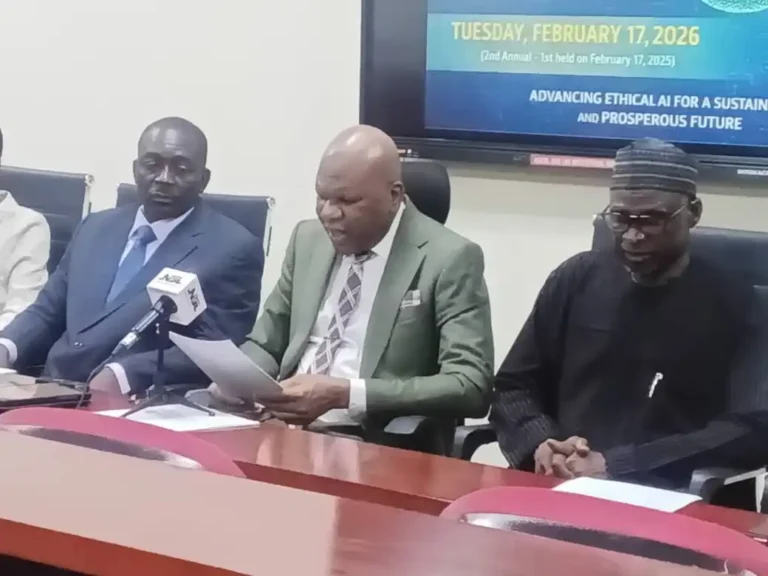
The National Association of Artificial Intelligence Practitioners (NAAIP) on Wednesday allayed fears over possible job losses arising from the growing use of artificial intelligence (AI), saying the technology will create more employment opportunities rather than render Nigerians jobless.

The assurance was given at the 2026 AI Awareness Day held in Abuja, where experts and stakeholders gathered to discuss the future of AI in the country.

The association, founded by former Acting Vice Chancellor of Lagos State University, Prof Peter Okebukola, said Nigeria must move from being mere consumers of foreign AI tools to producers of indigenous data and solutions that reflect local realities.

Addressing journalists, the NAAIP President, Prof Eyitope Ogunbodede, dismissed speculations that AI would lead to mass unemployment.

“AI will not render some people jobless as speculated by some people. It’s just like when we used typewriters in those days, and then computers came along. It didn’t render anybody jobless,” he said.

He explained that the real risk lies in refusing to adapt to new technology.

“If you are not in tune with developments in AI, the person will become jobless. In fact, AI is creating more jobs. For those who move with AI and are conversant with what is going on, they will continue to retain their job.

“Today, some entrepreneurs and users of social media are sitting in the comfort of their rooms and earning a lot of money using AI. So, it’s creating more jobs.”

Ogunbodede, however, expressed concern over Nigeria’s heavy reliance on foreign data to power AI systems used in the country.

“However, we rely solely on data that is actually harvested from outside the country. That’s why NAAIP is creating awareness and insisting that as a nation, we have to generate our own data,” he said.

He pointed out that widely used AI tools are driven by background data that may not fully represent Nigerian realities.

“Even the common ones we are using now like the Chatbot and ChatGPT, the background data driving is essentially not our own. And that’s why you find that some of the information coming out of it may not really apply directly to us.

“So we are calling on all Nigerians to work with us to ensure that we are not just consumers but also people who will innovate and generate our own.

“So we have the data to be able to do that. But we simply need the support of our own people. And we need your own support to be able to do that. We have the wherewithal to do it. We just simply need the support.”

He also noted a growing gap between students and lecturers in the use of AI tools in higher institutions.

“In most Nigerian universities now, virtually all the students use AI. On the other hand, it’s not all the lecturers who can use AI,” he said.

Also speaking, the Vice-Chancellor of the National Open University of Nigeria, Prof Uduma Orji Uduma, who was represented by Prof Monioluwa Olaniyi, said AI usage in Nigeria had grown significantly.

“The current data provided by Google says that 93 per cent of Nigerians who have access to smartphones are active users of artificial intelligence.

“It is also said that 80 per cent of the users are deploying it to solve complex topics. Whether we like it or not, virtually everybody is actively using AI. So it means artificial intelligence is now popular in Nigeria and also makes us one of the largest markets for it.”

In his remarks, NAAIP Vice-President (North-West), Prof Nasiru Maiturare, urged stakeholders to take ownership of Nigeria’s AI development.

“We have a responsibility through the association and stakeholders to ensure that we develop and direct our own AI intelligence transformation in Nigeria.

“Otherwise, we’ll end up being victims. Some other people will plan it and then deploy it in a manner that will be detrimental to our own interests,” he said.

FHFL Launches AfDB FAST Artisan Training Programme in Katsina

0

Family Homes Funds Limited (FHFL) has officially commenced the African Development Bank (AfDB)-funded Artisan Skill Training (FAST) programme in Katsina State on Wednesday, marking a major step toward strengthening Nigeria’s construction workforce.

The initiative is designed to professionalise the housing value chain and equip young Nigerians with globally recognised construction skills. It is supported by a $1 million technical assistance grant from the Youth Entrepreneurship and Innovation (YEI) Multi-Donor Trust Fund.

Promoted by Family Homes Funds Limited, the programme aims to train 500 young Nigerians and prepare them for immediate entry into the construction industry. This launch in Katsina signals the beginning of a nationwide rollout that will extend to 12 states, creating what organisers describe as a self-sufficient and market-ready workforce for Nigeria’s housing sector.

In a statement signed and released on Wednesday, the FAST Project Lead, Mrs. Monsurat Muhammed, outlined the opportunities available to successful participants.

“This initiative aims to professionalise the housing value chain by equipping 500 young Nigerians with globally recognised skills.

“Upon successful completion, graduates will receive Nigerian Skills Qualification (NSQ) certification, starter packs to begin immediate work, and enrollment in the FHFL database for future deployment to nationwide housing projects,” Muhammed stated.

She explained that the programme is structured to meet international standards and position participants for long-term employment in the construction industry. According to her, after the Katsina pilot phase, the FAST programme will expand to Abia, Adamawa, Akwa-Ibom, Bauchi, Delta, Enugu, Kano, Lagos, Niger, and Ogun states.

Speaking at the training centre, the Katsina State Coordinator, Bldr Hamzat Isah, expressed confidence in the quality of trainees and the broader impact of the programme on the national economy.

“With this kind of training, we will now have local experts who can handle complex painting, carpentry, and POP work.

“We will no longer need to look outside our borders—to Ghana or Togo—for skilled artisans; these trainees will provide the best for Katsina and Nigeria at large,” Isah affirmed.

The FAST programme provides hands-on instruction in high-demand trades such as masonry, electrical wiring, tiling, painting, and plumbing. Organisers say the practical focus is meant to ensure participants can immediately apply their skills in real projects.

Highlighting the level of interest among participants, Isah noted the growing inclusion of women in the training.

“Most of the students are showing keen interest in the program. We are educating them on various trades… and the number of women we have compared to men is 28%. Yes, 28% of them are women. This reflects a strong shift in trades traditionally dominated by men,” he said.

The initiative has received strong backing from the Katsina State Government. Governor Malam Dikko Umaru Radda is providing logistical support for the programme, including feeding and accommodation for participants, as part of his administration’s focus on youth empowerment.

Family Homes Funds Limited, a social housing finance institution owned by the Federal Government, is leading the project as part of efforts to bridge Nigeria’s housing deficit while creating sustainable jobs for young people across the country.

Rivers State initiative to empower 5,000 rural women with grants

The Toby Jug Foundation, in partnership with Rivers Women Unite for SIM, has announced the first phase of the Rivers Rural Women Support Stimulus (RRWSS) initiative to empower 5,000 women across all 23 local government areas of Rivers State with grants.

The announcement was made on Saturday, February 14, 2026, at Isaac Boro Park, where women from across Rivers State gathered in a colourful event that blended faith, civic responsibility, and community celebration. The gathering, themed “For the Love of State and Country,” drew inspiration from the biblical admonition in Matthew 12:25 on the strength of unity.

Organisers described the event as a clear shift from conventional festivities, turning it into a platform for prayer, thanksgiving, and collective responsibility toward nation-building. Participants said the occasion reflected a renewed commitment to unity and sustained peace in the state and across Nigeria.

At the centre of the event was a joint commendation issued to Bola Tinubu, Siminalayi Fubara, and Nyesom Wike for choosing dialogue and reconciliation over political confrontation. The women stated that the current atmosphere of calm in Rivers State is vital for social stability, economic growth, and long-term development. They urged all stakeholders to preserve and strengthen the peace that has been achieved.

Speaking at the rally, the President of the Toby Jug Foundation, Amaopuorubo Sotonye Toby Fulton, said prioritising stability over rivalry represents a shared victory for citizens. She noted that previous political tensions had slowed progress in the state and stressed that unity must be actively protected through responsible leadership and civic participation.

According to her, “Genuine love for the state is best expressed through service, prayer, and actions that uplift vulnerable communities.” She added that the women’s gathering was not just symbolic but a practical demonstration of their commitment to peace and development.

A major highlight of the event was the formal unveiling of the Rivers Rural Women Support Stimulus (RRWSS). Organisers said the empowerment initiative is designed to provide financial grants to 5,000 women in its first phase. The programme will target rural communities across all 23 local government areas, with special focus on market women, Muslim women’s groups, and non-indigenes residing in the state.

The organisers described the scheme as a practical extension of their commitment to inclusive development and social equity. They explained that the initiative aims to strengthen small businesses, improve household income, and promote broader participation of women in local economic activities.

The gathering also featured intercessory prayers for national and state leaders, families, and the future of Nigeria. The prayers were led by Salvation Oziri of Conquerors World Glorious Ministry International. The spiritual session, marked by worship and reflection, reinforced the message that faith and unity remain central pillars of societal harmony.

Beyond the formal activities, the event maintained a family-friendly atmosphere. Children took part in games and recreational sessions, while mothers engaged in fellowship and reflection. The celebration concluded with a ceremonial cake-cutting to symbolise love, shared purpose, and special milestones among participants.

Through the event, Rivers women projected a united voice, affirming that peace, faith, and collective action are essential foundations for a thriving society and a stable future for Rivers State and Nigeria.

FG to Deploy Diaspora Doctors Nationwide in July 2026

0

The Nigerians in Diaspora Commission (NiDCOM) has announced plans to deploy Nigerian medical professionals in the diaspora across the country in July 2026 to strengthen healthcare delivery nationwide.

Chairman/CEO of NiDCOM, Abike Dabiri-Erewa, disclosed this in Abuja while unveiling the Diaspora Health Impact Initiative (DHII) 2026. She described the programme as a coordinated national platform designed to harness the expertise, innovation and commitment of Nigerian health professionals living abroad to improve health outcomes at home.

According to her, the initiative will run during the week preceding National Diaspora Day, observed annually on July 25. She explained that the focus will be on specialist interventions, capacity building and long-term institutional partnerships rather than short-term outreach missions.

Dabiri-Erewa noted that diaspora remittances to Nigeria exceed $20 billion annually, but stressed that the knowledge and professional skills of Nigerian doctors abroad remain an underutilised national asset. She said DHII 2026 will align with national and state health priorities, especially in underserved communities across the six geo-political zones.

She added that the programme aims to strengthen specialist service delivery, improve access to quality healthcare, enhance clinical governance, promote medical innovation and generate data to guide policy reforms.

Implementation will be carried out in collaboration with the Federal Ministry of Health and Social Welfare, the Federal Ministry of Education, the Nigerian Medical Association, and the Medical and Dental Council of Nigeria.

Seven diaspora medical associations from the United States, Canada, the United Kingdom, Germany, Australia and South Africa have been assigned to specific states for interventions scheduled between July 20 and 23, 2026. The interventions will include advanced specialist lectures, maternal and newborn care, sickle cell screening, women’s health services, interventional radiology, neurosurgery and broader health systems strengthening.

The initiative will be officially flagged off in Abuja at the start of Diaspora Week 2026 before medical teams deploy to designated states in partnership with state governments and local health institutions.

Also speaking, President of the Medical Association of Nigerians Across Great Britain, Dr. Jide Menakaya, described the programme as inclusive and multidisciplinary. He stressed that nurses, midwives, pharmacists and other healthcare professionals all have critical roles to play.

Dabiri-Erewa commended Bola Ahmed Tinubu for supporting diaspora engagement as part of national development efforts and called on more Nigerian health professionals abroad to participate in the initiative.

Nigeria, Denmark Hold Marine and Blue Economy Cooperation Talks

0

A high-level technical dialogue between Nigeria and Denmark is signaling renewed momentum in bilateral cooperation on marine and blue economy development, underscoring both countries’ strategic ambitions in the maritime sector.

The meeting brought together a delegation from Nigeria’s Federal Ministry of Marine and Blue Economy (FMMBE) and senior Danish officials to explore expanded collaboration across maritime security, sustainable ocean governance and value chain development.

The Danish delegation was headed by Jens Ole Bach Hansen, Denmark’s ambassador in Nigeria, alongside Jette Bjerrum, consul general for Sustainable Value Chains, Tumi Onamade, Maritime Advisor, and Henrik Laugesan, Defence Attaché.

Nigeria’s delegation was led by Kalthum Ibrahim, Director of Planning, Research and Statistics at FMMBE, together with Busayo Fakinlede, Senior Special Assistant to the President on Marine and Blue Economy.

Frederik Klinke, Vice President of the European Chamber of Commerce in Nigeria, also contributed perspectives from the European private sector, information gathered by BusinessDay on Wednesday indicated.

The talks focused on strengthening institutional ties, accelerating sustainable marine initiatives, and enhancing trade competitiveness through more resilient and efficient maritime value chains. Both sides emphasized the importance of translating policy dialogue into measurable economic impact, noting that cooperation must deliver practical results.

Denmark enters the partnership as one of the world’s foremost maritime nations. Ranked ninth globally, it operates approximately 61 million gross tonnage and maintains a Danish-flagged fleet of 744 vessels as of January 2026. Shipping remains the country’s largest export sector, supported by globally competitive expertise in maritime technology and energy-efficient solutions.

Nigeria, meanwhile, is positioning the blue economy as a cornerstone of its economic diversification agenda. With an 853-kilometre Atlantic coastline, more than 10,000 kilometres of inland waterways, and a vast Exclusive Economic Zone in the strategically vital Gulf of Guinea, the country plays a central role in regional trade and maritime activity.

The dialogue builds on established cooperation frameworks, including the Danish Gulf of Guinea Maritime Security Programme (2022–2026), which aims to strengthen maritime domain awareness and regional security. It also reflects longstanding commercial engagement, notably investments by APM Terminals in Nigerian port and logistics infrastructure.

The renewed engagement aligns with Denmark’s Africa Strategy, which prioritizes equal partnerships, green transition and sustainable economic cooperation. For both countries, officials said, the objective is clear: harnessing the blue economy not only as a policy concept, but as a practical engine for jobs, trade and long-term growth.