Home Blog Page 324

NDE trains 253 Ekiti youths on entrepreneurship, business management

0

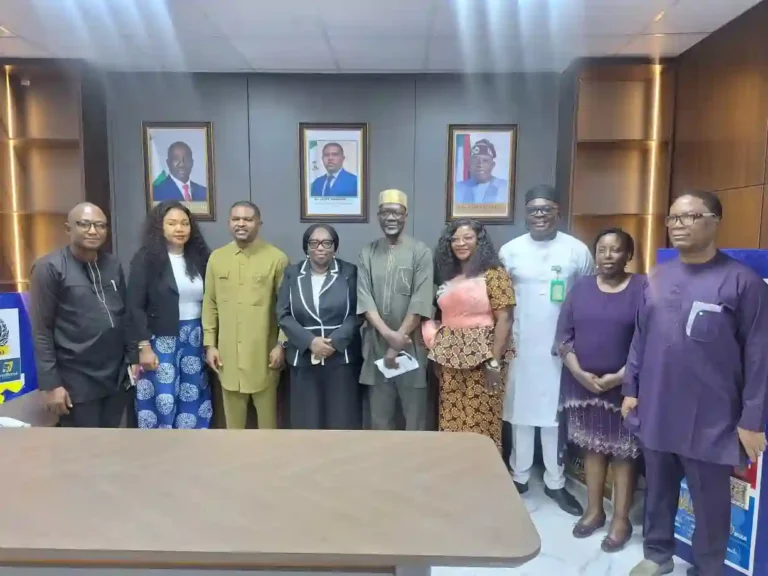
The National Directorate of Employment (NDE) has trained no fewer than 253 youths in Ekiti State on entrepreneurship and business management skills. The one-week programme, tagged ‘Entrepreneurship Development Training (EDT)’, was held for young people in Irepodun/Ifelodun Local Government Area of the state to promote small business growth and self-employment.

The sessions were facilitated by experienced Small Business Development experts who offered practical guidance to help participants turn their business ideas into sustainable ventures. The training covered high-value areas such as business planning, financial management, opportunity identification, and enterprise sustainability, all aimed at promoting economic empowerment and job creation.

Declaring the exercise open, the Director General of NDE, Silas Ali Agara, said the initiative was designed to equip the youths with relevant entrepreneurial and business management skills for self-reliance and economic development. Represented by the NDE State Coordinator, Orelusi Michael Omoniyi, the DG explained that the training was part of the agency’s continued efforts to reduce unemployment and promote wealth creation through entrepreneurship in Nigeria.

Agara urged the beneficiaries to apply the knowledge gained to start and grow their own businesses, stressing that “youth entrepreneurship is a powerful tool for driving inclusive economic growth in Ekiti and across the nation.”

A representative of Femiboyede Consulting Limited, Chief Femi Boyede, praised the participants’ commitment and enthusiasm throughout the programme. He stated that “sustained learning, discipline, and innovation remain key to achieving long-term business success.”

Some of the participants expressed appreciation to NDE and the facilitators, noting that the training had expanded their entrepreneurial mindset and positioned them to become job creators. They appealed to the agency to provide startup tools and equipment to help them begin their ventures.
Advertisement

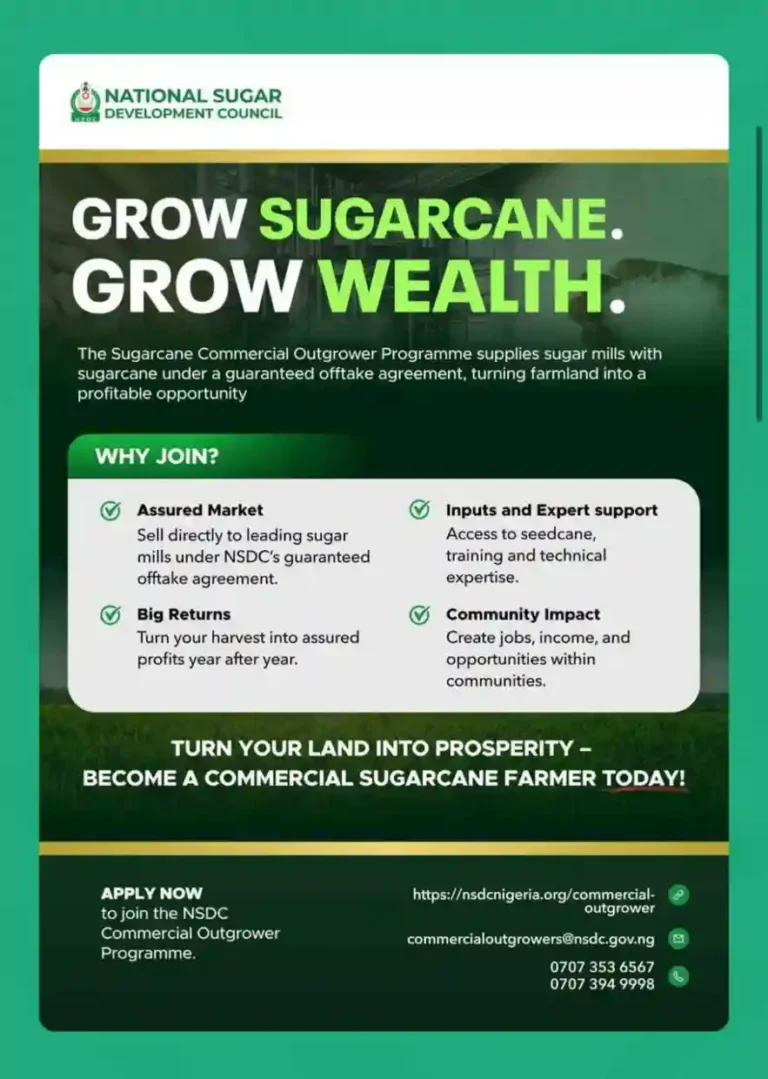
NSDC application for EOI in sugarcane outgrower development programme

0

The National Sugar Development Council (NSDC) has called on interested farmers, cooperatives, and agribusinesses to submit their Expression of Interest (EOI) to participate in its Sugarcane Outgrower Development Programme (SODP). The initiative is aimed at boosting local sugarcane production and reducing Nigeria’s dependence on imported sugar.

According to the NSDC, the Sugarcane Outgrower Development Programme is a vital part of the National Sugar Master Plan II, which seeks to achieve 70 percent self-sufficiency in sugar production. The Council said the programme will help strengthen the sugar value chain by integrating outgrower farmers to complement existing large sugar estates.

The SODP is designed to empower farmers and rural communities by providing smallholders and commercial farms with access to training, resources, and financial support. “It will also promote sustainable agriculture through efficient land use and modern irrigation techniques.”

The NSDC, which operates under the Ministry of Industry, Trade and Investment, said selected participants would manage sugarcane farms across designated locations in Nigeria. Participants will sign a six-year off-take agreement with the NSDC and designated off-takers for guaranteed market access and fair pricing.

Under the programme, agribusinesses are expected to cultivate a minimum of 50 hectares, cooperatives a minimum of 30 hectares, and individual farmers up to 30 hectares. All participants must meet production goals of at least 100 metric tonnes of cane per hectare with a minimum sucrose content of 8 percent.

The NSDC said all applicants must have the financial capacity to operate and submit relevant documents showing experience in farming or agricultural production. “Financial capacity is mandatory for all categories,” the Council noted.

Individual farmers must show proof of land ownership or lease, valid identification, and a record of past farming activities. Cooperatives are to submit registration certificates, leadership structures, technical proposals, and evidence of previous crop production. Agribusinesses must provide incorporation documents, technical and financial reports, company profiles, and audited accounts.

Submissions will be evaluated based on technical competence, experience, financial strength, compliance with regulations, and innovative value addition.

The NSDC emphasized that applications must be submitted online only through the official website before Friday, November 21, 2025. “Hard copy or email submissions will not be accepted,” it stated.

The Council advised that all documents must be arranged and paginated in PDF format. “Submission of EOI does not constitute a contract offer,” the statement said. For inquiries, interested participants can contact the NSDC via commercialoutgrower@nsdc.gov.ng or call 0707 353 6567 and 0707 394 9998.

Edo Government empowers 4300 agripreneurs, 3800 youths, women

0

Edo State has reaffirmed its strong commitment to agricultural transformation through closer collaboration with the Federal Government, the Niger Delta Development Commission (NDDC), and the International Fund for Agricultural Development (IFAD) under the Livelihood Improvement Family Enterprise Project in the Niger Delta (LIFE-ND).

The Commissioner for Agriculture and Food Security, Dr. Jerry Uwangue, announced this during the Inception Workshop of the 5th Joint Supervision Mission of the FGN/NDDC/IFAD-Assisted LIFE-ND Project held on Wednesday in Benin City.

Represented by the Programme Manager of the Agricultural Development Programme (ADP), Princewill Edoba Igbinedion, Dr. Uwangue said the LIFE-ND Project has remained a major driver of Governor Monday Okpebholo’s agricultural transformation vision. He explained that through its innovative incubation model, the project has empowered 4,300 agripreneurs and 3,800 youths and women across several local government areas, giving them the skills and resources to operate profitable agribusinesses.

According to him, “LIFE-ND has recorded remarkable achievements in mentorship, cluster development in poultry, fisheries, cassava, and rice value chains, as well as the promotion of climate-smart agricultural practices. It has also strengthened rural infrastructure and market linkages, thereby boosting productivity and improving incomes for smallholder farmers.”

Dr. Uwangue stated that the state government continues to offer policy support, counterpart funding, and an enabling environment to ensure the effective implementation of the project. He further revealed that Governor Okpebholo has pledged ongoing support for LIFE-ND, with plans to expand its reach to eight additional local government areas, a move expected to benefit another 3,000 women and youths.

In her remarks, Mrs. Dede Ekoue, Country Director and Head of Mission, IFAD Nigeria, praised the Edo State Government for its strong leadership and commitment to food security, job creation, and sustainable rural livelihoods. “We appreciate the state’s strong support, especially in championing the LIFE-ND+ scale-up initiative. This reflects a shared vision for youth and women empowerment and inclusive agricultural transformation,” she said.

Mrs. Ekoue disclosed that LIFE-ND has empowered more than 26,000 smallholder farmers, created 23,751 agribusiness enterprises, and partnered with 966 small and medium enterprises (SMEs) that serve as incubators. She added that the project has generated ₦31 billion (USD 49.7 million) in sales, mobilized USD 1.2 million in credit, and enhanced food system resilience across the Niger Delta region.

Beneficiaries from Edo State, including Grace Nwozuzu and Marvis Edogiawerie, expressed gratitude to Governor Okpebholo and project partners, describing LIFE-ND as a life-changing initiative that has improved livelihoods and created opportunities in rural communities.

The workshop also featured updates on the implementation of previous recommendations, a progress overview by National Programme Coordinator Dr. Abiodun Sanni, and the presentation of the 5th Supervision Mission Roadmap by the lead consultant.

Lagos Govt launches free EKO Studio Culture training for youths

0

Lagos State Government, through the Ministry of Wealth Creation and Employment, has announced plans to host a unique training programme called “EKO Studio Culture”, a two-month free masterclass in music and media production aimed at enhancing the employability and creativity of young people across the State.

The initiative, organised in collaboration with Dreams Music Hall, is designed to provide practical training and exposure in various aspects of the creative industry. Participants will gain hands-on experience in music production, sound engineering, movie scoring, sound design, music business, camera handling, and DJing, which is specially tailored for females.

According to the Ministry, the programme forms part of its “Detty December” activities and underscores the government’s continued investment in creative enterprise and youth empowerment. The training will feature leading music producers and entertainment industry experts who will guide participants through professional and technical sessions aimed at boosting employability in the creative economy.

Speaking on the project, the Commissioner for Wealth Creation and Employment, Mr. Akinyemi Ajigbotafe, described the upcoming masterclass as “impactful and transformative.” He explained that the initiative aligns with Governor Babajide Sanwo-Olu’s THEMES Plus Agenda, which prioritises sustainable job creation, innovation, and youth empowerment.

“This training will not only empower young creatives with the technical know-how to excel in music and media production but will also open doors to quick job opportunities within the creative economy,” Mr. Ajigbotafe stated.

He further noted that the programme complements other youth-oriented empowerment projects under the Ministry, including the StartRight Lagos Entrepreneurship Programme and the Technical and Vocational Education and Training (TVET) schemes, both of which have trained and supported hundreds of young people across Lagos State.

Interested youths aged 18 to 35 years are encouraged to apply for free via tinyurl.com/eko-studio before November 25, 2025. Successful applicants will participate in a grand audition scheduled for December 10 at Ikorodu Town Hall, where top celebrities from the music and film industries will serve as judges.

Mr. Ajigbotafe reaffirmed the Ministry’s commitment to initiatives that equip Lagos youths with vital skills for employability, entrepreneurship, and wealth creation, in line with Governor Sanwo-Olu’s vision to make Lagos a hub of creativity and innovation.

36 Finalists compete for ₦150 million Lagos Agrithon 2025 grant

0

Thirty-six finalists pitched for the ₦150 million Lagos Agrithon 2025 grant, presenting bold and innovative solutions to improve Lagos’ food systems. The event highlighted how much each business case had evolved after the mentorship phase, showing strong progress in agribusiness innovation and entrepreneurship.

“It was inspiring to see how much each business case evolved after the mentorship phase,” organisers said, praising the participants’ creativity and commitment to food sustainability.

The Grand Winners will be announced at the Lagos Agrinnovation Summit 2.0, scheduled for next Thursday at Harbour Point, Victoria Island. The summit will be livestreamed to enable virtual participation. Interested participants can register via bit.ly/4ooxyH9 to join the discussion on driving innovation and sustainability in Lagos’ food systems.

A’Ibom civil service CBT: Applicants awaiting emails urged to be patient

The Computer-Based Test (CBT) for the Akwa Ibom State Civil Service recruitment has entered Day Five, with the exercise continuing smoothly at the CBT Centre, Idongesit Nkanga Secretariat Complex, Uyo.

Authorities have once again appealed to applicants who are yet to receive their invitation emails to remain patient, assuring that the invitations are being sent out in batches.

According to a clarification from the recruitment committee, the CBT examination is still ongoing, and every qualified applicant will be duly invited to participate. The committee explained that the notice became necessary following numerous inquiries and messages of concern from applicants who have not yet been scheduled for the test.

Officials reaffirmed that the entire recruitment process is strictly merit-based, emphasizing that only those who attain the required passing score at the CBT stage will move on to the next phase of the exercise. They also dismissed speculations about favoritism or political influence, maintaining that the recruitment is transparent and guided by fairness, competence, and equal opportunity.

“The process is in line with the ARISE Agenda of Governor Umo Eno PhD-led administration,” an official stated. Applicants were further advised to keep checking their email inboxes and spam folders for updates and to remain calm as the process unfolds.

FG, O2 Academy, World Bank launch AI filmmaking training

0

O2 Academy Lagos has partnered with the Federal Ministry of Education under the Innovation Development and Effectiveness in the Acquisition of Skills (IDEAS–TVET) programme, powered by the World Bank, to train Nigerian youths in AI Filmmaking and Mobile Content Creation.

The initiative, officially flagged off at O2 Academy Lagos, Ojota, marks a major milestone for Nigeria’s creative and film industry as it introduces artificial intelligence into the heart of content production and storytelling. The programme aims to bridge the gap between traditional filmmaking and modern technology, positioning Nigerian youths to compete globally in the digital economy.

“Today marked the flag off of a landmark event in Nigeria, this is the first time we are organizing an AI training to empower Nigerian youth on how they can be relevant in the fourth Industrial revolution,” said Ucher Ozor, Associate Provost at O2 Academy.

According to him, the world is rapidly moving towards automation, and it is important that Nigeria’s creative sector adapts early. “We are in an era where AI is slowly creeping into everything we do and when it comes to the area of filmmaking we are looking at forward ways to help Nigerian youths catch on this flu before it becomes outdated for everyone. So this is the flag off in collaboration with the Ministry of Education as well as the World Bank with the initiative of wanting to empower 75,000 youths in the aspect of skill empowerment. So we intend to bring 100 out of the 75,000 up-skill them with AI and mobile content video creation,” he explained.

Speaking at the event, former President of the Directors Guild of Nigeria (DGN), Victor Okhai, described the programme as a game changer for Nollywood and the larger creative ecosystem. “These young people are very fortunate,” he said. “The relationship that O2 Academy has built over the years in the industry will open doors for placement and job opportunities. This is a very good initiative by the Federal Government because we’re finally investing in a sector that can rival oil in economic impact.”

Okhai added that the focus on AI filmmaking signals a new era for Nigerian cinema and creative technology.

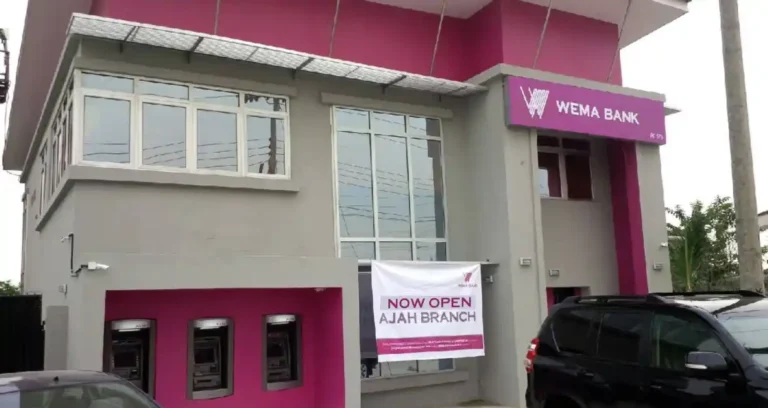
Wema Bank Hackaholics 6.0 trains over 3,000 young innovators

0

Wema Bank has successfully engaged more than 3,000 young innovators and entrepreneurs in the sixth edition of its Hackaholics programme. The initiative took place across four cities in Nigeria, including the Federal University of Technology, Akure (FUTA); Ahmadu Bello University (ABU), Zaria; University of Ibadan (UI); and Purple Academy, Lagos, as part of the bank’s commitment to empowering youth innovation and entrepreneurship.

The programme brought together creative minds to develop transformative solutions to real-world challenges through masterclasses, ideation sessions, and mentorship. For four days in each location, participants experienced the full Hackaholics journey, from idea generation to pitch readiness, ending with high-energy final presentations where the best ideas were selected.

In each of the four locations, three winning teams emerged, including one women-led group and two Hackathon teams, who received invitations to compete at the Hackaholics 6.0 Grand Finale. These selected teams now have the opportunity to scale their solutions with support from Wema Bank’s innovation ecosystem.

Speaking on the initiative, the Managing Director and Chief Executive Officer of Wema Bank Plc, Moruf Oseni, said Hackaholics represents more than just technology. “Hackaholics has always been about more than technology but about empowering young people to think differently, create boldly, and contribute solutions that can move the industry and nation forward,” he said.

Oseni further emphasized the creativity seen among participants. “The level of talent and creativity we have witnessed so far further reinforces why we continue to invest in this programme. The innovative ideas and solutions coming out of the participants have the power to shape the future of financial services and beyond, and we are excited to see them come to life.”

With over 12,000 applicants from 15 universities and $300,000 disbursed in funding, Wema Bank’s Hackaholics 6.0 has continued to strengthen its position as a major platform for youth development, entrepreneurship, and digital innovation in Nigeria.

CCAC application for eCooking challenge across Africa

0

Application is now open for businesses and organisations across Africa developing electric cooking (eCooking) solutions that can reduce indoor air pollution and carbon emissions. The Climate & Clean Air Coalition (CCAC) Challenge Program has launched a new call for proposals aimed at accelerating the uptake of eCooking technologies across the continent.

According to the CCAC, this challenge is designed to support scalable projects that help shift households and small enterprises from solid fuels to cleaner, electric-based cooking methods. The coalition noted that “each challenge is designed with clear outcomes, evaluation criteria and tailored assistance” to ensure impact and sustainability.

Indoor smoke from firewood and charcoal remains a major health and environmental problem in many African communities. Through this initiative, the CCAC seeks to reduce such pollution by backing innovative businesses and NGOs offering clean energy solutions. Entrepreneurs, SMEs, NGOs and energy-service providers can apply to receive funding, technical assistance, and access to a global clean energy network.

The program offers funding support for selected projects, access to expert coaching and technical advice, and visibility among international clean air and clean energy partners. It also provides opportunities to pilot and scale technologies or business models that promote cleaner cooking for households and small enterprises in Africa.

To be eligible, projects must propose eCooking solutions that will be implemented in one or more African countries. Applicants can be businesses, NGOs, or other organisations ready to deliver measurable outcomes aligned with the CCAC’s objectives of reducing pollution and promoting clean energy transition.

Applicants are encouraged to describe measurable impact, show business scalability, and address local contexts. The CCAC also advises applicants to “avoid vague claims” and instead provide clear data such as the number of households to benefit or the amount of emissions to be reduced.

The deadline for submission is December 12, 2025. Interested applicants should visit the official CCAC Challenge Programme Page for the full call document and submission details.

Abia State MOBSE batch 2 teacher recruitment application

Abia State Ministry of Basic and Secondary Education (MOBSE) has opened applications for Batch Two of its teachers’ recruitment exercise. The new phase is aimed at addressing the shortage of educators in both primary and secondary schools across the state. According to the ministry, this second batch builds on the achievements of the first recruitment phase and demonstrates the government’s commitment to improving education quality in Abia.

Under the leadership of Governor Alex Otti, the initiative seeks passionate and qualified teachers who are ready to serve in rural and riverine areas. Successful candidates would be expected to serve in rural or riverine schools for a period of at least five years in the first instance. It added that applicants who are not ready to work in such locations need not apply.

The ministry noted that priority will be given to critical subject areas, especially in hard-to-reach communities, to ensure that every child in Abia State receives access to quality education. “This bold step is an investment in our children and in the state’s socio-economic growth,” the statement added.

Interested applicants must meet the required educational qualifications for their chosen subjects. Holders of a Postgraduate Diploma in Education (PGDE), NCE, or other relevant teaching certifications are encouraged to apply. Candidates are required to submit academic and professional certificates, NYSC discharge or exemption certificates, certificates of local government of origin, birth certificates or age declarations, first school leaving certificates, and a National ID card or NIN number where available.

The recruitment process includes application submission, shortlisting, an aptitude test, interviews, document verification, and practical teaching demonstrations before final selection and deployment. The ministry emphasized that the process is inclusive, adding, “Individuals with disabilities are encouraged to apply. Reasonable accommodations will be provided during the screening and interview stages.”

Applications are free and must be completed online through the official portal of the Abia State Ministry of Basic and Secondary Education Link. The deadline for submission is Saturday, November 15, 2025.