Home Blog Page 326

Nigeria secures €21m German support to boost energy transition

The Federal Government of Nigeria has secured a financial boost from Germany to advance its energy transition agenda, with a total funding commitment of €21 million directed towards strengthening renewable energy development, improving energy efficiency, and increasing private sector participation.

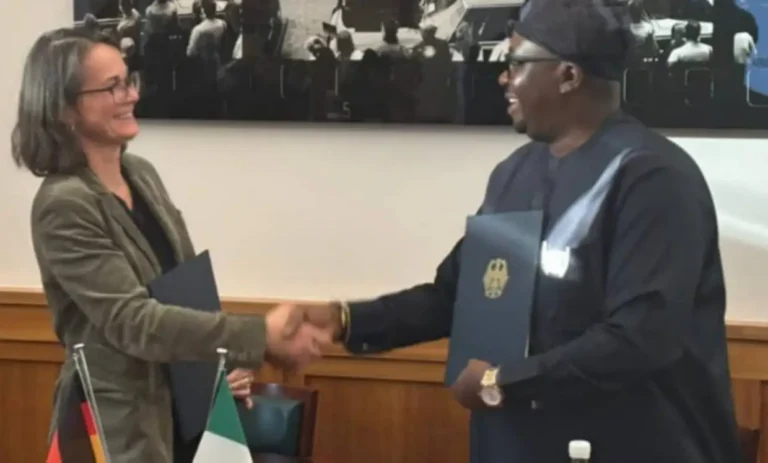
The announcement was made during the Working Group on Power, Energy and Climate meeting held on November 3, 2025, in Germany, where both countries signed a Joint Declaration of Intent on Bilateral Energy Transition Dialogue and Cooperation.

Under the new arrangement, Germany’s Federal Ministry for Economic Cooperation and Development (BMZ) is providing an additional €9 million to the Nigeria Energy Support Programme (NESP) in 2024, along with another €12 million for the newly launched Energy Transition Challenge Fund (ETCF).

Bolaji Tunji, special adviser on strategic communication and media relations to the Minister of Power, Adebayo Adelabu, said in a press release that the funding commitment marks a major step toward building a sustainable and secure energy system capable of accelerating Nigeria’s socio-economic transformation.

“The financial mechanisms, including the ‘Green Line of Credit’ for our SMEs and the mobilisation of private investment through GET.invest, are critical enablers,” Adelabu stated. “When combined with the technical expertise now formalised in our Joint Declaration, we are building a comprehensive ecosystem for energy success.”

The Nigeria Energy Support Programme (NESP), which has been jointly implemented by Nigeria and Germany over the years, focuses on expanding access to clean energy, promoting energy efficiency, and supporting policy reforms in the power sector. The new funding is expected to further scale up renewable energy deployment in underserved areas, enhance power generation capacity, and stimulate private investment in off-grid and mini-grid solutions.

The Energy Transition Challenge Fund (ETCF) is designed to support innovative projects that align with Nigeria’s long-term decarbonisation and green growth objectives. The Fund will act as a co-financing platform for clean energy ventures and help strengthen local capacity for climate-resilient energy development.

Both countries reaffirmed their commitment to maintaining the momentum of the partnership, ensuring that the energy transition brings tangible socio-economic benefits to Nigerians.

According to the statement, the meeting also reviewed ongoing progress under the Presidential Power Initiative and highlighted the importance of private sector participation in achieving Nigeria’s national energy goals. Germany further proposed that NGEP meetings be institutionalised and held annually at the level of undersecretaries from 2026 to enhance coordination and accountability in the energy partnership.

Advertisement

Edo launches plan to fight malnutrition, improve nutrition

0

The Edo State Government, through the Ministry of Budget and Economic Planning, has officially launched a four-year Multi-Sectoral Plan of Action for Food and Nutrition (2025–2029) to reduce malnutrition and improve the nutritional wellbeing of residents across the eighteen Local Government Areas of the state.

At the launch, the State Governor, His Excellency, Sen. Monday Okpebholo, represented by the Commissioner for Health, Dr. Cyril Adams Oshiomole, reaffirmed the government’s commitment to tackling malnutrition and enhancing the wellbeing of families, especially women and children. He said the initiative reflects the administration’s dedication to building a healthier and more productive population, adding that food and nutrition security go beyond health issues to encompass economic and social development.

Sen. Okpebholo explained that malnutrition negatively impacts learning outcomes in schools, reduces workplace productivity, and weakens community wellbeing. He stressed that addressing the issue requires strong coordination across different sectors such as health, agriculture, education, water, sanitation, and social protection.

“As a government, we recognize that addressing malnutrition requires more than good intentions. It demands strategy, coordination, and strong partnerships,” he said.

He added, “That is why the Multi-Sectoral Plan of Action brings together key sectors to work in synergy towards a common goal of ensuring that every Edo citizen, regardless of status, has access to safe, affordable, and nutritious food all year round. Our vision is simple but powerful, to make Edo State a place where no child suffers from malnutrition, where mothers are healthy and productive, and where every family can thrive because they are nourished to live full and dignified lives.”

The Governor emphasized that the real success of the plan will be seen in its implementation. He stated that the State Government will ensure that adequate resources are mobilized, institutions are strengthened, and accountability mechanisms are put in place to track progress and ensure transparency. According to him, the plan serves as a roadmap and a call to action that aligns with the Edo State Development Plan and global commitments, including the Sustainable Development Goals (SDGs) Two and Three, which focus on Zero Hunger, Good Health, and Well-being.

Sen. Okpebholo appreciated the Ministry of Budget and Economic Planning for coordinating the development of the plan in collaboration with Ministries, Departments, and Agencies (MDAs), Development Partners, Civil Society Organizations (CSOs), and technical experts. He thanked development partners for their technical and financial support and urged all Edo citizens to take ownership of the initiative for sustainable results.

In her remark, the Commissioner for Budget and Economic Planning, Dr. Elizabeth Ebosele, described adequate nutrition as a critical factor for growth, development, and productivity. She said the Edo State Government’s collaboration with the United Nations Children’s Fund (UNICEF) and other partners in ensuring that no child in Edo State suffers from malnutrition is a worthy effort that will improve the quality of life and economic performance of the population.

Dr. Ebosele explained that the plan was developed through broad stakeholders’ engagement and designed to deliver measurable and sustainable nutrition outcomes. She stressed that achieving food and nutrition security is central to economic growth and human capital development, while pointing out that malnutrition continues to pose serious challenges, especially among women and children, resulting in stunted growth, reduced productivity, and increased vulnerability to diseases.

According to her, the new plan focuses on improving access to nutritious food, promoting maternal and child health, strengthening local food systems, and building community awareness about balanced diets. She said the government is committed to ensuring that the plan is effectively implemented in all local government areas to achieve long-term health and development benefits.

The State Nutrition Officer, Mrs. Phil-Imade Amenze Nekpen, gave an overview of the current nutrition situation in Edo State, highlighting the high prevalence of anaemia among children under five years and women of reproductive age as a major concern. She identified poverty, poor public health conditions, and disruptions to food systems as the main causes of malnutrition.

Representatives of UNICEF, the World Health Organisation (WHO), the National Primary Health Care Development Agency (NPHCDA), and the Nutrition Society of Nigeria, in their goodwill messages, commended the Edo State Government for its proactive approach to improving nutrition and pledged continued support to ensure effective implementation of the plan.

The UNICEF Officer in Charge of Lagos Office, Mr. Muhammad Okorie, described the launch as a clear sign of the State Government’s strong political will and urged the government to provide adequate budgetary support for the plan’s implementation. He said UNICEF will continue to partner with the state in its effort to achieve sustainable nutrition and health outcomes.

Also speaking, the WHO State Coordinator, Dr. Eyo Nora, encouraged the State Government to leverage available funding platforms to scale up interventions across communities, while emphasizing the importance of monitoring and data collection to track progress.

Similarly, the NPHCDA State Coordinator, Mr. Lawani Osawe, praised the Edo State Government for its consistent strides in health and nutrition initiatives. He described the Multi-Sectoral Plan of Action as another milestone in the government’s effort to improve public health and promote sustainable development.

Highlights of the event included the official unveiling of the Multi-Sectoral Plan of Action for Food and Nutrition (2025–2029) and the investiture of His Excellency, Sen. Monday Okpebholo, as Nutrition Ambassador and Best Performing Governor by the Nutrition Society of Nigeria for his role in advancing and promoting nutrition in Nigeria.

The ceremony, organized by the Ministry of Budget and Economic Planning in collaboration with UNICEF, brought together key stakeholders including Commissioners, Local Government Chairmen, Heads of MDAs, Development Partners, and Civil Society Organizations.

COP30: Nigeria to mobilise $3bn annually for climate finance, VP Shettima

0

Nigeria has called on the international community to significantly increase global financing to protect and restore nature’s economic value through predictable, equitable, and accessible funding mechanisms.

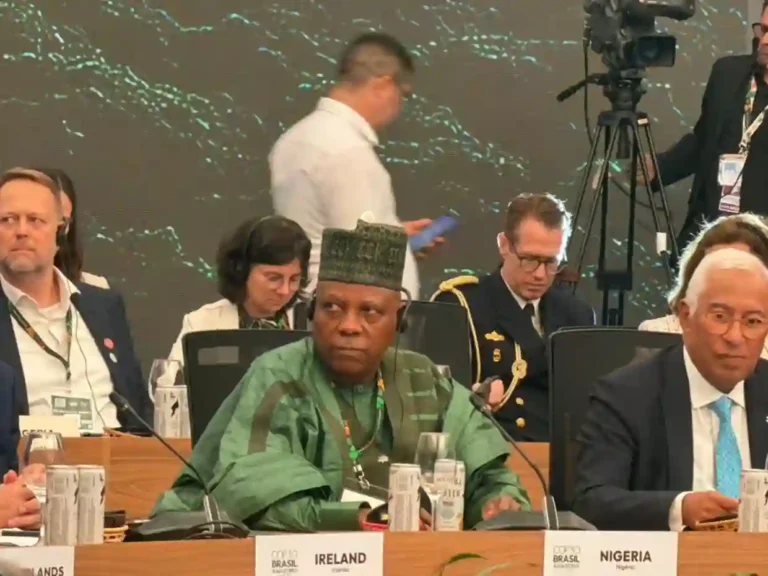
Speaking in Belem, Brazil, Vice President Senator Kashim Shettima, who represented President Bola Ahmed Tinubu at a high-level thematic session titled “Climate and Nature: Forests and Oceans,” at the ongoing United Nations Climate Change Conference (COP30), stressed that forests, landscapes, and oceans are shared global resources that require collective protection.

According to him, “since forests, landscapes, and oceans are shared resources that are outside the jurisdiction of any single nation, their protection requires global solidarity.”

Senator Shettima lamented that while nature is arguably the world’s most critical infrastructure, it has long been treated as a commodity to exploit rather than an asset to invest in. He noted that Nigeria is guided by this understanding and is “solidly driven by this knowledge to integrate nature-positive investments into its climate finance architecture.”

The Vice President explained that through Nigeria’s National Carbon Market Framework and Climate Change Fund, the government aims to mobilise up to three billion US dollars annually in climate finance. “These resources will be reinvested in community-led reforestation, blue carbon projects, and sustainable agriculture,” he stated.

He urged the international community to recognise the economic value of nature and channel significant financial resources toward protecting and restoring it through predictable and accessible mechanisms. “We call on our global partners to recognise the economic value of nature and to channel significant finance towards protecting and restoring it through predictable, equitable, and accessible funding mechanisms,” Senator Shettima said.

The Vice President also highlighted the injustice faced by developing nations in the global climate crisis. He noted that the Global South countries “have contributed least to this crisis but are today paying its highest price.” He insisted that for climate justice to be achieved, countries that have benefited more “from centuries of extraction must now lead in restoration.”

Senator Shettima further called on developed countries to increase grant-based financing, operationalise Blue Carbon Markets, and implement debt-for-nature swaps to enable developing nations to invest in conservation. “We urge the international community to scale up grant-based finance for nature-based solutions, implement debt-for-nature swaps that free developing countries to invest in conservation, operationalise Blue Carbon Markets under Article 6 of the Paris Agreement, and strengthen community-led governance so that indigenous peoples, farmers, and fisherfolk are rewarded for their stewardship rather than displaced by it,” he added.

He emphasised that nations that took their forests and oceans for granted have paid heavily for it, stressing Nigeria’s commitment to active participation in global ecological dialogues. “We, too, are under siege. We see the signs of danger in deforestation, desertification, illegal mining, coastal erosion, and rising sea levels within our borders. The Sahara advances by nearly one kilometre each year, displacing communities and eroding livelihoods. Each piece of land these threats overcome invites conflict into human lives, compounding our development challenges,” he said.

The Vice President told world leaders that Nigeria’s Climate Change Act 2021 enshrines nature-based solutions as a legal obligation of the state, adding that the government is “taking bold, coordinated steps to restore balance between climate, nature, and development.”

He explained that the National Council on Climate Change provides the institutional backbone for integrating climate action into all sectors of governance. “We are implementing the Great Green Wall Initiative, reforesting degraded lands across eleven frontline states, planting over ten million trees and creating thousands of green jobs for our youth and women,” he noted.

He also stated that Nigeria’s National Afforestation Programme and Forest Landscape Restoration Plan aim to restore more than two million hectares of degraded land by 2030. “We have also launched our Marine and Blue Economy Policy to harness the vast potential of our seas sustainably — promoting climate-smart fisheries, coastal protection, and marine biodiversity conservation,” he added.

Senator Shettima reaffirmed Nigeria’s commitment to working with global partners to advance an agenda where climate action aligns with nature restoration and human prosperity. He dismissed the portrayal of Africa as a mere victim of climate change, describing it as “an outdated narrative about a continent that is also a source of its solutions.”

He pointed out that Africa’s rainforests, mangroves, peatlands, and oceans are among the world’s largest untapped carbon sinks, while the continent’s youth represent “the world’s greatest untapped source of innovation and resolve.”

“Nigeria believes that COP30 must mark the beginning of a new compact — one that recognises Africa’s ecosystems as global assets deserving of global investment and protection. We invite all partners to join Nigeria and the African Union in advancing the African Nature Finance Framework, designed to unlock private capital for reforestation, ecosystem restoration, and blue economy development across the continent,” he said.

Abia State increases NYSC allowance from N4,000 to N50,000

0

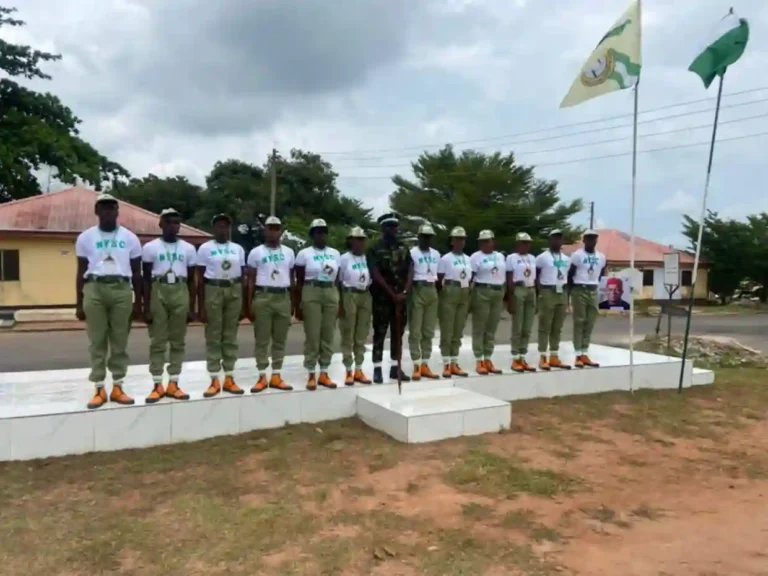
Governor Alex Otti of Abia State has approved a significant increase in monthly allowances for members of the National Youth Service Corps (NYSC) serving in the state, raising the payment from ₦4,000 to as much as ₦50,000.

According to a statement issued on Friday by the Chief Press Secretary to the Governor, Njoku Ukoha, the new allowance structure introduces a ₦20,000 base payment for all corps members serving in Abia. In addition to this ₦20,000, those deployed to state government establishments will receive an extra ₦10,000, while medical and teaching corps members will earn an additional ₦30,000 monthly.

“In addition to the Federal Government’s increased monthly NYSC allowance of ₦77,000, all corps members serving in Abia State will now earn a base monthly allowance of ₦20,000, while those serving within state government establishments, and specifically teaching and medical personnel, will earn an additional discriminatory allowance of ₦10,000 and ₦30,000, respectively, to motivate interested corps members, thereby bridging the human capacity gap created by decades of neglect and attrition in both sectors,” the statement read.

Ukoha explained that the increment complements the Federal Government’s ₦77,000 NYSC allowance and aligns with Governor Otti’s broader policy to strengthen youth empowerment and public sector capacity across Abia. “This marks the first major adjustment after 27 years, reflecting Governor Otti’s commitment to youth empowerment and workforce development in Abia,” he stated.

The statement also highlighted that the Otti administration has continually supported corps members through several projects, including the renovation of the NYSC Orientation Camp in Bende Local Government Area. The improvements include internal road construction, upgraded camp facilities, and the installation of new power infrastructure, all aimed at improving the welfare of corps members serving in the state.

“The governor believes that every institution or infrastructure within Abia, whether federal or state-owned, deserves attention because it is Abians who benefit the most,” Ukoha said.

The Chief Press Secretary further noted that the administration’s attention to youth welfare forms part of a wider reform that also includes improved salary structures for health workers. He recalled that the government recently implemented the Consolidated Health Salary Structure for healthcare employees and extended it to local government staff, aligning their pay with federal standards.

According to Ukoha, about 35 per cent of the state’s budget is allocated to healthcare and education, which the administration describes as “pillars of institutional capacity and human capital development.” He added that these investments demonstrate the government’s determination to rebuild critical sectors and retain young professionals within the state.

Governor Otti said the latest reforms are designed to make service more rewarding for corps members and to encourage youth participation in the state’s growth and development. “Governor Otti’s latest move sends a clear message: Abia State is serious about empowering youth, rewarding excellence, and building a future where service is truly valued,” the statement concluded.

With this allowance increment, Abia State now ranks among the states offering the highest monthly stipends for NYSC members, signaling a renewed commitment to youth development, public sector productivity, and human capital advancement in Nigeria.

FG launches Happy Woman Platform to empower 10 million women

The Federal Ministry of Women Affairs, in partnership with Intelligent Innovations, has launched the Happy Woman Platform, a national initiative designed to empower 10 million Nigerian women with financial independence and sustainable economic growth opportunities across various sectors.

The Happy Woman Platform is described as a one-stop digital ecosystem that connects women-owned small businesses, professionals, and creatives to essential resources. These include financing, digital tools, mentorship, training, and community support aimed at promoting entrepreneurship and economic inclusion.

According to the implementing partners, the platform will enable women across Nigeria to access business growth tools, including loans, funding, and capacity-building programs to expand their ventures.

This was disclosed in a statement released on Thursday by the Chief Executive Officer of Intelligent Innovations, Kunle Erinle.

Speaking during the launch, the Minister of Women Affairs, Hajiya Imaan Sulaiman-Ibrahim, described the Happy Woman Platform as a groundbreaking step in advancing gender-inclusive economic development.

“It’s Woman’O’clock in Nigeria! The Happy Woman Platform represents a new dawn for Nigerian women — a future where access to opportunities, funding, and digital empowerment are no longer limited by background or circumstance,” the Minister said.

She explained that the initiative aligns with the Federal Government’s Renewed Hope Agenda, championed by President Bola Ahmed Tinubu, which focuses on inclusive economic empowerment and ensuring that no woman is left behind in Nigeria’s economic transformation.

“Through this platform, we are ensuring that millions of women have the tools and resources they need to thrive, create wealth, and uplift their families and communities,” Sulaiman-Ibrahim stated.

The programme is structured to train and equip women with essential financial management and business growth skills. It will also include capacity development through training, mentorship, and skill-building programs designed to enhance employability and entrepreneurship.

A statement from the organisers noted, “The women will also acquire capacity development: training, mentorship, and skill-building programs to enhance employability and entrepreneurship. They will also have access to health & wellness support: partnerships that give women access to affordable health insurance and wellness programs.”

It further explained, “This is a programme to train and equip women on how to manage and grow money. You will have a basic understanding of how money can be better used as leverage for business growth. This training is a mandatory entry point for anyone looking for financing opportunities.”

The initiative connects female business owners to low-interest financing, equipment loans, and inventory support through partner financial institutions, helping them grow and scale their businesses sustainably.

A nationwide search tagged the Women Innovation Challenge will also be launched to identify and showcase innovative business ideas from women entrepreneurs across Nigeria. The Challenge aims to bridge the access-to-funding gap by connecting participants with grants, loans, and investor opportunities to expand their businesses.

According to the organisers, the goal is to identify and empower 1,000 women business owners who demonstrate innovation and sustainability in their ventures.

In addition, the Happy Woman Platform seeks to empower digital creators through mentorship, training, and access to content creation tools. The program will target 10,000 women who want to start or expand their YouTube and social media-based businesses, helping them monetise their creativity and actively engage in the digital economy.

Speaking on the collaboration, Erinle expressed optimism about the project’s impact and its potential to reshape women’s economic participation in Nigeria.

“Our goal with the Happy Woman Platform is to connect 10 million Nigerian women to financial freedom. By leveraging technology, data, and partnerships, we are breaking barriers and creating a single gateway where women can access everything they need — from funding and training to visibility and community. Together, we are building a future powered by empowered women,” Erinle said.

Co-founder of Happy Woman, Omowunmi Akingbohungbe, also shared her excitement about the project, noting that the initiative had been in development for over three years.

“I am truly delighted to see the Happy Woman vision come to life after a journey of over three years. This platform represents a new era for Nigerian women, an avenue to access timely information, funding, and empowerment opportunities that can transform lives. I encourage every woman to sign up and be part of this movement. Together, we can strengthen our impact as vital contributors to Nigeria’s economic growth,” Akingbohungbe said.

The platform will serve as a national connector linking women to partners across the financial services, FMCG, insurance, and technology sectors. It aims to create millions of jobs, boost entrepreneurship, and drive inclusive GDP growth by empowering women to succeed in all sectors of the economy.

Powered by Intelligent Innovations in collaboration with the Federal Ministry of Women Affairs, the Happy Woman Platform envisions a future where every Nigerian woman has access to the tools, knowledge, and networks needed to achieve financial freedom and participate fully in economic development.

UNDP announces new date, extra review stage for youth-led design sprint

0

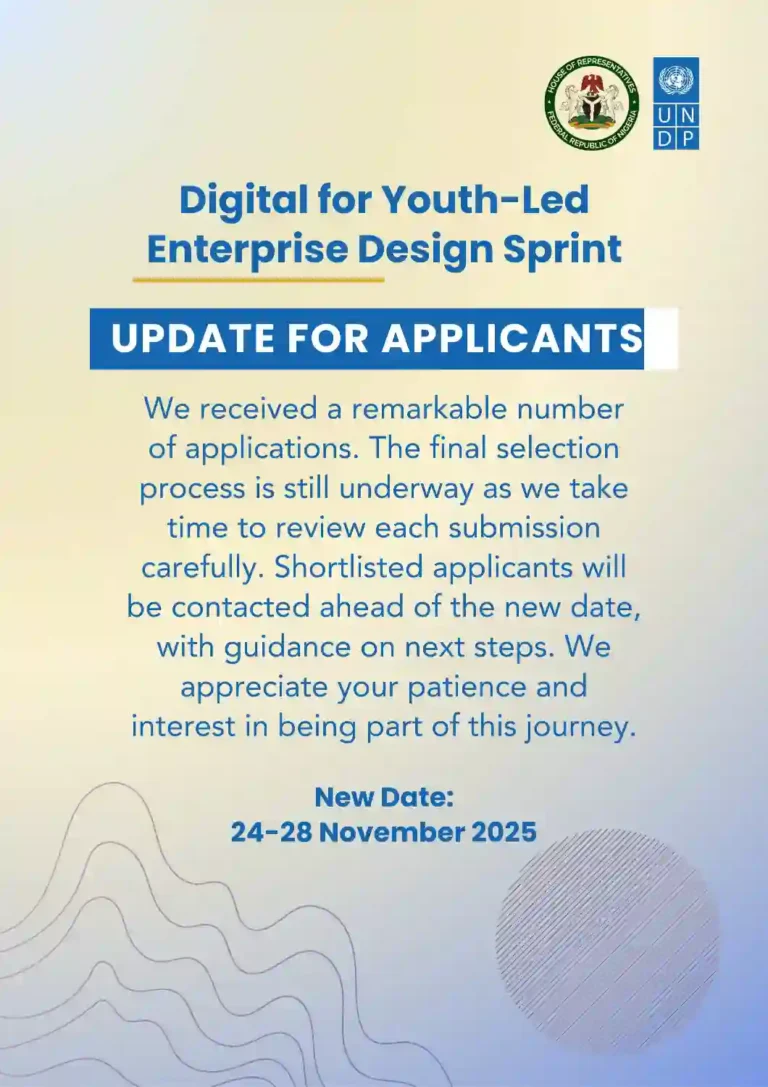
The United Nations Development Programme (UNDP) has announced an important update for applicants of the Digital for Youth-Led Enterprise Design Sprint. In a statement, the organization confirmed that it received a remarkable number of applications from young innovators across Nigeria.

“The final selection process is still underway as we take time to review each submission carefully,” the statement read. UNDP noted that shortlisted applicants will be contacted ahead of the new date, with guidance on the next steps. The new date for the program is set for November 24 to 28, 2025, in Abuja.

Thanking all participants, the agency said, “The response has been incredible. Young innovators across Nigeria are thinking boldly about the future.” Due to the large volume of applications, UNDP explained that it has added an extra review stage to understand each applicant’s ideas and how they aim to drive digital change in their communities and businesses.

The organization highlighted that the selection team is paying close attention to “fresh perspectives, strong problem-solving, and ideas that stand out.” Applicants are advised to check their email inbox and spam folder for updates.

FG to sustain drop in food prices through agricultural interventions

0

The Federal Government has reaffirmed its commitment to maintaining the recent decline in food prices across Nigeria through sustained interventions in the agricultural value chains.

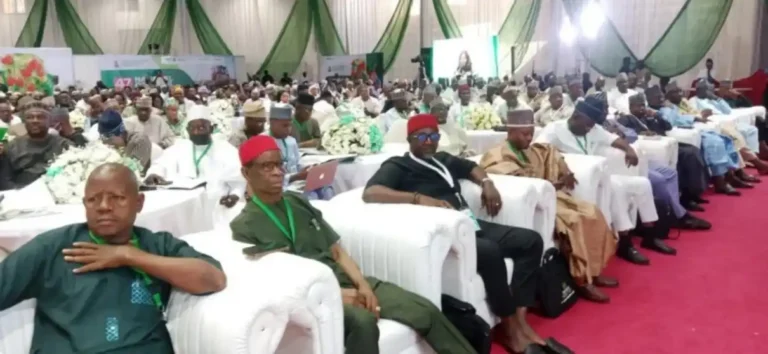
The Minister of Agriculture and Food Security, Senator Abubakar Kyari, disclosed this during the 47th Regular Meeting of the National Council on Agriculture and Food Security (NCAFS) held in Kaduna. The 2025 NCAFS, themed “Food Sovereignty and Food Security: An Era of Renewed Hope,” focused on strategies to ensure long-term food stability and availability in the country.

Kyari said that operations at the National Strategic Grain Reserve Silos located in Zamfara, Katsina, Nasarawa, Adamawa, Niger, Osun, Edo, and Kwara States were being improved for greater efficiency and capacity. He explained that these upgrades would help strengthen national food security and stabilize prices of essential commodities such as rice, maize, and wheat.

According to him, integrating the silos into the national food distribution framework would help establish a responsive system capable of providing timely interventions during shortages while supporting sustainable agricultural growth.

“Nigeria is charting a new course towards all-year-round farming and self-sufficiency in wheat production, bringing us closer to meeting our national demand,” Kyari said.

Speaking on the theme, the minister emphasized that food sovereignty involves control over what the nation grows, how it is cultivated, and how it is consumed. He added that food security ensures that every household has access to safe, affordable, and nutritious food.

“Together, they define the pathway toward an inclusive and resilient agricultural system that leaves no one behind,” he said.

Kyari noted that the nation was already witnessing a reduction in the prices of major food items due to targeted government market interventions. “While we are not yet where we want to be, this positive trend confirms that we are moving in the right direction,” he stated.

He further highlighted that consistent, high-yield production supported by access to quality and affordable inputs remains a key step toward achieving food sovereignty and economic growth.

Kyari explained that the ministry, in collaboration with the African Development Bank (AfDB) and various state governments, had strengthened the National Agricultural Growth Scheme–Agro-Pocket (NAGS-AP), Nigeria’s flagship programme for input delivery and productivity expansion.

“Through this programme, wheat production has continued to expand across the country from 15 participating states in the 2023/2024 dry season to broader coverage in the 2024/2025 farming season. The increase in scale reflects our ongoing efforts to enhance production capacity and boost self-sufficiency in key staples,” he added.

FUTA receives N1bn federal intervention for agricultural commercial farm

0

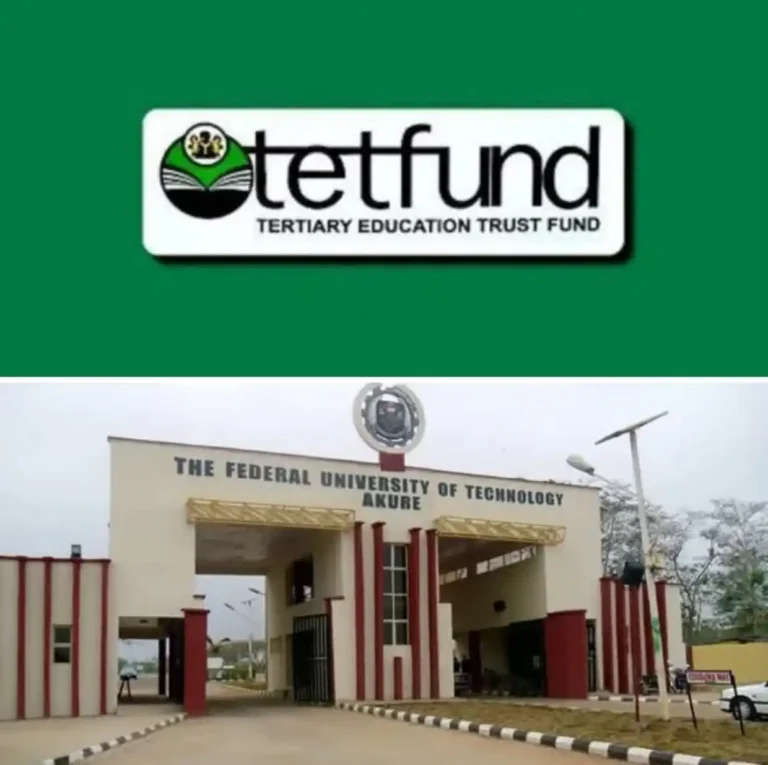
The Federal Government of Nigeria has approved the allocation of N1 billion to the Federal University of Technology, Akure (FUTA) as part of its 2025 Special Intervention for Agricultural Commercial Farm. The fund, aimed at boosting agricultural productivity and supporting commercial farming, was announced through a letter from the Executive Secretary of the Tertiary Education Trust Fund (TETFund), Arc. Sonny Echono, to the Vice Chancellor, Professor Adenike Oladiji.

Echono stated, “Further to the approval of the year 2025 intervention budget by President Bola Ahmed Tinubu, GCFR, and in line with the provisions of the Tertiary Education Trust Fund Act 2011, I write to inform you that your institution has been allocated a special intervention for Agricultural Commercial Farm in your institution. Accordingly, I hereby convey the allocation of the sum of One Billion Naira (N1,000,000,000.00) only for Agricultural Commercial Farm.”

Responding to the development, Professor Adenike Oladiji expressed deep appreciation to President Bola Ahmed Tinubu for finding FUTA worthy of the intervention. She emphasized the university’s commitment to addressing the issue of food insecurity through advanced agricultural research and commercial production.

“This allocation is a further testament to FUTA’s relevance in tackling food insecurity. FUTA is pulling its weight in the area of providing solutions to food insecurity in the country,” she said. “The vegetable production center of the university is ready to guide interested farmers through the process of planting and nurturing the F1 specie of bell pepper and tomatoes, a specie propagated at the Teaching and Research Farm of the University, which have a lot of advantages over the traditional ones.”

She added that FUTA had doubled the trees in its palm tree plantation and was expanding its greenhouses, noting that the intervention fund would boost its commercial farming efforts for national benefit. Professor Oladiji assured that the fund would be judiciously utilized for its intended purpose.

FG to launch electric tricycle empowerment initiative

0

The Federal Ministry of Youth Development, in partnership with House of Destiny and NATOMORAS, has announced the National Launch of the Electric Tricycle Empowerment Initiative, described as a major step toward sustainable youth empowerment and green mobility in Nigeria.

According to the ministry, the event will create new jobs and promote clean energy for young Nigerians, especially those in the informal transport sector. The launch will take place on November 26, 2025, at Eagle Square, Abuja, beginning at 11:00 AM.

OHCSF denies conducting Federal Civil Service recruitment

0

The Office of the Head of the Civil Service of the Federation (OHCSF) has clarified that it does not conduct recruitment into the Federal Civil Service. According to a statement, “The statutory authority to recruit eligible Nigerians into the Federal Civil Service is vested by law in the Federal Civil Service Commission (FCSC).”

The OHCSF advised that all recruitment enquiries, applications, and complaints be directed to the FCSC.