Home Blog Page 346

MDCN issues scam alert on scholarship scheme

0

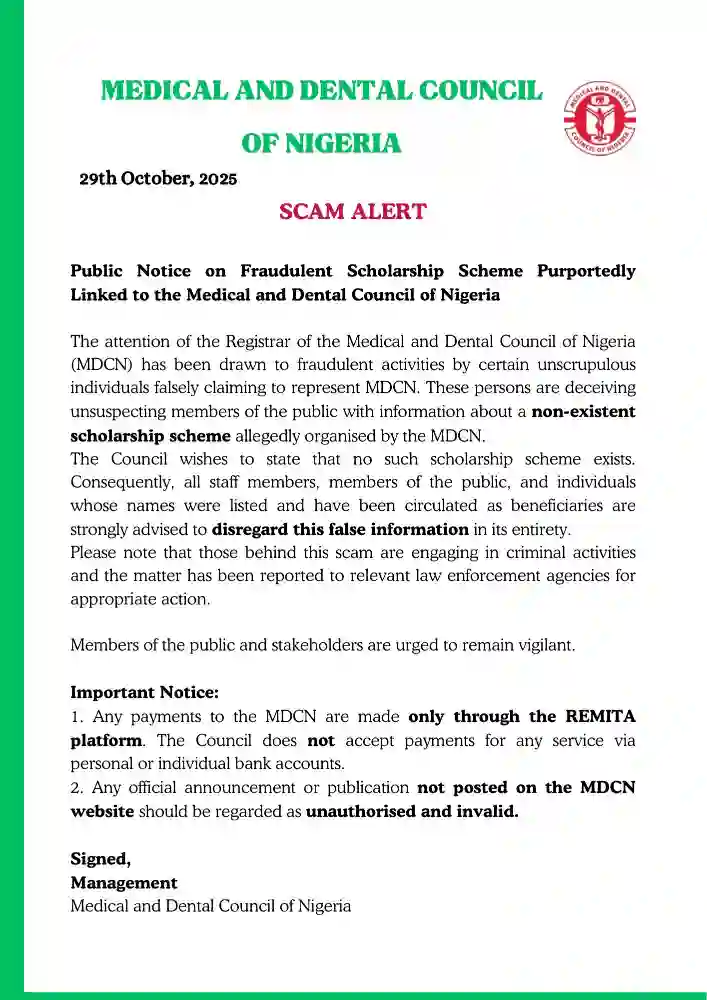
The Medical and Dental Council of Nigeria (MDCN) has issued a scam alert warning the public against a fraudulent scholarship scheme falsely linked to the Council.

In a statement released on October 29, 2025, the Registrar of the Medical and Dental Council of Nigeria said the Council’s attention has been drawn to the activities of “certain unscrupulous individuals falsely claiming to represent MDCN.” The statement explained that these individuals are deceiving unsuspecting members of the public with false information about a non-existent scholarship programme allegedly organised by the Council.

“The Council wishes to state that no such scholarship scheme exists,” the statement read. “All staff members, members of the public, and individuals whose names were listed and circulated as beneficiaries are strongly advised to disregard this false information in its entirety.”

The MDCN described the act as criminal and confirmed that “the matter has been reported to relevant law enforcement agencies for appropriate action.” The management urged members of the public and stakeholders to remain vigilant and verify information before taking any action.

As part of the alert, the Council issued two key reminders: “Any payments to the MDCN are made only through the REMITA platform. The Council does not accept payments for any service via personal or individual bank accounts.” It also cautioned that “any official announcement or publication not posted on the MDCN website should be regarded as unauthorised and invalid.”

The statement was signed by the management of the Medical and Dental Council of Nigeria.

Advertisement

FG releases N2.3bn salary arrears to university lecturers

0

The Federal Government has restated its firm commitment to revamping Nigeria’s tertiary education system through major fiscal interventions, policy reforms, and ongoing dialogue with the Academic Staff Union of Universities (ASUU) and other university-based unions.

The Minister of Education, Chief (Dr.) Maruf Olatunji Alausa, FAMedS, CON, made this known while giving updates on the government’s engagement with ASUU and related unions. He emphasized that President Bola Ahmed Tinubu remains determined to resolve all lingering issues surrounding staff welfare and funding in a fair and transparent manner.

Dr. Alausa announced that the Federal Government has released N2.3 billion, representing Batch 8 salary and promotion arrears, to universities across the country. The funds, processed through the Office of the Accountant-General of the Federation (OAGF), underscore the Tinubu administration’s resolve to clear inherited backlogs and enhance the welfare of academic and non-academic staff in tertiary institutions.

According to him, “A total of N2.311 billion, representing Batch 8 salary and promotion arrears, has been released through the Office of the Accountant-General of the Federation to universities. Benefiting institutions should begin to receive payment alerts anytime from now.”

He also disclosed that the Federal Government, through the Ministry of Finance and the OAGF, is finalising the release of third-party non-statutory deductions and pension remittances to the Nigeria University Pension Management Company (NUPEMCO). The process, he said, is expected to be completed within days.

The Minister further revealed that the government has approved the full mainstreaming of the Earned Academic Allowance (EAA) into university staff salaries starting from 2026. This, he explained, will ensure regular and sustainable payments going forward. He added that funds have also been released under the Needs Assessment of Nigerian Universities project, with corresponding budgetary allocations made to sustain the initiative.

Dr. Alausa stated that these actions reflect the Federal Government’s strong commitment to addressing long-standing challenges that have affected the education sector for decades. He noted that over the past twenty-six months, the government has cleared a substantial portion of outstanding obligations while maintaining open dialogue with academic and non-academic unions in the tertiary education system.

“The Federal Ministry of Education assures that these engagements are being conducted truthfully and in good faith. However, while the government remains committed to improving staff welfare, it will only enter into agreements that are realistic and financially sustainable,” Dr. Alausa stated.

He explained that the Yayale Ahmed Negotiating Committee continues to serve as a bridge between the Federal Government and university unions to ensure that all welfare-related matters are resolved through sincere and respectful dialogue. “Negotiations are being conducted sincerely, mutually, and respectfully,” he said.

Dr. Alausa emphasized that the Federal Government will not engage in fiscal practices that could threaten economic stability. “Our priority is to ensure that all matters are addressed responsibly and in the best interest of our education system,” he added, stressing that commitments must align with budgetary provisions for long-term sustainability.

He praised President Bola Ahmed Tinubu for his unwavering dedication to improving the education sector, noting that several challenges that had persisted for years are now being tackled decisively.

The Minister expressed optimism that the ongoing reforms and financial interventions will promote lasting industrial harmony, restore public confidence in Nigeria’s tertiary education, and strengthen the sector’s capacity for national development.

FG allocates N450M fertiliser to Jigawa farmers

0

The Federal Government has allocated fertiliser worth over ₦450 million for sale to farmers in Jigawa State at subsidised rates as part of ongoing efforts to boost agricultural productivity and ensure food security under President Bola Ahmed Tinubu’s Renewed Hope Agenda.

Governor Malam Umar Namadi disclosed this during the Citizens’ Engagement Programme held in Miga, the headquarters of Miga Local Government Area of the state.

According to him, “Under President Bola Ahmed Tinubu’s Renewed Hope Agenda, the Federal Government has allocated 20 trucks of fertiliser to Jigawa State to be sold at subsidised rates to farmers. This initiative is aimed at supporting farmers with essential inputs and equipment to enhance food production and agricultural business across the state.”

Governor Namadi noted that Miga, being an agrarian area with vast arable land suitable for year-round farming, stands to benefit significantly from the Federal Government’s agricultural support programme.

He explained that his administration’s 12-point agenda aligns with the Renewed Hope vision, placing agriculture and food security as top priorities. “To complement President Tinubu’s efforts, we have introduced several innovations to modernise and transform traditional farming into a mechanised system,” he said.

The governor further announced the establishment of the Jigawa State Farm Service Mechanisation Company Limited, which is designed to provide affordable and efficient mechanisation services to farmers across the state.

“The company will operate a network of service centres equipped with modern tractors, combine harvesters, and other agricultural machinery. We are also seeking qualified and motivated individuals to manage and operate these centres effectively,” he added.

Governor Namadi commended the people of Miga for their warm reception during his visit. As a sign of appreciation, the community presented him with gifts including bags of rice, fish, a ram, sets of special calabashes, and a horse, in recognition of his administration’s contributions to Miga’s development.

The Alternative Bank, Utiva launch Women in tech scholarship

0

The Alternative Bank (AltBank) has launched a new tech scholarship designed to empower women entrepreneurs with digital skills, innovation design, and business growth training.

The scholarship programme, set to begin in November 2025, is part of the bank’s broader Corporate Social Investment commitment aimed at bridging gender and digital divides. It seeks to equip women with tools to grow their enterprises and strengthen their participation in the fast-evolving digital economy.

Known as The Alternative Bank-Utiva Women in Tech Scholarship, the initiative was unveiled during a high-level virtual convening held recently to mark the International Day for Rural Women. The event, themed “Rural Women and MSMEs: Driving Sustainability, Strengthening Economies, Securing Our Shared Tomorrow,” gathered thought leaders, policymakers, and development partners to celebrate and empower rural women across Nigeria and Africa.

“Women are the heartbeat of food systems, the lifeline of families, and the silent architects of community resilience. Empowering rural women is a moral imperative as much as it is smart economics and a cornerstone of sustainable national growth. The doors of The Alternative Bank remain open, ready to partner, finance ideas, and co-create sustainable solutions that empower women and strengthen communities,” said Mrs Korede Demola-Adeniyi, Executive Director for South at The Alternative Bank.

Also speaking, Utiva’s Chief Executive, Eyitayo Ogunmola, said, “At Utiva, we believe that when women are equipped with the right digital skills, they don’t just transform their businesses, they transform their communities. This partnership with The Alternative Bank is about creating pathways for inclusion, innovation, and long-term economic empowerment for women shaping Africa’s future.”

KEDCO to distribute 128000 free prepaid meters in Kano, Katsina, Jigawa

0

Kano Electricity Distribution Company (KEDCO) has announced plans to begin mass prepaid meter installations across its franchise areas under the Distribution Sector Recovery Programme (DISREP), a $500 million World Bank-supported initiative.

In a statement on Wednesday, KEDCO’s Head of Corporate Communications, Sani Bala Sani, said the company will distribute 128,000 prepaid meters free of charge to electricity consumers in Kano, Katsina, and Jigawa States.

According to him, the initiative is aimed at improving power supply management, enhancing transparency, and ending estimated billing, which has been a major concern for electricity users. “This rollout represents a significant step towards ensuring accurate billing and better customer satisfaction,” Sani stated.

KEDCO’s Managing Director and Chief Executive Officer, Dr. Abubakar S. Jimeta, explained that the distribution process will prioritise existing unmetered customers across the three states. “We are committed to bridging the metering gap and improving service delivery in our franchise areas,” he said.

Although the company did not reveal the exact commencement date, it confirmed that preparations are already at an advanced stage.

The DISREP project, implemented by the Federal Government in partnership with the World Bank, seeks to improve the technical and financial performance of electricity distribution companies, reduce commercial losses, and modernise Nigeria’s power infrastructure.

National health fellows programme set to open applications

0

The National Health Fellows Programme is set to open applications for its next cohort on November 1, 2025, giving young Nigerians another opportunity to drive change within the nation’s healthcare system.

According to the organisers, the last cohort saw hundreds of young Nigerians make a real impact by transforming healthcare within their local government systems. “This time, it could be your turn to do even more,” the announcement stated.

The fellowship is domiciled in the Sector Wide Approach (SWAp) coordination office under the Office of the Coordinating Minister of Health and Social Welfare. Selected fellows will be recruited, remunerated, and equipped with the tools needed to drive positive transformation in the health sector.

Eligibility requirements specify that applicants must be between 25 and 35 years old, hold a bachelor’s degree in a health-related field, IT, or social sciences, and show demonstrable interest or experience in public health, NGO work, or community projects that highlight leadership and initiative.

Candidates must also be indigenes of the state they apply for, possess smartphones with internet access for platforms like WhatsApp and Zoom, and be available for full-time participation. A recommendation from a University Dean, NYSC supervisor, or a respected organisation showing good character and leadership is also required.

Interested candidates are encouraged to mark their calendars and prepare their applications early.

FG, Fashion Academy conclude fashion training under CLAP

The Federal Ministry of Art, Culture, Tourism and the Creative Economy, in partnership with The Fashion Academy Abuja (TFA), has successfully concluded a one-month intensive training under the Creative Leap Acceleration Programme (CLAP). The programme focused on Pattern Making and Professional Sewing Techniques, aimed at empowering participants with practical, industry-ready skills to excel in Nigeria’s growing fashion sector.

According to the Ministry, the training is part of efforts to “inspire a new generation of creatives to dream, design, and deliver.” The graduating students were celebrated for their dedication and excellence, while appreciation was extended to The Fashion Academy Abuja for its continued partnership and commitment to global standards in fashion education and enterprise development. The initiative supports the Ministry’s vision to create jobs, grow Nigeria’s creative economy, and promote fashion as a symbol of national pride.

CardinalStone opens 2026 graduate management trainee programme

0

CardinalStone, a full-service investment banking firm based in Lagos, Nigeria, has announced the opening of its 2026 Graduate Management Trainee Programme. The firm, which began operations in June 2008, is registered by the Nigerian Securities and Exchange Commission as an Issuing House, Fund Manager, and Broker/Dealer. Its subsidiary, CardinalStone Securities Limited, is a licensed stockbroking company.

According to the company, the programme seeks to recruit resourceful, analytical, and driven graduates who are passionate about the financial services sector. “Are you smart, open to learning, passionate about financial services and looking to join a team of result-oriented young professionals? If yes, we are looking for you,” the firm stated.

The available roles cut across both technical and non-technical departments, including Investment Banking, Investment Research, Portfolio Management, Legal, and Human Resources.

For technical positions, selected candidates will analyze financial statements, conduct due diligence on potential investee companies, and prepare valuation analyses. They will also execute client trades, identify investment opportunities, and develop research on domestic and global markets.

Non-technical roles include Investment Advisory, Institutional Sales, Operations, Transformation, Internal Control, Trustees, Legal and Compliance, Financial Control, and Human Resources. Trainees will advise clients on investment portfolios, manage relationships, and contribute to business growth by offering personalized financial solutions.

In the Institutional Sales unit, trainees will work with institutional clients such as insurance firms, PFAs, and fintech companies to expand business opportunities. The Operations and Transformation department will focus on improving efficiency and streamlining processes, while Internal Control will help maintain compliance with financial regulations and internal policies.

CardinalStone emphasized that applicants must hold at least a Second-Class Upper Bachelor’s Degree in a numerical or business-related field, have completed the NYSC programme, and must not be older than 26 years. Candidates with a Master’s degree or CIS certification will have an advantage.

Applications are to be submitted online via cardinalstone.seamlesshiring.com, and the deadline for submission is Friday, November 7, 2025.

Sanwo-Olu disburses N460M to over 1000 vulnerable Lagos residents

0

Lagos State Governor Babajide Sanwo-Olu has released a total of ₦460 million in financial assistance to more than 1,000 vulnerable residents across the state under the EKO Cares Initiative. The initiative, supervised by the Office of Political, Legislative and Civic Engagement, aims to reduce poverty and empower less privileged citizens.

The cheque presentation ceremony took place at the Blue Roof, LTV Complex, Alausa, Ikeja, where beneficiaries gathered to receive support from the state government. Represented by his Deputy, Dr Obafemi Hamzat, Governor Sanwo-Olu described the event as a demonstration of the government’s continuous effort to promote inclusive governance and improve the welfare of Lagosians facing economic challenges.

“Today is a day filled with joy, a day when the government reconnects with the people at their points of need. This presentation of cheques is not just a ceremony; it is a celebration of compassion and our shared humanity,” Sanwo-Olu said.

He explained that the ₦460 million disbursed was part of a wider empowerment initiative aimed at supporting thousands of residents across different local governments. According to him, in 2024 alone, ₦1.1 billion was distributed to 2,477 beneficiaries, while ₦1.6 billion has been earmarked this year to assist an additional 2,850 Lagosians.

“So far, EKO Cares has made a real difference in the lives of over 8,100 individuals, while EKO Listens has supported more than 8,690 beneficiaries,” the governor added.

Sanwo-Olu said that his administration’s vision for governance goes beyond physical infrastructure, focusing instead on empathy, inclusion, and social support to improve the living standards of residents. “Our belief is that governance should directly touch lives — not from afar, but with genuine empathy and decisive action. Behind every household is a story filled with dreams and challenges. It is our duty to ensure that these challenges do not dictate their futures,” he stated.

The EKO Cares Initiative, launched in 2020, provides targeted assistance in areas such as healthcare, housing, education, and small business development. The programme is designed to help vulnerable households overcome financial hardship and restore dignity.

Addressing the beneficiaries, the governor urged them to make good use of the financial assistance they received. He described the gesture as a “seed of hope” that should inspire growth and self-reliance. “Use this support wisely. Let it ignite your next breakthrough, strengthen your business, or bring peace to your home. The government can open doors, but it is your determination that keeps them open,” he advised.

The Special Adviser to the Governor on Political, Legislative and Civic Engagement, Dr Tajudeen Afolabi, also spoke at the event. He said the disbursement represents a clear example of inclusive governance under the T.H.E.M.E.S+ Agenda. “Today’s disbursement is a tangible expression of Mr Governor’s dedication to listening to the voices of our people and responding meaningfully to their needs — especially those grappling with economic hardship,” Dr Afolabi said.

He explained that his office remains committed to strengthening the connection between the Executive and Legislative arms of government while ensuring that every Lagos resident feels secure, engaged, and represented.

House urges CBN to provide loans for cassava farmers

0

The House of Representatives has urged the Federal Government, through the Central Bank of Nigeria (CBN), to ensure cassava farmers across the country have easy access to short-term loans. The move is aimed at strengthening food security and expanding Nigeria’s agricultural value chain.

Lawmakers also called on President Bola Tinubu to reconstitute the defunct Presidential Committee on Cassava Initiative to enhance the welfare of cassava farmers and reposition the subsector for export competitiveness.

The resolution was adopted following a motion sponsored by Hon. Canice Nwachukwu, a member representing Imo State under the All Progressives Congress (APC), during Wednesday’s plenary session.

Nwachukwu explained that cassava cultivation has become one of Nigeria’s most organised and promising agricultural ventures. He noted that cassava processing plays a vital role in producing food products, livestock feed, and industrial materials. According to him, cassava by-products such as garri have become major export commodities, contributing significantly to Nigeria’s foreign exchange earnings.

He pointed out that cassava is grown in all 36 states and the Federal Capital Territory, serving multiple economic and nutritional purposes. “Beyond its use as food, cassava peels and starch derivatives are valuable in livestock feed production, pharmaceuticals, and industrial manufacturing,” Nwachukwu said.

The lawmaker stressed that easy access to short-term loans and modern processing equipment would revolutionise cassava farming, enhance farmers’ income, and increase productivity. “If cassava processing machines and short-term loans are provided, farmers can transform cassava into garri and fufu hygienically and efficiently. This will boost market value, improve food quality, and help farmers contribute more to national GDP,” he stated.

Nwachukwu added that Nigeria could achieve greater economic diversification by exploring cassava’s export potential as a viable alternative to crude oil for foreign exchange earnings. He expressed concern that despite being one of Africa’s largest cassava producers, Nigeria still processes about 90 percent of its yield locally, mainly at the cottage level using outdated technology.

“Most processors are women who work under poor hygienic conditions with limited access to credit and modern equipment. These challenges result in low productivity, poor packaging, and minimal profits along the value chain,” he lamented.

Following deliberations, the House urged the CBN to direct the Bank of Agriculture, Bank of Industry, and other financial institutions to create mechanisms that guarantee cassava farmers easy access to short-term credit facilities.

Lawmakers further called on the Federal Government to revive the Presidential Committee on the Cassava Initiative Programme, also known as the Composite Cassava Flour Initiative of 2002, to promote value addition, research, and farmer support.

In addition, the House mandated the Federal Ministry of Agriculture and Food Security to conduct extensive training for peasant farmers on cassava production, processing, and packaging to improve standards and global competitiveness.

The Committees on Agricultural Production and Services and Legislative Compliance were instructed to monitor the implementation of the resolution and report back within four weeks for further legislative action.