Home Blog Page 362

NAPEP: how a fake website revived dead FG programme to scam Nigerians

The National Poverty Eradication Programme (NAPEP) was a 2001 initiative by the Nigerian government aimed at addressing poverty and unemployment across the country. The programme was created to train youths in vocational trades, support internships, promote micro-credit, create employment in the automobile industry, and assist women suffering from Vesico-Vaginal Fistula (VVF).

According to a 2008 report, NAPEP successfully trained about 130,000 youths and engaged around 216,000 people. However, it was noted that most of the beneficiaries were non-poor individuals, a flaw that weakened the programme’s impact on the actual poor population it was designed to serve.

In late May 2011, the NAPEP website was targeted by Nigerian hacktivists during the inauguration of President Goodluck Jonathan, an event that marked one of the first major cyberattacks on a government-linked platform in Nigeria.

Fast forward to 2025, and a website named napep-gov.ng suddenly appeared online. At first glance, it looked like a government website reviving the dead NAPEP initiative. BUT, it would turn out to be a fraudulent scheme. The scammer(s) behind it used a trick called “domain spoofing” or “look-alike domain fraud,” which is a structural deception where a fake domain mimics a real one. Instead of using a genuine government domain like “.gov.ng,” they used a hyphen “-gov.ng,” misleading Nigerians into believing they were dealing with a legitimate government website.

According to records from the Wayback Machine (web.archive.org/web/20250115000000*/Napep-gov.ng), this fake domain first appeared on January 21, 2025, which also matched its registration date on the Whois record. We could not tell registrant’s details were hidden, making it impossible to trace who owned or created the domain.

By February 11, 2025, this scam website had rebranded itself to appear as if it belonged to the Bank of Industry (BOI). The official BOI website is www.boi.ng, but the scam site cleverly copied its layout and even featured the legitimate “FGN MSME Intervention Program,” which was a genuine federal initiative at that time.
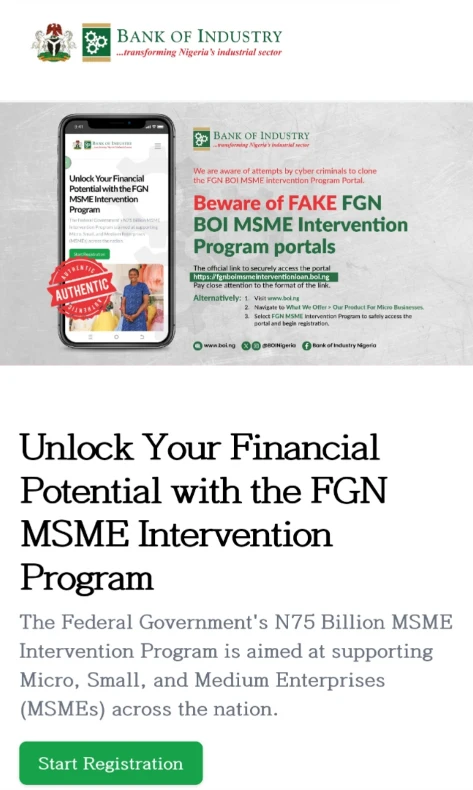
However, while the “Sign Up” button on the fake site redirected users to the actual BOI website, the phone numbers displayed on the fake site were +234 700 225 6264 and +234 700 055 1111. The first number belonged to the scammers. This made victims believe they were contacting BOI directly, but in reality, they were speaking with fraudsters.

When the scammers realized that impersonating BOI was not profitable, they decided to pivot and revive the non-existent NAPEP programme instead. They restructured the fake site into a new version of NAPEP, complete with new contact details including enquiries@napep-gov.ng and two phone numbers: +234 907 728 4732 and +234 703 778 1825.

The redesigned website featured a “Start Registration” button, encouraging unsuspecting applicants to register and provide personal details under the false impression that they were dealing with the Nigerian government.

Throughout these changes, two things the scammers did well were keeping the website’s layout simple and form-focused, and using emotional images about poverty alleviation to attract their target audience, mostly low-income Nigerians looking for government opportunities.

By April 2025, the website’s popularity skyrocketed. Its success was largely because the scammers picked a defunct government initiative with a familiar name, similar to ongoing federal poverty alleviation programmes. This created instant credibility among Nigerians who were already familiar with social intervention programmes like N-Power and Conditional Cash Transfers.

The Zenith

Between June 1st and 5th, 2025, Google Trends data showed a huge spike in searches related to NAPEP. Thousands of people were searching for information about the programme. During this period, Nigeriastartupact.ng also received 100,000s visits linked to the NAPEP story, believing it to be legitimate, especially since two major Nigerian media outlets had already published the NAPEP story in March and April 2025. There is a possibility those publications were sponsored by the scammers to make their scheme appear authentic, something scammers often do to gain public trust.

As a result, this fake NAPEP website began ranking high on Google and other search engines. At the same time, the government’s Conditional Cash Transfer (CCT) initiative was trending across the country.

The Steal

One of the reasons the fake NAPEP scheme spread quickly was because many Nigerians believe in applying for any government programme that promises money or employment opportunities. Many share links and posts without verifying the authenticity, which gave the fake NAPEP massive online attention.

The story spread across major social platforms like Facebook, Nairaland, and X, and even showed up as a trending search on Google (Google Trends). Many Nigerians assumed it was a federal programme and proceeded to fill out the application form and make payments for “NIN verification” as was required on the website.

Most applicants thought it was linked to the Conditional Cash Transfer Programme. This worked because the real CCT programme does not require individuals to apply directly, so Nigerians signed up thinking this was it. How CCT works is that it uses what is called a National Social Safety Nets System (NASSP) whereby identified households are then added to the National Social Register (NSR). This register is the main database used to decide who gets support under programs like the CCT.

At the time, there were ongoing public debates about the government’s claim of disbursing ₦330 billion to 8.1 million vulnerable households. This also contributed to the confusion that made the fake NAPEP scheme appear more credible.

The scammers cleverly took advantage of Nigeria’s Rapid Response Register (RRR) under the Conditional Cash Transfer (CCT) and National Social Safety Nets Project (NASSCO).

A new wave of NAPEP applications began after the Minister of State for Humanitarian Affairs and Poverty Reduction, Tanko Sununu, confirmed that ₦25,000 was being paid to 2.1 million households through the CCT-HoPE-RRR initiative managed by the National Cash Transfer Office (NCTO) in August 2025.

The Requirements and the Scam

The fake NAPEP website listed three major requirements for applicants: National Identification Number (NIN), O-Level result, and an age limit of at least 18 years. The inclusion of O-Level was strange, but the real goal was the NIN verification.

The scammers charged ₦760 per applicant for “NIN verification.” While some cautious citizens backed out at this stage, thousands of others made the payment. The deception worked because many people believed it was normal to pay a small fee for NIN verification.

When you use your NIN for things like SIM registration, BVN linking, job applications, or digital ID checks, some platforms or private agents may charge a small service fee (usually between ₦500 and ₦1,000) to cover token generation through NIMC-licensed agents or the National Identity Management Commission (NIMC) portal. So, the scammer took advantage of this reality to add a NIN verification fee.

Ironically, their FAQ section contained this statement:

“NAPEP does not charge a fee at any stage of the application. You are only required to validate your National Identification Number NIN with NIMC (Charges may apply). NAPEP disassociates itself from any fraudulent activities being perpetrated purportedly in the name of the NAPEP, and/or its officials, and strongly recommend applicants to exercise caution and report any suspected fraudulent activities to local law enforcement authorities for appropriate action.”

The website initially claimed the application deadline was April 30, 2025. But after collecting enough money from applicants, the scammers updated the information to “Application is still Ongoing.”
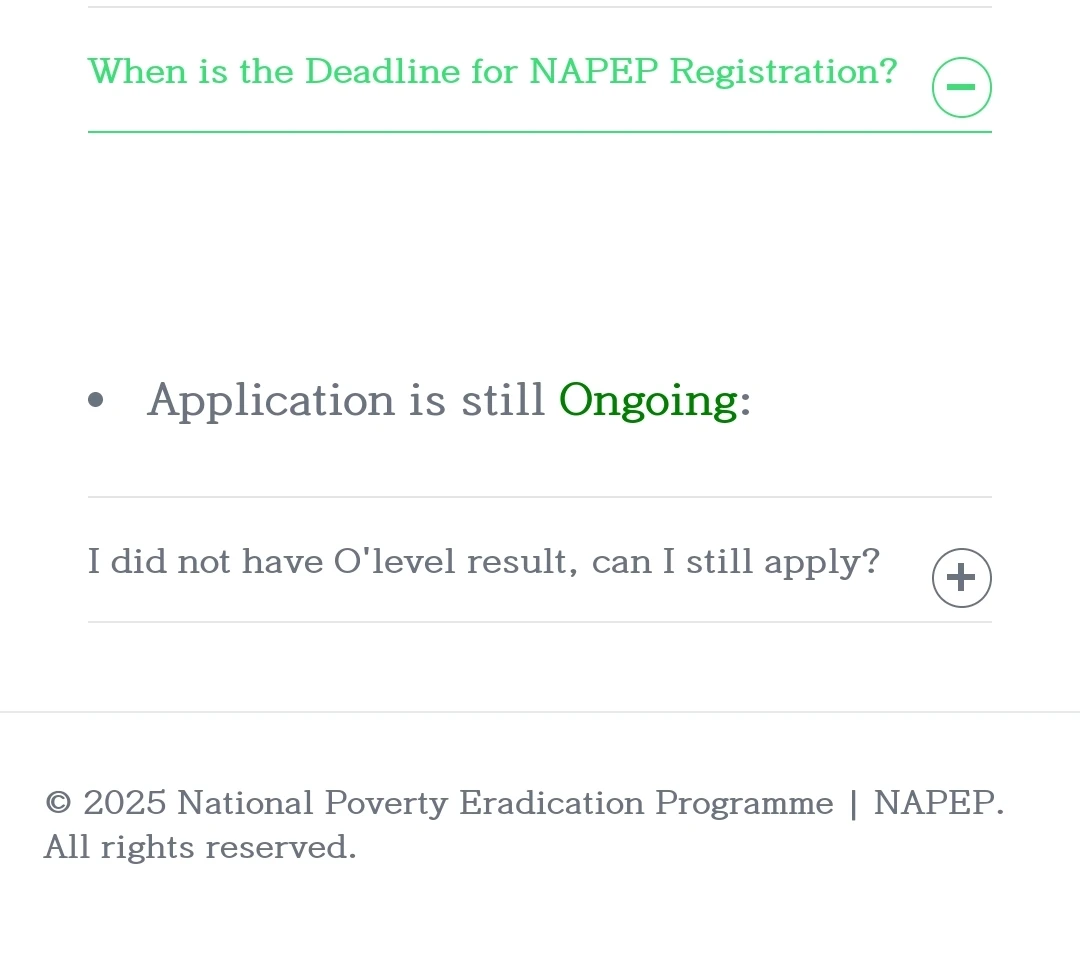
Another section of the FAQ attracted even more victims. It stated:

“All selected beneficiaries will receive a monthly stipend of ₦100,000 paid by National Poverty Eradication Programme (NAPEP) subject to achieving planned results for each month.”
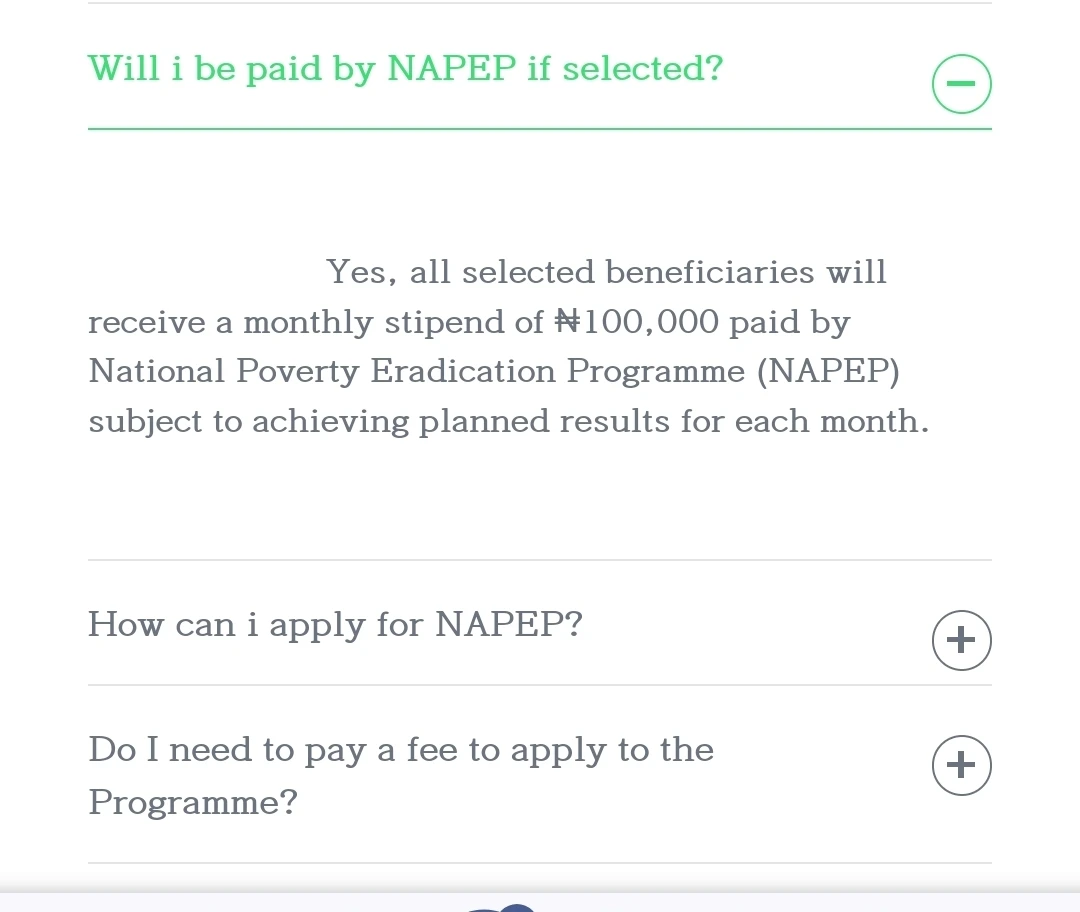
The real Conditional Cash Transfer programme offers ₦75,000 in three installments of ₦25,000 each, making the fake NAPEP’s ₦100,000 promise sound even more appealing. Sadly, many Nigerians refused to believe it was a scam even after warnings.
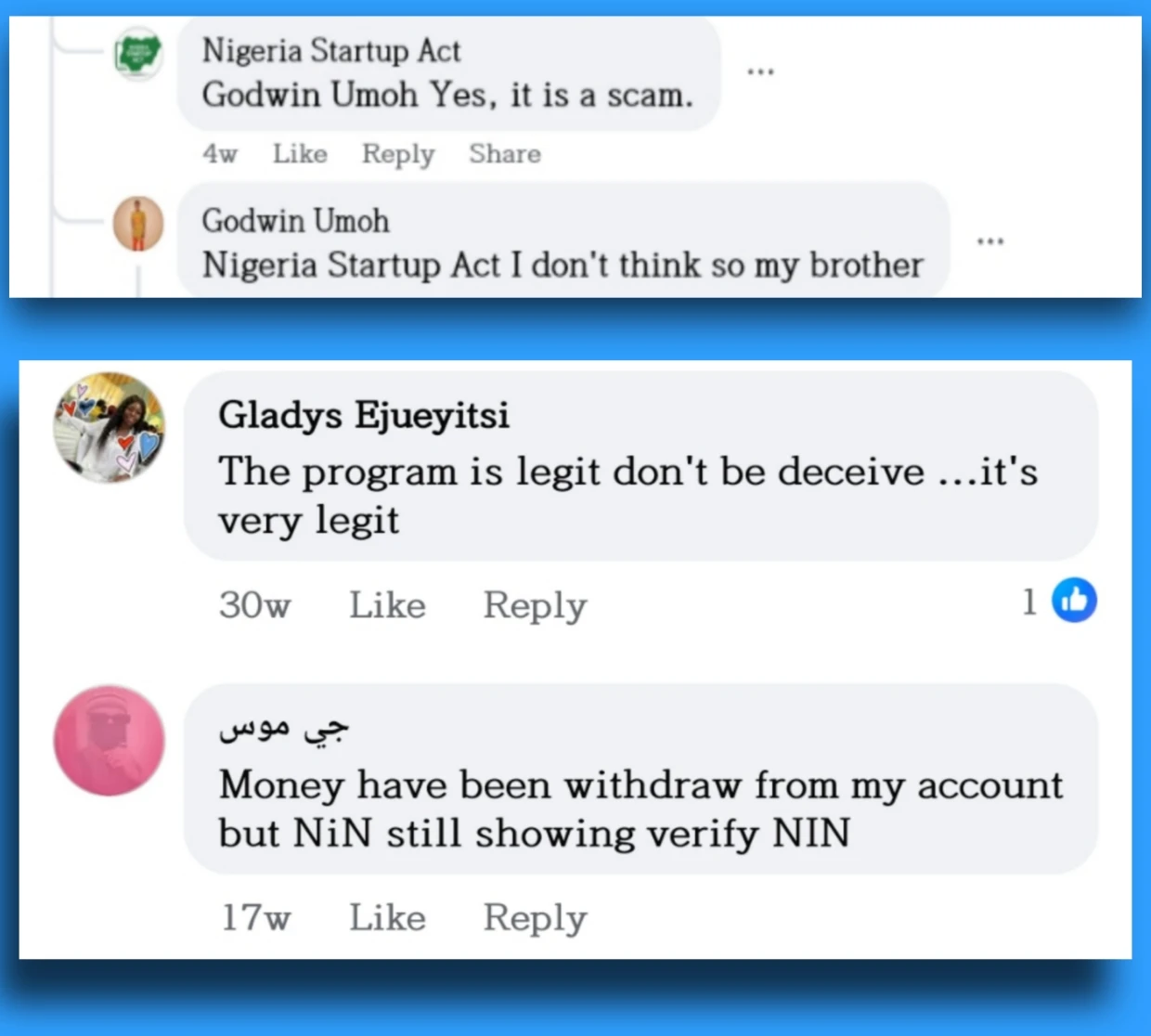
On one Facebook group dedicated to NAPEP with over 1,000 members, Nigeriastartupact.ng published a warning post explaining the scam. But one user replied, “Nigeria Startup Act I don’t think so my brother.”

The Threats

After Nigeriastartupact.ng exposed the scam, the people behind NAPEP threatened our website to take down the reports.

The Abuse Report

On August 17, 2025, the fake NAPEP operators filed an abuse report to Nigeriastartupact.ng’s web host, HostAfrica.
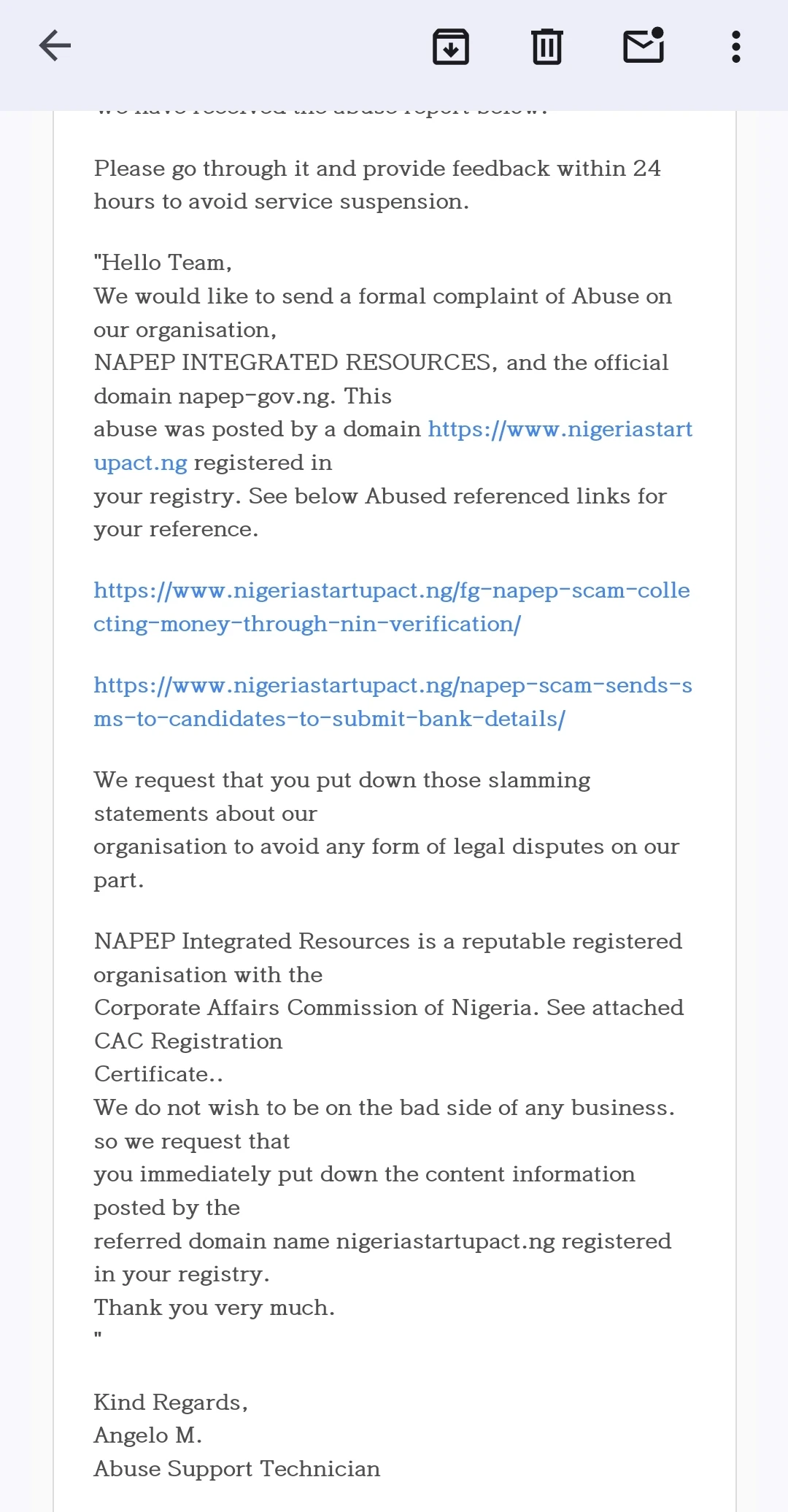
They referenced two specific articles:
https://www.nigeriastartupact.ng/fg-napep-scam-collecting-money-through-nin-verification/ and
https://www.nigeriastartupact.ng/napep-scam-sends-sms-to-candidates-to-submit-bank-details/

In their complaint, they accused Nigeriastartupact.ng of “slandering statements” and warned that legal action could follow if the stories were not removed. They also claimed that “NAPEP Integrated Resources” was a legally registered business with the Corporate Affairs Commission (CAC) of Nigeria.

Attached to their complaint was a CAC registration certificate.

NAPEP scam

A public business search on CAC’s official website (https://icrp.cac.gov.ng/public-search) showed the following details:

Date of Registration: June 10, 2019

Nature of Business: General Contract and Merchandise

Status: INACTIVE

What happened here is that the scammers found a possibly legitimate but inactive registered company with a similar name and used it to boost their credibility.

Further checks revealed that NAPEP Integrated Resources listed the following individuals:

Garba Mutah – Director and Shareholder
Samuel Sunday Babajide – Director, Shareholder, and Secretary
Abubakar Salisu – Deponent

The CAC email on record was samuelsundaybaba@yahoo.com, and the registered address was 25, Johnson Street, Off Bode Thomas, Surulere, Lagos State.

Given the timeline, this business name existed since 2019—long after the end of the real NAPEP. It is likely the scammers hijacked this old business identity to appear legitimate in 2025.

It questions why the scammers could not reactivate the CAC registration if they were truly behind it. A suggestion they had no control over the registration. Their timing and domain registration patterns strongly suggest ‘opportunism’ rather than ‘legitimacy’.

The message is that Nigerians must remain alert and cautious when dealing with any supposed government initiative online. Those who already made payments to this fake NAPEP site should report to the Economic and Financial Crimes Commission (EFCC), as the scammers may have collected millions of naira under the false promise of government empowerment.

The fraudsters behind this fake NAPEP transitioned from pretending to represent the Bank of Industry to posing as a government poverty eradication agency. They exploited trust, poverty, and digital ignorance to run a large-scale online scam.

To the Nigeria Internet Registration Association (NIRA), do investigate and ensure that similar fake “.gov.ng” domains are not used to exploit citizens. Our recommendation is to scrutinize registrants whose domain names are in formats like ‘site-gov.ng’ or ‘sitegov.ng’, as they could be up to something. HostAfrica, which received the abuse report, also confirmed that it copied NIRA in the correspondence. The hope now is that stronger measures will be put in place to protect Nigerians and prevent such scams in the future.

— Nigeriastartupact.ng Editorial Desk | Paulinus Sunday

Advertisement

FG targets wider financial access through NIN, BVN, mobile money

0

The Federal Government has reaffirmed its commitment to expanding financial inclusion in Nigeria through digital identity and pro-growth regulation. This pledge was restated by the Minister of State for Finance, Dr. Doris Uzoka-Anite, during Semafor’s Next 3 Billion Tour held at the Transcorp Hilton, Abuja.

The event, produced by Semafor in partnership with the Bill and Melinda Gates Foundation, gathered policymakers, business leaders, innovators, and civil society members to translate global research on inclusion and connectivity into country-level action. The Abuja session follows Semafor’s New York summit held on the sidelines of the 2025 United Nations General Assembly and comes ahead of additional tour events scheduled across Africa and the Middle East.

Speaking during a panel moderated by Semafor’s Yinka Adegoke, Dr. Uzoka-Anite highlighted the progress achieved through reforms under President Bola Ahmed Tinubu’s Renewed Hope Agenda. She emphasized the importance of trusted digital identity systems, agent banking, and the growing role of mobile money platforms in deepening financial access.

“Trust is the foundation of inclusion. With NIN and BVN strengthening identity verification, more Nigerians can be safely onboarded into the financial system,” she said.

The Minister noted that mobile-first solutions and nationwide agent networks are helping reduce barriers to financial services. “People can transact, save, and receive payments in their communities without heavy brick-and-mortar infrastructure,” she added.

Dr. Uzoka-Anite praised the impact of platforms such as Moniepoint, OPAY, and PalmPay, alongside bank-led wallets and agency services, in driving daily-use cases like payments and remittances for households and small businesses. She also revealed that consumer credit reforms are being designed to help Nigerians spend wisely, earn, and build assets over time.

“When people can save securely within the financial system instead of keeping cash at home that is vulnerable to theft, fire, or flooding, they protect their income capital and strengthen long-term stability,” she said. “Our focus is practical and people-centered. Expand connectivity, improve affordability, raise digital literacy, and keep regulation smart so innovation can scale responsibly.”

The Minister commended the Central Bank of Nigeria and ecosystem partners for improving settlement infrastructure and supporting the nationwide growth of agent banking. She, however, acknowledged that gaps remain in power supply, connectivity, and digital skills. According to her, the Ministry will continue collaborating with relevant ministries, regulators, state governments, and the private sector to close these gaps.

“Change can feel gradual, but days like today show the distance we have covered,” she stated. “Under the Renewed Hope Agenda, we will keep linking policy to the tools people actually use on their phones every day to work, trade, and save.”

Dr. Uzoka-Anite expressed appreciation to Semafor, the Gates Foundation, and participants for fostering a solutions-focused dialogue. The Next 3 Billion Tour is spotlighting insights from the Global Findex 2025 report and the Global Digital Connectivity Tracker to shape inclusive growth strategies in emerging markets.

With Nigeria’s renewed focus on digital identity, fintech innovation, and pro-growth regulation, the nation is positioning itself to accelerate financial inclusion and drive sustainable economic growth for its citizens.

Dangote denies ownership of truck involved in Akungba-Akoko accident

0

Contrary to reports circulating online, the recent road accident that occurred in Akungba-Akoko, Akoko South-West Local Government Area of Ondo State, was not caused by a truck belonging to the Dangote Group.

In a statement released on Thursday, the conglomerate clarified that the vehicle involved in the unfortunate crash does not belong to it or any of its subsidiaries. The company described claims linking the truck to its operations as false and misleading.

According to Dangote Industries Limited, “The truck involved in the incident was not conveying any of our products but was transporting crushed stones in reused sacks bearing various brand names.” The company added that verified registration details confirmed the truck, with plate number JJJ 365 XB, is owned and operated by an independent logistics company with no connection to Dangote Group.

The statement further explained that the company maintains a strict fleet management policy that includes proper vehicle branding, tracking, and operation by trained drivers under rigorous safety standards. “For clarity, all genuine Dangote trucks carry distinct company markings and fleet numbers, making them easily identifiable,” the statement added.

Dangote Group also expressed sympathy for those affected by the accident, emphasizing that it prioritizes road safety and responsible operations across Nigeria. The company urged members of the public and media outlets to verify information before linking it to accidents, cautioning against the use of images of Dangote-branded trucks in unrelated incidents.

Dangote Industries reaffirmed its commitment to safety, regulatory compliance, and responsible corporate conduct, stressing its continued dedication to maintaining high standards in transportation and logistics across the country.

FG sets uniform prices for Renewed Hope housing units

0

The Federal Ministry of Housing and Urban Development has announced uniform sale prices for housing units under its Renewed Hope Estate Programme nationwide.

This was contained in a statement signed by the Ministry’s Director of Press and Public Relations, Badamasi Haiba, in Abuja on Thursday.

According to the statement, the housing units, which include one-, two-, and three-bedroom semi-detached bungalows, are part of the government’s efforts to make homeownership more accessible and equitable for Nigerians.

Haiba stated, “The approved selling prices are: One-bedroom semi-detached bungalow: ₦8.5 million, Two-bedroom semi-detached bungalow: ₦11.5 million, and Three-bedroom semi-detached bungalow: ₦12.5 million.” He explained that the adoption of uniform selling prices aims to promote affordability, transparency, and fairness, ensuring that Nigerians across all regions have equal opportunities to benefit from the Renewed Hope Housing Programme.

Minister of Housing and Urban Development, Arc. Ahmed Musa Dangiwa, noted that priority in the allocation of the housing units will be given to low- and middle-income earners, civil servants at all levels of government, employees in the organised private sector with verifiable sources of income, and Nigerians in the Diaspora who wish to own homes in the country.

Providing more details, the Permanent Secretary, Dr. Shuaib Belgore, said that several payment options have been provided to make the houses affordable and flexible. These include outright (full) payment, mortgage, rent-to-own scheme, and installment payment plans.

The Ministry added that the sale of completed housing units across the northern and southern regions will soon commence. Interested applicants can apply through the Renewed Hope Housing online portal at www.renewedhopehomes.fmhud.gov.ng or visit the Ministry’s headquarters and field offices nationwide.

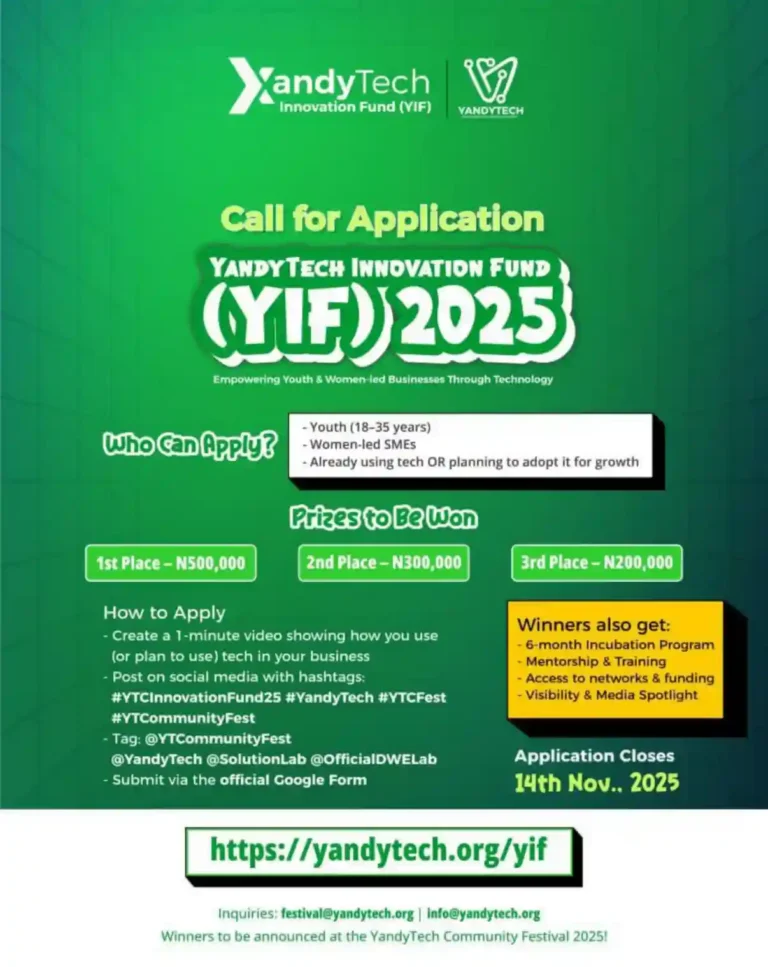
YandyTech opens innovation fund 2025 with N500,000 grant

The YandyTech Innovation Fund (YIF) 2025 has officially opened applications for young women entrepreneurs who are ready to use technology to grow their businesses and create lasting community impact. According to the organizers, the program aims to “unveil something truly empowering for all the bold, brilliant, and tech-savvy women changemakers out there.”

The initiative invites women-led startups and SMEs between the ages of 18 and 35 who are either already using technology or planning to adopt it for business growth. “Whether you’re building a startup from your dorm room, running a small business from your kitchen table, or developing that next big digital idea, this fund is for you,” the statement added.

Prizes include N500,000 for first place, N300,000 for second place, and N200,000 for third place. Winners will also receive a 6-month incubation program with mentorship, training, funding access, and media visibility.

To apply, participants are required to create a 1-minute video showing how they use or plan to use technology in their businesses. They must post it on social media using the hashtags #YTCInnovationFund25, #YandyTech, #YTCFest, and #YTCommunityFest, tagging @YTCommunityFest, @YandyTech, @SolutionLab, and @OfficialDWELab. Applications close on November 14, 2025, via the official Google Form Link.

NJFP 2.0: email verification glitch affects applicants

0

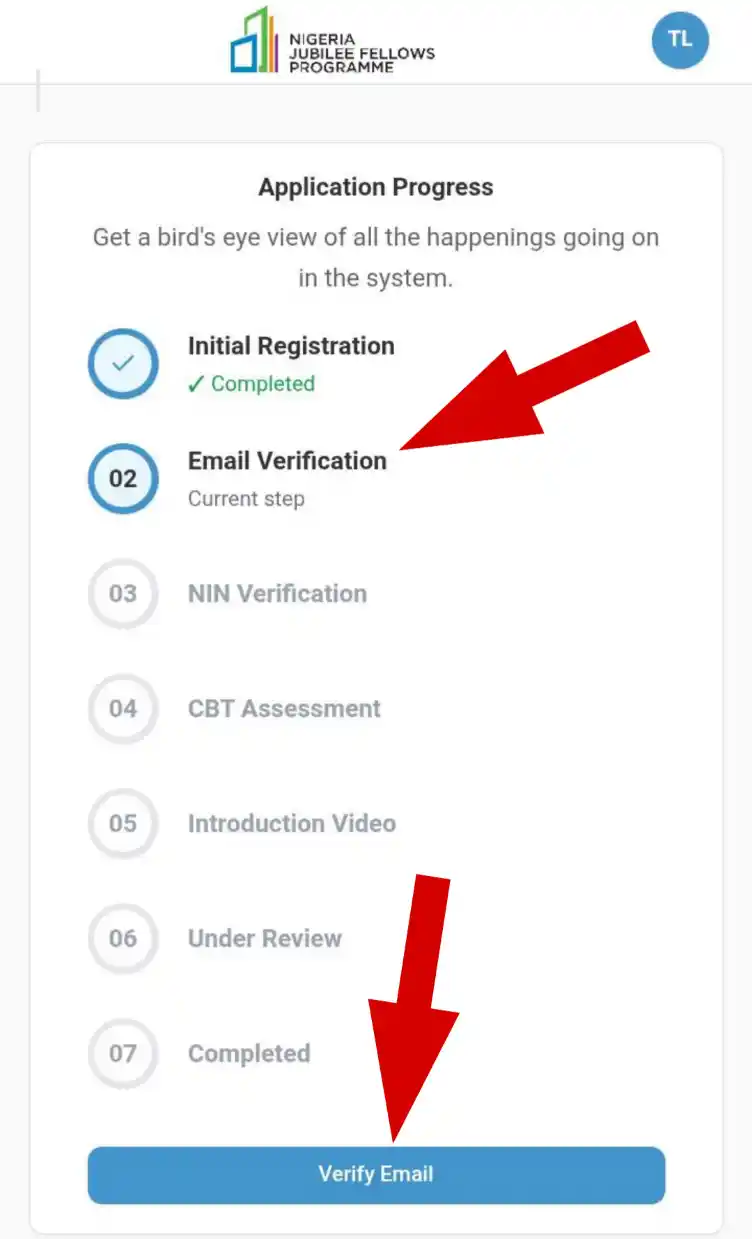
The current trend on social media shows that the Nigeria Jubilee Fellows Programme (NJFP) 2.0 is facing an email verification problem. Many applicants report that when they reach the email step under the Application Progress, they do not receive any verification mail.

According to reports, this is a general issue caused by heavy traffic on the NJFP portal. “The solution is to keep trying,” a source explained, adding that the verification email eventually arrives. The issue is mainly linked to network glitches and massive application numbers.

Update:

Email verification is now working for the Nigeria Jubilee Fellows Programme. You can try verifying your email address again.

NJFP 2.0 sends cbt exam schedule email to shortlisted candidates

0

Nigeria Jubilee Fellows Programme (NJFP) has started sending Computer-Based Test (CBT) schedules via email to candidates shortlisted for the exam. After the successful application process, shortlisted applicants are now being invited to take the NJFP CBT, which will determine their qualification for the fellowship placement.

The test is a 30-minute assessment consisting of 15 multiple-choice questions. The passing score is set at 70% or higher, and candidates are allowed a maximum of three attempts. According to the NJFP update, “The CBT Assessment is a comprehensive test covering basic mathematics, logical reasoning, and problem-solving skills.”

The test is designed to measure analytical ability and readiness for the program. The key areas include Basic Arithmetic, Algebra, Geometry, Percentages, and Number Sequences. Applicants are encouraged to prepare adequately to meet the required pass mark.

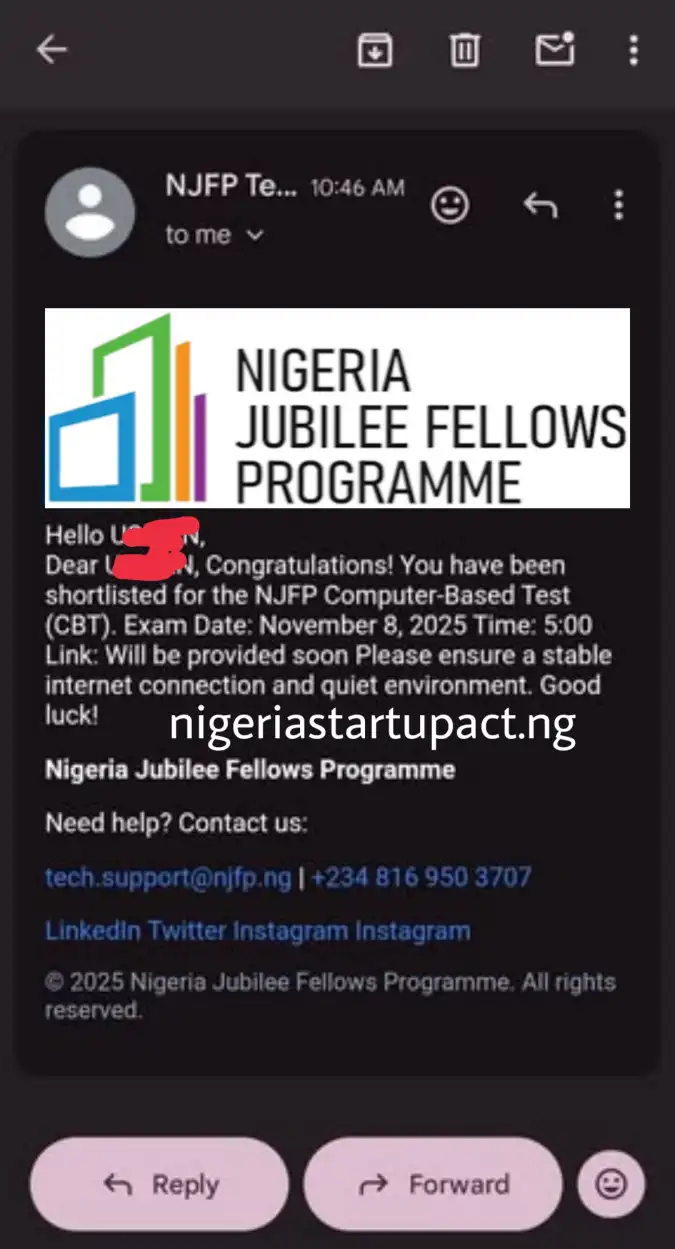
If your current status on the NJFP portal shows “Test Not Scheduled,” you are advised to click on “Schedule Test Now” to view your CBT date. Once scheduled, candidates will receive an official email from NJFP with the following message:

“Hello, Dear candidate, Congratulations! You have been shortlisted for the NJFP Computer-Based Test (CBT). Exam Date: November 8, 2025 Time: 5:00 Link: Will be provided soon. Please ensure a stable internet connection and quiet environment. Good luck!”

Nigeriastartupact.ng advises all applicants to check their emails regularly to know their NJFP CBT exam date.

Attached below is screenshot proof:

Nigeria to Establish Indian Institute of Technology Campus

0

The Federal Government of Nigeria has reaffirmed its readiness to collaborate with the Government of India to establish a Nigerian campus of the globally acclaimed Indian Institute of Technology (IIT). The move aims to promote science, technology, and innovation-driven education in Nigeria and strengthen bilateral relations between both countries.

Honourable Minister of Education, Dr. Maruf Tunji Alausa (CON), made this known during a courtesy visit by the Indian High Commissioner to Nigeria, H.E. Abhishek Singh, at the Ministry’s headquarters in Abuja. Dr. Alausa described the plan as a landmark in Nigeria–India educational cooperation and an important part of President Bola Ahmed Tinubu’s Renewed Hope Agenda.

According to the Minister, the Federal Government Academy (FGA), Suleja, has been identified as the proposed flagship site for the project. He said it would be transformed into an autonomous centre of excellence that aligns with the global standards of IIT institutions. To ensure smooth implementation, Dr. Alausa announced the creation of a joint technical working group led by Dr. Layi Olatawura and Mrs. Mary Millicent Nnawuogo to coordinate feasibility studies in partnership with the Indian High Commission.

Dr. Alausa commended India for its support in human capital development through the ITEC and ICCR programmes, praising the IIT system for its global reputation. In response, H.E. Abhishek Singh reaffirmed India’s commitment, citing the success of IIT Madras Zanzibar as a model for the Nigerian project. Both governments pledged to make IIT Nigeria a hub of academic excellence, innovation, and partnership.

Federal University of Technology Akure announces 2025 recruitment

0

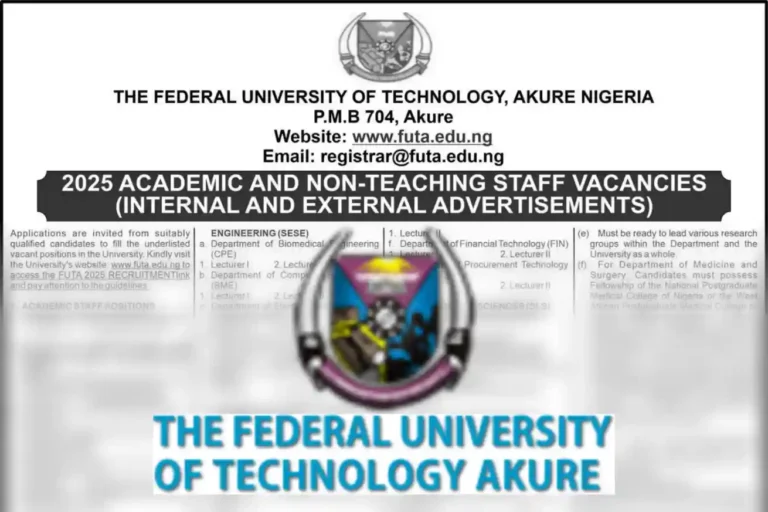
The Federal University of Technology, Akure (FUTA) has announced the opening of its 2025 academic and non-teaching staff recruitment exercise for both internal and external applicants. In an official notice from the Registrar, C.O. Adeleye, the University invited qualified candidates to apply for various positions across multiple schools and departments.

According to the statement, “Applications are invited from suitably qualified candidates to fill the underlisted vacant positions in the University.” Interested applicants are directed to visit the University’s website at www.futa.edu.ng to access the FUTA 2025 Recruitment Link and follow the provided guidelines.

The recruitment covers a wide range of positions in academic and administrative units. Academic staff vacancies include roles such as Professor, Senior Lecturer, Lecturer I, Lecturer II, and Assistant Lecturer across schools including Agricultural and Agricultural Technology, Health Sciences, Earth and Mineral Sciences, Electrical Systems Engineering, Environmental Technology, Life Sciences, Computing, and others.

The School of Agricultural and Agricultural Technology has openings for Lecturer I and Assistant Lecturer positions in departments such as Agricultural Extension and Communication Technology, Animal Production, Agricultural and Resource Economics, and Ecotourism and Wildlife Management. Similarly, the College of Health Sciences announced opportunities in the Departments of Human Anatomy, Physiology, Medical Laboratory Science, and Public Health.

Non-teaching positions are also available across several units including the Registry, Bursary, Works and Services, Library, and Computer Resource Centre. Positions range from Administrative Officers, Accountants, and Secretaries to Engineers, Technologists, and Security Guards. The notice stated that “All applicants for academic positions and applicants for positions on CONTISS 06 – CONTISS 12 must be computer literate.”

FUTA listed the salary scales and qualifications for each category. For example, Professors are to earn between N7,932,333.00 and N10,458,708.00 annually, with a requirement of a Ph.D. and a minimum of twelve years of teaching and research experience. Candidates for Reader or Associate Professor positions are expected to have at least ten years of similar experience, while Senior Lecturers must possess six years of relevant experience with a Ph.D.

The Registrar emphasized that the appointment is normally on probation for the first two years and may be confirmed upon satisfactory performance. “The post is pensionable,” the announcement added.

Applications are to be submitted online through the University’s website not later than six weeks from Thursday, October 23, 2025, which marks the commencement date of the recruitment process. Only shortlisted candidates will be acknowledged.

Interested candidates are encouraged to apply now through www.futa.edu.ng.

UNIDO, FG launch 2024–2028 industrial partnership plan

0

The United Nations Industrial Development Organization (UNIDO), in collaboration with the Federal Ministry of Industry, Trade and Investment and the Federal Ministry of Budget and Economic Planning, has officially launched the Programme for Country Partnership (PCP) Flagship Strategy (2024–2028) and inaugurated its National Coordination Body (NCB) in Abuja.

The initiative is designed to promote and accelerate Inclusive and Sustainable Industrial Development (ISID), stimulate economic growth, and foster innovation for Nigeria’s long-term prosperity. It also aims to strengthen local industries, create jobs, and attract foreign investment into key production sectors.

Speaking at the launch, Minister of State for Industry John Owan Enoh said industrialisation remains central to Nigeria’s economic policy because it provides a mechanism for sustainable growth. He explained that “the Programme identifies productive base across priority areas and also identifies core pillars of industrialisation. They are aligned with government drive to foster export-oriented growth and promote inclusive and regionally balanced development.”

He added that the collaboration with UNIDO seeks to build synergy, promote technology transfer, and expand export competitiveness. According to him, “the economy is expanding but production is not and that is where the problem lies which we want to correct.”

UNIDO Representative to Nigeria and ECOWAS, Ambassador Philbert Johnson, highlighted the importance of the new framework. “In Nigeria, the PCP serves as the framework for implementing the industrial development component of the country’s medium-term plan,” he said, noting that the strategy supports national goals to diversify the economy and strengthen industrial productivity.

While inaugurating the National Coordination Body, the Minister of Budget and Economic Planning, Atiku Bagudu, said inflation and interest rates are beginning to moderate, creating a mix of opportunities for private investments and economic expansion.

He stated that “the government is already putting together the 2025 to 2030 development plan as Nigeria targets to be a $1trn economy and mobilising jobs in 8,809 wards.”

Bagudu further revealed that “1.2 million dollars has been set aside by the federal government as a commitment to drive the programme.”