Home Blog Page 380

FG urges schools to begin young farmers’ club for food security

0

The Federal Government has urged schools across the country to embrace the Young Farmers’ Club initiative as part of ongoing efforts to strengthen food security, boost agricultural productivity, and promote inclusivity among young Nigerians.

Minister of State for Agriculture and Food Security, Sen. Aliyu Abdullahi, made this call during a visit to 1st UBE Primary School, Pasali, Kuje, in Abuja, as part of activities marking the 2024 World Food Day celebration.

Abdullahi explained that the initiative aims to create early awareness of agriculture as a viable and dignified profession while equipping students with modern farming skills and reviving interest in the sector.

“The programme fosters entrepreneurship, responsibility, and self-reliance through practical training and home farming projects,” the minister said.

He added that the idea was reinforced during his previous visit to Government Girls Secondary School, Dutse, noting that engaging students early in agricultural activities would support the country’s long-term food sustainability goals.

The minister also commended the First Lady, Sen. Oluremi Tinubu, for her “Every Home a Garden” initiative, describing it as a strong contribution to national food security and a key driver of household farming awareness.

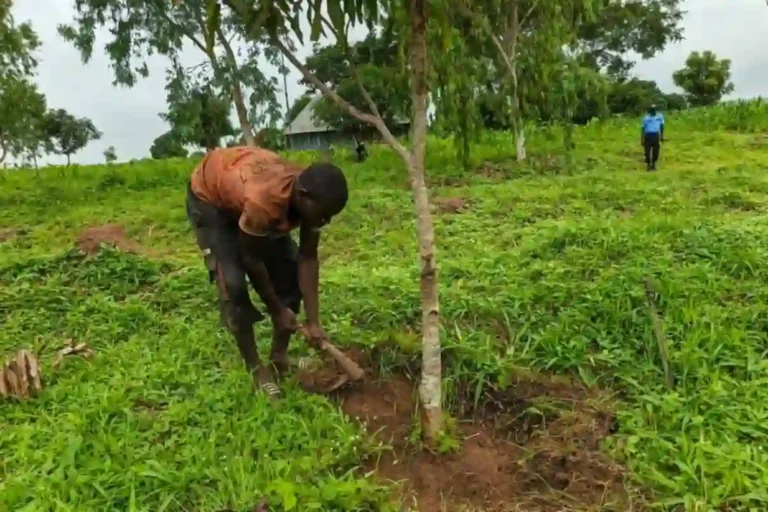
At the Kuje school, Abdullahi inspected student-run horticultural projects and encouraged pupils to embrace the message, “Produce what you eat and eat what you produce.”

He directed the Horticulture Department of the ministry to assist the school’s club under the Urban Agriculture programme, stressing that sustainable farming and all-year-round production were essential to addressing food challenges in the country.

Abdullahi further revealed that the Federal Government was reviewing the national school curricula to integrate agriculture at all educational levels.

Also speaking, the Minister of Livestock Development, Idi Maiha, advocated for the inclusion of animal husbandry in school farming activities to give students a complete understanding of food production processes.

“Children shouldn’t think food comes from the supermarket. Someone has to work in the field,” Maiha said.

He announced plans to introduce new grass varieties for animal feed production, describing livestock farming as the missing link in school-based agriculture.

Speaking on behalf of the students, Emmanuel Ndubisi expressed gratitude to the ministers, noting that pupils had already started cultivating crops such as okro, corn, and groundnut.

The minister also visited Government Secondary Schools in Karshi and Karu, where he presented farm inputs to support ongoing agricultural projects.

Advertisement

Edo, German film academy partner to train young filmmakers

As part of its efforts to grow the creative industry, foster youth innovation, and promote the creative sector, the Edo State Government has partnered with the German Film Academy to enhance the skills of young filmmakers and drive innovation in the state’s creative economy. The collaboration aims to equip local filmmakers with advanced equipment and techniques, preparing them for future opportunities and promoting the overall growth of the sector.

During a meeting with the German Film Academy at Government House in Benin City, the Coordinator, Office of the First Lady, Edo State, Mrs. Edesili Okpebholo Anani, expressed enthusiasm for the partnership, describing it as a vital step toward empowering local talents. She highlighted Edo State’s openness to investments, especially in the creative sector, which she noted holds great potential for development.

“I am excited that we are having this exchange programme. Edo State is open to investment of all kinds. The creative industry, in particular, remains largely untapped, presenting a significant opportunity for growth and development. We are grateful for your partnership and invite you to explore more collaborations with us. We also invite you to learn from our unique cultural context and experiences, as Africa and Nigeria are blessed with rich creative potential,” Mrs. Anani said.

She emphasised the state’s deep cultural roots and creative heritage, noting the renewed sense of pride following the return of the state’s artefacts. According to her, “We are people of culture and we are proud of our rich cultural heritage, which has been reignited by the return of our artifacts, and we are grateful to the German Government. This underscores our deep connection to art and creativity, dating back to centuries. Our people are known for their intelligence, industriousness, and hard work, particularly the Edolites, who are eager to collaborate. As I mentioned earlier, our State is open to investment, and the creative sector is a key area for growth. We are excited about the film project you mentioned and look forward to exploring opportunities for partnership.”

Mrs. Anani further expressed her passion for the knowledge exchange initiative, saying it would not only educate and enlighten people about societal issues but also present Nigerian culture in an authentic way. She encouraged the visitors to experience Edo’s cultural attractions, such as Igun Street, to appreciate the local heritage.

Earlier, the Edo State Director of Entertainment and Creative Economy, and the Team Lead, Ambassador Solomon Okosun, said that local filmmakers in Benin are currently being trained by the German Film Academy, using modern filmmaking equipment for a new film project. According to him, “I am here with the leaders of the German Film Academy for the upcoming workshop they are conducting in Benin. We are collaborating with the Creative Hub. We have six students from the German Film Academy. In return, they are providing advanced training to our indigenous filmmakers. We will provide twelve and they will select six. By doing so, they are helping us expand the knowledge of these young filmmakers, preparing them for the future.”

He added that the ongoing workshop has the potential to expose local filmmakers to advanced global film standards through the partnership. The training programme, he explained, includes three weeks of intensive sessions in Benin City and one week at the Nollywood Film Festival in Lagos. The top two participants from the programme will later travel to Germany for additional training opportunities.

Also speaking, the Project Manager, Nollywood Workshop 2025, from the Filmakademie Ludwigsburg, Germany, Mr. Abel Alechenu, highlighted that the Edo-German collaboration is a three-year partnership which began in 2023. He noted that the project focuses on selecting promising local filmmakers for training in Germany, with an emphasis on promoting cultural exchange and technical development.

According to Alechenu, the programme partners with international organisations such as GIZ and provides access to advanced filmmaking tools, including high-end ARRI cameras. He said the partnership would continue to strengthen ties between Germany and Nigeria while giving Edo’s creative talents a platform to compete globally in the film and entertainment industry.

Wema Bank completes N50bn capital raise through private placement

0

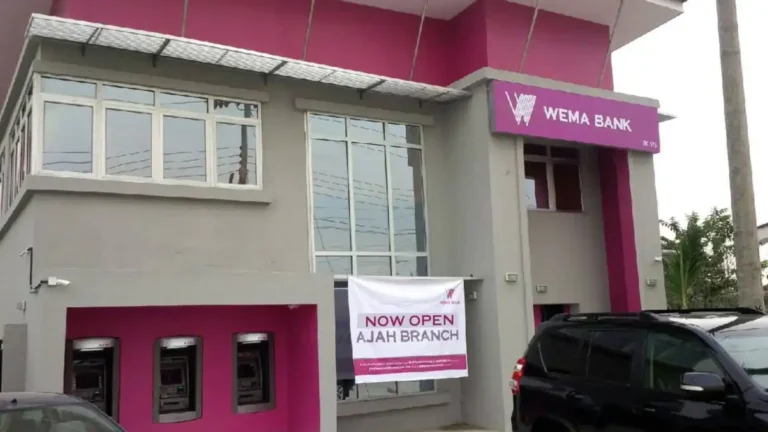
Wema Bank Plc has successfully completed the second tranche of its N50 billion capital raise through a fully subscribed private placement, marking a major step in its capital management programme.

The latest exercise follows the earlier conclusion of a N150 billion Rights Issue in September, which brought the bank’s total qualifying capital to N264.87 billion. This figure now surpasses the Central Bank of Nigeria’s (CBN) minimum capital requirement of N200 billion for commercial banks with national authorisation.

In a statement issued on Thursday, Wema Bank confirmed that it had secured all requisite regulatory approvals for the new capital injection. The bank described the achievement as a significant milestone in its ongoing efforts to strengthen its financial position, enhance liquidity, and ensure compliance with the CBN’s revised capital requirements.

According to the statement, the capital raise forms part of a broader plan aimed at supporting Wema Bank’s future growth and expansion strategies, while ensuring a solid balance sheet and sustainable performance.

Wema Bank’s Managing Director and Chief Executive Officer, Mr Moruf Oseni, said the approval reflected another major step in the institution’s growth journey.

“We are delighted to have received all necessary regulatory approvals for our N50 billion special placement,” Oseni said. “This marks another major step in our strategy to strengthen Wema Bank’s capital base, enhance liquidity, and position the institution to pursue emerging opportunities for sustained growth.”

He expressed appreciation to shareholders, regulators, and customers for their continued confidence and support. “We appreciate the continued confidence and support of our shareholders, regulators, and customers as we execute our growth agenda,” he added.

Oseni further stated that the proceeds from the capital raise would accelerate Wema Bank’s digital transformation drive, expand its retail, SME, and corporate banking segments, and boost lending to key productive sectors of the Nigerian economy.

“It will also support ongoing investments in technology and human capital development, further strengthening operational efficiency and service excellence,” he said.

The bank reaffirmed its commitment to delivering superior value to shareholders, empowering customers through innovative financial solutions, and contributing to Nigeria’s economic growth and financial inclusion goals.

FG launches all-year farming plan to boost food production

0

The Federal Government has announced plans to promote all-year-round farming as part of efforts to boost food production across the country.

The Minister of State for Agriculture and Food Security, Senator Aliyu Abdullahi, made this known in Abuja during a ministerial news conference held to mark the 2025 World Food Day, themed “Hand in Hand for Better Food and a Better Future.”

According to Abdullahi, the 2025 Wet Season Agricultural Performance Survey confirmed steady growth in Nigeria’s agricultural output, particularly in rice, maize, sorghum, millet, cowpea, yam, and cassava production. He explained that all the crops recorded higher yields compared to 2024. The gains, he said, were the result of modest expansion in cultivated areas, improved farming practices, and the resilience of farmers across major producing states.

“These gains have reinforced food security and sustained agro-industrial value chains,” Abdullahi said.

He disclosed that the government had commenced a Dry Season Initiative to ensure all-year-round farming on 500,000 hectares of land. “The first phase focused on wheat production in 15 wheat-producing states, while the second phase covers rice, maize, and cassava,” he added.

The minister further revealed that the government was scaling up industrial transformation in the agriculture sector through the rollout of Special Agro-Industrial Processing Zones (SAPZ), supported by the African Development Bank and other development partners.

Abdullahi said the first phase of the five-year SAPZ programme covers Kaduna, Cross River, Kano, Kwara, Imo, Ogun, Oyo, and the Federal Capital Territory. He confirmed that implementation had already commenced in Kaduna and Cross River States in April 2025.

He stated that the SAPZ programme is designed to boost agricultural output by over 60 per cent, reduce post-harvest losses by 80 per cent, promote value addition, create jobs, and improve market access for farmers and agribusiness investors. “Through the SAPZ project, Nigeria aims to accelerate its shift towards an agro-industrial economy and support broader national diversification efforts,” Abdullahi said.

The minister also disclosed that the government had unveiled a plan to strengthen the National Strategic Food Reserve to ensure adequate stockpiling of essential commodities. “This measure will help prevent crises arising from acute food shortages and reduce dependence on imports,” he said.

Abdullahi explained that the strategic food reserve would help stabilise food prices, ensure a steady supply of essential commodities, and protect both consumers and farmers from extreme market fluctuations.

In his remarks, the Minister of Livestock Development, Alhaji Idi Maiha, said the creation of the Livestock Ministry was part of government’s plan to transform the sub-sector into a modern, economically viable industry. “We are here to synergise and partner with the Ministry of Agriculture because our efforts are complementary,” Maiha said.

Farm inputs such as sprayers, organic fertilisers, and water pumps were distributed to women farmers’ organisations, young farmers’ clubs in schools, and farmers’ cooperatives during the event.

CBN to launch new currency trade scheme with partner nations

The Governor of the Central Bank of Nigeria, Olayemi Cardoso, has announced that Nigeria is developing a new framework to promote the use of national currencies in bilateral trade settlements. Speaking at a press briefing during the IMF and World Bank Annual Meetings in Washington DC, Cardoso explained that although the country had previously experimented with local currency trade agreements, the initiative did not produce the desired outcomes.

“We have had an experiment with that (switching to national currencies in bilateral trade). And to be frank, it did not work out very well for us,” he said. “That is not to say that we are not interested in doing this. We are. And we are really at an elementary stage of putting up a framework, now that our currency is more competitive, to be able to ensure that it is a win-win for everybody.”

Cardoso stated that the Central Bank was adopting a more cautious and structured approach this time to guarantee that future local currency trade arrangements deliver mutual benefits and reduce dependence on foreign exchange in cross-border transactions.

Bilateral currency trade arrangements, also known as local currency settlement agreements, allow two countries to trade directly using their national currencies instead of the U.S. dollar or other reserve currencies. Nigeria has tried this approach before, most notably with China through the 2018 currency swap agreement signed between the Central Bank of Nigeria and the People’s Bank of China.

The deal, valued at about N720 billion or RMB 15 billion, was designed to ease pressure on Nigeria’s dollar reserves, promote trade with China, and make it easier for Nigerian importers to access yuan for Chinese goods. However, the arrangement faced challenges such as limited awareness among traders, logistical difficulties, exchange rate uncertainty, and the absence of a robust settlement framework. Many Nigerian businesses continued to depend on the U.S. dollar for imports, while local banks struggled to maintain sufficient yuan liquidity.

CBN officials later admitted that the pilot phase “did not work as efficiently as expected,” though it offered important lessons for designing more effective frameworks in the future. Despite these challenges, a new bilateral currency swap agreement was reached in December 2024 between Nigeria and China.

The renewed deal, jointly announced by the CBN and the People’s Bank of China, is worth N3.28 trillion, equivalent to approximately 15 billion yuan or $2.09 billion. Valid for three years and renewable upon mutual agreement, the swap aims to strengthen financial cooperation, simplify naira and yuan transactions, and reduce Nigeria’s reliance on the U.S. dollar in trade.

Cardoso’s comments indicate that the Central Bank is revisiting the idea of using national currencies for bilateral trade, especially now that the naira has become more competitive following recent foreign exchange reforms. He also said that Nigeria’s foreign exchange reforms and macroeconomic adjustments have strengthened the country’s external position, leading to a positive balance of trade for the first time in years.

“From Nigeria’s perspective, it is less of a problem for us because a lot of the things that needed to have been done, we did much earlier,” he explained. “We now have a more competitive currency, and as a result, for once, we have a situation where we have a positive balance of trade, a trade surplus expected to be around six per cent of GDP and to remain at that for some time.”

He said this development reflected a “complete restructuring” of the economy that had improved resilience and created buffers against external shocks, particularly in the oil sector, Nigeria’s major export earner. Cardoso added that ongoing economic reforms had boosted investor confidence and improved the country’s trade position, noting that a flexible exchange rate was already encouraging local production and discouraging excessive imports.

Cardoso, who also serves as First Vice-Chair of the G24, highlighted that developing and emerging economies were now better represented in global financial discussions, especially under the Bretton Woods institutions such as the International Monetary Fund and the World Bank.

“It has been very useful, and it is clear to me that under the leadership of Argentina, being the Chair of the G24, we have certainly advanced the cause with the voice of the emerging economies,” he said. “We have been able to get a more effective seat at the table, especially with respect to the Bretton Woods Institutions and getting our voices heard. That, in itself, is a major step forward. We expect that the very good work that has been done will be further deepened in the years ahead.”

The G24, formally known as the Intergovernmental Group of Twenty-Four on International Monetary Affairs and Development, unites developing countries to coordinate their positions on international financial and development matters. Cardoso described the platform as “a useful space for mutual learning” between global financial institutions and developing nations.

“We had a dialogue with both the Managing Director of the IMF and the representative of the World Bank President,” he said. “There was an exchange of ideas that helps the Bretton Woods leadership to better understand directly from the players what the issues are and where the pain points really are.”

He also noted that the G24 communiqués now capture critical issues affecting member states, such as domestic resource mobilisation, inflation, debt, and growth challenges. “They learn from us, and we also learn from them,” Cardoso added.

The CBN governor emphasised that consistent and sound macroeconomic policies were essential for achieving disinflation, sustainable growth, and resilience among emerging economies. “One of the issues that can help to get many of our countries out of the difficult situation are macroeconomic policies, and sound macroeconomic policies at that,” he said. “There is a clear correlation between those who have adopted such policies and the progress they are recording in growth and disinflation.”

Cardoso further noted that Nigeria’s economic progress was the result of early and decisive policy measures that helped shield the economy from deeper shocks and restored confidence in the local currency. He said the ongoing reforms had encouraged stability, reduced speculative activities in the foreign exchange market, and promoted greater use of the naira in international trade.

He reaffirmed that the CBN would continue implementing fiscal and monetary policies that support productivity, enhance foreign exchange stability, and promote trade diversification. According to him, the Central Bank’s new approach to bilateral currency settlement frameworks would help Nigeria benefit more from international trade while supporting local businesses.

The G24, established in 1971, continues to coordinate developing countries’ positions on global monetary and development finance issues, ensuring that their voices are included in key international decisions that affect their economies.


Nigeria Customs denies claims of appointment letters circulating online

The Nigeria Customs Service (NCS) has denied claims circulating online that it is issuing appointment letters to successful applicants. According to the Service, such reports are false and misleading, urging the public to disregard them immediately.

In a statement, the NCS explained that the ongoing recruitment process has not reached the stage of issuing appointment letters. The process is still at the examination level. The Service stated, “The Superintendent Cadre recently completed their Computer-Based Test (CBT) across the six geopolitical zones, while the Inspector and Customs Assistant Cadres also just concluded their online CBT.”

The NCS described the fake appointment letters as another attempt by fraudsters to deceive unsuspecting applicants. It advised the public to remain calm, avoid spreading fake news, and rely only on verified updates from its official platforms.

Nigeriastartupact.ng earlier reported a similar false claim that the NCS Superintendent Cadre List contained 1,785 shortlisted candidates. The recruitment team clarified that the information did not come from them.

Venite University Iloro-Ekiti opens applications for staff recruitment

0

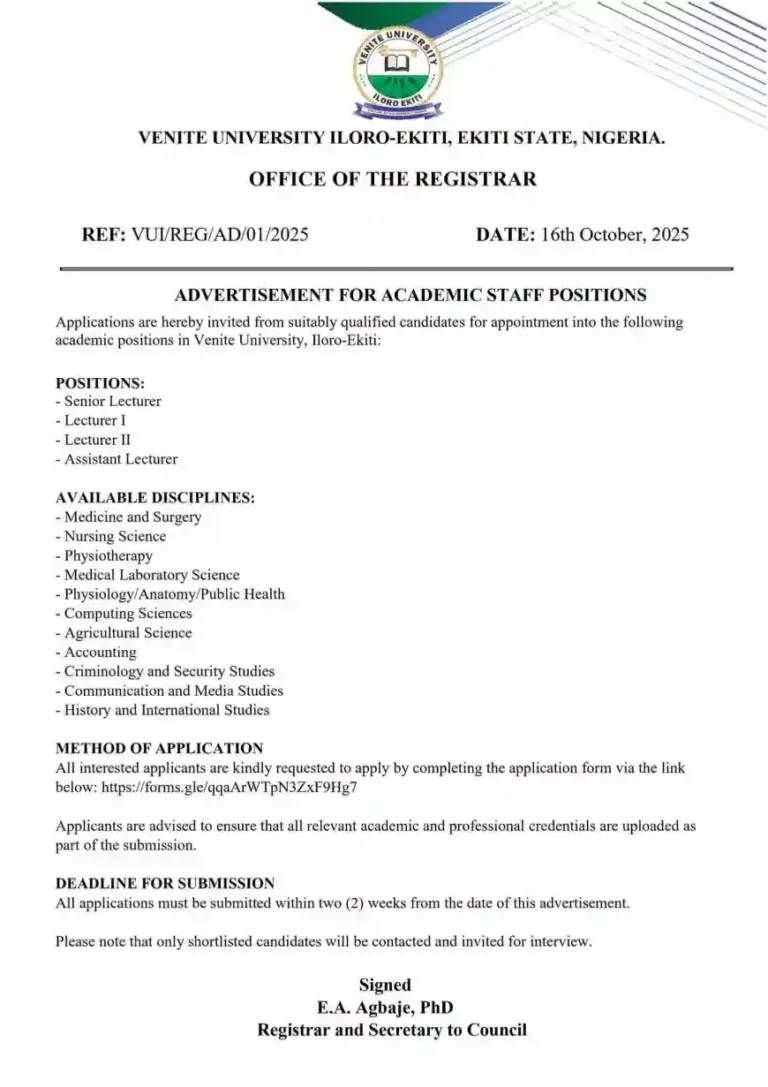
Venite University, Iloro-Ekiti, Ekiti State, has announced recruitment openings for qualified individuals to join its academic team. In a notice released from the Office of the Registrar, Ref: VUI/REG/AD/01/2025, dated October 16, 2025, the institution invited applications for various teaching positions.

The statement reads, “Applications are hereby invited from suitably qualified candidates for appointment into the following academic positions in Venite University, Iloro-Ekiti.” The available positions include Senior Lecturer, Lecturer I, Lecturer II, and Assistant Lecturer.

According to the announcement, the disciplines open for recruitment are Medicine and Surgery, Nursing Science, Physiotherapy, Medical Laboratory Science, Physiology, Anatomy, Public Health, Computing Sciences, Agricultural Science, Accounting, Criminology and Security Studies, Communication and Media Studies, and History and International Studies.

Applicants are instructed to complete their applications online through the portal Link. The university advised that “all relevant academic and professional credentials should be uploaded as part of the submission.”

The notice also stated that all applications must be submitted within two weeks from the date of the advertisement. “Please note that only shortlisted candidates will be contacted and invited for interview,” it added.

NG-CARES poverty eradication programme reaches 17 million Nigerians

0

As the world marks the International Day for the Eradication of Poverty, the Federal Government of Nigeria has restated its commitment to improving the lives of poor and vulnerable citizens through the Nigeria Community Action for Resilience and Economic Stimulus (NG-CARES) Programme. The programme, launched in 2020, continues to align with President Bola Ahmed Tinubu’s Renewed Hope Agenda, focusing on creating access to better livelihoods, food security, and economic opportunities for millions of Nigerians.

According to official figures, the NG-CARES Programme has already reached over 17 million Nigerians across the federation. It aims to further advance the Sustainable Development Goal (SDG) 1, which targets the eradication of poverty in all its forms.

Speaking on the importance of the global observance, the National Coordinator of the Federal CARES Support Unit, Dr. Abdulkarim Obaje, said the federal government’s sustained efforts have led to transformative interventions across the country. “In the past two years, the Federal Government has inspired NG-CARES to implement transformative interventions that have improved access to basic services, enhanced livelihoods, and restored hope in communities most affected by economic shocks,” he stated.

Dr. Obaje commended President Bola Ahmed Tinubu for his “visionary leadership and commitment to poverty reduction through the Renewed Hope Agenda.” He also acknowledged the Minister of Budget and Economic Planning, Senator Abubakar Atiku Bagudu, for his “consistent policy guidance and strong support” which he said have been key to sustaining the momentum of the NG-CARES Programme.

The National Coordinator noted that more Nigerians now enjoy access to basic social services, financial inclusion, and agricultural support. He explained that farmers are better equipped, food availability has improved, and poverty levels continue to decline steadily across the states.

The theme for this year’s celebration, “Decent Work and Social Protection: Putting Dignity in Practice for All,” mirrors the core focus of NG-CARES in restoring livelihoods and creating economic opportunities. The programme also prioritises safety under its Labour Intensive Public Work (LIPW) scheme, ensuring that participants work in secure and supportive conditions.

So far, over 13,102,727 Nigerians have benefited from the Basic Services component of the NG-CARES Programme through interventions such as social transfers, LIPW, livelihood support, and infrastructure development at community and group levels. In promoting food security, more than 4,158,896 farmers have received different forms of assistance, ranging from farm inputs to productivity-enhancing tools.

Additionally, the NG-CARES Programme has provided support to 349,859 micro, small, and nano enterprises nationwide, helping them to recover and expand. This intervention, according to the Federal CARES Support Unit, is strengthening local economies, encouraging entrepreneurship, and promoting inclusive economic growth.

FG to launch Nigeria First Campaign to promote made-in-Nigeria goods

0

The Federal Government has announced plans to launch a national campaign under the Nigeria First policy to promote Made-in-Nigeria goods and services as part of efforts to revitalise the country’s manufacturing sector.

President Bola Tinubu disclosed this in Lagos at the fifth Adeola Odutola Lecture organised by the Manufacturers Association of Nigeria. He was represented at the event by the Minister of State for Industry, Trade and Investment, Senator John Enoh.

According to the President, the campaign seeks to redirect national demand towards Nigerian-made products that meet international quality standards while addressing the nation’s dependency on imported goods. He explained that the Nigeria First campaign would not only boost domestic manufacturing but also help in creating more jobs and improving economic stability.

Tinubu stated that preliminary studies had shown that the policy could boost Nigeria’s manufacturing output by as much as six per cent and generate over 500,000 new jobs within three years. He added that his administration would continue to support initiatives that promote local production, domestic consumption, and the export of Made-in-Nigeria goods.

“No country achieves prosperity or dignity without producing what it can and exporting at scale what it does best,” Tinubu said. “Economics of resilience begins in the factory and thrives in the marketplace, and we are committed to reducing structural costs and enabling our manufacturers to compete effectively both at home and abroad.”

The President outlined six key policy commitments under the Nigeria First strategy. These include reforms in federal procurement, strict quality and standards enforcement, export expansion, improved access to finance, better energy and logistics systems, skills development, and input security for local industries.

He urged members of the Manufacturers Association of Nigeria to maintain high quality standards and transparency in production processes. He also encouraged them to collaborate with government agencies by sharing accurate data on capacity and pricing to guide effective industrial policy planning.

The President of Dangote Group, Alhaji Aliko Dangote, represented by Mr Mansur Ahmed, former President of MAN, said manufacturers had outlined eight key expectations from the Nigeria First policy.

Dangote emphasised that for the policy to succeed, it must be structured as a durable and binding national strategy that could withstand both political changes and economic pressures. He stated that the Nigeria First policy must be built on global best practices while being aligned with Nigeria’s unique industrial realities.

He listed the expectations to include legislating the policy as binding law with clear punitive measures for non-compliance, ensuring policy stability and consistency, and maintaining long-term commitment from all stakeholders.

Other expectations include establishing a national supplier registry, encouraging consumer engagement and cultural reorientation towards locally made products, incentivising backward integration, and addressing infrastructure and energy challenges.

Dangote also called for stronger access to finance for local manufacturers to expand capacity, build reliable supply chains, and take advantage of the African Continental Free Trade Area (AfCFTA) for regional exports.

“The Nigeria First Policy represents a bold opportunity to industrialise sustainably,” he said. “Its success depends on clear legislation, institutional enforcement, stable policy implementation, and strong alignment across government agencies and industry.

“To transform the economy, the Nigeria First Policy must move beyond declarations into actionable, measurable outcomes that prioritise local value creation and national prosperity. Every nation is in a race to improve the living conditions of its citizens and we must realise that we are in this race, and it is a very competitive race. The government has done a few things that have given us a fighting chance. The Nigeria First policy, if embraced, will place us in a very competitive position.”

The President of the Manufacturers Association of Nigeria, Otunba Francis Meshioye, commended the Federal Government’s ongoing efforts to strengthen the economy through strategic policy reforms, including the Nigeria First initiative.

He noted that the proper legislation and implementation of the policy could significantly enhance the performance of the manufacturing sector and improve the overall well-being of Nigerians.

Meshioye, however, highlighted the current challenges confronting manufacturers in the country, citing global economic headwinds and domestic policy constraints as major hurdles. He explained that the Nigeria First policy was not just an economic target but a vital step toward national survival.

“If we do not intentionally support our own manufacturers, we will not be able to compete globally,” Meshioye said. “MAN believe that the Nigeria First policy is about building national resilience, creating jobs at home, saving foreign exchange, driving technological innovation, and giving Nigeria the productive foundation it needs to be competitive globally.

“To this end, effective legislation and implementation is key and must be carried out without any prevarication.”

Nigeriastartupact.ng reports that the Nigeria First policy aligns with the government’s broader economic diversification agenda and is expected to strengthen the country’s manufacturing base, improve local production, and reduce dependence on imported goods.

NDDC releases N1.5bn business funds to 1500 Niger Delta beneficiaries

0

The Niger Delta Chamber of Commerce, Industry, Trade, Mines and Agriculture, NDCCITMA, with the support of the Niger Delta Development Commission, NDDC, has disbursed cheques worth N1.5 billion to 1,500 beneficiaries to boost small and medium-scale businesses in the Niger Delta region.

During the flag-off of the Investment Partnership Scheme in Port Harcourt, the Chairman of NDCCITMA, Ambassador Idaere Gogo-Ogan, explained that the fund marks the first phase of the disbursement aimed at empowering people across the region. He said the initiative is part of a broader economic empowerment strategy to reduce poverty and promote business growth in the Niger Delta.

According to him, the programme targets various categories of entrepreneurs. “The nano group of beneficiaries, the poorest of the poor, will receive 200,000 naira each, while the micro, small-scale and medium-scale categories will receive N3 million, N7 million, and N20 million, respectively, to boost their investments,” Gogo-Ogan stated.

He further explained that the aim of the partnership is to uplift vulnerable people and promote inclusive growth. “Our core mandate is to strive to reduce poverty in the region. We are optimistic that our partnership with a strong institution like NDDC will enable us to reach the poorest of the poor, small-scale businesses, and lift over 2,000 people in the region out of poverty. We believe that robust development comes not only from the top but also from the bottom. So, when you aggregate all the categories, you can begin to see the gains of genuine economic prosperity,” he added.

The NDCCITMA Chairman revealed that the beneficiaries would enjoy a low interest rate of 0.6 per cent, noting that it would allow more people to benefit from the fund. He assured them that the Chambers of Commerce would continue to offer mentorship, business support, and promotions to help their enterprises compete favourably with others across the country.

Also speaking, the NDDC Director of Commercial and Industrial Development and Chairman of the Implementation Committee, Mrs. Lyna Okara, commended the leadership of the NDDC for creating a platform that connects business-minded individuals across the region. She said the launch of the investment partnership scheme was timely and a clear indication that the region is moving toward rapid economic growth.

A representative of the Small and Medium Enterprises Development Agency of Nigeria, SMEDAN, Mrs. Olalek Rasheed, urged entrepreneurs to maintain proper documentation to access the funds. She also advised beneficiaries not to divert the support to non-economic activities.