Home Blog Page 385

FG partners ICRISAT on crop residue feed machines

0

The Federal Ministry of Livestock Development has announced plans to collaborate with the International Crops Research Institute for the Semi-Arid Tropics (ICRISAT) on the use of locally fabricated stover chopper machines that convert crop residues into animal feed with up to 90 percent utilization efficiency.

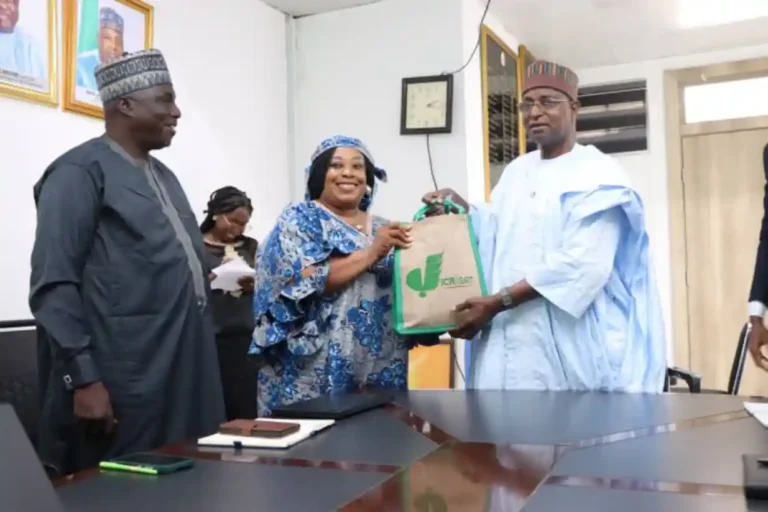
The Honourable Minister of Livestock Development, Idi Mukhta Maiha, made this known when he received a delegation from ICRISAT in his office in Abuja on Wednesday, October 15, 2025. He said the initiative aims to enhance livestock productivity and promote sustainable agriculture in Nigeria through innovative feed solutions and technology-driven farming practices.

Maiha explained that the partnership will focus on crop-livestock integration, machinery accessibility, and the strengthening of extension services to support agricultural growth. “People can take the grains, the foliage, and the residue, everything can be turned into animal feed,” the Minister said. He added that agricultural challenges can be turned into opportunities through collaboration between farmers, researchers, and policymakers.

The Minister encouraged ICRISAT to start by utilizing existing crop varieties before expanding into grass and pasture cultivation that can work in synergy with crop residue utilization. He further called on the Institute to intensify sensitization among farmers and rural stakeholders using local languages, emphasizing that the adoption of residue-based feed is a cost-effective and sustainable option for livestock owners.

Reaffirming the Ministry’s commitment to agricultural development, Maiha revealed that discussions are ongoing with state governors to strengthen livestock projects across the country. “We are commencing with five grazing reserves across Adamawa, Plateau, the FCT, and other selected states,” he stated.

In his remarks, Dr. Ignatius Ijantiku Angarawai, Senior Scientist for Sorghum Breeding and ICRISAT Country Representative for Nigeria, said that in collaboration with Crop Mandate NARES, the Institute has developed dual-purpose sorghum and millet varieties that can benefit farmers and feed producers.

He added that research results have shown that birds fed with Kaura sorghum recorded an 8-kilogram weight gain compared to those fed with maize, making sorghum a strong substitute in poultry feed production. Dr. Angarawai reaffirmed ICRISAT’s readiness to support the Nigeria Livestock Growth Acceleration Strategy through extension programs and policy framework development for staffing and recruitment within the livestock sector.

Advertisement

NILDS invites professionals to virtual open day programme

0

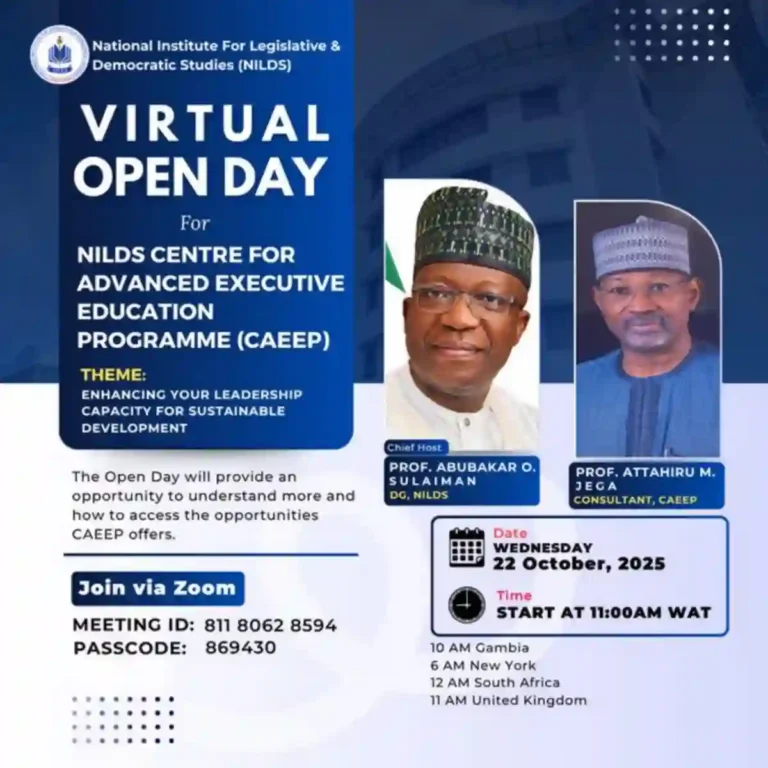
The National Institute for Legislative and Democratic Studies (NILDS) has announced an open invitation to its upcoming virtual Open Day for the Centre for Advanced Executive Education Programme (CAEEP). The event, themed “Enhancing Your Leadership Capacity for Sustainable Development,” is scheduled to take place on Wednesday, October 22, 2025.

According to NILDS, the initiative aims to create and promote a cutting-edge knowledge pathway towards sustainable development. The Centre for Advanced Executive Education Programme (CAEEP) was established as a strategic platform for technocrats, leaders, chief executives, and captains of industries to strengthen their ability to lead with vision, make evidence-based decisions, and drive transformative changes in their organizations.

Speaking on the importance of the event, Dr. Bethel Uzoma Ihugba, Coordinator of CAEEP, stated, “The NILDS-CAEEP through its Advanced Executive Education courses creates a platform for networking, strengthens the capacity of leaders and decision-makers for more effective leadership across sectors, industries, and institutions.”

The Open Day will serve as an opportunity for participants to explore how the CAEEP programme enhances leadership capacity and promotes good governance. NILDS emphasized that the programme is designed for senior professionals and industry leaders across both private and public sectors. Eligible participants include leaders in law, accounting, financial management, health, education, natural and physical sciences, and other related fields.

Others expected to attend include legislators, political appointees, technocrats, senior bureaucrats, and political office holders, as well as heads of ministries, departments, agencies, private sector executives, and political party leaders. Civil society and NGO leaders are also encouraged to participate.

The virtual Open Day will begin at 10 AM Gambia time, 6 AM New York, 11 AM Nigeria, 12 AM South Africa, and 11 AM United Kingdom. Interested participants can register through the provided link forms.gle/BbBXQi7pcXZhyf and join via Zoom at us06web.zoom.us/j/81180628594.

Dr. Ihugba added, “The Institute recognises your efforts and desires for enduring development and would be pleased to have you participate in the Programme.”

NOA Animation Challenge 2026 application opens with N10m prize

The National Orientation Agency (NOA), in partnership with the Lagos International Festival of Animation (LIFANIMA), has officially announced the opening of entries for the NOA Animation Challenge 2026. The competition invites Nigerian animators to creatively interpret the theme “Who Is a Real Nigerian?” through animation that reflects national identity, culture, and values.

According to the organizers, the challenge aims to promote the Nigerian Identity Project, a national initiative designed to strengthen unity and patriotism. The project is based on the Nigerian Values Charter (NVC), which outlines seven promises of the nation and seven citizen codes that define the responsibilities of all Nigerians. The NOA stated that “this initiative reinforces the synergy between governance and creativity, empowering local talent to tell stories that reflect Nigeria’s identity, culture, and values.”

Animators are required to produce original short films lasting no longer than three minutes. Accepted formats include 2D, 3D, and stop motion animation styles. Each entry must also include the creator’s profile. Winners will share a total prize of 22.5 million naira, with ₦10 million awarded to the first-place winner, ₦7.5 million to the second, and ₦5 million to the third. In addition, all winning entries will air on national television for three months, giving participants valuable exposure in Nigeria’s growing animation industry.

Participation in the NOA Animation Challenge 2026 is open exclusively to Nigerian citizens, including individual animators and studios. “Exclusive to Nigerians only,” the agency emphasized, noting that the challenge seeks to inspire creators to embrace the Nigerian identity through digital art and storytelling.

Entries are to be submitted via FilmFreeway at filmfreeway.com/lifanima, following the standard LIFANIMA submission process. The deadline for submission is June 2026.

FG raises ₦3.96bn from October 2025 savings bonds

0

The Federal Government of Nigeria has raised a total of ₦3.96 billion from the October 2025 Federal Government of Nigeria Savings Bonds, according to the Debt Management Office (DMO).

Introduced in 2017, the FGN Savings Bond programme was created to deepen the domestic bond market, promote financial inclusion, and give retail investors access to secure and low-risk government securities. The DMO stated that the October 2025 allotment was higher than the ₦3.05 billion recorded in September, showing an increase in investor participation.

For the October issuance, the government offered two tranches of savings bonds — a two-year FGN Savings Bond due October 15, 2027, and a three-year FGN Savings Bond due October 15, 2028.

The two-year FGN Savings Bond was allotted at an interest rate of 15.541% per annum, raising ₦631.762 million from 793 successful subscriptions. At an interest rate of 14.062% per annum, another two-year bond recorded 1,052 total subscriptions valued at ₦779.047 million. The bonds were issued at ₦1,000 per unit, with a minimum subscription of ₦5,000 and in multiples of ₦1,000 thereafter, up to a maximum of ₦50 million.

Meanwhile, the three-year FGN Savings Bond attracted more investor interest, raising ₦3,185.695 million with 1,435 successful subscriptions at a coupon rate of 15.062% per annum. The DMO said, “The offer period for both instruments was held between October 6 and 10, 2025, with settlement taking place on October 15, 2025.”

Coupon payments are scheduled quarterly on January 15, April 15, July 15, and October 15 each year until maturity. The DMO also confirmed that the three-year FGN Savings Bond due September 2028 recorded an allotment of ₦2.416 billion at an interest rate of 16.541% per annum from 1,246 successful investors.

FG, Jigawa to launch new agricultural loan risk framework

0

Nigeria, Jigawa launch first sub-national agricultural lending de-risking framework

Nigeria’s drive toward food self-sufficiency and inclusive agricultural growth has received a significant boost as the National Agriculture Development Fund (NADF) and the Jigawa State Government jointly launched a groundbreaking initiative to create the country’s first sub-national agricultural lending de-risking framework.

The two-day co-design workshop, themed “Jigawa State Agricultural Lending De-Risking Model,” was held in Abuja on Wednesday. The event marks a major step in improving access to finance for smallholder farmers and agribusinesses through innovative, state-led financial risk management mechanisms aimed at boosting agricultural productivity and food security.

Speaking at the event, Mohammed Ibrahim, Executive Secretary of NADF, said the initiative represents a bold and practical solution to long-standing barriers that have hindered agricultural lending in Nigeria.

“Persistent barriers to access to finance for smallholder farmers and agribusinesses cannot be overemphasised. If state-led mechanisms like this are put in place, those barriers can be easily surmounted,” Ibrahim said.

He explained that while national-level financing bodies have made progress, a bottom-up approach led by state governments and tailored to their unique agricultural challenges will have a greater impact.

“National-level financing bodies like ours have done well, but a bottom-up approach led by state governments, tailored to their peculiarities, will have greater impact,” Ibrahim stated.

He noted that the NADF, established by an Act of Parliament in 2022, plays a statutory role in bridging the gap between national and sub-national agricultural finance systems. The Fund, according to him, will continue to facilitate partnerships and provide technical guidance to ensure the success of the Jigawa pilot model.

“Our role is to bridge finance ecosystems and facilitate engagements for the entire agriculture sector. This is a bold initiative, and with the technical assistance of Propcom+, a UKAid-funded programme, we will do our very best to ensure it succeeds,” Ibrahim added.

Representing the Jigawa State Government, Saifullahi Umar, Director General of the Jigawa Agricultural Transformation Agency (JATA), reaffirmed the state’s commitment to agricultural transformation through innovation, private sector inclusion, and strategic partnerships.

He disclosed that Jigawa State has invested nearly $30 million in agriculture over the past two and a half years, focusing on mechanisation, input financing, and rural infrastructure development. Despite this, he noted that the financing needs of the state’s agricultural sector, valued at N3.4 trillion, remain substantial.

“Our mechanisation program cost about $17 million, and input financing, especially for rice, was around $7 million. But government alone cannot meet the capital requirements of agriculture. We need to attract private investors and financial institutions into every link of the value chain, from input supply and production to processing, marketing, and distribution,” Umar said.

Jigawa State, with 2.4 million hectares of arable land, 3.6 million cattle, and over 6 million sheep and goats, is one of Nigeria’s top producers of rice, wheat, and sesame. The state currently produces 2 million metric tons of rice annually and aims to reach 4 million metric tons by 2030.

“That would not happen without the right financing. We must create an enabling environment and mechanisms that attract private sector investment and ensure sustainable financing for farmers,” Umar added.

According to Naona Usoroh, NADF’s Head of International Partnerships, the framework is being co-designed with technical support from Propcom+. NADF is leading the process to ensure that the framework aligns with national agricultural plans, global best practices, and climate-smart agriculture principles.

“Our mission is to be Nigeria’s leading catalytic institution driving inclusive, resilient, and commercially viable agriculture. Through this initiative, NADF will help states like Jigawa develop de-risking models that ensure not only affordable but also sustainable financing for smallholder farmers,” Usoroh explained.

She highlighted that the model will focus on four main pillars: framework development, financial innovation, policy alignment, and institutional capacity building. The framework aims to enhance transparency and attract private capital by ensuring that every N1 of state commitment generates multiple inflows from development partners and financiers.

“We want to move away from one-off project financing to systems that sustain themselves. The idea is to create a catalytic effect that multiplies investment and ensures continuous access to affordable finance,” Usoroh added.

The workshop also highlighted Jigawa State’s readiness to lead the pilot, supported by policy reforms under Governor Umar Namadi’s administration. Recent laws such as the Ministry of Livestock Development Law and the Jigawa Agricultural Transformation Service (JATS) Law have established strong institutional frameworks to industrialise agriculture, formalise livestock value chains, and promote climate-resilient practices.

The state’s 2024–2030 Agricultural Policy envisions transforming Jigawa into West Africa’s leading hub for agricultural production and processing, focusing on food security, youth and women empowerment, and private sector collaboration.

Under these reforms, the state has constructed over 800 kilometers of rural access roads, empowered more than 300,000 women and youth, and gained national recognition for leadership in agricultural innovation and productivity.

Olumide Ojo, Strategy Director at Propcom+, described the initiative as a critical move toward inclusive finance and climate resilience. He explained that the programme’s access-to-finance strategy is designed to build business readiness, enhance capacity, and create innovative financial products for underserved farmers.

If successful, experts say the framework could serve as a national model for other states, accelerating Nigeria’s agricultural transformation agenda while contributing significantly to food security, rural development, and sustainable economic growth.

Youth network launches girl child club to empower 250000 girls

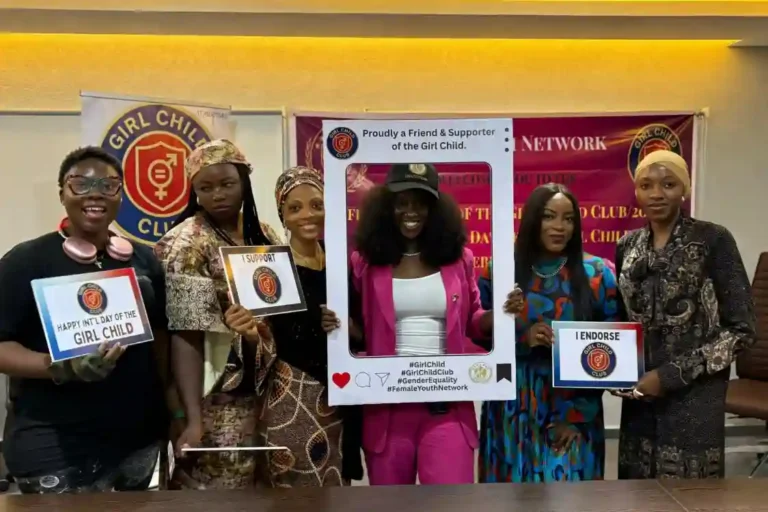
The Female Youth Network (FYN) has launched a nationwide empowerment initiative to commemorate the 2025 International Day of the Girl Child, with the goal of reaching over 250,000 Nigerian girls annually through school-based mentorship and leadership development programmes.

The initiative, unveiled in Abuja under the theme “Empowered Girls, Transformed Nation,” is known as the Girl Child Club (GCC). It is designed to equip girls with leadership, digital, climate, and entrepreneurial skills needed to thrive in the 21st century.

During the launch, Senator Ireti Heebah Kingibe, who represents the Federal Capital Territory (FCT), was named the Grand Matron and Chairperson of the Council of Matrons for the programme.

Speaking at the event, the founder and President of the Female Youth Network, Comrade Ebere Ebenezer, said the initiative is more than just a programme. “It is a movement to raise confident, creative, and courageous girls who will lead change across every sphere of life,” she stated.

Ebenezer explained that through the Council of Matrons, the network seeks to connect established women leaders with young girls in schools to provide mentorship, sponsorship, and advocacy. She noted that the Girl Child Club has already started in 30 senior secondary schools across the FCT with the approval of the FCT Secondary Education Board (FCT-SEB).

She added that plans are in place to extend the programme to junior secondary and primary schools under the FCT Universal Basic Education Board (UBEB) and later to all 110 Federal Unity Schools in collaboration with the Federal Ministry of Education. “With 25 girls per club unit and three units per educational level, the initiative targets more than 23,000 girls annually in its pilot phase, and over 250,000 girls nationwide upon full implementation,” Ebenezer said.

The organisation called on government agencies, development partners, private sector players, and philanthropists to support the expansion of the Girl Child Club through the adoption of club units and the provision of digital learning and climate education tools. “We are building a national legacy where empowered girls will become tomorrow’s lawmakers, innovators, and nation builders,” Ebenezer added.

The Female Youth Network commended the Director and Secretary of the FCT-SEB for providing institutional support and guidance, describing his leadership as key to the project’s success.

Acknowledging others who contributed to the initiative, the organisation mentioned Hon. Rachel Ese, a member of the Board of the North Central Development Commission; Hon. Tony Nwulu, Director General of the Youth in Parliament Forum; and Hon. Amb. Solomon Adodo, President of the National Youth Council of Nigeria (NYCN).

Others recognized include Comrade Abubakar Muhammed, Chairman-in-Council of the North Central Youth Council (NCYC); Comrade Oyefeso Blessing, President of Nigeria Youths in Politics; and Comrade O. H. Akor, Founder of the Climate Champions Club and Special Assistant on Climate Change and Youth Resilience to the NYCN President.

NELFUND tells schools to upload student details for 2025/2026 session

0

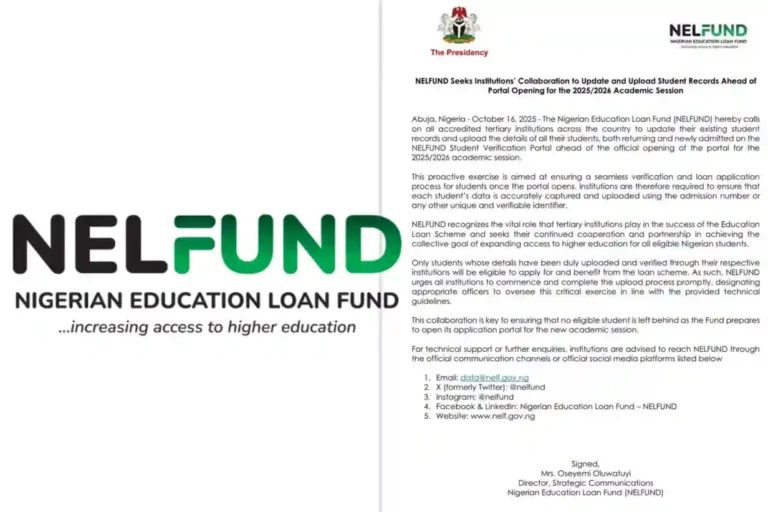
The Nigerian Education Loan Fund (NELFUND) has called on all accredited tertiary institutions across the country to update their existing student records and upload the details of both returning and newly admitted students on the NELFUND Student Verification Portal ahead of the official opening for the 2025/2026 academic session.

According to NELFUND, this proactive step is designed to ensure a smooth verification and loan application process once the portal opens. Institutions have been directed to make sure that each student’s data is correctly captured and uploaded using the admission number or another unique and verifiable identifier.

In a statement, the Fund emphasized the importance of institutional collaboration. “NELFUND recognizes the vital role that tertiary institutions play in the success of the Education Loan Scheme and seeks their continued cooperation and partnership in achieving the collective goal of expanding access to higher education for all eligible Nigerian students,” it stated.

The agency further noted that only students whose details have been duly uploaded and verified through their respective institutions will be eligible to apply for and benefit from the student loan scheme. It therefore urged all institutions to begin and complete the upload process promptly.

“Institutions are expected to designate appropriate officers to oversee this critical exercise in line with the provided technical guidelines,” NELFUND added.

The Fund stressed that this collaboration is key to ensuring that no eligible student is left behind as it prepares to open the student loan application portal for the new academic session.

Viral claims circulate on CDCFIB recruitment training exercise

0

Rumors have recently surfaced online regarding a supposed recruitment training exercise for the Civil Defence, Correctional, Fire and Immigration Services Board (CDCFIB). However, CDCFIB has nothing to do with the circulating information.

According to the claims being shared, “To be followed after the successful documentation exercise of newly recruited personnel, basic training will resume across all states formations of The Services and the Federal Capital Territory.”

The viral message further reads, “Prior to the nationwide training, all the recruits will be subjected to full documentation in batches at their designated Service headquarters, where their details including biometric data will be captured.”

Another part of the message claims, “At state commands level where they are to undergo basic mandatory training before proceeding for career courses, the new entrants are required to physically present themselves for the already pre-planned programme coordinated from the National Headquarters.”

It also states that “The harmonized basic training is expected to progress simultaneously for three months in different locations across the country where they will be exposed to regimental orientation and the mandates of the Corps. Thereafter, they will proceed in batches for more training at the various training colleges of the Service.”

“The CDCFIB expects the new recruits to show commitment and exhibit high level of discipline during the training as this would help them to sharpen their skills for the task ahead,” the statement added.

The unofficial message even boldly ends with “copied from CDCFIB,” which isn’t the case.

While many applicants are eagerly waiting for the official shortlist, it is important to ignore unverified news on social media. Genuine shortlisted candidates will be contacted directly through email and SMS with further instructions.

Plateau Gov signs MoU with Solutron for broadband project

0

Plateau State Governor, His Excellency Barr. Caleb Manasseh Mutfwang, has taken a significant step in driving digital transformation with the signing of a Memorandum of Understanding (MoU) between the Plateau State Government and Solutron Eastern Fibre Limited for the implementation of a state-wide Broadband Fibre Infrastructural Project.

The signing ceremony, held at the Twin Theatre, New Government House, Little Rayfield, marks a milestone in the State’s journey toward becoming a digitally connected and knowledge-driven society. Governor Mutfwang described the partnership as “a game changer and a homecoming for Plateau’s digital revolution,” emphasizing that the project will make Plateau one of Nigeria’s most connected and data-driven states while positioning it as an emerging ICT hub for youth entrepreneurs and innovators.

“With this new journey, you can now sit anywhere across the State and work in America,” the Governor said, stressing how the initiative will open global opportunities for Plateau citizens through high-speed digital connectivity. He appreciated Mr. Ron Chang for his support and contribution to the project, reaffirming his administration’s dedication to leveraging technology for inclusive growth and sustainable development.

“Every genuine son, daughter, and friend of Plateau has a duty to bring value home. If we redirect even 10% of the resources circulating elsewhere back to Plateau, our economy will experience an unimaginable transformation,” he added. Governor Mutfwang also urged all stakeholders to embrace the digital era as a key driver of development, productivity, and global competitiveness.

The 25-year Build, Operate, and Transfer (BOT) partnership will create a strong fibre optic network connecting ministries, departments, and agencies (MDAs), as well as schools, hospitals, and residential areas, with reliable broadband internet access. At the end of the operational period, the entire infrastructure will be handed over to the Plateau State Government.

Governor Mutfwang explained that the agreement would allow the State to map and redesign existing fibre routes for efficient planning and management, expand internet coverage to rural areas, and support his digital inclusion agenda. He noted that the project would also empower local Internet Service Providers (ISPs), promote tech entrepreneurship, and align with Nigeria’s National Broadband Plan and the “Dig Once” Policy aimed at promoting sustainable digital growth.

He described the signing of the MoU as “a turning point, not just in technology, but in the destiny of our people. It is a bold declaration that Plateau is ready to compete, connect, and create.”

Speaking at the event, the Director-General of the Plateau Information and Communication Technology Development Agency (PICTDA), Mr. Datong Dominic Gwaman, revealed that since Governor Mutfwang assumed office, fibre coverage in the State has expanded from 900 kilometers to 2,500 kilometers. He attributed this growth to “vision, collaboration, and leadership determined to bridge the digital divide.”

Mr. Gwaman highlighted that the Broadband Infrastructure Project will help establish Plateau as a major digital hub in Northern Nigeria, drawing investors, encouraging e-governance, and driving innovation in fields like telemedicine, smart security, and electronic traffic management. “When we improve connectivity, we don’t just increase Internet speed, we unlock economic possibilities,” he said. “From business process outsourcing to remote learning and smart governance, this project will power a new Plateau economy.”

Also present at the event, the Chief Operating Officer of Solutron Eastern Fibre Limited, Mr. Chris Eguaibor, expressed confidence in the success of the partnership, describing it as a move that will “open the doors to a connected, creative, and competitive Plateau.” He assured that the company is fully committed to transparency, innovation, and sustainable value creation throughout the implementation process.

When fully implemented, the Plateau State Broadband Infrastructure Project is expected to transform communication, governance, education, healthcare, and business operations across the State. It will mark the beginning of a new era of innovation, inclusion, and prosperity for Plateau citizens, supporting digital transformation and technological advancement in Nigeria.

ITF SUPA begins screening 15000 artisans in Plateau

0

The Industrial Training Fund (ITF) on Wednesday commenced the screening of 15,000 artisans in Plateau State under the Federal Government’s Skill-Up Artisans (SUPA) programme. The initiative aims to equip Nigerians with vocational and technical skills that can boost employment opportunities and promote economic growth.

The screening exercise, held at the ITF Vocational Training Centre in Jos, attracted thousands of applicants hoping to participate in the nationwide empowerment programme designed to enhance job creation and skill acquisition.

Speaking with journalists after addressing the artisans, the Director-General of the Industrial Training Fund, Dr. Afiz Ogun, said the screening process was essential to identifying genuine applicants and ensuring proper placement into suitable training centres.

“We want to screen the artisans. We do not know who they are or whether some of these applications were done by proxy,” Ogun explained, emphasizing the need for physical verification to maintain transparency in the exercise.

According to him, the Skill-Up Artisans programme provides training in 24 trade areas, including information and communications technology, tailoring, plumbing, electrical installation, and hospitality. He stated that the programme’s goal is to empower young Nigerians to become self-reliant and financially independent.

“We want to take as many people as possible off the streets and give them financial independence,” the ITF Director-General said. “For Plateau alone, we are screening 15,000 artisans within this period. We have our officers across all local governments of the state, and similar exercises are ongoing in other states of the federation.”

Ogun also pointed out that one of the major challenges facing the agency is the shortage of standard training centres across the country. He appealed to both the government and private individuals to invest in building modern facilities that can support technical and vocational training.

“One of our biggest challenges is the inadequate number of centres,” he said. “We are not going to onboard trainees to shops in markets or makeshift spaces. They will be trained in state-of-the-art facilities equipped with the right tools because they will be sitting for internationally recognised certification exams.”

He explained that the certifications to be obtained from the training would increase the employability and global competitiveness of Nigerian artisans.

Ogun, who was represented by the Director of Technical and Vocational Skills Training, Mrs. Nancy Ekong, urged state governments to establish at least three well-equipped training centres in their states to support the initiative.

“We are appealing to governments to help build quality training centres with the necessary equipment. If each state can provide at least three centres for key trades, it will make implementation easier,” Ekong said.

The screening exercise in Plateau is scheduled to last for two days. The Skill-Up Artisans programme is part of the Federal Government’s plan to empower citizens with practical skills, reduce unemployment, and drive inclusive economic development.