Home Blog Page 406

Ananse centre for design opens in Lagos to train 5000 creatives, create 50000 jobs

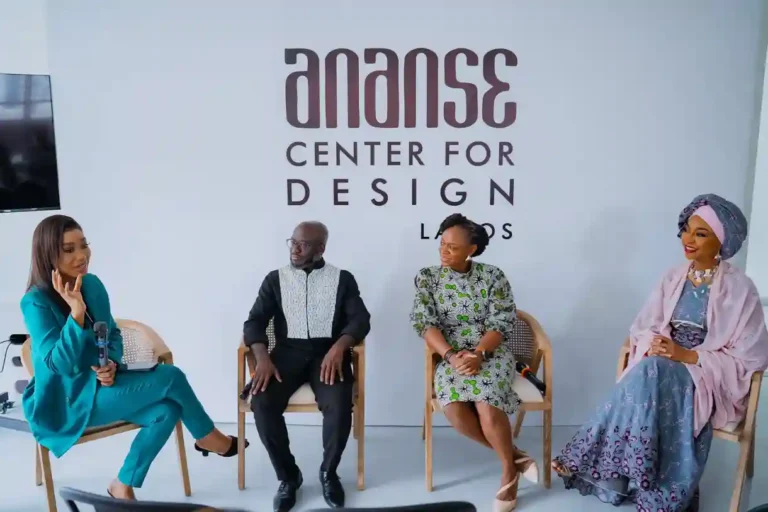
The Ananse Centre for Design has officially opened in Lagos with a strong focus on job creation, empowerment, and sustainability within Nigeria’s creative economy. The centre, located in the Lekki area, was inaugurated on Friday by the Minister of Art, Culture and Creative Economy, Hannatu Musawa.

The initiative, developed by Ananse in partnership with the Mastercard Foundation and the Federal Ministry of Art, Culture and Creative Economy, aims to empower more than 5,000 emerging creatives in fashion and design while creating access to 50,000 jobs. Seventy per cent of these opportunities are expected to benefit women.

According to the organisers, the Ananse Centre for Design Lagos will address critical gaps in Nigeria’s fashion industry and serve as a hub for creativity, skills development, and entrepreneurship. The centre will also promote innovation, inclusion, and sustainability through advanced training and global market access for local designers.

Speaking during the inauguration, the founder and Chief Executive Officer of Ananse, Samuel Mensah, described the launch as a step toward transforming Africa’s creative landscape. “The Ananse Centre for Design Lagos is more than a space; it is a catalyst for change. By combining training, infrastructure and global market access, we are giving thousands of young creatives, especially women, the chance to turn their talent into sustainable livelihoods. This launch marks an important step in building a future where African design thrives locally and globally,” Mensah said.

He explained that the initiative was created with affordability in mind to make training and access to equipment easier for emerging designers. “The centre is designed to be affordable for ordinary fashion creators who ordinarily don’t make a lot of money. So there are a couple of things that we’ve done. The first is that we’ve worked with partners like MasterCard Foundation to ensure that the key training and masterclasses that are offered there are free classes that are available to people who have limited resources. The second thing is that the training is also subsidised, so even when there is a fee, the fee is quite small relative to what you would pay ordinarily,” Mensah said.

He added that the model provides affordable access to high-end industrial machines. “The third thing about the model, which I think we’re pioneering, is the access to very sophisticated, advanced equipment at an hourly cost, so you don’t have to have the money to buy an expensive one. You can see with the industrial computerized embroidery machine, for example, that can do in a couple of minutes what it will take a human hand an entire day or two to do. A creative doesn’t have to have the resources for that, but they can have access to it at a fractional cost.”

The Country Director of the Mastercard Foundation’s Nigeria Programme, Rosy Fynn, said the organisation’s collaboration with Ananse was in line with its broader mission to support the creative industry and promote youth employment.

Fynn said, “Our partnership with Ananse and the unveiling of the Centre for Design Lagos reflects the Mastercard Foundation’s strategic commitment to the creative sector as a catalyst for youth opportunity. By bringing together training, infrastructure, and access to markets, the Centre creates pathways for young people, especially young women, to thrive, build sustainable livelihoods, and contribute meaningfully to inclusive economic growth.”

She further explained that Nigeria plays a central role in the foundation’s vision for job creation. “Our focus is to enable work opportunities for young people, and we anticipate that 10 million of those work opportunities will come from Nigeria, and the creative sector is absolutely central to that. So our goal is to partner with like-minded organisations such as Ananse, who are unlocking systemic barriers that exist in the lives of your average creatives, professionals—things like access to finance, the right skills, the right tools, market access, so that they can get their product on the global stage. Those are exactly the things that Ananse is unlocking,” Fynn said.

She added, “If you’ve had a chance to look at this centre, you will see world-class machines, world-class tools, and everything that a young creative needs to succeed on the global stage. So we’re super excited about this partnership, and are looking forward to seeing a centre like this in every state in Nigeria.”

Participants at the Ananse Centre for Design will have access to 22 courses offered under five key modules: Business Skills, Business Development, E-commerce, Marketing, and Product Development. The courses will be delivered both physically at the Lekki hub and virtually through live interactive sessions.

The Ministry of Art, Culture and Creative Economy has also pledged strong support for the project. The ministry signed a five-year memorandum of understanding with Ananse to expand the model across Nigeria.

Minister Hannatu Musawa said the initiative aligns with the federal government’s agenda to promote creativity and innovation. “The launch of the Ananse Centre for Design Lagos aligns with our commitment to advancing Nigeria’s creative economy. By investing in skills, facilities and global visibility for our designers, we are creating jobs supporting women and youth, and ensuring Nigerian creativity is recognised on the world stage. Our collaboration with Ananse will help scale this model across the country and secure lasting impact for the sector,” Musawa said.

She added that the centre would not only focus on creating jobs but also on improving the skills of Nigerian designers to make them more competitive. “When you’re talking about job creation, it’s not just about the job creation. It’s also about empowering those in the industry with the capacity that they need to really add value to their own community, to the country. Also, to the soft power. So, it’s about our expression as a people, the expression of our fashion. Ananse will give us that viability and that certification that is required for us to hit that soft power, and then at the very grassroots, to really absorb as many people into the job market,” she explained.

The launch also drew participation from key international and regional partners such as DHL, Ecobank, and the African Union, who are working to strengthen the connection between Nigerian design and global audiences.

Through the Ananse.com platform, Nigerian designers will gain access to a digital marketplace that integrates logistics and secure digital payment systems. This will enable them to showcase their products to international buyers while streamlining delivery and financial transactions.

In its statement ahead of the launch, the centre emphasised sustainability as a core value, focusing on the use of eco-friendly materials and low-carbon production techniques. “By reducing reliance on imports and building strong local production chains, the Centre aims to make Nigerian design not only competitive but environmentally responsible,” the statement read.

It also noted that the initiative could create significant economic impact. “Impact modelling indicates that the facility and its ecosystem could generate tens of thousands of direct and indirect jobs in the coming years, thereby boosting exports, small and medium-sized enterprises, and foreign exchange earnings,” the statement added.
Advertisement

Fidelity Bank launches She Leads program

Fidelity Bank Plc has launched a flagship programme called “She Leads” to celebrate and empower young girls across Nigeria in honour of the 2025 International Day of the Girl Child.

According to a statement by the bank’s media unit on Friday in Lagos, the initiative aims to create a platform for girls to showcase leadership, creativity, and confidence through mentorship sessions, debates, essay competitions, and healthcare interventions. The programme is open to girls in secondary schools nationwide and highlights Fidelity Bank’s commitment to promoting female-focused engagements that build stronger and more inclusive communities.

Speaking on the initiative, the Divisional Head, Product Development, Fidelity Bank Plc, Mr. Osita Ede, said empowering women and girls with the right skills and opportunities was vital to the nation’s growth. “The ‘She Leads’ initiative is one of the many ways we are nurturing the leaders of tomorrow by giving them a voice today,” he said.

Ede added, “This is going to be one of our most impactful investments in nation building. By providing young girls across Nigeria with the skills, knowledge and confidence to lead, we are paving the way for a more inclusive and sustainable future.”

The bank has invited schools across the country to nominate outstanding young girls for participation, with submissions open until October 14. Selected participants will receive mentorship, recognition, and personal development opportunities.

Interested schools and guardians are advised to visit https://bit.ly/FBInternationalGirlchildEvent for full details on participation and entry requirements.

The “She Leads” initiative aligns with global efforts to promote gender equality, women’s empowerment, and leadership development among young females.

Jigawa SUBEB shortlists 274 for CBT out of 1156 applicants

Over 1,156 candidates have applied for the 27 positions of Local Government Education Secretary in Jigawa State, according to the State Universal Basic Education Board (SUBEB). The chairman of the board, Professor Haruna Musa, disclosed this on Friday, adding that the Computer-Based Test (CBT) for the recruitment exercise will take place at the Federal University, Dutse.

Professor Musa explained that the online recruitment portal was opened for applicants across the 27 local government areas in Jigawa State. He revealed that the board received a total of 1,156 applications during the process, but only 274 candidates were shortlisted to participate in the CBT examination.

He said the initiative aims to ensure the appointment of competent and capable education secretaries who can drive positive change in the state’s education sector. The chairman noted that the board’s decision is part of ongoing efforts to improve basic education management and service delivery.

Professor Musa had earlier criticized some education secretaries for negligence, saying it led to teacher absenteeism and poor learning outcomes in schools.

Akwa Ibom unveils cbt centre for civil service recruitment

Akwa Ibom State Governor, Pastor Umo Eno, has reaffirmed his administration’s commitment to digitizing the State’s public service as he unveiled the deployment of Computer-Based Test (CBT) technology in the forthcoming recruitment exercise.

Governor Eno made this known during an inspection visit to the CBT Centre at the Idongesit Nkanga Secretariat on Friday, October 10, 2025, where he confirmed the readiness of the facility. According to him, the centre has the capacity to accommodate up to 2,000 candidates per day for the digitized aptitude test.

He explained that the introduction of the CBT system in the civil service recruitment process is aimed at promoting merit, transparency, and efficiency while eliminating the influence of godfatherism in the system. “The Civil Service is the engine room of governance. The quality of people we bring into the service in this 21st century matters. The world has even moved to AI now, so we need people who at least understand basic computing to the extent that they can take an exam.

“This system will also eliminate godfatherism. People should have confidence that they got into the service by merit—by passing the required exams. We’re in the 21st century, and that’s the way it should be,” Governor Eno stated.

The Head of Civil Service, Elder Effiong Essien, who accompanied the Governor during the inspection, praised his commitment to institutionalizing e-governance in Akwa Ibom State. He noted that prospective candidates would be given the opportunity to familiarize themselves with the digital platform before the actual test, which is scheduled to take place in ten days.

Also speaking, the Commissioner for Science and Digital Economy, Dr. Frank Ekpenyong, assured that the CBT Centre is fully equipped with digitally integrated systems capable of conducting up to 2,000 tests daily. He added that the facility was developed in line with the Governor’s vision to use technology to ensure transparency and merit-based recruitment into the State Civil Service.

Governor Eno’s initiative represents a major milestone in his administration’s effort to modernize the public service through digital transformation, further consolidating his commitment to the ARISE Agenda pillars of governance, innovation, and inclusivity.

Claim circulates of 1785 shortlisted by state for NCS superintendents cbt

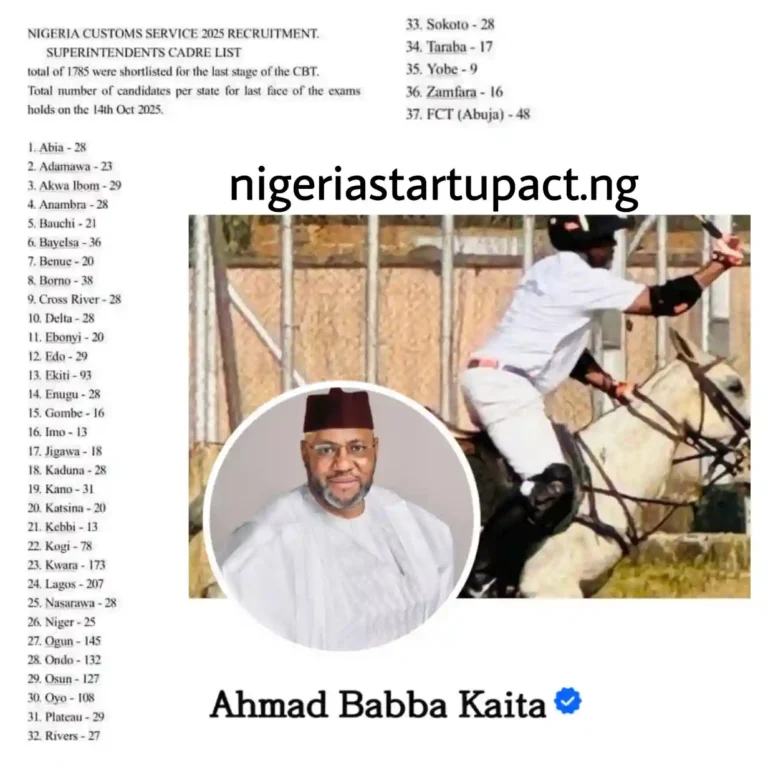
There is a circulating report claiming that the Nigeria Customs Service (NCS) Superintendents Cadre List has a total of 1,785 candidates shortlisted for the final stage of the Computer-Based Test (CBT).

A verified Facebook account belonging to Senator Ahmad Babba Kaita made this claim, stating that the NCS Superintendents Cadre List includes the shortlisted applicants from each state. According to him, “This is the Nigeria Customs Service 2025 recruitment Superintendents Cadre list. Total number of 1,785 were shortlisted for the CBT. Only Lagos has 207 and Kano State has 31.”

The post also stated that “Superintendents Cadre List total of 1,785 were shortlisted for the last stage of the CBT. Total number of candidates per state for the last phase of the exams holds on the 14th Oct 2025.”

The post detailed the number of shortlisted candidates per state as follows: Abia – 28, Adamawa – 23, Akwa Ibom – 29, Anambra – 28, Bauchi – 21, Bayelsa – 36, Benue – 20, Borno – 38, Cross River – 28, Delta – 28, Ebonyi – 20, Edo – 29, Ekiti – 93, Enugu – 28, Gombe – 16, Imo – 13, Jigawa – 18, Kaduna – 28, Kano – 31, Katsina – 20, Kebbi – 13, Kogi – 78, Kwara – 173, Lagos – 207, Nasarawa – 28, Niger – 25, Ogun – 145, Ondo – 132, Osun – 127, Oyo – 108, Plateau – 29, Rivers – 27, Sokoto – 28, Taraba – 17, Yobe – 9, Zamfara – 16, and FCT (Abuja) – 48.

However, the Nigeria Customs Service has not officially acknowledged or verified this claim, and the public is advised to treat the information with caution as it may not reflect the actual recruitment figures.

Michael Okpara University Umudike announces recruitment

0

Michael Okpara University of Agriculture, Umudike (MOUAU), has announced vacancies for recruitment for both teaching and non-teaching positions through an internal and external advertisement. The management stated that applications are invited from suitably qualified candidates to fill the available positions across various colleges in the institution.

The teaching positions advertised include Professor, Associate Professor, Senior Lecturer, Lecturer I, Lecturer II, Assistant Lecturer, and Graduate Assistant. These positions are spread across the College of Physical and Applied Science (COLPAS), College of Education (COED), College of Agric Economics, Rural Sociology and Extension (CAERSE), College of Animal Science and Animal Production (CASAP), College of Applied Food Sciences and Tourism, College of Crop and Soil Science (CCSS), College of Engineering and Engineering Technology (CEET), School of General Studies (SGS), College of Management Sciences (COLMAS), College of Natural Resources and Environmental Management (CNREM), College of Natural Sciences (COLNAS), and the College of Veterinary Medicine.

Non-teaching positions available include Confidential Secretary, Administrative Assistant, Administrative Officer, Higher Executive Officer, Accountant I, Accountant II, Data Processing Officer/Senior Secretarial Assistant I, Programmer/System Analyst, Senior Porter, Medical Officer, Veterinary Officer, Matron/Principal Nursing Superintendent, Medical Records Technician I, Medical Laboratory Scientist II, and Pharmacist I.

The general requirements state that candidates for academic positions must possess a Ph.D in the relevant field, evidence of academic leadership and PhD supervision, adequate scholarly publications, and years of teaching or research experience depending on the level being applied for. For non-academic positions, the institution requires good first degrees with a minimum of Second Class Honours, Master’s degrees where applicable, NYSC discharge or exemption certificates, post-qualification work experience, and professional registrations with relevant regulatory bodies. ICT proficiency is also emphasized.

Applicants for medical and allied health roles must provide evidence of one-year housemanship or internship and full registration with relevant professional councils and boards such as NMCN, VCN, MRTB, MLSCN, ODORBN, and others.

The method of application requires interested candidates to submit their applications through career.mouau.edu.ng with detailed Curriculum Vitae and other documents. The CV should include full name, date and place of birth, state of origin, nationality, permanent and current addresses, marital status, number of children, institutions attended, qualifications, work experience, community service, administrative experience, publications, and names of three referees.

The management added, “Applicants should also indicate in their Curriculum Vitae any capacity and extra training they have undergone in their career.”

The advertisement further noted that the closing date for submission of applications is three weeks from Friday, October 10, 2025.

Federal Medical Centre Bida announces recruitment

0

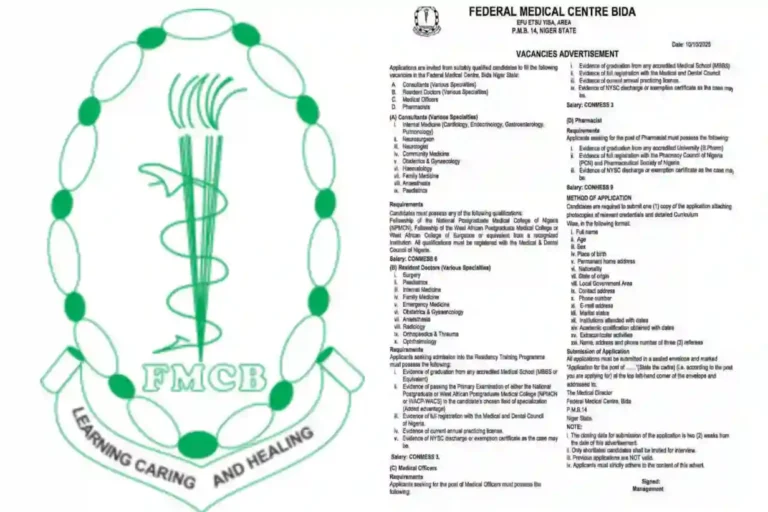
Federal Medical Centre Bida, Niger State, has announced the opening of new vacancies for recruitment of qualified medical professionals to join its healthcare team. In a statement released by the hospital management, applications are now being invited from suitable candidates for several positions.

According to the notice, “Applications are invited from suitably qualified candidates to fill the following vacancies in the Federal Medical Centre, Bida, Niger State.” The available positions include Consultants in various specialties, Resident Doctors, Medical Officers, and Pharmacists.

The hospital outlined specific general requirements for each category of applicants. For Consultants, candidates must possess the Fellowship of the National Postgraduate Medical College of Nigeria (NPMCN), Fellowship of the West African Postgraduate Medical College or the West African College of Surgeons, or equivalent qualifications from recognized institutions. It further stated that all qualifications must be registered with the Medical and Dental Council of Nigeria.

For those applying for the Residency Training Programme, the statement emphasized that candidates must provide evidence of graduation from any accredited medical school with an MBBS or equivalent degree. They must also present proof of passing the Primary Examination of either the National Postgraduate Medical College or the West African Postgraduate Medical College in their chosen field of specialization, which serves as an added advantage.

Additionally, applicants must show evidence of full registration with the Medical and Dental Council of Nigeria, a current annual practicing license, and either an NYSC discharge or exemption certificate. For pharmacists, the requirements include a degree in Pharmacy (B.Pharm), full registration with the Pharmacy Council of Nigeria (PCN), and membership in the Pharmaceutical Society of Nigeria (PSN).

The management advised all applicants to submit one copy of their application along with photocopies of relevant credentials and a detailed Curriculum Vitae. The CV should include personal information such as full name, age, sex, place of birth, contact address, phone number, and details of academic qualifications.

“All applications must be submitted in a sealed envelope and marked ‘Application for the post of…’ at the top left-hand corner of the envelope,” the notice stated. It added that applications should be addressed to the Medical Director, Federal Medical Centre, Bida, P.M.B.14, Niger State.

The closing date for submission is two weeks from the date of the advertisement, and only shortlisted candidates will be invited for an interview.

Nigerian Army opens recruitment for SSC course 49/2026

The Nigerian Army has officially announced the opening of applications for the Short Service Combatant Commission (SSC) Course 49/2026. According to the Army authorities, eligible Nigerians are invited to apply for commission as officers through the SSC program. The application is open to both civilians and serving military personnel who meet the required qualifications.

In a statement released by the Nigerian Army, the recruitment exercise is aimed at strengthening the military’s combat readiness and providing opportunities for qualified Nigerians to serve their country. “Applications are invited from eligible Nigerians for commission into the Nigerian Army as Short Service Combatant Commission officers,” the statement read.

The Army outlined that interested applicants must be citizens of Nigeria by birth and aged between 23 and 27 years by January 31, 2026. All candidates must be medically, mentally, and physically fit. The Army also noted that every applicant must be recommended by at least two recognized referees, who could be a Local Government Chairman or Secretary, an officer of the Armed Forces not below the rank of Lieutenant Colonel or its equivalent, or an Assistant Commissioner of Police and above.

Applicants are also expected to submit a letter of attestation from their former institutions. Minimum height requirements are 1.68 meters for males and 1.65 meters for females. The Army emphasized that no candidate should have been convicted by any court of law or have any pending case. Serving military personnel must be recommended by their Commanding Officer or Commander.

Educationally, candidates must possess at least a first degree with not less than Second Class Lower Division or an HND with Lower Credit in Arts, Sciences, or Humanities from an accredited institution. Only tertiary academic credentials obtained from 2017 to date will be accepted.

Applicants must have valid birth and state of origin certificates and present an NYSC discharge or exemption certificate, except serving military personnel. The Army further warned that “candidates must not have any body inscriptions or tattoos and must not belong to any cult, secret society, or fraternity.”

Applications are to be made online free of charge from Thursday, October 9, 2025, to Wednesday, November 12, 2025. Interested Nigerians should visit the official recruitment portal at recruitment.army.mil.ng and select the SSC option to apply.

Gov Oyebanji presents N415.57bn 2026 budget to Ekiti Assembly

0

Ekiti State Governor, Mr. Biodun Oyebanji, on Friday presented a budget estimate of N415.57 billion for the 2026 fiscal year to the Ekiti State House of Assembly. The budget, titled “Budget of Impactful Governance,” aims to consolidate the achievements of his administration over the last three years and advance key projects across the state.

The 2026 budget proposal comprises a Recurrent Expenditure of N221.87 billion, representing 53 percent of the total budget size, and a Capital Expenditure of N193.70 billion, which accounts for 46 percent. The proposed budget represents an increase of about 11 percent compared to the approved 2025 budget of N375.79 billion, which had a Recurrent Expenditure of N252.15 billion and a Capital Expenditure of N104.51 billion.

Presenting the budget during a plenary session at the Old Assembly Complex in Ado-Ekiti, Governor Oyebanji explained that the 2026 fiscal plan was designed to complete all ongoing infrastructural development projects. He said the new budget would also focus on agriculture, wealth creation, and improving the welfare of citizens, aligning with the Shared Prosperity agenda of his administration.

According to the Governor, the substantial investment in agriculture and the related value chain is targeted at generating employment, stabilizing food prices, ensuring food security, and boosting the sector’s contribution to the state’s Gross Domestic Product (GDP). He noted that the state’s revenue sources for funding the budget would include Federal Allocation, Value Added Tax (VAT), internally generated revenue from Ministries, Departments and Agencies (MDAs), tertiary institutions, international donor agencies, and other income sources.

Governor Oyebanji stated that the 2026 Budget was the result of extensive consultations across the three senatorial districts of the state. He explained that during the statewide town hall meetings, traditional rulers, community representatives, civil society organizations, and other stakeholders made significant inputs that shaped the proposal.

He emphasized that the new budget aligns with the State Development Plan (2021–2050), the Medium Term Expenditure Framework (MTEF) for 2026–2028, and the Six Pillars of his Administration. The budget was also prepared in accordance with the National Chart of Accounts (NCoA) Template, as agreed upon by the sub-nationals through the Nigerian Governors’ Forum (NGF).

Governor Oyebanji reaffirmed his administration’s commitment to fiscal discipline and transparency in implementing the proposed budget. He said, “Distinguished Honourable members, without any fear of contradiction, I make bold to say that our Administration has demonstrated a high level of fiscal discipline and prudence in the utilization of our commonwealth to implement laudable developmental projects.”

He added, “These projects are not only impactful, they will set our State on the path of realizing the Shared Prosperity vision. I, therefore, affirm my commitment to continued fiscal discipline, transparency and accountability.”

Oyebanji stressed that transparency and accountability remain central to governance in Ekiti State under his leadership. “To further promote good governance, we have designed a framework for effective policy formulation and implementation that would further boost the economy of our dear State. We have also institutionalized several fiscal reforms at the State and the Local Government levels for quality service delivery. These reforms are already paying off,” he said.

The Governor also appreciated President Bola Ahmed Tinubu for his continued support to the government and people of Ekiti State. He said the President’s interventions had been instrumental in alleviating poverty and supporting the delivery of campaign promises. “I express my profound gratitude to President Bola Ahmed Tinubu for his very strong support to the government and the good people of Ekiti State. This support has translated to several interventions and has been very helpful in the quest to alleviate poverty in the State,” he stated.

Reviewing the performance of the 2025 budget, Oyebanji expressed satisfaction with its implementation, noting that several projects were executed across the state. He said, “Our government has ensured good implementation of the 2025 Budget with several projects and programmes being executed, which include construction and rehabilitation of several roads, renovation of eight general hospitals, among others.”

Speaking on the floor of the Assembly, the Speaker of the Ekiti State House of Assembly, Rt. Hon. Adeoye Aribasoye, commended the Governor for presenting the 2026 Appropriation Bill and assured that lawmakers would handle it with diligence and fairness.

He said, “The lawmakers will deliberate on the budget with diligence, patriotism, and impartiality to ensure that the 2026 Appropriation Bill reflects the aspirations of the generality of Ekiti people.”

The Speaker urged his colleagues to approach the budget review with integrity and shared purpose. “With united effort, we can sustain the momentum of reforms, catalyze inclusive growth, and build an Ekiti State where opportunity is within reach for all,” he said. He also called on heads of MDAs to be ready to explain their budgetary provisions when invited.

Rt. Hon. Aribasoye reaffirmed the Assembly’s commitment to financial accountability. “Every naira will be accounted for and directed to priority sectors that yield maximum public benefit,” he assured.

The presentation of the budget was attended by top government officials, including the Deputy Governor, Chief (Mrs.) Monisade Afuye; Secretary to the State Government, Prof. Habibat Adubiaro; Head of Service, Dr. Folakemi Olomojobi; Chief of Staff, Mr. Oyeniyi Adebayo; members of the State Executive Council; heads of MDAs; tertiary institution leaders; traditional rulers; heads of security agencies; and political leaders.

FG denies ending revenue agencies cost of collection deductions

0

The Federal Ministry of Finance has dismissed recent media reports claiming that the Federal Government has stopped revenue-generating agencies such as the Federal Inland Revenue Service (FIRS), the Nigerian Upstream Petroleum Regulatory Commission (NUPRC), and the Nigeria Customs Service (NCS) from deducting their cost of collection at source.

In an official statement, the Ministry described such reports as inaccurate and misleading, emphasizing that the policy on cost of collection remains unchanged.

“The Federal Ministry of Finance wishes to address recent media reports suggesting that the Federal Government has discontinued the practice of allowing revenue-generating agencies such as the Federal Inland Revenue Service (FIRS), the Nigerian Upstream Petroleum Regulatory Commission (NUPRC), and the Nigeria Customs Service (NCS) to deduct their cost of collection at source. We categorically state that these reports are inaccurate and misleading,” the statement read.

According to the Ministry, at no point during his remarks at the Nigeria Development Update (NDU) programme hosted by the World Bank did the Honourable Minister of Finance and Coordinating Minister of the Economy, Mr. Wale Edun, announce or imply any change to the existing policy.

“For the avoidance of doubt, there has been no policy change regarding the deduction of costs of collection at source by revenue-generating agencies. The current framework remains in effect,” the Ministry added.

The statement clarified that the ongoing discussions are only part of policy reviews directed by President Bola Ahmed Tinubu to assess the cost of collection structure. These reviews are aimed at enhancing transparency, efficiency, and value-for-money in public financial management. It further explained that no final decision has been made on the matter.

“The Ministry assures all stakeholders and the public that revenue operations continue uninterrupted and that any future adjustments will be guided by due process, stakeholder engagement, and clear communication,” it said.

The Ministry also urged media outlets to verify information from official sources before publication to avoid unnecessary confusion. It appreciated the support of Nigerians, reaffirming its commitment to building a stronger, more transparent, and sustainable economy.