Home Blog Page 408

Dangote Refinery denies importing high-sulphur petrol from UK

0

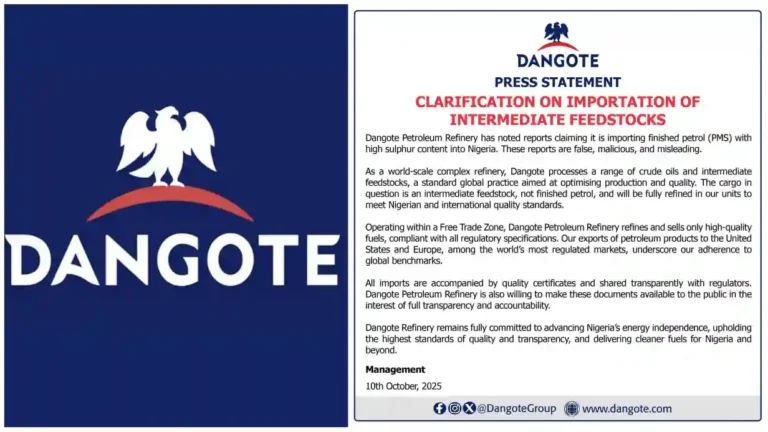
Dangote Petroleum Refinery has dismissed recent media claims that it is importing finished petrol with high sulphur content into Nigeria, describing the reports as false, malicious, and misleading. The clarification follows a report by Sahara Reporters which alleged that the refinery imported dirty fuel from the United Kingdom with sulphur content thirteen times higher than Nigeria’s approved 50 parts per million (ppm) limit.

In its official statement, Dangote Petroleum Refinery explained that the cargo in question was not finished petrol but an intermediate feedstock, a standard input used by refineries across the world for production optimisation. The company emphasised that the feedstock will be fully refined in its units to meet both Nigerian and international fuel quality standards.

“As a world-scale complex refinery, Dangote processes a range of crude oils and intermediate feedstocks, which is standard global practice aimed at optimising production and quality,” the statement read. “The cargo in question is an intermediate feedstock, not finished petrol, and will be fully refined in our units to meet Nigerian and international quality standards.”

Sahara Reporters had earlier published an exclusive story alleging that the refinery imported Premium Motor Spirit (PMS) with sulphur content far exceeding Nigeria’s approved environmental standard. The report cited an unnamed industry source who claimed that a vessel, MT Clearocean Mary, was scheduled to arrive at the refinery’s offshore facility on October 9, 2025, with about 37,000 metric tonnes (49.6 million litres) of petrol containing 690ppm sulphur.

The report also alleged that the product was loaded from the Phillips 66 Refinery in Immingham, United Kingdom, and supported this with a Certificate of Quality indicating that the consignment contained high-sulphur catalytic gasoline. The document, signed by a representative of the Humber Refinery’s quality-assurance department, stated that the fuel had characteristics consistent with refinery-grade gasoline, including a Research Octane Number of 92.3, a Motor Octane Number of 79.3, and a density of 0.7375 kilograms per litre. However, it recorded a sulphur concentration of 690ppm, well above the 50ppm limit enforced by the Nigerian Midstream and Downstream Petroleum Regulatory Authority (NMDPRA).

Responding to these claims, Dangote Refinery maintained that it operates within a Free Trade Zone and only refines and sells high-quality fuels compliant with all regulatory standards. The company added that its exports of petroleum products to the United States and Europe, two of the most strictly regulated fuel markets, prove its adherence to global benchmarks.

“All imports are accompanied by quality certificates and shared transparently with regulators,” the refinery said. “We are also willing to make these documents available to the public in the interest of full transparency and accountability.”

Dangote Refinery reaffirmed its commitment to Nigeria’s energy independence and stated that it remains focused on producing cleaner fuels for both domestic and international markets. The company reiterated that its operations uphold the highest standards of environmental safety, transparency, and product quality.

Industry sources had alleged that the refinery’s Fluid Catalytic Cracking (FCC) unit was not operational and claimed that the company was selling imported fuel as locally refined petrol. However, Dangote Group dismissed these allegations, insisting that its refining process complies with global environmental and quality standards.

Dangote Refinery was inaugurated in May 2023 and has a capacity of 650,000 barrels per day. The facility, located in the Lekki Free Trade Zone, was built to reduce Nigeria’s dependence on imported refined products and boost energy security.

The refinery stated that it remains committed to producing petrol that meets the 50ppm sulphur specification in line with Nigeria’s “Clean Fuels” initiative under the Petroleum Industry Act. It also assured Nigerians that no product will be released for sale until it meets both domestic and international quality requirements.

“We remain fully committed to advancing Nigeria’s energy independence, upholding the highest standards of quality and transparency, and delivering cleaner fuels for Nigeria and beyond,” the statement concluded.
Advertisement

YCI launches vision 2035 AI-athon to train Nigerian girls

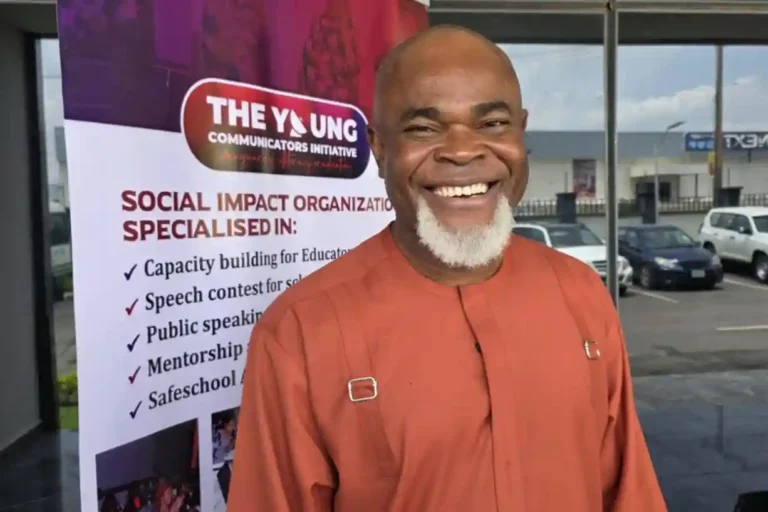
As Nigeria joined the rest of the world to mark the International Day of the Girl Child, the Young Communicators Initiative (YCI) launched the Vision 2035 AI-Athon in Abuja. The event served as an inter-school digital leadHERship summit and speech contest designed to nurture young female leaders for an AI-driven future.

The summit, themed “Effective LeadHERship in a Digital Age for National Development,” brought together schoolgirls from both public and private schools to enhance their leadership capacity and digital literacy skills. It aimed to encourage young girls to embrace technology as a tool for development and leadership growth in Nigeria.

Representing the Deputy Commissioner of the British High Commission, Senior Programme Manager Ms Na’anchin Muhammad described investing in girls as a direct investment in the nation’s progress. “For us, investing in girls is investing in Nigeria’s development. Technology opens opportunities to contribute to nation-building,” she said.

She encouraged the participants to aim higher and be open to possibilities in the digital space. “We have so many goals, that there’s a national plan, there are the SDGs, you know, and other things, and this particular event, especially the AI and digital space, I believe it’s an opportunity to just open the minds of these girls, and help them to see what they can do, to contribute to the national development of Nigeria. So, it’s really great,” she added.

Dr Chikodi Onyemerela, Director of Programmes and Chairman of the Board, British Council Nigeria, described the YCI summit as “a winning model by an indigenous NGO.” He called for stronger collaboration between government and civil society to increase its reach. “This is a very interesting model, harvesting young girls who are prefects in their respective schools. Because they have been charged with leadership responsibilities early, chances are that they will be leaders at the university level, at NYSC, and even nationally.”

He further stressed the importance of corporate support for initiatives that promote girls’ leadership and development. “Being a girl doesn’t connote limitation. Anecdotally, girls lead better because the audacity to commit certain things is rare among them. I call for corporate support to NGOs of this nature. I don’t know how they are funding it, but I sense a genuine interest in developing the girl child,” he said.

Mrs Adesola Oyinloye-Ndu, Special Adviser to the Chairman of the Federal Inland Revenue Service (FIRS) on Customer Centricity, encouraged confidence and equality in child upbringing. “I’m a mentor and anti-bullying advocate. Once you’re confident, the sky is the starting point. The girl child must believe she can do it,” she said.

Reflecting on education and determination, she added, “Education accessibility and affordability need rethinking, but determination matters most. We must bring back the values of ‘I can do it.’ Raise every child as a human being first; gender is secondary.”

Chinenye Priscilla Anaemena, Founder of YCI, explained that the Vision 2035 AI-Athon was conceived to bridge the gender gap in leadership and digital inclusion. “It’s high time our girls were prepared to bridge that gap. We’re not just training them; we’re facilitating learning in artificial intelligence,” she said.

She noted that the participants would go through mentorship after the summit to design and implement community projects. “They’ll conceptualise leadership frameworks and community development projects, like ‘Paint to Protect,’ which promotes pedestrian safety. We won’t put words in their mouths; these are their own ideas,” she stated.

On plans to expand the programme, Anaemena said, “This is the maiden edition. We’re collaborating with the FCT Secondary Education Board and UBEC to replicate it nationwide. We have participants from underserved areas because leadership opportunity shouldn’t be for the privileged few.”

She concluded her remarks with a passionate appeal: “Do not forget; train a woman, you train a nation. If we must move female representation from 4.3% to 15 or 20%, we must start with the girl child.”

Mrs Funmilayo Kayode, Director of Mobilisation and Sensitisation at the FCT Secondary Education Board, said that partnering with YCI reflects the agency’s dedication to empowering girls through education. “Knowledge is power. What these girls are getting here today can take them to greater heights,” she said.

Recalling her experience as a former school principal, she highlighted how girls often excel when given opportunities. “When we allowed democratic elections for prefects, 90% of class captains turned out to be girls. We encouraged them, and 80% of leadership positions were taken by girls. It shows what happens when they’re given a chance,” she explained.

However, she also noted the need to maintain balance in gender-focused programmes. “This focus on girls is yielding fruit, but boys too need support. Many come from single-mother homes, and we must balance our advocacy,” she cautioned.

Anuli Aniebo, Founder and Executive Director of Heir Women Hub, advised the girls to embrace inclusion and resilience while facing societal challenges. “While you do this for girls, remember — it’s for all of us. There are structural and systemic barriers, but don’t let them get to you,” she said.

She encouraged boldness and determination. “There is a place for you. Move from being uncomfortable. The world won’t give it to you because you’re a girl; you must show up and work hard. Intelligence is your best tool,” she advised.

On exploring opportunities in artificial intelligence, Aniebo added, “Push yourself past the limits of what this country provides. The AI era is yours. You can create the space and move it forward. The next global celebration could be yours.”

For the young participants, the summit was an eye-opening experience filled with motivation and empowerment.

Thirteen-year-old Oluwaoloni Gbadamosi from Nigerian Tulip International Colleges said, “It makes me feel seen as a girl child. Sometimes it’s hard dealing with stereotypes, but this programme shows me I’m not alone. I can do this.”

Halima Adeola Akanbi, 15, from Government Secondary School, Mabushi, shared a similar experience. “Most people think girls can’t do much, but this programme breaks barriers. It makes me feel I can do anything. AI helps me with schoolwork and assignments. This AI-thon is a big deal to me,” she said.

For Aisha Sadiq Yari, 15, from Fariah Academy, the event sparked creativity and ambition. “It empowers young girls like me in the AI world, and it helps us foresee our future, how it’s going to be, and how things are going to work out. I want to build an app for young girls like us, growing up,” she said.

She added, “It will help young girls like us be what we want to be, help us choose our future career paths because I’ve had a really bumpy journey choosing a career for myself, so I don’t want that to happen for other people growing up.”

NCS releases superintendent shortlisted candidates, exam slip printing link

The Nigeria Customs Service (NCS) has released the list of shortlisted candidates for the Superintendent cadre, and successful applicants can now print their Examination Slip.

According to a previous report by Nigeriastartupact.ng, the shortlisted Superintendent Cadre applicants qualify for the Final Computer-Based Test (CBT) scheduled for Tuesday, 14th October 2025, across the six geopolitical zones in Nigeria.

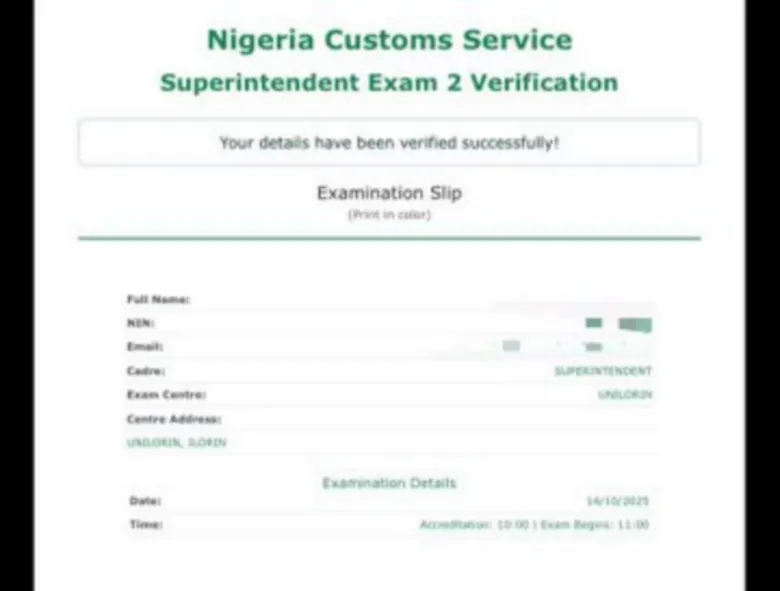
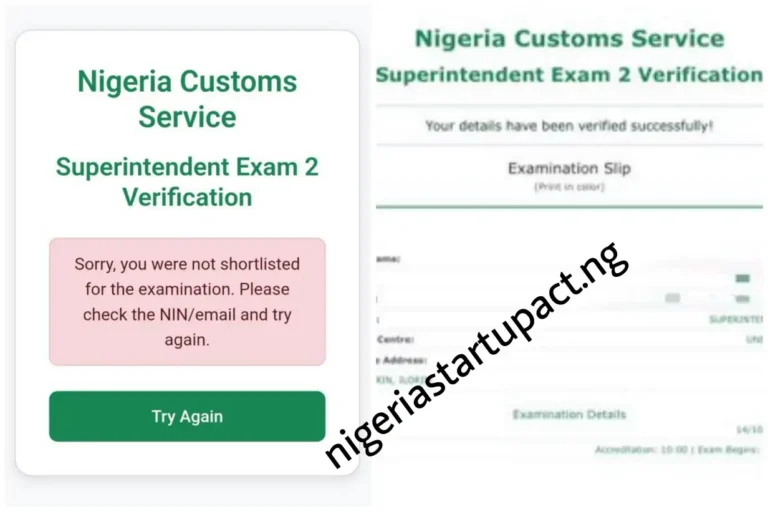
On the NCS dashboard, the message for successful candidates reads:
“Nigeria Customs Service
Superintendent Exam 2 Verification

Your details have been verified successfully!

Examination Slip
(Print in color)

Full Name:
NIN:
Email:
Cadre: SUPERINTENDENT
Exam Centre:
Centre Address:

Examination Details
Date: 14/10/2025
Time: Accreditation: 10:00 | Exam Begins: 11:00.”

Successful candidates are advised to print their examination slip via updates.customs.gov.ng. Those not shortlisted will receive the message, “Sorry, you were not shortlisted for the examination. Please check the NIN/email and try again.”

Attached below is the screenshot of shortlisted candidate:

Petty traders grant support programme circulates without verification

0

A new initiative called the Petty Traders Grant Support Programme has been trending on social media from October to December 2025. However, based on all its claims and available details, this appears not to be a legitimate grant.

The unverifiable scheme is circulating widely online, claiming to support petty traders across Nigeria. Authorities and observers have advised individuals to be cautious, as there is no credible source confirming the authenticity of this grant.

According to the claims shared online, the Petty Traders Grant Support Programme is said to be “a community-driven initiative designed to empower aspiring and existing small-scale business owners.” The organizers claim that the grant offers financial assistance to individuals who need low start-up capital for petty trading, such as buying and selling goods or offering basic services. It also claims that existing traders can access additional funding to strengthen and expand their businesses.

The alleged grant reportedly “provides seed capital between ₦10,000 and ₦100,000 to help petty traders generate sustainable income.” It further states that “no business registration is required, and the process is simple with minimal documentation.” The programme claims to be open to all Nigerian residents within a required age bracket who wish to apply.

Another claim shared online says that the grant is open to both intending entrepreneurs and existing business owners who need recapitalization or financial support to grow their enterprises. It allegedly supports individuals to start or grow a small business, specifically those requiring little start-up capital.

The stated requirements include being between 18 and 55 years old, possessing a valid National Identification Number (NIN Slip), providing one contact person, having a verifiable residential address, and maintaining a valid 10-digit bank account number. Applicants are also required to reside in Nigeria and submit a duly completed application form.

The link circulating online is bit.ly/PettyTradersGrant, with a stated deadline of December 19, 2025. Nigerians are urged to remain cautious as authorities continue to monitor the claims and intentions behind this so-called support grant.

Edo state civil service commission opens 2025 recruitment portal

Edo State Civil Service Commission (CSC) has announced the commencement of its 2025 recruitment exercise, calling on suitably qualified candidates to apply for available positions within the state civil service.

According to the Commission, the recruitment process is open to individuals who meet the academic and professional qualifications for the advertised roles. The announcement stated, “Applications are hereby invited from suitably qualified candidates to fill the following vacancies in the Edo State Civil Service. Candidates for the posts must possess the required qualifications, experience, and skills specified below.”

The Commission listed the general requirements, noting that applicants must possess the minimum academic qualifications for each role. Degrees not lower than Second Class (Lower Division) are eligible for Grade Level 08 positions.

In a statement signed by the Chairman, Civil Service Commission, Benin City, Sam Oko-Ose, mni, applicants were reminded to apply for only one position. “Candidates shall apply for only one (1) position as multiple applications will result in disqualification,” the statement read.

Positions available include Agricultural Officer II, GL08, which requires a first degree in Agriculture, Agricultural Science, Agricultural Economics, Horticulture, Crop Science, or Crop Production from a recognized university. Also open is the position of Community Development Officer II, GL08, requiring a first degree in Social Work, Home Economics, or any of the Social Sciences or related subjects.

The Commission emphasized that the recruitment process is free and fair. “Edo State Government does not require candidates to make any payments to any person or organization. Equal opportunity is guaranteed for all candidates,” it stated.

Interested candidates are to apply through the official recruitment portal at csc.edostate.gov.ng within three weeks from the date of publication.

NCS sets final cbt exam date for superintendent cadre applicants

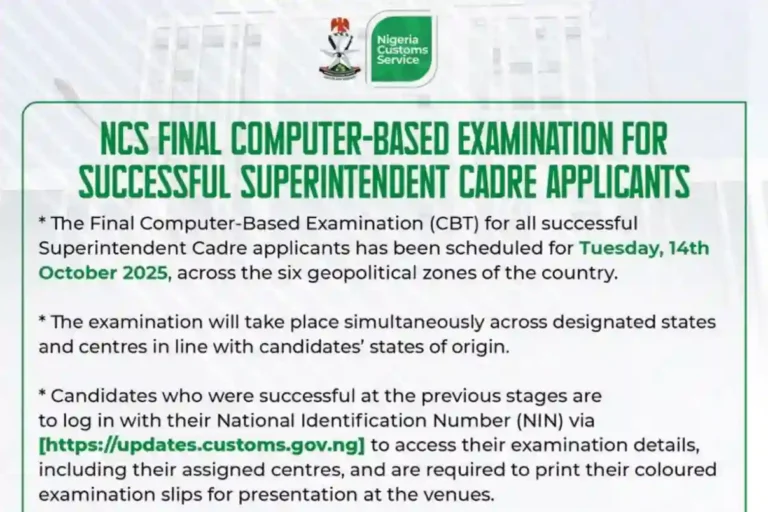
NCS final computer-based examination for successful Superintendent Cadre applicants has been scheduled for Tuesday, 14th October 2025, across the six geopolitical zones of the country. The Nigeria Customs Service (NCS) announced that the examination will take place simultaneously across designated states and centres in line with candidates’ states of origin.

According to the Service, candidates who were successful at the previous stages are required to log in with their National Identification Number (NIN) via the official recruitment portal at updates.customs.gov.ng to access their examination details. The statement further noted that applicants must print their coloured examination slips for presentation at their respective venues.

“The examination will be conducted concurrently in the following designated centres across the zones,” the announcement stated. For the South West, the centres are Lagos and Osun; the South East will have Enugu and Abia; while the South South centres will be Rivers and Edo. In the North Central, Abuja and Kwara will host candidates, while Bauchi and Adamawa are the selected centres for the North East. Kaduna and Sokoto will serve as the examination centres for the North West.

Candidates are reminded to report strictly to their assigned examination centres as indicated on their slips. The Service cautioned that failure to comply with the given instructions may result in disqualification. Further details and specific guidelines regarding the examination process will be communicated through the NCS Recruitment Update Portal. This stage is strictly for successful applicants of the Superintendent Cadre.

Kaduna school feeding programme empowers women and farmers

The Special Assistant to the Kaduna State Governor on School Feeding Programme, Dr. Fauziya Buhari-Ado, has said that the initiative continues to empower women employed as cooks while also supporting local farmers through the supply of food materials.

She made this known while receiving the 2025 4th Humanitarian Bootcamp Award in Nairobi, Kenya, according to a statement she personally signed and released on Friday morning.

Dr. Buhari-Ado called for stronger humanitarian leadership and strategic partnerships to combat hunger and promote sustainable economic transformation across Africa.

In her presentation, titled “Feeding the Future: Leveraging Humanitarian Leadership to Achieve Food Security and Economic Transformation in Africa,” she expressed appreciation to Governor Uba Sani of Kaduna State for his trust and vision in driving the Kaduna State School Feeding Programme, a flagship social intervention providing daily meals to thousands of schoolchildren.

“Governor Uba Sani’s confidence in my capacity to serve has made it possible to impact the lives of children across Kaduna State,” she said. “Under his leadership, the School Feeding Programme has become a model of inclusive development — improving nutrition, boosting school attendance, empowering women, and supporting local farmers.”

She described the initiative as a holistic approach that strengthens different sectors of the economy, noting that every meal provided goes beyond nourishment to symbolise hope and opportunity for the next generation.

“Each meal we provide is not just food; it is a bridge to learning, a shield against poverty, and a promise that we see these children, we care for them, and we will not abandon them,” she stated. “Feeding our children is not charity — it is nation-building.”

Dr. Buhari-Ado emphasised that food security should be considered a strategic pillar for Africa’s development, adding that eradicating hunger remains vital for ensuring peace, stability, and productivity across the continent.

She also paid tribute to women leaders advancing humanitarian efforts and leadership development in Africa. She commended Dr. Martina Nentawe Yilwatda, Patron of the Women’s Leadership Network, for her foresight and mentorship, and Mrs. Deborah Hornecker, the Network’s founder, for her resilience and contribution to women’s empowerment.

“The Women’s Leadership Network represents a powerful platform for collaboration and transformation,” Dr. Buhari-Ado noted. “It brings together professional women from diverse sectors to drive inclusion, social impact, and leadership development across communities.”

She further urged African governments, development partners, civil society organisations, and the private sector to collaborate in the fight against hunger, stressing the need for collective action to achieve food security and economic transformation.

“When the day comes that no African child — and no African adult — goes to bed hungry, we will know that we have truly fed the future — not through power, but through humanity, compassion, and love,” she said.

According to data from the Kaduna State Government, the school feeding programme is funded annually with over N4 billion. It currently feeds more than 730,000 pupils and employs over 7,000 cooks across 3,400 public schools. The initiative aims to increase school enrollment, support local farmers, and improve the nutrition of pupils.

The programme is part of Kaduna State’s broader efforts to promote inclusive education and social welfare while reducing poverty through food production and women empowerment. The School Feeding Programme has become a major driver of local agricultural productivity and community development, boosting smallholder farmers’ income and strengthening rural economies.

Similarly, on October 3, 2025, President Bola Tinubu reaffirmed his administration’s commitment to reducing child malnutrition and improving school enrolment through the Renewed Hope Mo’Feed Project. The initiative is a school feeding and empowerment programme designed to reach over 600,000 vulnerable Nigerians across the six geopolitical zones.

The Senior Special Assistant to the President on School Feeding, Dr. Yetunde Adeniji, who represented the President at the official launch in Lagos, said the initiative aligns with the Renewed Hope Agenda by tackling food insecurity, poverty, and gaps in education.

She explained that the Renewed Hope Mo’Feed Project would complement state-level interventions like Kaduna’s School Feeding Programme, creating a stronger framework for nutrition support, local food production, and youth empowerment.

Ogun govt distributes gardening tools to 4316 smallholder farmers

0

The Ogun State Government has empowered 4,316 smallholder farmers with home gardening toolkits and improved planting materials under its Special Agro-Industrial Processing Zones (SAPZ) programme to strengthen food security and enhance rural livelihoods.

Governor Dapo Abiodun, represented by the Commissioner for Agriculture, Bolu Owotomo, disclosed this during the flag-off of the distribution exercise in Odogbolu. He said the initiative was designed to equip farmers with tools and inputs needed to increase household food production and income.

Owotomo explained that the gesture demonstrated the Abiodun administration’s commitment to building a productive and self-reliant agricultural sector through inclusive and community-driven programmes. “This initiative is a practical step toward food security at the household level,” he said. “With the toolkits and improved planting materials, every beneficiary household can cultivate vegetables, tomatoes, okra, peppers, and fruits even in small spaces. What we are giving is not a handout but a seed of independence that will grow into a culture of productivity across our homes.”

He added that the world faced increasing food insecurity and nutritional challenges, making it necessary to embrace resilient, community-based food systems. “Home gardening is one of the most impactful ways to achieve this,” Owotomo stated.

The commissioner noted that the current phase of the programme covered Obafemi Owode, Odogbolu, Ijebu-East, and Yewa-North local government areas, with plans to include other councils in subsequent phases.

Governor Abiodun commended the SAPZ team and development partners for ensuring that the project reached genuine beneficiaries. He said the empowerment drive aligned with his administration’s ISEYA mantra and the state’s goal of sustainable agricultural development. The governor urged beneficiaries to take ownership of the materials and use them to improve their nutrition and earnings. “Development begins when people are empowered to feed themselves and live with dignity,” he said.

Chairman of Odogbolu Local Government, Babatunde Diya, described the empowerment as a strategic effort to build a new generation of agripreneurs. He revealed that the council had donated 400 hectares of land to support landless youths and women in agribusiness under the SAPZ initiative. “This programme particularly targets women, especially those of childbearing age, because they are the backbone of household nutrition and stability,” Diya noted.

In her remarks, the Permanent Secretary and State SAPZ Coordinator, Kehinde Jokotoye, said the empowerment aimed to enable women farmers to grow fresh, healthy food for their families and communities. “This year’s intervention focuses on four LGAs, and more will benefit in the next phase,” she said. Jokotoye warned beneficiaries against selling the toolkits, stressing that they were costly and meant to improve their livelihoods.

A resource person, Mr. Akinwande, trained the farmers on how to use the distributed materials effectively and adopt good agronomic practices to achieve quality yields.

Some beneficiaries, including Sunamite Atobisan and Okepopo Bolanle, expressed appreciation to the Ogun State Government for its continued investment in agriculture, promising to use the materials to enhance household nutrition and income.

The distributed items included okra, pepper, amaranthus, ewedu, pawpaw, and tomato seeds, along with cocopeat, germination trays, grow bags, hand gloves, organic fertilisers, organic insecticides, rakes, shovels, and SAPZ-branded bags.

The SAPZ programme is a Federal Government initiative implemented in collaboration with the African Development Bank, the International Fund for Agricultural Development, the Islamic Development Bank, and the Ogun State Government.

NCTO unveils new HoPE website for household empowerment

The National Cash Transfer Office (NCTO) has announced the launch of its newly revamped Household Prosperity and Empowerment Programme (HoPE) website. According to the agency, the new platform serves as the official and verified source of information about the HoPE initiative, which aims to improve the livelihood and economic well-being of households across Nigeria through targeted empowerment and support.

Speaking about the development, the NCTO stated, “This upgraded platform provides enhanced transparency, giving users easier access to verified updates and programme objectives.” The office also highlighted that the new website ensures better communication, allowing citizens to stay informed about new developments in the programme’s implementation process.

The platform has been fully redesigned for accessibility, catering to beneficiaries, stakeholders, and the general public. Nigerians are encouraged to explore the new HoPE website to stay updated on social protection and empowerment opportunities at https://ncto.gov.ng.

CADEF, JLA graduate greenlabs cohort, open applications for cohort 2

0

The Consumer Advocacy and Empowerment Foundation (CADEF), in partnership with Jacob’s Ladder Africa (JLA), has announced the graduation of the inaugural cohort of the greenlabs Incubation Program. According to an official release, the graduation ceremony is scheduled to take place on Friday, October 10, 2025.

The statement noted that this milestone event will celebrate the culmination of nine transformative months where young African innovators transitioned from bold ideas to market-ready, climate-smart solutions. The greenlabs Incubation Program is described as a Pan-African initiative dedicated to nurturing the next generation of green innovators and entrepreneurial leaders. The program currently operates in both Nigeria and Kenya, underscoring a continental commitment to driving sustainable innovation and accelerating Africa’s transition to a low-carbon, circular economy.

The Lagos Cohort 1 journey began with a highly competitive selection process that attracted numerous applications from passionate young Nigerians determined to pioneer change. Following an intensive Renewable Energy Innovation Challenge, the most promising ideas advanced to the incubation phase. Over the course of ten months, participants underwent a rigorous series of capacity-building workshops, technical mentorship sessions, and business coaching activities designed to refine their concepts and prepare them for market readiness.

These young entrepreneurs did not only acquire technical skills but also transformed their innovative ideas into viable green ventures. The graduating innovators are unveiling projects that are redefining sustainability in their local communities. Some of the standout ventures include initiatives that convert organic waste into clean, renewable energy, deploy affordable solar-powered irrigation systems to improve food security for smallholder farmers, and introduce recycling and upcycling models that both create income and significantly reduce environmental impact.

Prof. Chiso Ndukwe-Okafor, Executive Director of CADEF, emphasized the organization’s focus on empowering youth through innovation. “The greenlabs program is proof that sustainability starts with empowerment. This first cohort hasn’t just developed innovative ideas; they’ve created viable, scalable enterprises. They are not merely responding to Africa’s climate challenges, they are building the profitable, long-term solutions our continent desperately needs. This is the future of African enterprise,” she said.

The upcoming graduation event will highlight the achievements of these innovators while also showcasing the strength of the partnership between CADEF and Jacob’s Ladder Africa. Together, the two organizations are building a growing network of African change makers equipped with the knowledge and skills to address pressing environmental and economic challenges through innovation and entrepreneurship.

Karen Chelangat, Chief Innovation Officer at Jacob’s Ladder Africa, spoke about the program’s vision for future expansion. “Our mission is to ensure African youth are the architects of the green economy, not just its beneficiaries. The success of Cohort 1 fuels our commitment to further scale this impact. Cohort 2 will strengthen this movement, building the essential green jobs, green skills, and green enterprises that will drive inclusive and resilient growth across the continent,” she stated.

Following the success of the first edition, CADEF has officially opened the call for applications for the greenlabs Incubation Program Cohort 2. The next phase is expected to feature expanded collaborations across African countries, strategic partnerships, and new opportunities for aspiring green entrepreneurs. Young Nigerians passionate about sustainability, entrepreneurship, and innovation are encouraged to apply and become part of this growing network of leaders shaping Africa’s green future.