
Home Blog Page 410

Nigeria increases nursing and midwifery enrolment to 115,000 by 2025

0

The Coordinating Minister of Health and Social Welfare, Professor Muhammad Pate, has announced a major expansion in nursing and midwifery enrolment across Nigeria, increasing from 28,000 in 2023 to 115,000 in 2025.

Speaking in Abuja during the launch of the National Strategic Direction for Nursing and Midwifery (NSDNM) 2025–2030, Professor Pate said the move is part of government efforts to tackle workforce shortages and improve healthcare delivery nationwide.

He disclosed that 69,000 frontline health workers have been retrained, while 20,000 new workers have been recruited, with 60% of them being nurses and midwives. According to him, this initiative aligns with President Bola Tinubu’s Renewed Hope Agenda and demonstrates Nigeria’s commitment to strengthening human resources for health.

“Our fight for a stronger health system cannot succeed without empowering nurses and midwives,” Professor Pate stated. He further noted that Nigeria is the first country in West Africa to adopt the Best Practice Frontline Organisation Model, developed with the Registered Nurses Association of Ontario, Canada, to enhance leadership and retention among frontline workers.

Delivering the keynote address, Professor Saleh Garba highlighted that nurses and midwives account for nearly 60% of the global health workforce, but Nigeria continues to face a severe shortage. He revealed that one nurse currently serves about 1,260 people, far below the World Health Organization (WHO) standard of one nurse to 1,000 people.

He described the new strategy as a lifeline for the profession, which has been hit by brain drain and poor working conditions. “Without investment in human resources, infrastructure, and fair pay, we cannot retain our talent,” Garba said, emphasising that the plan is vital to achieving universal health coverage and reducing maternal and child mortality.

Representing WHO, Dr Mary Brantuo said the global shortage of nurses could reach 4.8 million by 2030, with Africa expected to be the hardest hit. She described Nigeria’s strategy as timely and pledged WHO’s continued technical and policy support for its implementation.

Earlier, the Permanent Secretary of the Ministry of Health and Social Welfare, Daju Kachollum, represented by Teshoma Dafeta, Director of Human Resources, said the plan is a living document aimed at reforming nursing education, creating jobs, and building leadership across all levels. Mrs Dafeta called for collaboration among states, professional bodies, and universities to achieve real progress.

Advertisement

YEIDEP shortlist claims as partner banks await FG disbursement directive

0

There are ongoing rumours that the Youth Empowerment and Innovation Development Programme (YEIDEP) shortlist is out. However, the shortlisted candidates list was already concluded, and payment is what will follow next. The current claims about a new shortlist do not tally with the present structure of the programme.

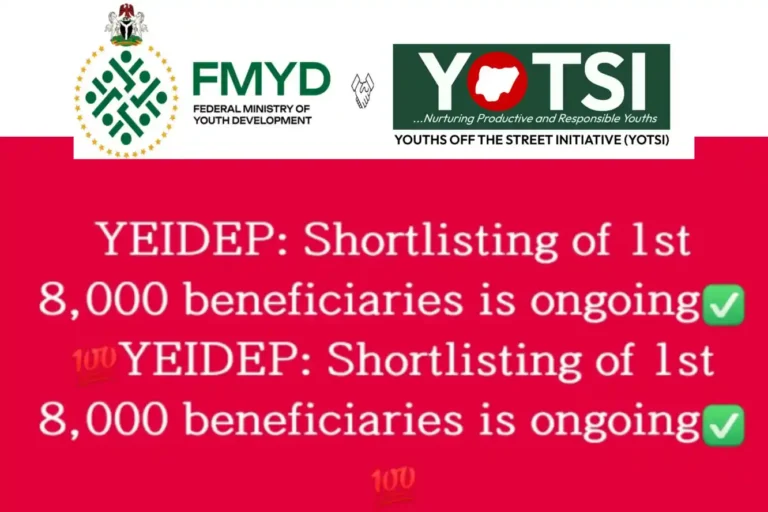
Some social media users have been posting messages such as “YEIDEP: Shortlisting of 1st 8,000 beneficiaries is ongoing.” This claim is false. The shortlist is not ongoing as claimed. YEIDEP had already selected 8,000 beneficiaries for the first tranche of disbursement. Therefore, the only thing that will happen next is the disbursement of funds.

Fidelity Bank confirmed this in a statement saying, “At this stage, we are currently awaiting the official announcement and next steps from the Federal Government regarding the disbursement and activation of the associated programs. Once the directive is issued, all account holders will promptly be communicated with regarding any necessary actions or updates.”

This means that once the Federal Government gives the directive, all beneficiaries in the first tranche will be paid between ₦50,000 and ₦500,000 as initially proposed.

Previously, Nigeriastartupact.ng reported that engagement with beneficiaries is what is currently ongoing. The disbursement for the 8,000 Batch A beneficiaries is expected to begin between October 20 and 30, 2025. However, this timeline remains unconfirmed, as the programme management has not officially announced it.

Meanwhile, there are also claims that Opay and Moniepoint will start creating accounts for YEIDEP beneficiaries. This is not true. The only official YEIDEP partner banks are Keystone Bank, Lotus Bank, Fidelity Bank, Access Bank, Zenith Bank, Union Bank, UBA, FirstBank, Wema Bank, Jaiz Bank, and The Alternative Bank.

Those selected for YEIDEP should simply expect credit alerts once disbursement begins.

Kaduna urges indigenes to apply for Nigerian army 90 rri recruitment

The Kaduna State Government has announced that the Nigerian Army has begun online registration for the 90 Regular Recruits Intake (RRI) for Trades and Non-Tradesmen/Women. The government urged qualified indigenes of Kaduna State to take advantage of the opportunity to serve the nation through military service.

According to the announcement, “Interested and qualified indigenes of Kaduna State are encouraged to apply via the official portal: recruitment.army.mil.ng.” It also stated clearly that the application process is free of charge.

This recruitment exercise offers a significant chance for patriotic citizens to join the Nigerian Army and contribute to national security and development. The Kaduna State Government emphasised the importance of participation in strengthening the nation’s defence system and supporting youth employment across the state.

Fidelity Bank to begin N5bn NCGC credit scheme for MSMEs, women, youths

0

Fidelity Bank Plc has announced its readiness to begin the disbursement of funds under the National Credit Guarantee Company (NCGC) N5 billion Credit Intervention Scheme. The initiative aims to expand access to finance for Micro, Small and Medium Enterprises (MSMEs), as well as businesses owned by women and youths across Nigeria.

The development was disclosed by the Managing Director and Chief Executive Officer of Fidelity Bank Plc, Dr. Nneka Onyeali-Ikpe, during the signing of a Memorandum of Understanding (MoU) between the bank and the NCGC.

According to Dr. Onyeali-Ikpe, the partnership with NCGC represents a major step in Fidelity Bank’s continuous efforts to promote financial inclusion and stimulate economic growth through broader access to credit. She said, “This guarantee will enable us to further expand financing opportunities for those who need it most, while strengthening our capacity to support businesses across key sectors of the Nigerian economy.”

The facility will cover vital sectors including food processing, secondary agriculture such as fish and poultry processing, fashion, green energy, light manufacturing, the agricultural value chain including feed mills and equipment fabrication, export-oriented businesses, and education.

Dr. Onyeali-Ikpe explained that Fidelity Bank has consistently supported various sectors through targeted programmes such as the Green Energy Financing Programme for renewable energy entrepreneurs, the Fidelity SME Hub designed for small businesses, and the Creativerse platform which is dedicated to supporting the creative industry. She also mentioned the Fidelity Bank Education Support Scheme, which offers affordable financing to improve educational infrastructure and technology.

“With the backing of the NCGC credit guarantee, we can now extend financing to businesses that have traditionally been excluded from formal credit systems—without compromising our risk standards or operational efficiency,” she added. “While we have supported MSMEs with short-term facilities in the past, this partnership allows us to provide long-term credit facilities that empower businesses to expand sustainably.”

Nigeriastartupact.ng earlier reported that Fidelity Bank has disbursed over N500 billion in loans to MSMEs in the past five years, empowering thousands of entrepreneurs and creating sustainable livelihoods across Nigeria.

Also speaking at the event, the Managing Director of NCGC, Mr. Bonaventure Okhaimo, said the organisation was established to bridge the financing gap faced by MSMEs in Nigeria by reducing lender risks through credit guarantees. He noted, “Although MSMEs are key contributors to Nigeria’s economic development, many of them struggle to secure funding from financial institutions due to perceived high risks. Through the credit guarantee scheme, NCGC shares this risk with banks, making it easier for MSMEs to access much-needed capital.”

Mr. Okhaimo further stated that NCGC and Fidelity Bank will collaborate to provide financial literacy and business management training to MSME beneficiaries. This initiative, he explained, will ensure that entrepreneurs have the right knowledge and skills to manage their loans effectively and achieve long-term business growth.

The partnership between Fidelity Bank and NCGC demonstrates both institutions’ commitment to fostering entrepreneurship, supporting MSMEs, and driving inclusive economic growth across Nigeria. The collaboration aligns with the Central Bank of Nigeria’s efforts to boost access to finance and strengthen the MSME ecosystem.

Ranked among the best banks in Nigeria, Fidelity Bank Plc operates as a full-fledged commercial deposit money bank serving over 9.1 million customers through its digital banking channels, 255 business offices across the country, and its United Kingdom subsidiary, FidBank UK Limited.

Fidelity Bank has earned several local and international recognitions for its role in supporting MSMEs and digital innovation. The bank received the 2024 Excellence in Digital Transformation & MSME Banking Award at the BusinessDay Banks and Financial Institutions (BAFI) Awards. It also won the 2024 Most Innovative Mobile Banking Application award for its Fidelity Mobile App from Global Business Outlook and the 2024 Most Innovative Investment Banking Service Provider award from Global Brands Magazine.

Additionally, Fidelity Bank was named the Best Bank for SMEs in Nigeria by the Euromoney Awards for Excellence and received the Export Financing Bank of the Year award at the BusinessDay Banks and Financial Institutions (BAFI) Awards.

Nasarawa scholarship board confirms merit-based p-payment for students

The Executive Secretary of the Nasarawa State Scholarship Board, Hajiya Sa’adatu O. Yahya, has addressed the press in her office in Lafia on October 8, 2025, regarding the ongoing disbursement of e-payment allowances to eligible students across the state.

In her remarks, Hajiya Sa’adatu expressed gratitude to Almighty Allah (S.W.T.) and appreciated His Excellency, Engr. Abdullahi A. Sule, the Executive Governor of Nasarawa State, for giving her the opportunity to serve as the head of the board. She acknowledged that “in every human endeavour, people are bound to face criticism, whether their actions are good or bad.”

The Executive Secretary explained that the ongoing payment exercise was conducted strictly on merit and eligibility. She revealed that some applicants were disqualified due to forged results or non-indigeneship of the state. According to her, “the board remains committed to fairness and justice.”

She further stated that students who missed the earlier screening in their zones were given another opportunity to be screened at the board’s headquarters in Lafia.

Hajiya Sa’adatu refuted allegations that her staff had proposed sharing unutilized funds, praising them instead for their dedication and collective effort toward transparency in the entire disbursement process.

The Executive Secretary also commended Governor Sule’s passion for education, noting his consistent approval of financial assistance to students, increased allocation of funds to beneficiaries, and inclusion of students studying abroad.

She encouraged students who missed the current exercise to “continue to pray for the Governor’s administration and remain hopeful for future opportunities.”

In her final remarks, Hajiya Sa’adatu called on the people of the Nasarawa North Senatorial Zone to support Governor Sule’s potential senatorial ambition, emphasising the numerous benefits his leadership has brought to the state.

Babcock University warns students about fake N250000 SIWES fee

0

Babcock University has issued a public warning to its students and parents over a fake notice circulating on campus, which falsely demands the payment of ₦250,000 as a SIWES Programme Support Fee. According to the fraudulent message, the payment was to be made between October 5 and 19, 2025.

In an official statement released by Dr. Joshua Suleiman, Director of Marketing and Communications at Babcock University, the notice was described as “FAKE, FRAUDULENT, and ILL-MOTIVATED.” He clarified that the document did not bear his signature and did not originate from him or the Department of Marketing & Communications.

Dr. Suleiman strongly condemned the malicious act, stressing that the perpetrators aim to deceive students and their parents. “The attention of my office has been drawn to a fraudulent notice titled: NOTICE TO POST-SIWES STUDENTS, currently circulating among Babcock University students, demanding the payment of #250,000 (Two Hundred and Fifty Thousand Naira) as SIWES Programme Support Fee between October 5 and 19, 2025,” he stated.

He further added, “I wish to categorically state that: The said notice is FAKE, FRAUDULENT, and ILL-MOTIVATED. The document does not bear my signature, which immediately calls its authenticity and credibility into question. It did not originate from me nor from the Department of Marketing & Communications, and therefore, should be completely disregarded.”

Dr. Suleiman also urged students, parents, and guardians to stay vigilant and not fall for such scams. “I strongly condemn in the strongest terms the actions of the fraudulent individuals behind this malicious act whose intent is to deceive unsuspecting students and their parents. Students, parents, and guardians are warned not to fall prey to such deceptive messages or make any payments into unauthorized accounts.”

The university reiterated its commitment to student protection and transparent communication through verified channels only.

TAJBank’s N20bn sukuk bond records 185% oversubscription

0

TAJBank Limited, Nigeria’s fastest-growing non-interest bank, has once again shown its strong position in the country’s non-interest banking investment market as its latest ₦20 billion Mudarabah Sukuk bond offer achieved a remarkable 185.15% oversubscription rate.

According to data released by investment market authorities, the Sukuk bond, which carries a 20.5% annual profit rate, recorded a total allotment of ₦57.03 billion. This figure represents a 185.15% oversubscription, highlighting the growing confidence of investors in TAJBank’s stability and performance in Nigeria’s financial sector.

Speaking on the impressive performance of the bond, TAJBank’s Founder and Managing Director, Mr Hamid Joda, said the result of the ₦20 billion Mudarabah Sukuk bond subscription, which is the second tranche of the bank’s ₦100 billion Sukuk bond programme, was remarkable, especially given the tough economic environment in Nigeria.

He stated, “Let me say that this outstanding performance of the Sukuk bond is a clear demonstration that the bank is enjoying growing investor confidence, and this can only be attributed to the quality of innovative products and services, and value addition TAJBank is delivering in the non-interest banking subsector of the banking system, especially when analysed within the context of the current realities in the debt instrument market today.”

Mr Joda expressed appreciation to the board, management, and staff of the bank, as well as the regulatory authorities and investors, for their roles in the success of the bond issuance. “I also assure them that TAJBank shall continue to protect their interest to ensure a win-win experience for all stakeholders as we sustain our drive to maintain the bank as the leading player in the nation’s non-interest subsector of the banking system,” he added.

In his remarks, the Co-Founder and Executive Director of TAJBank, Mr Sherif Idi, noted that the achievement reflected the confidence investors have in the bank. “This investment feat is a clear demonstration of investors’ trust in TAJBank, and we will continue to do our best to surpass their expectations through world-class products and services. As always, our interest in the customers and investors is paramount,” he said.

Financial analysts have commended the success of the ₦20 billion Sukuk bond, noting that the result would likely attract more investors, businesses, and customers to the bank. They believe this would further strengthen the growth of non-interest banking and increase financial inclusion in Nigeria.

Since its debut in the non-interest banking space about five years ago, TAJBank has promoted ethical banking through innovative products and customer-focused services. The bank’s long-term goal is to become one of Nigeria’s top 20 banks by 2029.

TAJBank’s outstanding performance has also earned it several national and international awards, including the Global Islamic Finance Award (GIFA) 2023 for the “Best Sukuk Deal of the Year 2023.” It also received BusinessDay’s “Islamic Bank of the Year” awards in 2021, 2022, and 2023, as well as Leadership Newspaper’s “Bank of the Year” award in 2020.

Niger State reaffirms support for IFAD VCDP

Niger State government has reaffirmed its commitment to providing an enabling environment for the assessment team from the International Fund for Agricultural Development (IFAD) Value Chain Development Programme (VCDP) to succeed in its 12th supervision mission to the state.

Governor Mohammed Umaru Bago, represented by the Secretary to the State Government, Abubakar Usman, made this known during a special dinner organised in honour of the IFAD VCDP team at the Government House, Minna.

He said the state government had put in place all necessary measures to ensure the team carried out its mandate with ease, adding that all stakeholders were ready and willing to cooperate with the team in every part of the state.

According to him, “the dinner also provided an opportunity to foster unity among Africans, especially within the West African region, through the display of cultural heritage and shared values.”

The Country Director, IFAD VCDP, Mrs Dede Ekoue, expressed appreciation to the farmer governor for what she described as high-quality hospitality, reaffirming IFAD’s commitment to supporting smallholder farmers to actualize the governor’s agricultural development agenda in the state.

In her words, “IFAD remains dedicated to helping small farmers achieve greater productivity, improve food security, and strengthen the agricultural value chain across Niger State.”

Permanent Secretary, Ministry of Agriculture, Dr Mathew Ahmed, also stressed the importance of harnessing Niger State’s vast agricultural potential, noting that development partners like IFAD had continued to demonstrate reliability in supporting sustainable growth.

All members of the visiting team were presented with local hats and traditional attires, and were treated to delicious local dishes while enjoying live entertainment by the GWAPE music group.

Access Bank opens 2025 entry level training program

0

Access Bank PLC has opened applications for its 2025 Entry Level Training Program (ELTP), designed to recruit and develop the next generation of banking leaders across Nigeria. The on-site program will take place in Lagos, offering young graduates a chance to launch their careers in one of Africa’s leading financial institutions.

According to the bank, “We don’t just offer jobs; we build careers, empower dreams, and develop the next generation of leaders redefining Africa’s financial future.” The program aims to train young professionals through a world-class learning experience that prepares them to thrive in today’s fast-changing financial environment.

The initiative begins at the School of Banking Excellence (SBE), where participants will undergo immersive and practical learning. Access Bank described the SBE as “an immersive training ground where high-caliber graduates are challenged, inspired, and prepared to make an impact from day one.”

The 2025 Entry Level Training Program has three main tracks. The ELTP Grad is for high-potential graduates who aspire to shape the future of banking. Applicants must hold at least a Second-Class Upper Division (2:1) degree in any discipline from an accredited university. The ELTP Retail track is tailored for candidates passionate about customer service and relationship management, requiring a minimum of a Second-Class Lower Division (2:2) degree. The ELTP Tech track focuses on digital innovation and problem-solving within the bank’s technology and digital transformation space, also requiring a 2:2 degree in any discipline.

All applicants must have completed their NYSC, reside in or be eligible to work in Nigeria, and possess access to a personal laptop with a reliable internet connection. The bank cautions that submitting multiple applications will lead to disqualification, stating that “applicants are required to apply for only one ELTP track.”

Access Bank emphasised that the program offers more than training. It provides structured career growth, global exposure, and competitive compensation. “At Access Bank, we believe that greatness thrives where passion meets purpose,” the bank said, highlighting its commitment to innovation, collaboration, and integrity as the foundation of success.

Interested applicants are encouraged to apply through the official portal via apply.workable.com/access-bank/j/2DBE648318.

Jigawa targets N30bn yearly from date palm farming

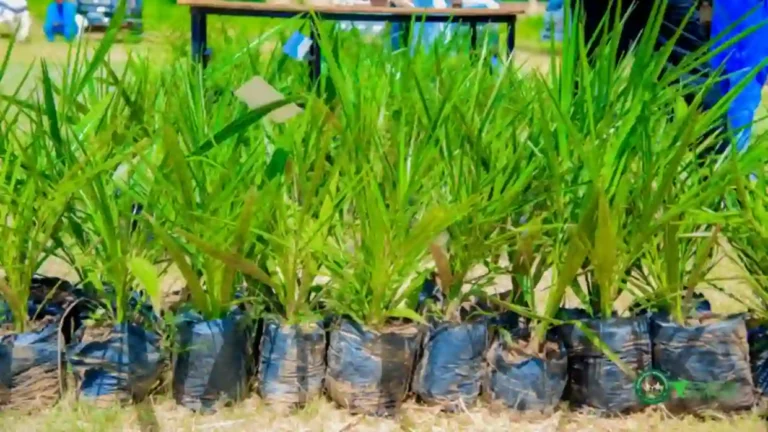
The Jigawa State Government has announced plans to generate over ₦30 billion annually from date palm farming as part of its effort to empower young people and reduce dependence on federal allocation.

Speaking on the development, officials said the initiative aims to boost local production, create jobs, and promote agricultural sustainability in northern Nigeria. According to experts, the programme could become a major contributor to Nigeria’s agricultural GDP if properly managed.

Earlier, Nigeriastartupact.ng reported that the federal government launched the planting of 50 million date palm trees in Jigawa State under a national plan to combat desertification and restore degraded land across the North.

The Jigawa government also confirmed that 400 youths have been trained on hybrid date production techniques. “Each seedling can produce over 70 kilos initially and, if well managed, can generate up to ₦7 million monthly,” an official explained.

The project was officially flagged off by the Minister of Environment, Balarabe Abbas Lawal, alongside the Deputy Governor of Jigawa State and the Director-General of the National Agency for the Great Green Wall (NAGGW).