Home Blog Page 411

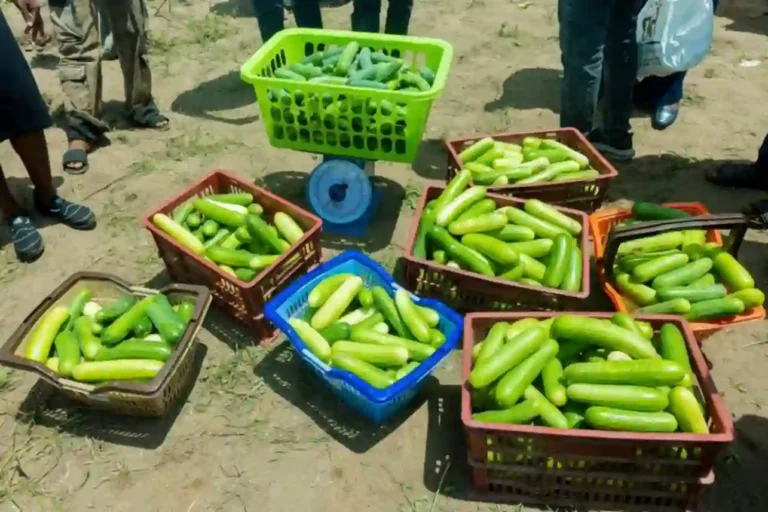
Kogi records first greenhouse cucumber harvest

The Kogi State Government has achieved another major step in its agricultural revolution with the first successful harvest of greenhouse-grown cucumber at the Federal University, Lokoja. The project, implemented through the Agro-Climatic Resilience in Semi-Arid Landscapes (ACReSAL) initiative, is designed to boost food security, promote technology transfer for smart farming, and empower women and youths across the state.

According to reports, beneficiaries of the programme include women farmers from the Falele and Crusher communities, as well as staff and students of the institution. During Thursday’s maiden harvest, a total of 260 kilograms of cucumber was harvested. The harvest is expected to continue weekly for the next three months before another crop will be planted.

Representing Governor Ahmed Usman Ododo at the farm to supervise the harvest were the Commissioner for Environment and Ecological Management, Engr. Olusegun Joseph, and the State ACReSAL Project Coordinator, Barr. Ladi Ahmed Jatto, OON. The project is currently being implemented in the three senatorial zones of the state, as part of efforts to strengthen agricultural productivity and climate resilience.

Speaking on the development, the Commissioner for Information and Communications, Kingsley Femi Fanwo, said the success of the greenhouse project reflects Governor Ododo’s commitment to tackling food inflation, promoting food security, and achieving sustainable prosperity for the people of Kogi State.

“Our women and youths are now at the forefront of Kogi’s agricultural revolution,” he said. “Through ACReSAL, thousands of farmers are being empowered across the state, and Kogi is fast becoming a model of agricultural resilience and productivity. We didn’t just go to Lagos to sign the Food For Lagos Partnership just for the television flashes. We are back home to walk our talk and become the noiseless food basket of Nigeria,” he added.

Fanwo further stated that the ongoing agricultural revolution in Kogi State under the leadership of Governor Ahmed Usman Ododo was inspired by the Renewed Hope Agenda of President Bola Ahmed Tinubu, which prioritises supporting states to produce what Nigerians eat and eat what Nigerians produce.

“Mr. President has empowered the state and energised the agricultural sector with his policies and support. We’re only responding by ensuring farmers benefit directly and by expanding our value chain in the sector as a state. We’re grateful to Mr. President for sparking a revolution in the nation’s agricultural sector,” he said.
Advertisement

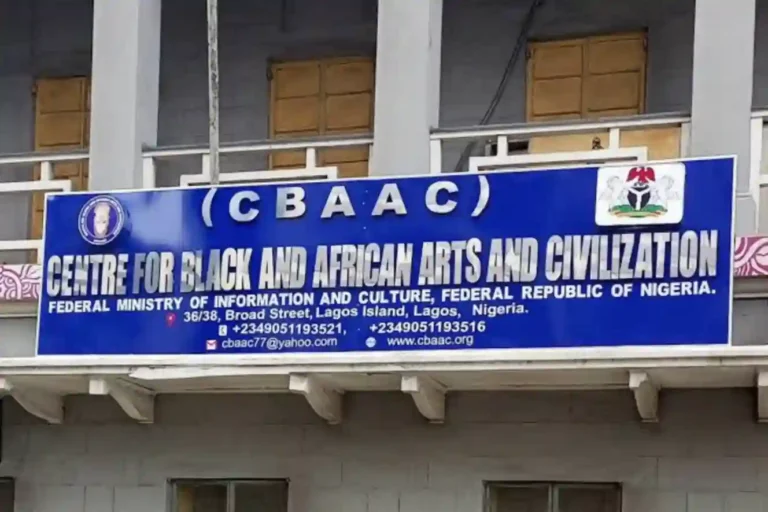
CBAAC, EU launch €50000 Pan-African indigenous skills programme

0

The Centre for Black and African Arts and Civilisation (CBAAC), in partnership with the European Union National Institutes for Culture (EUNIC), Nigeria Cluster, has inaugurated the ‘Roots and Roofs: Pan-African Indigenous Skills Development’ (PAID) programme aimed at promoting indigenous creativity and sustainable innovation across Africa.

The initiative, supported with a grant of €50,000 by EUNIC, Nigeria Cluster, was announced in a joint statement signed by the Director-General of CBAAC, Mrs Aisha Augie, and the President of EUNIC, Nigeria Cluster, Dr Nadine Siegert, on Wednesday in Lagos.

Information obtained by Nigeriastartupact.ng shows that members of the EUNIC Nigeria Cluster include the Goethe-Institut, British Council, Embassies of Spain and Ireland, National Troupe of Nigeria, and the Institute of African and Diaspora Studies, University of Lagos.

The statement explained that the PAID project is one of seven selected out of 36 applications across Africa to benefit from the 2025 Grant for Africa-Europe Partnership under the Spaces of Culture Programme of the European Union. The €50,000 fund will be domiciled and managed by CBAAC and Goethe-Institut Nigeria to ensure smooth implementation.

The theme for the programme is ‘African-Inspired Interior and Exterior Architecture’. It is designed to safeguard and revitalise Africa’s indigenous architectural and artistic traditions while empowering a new generation of creative innovators through equitable Africa-Europe cultural partnerships.

According to the project’s steering committee, the PAID initiative reflects Africa’s vision of development rooted in its cultural identity. “It repositions indigenous learning as a driver of innovation, sustainability, and youth empowerment. These are core to Nigeria’s Cultural Policy, the African Union’s Agenda 2063, and the UN Sustainable Development Goals,” the statement said.

The committee also noted that by connecting African institutions with European counterparts, the project aims to demonstrate a new model of cultural partnership built on collaboration and shared learning.

The one-year programme will focus on inclusivity, gender balance, and regional diversity, engaging young Nigerians between the ages of 25 and 35 from all 36 states and the Federal Capital Territory.

“Roots and Roofs, under the PAID initiative of CBAAC, aims to equip young Africans with hands-on training in indigenous architectural design thinking, sustainable practices, and cultural documentation while exploring the dynamic relationship between built environments, performance, and storytelling,” the statement added.

The programme will feature workshops, apprenticeships, and community-based projects to bridge ancestral wisdom with contemporary innovation. It is also expected to address cultural, social, and environmental challenges while supporting President Bola Tinubu’s Renewed Hope Agenda on job creation and human capital development.

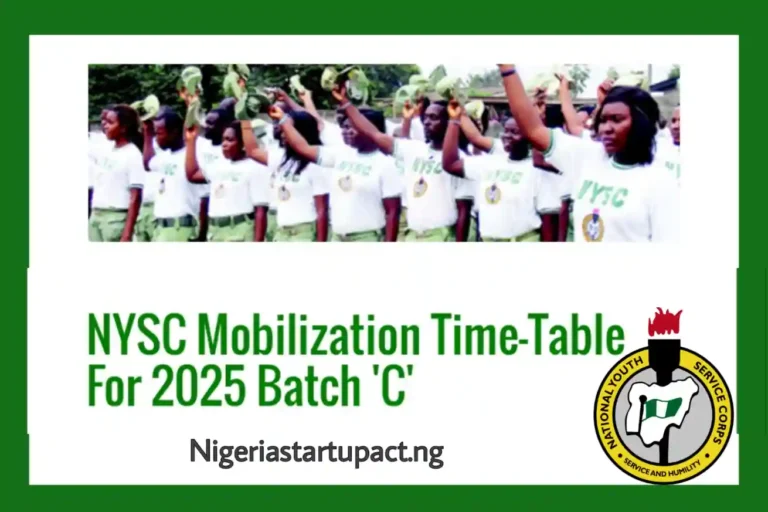
NYSC releases 2025 batch C mobilization timetable

0

National Youth Service Corps (NYSC) has officially released the Mobilization Time-Table for the 2025 Batch ‘C’ exercise. According to the NYSC management, the process will begin with the uploading of Senate and Academic Board approved results for full-time and part-time graduates by Corps Producing Institutions (CPIs) from October 20 to 24, 2025.

The 2025 Batch ‘B’ Post Mobilisation Workshop is scheduled to hold from October 15 to 18, 2025. This will be followed by the briefing of final-year prospective corps members (PCMs) in all Corps Producing Institutions between October 20 and November 14, 2025.

The submission of hard copies of approved results by CPIs will take place from November 3 to 7, while the Batch ‘C’ Pre-Mobilisation Workshop will run from November 2 to 6, 2025. NYSC also announced that online registration for both Nigerian and foreign-trained graduates will be open from November 4 to 9, 2025.

Pre-camp physical verification for foreign-trained graduates will hold between November 9 and 13, followed by ICT Department actions from November 12 to 15.

According to the NYSC, “Online printing of deployment by Corps Producing Institutions and delivery of physical call-up letters to institutions will take place from November 16 to 18, 2025.” The same dates apply for notification and printing of call-up letters by PCMs.

Corp members can also access the mobilization timetable by visiting this link nysc.gov.ng/mobtable.html.

Nigeriastartupact.ng also reported that NYSC issued a circular requiring NERD clearance for 2025 batch C corp members.

Abia subeb warns public against teachers recruitment circular

The attention of the Anambra State Universal Basic Education Board (ASUBEB) has been drawn to the circulation of a fake circular across various Local Government Education Authorities (LGEAs). The document allegedly invites prospective teachers willing to teach in rural areas to submit applications for employment.

In an official statement, the Board clarified that no such directive was issued. “Please note that such a directive did not come from either the Executive Chairman or the Board and, as such, should be discountenanced,” the statement read.

The Ministry of Basic and Secondary Education, in partnership with ASUBEB and the State Education Management Board (SEMB), emphasized that the public will be duly informed through official communication channels when the second batch of recruitment begins.

The clarification was signed by Dr. Uzoamaka Amah-Mbah, Board Secretary, on behalf of the Executive Chairman, to prevent misinformation and protect job seekers from fraudulent recruitment claims.

NDDC awards scholarship to 600 Niger Delta postgraduate students

0

The Niger Delta Development Commission (NDDC) has awarded scholarships to 600 successful candidates under its 2025/2026 local postgraduate scholarship programme. The presentation of the scholarship award letters took place in Port Harcourt, Rivers State, during a ceremony attended by top officials of the commission.

Presenting the letters, the Managing Director of the NDDC, Dr Samuel Ogbuku, said the scholarship initiative was part of the commission’s efforts to promote human capital development across the Niger Delta region. He explained that the programme was designed to help the region produce skilled professionals who can contribute to solving its developmental challenges.

Dr Ogbuku, who was joined by the Executive Director of Corporate Services, Ifedayo Abegunde; the representative of Bayelsa State on the NDDC Board, Senator Dimaro Denyanbofa; and other directors, urged the beneficiaries to uphold integrity and excellence in their studies. He encouraged them to be good ambassadors of the Niger Delta and to use the opportunity to make a meaningful impact in their communities.

This was contained in a statement released in Port Harcourt by the NDDC Director of Corporate Affairs, Seledi Thompson-Wakama.

According to Dr Ogbuku, “Education remains the most powerful weapon for changing the fortunes of the Niger Delta region.” He commended past beneficiaries who have made the region proud, stating, “It is remarkable that 32 of our scholars graduated with distinction in Coventry University this year.”

He reminded the new scholars that they carried the hopes of millions, saying, “You are the torchbearers of transformation. Your education is not just for you but for the millions who look up to you for hope. As you pursue your postgraduate studies, remember that every lecture you attend, every paper you write, and every solution you provide is a step towards transforming our communities.”

The NDDC Director of Education, Health and Social Services, Dr George Uzowanne, revealed that out of 46,240 applicants, only 600 were selected after a transparent electronic examination process. He said, “I congratulate the successful candidates who applied and went through a seamless selection process.”

Dr Uzowanne emphasised the fairness of the process, noting that “competition for the programme was intense and fair.” He added, “Through initiatives like the NDDC Local Scholarship Programme, we are investing in the minds that will shape the Niger Delta’s tomorrow. By equipping our youth with advanced knowledge in fields like engineering, environmental sciences, technology, humanities and management sciences, we empower them to tackle our region’s unique challenges.”

Also speaking, the NDDC Director of Education, Dr Angela Chukwudifu, explained that the scholarship now focuses on local institutions to help students stay connected to the realities of the Niger Delta. She said the approach would help them understand the region’s challenges and take ownership of its development.

The best-performing candidate, Mr Reginald Omubo-Pepple, expressed gratitude to the NDDC for the opportunity, pledging that all beneficiaries would remain dedicated and committed to contributing positively to the progress of the Niger Delta region.

Lagos launches StartRight programme to empower startups, MSMEs

The Lagos State Government, through the Ministry of Wealth Creation and Employment, has officially launched the StartRight Entrepreneurship Development Support Programme to empower startups and Micro, Small, and Medium Enterprises (MSMEs) across the state. The programme aims to equip entrepreneurs with the essential knowledge, skills, and resources required to build sustainable and profitable businesses in today’s competitive economy.

Speaking at the launch held on Tuesday, 7th October 2025, at the STO Resource Centre, Central Business District, Alausa, Ikeja, the Honourable Commissioner for Wealth Creation and Employment, Hon. Akinyemi Bankole Ajigbotafe, described the initiative as a significant step in advancing Governor Babajide Olusola Sanwo-Olu’s vision of a #Greater Lagos driven by enterprise, innovation, and inclusive prosperity.

Ajigbotafe explained that the StartRight Lagos Programme was created to assist entrepreneurs and MSMEs in building solid foundations for their ventures. He emphasized the importance of sustainability and scalability in modern businesses. “It is no longer enough to start a business,” he said. “It is important to start right, sustain right, and scale right.” He added that the programme reflects the government’s continuous investment in developing future-ready entrepreneurs who will contribute meaningfully to the economic growth of Lagos State.

The Commissioner reaffirmed the Ministry’s commitment to promoting youth empowerment, skill development, business incubation, and access to finance. He noted that these efforts are in line with the State Government’s T.H.E.M.E.S Plus development agenda. Ajigbotafe also commended the facilitators and development partners for their dedication to supporting the entrepreneurial ecosystem and for complementing government efforts toward building a productive and self-reliant citizenry.

In his welcome address, the Permanent Secretary of the Ministry of Wealth Creation and Employment, Esv. Wasiu Adebayo Olayinka, described the StartRight Lagos Programme as another milestone in the state’s continuous drive to promote innovation, enterprise, and economic inclusion. He explained that the initiative was designed to provide participants with essential business knowledge, ethics, and management skills needed to start, manage, and sustain successful enterprises.

According to Olayinka, the goal is to equip Lagos entrepreneurs with the right mindset and capacity to transition from job seekers to job creators. “The StartRight Lagos initiative embodies that mission by providing practical learning, mentorship, and exposure to growth strategies,” he said. He appreciated the facilitators for their expertise and assured that the Ministry would continue to strengthen partnerships with both public and private sector stakeholders to maintain the momentum of entrepreneurship development across the state.

Also speaking at the event, Mrs. Lanre Oniyitan, a Consultant and Chief Executive Officer of W-Holistic Business Solutions, provided an overview of the StartRight Lagos Programme. She highlighted its structure, objectives, and expected outcomes in supporting startups and MSMEs to establish sustainable business foundations. Oniyitan noted that the initiative is designed to help entrepreneurs navigate the challenges of business management and achieve long-term growth.

The StartRight Lagos Entrepreneurship Development Support Programme stands as one of the flagship initiatives of the Ministry of Wealth Creation and Employment. It focuses on enhancing entrepreneurial capacity, stimulating innovation, and providing practical business support for startups and MSMEs. The initiative aligns with the Lagos State Government’s commitment to economic inclusion, wealth creation, and youth empowerment, ensuring that more young people in Lagos can access business development opportunities and contribute to the state’s economic progress.

FG disburses ₦297bn to 15m households under expanded CCT programme

The Federal Government has announced that a total of ₦297 billion has been disbursed to about 15 million households across the country under its expanded Conditional Cash Transfer (CCT) programme. This initiative is part of ongoing efforts to cushion the effects of economic hardship and promote inclusive growth.

The Special Adviser to the President on Media and Public Communication, Chief Sunday Dare, said on Wednesday that President Bola Ahmed Tinubu remains committed to ensuring that ongoing economic reforms translate into better living standards for citizens.

According to Dare, the Tinubu administration “remains firmly focused on improving household welfare through targeted, verifiable interventions,” stressing that the goal is not only achieving macroeconomic stability but ensuring visible improvements in the lives of ordinary Nigerians.

He explained that the CCT, one of the administration’s major social protection programmes, has been expanded to reach millions of poor and vulnerable households nationwide. Beneficiaries, he said, were enrolled through a verified digital process under the National Social Register to ensure transparency and accountability.

As obtained by Nigeriastartupact.ng, Dare also highlighted the Renewed Hope Ward Development Programme (RH-WDEP) as one of the new grassroots initiatives targeting all 8,809 electoral wards across the country. According to him, the programme delivers micro-infrastructure, livelihood support, and social services directly at the community level to stimulate local development and improve welfare.

The presidential aide noted that the administration is consolidating and expanding the existing National Social Investment Programmes (NSIPs), which include N-Power, GEEP micro-loans such as TraderMoni, MarketMoni, and FarmerMoni, as well as the Home-Grown School Feeding Programme. These programmes are designed to protect jobs, boost small enterprises, and keep children in school.

Speaking on food security, Dare said the government is implementing several interventions to ease inflationary pressures on essential goods through the distribution of subsidised grains and fertilisers, mechanisation partnerships, and the revival of strategic food reserves. He added that these efforts are aimed at stabilising food prices and improving household nutrition.

He further explained that the Renewed Hope Infrastructure Fund (RHIF) would finance key projects in road construction, energy, and housing to lower living costs and create new employment opportunities for Nigerians.

Similarly, the National Credit Guarantee Company (NCGC) is expanding access to affordable credit for small businesses, women, and youth entrepreneurs through partnerships with commercial banks. Dare said this initiative will help strengthen small and medium-scale enterprises and drive inclusive economic growth.

While acknowledging that some reforms, such as the removal of fuel subsidy and the unification of exchange rates, have been challenging for citizens, Dare described them as “bold and necessary choices to tackle the root causes of poverty rather than its symptoms.”

“Even the World Bank itself has acknowledged that these reforms are already restoring macroeconomic stability and renewed growth momentum,” he stated.

He added that the administration is scaling up investments in agriculture, MSMEs, and reliable power supply to generate jobs and reduce living costs. The agricultural value chain expansion, gas-to-power projects, and new skills development hubs, he said, are designed to empower households and support local production.

“As these programmes mature, Nigerians should begin to feel more visible improvements in food prices, income, and purchasing power,” he assured.

The presidential aide further emphasised that the Tinubu administration is strengthening its social investment structure through a unified, data-driven framework to ensure transparency and effective targeting. “This includes scaling up existing NSIP schemes, expanding the National Social Register, and rolling out the Renewed Hope Ward Development Programme — ensuring that no vulnerable community is left behind,” he said.

Dare reaffirmed that President Tinubu’s government “remains focused on empowering households, expanding opportunity, and building a resilient, inclusive economy where growth translates directly to improved living standards.”

“The reforms are necessary. The direction is right. The foundation for a fairer and more prosperous Nigeria is being firmly laid,” he added.

100 youths graduate From FG Skillnovation training programme

0

The Federal Government has reaffirmed its dedication to youth empowerment and economic self-reliance as 100 young Nigerians graduated from the second cohort of the Skillnovation Training Programme held in Gwagwalada, Abuja. The closing ceremony, which took place on Wednesday, marked the completion of a four-week intensive training focused on vocational and digital skills.

At the event, certificates and cheques were presented to participants. Chief Obinna Nwaka, Director General of the Committee of Youth on Mobilisation and Sensitisation (CYMS), represented the Minister of Youth Development, Engr. Olawande Emmanuel Ayodele. The Skillnovation Training Programme, organised in collaboration with development and training institutions, provided hands-on experience in hair making, make-up artistry, confectionery, digital marketing, and shoemaking. These fields were chosen to promote self-employment and strengthen economic inclusion among Nigerian youths.

Speaking during the ceremony, Chief Nwaka said the programme continues to play an important role in boosting innovation, productivity, and economic resilience. He explained that the initiative aligns with other youth-focused projects under the Ministry, such as the Nigerian Youth Academy (NiYA), the Pi CNG Youth Initiative, and the Nigerian Youth Investment Fund (NYIF).

“The Skillnovation Programme demonstrates our unwavering commitment to equipping young Nigerians with skills that promote entrepreneurship, creativity, and sustainable livelihoods,” Nwaka stated on behalf of the Minister.

He also praised Dr Chiji Ojukwu, Managing Director of the African Project Development Centre Group (APDC), for his continuous dedication to youth development and his support for government-led empowerment programmes. “Dr Ojukwu’s passion for youth development is worthy of recognition. Partnerships like this show how collaboration can drive tangible change in our society,” he added.

Nwaka further noted that as the participants move forward with their new ventures, the Skillnovation Training Programme remains a practical example of the Federal Government’s ongoing efforts to equip young Nigerians with the skills required to thrive in a dynamic economy.

Other notable attendees included Hon. Kelechi Ugwumba, CYMS Director of Contacts and Mobilisation, and Ms Evelyn from the Volunteer Group. Both speakers stressed the importance of continuous investment in youth empowerment as a foundation for national development. “Our youths are the engine of growth; empowering them means securing the future of our nation,” Ms Evelyn said.

The highlight of the ceremony was the presentation of certificates and financial support to the graduates, concluding the one-month training designed to reduce unemployment and promote entrepreneurship across Nigeria.

Katsina set to benefit from World Bank AGROW project

Katsina State is set to benefit from the World Bank’s Agriculture Value Chains for Growth (AGROW) Project, a major initiative aimed at unlocking Nigeria’s agribusiness sector to boost job creation and food nutrition security.

Governor Malam Dikko Umaru Radda received the Task Team Leader for the AGROW Project, Dr. Hardwick Tchale, at Katsina House in Abuja, where discussions were held on the state’s readiness to participate in the programme.

During the meeting, the World Bank delegation briefed the Governor on the new development and urged the state to begin preparations for the project’s take-off. Katsina is among the selected states identified to participate in the initiative.

Dr. Tchale explained that the AGROW Project focuses on building a strong agricultural value chain that connects farmers, processors, and markets, thereby creating jobs and improving food supply across the country. He noted that the project’s main objective is to strengthen Nigeria’s agribusiness sector for sustainable economic growth.

“The objective of the project is to unlock Nigeria’s agribusiness sector for jobs creation and food nutrition security. States need to create a complete value chain circle in agriculture to ensure sustainable economic development,” Dr. Tchale said.

Responding, Governor Radda reaffirmed Katsina’s commitment to meeting the technical and administrative requirements needed to access the World Bank grant.

“Katsina is an agrarian state, with the majority of our citizens engaged in farming. However, insecurity has been a major challenge for our farmers. We welcome this intervention as timely, with the required modalities to address both economic and security issues in the state,” the Governor stated.

He further assured the World Bank team that his administration would ensure the successful implementation of the AGROW Project, emphasizing that agriculture remains central to Katsina’s economic transformation agenda.

Earlier, the Executive Secretary of the Katsina State Development Management Board, Dr. Mustapha Shehu, said that promoting partnerships and investments of this kind aligns with the Board’s mission to drive sustainable development and economic growth in the state.

The AGROW Project is expected to enhance agricultural productivity, generate employment, and strengthen food security across all participating states.