Home Blog Page 415

Nigerian institute, NADDC partner on cng, electric vehicle development

0

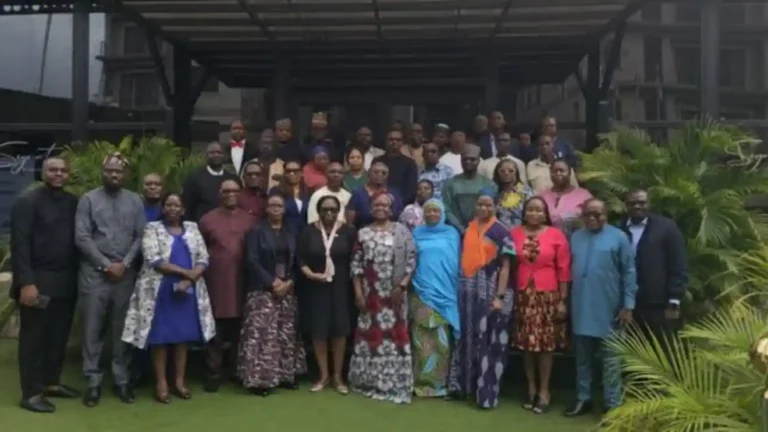
The Director-General of the Nigerian Institute of Transport Technology (NITT), Zaria, Dr. Alhaji Bayero, on October 7, 2025, paid a courtesy visit to the Director-General of the National Automotive Design and Development Council (NADDC), Chief (Otunba) Joseph Oluwemimo Osanipin, to strengthen collaboration between the two agencies.

Dr. Bayero explained that the visit was aimed at advancing synergy between NITT and NADDC in supporting the Federal Government’s ongoing efforts toward the adoption and sustainability of Compressed Natural Gas (CNG) and Electric Vehicle (EV) technologies across Nigeria. He said the collaboration would focus on key areas such as Technician Certification, Training Standardization, and Policy Enforcement to ensure quality, safety, and manpower readiness in the nation’s energy transition.

He commended NADDC for its leadership in driving Nigeria’s automotive industry toward a cleaner and more sustainable future, particularly through the development of National Occupational Standards (NOS) for CNG conversion and EV maintenance.

Highlighting NITT’s mandate as the apex transport and logistics training and research institute in Nigeria, Dr. Bayero reaffirmed the Institute’s commitment to manpower development, public enlightenment, and the establishment of training centers across all geopolitical zones to support the Presidential CNG Initiative. He added that NITT had developed a Certificate Verification Portal for CNG technicians, which ensures that all vehicle conversions are handled by certified professionals. According to him, this initiative will enhance regulatory enforcement, public confidence, and safety in the nation’s automotive sector.

Dr. Bayero proposed the signing of a Memorandum of Understanding (MoU) between NITT and NADDC to formalize cooperation in areas such as standardization, joint capacity building, and data-driven policy support.

In his response, NADDC’s Director-General, Chief (Otunba) Joseph Oluwemimo Osanipin, welcomed the partnership, noting that collaboration between both agencies was crucial to advancing the automotive and transport sectors. He emphasized that such efforts would help achieve Nigeria’s vision for clean, safe, and sustainable mobility.

The meeting ended with a joint commitment by both institutions to formalize collaboration through an MoU and align efforts toward promoting cleaner and more sustainable transport technologies in Nigeria.

Advertisement

FG CAADP policy to boost food security

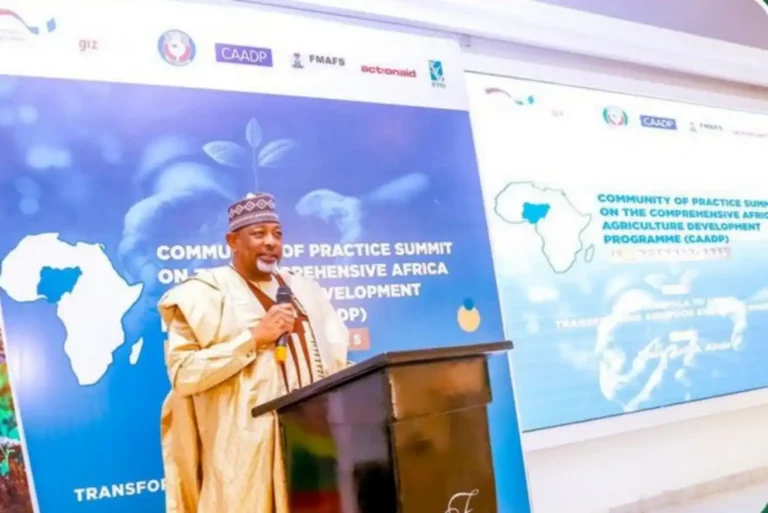
The Honourable Minister of Agriculture and Food Security, Senator Abubakar Kyari, CON, has launched the Comprehensive Africa Agriculture Development Programme (CAADP) Simplified Policy Document, reaffirming the Federal Government’s commitment to transforming Nigeria’s agrifood systems in line with continental agricultural frameworks.

The launch took place during the Community of Practice (CoP) meeting held on Monday, 6th October 2025, at Fraser Suites, Abuja. The meeting brought together Commissioners of Agriculture, Livestock, Fisheries, and Rural Development from across the country to deliberate on strategies for advancing agricultural transformation and boosting food security in Nigeria.

Speaking during the event, Senator Kyari emphasized that as the Malabo Declaration (2014–2025) comes to an end, the newly adopted Kampala Declaration (2026–2036) will guide Africa’s agricultural development for the next decade. He explained that the Kampala Declaration will focus on scaling up agricultural investments, fostering inclusivity, strengthening intra-African trade, and promoting innovation and technology adoption across the continent.

“The responsibility before us is great, but so too is the opportunity. We must move beyond business-as-usual approaches and embrace bold reforms that will make our food systems more productive, resilient, inclusive, and sustainable,” he stated.

Highlighting key Federal Government interventions aimed at achieving food security and economic growth, the Minister disclosed that 2,000 tractors and implements have been provided to support mechanized farming and improve agricultural productivity.

He added that Special Agro-Industrial Processing Zones (SAPZ) have been launched in Kaduna, Cross River, and Ogun States, with additional states to follow. According to him, the project already leverages $538.05 million in investments and is projected to attract an additional $1 billion by 2027, boosting agribusiness, employment, and rural development.

Senator Kyari also announced the introduction of the Nigeria Postharvest Systems Transformation Program (NIPHAST), designed to address postharvest inefficiencies estimated at ₦3.5 trillion annually. The program aims to reduce food waste, enhance agricultural value chains, and strengthen national food sovereignty.

To ensure effective coordination, the Minister revealed that an Agricultural Sector Working Group has been established, bringing together research institutions, the private sector, development partners, and civil society organizations. The group will serve as a governance mechanism to promote accountability, scale up best practices, and stimulate collective action within the agricultural sector.

According to him, these initiatives are expected to raise household incomes, create direct and indirect employment—especially for youth and women—and build a resilient agricultural value chain that guarantees national food security.

Senator Kyari urged stronger collaboration between Federal and State Governments, noting that synergy is essential for sustainable agricultural transformation under the Kampala Declaration. He then declared the CoP meeting open after unveiling the CAADP Simplified Policy Document, which serves as an accessible guide for policy domestication and agricultural transformation at both national and sub-national levels.

CAC notifies FG of withdrawal of NYCN registration

0

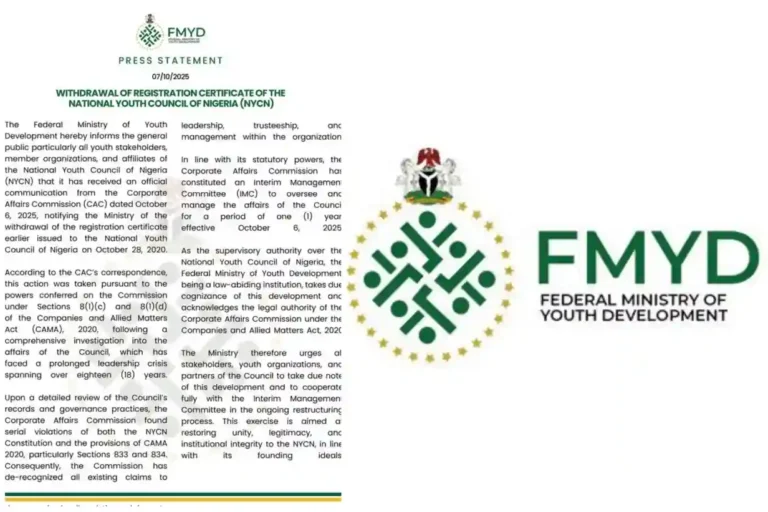
The Federal Ministry of Youth Development has announced that the Corporate Affairs Commission (CAC) has officially withdrawn the registration certificate of the National Youth Council of Nigeria (NYCN). According to a statement issued by the Ministry, the notification came through an official correspondence from the CAC dated October 6, 2025. The original certificate had been issued to the Council on October 28, 2020.

The Corporate Affairs Commission explained that the withdrawal was made under Sections 8(1)(c) and 8(1)(d) of the Companies and Allied Matters Act (CAMA) 2020, following a detailed investigation into the operations of the NYCN. The CAC said the action became necessary after uncovering long-standing governance issues. “The investigation revealed serial violations of both the NYCN Constitution and the provisions of CAMA 2020, particularly Sections 833 and 834,” the statement noted.

According to the Commission, the Council has been facing a prolonged leadership crisis for over eighteen years, which affected its ability to function effectively as the umbrella body for Nigerian youth organizations. As a result of the findings, the CAC has de-recognized all existing claims to leadership, trusteeship, and management within the NYCN.

In line with its statutory responsibilities, the Corporate Affairs Commission has now set up an Interim Management Committee (IMC) to oversee the Council’s affairs for one year, beginning October 6, 2025. The IMC is expected to manage the restructuring process and ensure compliance with legal and administrative standards.

The Federal Ministry of Youth Development acknowledged the CAC’s decision, stating that it recognizes the Commission’s authority under the Companies and Allied Matters Act, 2020. The Ministry emphasized its commitment to supporting lawful actions that promote stability and accountability in youth governance. “The Ministry, being a law-abiding institution, takes due cognizance of this development and acknowledges the legal authority of the Corporate Affairs Commission,” it stated.

The Ministry urged all youth stakeholders, member organizations, and affiliates to cooperate with the Interim Management Committee. It added that the restructuring process is meant to “restore unity, legitimacy, and institutional integrity” to the NYCN.

The Ministry reaffirmed its dedication to building a credible and inclusive youth governance framework aligned with President Bola Ahmed Tinubu’s Renewed Hope Agenda.

Delta State disburses N150,000 grants to 320 women entrepreneurs

The Delta State Government, through the Office of the First Lady, Her Excellency Deaconess Tobore Oborevwori, in partnership with the Delta State Micro, Small and Medium Enterprises Development Agency (DEMSMEDA), has disbursed business grants of ₦150,000 each to 320 women under the MORE Cap-Up Programme. The event took place at the Unity Hall, Government House, Asaba.

The initiative aims to help women, especially those in rural communities, to start, sustain, and expand their small businesses through financial support and entrepreneurship training. Speaking during the presentation, Deaconess Tobore Oborevwori emphasized that the programme “is part of our continuous effort to empower women and promote inclusive economic growth across the state.”

She added that the initiative aligns with the vision of Governor Sheriff Oborevwori, whose administration remains committed to strengthening women-led enterprises and advancing the objectives of the MORE Agenda for Renewed Hope.

NYSC issues circular requiring NERD clearance for 2025 batch c

0

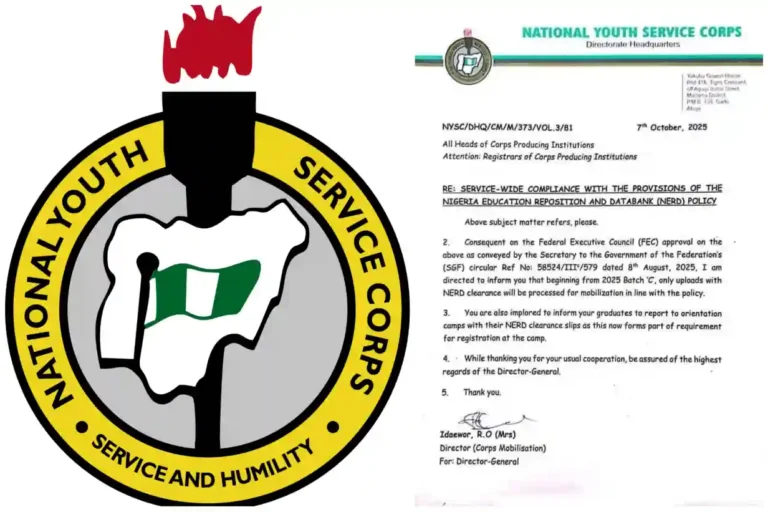
The National Youth Service Corps (NYSC) has issued a new circular announcing that compliance with the National Policy for the Nigeria Education Repository and Databank (NERD) has become a compulsory requirement for all graduates seeking mobilisation or exemption from the scheme. This development follows a recent approval by President Bola Ahmed Tinubu, as earlier reported by Nigeriastartupact.ng.

According to the circular dated October 7, 2025, and released from the NYSC Directorate Headquarters, Yakubu Gowon House, Abuja, the directive takes effect from the 2025 Batch ‘C’ mobilisation exercise. The document referenced as NYSC/DHQ/CM/M/373/VOL.3/81 was addressed to all Heads and Registrars of Corps Producing Institutions.

The circular reads: “Consequent on the Federal Executive Council (FEC) approval on the above as conveyed by the Secretary to the Government of the Federation’s (SGF) circular Ref No: 58524/III/579 dated 8th August, 2025, I am directed to inform you that beginning from 2025 Batch ‘C’, only uploads with NERD clearance will be processed for mobilization in line with the policy.”

It further stated that graduates are to “report to orientation camps with their NERD clearance slips as this now forms part of requirement for registration at the camp.” The statement, signed by Mrs Idaewor R.O, Director of Corps Mobilisation, on behalf of the Director-General, also thanked institutions for their cooperation while assuring them of the Director-General’s highest regards.

The NERD Policy, which was launched earlier this year by the Minister of Education, Dr. Tunji Alausa, is part of a broader national education data initiative. Section 6.1.23 of the policy provides that such submissions “will serve as a quality assurance check and as a yearly independent proof of continuous academic enrolment and affiliation” while helping to create a permanent academic footprint for each student.

Under this system, students and lecturers can earn lifetime revenues from their academic works deposited in the repository. The proposal, which Dr. Alausa presented to the Federal Executive Council, aims to improve the quality of academic content and research output across Nigerian universities and colleges.

The directive also clarified that the policy “will not affect Corps members already serving or graduates who were enrolled before the enforcement date.”

This enforcement derives its authority from Sections 2(4)(4) and 16(1)(C) of the NYSC Act and was part of Item 2(ix) of a circular issued by the Secretary to the Government of the Federation, Senator George Akume, confirming the presidential approval for a change in NYSC mobilisation criteria for both local and foreign-trained graduates.

FG, IFAD extend farmers support programme by two years

The Federal Government of Nigeria and the International Fund for Agricultural Development (IFAD) have approved a two-year extension of the Value Chain Development Programme (VCDP) to strengthen its achievements and deepen its impact across participating states.

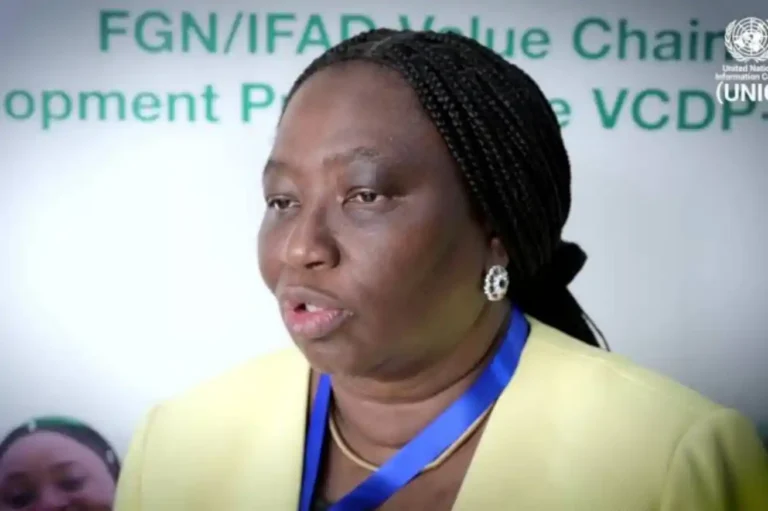
At the opening of the Joint FGN/IFAD 12th Supervision Mission in Abuja, the Director of the Federal Department of Development Partners Projects (FDDPP) in the Federal Ministry of Agriculture and Food Security, Mrs Iluromi Adebola, praised the collaboration between the Federal and State Governments, IFAD, farmers, and the private sector. She described the VCDP as a flagship initiative that is “driving food security, enhancing productivity, and improving rural livelihoods nationwide.”

According to Mrs Adebola, the extension of the programme followed its impressive results and visible impact in the nine participating states—Niger, Nasarawa, Kogi, Benue, Enugu, Ebonyi, Taraba, Anambra, and Ogun. The programme focuses on developing rice and cassava value chains, providing smallholder farmers with improved technologies, better market access, and higher income opportunities.

She revealed that rice yields among VCDP farmers have increased to between 5 and 6 tonnes per hectare, compared to the national average of 2 to 2.5 tonnes per hectare. This improvement, she said, demonstrates the success of the programme in promoting modern farming methods and supporting food security in Nigeria.

Mrs Adebola also noted that women and youth have become more involved in agribusiness innovation through initiatives that convert agricultural waste into value-added products such as briquettes and animal feed. She explained that this has encouraged environmental sustainability while expanding economic opportunities in rural areas.

The IFAD Country Director and Head of Mission, Mrs Dede Ekoue, commended the programme’s achievements and reaffirmed IFAD’s commitment to aligning with Nigeria’s Renewed Hope Agenda, the National Agriculture Technology and Innovation Policy (NATIP), and the Kampala CAAP Declaration.

She urged all stakeholders to maintain the programme’s momentum beyond its current phase, adding that IFAD will continue to support Nigeria’s agricultural and food systems transformation.

The 12th Supervision Mission will run from 6th to 31st October 2025 to review progress, assess challenges, and plan new strategies to strengthen results across the participating states.

Edo SUBEB begins training and onboarding for new teachers

The Edo State Universal Basic Education Board (SUBEB) has announced the training and onboarding of new teachers scheduled for October 8th (Wednesday) and 9th (Thursday), 2025. The event will take place from 9:00 a.m. to 4:00 p.m. daily at the John Odigie Oyegun Public Service Academy (JOOPSA) in Benin City, Edo State. SUBEB advised participants to “come with their writing materials” for the exercise.

IFAD reports $40m earnings for Nigerian smallholder farmers

Nigerian smallholder farmers have earned over $40 million in agricultural sales under the Federal Government and International Fund for Agricultural Development (IFAD) co-funded Value Chain Development Programme (VCDP), according to the IFAD Country Director, Mrs Dede Ekoue.

Ekoue made this known on Tuesday in Abuja during the inception workshop of the 12th Joint Federal Government of Nigeria (FGN) and IFAD Supervision Mission of the VCDP.

The $334 million programme, jointly financed by IFAD and the Federal Government, has been instrumental in transforming smallholder agriculture, particularly in rice and cassava value chains.

Ekoue described the initiative as a demonstration of Nigeria’s commitment to strengthening food systems, boosting productivity, and improving rural livelihoods. She said the programme had delivered visible results that contribute to national and continental agricultural goals.

Highlighting the key achievements, she explained that rice yields among participating farmers had increased to between 5 and 6 metric tonnes per hectare, compared to the national average of 2 to 2.5 tonnes. She noted that through the Commodity Alliance Forum (CAF), which serves as the programme’s public-private-producer partnership platform, farmers generated more than $40 million in sales from 878 formal agreements with off-takers, benefitting over 16,000 rice farmers across participating states.

“These achievements reflect the power of collaboration between federal and state governments, farmers, communities, the private sector, and IFAD,” Ekoue said. “We are proud to see how the VCDP aligns with President Bola Tinubu’s Renewed Hope Agenda, the National Agricultural Technology and Innovation Policy (NATIP), and the AU Kampala Declaration on agricultural transformation.”

She further revealed that over 39,000 beneficiaries, including 12,000 youth and 22,000 women, had been trained in income-generating activities, enabling them to move from subsistence farming to commercial agriculture. Ekoue also highlighted several sustainable innovations introduced through the programme, such as the conversion of agricultural by-products into briquettes and animal feed, promoting environmental sustainability and creating new business models for women and youth.

According to her, IFAD had continued to support the inclusion of climate-smart agricultural practices, digital weather and market information tools, and investments in irrigation, land development, and erosion control through the Adaptation for Smallholder Agriculture Programme (ASAP).

To further consolidate progress, she announced that IFAD had approved a two-year extension for the VCDP to strengthen its impact and achieve new milestones. “This 12th supervision mission will assess our progress, address implementation challenges, and shape the next phase of the programme,” she added.

Speaking at the event, Dr Fatima Aliyu, the National Programme Coordinator of VCDP, said the programme had proved that smallholder farming could be both profitable and sustainable, challenging long-standing beliefs that only large-scale farming could drive agribusiness growth.

“When you go to any VCDP state, you will see ownership; you will see that lives have been changed. Our farmers are employers of labour, they are creditworthy, and they have proven that smallholder farming can deliver economic scale,” Dr Aliyu said.

She noted that the VCDP’s work directly supports the Federal Government’s Renewed Hope Agenda, which prioritises social inclusion, food security, and poverty reduction, all aligned with the Sustainable Development Goals (SDGs).

Also speaking, Mrs Iluromi Adebola, Director of the Federal Department of Development Partners Projects (FD-DPP) at the Federal Ministry of Agriculture and Food Security, described the VCDP as one of the government’s flagship agricultural initiatives that continues to deliver measurable success across several states.

She said the programme, which is being implemented in nine states — Niger, Nasarawa, Kogi, Benue, Enugu, Ebonyi, Taraba, Anambra, and Ogun — has achieved significant progress in productivity, market linkages, and the inclusion of women and youth in the agricultural value chain.

“The testimonies of beneficiaries and the visible transformation in the field are strong evidence of success. The Federal Ministry remains deeply committed to sustaining and consolidating these achievements and ensuring that the programme’s impact reaches more households across Nigeria,” Adebola stated.

She reaffirmed the Federal Government’s commitment to maintaining the VCDP partnership with IFAD, expressing confidence that with continued collaboration, the programme would drive economic diversification, food security, and rural transformation across the country.

The supervision mission, which runs through October 31, is expected to evaluate progress, share best practices, and make recommendations to improve implementation and expand the programme’s impact in the coming years.


Lagos Council begins renewed hope cash transfer registration

Lagos State has begun the registration of residents for the Renewed Hope Conditional Cash Transfer (CCT) programme, starting with Ward B as the first phase of the exercise.

The Chairman of Ibeju-Lekki Local Government Area, Sesan Olowa, announced the commencement of the registration during a press briefing at the council secretariat in Ibeju on Tuesday. He explained that the registration exercise would run from October 7 to October 14, 2025.

According to Olowa, the registration aligns with President Bola Tinubu’s Renewed Hope Agenda focused on poverty alleviation and social inclusion. He said the initiative aims to provide targeted financial assistance to vulnerable households within the local government area as part of efforts to reduce economic hardship and improve livelihoods.

“The exercise will take place at designated centres across all wards in the council area. Residents are advised to visit the centre closest to them on their ward’s scheduled date for registration,” Olowa stated.

He explained that applicants are required to provide personal and household information, including their names, dates of birth, gender, marital status, address, and phone number. Valid identification such as a voter’s card, LASRRA, NIN, or BVN is mandatory for verification.

“Details on family size, building type, occupation, income level, health status, and disability information will also be captured to ensure comprehensive profiling,” he added.

Olowa stressed that the registration is entirely free and urged residents to provide accurate information to ensure a fair and transparent data capture process. He further noted that the Conditional Cash Transfer initiative is part of the Federal Government’s broader National Social Investment Programme (NSIP), designed to cushion the effects of economic reforms and reduce poverty among low-income households.

Reaffirming his administration’s commitment to supporting residents, Olowa said all necessary structures had been put in place to guarantee a smooth registration and verification process. He added that the programme would improve the living standards of residents, particularly women, the elderly, and persons with disabilities, by providing financial relief and promoting economic stability.

“Go to your ward’s centre at the designated date and present authentic documents to facilitate smooth registration and eventual inclusion in the scheme,” Olowa advised.

Barau gifts N50,000 each to Kano police recruits at Kaduna passing out parade

Deputy President of the Senate, Senator Barau I. Jibrin, CFR, has congratulated the 2022/2023 Batch B police recruits who graduated from the Police College, Kaduna, after months of intensive training designed to equip them for the complex realities of modern policing.

In a statement issued at the Passing Out Parade (POP), Senator Jibrin, represented by his Chief of Staff, Professor Muhammad Ibn Abdullah, commended the recruits for their commitment and resilience throughout the training period. He described the event as “a significant milestone in the nation’s ongoing efforts to strengthen security and promote professionalism within the Nigeria Police Force.”

The Police College, Kaduna, established in 1949, remains one of the premier police training institutions in Nigeria. According to the Commandant of the College, AIG Okunade Ronke Nurat, a total of 760 general duty constables passed out during the ceremony. The officers, drawn from Kaduna, Kano, and Katsina states, completed months of rigorous instruction and practical sessions aimed at improving their policing capacity.

Senator Jibrin expressed confidence that the newly trained constables would contribute meaningfully to the nation’s security system. “With the modern policing techniques and high-level discipline imparted to them, they will make a significant contribution to policing our country,” he said.

He further assured that the National Assembly would continue to support the Nigeria Police Force, all security agencies, and paramilitary organisations in addressing the security challenges facing the country in line with the Renewed Hope Agenda of President Bola Ahmed Tinubu, GCFR.

On his behalf, Professor Abdullah addressed the constables from Kano State, each of whom received N50,000 as transport fare after the ceremony.