Home Blog Page 434

Kebbi Gov wife distributes N20,000 cash, rice to women, youths

0

The wife of Kebbi State Governor, Nafisa Idris, has distributed bags of rice and cash to 1,000 women and youths in Bayan Kara and Gotar Aliero, Birnin Kebbi Local Government Area. The distribution took place on Thursday and was aimed at supporting residents and reducing hardship in the area.

Speaking at the event, Nafisa Idris said the gesture was to appreciate the support given to the state government by the people. She explained that the administration of Governor Nasir Idris places high priority on the well-being of citizens. She encouraged the beneficiaries to take part in the ongoing continuous voter registration so they can participate in the 2027 general elections.

Earlier, the Ward Chairman of Nassarawa 1, Nasiru Aliyu, praised the governor’s wife for the assistance. He said the food support and cash distribution would make a big difference to the lives of the people. Aliyu also advised the beneficiaries to make good use of what they received and continue to support the government’s efforts in improving the community.

In his remarks, the state Vice-Chairman of the All Progressives Congress, Musa Augie, commended the initiative and called on residents to engage actively in the continuous voter registration. According to him, the voter card is the most important tool citizens have to elect leaders of their choice.

One of the beneficiaries, Aisha Musa, expressed happiness and said, “The bag of rice and cash will help me feed my family and support my petty business. We thank the governor’s wife for remembering us.” Another beneficiary, Umar Abdullahi, noted that the N20,000 he received would help him buy farm inputs ahead of the dry season. “It shows that the government cares about us,” he said.

Advertisement

The Alternative Bank, Plateau University to scale alfalfa trials for livestock feed

0

The Alternative Bank, in partnership with Plateau State University (PLASU), has introduced a major development in livestock feed production through the successful cultivation of Alfalfa, a high-protein forage crop, now performing well under trial conditions in Plateau State. The initiative, funded under the bank’s Corporate Social Investment programme and officially handed over to the university in May 2025, is being described as a turning point for Nigeria’s livestock sector.

Stakeholders believe the project could increase animal productivity, lower feed costs, and help address the farmer-herder conflict by providing sustainable feed alternatives.

The results of the Alfalfa Adaptability and Performance Trials were presented during PLASU’s Green Field Day held at the Faculty of Agriculture Research Plot in Bokkos. The event brought together key players from research, policy, agriculture, and development sectors who came to witness the progress made on the trials.

Early outcomes have been encouraging, with germination rates reported at over 85 per cent within two weeks and plants reaching 66.5 centimetres in height within just 13 weeks. Researchers noted that these results confirm Alfalfa’s suitability for Plateau’s climate and soil conditions.

Projections show that biomass yields could reach 18 to 20 tons per hectare annually under rain-fed conditions, with protein levels meeting international standards.

Associate Professor Hosea Istifanus Finangwai, Dean of the Faculty of Agriculture and lead researcher on the project, highlighted the significance of the findings. He said the results “open new pathways for strengthening ruminant nutrition and establishing a more resilient livestock feed system across the country.”

Representing The Alternative Bank, Head of Agric Finance Ugonwa Ikegwuonu delivered the remarks of CEO Hassan Yusuf, who described the initiative as “a major milestone for Nigeria’s agricultural future.”

He added that the project demonstrates the value of collaboration between academia and the financial sector, aligning with the bank’s mission to promote regenerative agriculture and university-led innovations with commercial and social benefits.

PLASU Vice-Chancellor Professor Shedrack Gaya Best, represented by Associate Professor Keziah Ayuba, praised the collaboration, noting that it enhances the university’s role as a leader in agricultural innovation. He said the project offers students practical training, entrepreneurial exposure, and opportunities in agribusiness.

Members of the herder community who attended the event expressed gratitude for being involved in the process and pledged to support its implementation. Plateau State’s Commissioner for Agriculture, Dr. Sunday Akpa, commended the partnership and announced plans to scale up the project to all 17 local government areas.

He emphasised that the Alfalfa trials are key to improving the livestock value chain, boosting rural livelihoods, and advancing the state’s food security goals.

This Alfalfa initiative is part of The Alternative Bank’s commitment to supporting sustainable agriculture and funding research-based solutions that deliver measurable impact nationwide.

NABTEB releases 2025 June/July NBC/NTC results

0

The National Business and Technical Examinations Board (NABTEB) has announced the release of the 2025 June/July National Business Certificate (NBC) and National Technical Certificate (NTC) examination results. A total of 61,104 candidates, representing 68.18 per cent, obtained five credits and above including English Language and Mathematics.

The Registrar and Chief Executive Officer of NABTEB, Dr. Mohammed Aminu Mohammed, disclosed this on Thursday during a press briefing at the Board’s Annex Office in Abuja. He explained that the performance recorded was an improvement compared to the 2024 results where 65.34 per cent of candidates achieved the same benchmark.

According to Dr. Mohammed, 92,875 candidates registered for the 2025 examinations across 1,892 centres nationwide, marking a 37.08 per cent increase in enrolment compared to 67,751 candidates in 2024.

Out of this number, 89,621 candidates were graded. This group included 57,651 males, representing 62.07 per cent, and 35,224 females, representing 37.93 per cent.

He stated, “The NABTEB examinations were conducted nationwide from Monday, 16th June to Thursday, 17th July 2025. A total of 92,875 candidates registered for the examinations in 1,892 centres as against 67,751 in 1,708 centres in 2024, which represents 37.08% and 10.77% increase in enrolment and number of centres respectively.

Analyses of the enrolment indicate that candidates enrolled for 16 Engineering Trades, 7 Construction Trades, 9 Miscellaneous Trades, 4 Business Trades, and 16 General Education Subjects.”

Dr. Mohammed added that 85,476 candidates were graded in English Language, with 79,575 candidates (93.10%) passing and 5,901 (6.90%) failing. He noted that in comparison with the 2024 results, 63,866 candidates (95.87%) passed and 2,753 (4.13%) failed. In Mathematics, 85,805 candidates were graded, with 81,172 (94.60%) passing and 4,633 (5.40%) failing. Compared to 2024, 60,849 (91.39%) passed and 5,738 (8.61%) failed.

“This infers that more candidates passed Mathematics while fewer candidates passed English Language this year when compared to last year’s examination results,” he said.

The Registrar also reported a decline in examination malpractice cases. He revealed that 435 candidates, representing 0.47 per cent, were involved in 516 reported incidents. This marks a slight drop from 2024 when 349 candidates, representing 0.52 per cent, were involved in 524 cases.

He commended the Federal Government, the Federal Ministry of Education, and NABTEB staff for their support, highlighting the introduction of new Technical and Vocational Education and Training (TVET) initiatives launched in May 2025 under the Renewed Hope Agenda. He stated that these initiatives are essential for equipping Nigerian youths with 21st-century skills to bridge industry gaps.

Candidates can now check their results online by visiting eworld.nabteb.gov.ng, entering their Candidate Identification Number, selecting the type of examination, entering the four digits of the examination year, and inputting the card serial number and PIN from their scratch card before clicking submit.

Mobile phone result checking is also available. Candidates should send an SMS in the format NABTEBExamNoPINExamTypeExamYear to the short-code 32327. For example, to check for May/June results, send NABTEB01001001123456789012MJ2012. For Nov/Dec results, send NABTEB01001001123456789012ND2012. NABTEB advised candidates to ensure there are no spaces in the message to receive their results on their phones.

Dr. Mohammed further announced that registration has begun for the 2025 November/December NBC/NTC and Advanced National Business/Technical Certificate (ANBC/ANTC) examinations. He urged interested candidates to register online at novdec.nabteb.gov.ng or through any NABTEB state or zonal office to obtain guidelines for registration.

Cross River distributes 3,600 packs of improved cowpea seeds

0

Cross River State Government has launched a major agricultural initiative aimed at improving food security, nutrition, and household livelihoods through the distribution of improved cowpea seeds to farmers and families across the state. The programme was flagged off on Wednesday at the Calabar Municipal Council, marking a key step in the state’s food security strategy.

Commissioner for Agriculture and Irrigation Development, Hon. Johnson Andiambey Ebokpo, who presided over the event, said the state government is taking bold steps to ensure that families have access to affordable, protein-rich food. “We are not just distributing seeds today but deepening our collective commitment to food security, nutrition, and sustainable livelihoods for the people of Cross River State,” Ebokpo stated.

The distribution is part of the homestead cowpea cultivation programme, a component of Governor Bassey Otu’s Food Security and Nutrition Initiative. According to Ebokpo, a total of 3,600 packs of 1.5kg improved cowpea seeds, known as SAMPEA 20-T, are being shared with farmers and households. He explained that the programme will allow families to cultivate beans in their backyards and community spaces, helping to bridge critical nutritional gaps, especially for children.

Ebokpo highlighted that food inflation has made beans, a staple food in Nigerian homes, increasingly expensive in the southern part of the country due to high transportation costs. Prices of animal protein such as beef, chicken, and fish have also risen sharply, leaving many families unable to afford a balanced diet.

“By promoting homestead cowpea cultivation, we are offering families an affordable, accessible, and sustainable protein source,” he said.

The commissioner noted that beneficiaries are encouraged to “consume and conserve” by eating part of their harvest while saving seeds for future planting. He said state extension officers will support farmers with technical guidance to ensure continuous seed multiplication, which could lead to smallholder and commercial production.

Dr. John Ikongha, Permanent Secretary of the Ministry, emphasised the importance of nutrition and identified availability, access, utilisation, and stability as the four pillars of food security. He called the initiative “home-based” as it encourages cultivation within households. Director of Agricultural Services, Ubi Ubana, advised farmers on safe seed handling and explained that “the quantity given is 1.5kg. When properly planted, at the end of 75 to 90 days, you are going to harvest about 100kg of beans.” He cautioned that the seeds are treated and poisonous if consumed directly, urging farmers to wash their hands after planting.

Hilary Bisong, Chairman of the House Committee on Nutrition, pledged legislative backing for the initiative. “You cannot have healthy people that are hungry. You cannot do projects when people are hungry,” he said, stressing that cowpea will be a cheaper alternative to animal protein.

He also thanked the Institute for Agricultural Research, Ahmadu Bello University, Zaria, and the First Lady of Cross River State, Bishop Eyoanwan Otu, for championing the project.

Stakeholders and beneficiaries who attended the launch praised the programme, saying it has renewed their confidence in a secure agricultural future and brought hope to households across the state.

Oyo State to Launch Sub-National AfCFTA Programme

0

Oyo State is set to launch its Sub-National African Continental Free Trade Area (AfCFTA) Programme, taking a significant step toward strengthening its economic ties within Africa.

The initiative positions the state among the first in Nigeria to formally adopt and implement the AfCFTA framework at the sub-national level, opening doors for regional trade and investment.

Speaking ahead of Thursday’s launch, Neo Theodore Tlhaselo, Special Adviser on International Trade and AfCFTA to the Oyo State Government, said the programme reflects a strong commitment to boosting trade competitiveness.

“This is not merely a ceremonial launch; it is a clear signal that Oyo State is ready to engage in cross-border trade, attract investment, and establish itself as a key player within the African free trade landscape,” she stated.

The programme will focus on identifying priority sectors of the state’s economy, preparing local businesses for export, and connecting small and medium enterprises (SMEs) with regional partners. This approach is expected to enhance international trade and create opportunities for economic growth, particularly for entrepreneurs seeking access to larger markets.

A key highlight of the event will be the presentation of the Oyo State AfCFTA Strategy Document. This document serves as a roadmap outlining how the state plans to leverage the continental agreement to its advantage and maximise economic benefits for its citizens.

High-level stakeholders are expected at the launch, including representatives from the AfCFTA Secretariat, as well as participants from Nigeria’s public and private sectors.

Their involvement is likely to boost investor confidence and promote partnerships that can support the state’s long-term development goals.

Tlhaselo commended Governor Seyi Makinde’s administration for prioritising international trade and economic diversification. “With a population of more than eight million and a dynamic business environment, Oyo State has all the right fundamentals to become a regional trade hub,” she said.

She added that the Sub-National AfCFTA Programme supports Nigeria’s wider strategy to improve trade performance under the agreement, which covers 54 African countries and gives access to a potential market of over 1.4 billion people.

“Oyo’s pioneering effort is seen as a model for other states looking to localise the AfCFTA framework and tap into the continent’s vast trade and investment opportunities,” she explained.

World Food Programme: N50k payment claims circulate for 2.1M beneficiaries

0

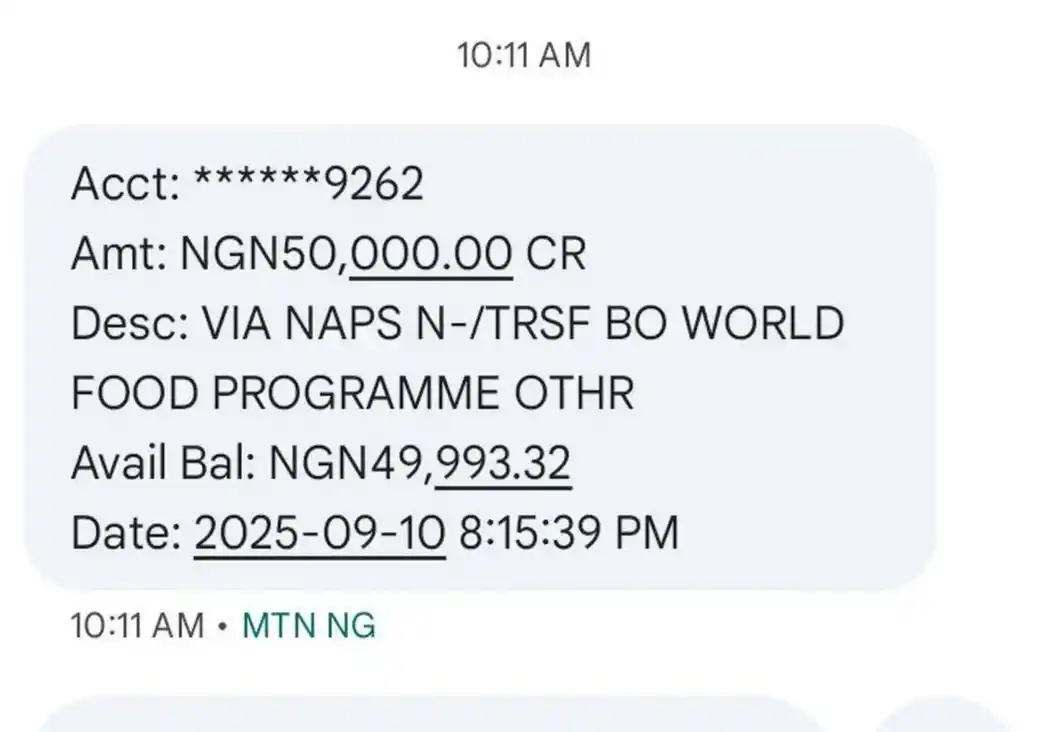
The United Nations World Food Programme (WFP) is once again in the news as Nigerians raise questions about possible ongoing disbursement of funds and food items. There are circulating claims that many beneficiaries have started receiving N50,000 under the World Food Programme initiative, along with items of food.

These claims are yet to be confirmed by either the Federal Ministry of Humanitarian Affairs and Poverty Alleviation or the United Nations office in Nigeria.

Recall that the World Food Programme was announced back in 2023 by the Federal Ministry of Humanitarian Affairs and Poverty Alleviation to fight hunger in Nigeria with a $2.5 billion investment.

The WFP pledged to support President Bola Tinubu’s Zero Hunger Programme as part of efforts to address food insecurity in the country. At the time, the Minister for Humanitarian Affairs and Poverty Alleviation, Dr. Betta Edu, who is now suspended, emphasised that this initiative would help millions of vulnerable Nigerians.

The World Food Programme had disclosed that 2.1 million Nigerians have already been captured as beneficiaries of the programme and said it hopes to expand further, working with the Ministry of Humanitarian Affairs.

The WFP explained that part of its plan is to support local food hubs by purchasing food locally and providing both cash transfers and food assistance. “These are very impressive,” the statement said during the launch.

Dr. Betta Edu had previously stated that there are over 133 million Nigerians affected by multidimensional poverty. She stressed that WFP’s intervention of $2.5 billion over five years “will go a long way to address some of the biggest challenges the country is facing, which is hunger.”

She also revealed that part of the plan was to create 774 humanitarian hubs, one in every local government area, to help distribute aid more effectively.

Attached below is circulating screenshot of disbursement SMS claims:

150,000 beneficiaries in Akwa Ibom receive N75,000 cash transfer

0

The National Cash Transfer Office (NCTO) has held a Stakeholders’ Sensitization Meeting in Uyo to address misconceptions about the Cash Transfer Programme under the National Social Safety Nets Programme (NSSNP).

The meeting focused on strengthening partnerships and deepening understanding of the initiative.

Speaking at the one-day workshop on Wednesday, the National Programme Manager of NCTO, Alhaji Abdulahi Iman, said the engagement was necessary to let people know the progress the office has made. He was represented by the Cross River State Programme Manager, Mr Francis Aribiah.

Iman explained that the initiative has provided financial support to poor and vulnerable households, helping them improve consumption and general well-being. According to him, the programme has recorded significant achievements, with more than 150,000 beneficiaries in Akwa Ibom State receiving direct cash transfers of 75,000 naira each.

Payments have been made either directly into their bank accounts or through debit cards by Financial Service Providers.

He stated, “We are here to clear the misconception surrounding the cash transfer initiative. People tend to doubt every government programme, especially those involving financial assistance to the poor and vulnerable. There is a belief that the funds are not reaching the intended beneficiaries. To address this, we’re explaining the programme’s structure to key stakeholders, who will then enlighten their communities.”

In his opening remarks, Dr Godwin Akpan, the State Focal Person of the National Investment Programme Agency, said the Cash Transfer Programme is a genuine initiative aimed at assisting vulnerable citizens.

He emphasized that the scheme is real and urged those who still have doubts to visit the Cash Transfer Desk Offices at their local government councils to verify the claims.

The sensitization meeting brought together stakeholders to discuss how to build trust around the cash transfer scheme and ensure that information about the programme reaches more communities.

Tinubu directs FG to cut rising food prices

0

President Bola Tinubu has directed the Federal Ministry of Agriculture and Food Security to take urgent measures to address the rising cost of food items across Nigeria.

The directive was revealed by the Minister of State for Agriculture and Food Security, Senator Aliyu Sabi Abdullahi, during a one-day capacity-building workshop for the Senate Press Corps held at the National Assembly Library Complex in Abuja.

Speaking at the event, Abdullahi outlined a series of reforms introduced by the Tinubu administration aimed at stabilising food prices, strengthening agricultural value chains, and easing the economic pressure faced by Nigerian households.

Abdullahi said, “The President has issued a marching order, and a Federal Executive Council committee is actively working to ensure the seamless movement of food products across key routes. The cost of transporting food significantly affects final prices, and this government is determined to intervene.”

He explained that the government’s intervention would focus on addressing inefficiencies in the country’s food transport system, which has long been identified as one of the main drivers of food inflation. The minister noted that poor transportation infrastructure continues to cause significant post-harvest losses and price increases.

To tackle this, the Federal Ministry of Agriculture is expanding the Post-Harvest for Sustainable Development Programme to help farmers reduce losses while improving storage and distribution capacity.

“The government is also launching initiatives such as the Farmer’s Health Skill Programme and a comprehensive reform of agricultural cooperatives to empower rural communities and boost local production,” Abdullahi added.

The minister also stressed the importance of reducing Nigeria’s dependence on imported agricultural inputs to protect the country from global price shocks. “These reforms are crucial for ensuring food security, creating jobs, and relieving the economic burden on Nigerians,” he said.

At the same workshop, former Presidential Adviser on National Assembly Matters, Senator Ita Enang, warned the 10th Senate against exceeding its constitutional mandate, particularly in matters involving private companies not engaged in managing public funds or executing federal laws.

Enang, who served in both chambers of the National Assembly between 1999 and 2015, said some recent activities by legislative committees showed overreach and threatened the rule of law.

“There is a current trend where the legislature, through her committees, has exceeded her powers in many respects, especially concerning private companies and citizens beyond her remit,” Enang said.

He cited legal precedents including DHL International Nigeria Ltd v. Senate and NECA & Ors v. Attorney-General of the Federation, restating that under Sections 88 and 89 of the 1999 Constitution (as amended), the National Assembly’s investigative and legislative powers apply strictly to public entities and those managing public resources.

Quoting Justice J.H. Sankey of the Court of Appeal in the NECA case, he noted that private organisations not handling public funds or implementing federal mandates cannot legally be subjected to legislative investigations.

“Any continued action by Senate Committees in this regard, especially with pending cases in court, amounts to undermining the rule of law,” Enang warned.

His caution followed concerns raised by the Nigeria Employers’ Consultative Association (NECA) in an open letter published in ThisDay on September 8, where the association highlighted what it described as legislative interference in corporate governance.

Enang aligned with these concerns, arguing that such actions “create confusion, undermine the authority of MDAs, and waste valuable business resources.” He advised the legislature to wait for the Supreme Court’s decision on the matter before pursuing further inquiries into private sector operations.

Addressing journalists at the event, Enang urged correspondents covering the National Assembly to focus on substance rather than sensationalism in their reporting.

He said, “Parliamentary journalism is a specialised field that contributes significantly to democratic growth. I encourage you to study bills before reporting them. This improves both public understanding and journalistic credibility.”

He further recommended regular training opportunities for legislative correspondents through institutions like the National Institute for Legislative and Democratic Studies (NILDS).

Enang also encouraged journalists to consider careers in politics. “Others have done it. You too can,” he said.

The workshop was attended by key figures including the Senate Spokesperson, Senator Yemi Adaramodu, Clerk to the National Assembly, Mr. Kamoru Ogunlana, and the Director-General of NILDS, Prof. Abubakar Sulaiman. Participants included correspondents and media professionals assigned to cover National Assembly activities.


Kano calls for nominations into digital ambassadors (KADA) programme

0

Kano State Information Technology Development Agency (KASITDA) has announced a call for nominations for the Kano Digital Ambassadors (KADA) programme.

The initiative is designed to promote digital innovation, collaboration, and strategic partnerships through natives in the diaspora while supporting the growth of the digital economy in Kano State.

According to KASITDA, “The Kano Digital Ambassadors (KADA) programme is an initiative organised to enhance digital innovation, collaboration, and strategic partnerships through natives in diaspora, promoting the growth of the digital ecosystem in Kano State.”

The agency explained that the programme will allow ambassadors to represent the state’s vision of becoming a digital hub. “As an ambassador in the Kano Digital Ambassadors (KADA) programme, you will be enabled to represent the state’s vision for a digital state,” it stated.

Nominations are open to professionals of Kano origin excelling in technology, digital innovation, and related fields. Deadline is to be announced, while applications can be submitted via https://kasitda.ng/kano-digital-ambassadors/.

NBTE circular: TVET staff without Master’s to convert to non-teaching

0

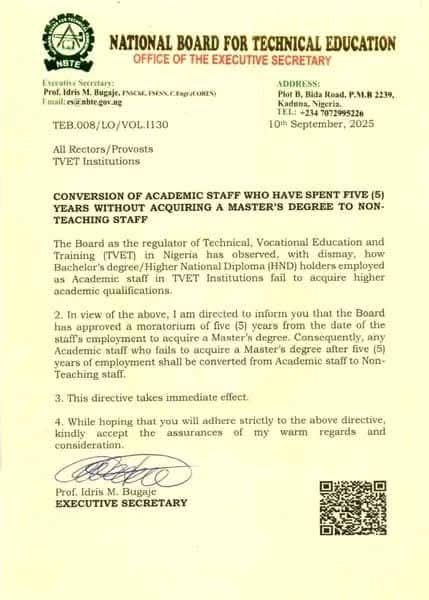
A circulating document dated 10th September 2025 has raised concerns within the education sector. The letter, signed by the Executive Secretary of the National Board for Technical Education, Prof. Idris M. Bugaje, FNIAE, FNSChE, Engr (COREN), carried reference number TEB.008/LO/VOL.1130 and was addressed to all Rectors and Provosts of Technical and Vocational Education and Training (TVET) institutions across Nigeria.

The document states that the Board, as the regulator of TVET in Nigeria, has observed “with dismay” how some Bachelor’s degree and Higher National Diploma holders employed as academic staff in TVET institutions fail to acquire higher qualifications.

According to the letter, a moratorium of five years has been approved for academic staff to obtain a Master’s degree. “Consequently, any Academic staff who fails to acquire a Master’s degree after five (5) years of employment shall be converted from Academic staff to Non-Teaching staff,” the directive reads.

The letter further notes that the directive takes immediate effect, urging all heads of institutions to comply strictly. Prof. Bugaje concluded by stating, “While hoping that you will adhere strictly to the above directive, kindly accept the assurances of my warm regards and consideration.”

As at the time of this report, there has been no official confirmation from the Board regarding the accuracy of this circulating document.

Attached below is the circular in circulation: