Home Blog Page 438

Bauchi State trains youths on cybersecurity

0

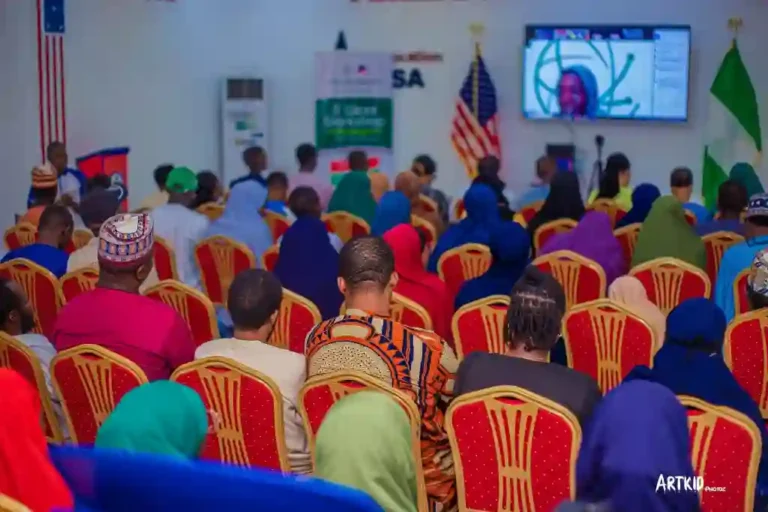
The Office of the Special Adviser on Youth and Entrepreneurship, in collaboration with American Space Bauchi, has successfully completed the 7th week of its flagship 8-Week Entrepreneurship and Digital Skills Training program.

This week’s session was led by Ms. Mustapha, Director of Cybersecurity at NITDA Abuja, who delivered a practical and interactive training on online safety, digital responsibility, and cybersecurity essentials. She emphasized the importance of building a credible online presence and protecting personal information.

Participants were taught how to identify and avoid internet scams, safely use public WiFi, and report cases of online fraud through the Central Bank of Nigeria (CBN). “Cybersecurity is not just about technology, it’s about awareness and taking proactive steps to stay safe online,” Ms. Mustapha said.

Over 80 participants attended the session, including an interpreter for the deaf. Their active engagement and questions highlighted the growing need for digital security education among young entrepreneurs in Bauchi.

Advertisement

NITT, ITF begin project Mgmt certification for skills-up artisans

0

The Nigerian Institute of Transport Technology (NITT), Zaria, in partnership with the Industrial Training Fund (ITF), has commenced examinations and certification for participants of the ITF Skills-Up Artisans Programme. The initiative focuses on improving employability and entrepreneurship by equipping Nigerians with practical skills to support national development.

The artisans, who completed intensive training, are being examined and certified in Project Management by the Chartered Institute of Project Managers of Nigeria (CIPMN). The exercise is taking place at the Transport Technology Centre (TTC), Zaria, and is coordinated by the Director of the Centre, Dr. Joshua Odeleye.

Dr. Odeleye said, “This programme reflects our dedication to advancing technical capacity and promoting professional excellence in the transport and allied sectors.”

The Skills-Up Artisans Programme is part of ITF’s broader plan to build a skilled workforce that drives sustainable economic growth.

NDE, NELFUND to expand student loans, skills training

0

The Director-General of the National Directorate of Employment (NDE), H.E Silas Ali Agara, has welcomed representatives from the National Education Loan Fund (NELFUND) in a meeting focused on collaboration to expand access to education and job creation in Nigeria. The NELFUND team was led by its Managing Director, Mr. Akintunde Sawyerr, who explained the agency’s mission of supporting Nigerian students.

According to Mr. Sawyerr, “NELFUND is committed to ensuring that no Nigerian student is denied access to higher education due to financial constraints.” He stressed the importance of education in creating value and empowering individuals, noting that the fund aims to bridge financial gaps by providing student loans and working with agencies such as NDE to enhance skills development.

Reports from Nigeriastartupact on July 22, 2025, confirmed that the Federal Government approved ₦120 billion for TVET training through NELFUND, highlighting the government’s investment in technical and vocational education.

The NDE Director-General expressed appreciation for the meeting with NELFUND and outlined the agency’s contribution to national growth. “The NDE has training centres across the country and continues to collaborate with universities to equip young graduates with technical skills,” he stated.

The meeting concluded with discussions on possible areas of partnership, including training programmes and skills development initiatives. Agara emphasized his readiness to work with NELFUND in expanding opportunities for Nigerian students and enhancing access to higher education and employment pathways.

National Universities Commission opens recruitment

0

The National Universities Commission (NUC), Nigeria’s apex regulatory agency for university education, has announced job vacancies at its headquarters located at No. 26, Aguiyi Ironsi Street, Maitama District, P.M.B. 237, Garki, Abuja. The Commission confirmed that applications are now open to suitably qualified Nigerians to fill positions across different cadres.

According to the notice, the vacant positions fall under three main categories: Officer Cadre, Confidential Secretary Cadre, and Clerical and Auxiliary Staff Cadre. Under the Officer Cadre, available roles include Senior Officer (CONTISS 9), Trainee/Officer I (CONTISS 8), and Trainee Officer II (CONTISS 7). The Confidential Secretary Cadre has an opening for Confidential Secretary I (CONTISS 7). The Clerical and Auxiliary Staff Cadre includes Assistant Cameraman (CONTISS 5), Data Processing Assistant (CONTISS 5), Artisan/Craftsman roles such as Carpenter, Plumber, Electrician, and Air-conditioning Mechanic (CONTISS 4 or CONTISS 3), Lift Operator (CONTISS 4 or CONTISS 3), and Motor Driver/Mechanic (CONTISS 4 or CONTISS 3).

The Commission stated, “Application is open to all eligible Nigerian citizens from the ages of 18 to 50 and are required to possess appropriate qualifications, competencies, skills, and orientation. NYSC discharge or exemption certificate, digital skills, and computer literacy shall be required for applicants for CONTISS 7-9.”

For the Senior Officer (CONTISS 9), applicants must possess a Ph.D. degree in disciplines relevant to the Commission’s mandate or a Master’s degree with at least four years of post-qualification cognate experience. A first degree with at least six years of cognate experience may also be accepted, with additional professional qualifications considered an advantage.

For Trainee/Officer I (CONTISS 8), candidates must hold a Master’s degree in relevant fields or a first degree plus at least three years of cognate experience. Trainee Officer II (CONTISS 7) requires a first degree in relevant disciplines, with professional qualifications serving as an advantage.

In the Confidential Secretary Cadre, applicants for Confidential Secretary I (CONTISS 7) must possess at least a Higher National Diploma in Secretarial Studies plus three years of post-qualification cognate experience.

For the Assistant Cameraman (CONTISS 5), a National Diploma in Cinematography or Mass Communication is required, with experience seen as an added benefit. A Data Processing Assistant (CONTISS 5) must have at least a National Diploma in fields relevant to the Commission’s work, with cognate experience also viewed as an advantage.

The Artisan/Craftsman roles under CONTISS 4 or CONTISS 3 require at least an ‘O’ Level Certificate or equivalent, with Class II/III Trade Test Certificates in the specific trade. Technical training and cognate experience are considered an advantage. Lift Operator applicants must have a First School Leaving Certificate, with technical training in lift operation seen as an added benefit. Motor Driver/Mechanic applicants are expected to hold at least an ‘O’ Level Certificate or equivalent, a Class II/III Trade Test Certificate for Motor Mechanic Work, and a valid Class ‘C’ Driving License. Experience is also considered an advantage.

The Commission emphasized that the method of application is strictly online. “Interested and eligible applicants are to visit careers.nuc.edu.ng or visit the Commission’s official website at www.nuc.edu.ng, navigate to Careers Portal (at the top right corner of the page) to access the portal and submit their applications not later than six weeks from the date of this advertisement,” the statement read.

It added, “Application is free, and only shortlisted candidates will be contacted for the next phase of the recruitment exercise.”

Cross River disburses N800m grants to 400 farmers, ex militants

0

Cross River State Government has empowered 400 of its citizens, including farmers and former members of the defunct Bakassi Defence Force, with grants worth N800 million to support reintegration and entrepreneurial growth in agriculture and other ventures.

The beneficiaries, who had recently completed intensive training on Innovative and Integrated Agricultural Value Chain at CSS Farms in Nasarawa State, each received N2 million as seed capital to establish and expand their businesses.

On September 23, Nigeriastartupact reported the full list of 400 Cross River beneficiaries under Gov Otu’s N800m grant.

The empowerment initiative, valued at N800 million, is part of the state’s broader People First agenda, which is targeted at wealth creation, employment generation, and the promotion of food sufficiency before the end of the current administration.

Governor Bassey Otu, speaking at the event in Calabar on Tuesday, said the program was designed to redirect the strength of young people away from destructive activities and channel it into productive ventures.

“Today’s empowerment program is primarily targeted at redirecting the strength and energy of our youths from destructive to productive ventures. The youth as a critical demographic set is the pulse of the society, as they are as versatile as they are volatile,” Otu stated.

The Governor explained that the initiative was not a showcase of abundant state resources but a deliberate human capital investment aimed at transforming societal liabilities into development assets.

He emphasized that agriculture was carefully selected as the focus sector, given its importance to food security and its cascading benefits to economic development.

“We are poised to remove the character of our young ones and transform them from being societal liabilities to veritable development assets. The seed capital we are giving out today is to test your dexterity and commitment. Once we see what you have done with this, we are ready to add another,” Otu assured.

The Governor further told the former agitators that they were not stigmatized but welcomed as contributors to the state’s development. He stressed that empowerment had always been his guiding principle, even during his time in the National Assembly.

Commissioner for Wealth Creation and Employment, Patrick Egbede, described the event as a milestone in the state’s drive to promote economic development and generate jobs.

“It is my great pleasure to celebrate the graduation of 400 Cross River State citizens—200 farmers and another 200 repentant agitators—from the intensive training at CSS Farms. The skills and knowledge acquired will enable them to make meaningful impact in their communities and contribute to state economic growth,” Egbede said.

He noted that the Otu-led administration had also trained 100 youths in ICT, particularly in web development and programming, showing its broader commitment to youth empowerment beyond agriculture.

Egbede added that monitoring committees had been set up across the three senatorial districts to ensure accountability and effective use of the grants. He explained that beneficiaries who demonstrate commitment and success in managing their seed capital will have access to additional funding support from the state government.

Some of the beneficiaries expressed appreciation to the state government for the opportunity. Speaking on behalf of the group, Mrs. Mary Ekuri and Solomon Essien thanked Governor Otu and pledged to make the best use of the empowerment for self development and wealth creation.

At the ceremony in Calabar, Governor Otu also described the initiative as a strategic step to position Cross River State as Nigeria’s coffee capital and an emerging player in the global coffee market.

“The project aligns with the administration’s People First agenda and is aimed at empowering farmers, creating jobs, promoting sustainable livelihoods, and boosting agro-industrial development,” he explained.

He added that with 30 million robust and climate-appropriate seedlings being distributed across the 18 Local Government Areas, the project will go beyond cultivation to drive job creation, wealth generation, ecological restoration, and the building of an inclusive economy.

The Governor said the seed capital support, agricultural expansion, and training programs are all targeted at creating sustainable wealth, promoting food sufficiency, and opening up more opportunities for youth empowerment and entrepreneurship in Cross River State.

UNGA80: Nigeria showcases $200bn energy transition, AfCFTA Investment

0

Vice President Kashim Shettima on Monday showcased Nigeria’s 200 billion dollar energy transition opportunity to global investors, stressing the importance of “partnerships” to maximize the multi-faceted, multi-billion investment opportunities across the country.

He also pointed out that Nigeria’s sovereign rating by international platforms such as Fitch and Moody’s indicates that the country is positioned as the natural hub for the African Continental Free Trade Area’s 3.4 trillion dollar market.

The Vice President drew global attention to the multi-billion economic reforms underway in Nigeria, which he said are anchored on President Bola Ahmed Tinubu’s Renewed Hope Agenda.

According to a release issued by his Media Assistant, Stanley Nkwocha, Shettima made the presentation at the Roundtable hosted by the Business Council for International Understanding, themed “Risk, Reform, Return.” The event was held on the margins of the 80th Session of the United Nations General Assembly in New York City.

Representing President Bola Tinubu at the UNGA80, Shettima stated that in today’s interconnected age, the wealth of a nation does not come through miracles or inheritance but through deliberate reforms and partnerships.

He began by showcasing the size of Nigeria’s economy, stressing that Nigeria is West Africa’s largest economy and Africa’s biggest consumer market, with 236 million people today, projected to rise to 320 million by 2040.

Highlighting Nigeria’s demographic advantage, Shettima noted that with a median age of about 17, more than 58 percent of Nigerians are under the age of 30. He said this makes the country home to one of the deepest talent pools in the world.

“When you add to this our geographic position as a natural hub for trade between Africa, the Americas, and Asia; our 44 distinct natural resources; our five tech unicorns; the largest oil reserves in Africa; and 210 trillion cubic feet of proven gas reserves, you see that Naija no dey carry last,” he told the gathering.

The Vice President emphasized that since mid-2023, under President Tinubu’s Renewed Hope Agenda, Nigeria has embarked on one of the boldest economic resets in its history.

He explained that the government has unified exchange rates, removed decades-old fuel subsidies that distorted the economy, modernized tax and customs regimes, strengthened fiscal oversight, and overhauled trade and investment policies.

“This reset includes full implementation of the AfCFTA, the roll-out of a National Single Window for trade, a new Investment and Securities Act, an upgraded PPP framework, and modernized bilateral investment treaties,” he said.

Shettima noted that reforms are already showing results. “Our GDP growth is accelerating, our external reserves are strengthening, and inflation is moderating. This is why investor commitments are also rebounding.”

He further recalled that in April, Fitch upgraded Nigeria’s sovereign rating to B with a stable outlook, while Moody’s raised its issuer rating to B3 with a stable outlook. He said both platforms cited Nigeria’s improved buffers and clearer policy direction. “This positions Nigeria as the natural hub for the AfCFTA’s 3.4 trillion dollar market,” he stressed.

The Vice President explained that Nigeria has built a four-pillar incentives framework designed to reduce investor risk, accelerate cash returns, and make the country one of the most competitive destinations for capital in the Global South.

“A simpler, predictable tax regime now offers clear capital allowances, research and development deductions, and export-linked rebates, while investors in priority sectors can achieve faster breakeven through five percent annual tax credits on qualifying capital expenditure,” he stated.

He also highlighted that in Nigeria’s Special Economic Zones, the federal government offers duty-free imports, rent concessions, rebates on non-oil export proceeds, and integrated logistics platforms that unlock working capital for exporters.

“Cross-border protections now include updated bilateral investment treaties, investor promotion and protection agreements, structured repatriation pathways, and streamlined FX access. These give investors confidence that their capital and profits are protected,” Shettima told investors.

On agriculture, the Vice President explained that Nigeria’s Special Agro-Industrial Zones are cutting post-harvest losses by up to 40 percent and linking farmers directly to processing and export hubs, thereby transforming the country from a fragmented producer into a continent-scale food system that serves millions across West Africa.

Speaking on energy, Shettima disclosed that Nigeria offers a 200 billion dollar energy transition opportunity, backed by 210 trillion cubic feet of gas reserves and one of the highest solar irradiation levels in Africa.

He added that fiscal incentives and VAT waivers are reducing investment risks in both traditional and renewable energy assets, including gas-fired independent power plants, off-grid solar projects, and clean hydrogen pilots.

The Vice President further observed that Nigeria faces a one billion dollar annual infrastructure gap in transport, ports, and power. However, through InfraCorp and the Nigeria Sovereign Investment Authority, the government is blending sovereign and private finance to fund metro lines, dry ports, and industrial corridors. According to him, these projects are building the backbone of West African trade while creating long-term revenue streams for investors.

“Special Economic Zone clusters now host over five billion dollars in installed industrial capacity, with backward-integration incentives and AfCFTA corridors opening a multi-billion dollar continental market. These reforms are transforming Nigeria into Africa’s production floor and innovation lab,” Shettima said.

He also disclosed that Nigeria is rich in mineral resources, hosting 44 commercially viable minerals worth over 700 billion dollars under a new beneficiation and security regime. He said investors have opportunities to secure early positions in lithium, gold, bitumen, and rare earths, which are critical to the global green transition.

The Vice President stressed that Nigeria accounts for 29 percent of Africa’s internet usage, has raised over two billion dollars in venture funding, and is currently training three million new tech talents. He said this makes the country Africa’s fastest-scaling digital hub, with growth in fintech, AI, cloud services, and broadband rollout.

He added that the creative economy, currently valued at 15 billion dollars, is projected to reach 100 billion dollars by 2030. “Nigeria’s entertainment hubs, especially Nollywood, Afrobeats, gaming, animation, and fashion, are expanding under incentives for IP protection and creative hubs that consolidate Nigeria’s place as the cultural superpower of the Global South,” he said.

On healthcare, Shettima noted that the sector is already an 18 billion dollar industry. He pointed to Executive Orders on local manufacturing, a 1.57 billion dollar World Bank primary healthcare programme, and specialist centres built by the Nigeria Sovereign Investment Authority as proof of government commitment to expanding the sector.

Minister of Industry, Trade and Investment, Dr. Olajumoke Oduwole, also emphasized that since May 2023, under President Bola Ahmed Tinubu’s Renewed Hope Agenda, Nigeria has embarked on one of the boldest economic resets in its history.

She explained that the administration unified the nation’s exchange rate, removed the fuel subsidy, modernized tax and customs regimes, and strengthened fiscal oversight.

Oduwole further noted that President Tinubu overhauled the nation’s trade and investment policy, which now includes full implementation of the African Continental Free Trade Area Agreement, a National Single Window Project for trade facilitation, a new Investment and Security Act, an upgraded Public-Private Partnership framework, and modernized Bilateral Investment Treaties.

She added that the impact of these reforms is already visible. “Gross Domestic Product growth is accelerating, external reserves are strengthening, inflation is moderating, and investment commitments are rebounding,” she said.

“In April, Fitch upgraded Nigeria’s Sovereign Rating to B, which is stable, and Moody’s lifted its issuance rating to B3, also stable. Now citing improved buffers and clear policy directions, there is over 50 billion dollars in investment interest and announcements tracked across key sectors since these reforms began,” Oduwole explained.

Earlier in the day, Vice President Shettima, representing President Tinubu, attended the United Nations General Assembly Hall at the UN Headquarters for the High-Level meeting marking the 80th anniversary of the UN General Assembly.

At the event, President Tinubu delivered a three-minute address where he celebrated the spirit and successes of the United Nations. He praised its legacy of promoting peace, protecting human dignity, and advancing global development goals.

ESMI opens application for NYSC low-cost programme cohort 3

0

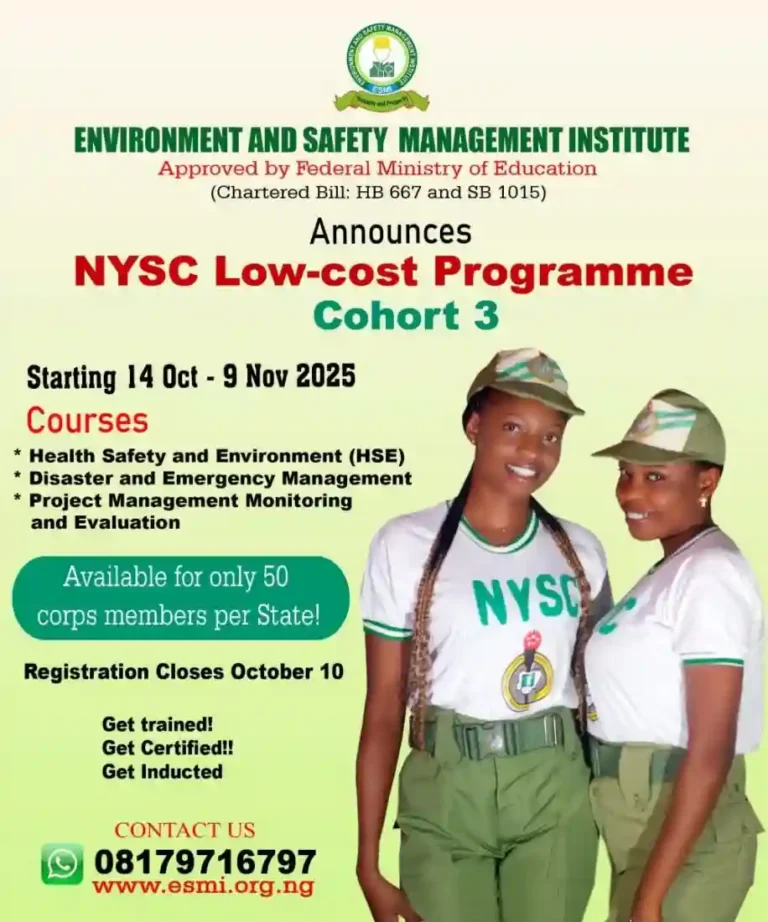
September 24, 2025 – Environment and Safety Management Institute (ESMI) has announced the launch of the ESMI NYSC Low-Cost Programme Cohort 3, approved by the Federal Ministry of Education.

The institute said the programme will provide corps members with affordable training in Health, Safety, and Environment, Disaster and Emergency Management, as well as Project Management, Monitoring, and Evaluation.

According to ESMI, “Registration will run from 14 October to 9 November 2025, and only 50 corps members per state will be admitted.” The institute stressed that spaces are limited, urging interested candidates not to delay.

The registration deadline is October 10, 2025. For details, corps members are advised to contact 08179716797 or visit www.esmi.org.ng.

Oyo youth skill-aid printing and publishing training opens registration

0

Oyo youths have been invited to register for the Oyo Youth Skill-Aid Printing and Publishing Training Program organized by the Office of the Special Assistant to the President on Youth Initiatives.

The program is led by Dr. Titilope Gbadamosi, Special Assistant to the President on Youth Initiatives (Monitoring and Delivery), in partnership with University Press Plc, the foremost publishers. The Skill-Aid Initiative is designed to provide practical training in printing, graphics, and publishing for employability and entrepreneurship.

The training is open to indigenes and residents of Oyo State between the ages of 18 and 40. She said, “The Oyo Youth Skill-Aid Printing and Publishing Training Program is a pathway for young people to unlock their future in the printing enterprise through hands-on training, industry-standard equipment, and expert instructors.”

The specialized courses include Certificate Course in Graphics Design, Digital Painting and Publishing, Certificate Course in Plate Making in Sheet-fed and Web-offset, Executive Course in Printing Business Management and Entrepreneurship Development, Certificate Course in Gravure and Flexo-Printing, and Certificate Course in Pre-press Operations covering design, layout, and color management.

Other areas of study are Post-press Operations in finishing, binding, and packaging, Printing Machine Installation and Maintenance, Troubleshooting and Repair, Printing Workflow Management, Print Estimating and Costing, Print Sales and Marketing, and Screen Printing.

The Skill-Aid professional printing training program is perfect for beginners and those who want to upskill. Candidates will be provided with real-world skills with certification after completion. Spots for the training are limited, and interested applicants have been urged to register through the link https://forms.gle/6SNTahJ5d18rZrxg8 before September 29, 2025. Training is scheduled to begin in the first week of October.

TVET portal login showing invalid credentials, network issues

0

There is a current trend of Technical and Vocational Education and Training (TVET) invalid credentials when trainees try to log into their dashboard. TVET portal login keeps showing Invalid credentials.

Don’t panic if you experience this on the login page www.tvet.education.gov.ng/login because it’s network issues. Even if you try resetting the password, it is all the same.

The solution is to keep trying, and eventually you will be logged in. Just make sure that you are entering your correct username and password. But before you click on log in, make sure to tick that ‘Remember Password’ to prevent your browser from asking for password when next you are logging in.

FME TVET approves trainees, sends email to resume training

0

September 24, 2025 – Federal Ministry of Education (FME) Technical and Vocational Education and Training (TVET) has approved trainees for its ongoing skills development programme. The approvals are now being sent to shortlisted candidates through email notifications and also appear on their individual dashboards.

The approval notice shows the candidate’s trade such as Solar PV Installation and Maintenance, approval status, name and email address. For candidates who have been approved, the dashboard displays the status as “Approved.”

The TVET approval email reads:

“Congratulations – You Have Been Matched to Your Training Centre”

“Dear Applicant,

Congratulations! You have been successfully matched to [trade], located at:

Address: (name of state)

Phone: …”

According to the notification, shortlisted TVET trainees are required to report to their training centre within five (5) days of receiving the email to complete registration. Failure to do so will result in the cancellation of the application and the slot will be reassigned to another pending applicant.

Candidates are also directed to log in to their portal via the link www.tvet.education.gov.ng and download resources from the Resources section. These include a sample ID card which must be printed, attached with a passport photograph, and presented at the training centre during reporting.

Also, download the additional materials/resources provided for your skill training and bring them when reporting to your centre.

Shortlisted trainees can accept or reject their placement. If you accept your training centre match, you have to upload a photo of yourself for verification.

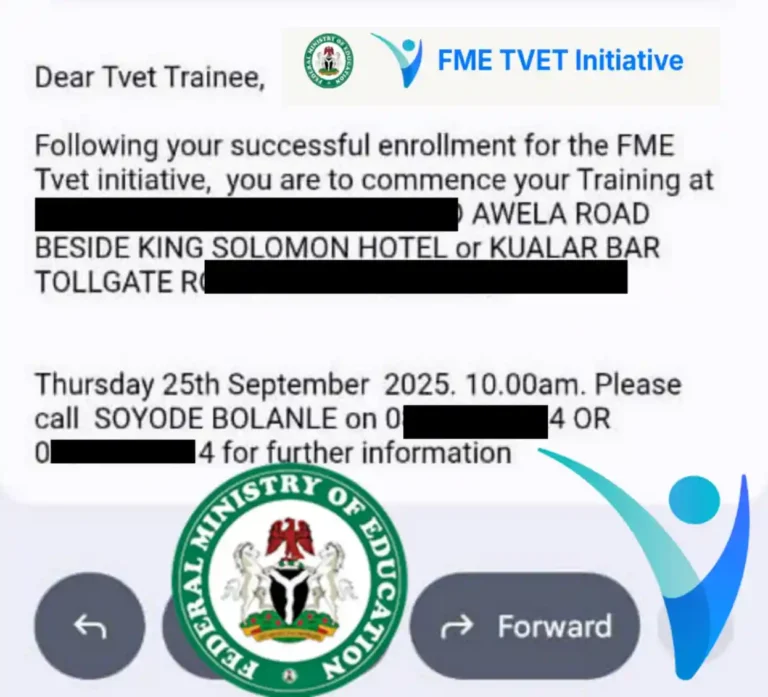
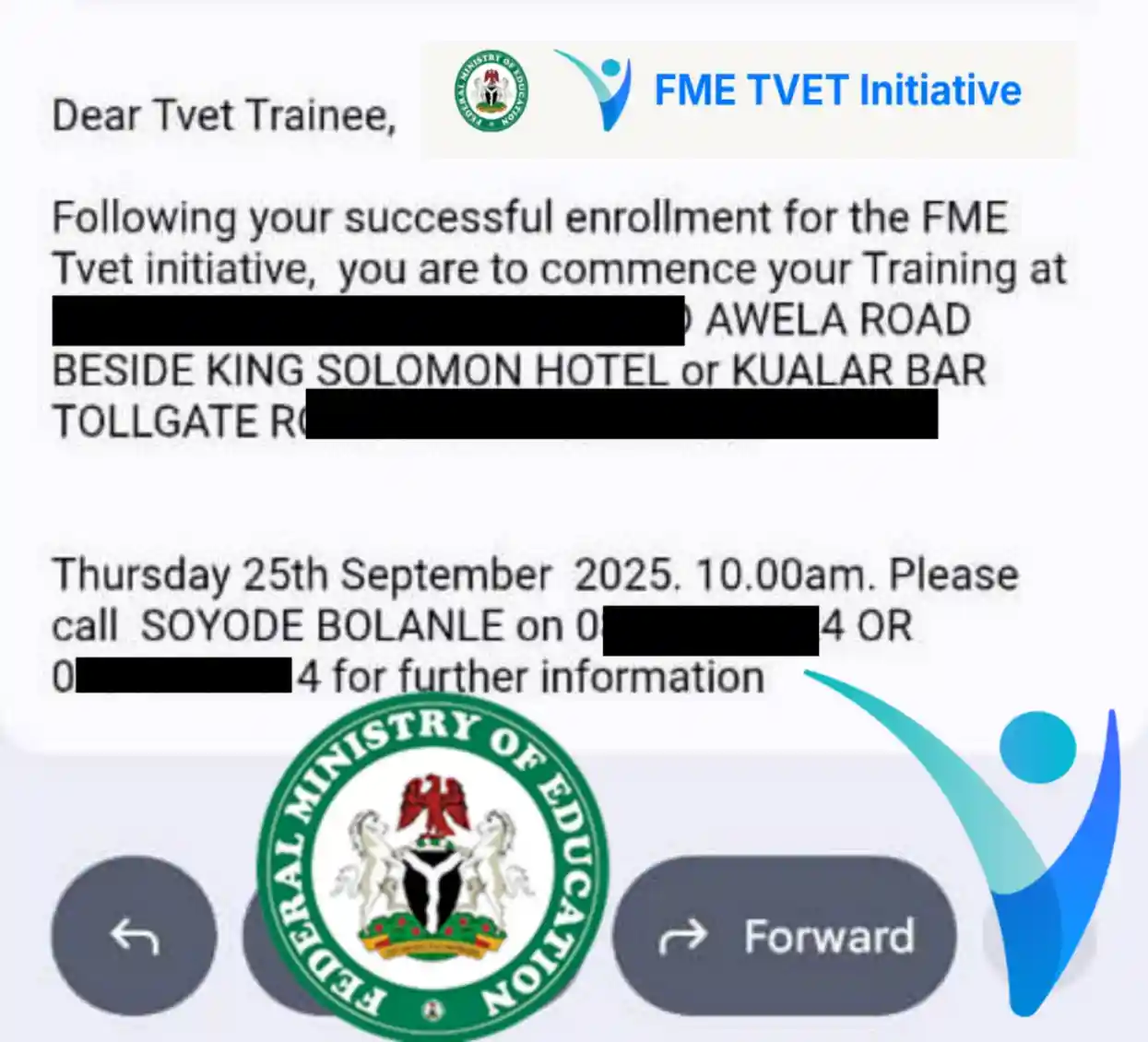
After successful enrollment under the FME TVET initiative, the trainee is expected to commence training at the centre mentioned in the email as well as on the dashboard. The follow-up email also includes the date, time, and phone number of the assigned trainer.

FME expects all trainees to maintain at least 65% attendance throughout this training programme. This is a requirement to qualify for the monthly stipend.

Some trainees are scheduled to begin training on Thursday 25th September 2025 at 10.00am.

Trainees whose status shows “Pending Approval” are to keep checking. The slots of approved trainees who fail to register will be transferred to unapproved applicants.

Trainees with other statuses like “Skill Type Not Available” and “Skill Not Assigned” should keep checking.

Attached below is screenshot proof of FME TVET trainee approval: