Home Blog Page 439

Road to Growth programme for women entrepreneurs in Ogun State now open

0

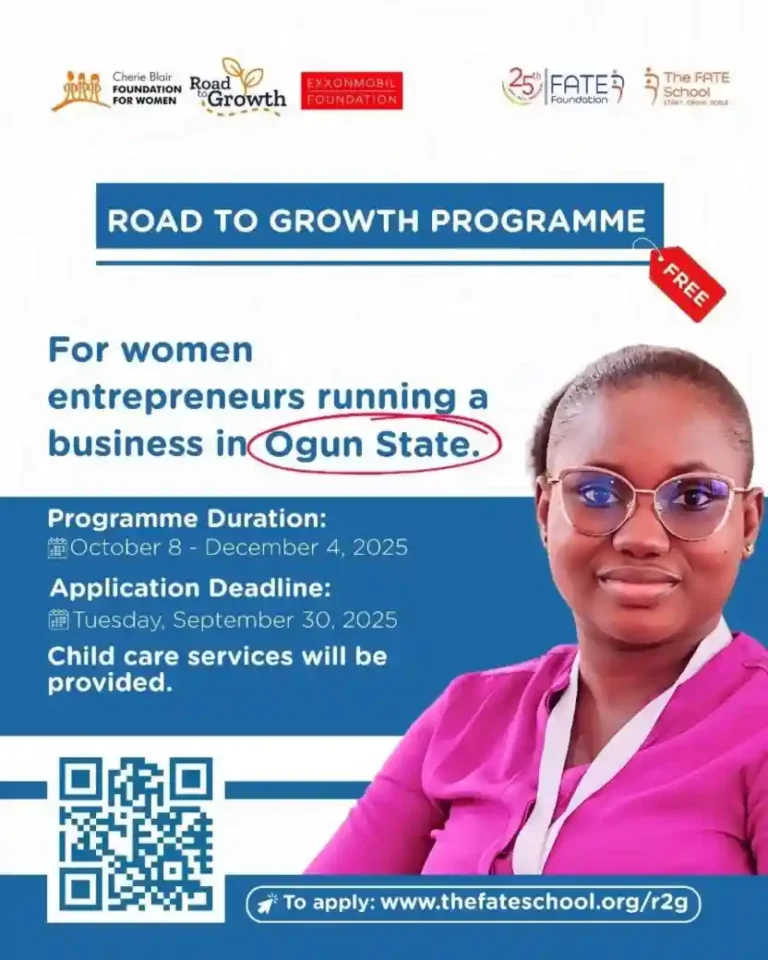
Applications are now open for the Road to Growth Cohort 6 Programme, a free initiative designed to support women entrepreneurs in Ogun State. The programme is powered by the Cherie Blair Foundation for Women in partnership with FATE Foundation, with ExxonMobil Foundation as a sponsor, and will run from October 8 to December 4, 2025.

According to the organizers, the Road to Growth Programme is a 9-week blended training that combines in-person and virtual sessions through the Cherie Blair Foundation Learning Management System (LMS). “The programme is designed to help women entrepreneurs build sustainable and thriving businesses,” they stated.

Participants will benefit from learning outcomes that include developing clear business visions, goals, and growth plans, stronger market positioning, improved financial literacy, and cash flow management. The training will also focus on digital marketing skills, access to financing, and strategies for balancing work and personal life.

“The Road to Growth Programme offers a robust financial and digital literacy curriculum, a financial management handbook, free MSME Hub resources, access to an AI financial tracker, and a business plan developer tool. Child care services will also be provided through a creche for nursing mothers,” the announcement explained.

The programme targets women entrepreneurs who own at least 50 percent of a business in Nigeria, with businesses that have been profitable for at least two years, employ between 3 and 49 workers, and are registered in Ogun State. Applicants must also have basic computer literacy and the ability to read and write in English.

The deadline for applications is Tuesday, September 30, 2025. Organizers urged eligible women to apply through the official portal link at www.thefateschool.org/r2g.

Advertisement

Akwa Ibom Gov tells NYCN to bring up programmes for youth development

0

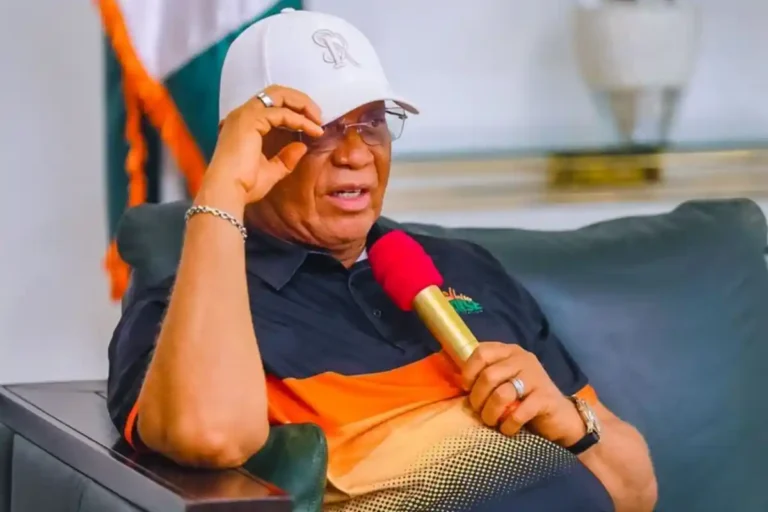
Akwa Ibom State Governor, Pastor Umo Eno, has urged the newly elected leadership of the State chapter of the National Youth Council of Nigeria (NYCN) to work closely with his administration and avoid sentiments that could divide the State. He made the call when he received the new youth leaders at Government House. The Governor, who had just returned from the gym dressed in shorts and a Polo tee-shirt, restated his focus on youth development, stressing that his government created a separate Ministry for Youth Development because of his strong belief in the future of young people.

He charged the council Chairman and his team to pursue impactful programmes that will leave lasting legacies. According to him, “During your tenure as Chairman, you should be able to say you pioneered this or that programme with your executive. That is the legacy you should leave behind. Work with the Honourable Commissioner to train and develop our young people. That is all I expect from you, not to fight yourself or the Government.”

The Governor emphasized his administration’s commitment to peace and unity, cautioning the youths against being used by individuals to cause unrest. He said, “There is no point in fighting each other. It is time for you to come together, sit together, work together, bring up programmes for the development of youths of Akwa Ibom State.”

He advised the leaders not to be swayed by those who may have sponsored their elections, stressing that their main commitment should be to the State. “From the faces I have seen here, I believe that you are good people and you should be able to collaborate and work with each other. Don’t bring ethnic sentiments here. We should work together. It is not about Ibibio, Annang, or Oro. You are all young people, and Akwa Ibom is one. Our forebears worked together, that is why we had the Ibibio State College in Annang Land,” the Governor said.

Governor Eno praised the Commissioner for Youth Development, Dr. Ekerette Ekanem, and the Electoral Board for the successful conduct of the election, urging the Commissioner to continue working with the new executive to advance youth empowerment initiatives under the ARISE Agenda.

Earlier, Dr. Ekanem recalled that it had been two years since the dissolution of the immediate past Executive Council of the NYCN. He explained that the election of new members was successfully conducted, in line with the Council’s constitution. He also commended the Governor for creating a separate Ministry of Youth Development and for supporting programmes that focus on youth empowerment. “Thank you so much for giving us the opportunity and platform to get our youths developed. Here before you are the new elected members of the State Youth Executive Council of the National Youth Council of Nigeria, Akwa Ibom State. The election was conducted successfully two days ago, and in line with the constitution of the National Youth Council of Nigeria,” Dr. Ekanem stated.

In his response, the newly elected State Chairman of the NYCN, Emmanuel Uko Ekong, expressed gratitude to the Governor for the opportunity to serve. He assured that the new executive would work with stakeholders to develop the youths of Akwa Ibom and align with the ARISE Agenda of the State Government.

Other members of the executive include Faith Godwin Akpan as Deputy Chairman, Peter Naphtali Akpan as Secretary, Oboho Akaiso Etim as Vice Chairman for Eket Senatorial District, Sunday Ubong Amanam as Vice Chairman for Uyo Senatorial District, Johnson Imoh Inyang as Vice Chairman for Ikot Ekpene Senatorial District, Urom Nseobong Mfonobong as Legal Adviser, and Udom Udokang Utitofon as Vice Chairman HQTRS.

Also elected were Akpan Friday Udo as Deputy Program Officer, David Solomon Ekpa as Organizing Secretary (Uyo), Abigail David Okon as Internal Auditor, Nsikak Abasi Okon Edet as Assistant Secretary, Otuwa Ubong Okon as Treasurer, John Nse Emmanuel as Organizing Secretary (Ikot Ekpene), and Sunday Ntiedo Ufot as Assistant Public Relations Officer. Others include Katomba Samuel Kingston as Organizing Secretary (Eket), Ibara Paul Paul as Public Relations Officer, Mfon Peter Akpan as Social Secretary, Ubong Effiong as Financial Secretary, Victor Archiving Etok as Programme Officer, Anietie Ita Nsikak as Organizing Secretary (HQTRS), and Akpan Anietie Benedict as Director of Entrepreneurship.

Additional members announced are Ubon Effiong Nelson as Director of Transport, Victor Edikpo as Director of Waterways, Augustine Aniema Bassey as Director of Education Monitoring, Akpan Demas Sunday as Director of Mobilization, Idot-eyen Thomas as Director of SDG, Brighten Sunday Maxwell as Director of Oil and Gas, Effiong Eyo Tuka as Director of Communication, and Akan Asukwo Offiong as Director of Intelligence.

Adamawa PAWECA releases batch A and B admission list for technical skill acquisition

0

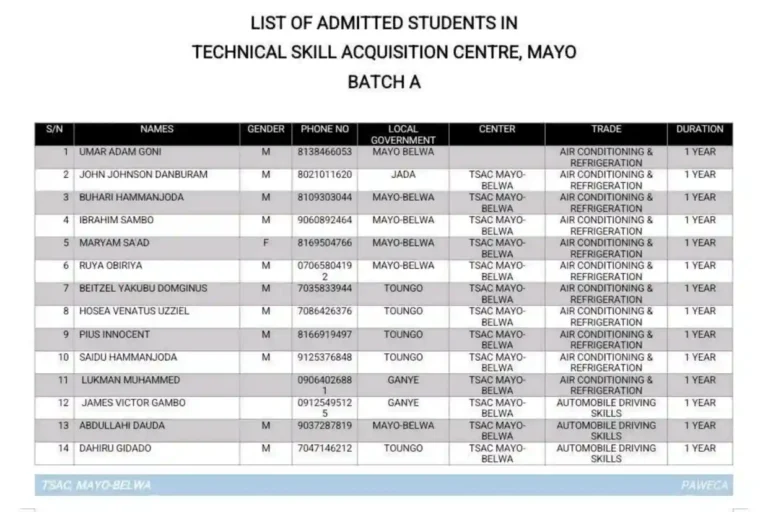
September 24, 2025 – Adamawa State Poverty Alleviation and Wealth Creation Agency (PAWECA) has announced that the admission list into the Technical Skill Acquisition for all the training centers Batch A and Batch B is out. The list of admitted candidates at the Technical Skill Acquisition Centre, Batch A and B, includes names, gender, phone number, local government, centre, trade, and duration.

The office of the coordinator has released an official notice to the public. According to the statement, “The final list of admitted students for the PAWECA skills acquisition program has been posted at the Local Government Secretariat.”

Beneficiaries have been urged to check and confirm their details. The coordinator added, “We kindly request all beneficiaries to visit and verify their names.”

FG unveils new agricultural incentives under renewed hope initiative

0

The federal government on Tuesday announced fresh incentives to boost agricultural investment under President Bola Tinubu’s Renewed Hope Agenda. This was part of ongoing reforms to unlock Nigeria’s vast food production potential through new policies that served as a game-changer for agriculture and infrastructure investments in the country.

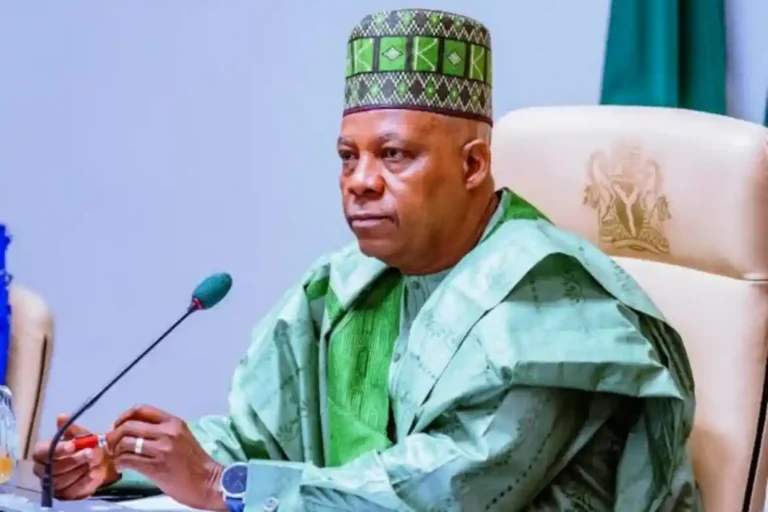
Vice President Kashim Shettima made this public in Abuja during the Food and Agriculture Organisation (FAO) National and Sub-regional Hand-in-Hand Investment Forum.

Shettima stressed that while hunger posed a global security issue, Nigeria must mobilise its strengths to secure a future of abundance.

According to him, “Nothing unifies humanity as much as hunger. It is the great equaliser that reveals our vulnerabilities and the shared fragility of our existence. Food is not merely a matter of survival; it is a matter of global security.”

He stated that the current administration was introducing single-window platforms for land registration, strengthening agricultural credit systems, expanding irrigation infrastructure, and scaling mechanisation.

He said, “We must facilitate access to land and resources for serious investors. We must drive mechanisation to reduce drudgery and enhance productivity. We must strengthen the agricultural credit system to ensure capital flows to where it is needed most.”

The vice president observed that irrigation was a game-changer, noting that Nigeria has river basins and aquifers capable of irrigating over three million hectares, but currently uses less than 10 per cent of them.

“Strategic investment in irrigation alone could triple yields, free us from seasonal dependency, and fortify our resilience against climate shocks,” he added.

Shettima also assured investors that Nigeria’s policies were being re-engineered to attract capital through regulatory reforms, public-private partnerships, and agri-tech innovation.

He said, “Nigeria is open for business, and we are ready to partner with you. Let us work hand-in-hand to build a Nigeria and a subregion where no one goes to bed hungry, where rural communities are hubs of wealth creation, and where agriculture is the true foundation of our prosperity.”

The vice president assured that Nigeria was open for business and ready to partner with relevant stakeholders and investors in implementing its national blueprint targeted at creating 21 million full-time jobs in rural and agrarian communities, while securing national food and nutrition sufficiency.

He stated, “The vehicle to this future is the quality of policies we have chosen to prioritise. At the top of these interventions stands our National Development Plan (2021–2025), which has set forth ambitious but achievable targets. This blueprint seeks to lift 35 million Nigerians out of poverty, create 21 million full-time jobs in rural and agrarian communities, and secure national food and nutrition sufficiency through deliberate and strategic investments in agriculture.”

Earlier, Minister of Agriculture and Food Security, Senator Abubakar Kyari, made a presentation on Nigeria’s investment atmosphere and country profile, highlighting key challenges and potentials for investment across the agribusiness value chain.

He said a combination of Nigeria’s domestic market, large arable land, clement weather and fast growing digital economy present unique opportunities for investment across the agribusiness ecosystem.

Minister of Budget and Economic Planning, Senator Atiku Bagudu, said the economic potential of Nigeria remained largely untapped, especially in agriculture and irrigation, which held significant promise for economic diversification and transformation.

Bagudu stated that agriculture, particularly agribusiness, was a pivotal component of Nigeria’s national development plan in the medium and long term, as well as the Renewed Hope Agenda.

Minister of Agriculture, Livestock and Food Security of The Gambia, Dr Demba Sabally, commended FAO for hosting the event and underscored Nigeria’s leadership in agriculture, highlighting the country’s success stories in the rice and cassava value chains as worthy of emulation by countries in the sub-region and beyond.

Sabally emphasised the need for peer review among countries in the West African sub-region because of their common challenges and opportunities for growth and transformation.

Speaking in a similar vein, the representative of FAO in Nigeria and ECOWAS, Dr Hussein Gadain, said the Hand-in-Hand Initiative was FAO’s “evidence-based, country-led, and country-owned flagship programme, designed to accelerate agricultural transformation and sustainable rural development.”

According to Gadain, the programme is squarely aimed at eradicating poverty, ending hunger and all forms of malnutrition, and reducing inequalities.

“It is our vehicle for achieving the SDGs,” he said.

Commending Nigeria’s clear agricultural development priorities and describing them as catalysts for transformative and sustainable growth within Africa’s agri-food systems, Gadain hailed Shettima’s commitment and visionary leadership in transforming Nigeria’s agri-food systems.

According to the FAO representative, the vice president’s “passion for agriculture, food security, and nutrition is unmatched. He has been a driving force in attracting crucial investments and fostering innovation, and his continued engagement deserves our highest commendation.”

Head of the EU Delegation in Nigeria, Mr Gautier Mignot, said the Hand-in-Hand initiative reflected Nigeria’s strong commitment to strengthen food security and deepen investment across the agribusiness value chain.

Mignot declared that the EU remained a long-term partner in Nigeria’s agricultural journey and was committed to investing in value chain development in the country, starting with the recent investment of over 80 million euros to unlock opportunities in key value chains across seven states.

Mignot said the EU stood ready to deepen collaboration with Nigeria as a partner to ensure irrigation became a pathway for economic growth and agricultural transformation.

Nigeria’s IGR jumps 411% from ₦711bn to ₦3.635trn in 2025

0

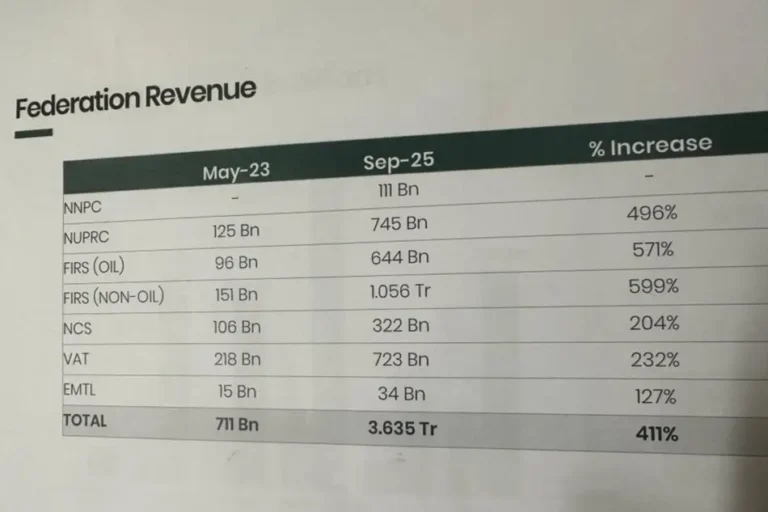
Sunday Dare, spokesperson to President Bola Tinubu, has said Nigeria’s internally generated revenue (IGR) has climbed by 411 percent within two years, moving from ₦711 billion in May 2023 to ₦3.635 trillion by September 2025.

He explained that in May 2023, the country was close to a financial breakdown. “A little over two years ago, Nigeria stood dangerously close to a fiscal cliff. Federation revenue was just ₦711 billion. Debt servicing consumed nearly all that government earned. Deficits were ballooning. Our economy risked being trapped in a vicious cycle of borrowing just to survive. In fact, many feared that Nigeria was inching toward insolvency — unable to service its debts, unable to fund development, unable to inspire confidence at home or abroad,” Dare said.

According to him, the story has now changed. “By September 2025, Nigeria’s story is transformed. Federation revenue has surged to ₦3.635 trillion — a remarkable 411 percent increase in just over two years. This leap is not an accident. It is the product of deliberate choices, bold reforms, and the steady hand of leadership. And this is where President Bola Ahmed Tinubu’s savvy came in,” he added.

Drawing parallels to Lagos, Dare recalled Tinubu’s track record as governor. “For those who remember Lagos in 1999, the parallels are striking. Then, Lagos was a state crippled by low revenues, struggling to meet its obligations, dependent almost entirely on federal allocations. But Governor Tinubu charted a new course. He built the foundations of an internally generated revenue machine that today makes Lagos the fifth largest economy in Africa.”

He said Tinubu achieved that by relying on his financial background and reform mindset. “He did not achieve this by chance. He drew on his professional background as a finance expert, an accountant who had cut his teeth in the oil and gas sector, and a man who had worked in Nigeria and America, understanding how modern systems deliver results. He combined technical knowledge with political courage — modernizing tax administration, broadening the revenue base, and showing that transparency and accountability could unlock prosperity. That same vision, that same courage, is what he has brought to the presidency.”

The breakdown of revenue performance shows significant gains. Dare said, “Today, the NNPC, once shrouded in opacity, is a contributor — remitting ₦111 billion. The NUPRC has grown its collections nearly fivefold, from ₦125 billion to ₦745 billion. The Federal Inland Revenue Service has shattered records: oil taxes up 571 percent, non-oil revenues up 599 percent, crossing the trillion-naira mark for the first time in history. VAT revenues have more than tripled. Customs revenues doubled. Even the Electronic Money Transfer Levy, modest as it seems, has grown by 127 percent.”

He warned that without the turnaround, the economy would have collapsed. “Let us be clear about what was avoided. Without this turnaround, Nigeria would be drowning in deficits. Debt service would have overwhelmed the treasury. Investor confidence would have collapsed. Our country would have faced the humiliation of sovereign default,” he said.

According to him, Tinubu acted with boldness in Abuja. “President Tinubu, with the same clarity of vision he brought to Lagos, acted in Abuja. He removed distortive subsidies. He harmonized exchange rates. He digitized processes. He blocked leakages. And most importantly, he applied political will — the ingredient without which reforms remain mere policy papers.”

Dare noted that the outcome has restored economic confidence. “The result is a Nigeria that is no longer staring into the abyss of insolvency, but standing on the firm ground of resilience. A Nigeria that now has the resources to fund infrastructure, strengthen healthcare, expand education, and restore hope,” he said.

He added that the president’s leadership style has been consistent across his career. “President Tinubu’s journey — from boardrooms in America, to legislative halls in Nigeria, to the governorship of Lagos, and now to the presidency — has always been about one thing: using knowledge, courage, and reform to turn weakness into strength.”

Dare described the current growth as a national renewal. “This is not just a revenue revolution. This is a renewal of Nigeria’s economic promise. And under the leadership of President Bola Ahmed Tinubu, the promise is being kept,” he said.

Kaduna, Gates Foundation launch framework to empower communities

0

Kaduna State Government has signed the Kaduna Mutual Accountability Framework (KaMAF) with the Gates Foundation to deepen strategic collaboration, accountability, and sustainable development.

Governor Uba Sani described the agreement as a vital move for Kaduna’s future. He said, “It represents a bold shift from promises to delivery. By ensuring accountability, transparency, and alignment with the priorities of our citizens, Kaduna State is working toward building a more inclusive, resilient, and prosperous future. We are proud to partner with the Gates Foundation to drive real, measurable change that improves lives across our state.”

A joint statement issued by Fatimah Abubakar Alkali, Senior Communications Officer of the Gates Foundation, and Ibraheem Musa, Chief Press Secretary to the Governor, confirmed that KaMAF was signed in New York on Tuesday, on the sidelines of the United Nations General Assembly.

According to the statement, KaMAF “represents a shared dedication to supporting the advancement of sustainable development in Kaduna State through targeted interventions and strengthened cooperation.”

It explained that the framework is a non-binding platform for dialogue and accountability and “is intended solely as a guide for collaboration and does not constitute, and shall not be interpreted as creating, any legally enforceable obligations or financial commitments by either Party.”

The document builds on the Kaduna State International Development Cooperation Framework (2017 – 2020) and introduces new mechanisms for strategic dialogue, measurable commitments, and citizen-centered monitoring.

KaMAF will focus on five main areas, including strengthening healthcare systems, improving Primary Healthcare, enhancing maternal and child health outcomes, and strengthening disease prevention and response mechanisms. It will also promote sustainable agricultural practices aimed at increasing farmer productivity and ensuring food security through innovative technologies and market access.

The framework further provides for robust data systems to support evidence-based decision-making, policy formulation, and program evaluation. It will also strengthen transparent and sustainable budgeting processes to optimise resource allocation and service delivery.

In addition, KaMAF will increase household economic resilience through financial inclusion, digital inclusion, and targeted empowerment initiatives for women.

Speaking on the significance of the framework, Uche Amaonwu, Gates Foundation Country Director for Nigeria, said, “Our work in Kaduna is grounded in a shared vision for inclusive, accountable, and data-driven development. We are not just investing in systems; we are investing in people, in communities, and in the institutions that support sustainable change.

“The Foundation stands ready to support Kaduna in strengthening primary health care, improving access to economic opportunities and ensuring that every naira spent delivers real impact.”

Edo/Delta Customs launches perfume-making empowerment for COWA

0

The Customs Area Controller of Edo/Delta Command, Comptroller Judith Kanu, has empowered members of the Customs Officers’ Wives Association (COWA) and their friends through the launch of a perfume-making skill acquisition programme. The event took place on Tuesday, 16 September 2025, at the Command’s Conference Hall.

In her opening remarks, Comptroller Kanu stressed the importance of skill acquisition as a pathway to empowerment, self-reliance, and sustainable development. She explained that perfume-making was carefully chosen because it combines creativity, entrepreneurship, and profitability.

“This programme will equip participants with practical skills that can enable them to establish small businesses, generate household income, and contribute to the wider economy,” she said.

The training session was facilitated by Mrs Patricia Yuguda, a COWA member and resource person. She demonstrated how to make three types of perfumes: body perfume, spray perfume, and oil-based perfume. During her presentation, she explained their differences, uses, ingredients, and production methods. She emphasised that the materials required are affordable and can be easily sourced from cosmetic shops or through online shopping platforms.

As part of her empowerment drive, Comptroller Kanu provided start-up capital of ₦25,000 each to five beneficiaries. The recipients were Miss Gift Henry, Mrs Gabriella Unoh, Mrs Ase Consider, Miss Tony Keturah, and Mrs Rita Daniel Francis. She encouraged them to seize the opportunity to improve their livelihoods and contribute to the local economy through small business development.

Closing the programme, the COWA Liaison Officer, DSC Ejomafuvwe Ogbakpah, commended Comptroller Kanu for her consistent motherly support and unwavering commitment to the Edo/Delta Chapter of COWA. He added that the initiative will help members become financially independent while also boosting entrepreneurship within their communities.

FG launches ABIS Livestock Academy, 36,000 jobs, $33tr market in focus

0

The Honourable Minister of Livestock Development, Idi Mukhtar Maiha, has reaffirmed the Federal Government’s commitment to transforming Nigeria’s livestock sector into a modern, resilient, and globally competitive industry, stressing the importance of knowledge, innovation, and international collaboration.

Speaking at the National Livestock Transformation Dialogue and the official launch of the ABIS Livestock Academy in Abuja on Tuesday, 23rd September 2025, the Minister said the sector can no longer remain constrained by outdated practices and weak knowledge transfer. He explained that sustainable productivity requires a seamless connection between grazing reserves, abattoirs, markets, and consumers.

“The grazing reserve and the abattoir are two ends of the same vision,” the Minister declared. “At one end, we raise animals sustainably; at the other, we process them to world-class standards. Between these two lies a value chain that creates jobs, empowers youth and women, drives growth, and secures Nigeria’s place in the global livestock market.”

He commended ABIS for its investments in abattoir modernisation, cold storage facilities, and structured meat distribution, while unveiling the ABIS Livestock Academy, which will serve as a platform for technical training and capacity building across the livestock value chain.

The Chairman of ABIS, Emmanuel Nelson Usman, announced that the company’s expanding facilities will create over 36,000 jobs nationwide. He added that the initiative will boost food security, promote sustainability through biogas innovation, and enhance Nigeria’s export competitiveness in the global agricultural market.

Similarly, the Managing Director of NIRSAL, Sa’ad Hamidu, revealed that in 2025 alone, NIRSAL trained more than 490 livestock actors nationwide. He disclosed that the agency has also facilitated over N270 billion in loans and investments to stakeholders within the livestock value chain.

In a related development, the Minister received the Belgian Ambassador to Nigeria, Pieter Leenknegt, on a courtesy visit. The Ambassador announced an upcoming Belgian trade mission to Nigeria in November, which will focus on agriculture, food systems, cold-chain management, and artificial intelligence solutions for livestock identification and traceability.

Responding, the Minister highlighted Nigeria’s vast livestock market, valued at over $33 trillion with more than 200 million ruminants. He outlined opportunities for collaboration in genetics, vaccines, pharmaceuticals, feed and fodder, and advanced technologies.

He expressed special interest in Belgian expertise, including the Belgian Blue cattle breed, vaccines, and AI-driven cattle tagging systems designed to improve productivity, collateralisation, and data-driven livestock management.

PAP deploys 161 beneficiaries to UK universities for 2025/2026 scholarships

0

The Administrator of the Presidential Amnesty Programme, Dr Dennis Otuaro, has expressed appreciation to President Bola Tinubu for his strong support towards the agency’s recent deployment of its foreign post-graduate scholarship beneficiaries.

Otuaro confirmed that the programme had, as at the latest count, deployed 161 post-graduate scholarship beneficiaries to various universities in the United Kingdom for the 2025/2026 academic year.

He also extended gratitude to the National Security Adviser, Mallam Nuhu Ribadu, for what he described as invaluable input and guidance in the exercise. Otuaro said the large number of beneficiaries deployed abroad for industry-relevant programmes was only possible because of the generosity and backing of President Tinubu.

He urged stakeholders of the Niger Delta to continue supporting the President, noting that such goodwill should be reciprocated in 2027. According to him, “I am eternally grateful to His Excellency, President Bola Ahmed Tinubu GCFR, for graciously supporting the Presidential Amnesty Programme as we deploy foreign scholarship beneficiaries for the academic session. But for the President’s magnanimity, it would not have been possible for us to send 161 beneficiaries to universities in the U.K. The number is huge and it aligns with His Excellency’s Renewed Hope Agenda and reflects his undying love for the Niger Delta.”

He added, “I am equally immensely thankful to the National Security Adviser, Mallam Nuhu Ribadu, for his usual incredible guidance and supervision, which helps us a great deal. I am highly encouraged by the President’s backing of our formal education and vocational training initiatives, and his strong desire for the socio-economic growth and development of our region. I believe that if we sustain the high number of scholarship deployments within and outside the country, the issue of human capacity development gap in our region will be decisively tackled.”

The PAP boss further stressed that the president has shown genuine love for the Niger Delta and should be supported for his re-election bid in 2027. He recalled that penultimate week, the PAP office had organised pre-departure briefing sessions for two batches of the beneficiaries of the foreign post-graduate sponsorship in Abuja.

Otuaro explained that the decision for massive deployment aligns with the Renewed Hope Agenda, noting that President Tinubu understands the challenges of human capacity development in the Niger Delta and has shown commitment to closing that gap. He added that empowering the people through foreign education will help galvanise socio-economic growth and development in the region.

He called on all scholarship beneficiaries to make good use of the opportunity, complete their studies successfully, and return to contribute to the development of the Niger Delta and the nation at large.

NDDC, SWAN ICAN launch training to empower women in Rivers State

0

The Niger Delta Development Commission (NDDC), in partnership with the Society of Women Accountants of Nigeria (SWAN ICAN), Port Harcourt Chapter, has introduced a training programme aimed at empowering women entrepreneurs in the Niger Delta.

The initiative, launched in Port Harcourt, is designed to equip participants with vital business sustainability skills to strengthen nano, micro, and small-scale enterprises in the region.

Speaking during the flag-off, NDDC’s Executive Director of Projects, Hon. Victor Antai, Ph.D., who was represented by Mr. Ehiorobo Friday, emphasised the importance of the programme. He said, “This initiative aligns with the Renewed Hope Agenda to support nano, micro, and small-scale enterprises in the Niger Delta.”