Home Blog Page 465

World Food Programme begins N50,000 anticipatory cash transfer in Adamawa

0

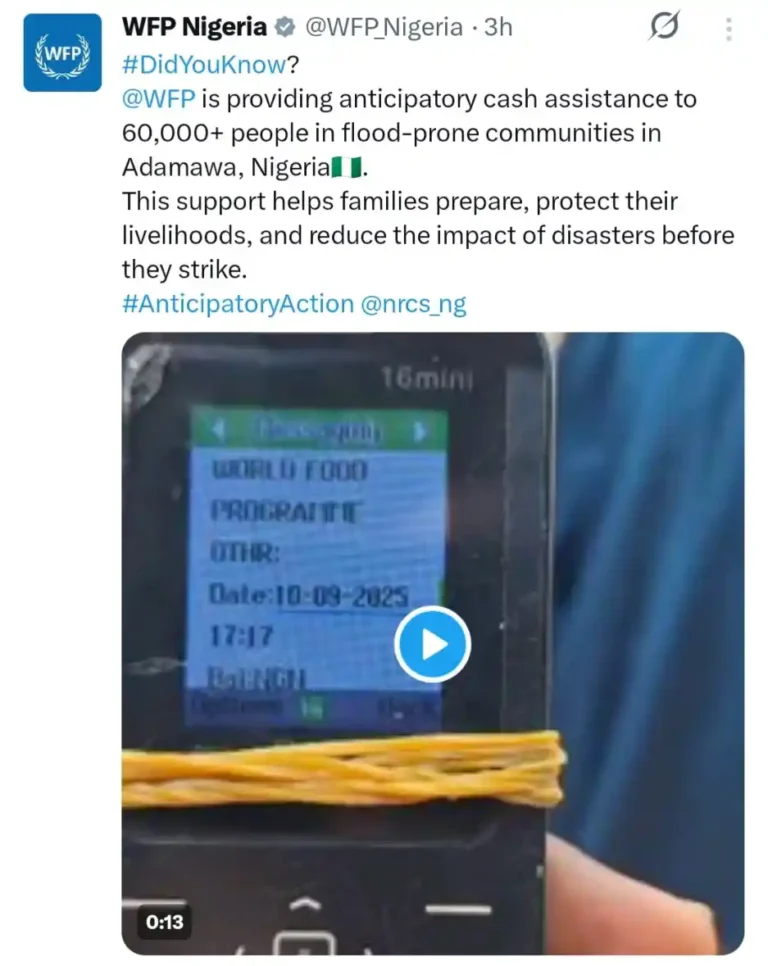
World Food Programme (WFP) has confirmed the rollout of anticipatory cash assistance to over 60,000 people living in flood-prone communities in Adamawa state, Nigeria.

The initiative is aimed at helping families prepare ahead of disasters, protect their livelihoods, and reduce the impact of floods before they strike.

An SMS notification received by beneficiaries read: “WORLD FOOD PROGRAMME OTHR: Date:10-09-2025 17:17 Bal:NGN 50,011.44 Des:N-10177337941/TRSF BO WORLD FOOD PROGRAMME 10-09-2025 05:18PM Txn: Credit Ac:288.77X.”

Under the programme, all 60,000 eligible beneficiaries are being credited with N50,000 cash transfer each.

WFP Nigeria confirmed the development on its official X handle, noting that the cash transfer assistance is ongoing and will cover all affected people in vulnerable communities across Adamawa. The support comes as part of disaster preparedness efforts.

Advertisement

NNPC Foundation launches training for 6,000 vulnerable farmers

0

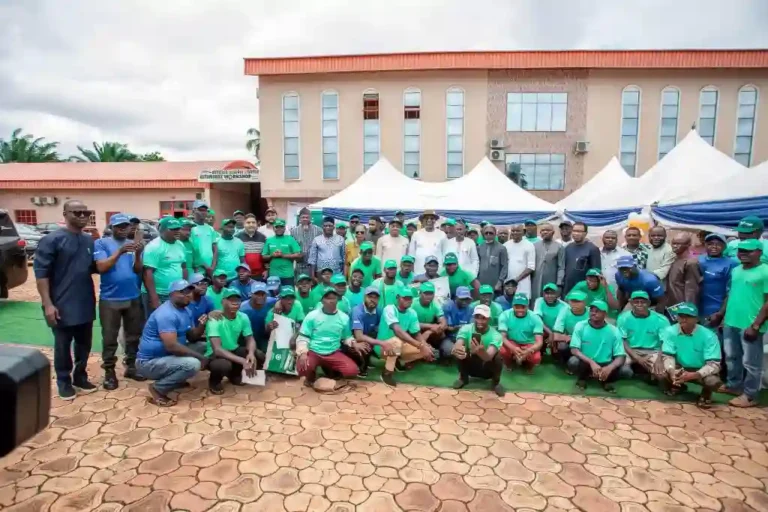
NNPC Foundation on Friday announced that it has concluded plans to train 6,000 vulnerable farmers across Nigeria as part of its effort to strengthen food security and reduce reliance on food importation.

Speaking during the “Flag-Off Training for Farmers in the Federal Capital Territory (FCT) Abuja/Nigeria Cluster,” the Managing Director of NNPC Foundation, Emmanuella Arukwe, said the programme will cover all six geopolitical zones of the country.

Arukwe explained that the initiative is a direct response to food insecurity in Nigeria, noting that the project will increase local food production and improve national food security.

She said, “The initiative focuses on addressing food insecurity, a critical issue in Nigeria. By training farmers across the six geopolitical zones, the project targets increasing local food production, thus reducing reliance on food imports and enhancing national food security.”

According to her, the launch in Abuja marked the beginning of the training in the northern geopolitical zones, starting with the North Central. She recalled that the programme had earlier kicked off in Kogi, Kwara, and Benue States.

“I am very delighted to stand before you today as the NNPC Foundation officially launches Training Programme for Vulnerable farmers in the northern geopolitical zones. We take off in the north geopolitical zone with the North-Central, which we earlier commenced in the previous week with the cluster of Kogi, Kwara, and Benue States,” she said.

Arukwe also noted that the foundation had started the training in the southern geopolitical zones in the second quarter of 2025 and successfully concluded it. She stated that the programme aims to uplift the living standards of 6,000 farmers by equipping them with essential skills and knowledge in modern farming techniques.

She said, “NNPC Foundation is embarking on this farmers’ training programme across the six (6) geopolitical zones of Nigeria, targeting to uplift the living standards of 6,000 vulnerable farmers by equipping them with essential skills and knowledge in modern farming techniques.”

The managing director pointed out that many local farmers face several challenges, including lack of seedlings, poor yields, limited access to tools, transportation issues, climate change, and inadequate knowledge to handle these problems. She explained that the foundation decided to intervene to bridge these gaps.

According to her, the foundation believes that improving the agricultural practices of local farmers will boost their productivity and income, enabling them to move from subsistence to commercial farming.

She added that the programme will also help farming communities understand climate change and adopt practices that allow all-year-round planting, improved yield, and stronger livelihoods.

Arukwe said the programme goes beyond short-term relief and is designed to create lasting impact. “I can assure you that the knowledge that will be gained from the insightful sessions will be invaluable to not just the individual beneficiary, but will give birth a spiral effect that will benefit communities and our dear country in the long term.

It is pertinent to note that rather than provide food to feed people in the short term, it is better to teach them how to produce food and achieve lasting impact and sustainability. Beyond the numbers, the programme will empower individuals and communities for food sustenance and hopefully create a viable food export market,” she stated.

The initiative, she said, is vital for the stability of Nigeria’s food supply chain, community resilience, and economic growth. She expressed optimism that participants will use the knowledge gained to make informed decisions in their farming activities.

Meanwhile, the Mandate Secretary of Agriculture and Food, FCTA, Ibrahim Yaro, commended the NNPC Foundation for the initiative, describing agriculture as a solution to 60 percent of Nigeria’s social challenges. He stressed that food security should be part of every development agenda.

He said, “Food production has increased and the prices are coming down in FCT.” Yaro, however, warned the beneficiaries against misuse of the starter packs they will receive. He remarked, “Do not marry more wives with the starter packs from the foundation.”

The mandate secretary also urged the foundation to ensure that farmers are provided with adequate and reasonable support to enable them practice agriculture effectively. He emphasized that training must come before empowerment, noting that 75 percent of Nigerian farmers still operate at the subsistence level.

The NNPC Foundation reiterated that the programme is designed to create long-term sustainability by equipping farmers with practical knowledge and resources to strengthen the nation’s agricultural sector and reduce food importation.

FG to support youth empowerment through Benue mechatronics training

0

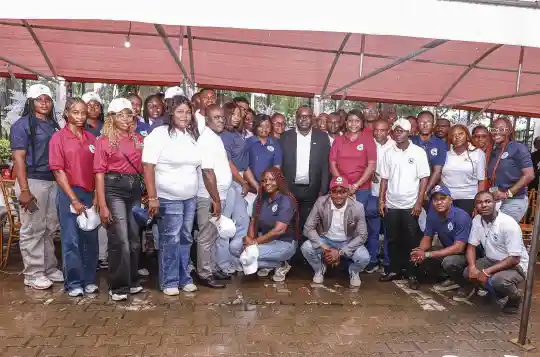
The National Automotive Design and Development Council (NADDC), in partnership with Simba Group Nigeria, has successfully completed a five-day specialized mechatronics training program on the repair and maintenance of tricycles and motorcycles powered by both petrol (PMS) and Compressed Natural Gas (CNG). The closing ceremony of the program took place at Auto 360 Workshop, Makurdi, Benue State.

The training, which started on September 8, 2025, provided both theoretical and practical knowledge to over 70 auto-technicians and youths in Benue State.

The participants were taught advanced skills to service, troubleshoot, and maintain modern tricycles and motorcycles, particularly those equipped with electronic systems and dual-fuel technology that are becoming more common across Nigeria.

Speaking at the closing event, NADDC Director-General and CEO, Mr. Olu Osanipin Joseph, who was represented by the Director of the Industrial Infrastructure Department (IID), Dr. Nua Omisanya, restated the Council’s dedication to continuous skill development in the automotive sector.

He praised Simba Group Nigeria for its technical expertise and collaboration, the Benue State Government for its support, and the Benue State Investment Promotion Agency (BENIPA) for their involvement in the program. He also gave special recognition to Rt. Hon. David Agada Ogewu and Rt. Hon. Terseer Ugbor for their leadership and contributions to the initiative.

Mr. Osanipin congratulated the graduating trainees, urging them to use their newly acquired skills to grow their careers, strengthen Nigeria’s economy, and support the country’s move toward sustainable automotive technologies.

He further acknowledged the active involvement of the Nigerian Automobile Technicians Association (NATA), the Automotive and Locomotive Engineers Institute (AutoEi), the Benue Tricycle Mechanics Association (BTMA), and the Motorcycle Mechanics Association of Benue State (MMAMBENS).

The Governor of Benue State, Fr. Hyacinth Iormem Alia, represented by his Deputy, Bar. Samuel Ode, reiterated the State Government’s commitment to preparing young people with relevant technical knowledge that aligns with Nigeria’s transition to cleaner and more sustainable energy sources.

Bar. Ode assured participants that the State Government would go beyond celebrating their graduation, pledging to support them in becoming trainers who can pass on the knowledge to other youths across Benue.

“The number of technicians we have trained today is not enough to service the economy of Benue State. Therefore, we will engage and empower these graduates to train others, ensuring that more of our youths benefit from this knowledge,” he said.

He emphasized that this initiative would not only help strengthen the local economy but also position Benue State as an active contributor to Nigeria’s larger industrial and environmental development goals.

Also speaking at the event, the Regional Manager of Simba Group, Mr. Sameer Upadhyay, highlighted that the project is about more than technical training.

According to him, “This initiative is not just about imparting technical knowledge but about creating opportunities, building capacity, and strengthening the foundation of transportation and mobility in Benue State and across Nigeria.”

Simba Group further encouraged the graduates to see the training as a long-term investment in their future and urged them to serve as ambassadors of innovation and excellence in their various communities.

Presidential Amnesty deploys 140+ scholarship beneficiaries to UK

0

The Presidential Amnesty Programme has deployed more than 140 beneficiaries for post-graduate studies in universities across the United Kingdom.

The beneficiaries, who were awarded foreign scholarships under the PAP formal education scheme, were officially briefed during a pre-departure orientation ceremony held at the PAP headquarters in Abuja on Thursday.

Speaking at the event, the Administrator of PAP, Dr Dennis Otuaro, said the deployment was part of efforts to strengthen human capital development in the Niger Delta and across Nigeria. He explained that the move was also in line with President Bola Tinubu’s Renewed Hope Agenda for the region.

According to him, the students were placed in competitive and professional courses designed to contribute to socio-economic advancement. “If you put the number of beneficiaries we are deploying today together, over 140, all of them are going for post-graduate studies in universities in the United Kingdom,” Otuaro said.

“We are confident that when they complete their studies and return, they will add value to the socio-economic advancement of the Niger Delta, and the human capacity resource of the region will be enriched. They will add value to our communities, the region, and the nation.”

At the ceremony, brand new laptops were distributed to the scholarship recipients to support their research and academic work abroad. Otuaro said the intervention was a deliberate step to reduce the human capital development gap in the Niger Delta. He noted that the students were not just beneficiaries of foreign education but future contributors to national growth.

“What we are doing today is a deliberate effort to take the development agenda of His Excellency, President Bola Ahmed Tinubu GCFR, to the people in the communities of the Niger Delta,” he said. “When the President appointed me last year, he gave me a mandate and that is to take this programme to the people. That is what we are doing.”

He advised the beneficiaries to focus on their studies and resist distractions while abroad. “This foreign post-graduate scholarship deployment takes cognizance of professional areas that are industry-competitive. We also deploy beneficiaries for other programmes in-country,” Otuaro added.

Other officials also spoke at the orientation programme. The Technical Assistant to the PAP Administrator, Edgar Daniel; the Provost Marshal of the Nigerian Army, Maj. Gen. M.O. Erebulu; and the Head of PAP’s Education Department, Dr Charles Ariye, delivered talks on the social and cultural aspects of studying in the UK and Europe, the diplomatic and security issues students may face abroad, and the academic demands of studying in the UK.

Some of the scholarship beneficiaries expressed gratitude to the programme. Gift Gbaminido and Amadimati Greatman thanked the PAP Administrator for the opportunity, promising to make good use of it and to serve as worthy ambassadors of their families, communities, and the Niger Delta.

FG distributes agricultural inputs to small-scale farmers in Niger State

0

The federal government has inaugurated the distribution of agricultural inputs to small-scale farmers in Niger State as part of efforts to boost food production and ensure food security in the country.

Speaking during the exercise in Minna on Friday, Aliyu Abdullahi, Minister of State for Agriculture, said the initiative aligns with President Bola Tinubu’s Renewed Hope Agenda, which places food security at the center of national priorities.

“We have declared food security as a national state of emergency, and we are committed to transforming the agriculture sector to make food available, accessible, and affordable to all Nigerians,” he said.

According to him, the items distributed include herbicides, cocoa fertiliser, fungicides, knapsack sprayers, growth enhancers, and tomato seeds. Power tillers and water pumps were also made available, and they will be shared through commodity associations, cooperative groups, farmers with special needs, and Internally Displaced Persons.

The minister added that the government has rolled out different programmes to support farmers in overcoming challenges and to ensure stable access to food nationwide. He stressed that all agricultural programmes are being designed to align with the presidential priority on food security.

Mr Abdullahi noted that the initiative would boost agricultural productivity, enhance food security, and reduce poverty levels across communities.

In his remarks, Marcus Olaniyi, the permanent secretary of the ministry, said at least 35 percent of the inputs were set aside for women farmers, in line with the National Gender Policy on Agriculture.

Also speaking, Governor Umaru Bago of Niger commended the federal government for selecting the state as a pilot area for the project. He said Niger would also launch a pilot scheme in 2026 that will focus on two million women in agriculture. According to him, beneficiaries of the scheme will be supported with chickens, goats, sheep, and crops to rear.

The governor highlighted Niger’s achievements in the agriculture sector, noting that the state exported $2.2 million worth of sesame seeds in 2025 through the Nigerian Women Police Cooperative in Farming. He also announced plans to establish sesame processing centres in the state.

Mr Bago disclosed that the Cooperative Bank of Niger State would be revived with N2 billion, adding that the bank would operate as a microfinance institution focused on agriculture to reduce the burden of interest rates for farmers.

Katsina State to boost export through product certification programme

0

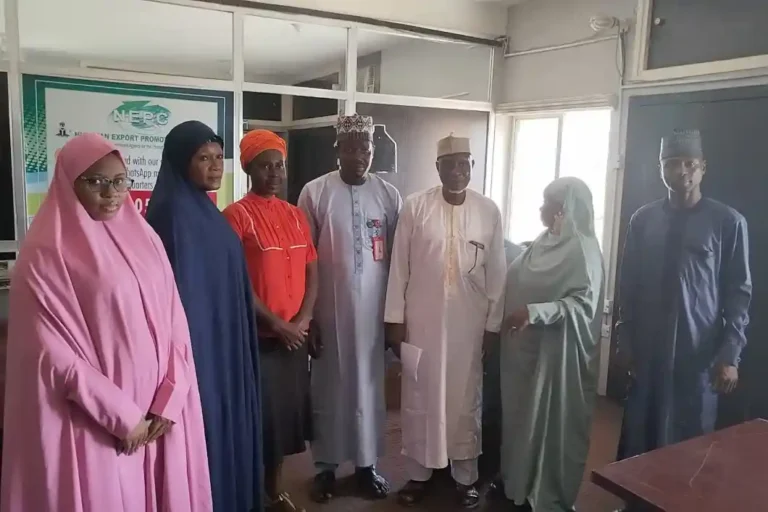
On 11th September 2025, the management of the Technology Incubation Centre (TIC) Katsina honoured an invitation to the Nigerian Export Promotion Council (NEPC) Katsina Office after a visit to the Special Adviser on Employment Promotion at the Katsina State Governor’s Office.

The Centre joined a one-day Capacity Building Programme on “Product Certification Tools for Global Market Access” organised by NEPC for registered exporters in the state.

The programme addressed the challenges faced by many entrepreneurs who struggle to take their products into international markets due to lack of proper certifications and knowledge of global standards.

According to NEPC officials, without proper certification, even quality products are often rejected at foreign borders, leading to financial losses, reduced customer trust and missed opportunities for young people seeking jobs in export driven industries.

The event brought together key stakeholders including the Katsina State Chamber of Commerce, Industry, Mines and Agriculture (KATSCIMMA), the Commissioner of the State Ministry of Commerce,

Industry and Trade, United Bank for Africa (UBA), the Nigerian Shippers’ Council among others. They discussed how exporters can access product certification and take advantage of international trade opportunities.

Entrepreneurs from TIC Katsina who have benefitted from NEPC’s voluntary certification schemes were also present. One of the Centre’s entrepreneurs, Alikabs Global Links Nig. Ltd, shared his success story.

He explained that with NEPC’s support, he secured FDA and HACCP certifications which boosted customer trust and improved his brand’s global reputation. “These certifications have opened doors to five different export markets and we are already planning to expand further,” he said.

Alikabs encouraged participants to take the training seriously, noting that two entrepreneurs from TIC Katsina have already secured FDA certification this year while another two obtained HACCP certification.

He further highlighted that the Incubation Programme helps him maintain production standards and remain competitive in international markets.

The programme ended with networking and exchange of contacts, with several participants showing interest in visiting TIC Katsina to explore opportunities for collaboration and enterprise growth.

FG reviews 17 silo programme after N10bn post-harvest losses

0

The Honourable Minister of Agriculture and Food Security, Senator Abubakar Kyari, CON, yesterday chaired a high-level meeting with the Infrastructure Concession Regulatory Commission (ICRC) led by its Director General, Dr. Jobson Oseodian Ewalefoh. Also present were the Commission’s Head of Legal, Director of Contract and Compliance, and other senior management staff.

The meeting was focused on reviewing the performance of Nigeria’s silo concession programme, which was introduced to tackle government’s inability to fully utilize silo complexes due to funding and operational challenges.

Dr. Ewalefoh stressed that private companies with genuine operational needs for silos should be the only ones allowed to retain them. He warned that “abandoned silos will be retrieved by the Federal Government,” pointing out that some concessionaires had failed to remit the required returns to government coffers.

A new committee is set to be formed to review contractual clauses, assess performance, and establish clear evaluation intervals.

Senator Kyari highlighted the urgent need to revive silo storage facilities as a key measure to reduce Nigeria’s massive post-harvest losses, which he estimated at $10 billion annually. According to him, “storage facilities are essential to our food security drive, as they directly address wastage and ensure year-round availability of staple crops.”

Out of the 17 silo complexes concessioned to five private companies, only Flour Mills of Nigeria has met all conditions and is performing optimally. The company operates three silo complexes under three different Special Purpose Vehicles (SPVs).

The Ministry’s review process showed that several concessionaires failed to put their facilities into proper operating condition despite earlier agreements. Monitoring visits revealed little or no progress in some locations, alongside reported cases of vandalization and perimeter fence collapse in Ikorodu and Ogoja.

It was further disclosed that many concessionaires defaulted on payment obligations, with only Flour Mills consistently meeting both performance and financial requirements.

The Ministry, working with ICRC, pledged to intensify oversight, enforce compliance, and ensure that only competent private operators handle silo facilities. This renewed effort is in line with President Bola Ahmed Tinubu GCFR’s agricultural transformation agenda to achieve national food security.

Sokoto Rep Dasuki launches empowerment program for 1,550 youths

0

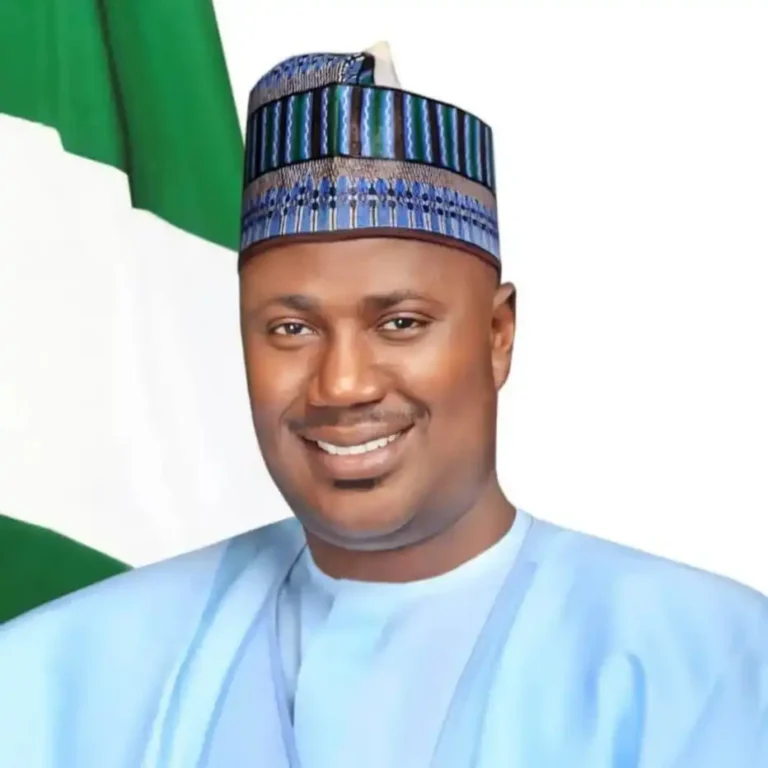
Rep Abdussamad Dasuki, representing Kebbe/Tambuwal Federal Constituency in Sokoto State, has launched a new empowerment program that will benefit 1,550 youths across the area.

The initiative, according to him, is aimed at supporting education, entrepreneurship, and agricultural development, giving young people opportunities to grow and contribute to the economy.

Speaking on the development, Dasuki said the program includes financial grants and scholarship packages for students. “This initiative is designed to promote education, encourage business growth, and strengthen agricultural activities within our constituency,” he stated.

The lawmaker’s efforts have been widely commended by community leaders and beneficiaries, who say his commitment to public service continues to create a lasting impact.

In previous interventions, Dasuki announced a N27.5 million scholarship scheme for 200 university students, alongside the distribution of agricultural inputs to farmers and financial support to women groups.

He also sponsored between 20 to 30 students on a fully funded scholarship at Iconic University to pursue Master’s degrees in Information Technology and Public Health. This scholarship, he explained, was introduced to build the capacity of young professionals in critical sectors of development.

In addition, Dasuki disbursed grants to small and medium-scale enterprise owners, including farmers, traders, and artisans. The grants, which ranged from ₦100,000 to ₦250,000, were targeted at helping beneficiaries withstand economic challenges and achieve self-reliance.

“These interventions reaffirm my pledge to support education, entrepreneurship, and agriculture, and to ensure that my constituents have opportunities to reach their full potential,” Dasuki noted.

TMC sets 2025 National Islamic Training programme date

0

The Muslim Congress (TMC) has announced that its 2025 National Islamic Training Programme (NITP) will take place between Wednesday, December 24 and Sunday, December 28, 2025.

The annual camping event, which is a flagship programme of the national headquarters of TMC, brings together adult males from across different regions in Nigeria for training, learning, and networking.

Speaking during the official kick-off of mobilisation for the programme, Mallam Saheed Gbadebo, Chairman of the Organising Committee, described the 2025 edition as bigger, better, and more valuable than previous ones.

He explained that this year’s camp will be held simultaneously across four zones in the country, including Ogun, Oyo, Edo States, and the Federal Capital Territory, Abuja.

He noted that over the years, the National Islamic Training Programme has consistently offered life-transforming opportunities to participants. According to him, “From past editions, many people have discovered new insights that further illuminated their practice of the Deen, built lasting relationships that changed their personal lives for the better, and also unlocked fresh possibilities that changed their professional lives from good to great.”

Mallam Gbadebo assured that the 2025 programme will uphold the legacy of NITP while introducing more enriching and engaging sessions. “The 2025 NITP will not only uphold that legacy, but it has also been carefully designed to be more educating, more entertaining, and even more fulfilling.

It will feature engaging learning sessions, practical spiritual and thought-provoking professional experiences, and exciting moments that will leave every delegate enriched, inspired and fulfilled,” he said.

He further called on members of TMC to take active roles in promoting the programme, stressing that the success of the annual camp requires collective effort. “As members and potential delegates, your role goes beyond just attending the programme.

You are ambassadors of the 2025 NITP and I need you to publicize it actively, telling your friends, colleagues, and networks about the opportunities that the 2025 NITP offer. You should use your voice on social media, your voice within your organizations, and your voice in your communities to spread the word that the 2025 NITP is coming and that no one should miss it for anything,” he urged.

On the matter of registration, Mallam Gbadebo encouraged early participation, highlighting the benefits of early bird registration. He stated, “For emphasis, I am counting on you to pay promptly since every payment you make on time helps us plan better and deliver more efficiently.”

The Organising Committee Chairman also made a call for sponsorship and support to cover the costs of hosting the large-scale programme. He explained that hosting such a qualitative event requires significant funding.

“That’s why we need funds from individuals and entrepreneurs both small and big. It’s funds like these that will help in bridging the financial gap in delivering the much-desired memorable moments at the 2025 NITP,” he said.

He added that sponsorship opportunities and exhibitions remain open for businesses and individuals who want to partner with TMC in delivering the 2025 edition of the National Islamic Training Programme.

In line with this announcement, the 2025 NITP is expected to attract high interest across the regions, as members, delegates, and sponsors prepare for the programme. With its combination of spiritual development, personal growth, and professional networking, the event stands out as a significant opportunity for participants to gain knowledge and experiences that extend beyond the camp.

FG to distribute 2,000 tractors, 9,000 implements to farmers

0

The Minister of Agriculture and Food Security, Abubakar Kyari, has announced that the Federal Government will soon distribute 2,000 tractors to farmers across the country as part of efforts to promote dry season farming and all-year agricultural production.

Speaking in an interview on ARISE News on Friday, Kyari said the tractors and implements, which were earlier commissioned this year, were not for display but for direct use to improve productivity in the sector.

According to him, “Those 2,000 tractors and 9,000 different implements to go with them were commissioned, but at the time land preparation for the wet season had passed. Nobody would use a tractor at that time. Logistics for distribution has been worked out. These tractors are not going to be there for show.”

He explained further that the government was determined to ensure that the machines are rolled out as Nigeria enters the dry season. “Very soon we are going to roll out these tractors so that we can face the dry season and all year-round farming that Mr. President is encouraging.”

On the issue of financing and management, Kyari revealed that the Ministry was introducing a monitored system to track usage.

He explained, “We are working on modalities where we are going to have tractors geofenced and geolocated. Anybody who had been allocated that tractor must have a specific number of hours he can cultivate in terms of hectares a year. If you own an 80 or 100-hectare farm and you are allocated a tractor, a tractor can do almost 500 hectares a year. So, you must also pass on those prices to your neighbours, those that cannot afford the tractor.”

Addressing concerns from farmers about tractors ordered from Belarus, the minister confirmed that delivery had already been completed. He said, “We have 2,000 tractors, 9,000 different implements, spare parts, and mobile workshops. We signed this contract in September 2024, looking at September 2025. They’ve been delivered to the Federal Ministry of Agriculture, but we are working on modalities of financing before rolling out to farmers. In the past, tractors were given out and ended up across the border. We have to make sure that these tractors are secured, performing, and producing.”

The minister also highlighted ongoing work under the Green Imperative Programme, stressing that it had gained momentum under the current administration.

“It started way back in 2017, but within the last two years, even the Brazilians were surprised at the traction it had achieved under President Bola Tinubu’s administration. In these past two years, we have signed agreements, we have signed MOUs, and now we are looking at the funding mechanism for the programme, which in the first instance is about a billion dollars.”

On Nigeria’s temporary policy on food importation, Kyari explained that it was never intended as a long-term measure. “The importation window was only for six months and it had come and gone. The amount that was imported when you look at the global demand field is not as much as it will make farmers discouraged to go into agricultural production.”

He added that farmers had received significant support during this period. “President Bola Tinubu also ordered the Central Bank to release 2 billion bags of fertilizer to the Federal Ministry of Agriculture for onward delivery to farmers free of charge at zero cost. And that was done. We had the NAGS programme that subsidized fertilizer 50% for farmers. So, there was a lot of production in 2024. And I would say broadly that prices have crashed.”

On storage and post-harvest losses, Kyari said government was working with investors to address challenges. He noted, “I presented that legacy project last week in Dakar at the Africa Food Summit, where we were looking for investors. The whole mantra here is to try to get the private sector involved. Government cannot sustain everything. We have 33 silo sites, 17 have been concessioned. Only three are performing. We have 1.3 million tons of storage capacity, but we are producing over 50 million tons of grains. We think we need much more storage. What we need to do is not only on those large-scale silos, but bring those silos closer to the grassroots, closer to the farmer.”

He also said steps were being taken to improve farmer data management and eliminate portfolio farmers. “We’ve already signed an MOU with the National Identity Management Commission (NIMC) and we’re working to verify our farmer data and farmland registry. We want to make sure that the inputs and support that government gives get to the right farmers. We have started working and will do the pilot scheme in Nasarawa State with 300,000 farmers in the first instance. What we want to do globally is about 6 million farmers.”

Speaking on the global shea nut industry, the minister emphasized the importance of processing locally rather than exporting raw materials.

“Nigeria produces 40% of the total shea nut capacity in the world, but we are only gaining 1% income. Let’s process and add value. Why should we continue exporting raw materials? These shea nuts are only processed into shea butter abroad. We should develop processing capacity here, provide jobs, and create value.”

He assured that farmers would get access to the tractors once they applied through the right channels.

“When they apply for the tractors, we will give them. We also have farm estates we are developing under NALDA and agricultural institutions that will get tractors to continue research and development.”