
Home Blog Page 466

FG to distribute 2,000 tractors, 9,000 implements to farmers

0

The Minister of Agriculture and Food Security, Abubakar Kyari, has announced that the Federal Government will soon distribute 2,000 tractors to farmers across the country as part of efforts to promote dry season farming and all-year agricultural production.

Speaking in an interview on ARISE News on Friday, Kyari said the tractors and implements, which were earlier commissioned this year, were not for display but for direct use to improve productivity in the sector.

According to him, “Those 2,000 tractors and 9,000 different implements to go with them were commissioned, but at the time land preparation for the wet season had passed. Nobody would use a tractor at that time. Logistics for distribution has been worked out. These tractors are not going to be there for show.”

He explained further that the government was determined to ensure that the machines are rolled out as Nigeria enters the dry season. “Very soon we are going to roll out these tractors so that we can face the dry season and all year-round farming that Mr. President is encouraging.”

On the issue of financing and management, Kyari revealed that the Ministry was introducing a monitored system to track usage.

He explained, “We are working on modalities where we are going to have tractors geofenced and geolocated. Anybody who had been allocated that tractor must have a specific number of hours he can cultivate in terms of hectares a year. If you own an 80 or 100-hectare farm and you are allocated a tractor, a tractor can do almost 500 hectares a year. So, you must also pass on those prices to your neighbours, those that cannot afford the tractor.”

Addressing concerns from farmers about tractors ordered from Belarus, the minister confirmed that delivery had already been completed. He said, “We have 2,000 tractors, 9,000 different implements, spare parts, and mobile workshops. We signed this contract in September 2024, looking at September 2025. They’ve been delivered to the Federal Ministry of Agriculture, but we are working on modalities of financing before rolling out to farmers. In the past, tractors were given out and ended up across the border. We have to make sure that these tractors are secured, performing, and producing.”

The minister also highlighted ongoing work under the Green Imperative Programme, stressing that it had gained momentum under the current administration.

“It started way back in 2017, but within the last two years, even the Brazilians were surprised at the traction it had achieved under President Bola Tinubu’s administration. In these past two years, we have signed agreements, we have signed MOUs, and now we are looking at the funding mechanism for the programme, which in the first instance is about a billion dollars.”

On Nigeria’s temporary policy on food importation, Kyari explained that it was never intended as a long-term measure. “The importation window was only for six months and it had come and gone. The amount that was imported when you look at the global demand field is not as much as it will make farmers discouraged to go into agricultural production.”

He added that farmers had received significant support during this period. “President Bola Tinubu also ordered the Central Bank to release 2 billion bags of fertilizer to the Federal Ministry of Agriculture for onward delivery to farmers free of charge at zero cost. And that was done. We had the NAGS programme that subsidized fertilizer 50% for farmers. So, there was a lot of production in 2024. And I would say broadly that prices have crashed.”

On storage and post-harvest losses, Kyari said government was working with investors to address challenges. He noted, “I presented that legacy project last week in Dakar at the Africa Food Summit, where we were looking for investors. The whole mantra here is to try to get the private sector involved. Government cannot sustain everything. We have 33 silo sites, 17 have been concessioned. Only three are performing. We have 1.3 million tons of storage capacity, but we are producing over 50 million tons of grains. We think we need much more storage. What we need to do is not only on those large-scale silos, but bring those silos closer to the grassroots, closer to the farmer.”

He also said steps were being taken to improve farmer data management and eliminate portfolio farmers. “We’ve already signed an MOU with the National Identity Management Commission (NIMC) and we’re working to verify our farmer data and farmland registry. We want to make sure that the inputs and support that government gives get to the right farmers. We have started working and will do the pilot scheme in Nasarawa State with 300,000 farmers in the first instance. What we want to do globally is about 6 million farmers.”

Speaking on the global shea nut industry, the minister emphasized the importance of processing locally rather than exporting raw materials.

“Nigeria produces 40% of the total shea nut capacity in the world, but we are only gaining 1% income. Let’s process and add value. Why should we continue exporting raw materials? These shea nuts are only processed into shea butter abroad. We should develop processing capacity here, provide jobs, and create value.”

He assured that farmers would get access to the tractors once they applied through the right channels.

“When they apply for the tractors, we will give them. We also have farm estates we are developing under NALDA and agricultural institutions that will get tractors to continue research and development.”


Advertisement

Zamfara Gov distributes N1.1bn grants to 3,060 business beneficiaries

0

Zamfara State Governor Dauda Lawal has flagged off the distribution of N1.1 billion to business groups under the State Action on Business Enabling Reforms program.

Speaking during the flag-off ceremony on Thursday in Gusau at the JB Yakubu secretariat, Dr Garba Nadama Hall, Lawal restated his commitment to changing the narrative of business development in the state.

The governor explained that the cash grant was targeted at small, medium, and large-scale businesses under the SABER program. He noted that the State Action on Business Enabling Reforms is a World Bank program in Nigeria designed to improve the business enabling environment by strengthening state-level policies and implementation.

According to him, the initiative aims to attract private investment and foster economic growth across Zamfara.

Governor Lawal said, “Today, we are distributing the sum of N1.1 billion to business groups that comprise of 2,000 people who will receive N150,000 each, 1,000 people to receive N500,000 each. Similarly, we are distributing N5 million to each of 60 other large-scale businessmen in the state. I’m happy that I fulfilled one of my promises to improve on business, returning business across the state.”

He added that very soon the state would witness an inflow of businessmen from outside Zamfara, which will further support economic growth and open more opportunities for investors.

Earlier, the Zamfara State Commissioner of Commerce, Industries and Tourism, Hon. Abdul Rahman Tumbido, said the intervention would help expand business capacity, create more markets, and stabilise the local economy.

He appreciated the World Bank for its technical support towards the implementation of the SABER program in Zamfara State.

Also present at the ceremony, the Director General and Chief Executive Officer of SMSE, Dr. Charles Oni, commended Governor Lawal’s foresight and commitment to supporting business development. He advised the beneficiaries to make proper use of the funds, stressing that the grants should be used to build self-reliance and create jobs within their communities.

Remi Tinubu launches N25m empowerment for 500 Kogi women

0

First Lady, Senator Oluremi Tinubu’s Renewed Hope Initiative in partnership with the Tony Elumelu Foundation has launched a N25 million empowerment programme for 500 women in Kogi State.

The disbursement was inaugurated on Thursday at the Government House in Lokoja, where the First Lady, represented by Kogi Governor’s wife, Hajia Sefinat Ododo, said the scheme was aimed at boosting economic growth and supporting women entrepreneurs across the country.

She explained that the initiative targets 18,500 women nationwide, with 500 beneficiaries in each state, including the Federal Capital Territory. According to her, 500 women in Kogi would each receive N50,000 grants to strengthen their small businesses and improve their economic stability.

“The programme is designed to support hardworking women traders and entrepreneurs who sustain their families while uplifting their communities,” she said.

Tinubu noted that empowering women was vital to achieving the Sustainable Development Goals, particularly SDG-5 on gender equality and SDG-8 on decent work and economic growth. She added that the initiative was made possible through a N1 billion donation by the Tony Elumelu Foundation to the Renewed Hope Initiative.

The First Lady further stated that the scheme underscored RHI’s commitment to promoting women’s economic independence and strengthening households, communities and the nation.

Secretary to the Kogi State Government, Dr Folashade Ayoade, thanked the First Lady for remembering Kogi women and praised Elumelu’s philanthropic support. She urged the beneficiaries to use the funds wisely to expand their businesses and ensure quality education for their children.

Also speaking, Kogi Commissioner for Women Affairs, Mrs Fatima Momoh, said the programme fulfilled a vision to uplift women and transform communities through sustainable support. She assured that her ministry would continue backing initiatives that promote women’s empowerment across the state.

At the event, Hajia Sefinat Ododo presented N50,000 cash to one of the beneficiaries. Grateful women, including Aisha Salihu, lauded the First Lady and the Governor’s wife, saying the support would enhance their businesses and improve livelihoods.

Fidelity Bank sends emails to YEIDEP beneficiaries for next phase

0

Fidelity Bank has begun sending confirmation emails to beneficiaries of the Youth Economic Intervention and De-Radicalization Programme (YEIDEP) whose registration has been successful.

The bank urged candidates to check their email messages to proceed with the next phase of the programme by opening a Fidelity Bank account. Beneficiaries are also encouraged to visit the nearest branch to request for an ATM card.

The email message sent by Fidelity Bank reads:

“Congratulations!

Your registration for the YEIDEP program is successful.”

“Dear Valued Customer,

To proceed to the next phase, kindly click HERE to open a Fidelity Bank account in order to participate in the scheme and access its financial benefits.

Remember to fund your account immediately and request for a Debit Card at your closest branch to enable you access your YEIDEP funds once its available.”

Beneficiaries are advised to open their Fidelity Bank account immediately and take the next step to avoid delays. After clicking the link in the email, the next page shows:

“We Are Fidelity, We Keep Our Word.”

The account details provided include Account No: 6687****** (Tier 1) and the name of the candidate. The bank stated that the Tier 1 account is currently restricted to single credit up to N50,000 daily and can only hold a balance of up to N300,000. Beneficiaries will also receive free monthly e-statements.

Candidates are required to upgrade their accounts by submitting valid identification such as National ID, International Passport, Driver’s License, or Permanent Voter’s Card.

Although not mandatory, they are advised to deposit at least N500 into the account to keep it active.

Attached is screenshot proof:

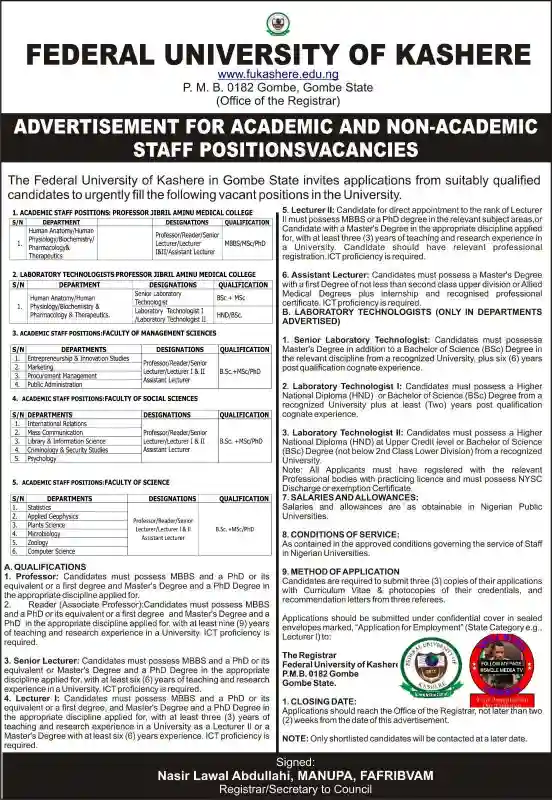
Apply: Federal University of Kashere recruitment 2025

0

September 11, 2025 – Federal University of Kashere in Gombe State has announced a massive recruitment exercise for both academic and non-academic staff positions.

In a notice released by the Registrar, Nasir Lawal Abdullahi, MANUPA, FAFRIBVAM, the institution invited suitably qualified candidates to urgently apply for various vacant positions across different faculties and departments.

According to the statement, the positions available in Professor Jibril Aminu Medical College include Human Anatomy, Human Physiology, Biochemistry, and Pharmacology & Therapeutics. The Faculty of Management Sciences is recruiting for Entrepreneurship & Innovation Studies, Marketing, Procurement Management, and Public Administration.

Other openings are in the Faculty of Social Sciences with vacancies in Mass Communication, International Relations, Library & Information Science, Criminology & Security Studies, and Psychology. The Faculty of Science has positions in Statistics, Applied Geophysics, Plant Science, Microbiology, Zoology, and Computer Science.

Academic staff positions available are Professor, Reader (Associate Professor), Senior Lecturer, Lecturer I, Lecturer II, and Assistant Lecturer. Laboratory Technologist positions are open in the advertised departments for Senior Laboratory Technologist, Laboratory Technologist I, and Laboratory Technologist II.

The qualifications listed include:
1. Professor: Requires MBBS or equivalent, plus Master’s and PhD in the relevant discipline, with significant teaching and research experience (about 9 years) and ICT proficiency.
2. Reader (Associate Professor): Requires MBBS or equivalent, plus Master’s and PhD, with at least 9 years of teaching/research experience and ICT proficiency.
3. Senior Lecturer: Requires MBBS or equivalent, plus Master’s and PhD, with at least 6 years of teaching/research experience and ICT proficiency.
4. Lecturer I: Requires MBBS or PhD, or Master’s with minimum 6 years of experience, plus ICT proficiency.
5. Lecturer II: Requires MBBS or PhD, or Master’s with at least 3 years of teaching/research experience, relevant professional registration, and ICT proficiency.
6. Assistant Lecturer: Requires a Master’s Degree with minimum Second Class Upper first degree or allied medical degree with internship/professional certificate and ICT proficiency.
7. Senior Laboratory Technologist: Requires Master’s plus BSc in relevant field and 6 years cognate experience.
8. Laboratory Technologist I: Requires HND or BSc plus at least 2 years cognate experience.
9. Laboratory Technologist II: Requires HND (Upper Credit) or BSc (minimum 2nd Class Lower).

The closing date is two weeks from the date of this publication.

How to apply:

All candidates are required to submit three copies of their applications with Curriculum Vitae, photocopies of credentials, and recommendation letters from three referees.

Applications must be submitted under confidential cover in sealed envelopes marked “Application for Employment” to:

The Registrar,
Federal University of Kashere,
P.M.B. 0182 Gombe,
Gombe State

The university also stated that only shortlisted candidates will be contacted.

FG assures support for farmers and grain suppliers

0

The Federal Government has assured the Amana Farmers and Grains Suppliers Association of Nigeria (AFGSAN) of its full support towards achieving sustainable food security in line with the Renewed Hope Agenda.

Secretary to the Government of the Federation, Sen. George Akume, CON, gave the assurance when a high-level delegation of the AFGSAN led by its National President, Alhaji Haruna Ahmad Pambegua, paid him a courtesy visit in Abuja.

Sen. Akume noted that the Association needs more support to enable it to do better in boosting food production, stating that the present administration is committed to supporting the group’s efforts. He said, “We will table your request before the President for the needed support to the Association.”

While commending the Association for its contributions so far in boosting food security, the SGF revealed that the Federal Government is investing heavily in revolutionising agriculture through mechanised farming. He said that new tractors and trucks were imported, dams and roads were constructed across the country to boost food production and improve supply chains. Akume urged the Association to assist the government in publicising the ongoing agricultural revolution.

In his remarks, the National President of the Association, Alhaji Haruna Ahmad Pambegua, praised the Tinubu-led administration for implementing policies and programmes that have positively transformed the lives of Nigerians.

He said, “We assure the Federal Government of our total support by contributing our quota towards complementing its efforts in achieving sustainable food security.”

Pambegua also requested that the Federal Government allocate tractors, fertilisers, and farm implements to members at subsidised rates to strengthen their capacity for production, supply, and delivery of farm produce across the country.

The meeting highlights the government’s commitment to agricultural development and food security, aligning with its goal of reducing dependence on food imports and creating opportunities for farmers through mechanised farming, subsidy support, and improved infrastructure for agricultural growth.

FG orders disbursement of N250bn to smallholder farmers

0

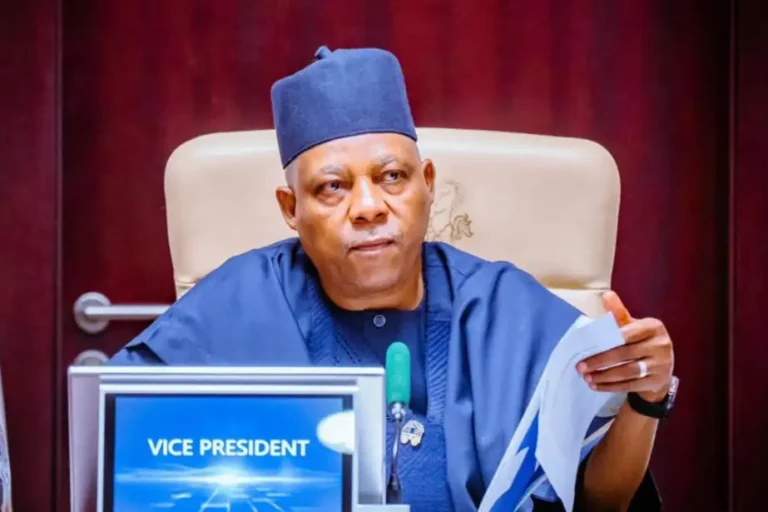
The Vice President, Senator Kashim Shettima, on Thursday directed the Presidential Food Systems Coordinating Unit (PFSCU) to fast-track the disbursement of the Federal Government’s ₦250 billion credit support for smallholder farmers at a single-digit interest rate.

Senator Shettima gave the directive during the sixth meeting of the PFSCU Steering Committee held at the Presidential Villa, Abuja. He stressed that the PFSCU must present an implementation roadmap to avoid further delays and ensure the funds reach the farmers who are the main beneficiaries of the initiative.

“On the Bank of Agriculture ₦250 billion facility, we need to sit down with all stakeholders and come up with a robust roadmap that ensures these funds reach the intended farmers and translate into real productivity gains,” the Vice President said.

He commended President Bola Ahmed Tinubu for granting the PFSCU political backing to deliver on critical reforms, including the liberalisation of fertiliser raw materials and the Presidential Seed Fund.

“I want to place on record our deep appreciation for Mr. President’s leadership and guidance. His clear directives on fertiliser liberalisation and the seed fund have empowered the PFSCU to fast-track delivery in ways that directly support farmers and strengthen our food systems,” he stated.

The Vice President praised the PFSCU for its achievements so far, noting that the collaboration between Federal Ministries, Departments and Agencies, the private sector, and development partners has shown that Nigeria can move from intent to delivery when stakeholders work together.

He also called for stronger collaboration to revitalise the seed sector and expand the country’s strategic grain reserve through ongoing reforms.

Governor Biodun Oyebanji of Ekiti State called for a clear structure to ensure the ₦250 billion support facility reaches smallholder farmers and pledged his state’s readiness to provide financial assistance to PFSCU on a monthly basis. Jigawa State Governor, Malam Umar A. Namadi, commended the Bank of Agriculture’s efforts but urged that subsidies be provided for local farmers.

Cross River State Governor, Senator Bassey Otu, supported the credit issuance and added that incentives should be given to encourage farmers.

PFSCU Coordinator, Ms. Marion Moon, highlighted the need to protect Nigeria’s fragile food security gains, noting that 30.8 million Nigerians remain food insecure. She revealed that 250,000 farmers have been insured under the National Agribusiness Policy Mechanism (NAPM), the ₦50 billion Seed Fund has been approved, and the World Bank–supported $500 million AGROW program is making progress.

Members at the meeting commended the Harvesting Hope Caravan, launched in eight states, for engaging communities and strengthening collaboration with state and local governments.

The meeting was attended by deputy governors of Niger and Ebonyi States, the Ministers of Finance and Agriculture, Ministers of State for Finance and Agriculture, ALGON President, as well as private sector and development partners.

NYSC rewards 3 corps members in National Creative Writing competition

0

The Director General of the National Youth Service Corps (NYSC), Brigadier General Olakunle Nafiu, has rewarded three Corps Members for their outstanding performances in a recently concluded creative writing competition organised by the Scheme.

Blessing Oluebube Ohanuka (BN/25A/0592), serving in Benue State, emerged overall best among nearly 40 entries received from across the country. She was presented with a cash reward of N100,000.00 for her work.

Yusuf Salahudeen Muhammad (LA/25A/19046), serving in Lagos State, secured the second position and was given N70,000.00, while Blessing Inyang Paul (NG/24A/2499), who served in Niger State, came third and went home with N50,000.00.

During the prize presentation ceremonies held at NYSC Secretariats in Makurdi, Lagos, and Benin, Brigadier General Nafiu praised the literary prowess and creative mindset of the three winners. He also commended other Corps Members who submitted entries for the competition but could not make it to the top three, noting that their efforts were appreciated.

Presenting the cash prize to Blessing Oluebube Ohanuka in Makurdi on behalf of the Director General, the NYSC Benue State Coordinator, Mrs Veronica Garba, congratulated her for the remarkable achievement. She encouraged her to “keep projecting the image of the Scheme and the nation at all times.”

In her acceptance speech, Miss Ohanuka expressed her gratitude for the recognition she received. “Writing has always been my way of expressing truth, faith, and hope, and the award has reinforced my belief in the power of words. This is a motivation to keep writing, keep learning, and keep inspiring,” she said.

She further dedicated the award to God, the organisers, the judges, and everyone who encouraged her throughout her writing journey.

The creative writing competition was instituted a few months ago to inspire Corps Members to tell compelling stories through pictures, poetry, and creative writing.

According to NYSC, the initiative is part of efforts to promote literary excellence and showcase the creative talent of Nigerian youths, encouraging them to contribute to national development through writing and storytelling.

FG Launches Second Phase of DELTA 2 Programme

0

The Federal Government of Nigeria has launched the second phase of the DELTA 2 programme, a joint initiative with the Czech Republic designed to accelerate technology transfer, innovation, and industrial growth. The programme is part of the government’s strategy to build an innovation-led economy and reduce dependence on imports.

Speaking at the inauguration ceremony on Thursday in Abuja, Uche Nnaji, the Minister of Innovation, Science and Technology, described DELTA 2 as a bold step toward Nigeria’s economic transformation. He said the future of global economies lies in science, technology, and innovation, adding that Nigeria must not be left behind.

Khalil Suleiman-Halilu, the Executive Vice-Chairman of the National Agency for Science and Engineering Infrastructure (NASENI), explained that DELTA 2 was designed to deliver applied research with real-world impact.

“This is not research for its own sake, but research with purpose, producing new knowledge, new products, and new skills that can bridge the gap between laboratories and the marketplace,” he stated.

Halilu also highlighted Nigeria’s growing digital economy, noting that ICT contributed nearly 20 percent of the nation’s GDP in the second quarter of 2024. He said Africa’s green economy was projected to create 3.3 million skilled jobs by 2030, showing that innovation could drive long-term prosperity.

Dr Muhammed Dahiru, Chairman of the Presidential Implementation Committee on Technology Transfer, announced that 10 of the 25 projects supported during the first phase had been completed and were now commercially available. He revealed that a documentary showcasing these achievements would soon be aired nationwide and said this success provided the momentum to launch the second phase with higher expectations.

The DELTA 2 programme is aligned with President Bola Tinubu’s Renewed Hope Agenda, focusing on food security, energy transition, job creation, and industrialisation. NASENI has also signed a Memorandum of Understanding with the Bureau of Public Procurement to promote the Nigeria First Policy, which gives preference to local innovations.

According to Halilu, empowering local innovators is essential. “We must expand the range of made-in-Nigeria products in the marketplace. DELTA 2 provides that platform for international collaboration and technology transfer,” he said.

Abike Dabiri-Erewa, Chairperson of the Nigerians in Diaspora Commission (NIDCOM), described the initiative as a chance for Nigerians abroad to contribute to national development. “Nigerians excel everywhere in the world, DELTA 2 creates the platform for them to bring home their knowledge and expertise, and I believe a dedicated diaspora version of the programme will soon emerge,” she stated.

Project Manager Togo Adjekughele announced that the call for proposals was open to researchers, entrepreneurs, engineers, and tertiary institutions. He explained that applicants must be registered with the Corporate Affairs Commission, comply with tax requirements, and show readiness to commercialise their innovations.

He added that priority areas include agriculture, renewable energy, aerospace, general manufacturing, and digital technology. “There is no age limit,” he said, “but ideas must be realistic, impactful, and achievable.”

Extension agents, lead farmers trained in Bauchi under IFDC soil values programme

0

International Fertiliser Development Corporation (IFDC) has begun the training of 50 extension agents and lead farmers on soil restoration, conservation techniques and integrated soil fertility management in Bauchi State.

The two-day training is being implemented under the IFDC Soil Values Programme and aims to improve soil fertility and restore degraded lands in the state. The exercise follows similar activities recently held in Kano and Jigawa States.

According to IFDC, the Soil Values programme operates in a context marked by climatic and socio-economic challenges facing Sahelian countries, such as recurrent droughts, socio-political conflicts, desertification and the effects of climate change.

The programme will improve soil fertility and productivity of two million hectares of agricultural land in the Sahel while strengthening the resilience and wellbeing of 1.5 million farmers, with a focus on women and youth.

Medina Ayuba-Fagbemi, Country Coordinator of the Soil Values Programme Nigeria, said this on the sidelines of the training exercise on Thursday in Bauchi. She explained that 30 extension agents would be trained under the first phase while 20 would be trained under the second phase of the exercise.

“Participants will be exposed to integrated soil fertility and soil health management techniques to boost crop production and enhance food security,” she said. Medina added that the participants are expected to step down the skills to about 20,000 smallholder farmers across Jama’are, Shira, Itas Gadau, Toro, Zaki, Bauchi and Gamawa Local Government Areas.

She noted that the programme is being implemented in collaboration with a consortium of partners and is focused on building the capacity of extension workers in Integrated Soil Fertility Management (ISFM) and Soil Health Management (SHM) technologies.

“This training exercise reflects our collective commitment towards restoring soil health, improving productivity, and building resilient farming systems. It will strengthen extension agents’ technical capacity and inspire new approaches to working hand-in-hand with farmers for sustainable agricultural transformation,” Medina said.

She added that the training is part of a 10-year initiative funded by the Kingdom of the Netherlands through its Directorate-General for International Cooperation (DGIS).

Also speaking, Joshua Arogunyo, MELS Coordinator of the Soil Values Programme, said the initiative focuses on enhancing farmer skills in integrated soil health management and soil water conservation to encourage agro-ecological practices and mitigate the impact of climate change.

He stated that the programme aims to restore degraded lands in Bauchi, Kano and Jigawa and will eventually cover 10 northern states.

“Our target is to restore two million hectares of degraded land across the Sahel. In Nigeria, we hope to restore 800,000 hectares, directly benefiting 600,000 smallholder farmers. The thrust of the programme is to reduce the yield gap, improve soil fertility, and make farmers more deliberate about giving back to the soil to ensure long-term productivity and food security,” Arogunyo said.

He added that the €100 million programme is implemented by IFDC, SNV Netherlands Development Organisation and Wageningen University and Research (WUR) with knowledge partners including IITA, AGRA, ICRAF, ISRIC and IWMI.

Arogunyo said the Soil Values consortium is also collaborating with the World Bank through ACReSAL and L-PRES to ensure wider impact. “We are implementing it across the Sahelian zone of Nigeria because that is where land degradation is most severe. It is our hope that at the end of this programme, Nigeria would have made significant progress in restoring degraded lands, increasing farmer incomes, and raising consciousness about the importance of investing in soil health in a sustainable manner,” he said.

Some participants expressed satisfaction with the training. Aliyu Safiyanu said he learnt new skills that would enable him to teach rural farmers how to utilise farm by-products to nourish their farmlands. Helen Ciroma said the new techniques would help women farmers improve soil fertility and increase productivity in their communities.