Home Blog Page 468

World Food Programme: N50k payment claims circulate for 2.1M beneficiaries

0

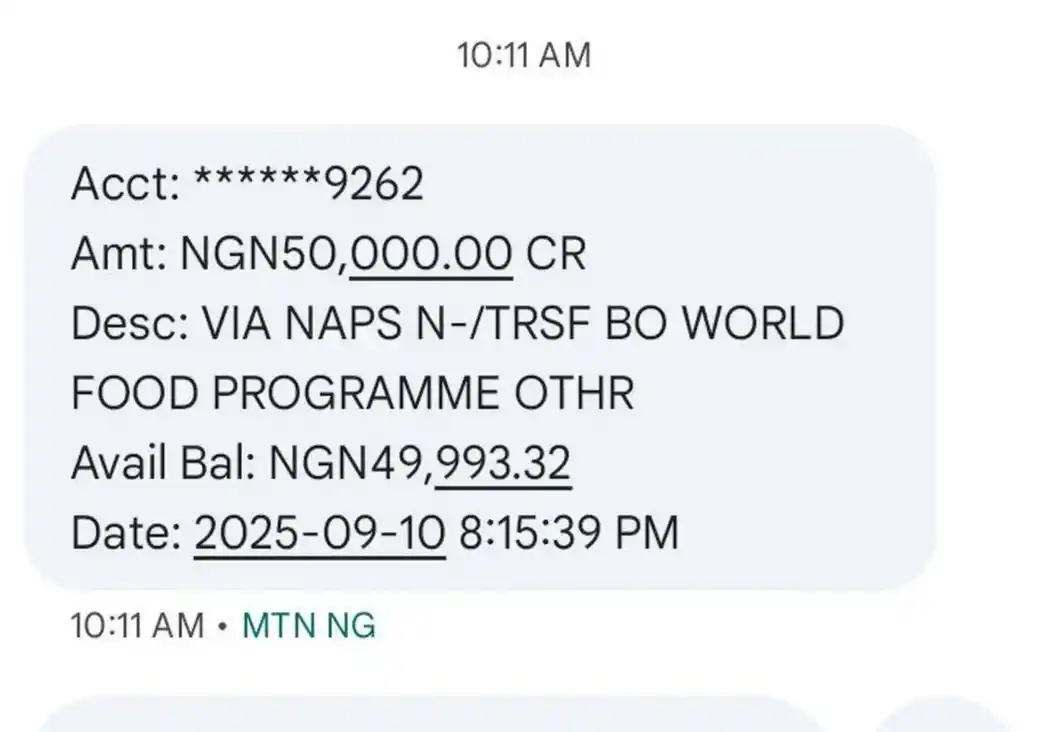
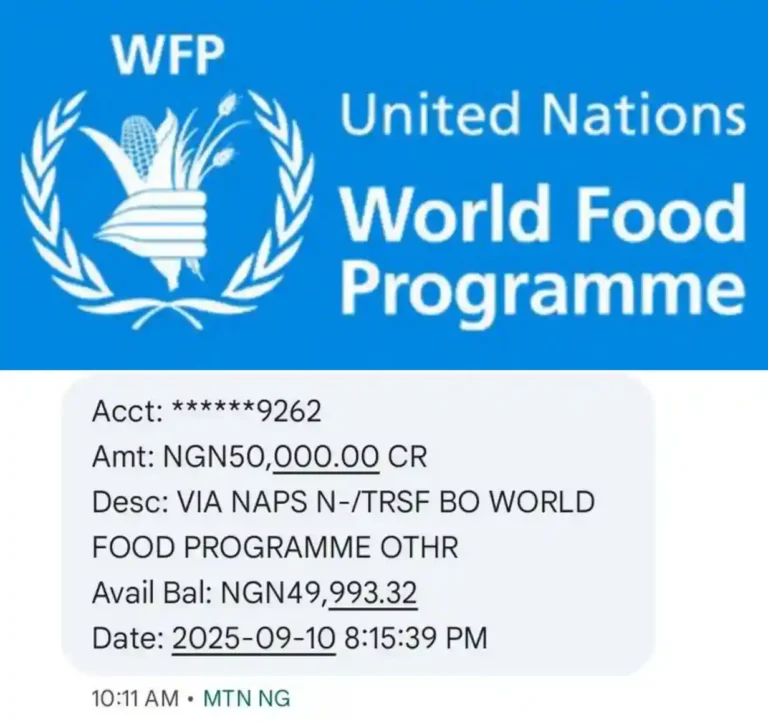
The United Nations World Food Programme (WFP) is once again in the news as Nigerians raise questions about possible ongoing disbursement of funds and food items. There are circulating claims that many beneficiaries have started receiving N50,000 under the World Food Programme initiative, along with items of food.

These claims are yet to be confirmed by either the Federal Ministry of Humanitarian Affairs and Poverty Alleviation or the United Nations office in Nigeria.

Recall that the World Food Programme was announced back in 2023 by the Federal Ministry of Humanitarian Affairs and Poverty Alleviation to fight hunger in Nigeria with a $2.5 billion investment.

The WFP pledged to support President Bola Tinubu’s Zero Hunger Programme as part of efforts to address food insecurity in the country. At the time, the Minister for Humanitarian Affairs and Poverty Alleviation, Dr. Betta Edu, who is now suspended, emphasised that this initiative would help millions of vulnerable Nigerians.

The World Food Programme had disclosed that 2.1 million Nigerians have already been captured as beneficiaries of the programme and said it hopes to expand further, working with the Ministry of Humanitarian Affairs.

The WFP explained that part of its plan is to support local food hubs by purchasing food locally and providing both cash transfers and food assistance. “These are very impressive,” the statement said during the launch.

Dr. Betta Edu had previously stated that there are over 133 million Nigerians affected by multidimensional poverty. She stressed that WFP’s intervention of $2.5 billion over five years “will go a long way to address some of the biggest challenges the country is facing, which is hunger.”

She also revealed that part of the plan was to create 774 humanitarian hubs, one in every local government area, to help distribute aid more effectively.

Attached below is circulating screenshot of disbursement SMS claims:

Advertisement

150,000 beneficiaries in Akwa Ibom receive N75,000 cash transfer

0

The National Cash Transfer Office (NCTO) has held a Stakeholders’ Sensitization Meeting in Uyo to address misconceptions about the Cash Transfer Programme under the National Social Safety Nets Programme (NSSNP).

The meeting focused on strengthening partnerships and deepening understanding of the initiative.

Speaking at the one-day workshop on Wednesday, the National Programme Manager of NCTO, Alhaji Abdulahi Iman, said the engagement was necessary to let people know the progress the office has made. He was represented by the Cross River State Programme Manager, Mr Francis Aribiah.

Iman explained that the initiative has provided financial support to poor and vulnerable households, helping them improve consumption and general well-being. According to him, the programme has recorded significant achievements, with more than 150,000 beneficiaries in Akwa Ibom State receiving direct cash transfers of 75,000 naira each.

Payments have been made either directly into their bank accounts or through debit cards by Financial Service Providers.

He stated, “We are here to clear the misconception surrounding the cash transfer initiative. People tend to doubt every government programme, especially those involving financial assistance to the poor and vulnerable. There is a belief that the funds are not reaching the intended beneficiaries. To address this, we’re explaining the programme’s structure to key stakeholders, who will then enlighten their communities.”

In his opening remarks, Dr Godwin Akpan, the State Focal Person of the National Investment Programme Agency, said the Cash Transfer Programme is a genuine initiative aimed at assisting vulnerable citizens.

He emphasized that the scheme is real and urged those who still have doubts to visit the Cash Transfer Desk Offices at their local government councils to verify the claims.

The sensitization meeting brought together stakeholders to discuss how to build trust around the cash transfer scheme and ensure that information about the programme reaches more communities.

Tinubu directs FG to cut rising food prices

0

President Bola Tinubu has directed the Federal Ministry of Agriculture and Food Security to take urgent measures to address the rising cost of food items across Nigeria.

The directive was revealed by the Minister of State for Agriculture and Food Security, Senator Aliyu Sabi Abdullahi, during a one-day capacity-building workshop for the Senate Press Corps held at the National Assembly Library Complex in Abuja.

Speaking at the event, Abdullahi outlined a series of reforms introduced by the Tinubu administration aimed at stabilising food prices, strengthening agricultural value chains, and easing the economic pressure faced by Nigerian households.

Abdullahi said, “The President has issued a marching order, and a Federal Executive Council committee is actively working to ensure the seamless movement of food products across key routes. The cost of transporting food significantly affects final prices, and this government is determined to intervene.”

He explained that the government’s intervention would focus on addressing inefficiencies in the country’s food transport system, which has long been identified as one of the main drivers of food inflation. The minister noted that poor transportation infrastructure continues to cause significant post-harvest losses and price increases.

To tackle this, the Federal Ministry of Agriculture is expanding the Post-Harvest for Sustainable Development Programme to help farmers reduce losses while improving storage and distribution capacity.

“The government is also launching initiatives such as the Farmer’s Health Skill Programme and a comprehensive reform of agricultural cooperatives to empower rural communities and boost local production,” Abdullahi added.

The minister also stressed the importance of reducing Nigeria’s dependence on imported agricultural inputs to protect the country from global price shocks. “These reforms are crucial for ensuring food security, creating jobs, and relieving the economic burden on Nigerians,” he said.

At the same workshop, former Presidential Adviser on National Assembly Matters, Senator Ita Enang, warned the 10th Senate against exceeding its constitutional mandate, particularly in matters involving private companies not engaged in managing public funds or executing federal laws.

Enang, who served in both chambers of the National Assembly between 1999 and 2015, said some recent activities by legislative committees showed overreach and threatened the rule of law.

“There is a current trend where the legislature, through her committees, has exceeded her powers in many respects, especially concerning private companies and citizens beyond her remit,” Enang said.

He cited legal precedents including DHL International Nigeria Ltd v. Senate and NECA & Ors v. Attorney-General of the Federation, restating that under Sections 88 and 89 of the 1999 Constitution (as amended), the National Assembly’s investigative and legislative powers apply strictly to public entities and those managing public resources.

Quoting Justice J.H. Sankey of the Court of Appeal in the NECA case, he noted that private organisations not handling public funds or implementing federal mandates cannot legally be subjected to legislative investigations.

“Any continued action by Senate Committees in this regard, especially with pending cases in court, amounts to undermining the rule of law,” Enang warned.

His caution followed concerns raised by the Nigeria Employers’ Consultative Association (NECA) in an open letter published in ThisDay on September 8, where the association highlighted what it described as legislative interference in corporate governance.

Enang aligned with these concerns, arguing that such actions “create confusion, undermine the authority of MDAs, and waste valuable business resources.” He advised the legislature to wait for the Supreme Court’s decision on the matter before pursuing further inquiries into private sector operations.

Addressing journalists at the event, Enang urged correspondents covering the National Assembly to focus on substance rather than sensationalism in their reporting.

He said, “Parliamentary journalism is a specialised field that contributes significantly to democratic growth. I encourage you to study bills before reporting them. This improves both public understanding and journalistic credibility.”

He further recommended regular training opportunities for legislative correspondents through institutions like the National Institute for Legislative and Democratic Studies (NILDS).

Enang also encouraged journalists to consider careers in politics. “Others have done it. You too can,” he said.

The workshop was attended by key figures including the Senate Spokesperson, Senator Yemi Adaramodu, Clerk to the National Assembly, Mr. Kamoru Ogunlana, and the Director-General of NILDS, Prof. Abubakar Sulaiman. Participants included correspondents and media professionals assigned to cover National Assembly activities.

Kano calls for nominations into digital ambassadors (KADA) programme

0

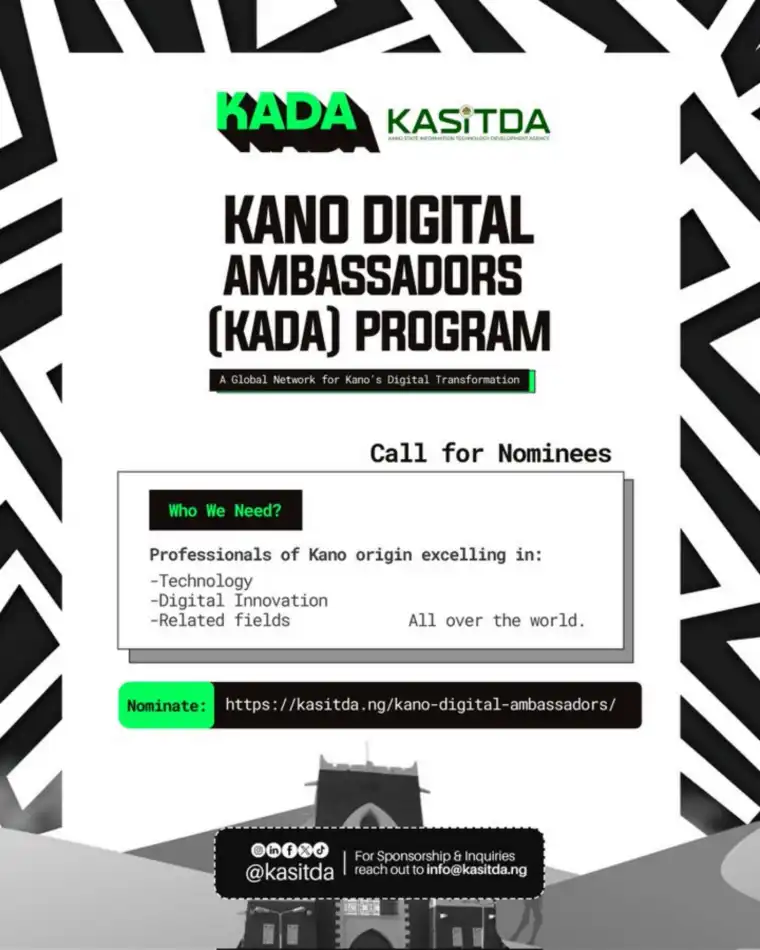
Kano State Information Technology Development Agency (KASITDA) has announced a call for nominations for the Kano Digital Ambassadors (KADA) programme.

The initiative is designed to promote digital innovation, collaboration, and strategic partnerships through natives in the diaspora while supporting the growth of the digital economy in Kano State.

According to KASITDA, “The Kano Digital Ambassadors (KADA) programme is an initiative organised to enhance digital innovation, collaboration, and strategic partnerships through natives in diaspora, promoting the growth of the digital ecosystem in Kano State.”

The agency explained that the programme will allow ambassadors to represent the state’s vision of becoming a digital hub. “As an ambassador in the Kano Digital Ambassadors (KADA) programme, you will be enabled to represent the state’s vision for a digital state,” it stated.

Nominations are open to professionals of Kano origin excelling in technology, digital innovation, and related fields. Deadline is to be announced, while applications can be submitted via https://kasitda.ng/kano-digital-ambassadors/.

NBTE circular: TVET staff without Master’s to convert to non-teaching

0

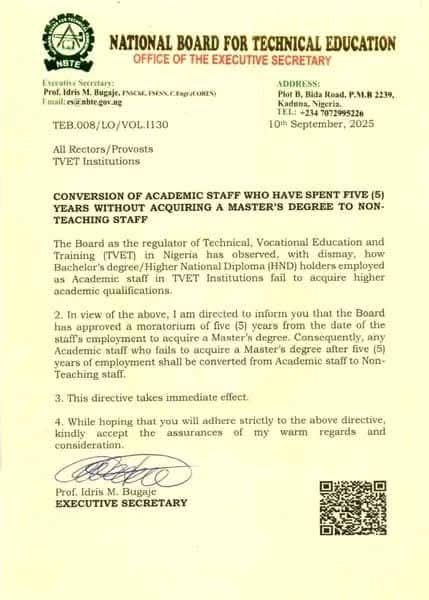
A circulating document dated 10th September 2025 has raised concerns within the education sector. The letter, signed by the Executive Secretary of the National Board for Technical Education, Prof. Idris M. Bugaje, FNIAE, FNSChE, Engr (COREN), carried reference number TEB.008/LO/VOL.1130 and was addressed to all Rectors and Provosts of Technical and Vocational Education and Training (TVET) institutions across Nigeria.

The document states that the Board, as the regulator of TVET in Nigeria, has observed “with dismay” how some Bachelor’s degree and Higher National Diploma holders employed as academic staff in TVET institutions fail to acquire higher qualifications.

According to the letter, a moratorium of five years has been approved for academic staff to obtain a Master’s degree. “Consequently, any Academic staff who fails to acquire a Master’s degree after five (5) years of employment shall be converted from Academic staff to Non-Teaching staff,” the directive reads.

The letter further notes that the directive takes immediate effect, urging all heads of institutions to comply strictly. Prof. Bugaje concluded by stating, “While hoping that you will adhere strictly to the above directive, kindly accept the assurances of my warm regards and consideration.”

As at the time of this report, there has been no official confirmation from the Board regarding the accuracy of this circulating document.

Attached below is the circular in circulation:

Niger State Targets 10m Metric Tons of Rice by 2030

0

Niger State has taken another step toward transforming its rice production capacity as a delegation from the AfricaRice centre visited Minna on a fact-finding mission to assess the state’s preparedness in driving the newly signed agricultural partnership.

The partnership, signed in July this year between the Niger State government and AfricaRice, is designed to raise the state’s annual paddy rice output from 1.5 million metric tons to 10 million metric tons by 2030.

It also focuses on climate-smart rice production, advanced processing technologies, and modern agricultural practices tailored to the state’s agro-ecological conditions over the next five years.

Receiving the team at the Council Chamber of Government House in Minna, the farmer governor described AfricaRice as an inspiration and reiterated the administration’s commitment to maximizing Niger State’s strength in agriculture. He noted that the state will leave no stone unturned in harnessing the vast potential of rice production.

“With this partnership, the quantity of rice Niger State will be producing would help in cutting down rice importation into the country by about 70%, create employment, increase revenue generation, and improve the socio-economic life of the people of the state,” the governor stated.

He appreciated the AfricaRice delegation for the visit and assured them of his government’s determination to make the collaboration a success.

The Director General of the AfricaRice centre, Dr Baboucarr Manneh, commended the efforts of the Niger State government in investing in agriculture. He described the state’s commitment and political will as impressive, stressing that AfricaRice is ready to support the transformation agenda.

“With the level of commitment and political will demonstrated by the farmer governor, AfricaRice is poised to translate the state’s ambition on rice production to reality,” Dr Manneh said.

He explained that AfricaRice will deploy its technical expertise across different stages of rice development, from seedlings to planting systems and extension services for farmers. According to him, the target is not only to boost output but also to achieve rice self-sufficiency and ensure sustainability in the long term.

FG to fix glitches in digital payments, boost e-commerce

0

The Federal Government of Nigeria is working towards removing all glitches against seamless digital payments and e-commerce across the country. The move, which is being driven by the Office of the Vice President through the Ministry of Industry, Trade and Investment alongside development partners, is targeted at ensuring that citizens can transfer money easily using their mobile phones and other digital devices.

Deputy Chief of Staff to the President in the Office of the Vice President, Senator Ibrahim Hassan Hadejia, revealed this on Tuesday in Abuja during a stakeholders roundtable.

Senator Hadejia emphasized the commitment of the administration of President Bola Ahmed Tinubu to enhance financial inclusion through different strategies that focus on expanding digital payment infrastructure to reach the last mile and serve Nigerians who are financially excluded.

According to him, Nigeria already has significant advantages in the digital payments space compared to many other nations. He explained, “There are very few countries in the West that have the kind of ease of payment and banking that is available in Nigeria. It doesn’t happen anywhere in the world, and by the time we begin to address these issues, we can use that reach to enter into the e-commerce stage. And like I said, from our own perspective, we are also worried about the exclusion that is inherent so that eligible Nigerians, no matter where they are, can have access to quality, simple financial services that are beyond educational and poverty levels.”

He further highlighted the importance of addressing the identity gap in the digital sector. “From the Office of the Vice President’s perspective, we look at digital payment and identity as really the last stumbling block in opening up e-commerce in Nigeria. Yes, there is e-commerce going on, but I think the biggest impediments surround the ease of payment, the identity issue and several things we are pushing, which are all interlinked,” he said.

Hadejia explained that solving these challenges would bring multiple benefits at once. “We are driving financial inclusion in the Office of the Vice President, which has to do with the strategy for different digital payment infrastructure that would essentially reach the last mile and serve the financially excluded. So, resolving these will amount to killing several birds with one stone. We have been to India and seen what robust PPI can do to e-commerce, and not just e-commerce but trade generally,” he added.

He assured that once government succeeds in making payment systems more seamless, millions of mobile phone users in Nigeria would be able to send and receive money with ease.

“You have a situation where, in a few years, the amount or volume of transaction from digital platforms is in excess of the traditional credit card. So, you have the likes of Wizard and Master card taking an interest, jumping into this space,” Hadejia noted.

He also linked the discussion to regional trade challenges. According to him, the inability of the African Continental Free Trade Agreement to gain the needed traction is tied to unresolved issues around cross-border payments and identity.

“And, of course, to also identify why the African Free Continental Trade Agreement has simply refused to gain the traction that it should have several years after it was established. We can also point to the fact that the issues have to do potentially with the cross-border payment and the identity issue. We are hoping that discussions like this will offer solutions,” he explained.

Hadejia further stated that the roundtable was a platform to gather information and data that would help government in shaping regulation, upgrading infrastructure, and enacting laws to address problems slowing down e-commerce in Nigeria.

At the event, the Principal Research Fellow, International Economic Development Group, Dr Max Mendez-Parra of ODI Global, said his organization had been working with the African Continental Free Trade Secretariat and other African countries on digital trade through wide-ranging coordination in the negotiations of the digital trade protocol.

Mendez-Parra pointed out that the implementation of the African Continental Free Trade Area would play a transformative role in the African economy and especially in Nigeria. He added that ODI had been assisting both the Nigerian government and the AFCTA Secretariat in Accra on various aspects linked to the agreement.

“In particular, we are supporting the negotiations and implementation of the investment protocol and the digital trade protocol as well. So, we have been working with the AFCTA. And this is what has brought us to Nigeria. Already, this is our fourth year that we have been here, and we are teaming up with the Office of the Vice President to basically enhance different aspects associated with the implementation of the digital trade protocol in Nigeria,” Mendez-Parra explained.

Also speaking, the Minister of Industry, Trade and Investment, Dr Jumoke Oduwole, said her ministry in partnership with the AFCTA Secretariat in Accra had developed an initiative called the AFCTA DG Pass, which would be used to operationalize digital identities.

Represented by her Special Adviser, Patience Okala, the minister said the initiative was still at its early stage but expressed confidence that the deliberations at the roundtable and the concerns raised by participants could help strengthen the process.

She noted that seamless digital identity is essential in the digital payment system and would encourage more participation in e-commerce, financial technology, and cross-border trade.

For his part, Mallam Salisu Dasuki Nakande, Special Assistant to the President on ICT Policy, explained that the project began two years ago with support from the Vice President, Senator Kashim Shettima.

“And this year is more importantly about the conversation across the payment which we are doing in alignment with the Federal Ministry of Industry, Trade and Investment. We believe that as much as Nigerians want to trade, they need to be able to make payments in a seamless way across board, and there is a lot of economy to tap in there. So, that is the basic for this conversation,” Nakande stated.

The roundtable also reinforced government’s plan to position Nigeria as a leading digital economy in Africa by resolving long-standing issues that hinder smooth financial transactions and limit the potential of e-commerce.

NNPC expands second phase vulnerable farmers training to Northern Nigeria

0

NNPC Foundation has extended its Vulnerable Farmers Training Programme to Northern Nigeria as part of efforts to strengthen food security, promote national development, and drive economic empowerment.

The initiative, which is the Corporate Social Responsibility arm of NNPC Ltd., marks the second phase of the programme.

The training is designed to equip farmers with modern agricultural techniques. It covers areas such as climate-smart farming, organic fertilization, post-harvest loss reduction, and improved market access strategies. These areas are seen as key in boosting agricultural productivity and reducing food insecurity across the country.

The first phase of the programme, which took place in the Southern region including the South-East, South-South, and South-West, successfully empowered over 4,000 farmers.

Participants were trained on modern farming practices and strategies to access better markets. According to the Foundation, the success recorded in that phase is now being expanded to cover the North East, North West, and North Central zones.

The second phase will include training sessions across six States in the northern zones and one session in the Federal Capital Territory, Abuja. The aim is to reach more farmers who are in need of skills to transition from subsistence farming to sustainable commercial agriculture.

During the official flag-off of the first phase in Nsukka, Enugu State, Managing Director of NNPC Foundation, Mrs. Emmanuella Arukwe, highlighted the importance of the initiative. She explained that it aligns with the Federal Government’s agricultural transformation agenda, which seeks to boost food security, increase productivity, and improve livelihoods for smallholder farmers.

“At NNPC Ltd, we recognize that agriculture remains the primary source of livelihood for over 70% of Nigeria’s population. Yet, many farmers remain trapped in subsistence-level production due to limited access to modern techniques, quality inputs, and competitive markets. This training is designed to change that narrative,” Arukwe said.

She added that the goal is to provide farmers with tools, resources, and knowledge that will help them shift from subsistence farming to commercial-scale agricultural production.

Borno State teachers recruitment portal to open in December

0

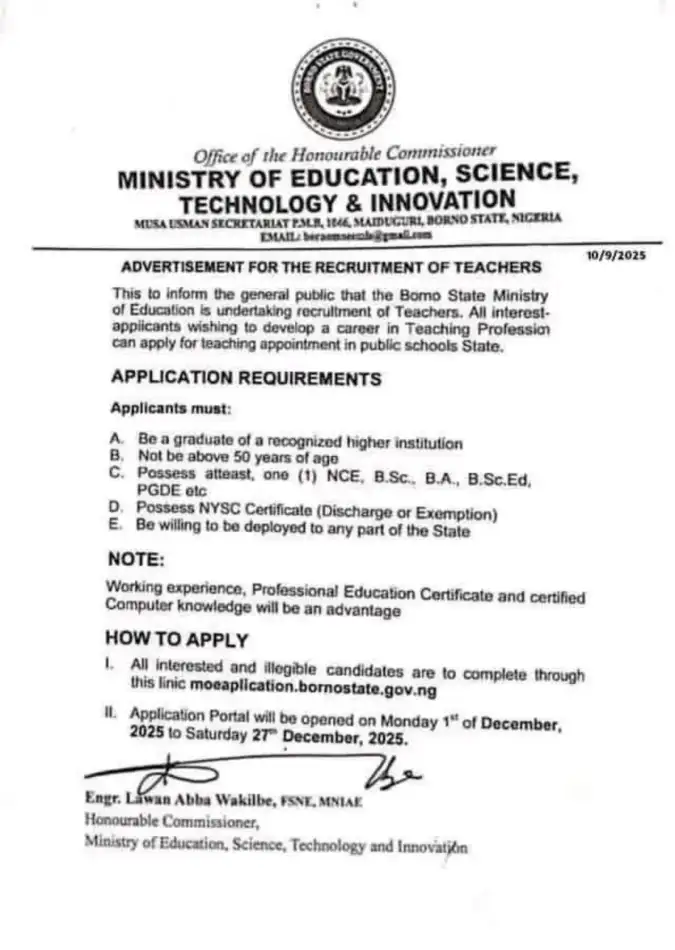
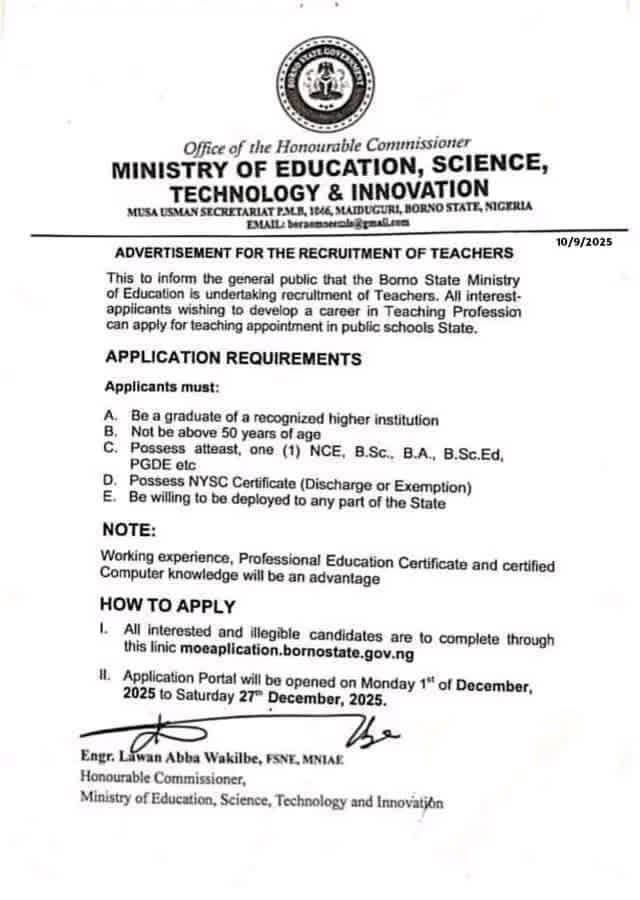
September 10, 2025 – An unconfirmed circular claims that the Borno State Ministry of Education, Science, Technology and Innovation has announced that recruitment of teachers will soon begin across public schools in the state.

According to the circular, the online application portal will open on Monday, December 1, 2025, and close on Saturday, December 27, 2025.

It claims that a statement from the Office of the Honourable Commissioner at Musa Usman Secretariat, Maiduguri, confirmed the exercise. It said, “This is to inform the general public that the Borno State Ministry of Education is undertaking recruitment of teachers. All interested applicants wishing to develop a career in the teaching profession can apply for teaching appointment in public schools in the state.”

The requirements state that applicants must be graduates of recognized higher institutions, not above 50 years of age, and must possess at least one of NCE, B.Sc., B.A., B.Sc.Ed, or PGDE. Candidates are also required to have an NYSC certificate, either discharge or exemption, and be ready for deployment to any part of the state.

The unverified advert also added that “working experience, professional education certificate and certified computer knowledge will be an advantage.”

Interested candidates are expected to apply online through the portal moeaplication.bornostate.gov.ng once it is open in December 2025.

News update (September 11, 2025):

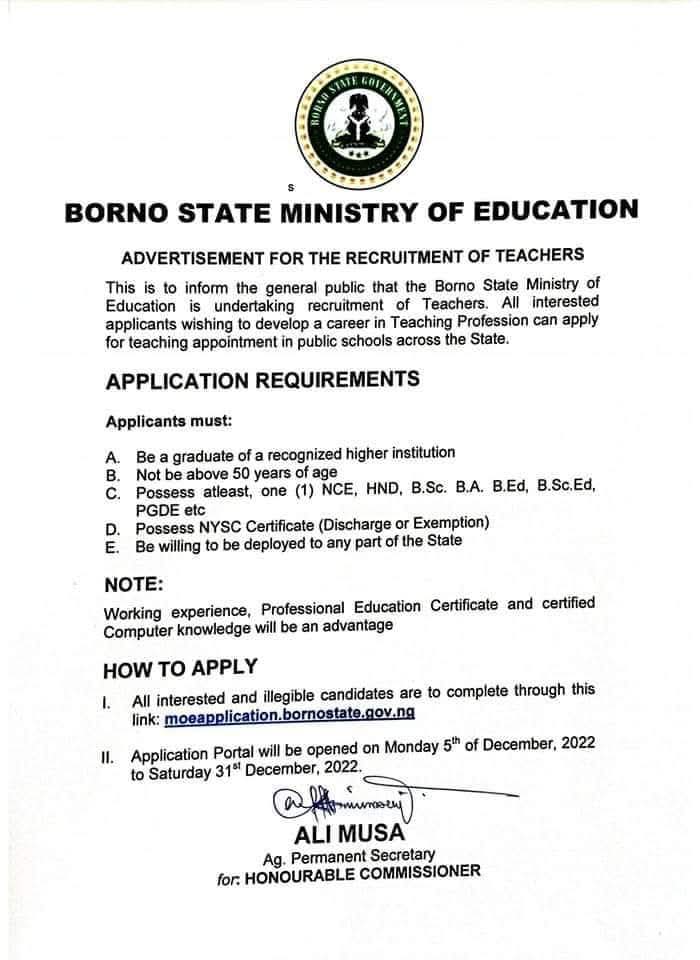
Our findings confirm that the recruitment advertisement in circulation is fake. The circular matches an old 2022 advert, suggesting it was edited to mislead the public. As of now, the Borno State Ministry of Education has not issued any official statement regarding this advert.

Attached below is the advert in circulation (Image 2 is a similar advert from 2022):

Image 1
Image 2

Lagos sets make-up indigeneship verification date 2023/2024 and 2024/2025

0

The Lagos State Scholarship Board (LSSB) has announced a make-up indigeneship verification exercise for applicants of the 2023/2024 and 2024/2025 Bursary and Scholarship Awards who missed the earlier process, as well as new applicants.

According to LSSB, the exercise will run from Monday, 22nd to Friday, 26th September 2025. The statement noted, “All affected applicants are advised to participate in this verification as it is a compulsory step for scholarship and bursary consideration.”