
Home Blog Page 469

FG to fix glitches in digital payments, boost e-commerce

0

The Federal Government of Nigeria is working towards removing all glitches against seamless digital payments and e-commerce across the country. The move, which is being driven by the Office of the Vice President through the Ministry of Industry, Trade and Investment alongside development partners, is targeted at ensuring that citizens can transfer money easily using their mobile phones and other digital devices.

Deputy Chief of Staff to the President in the Office of the Vice President, Senator Ibrahim Hassan Hadejia, revealed this on Tuesday in Abuja during a stakeholders roundtable.

Senator Hadejia emphasized the commitment of the administration of President Bola Ahmed Tinubu to enhance financial inclusion through different strategies that focus on expanding digital payment infrastructure to reach the last mile and serve Nigerians who are financially excluded.

According to him, Nigeria already has significant advantages in the digital payments space compared to many other nations. He explained, “There are very few countries in the West that have the kind of ease of payment and banking that is available in Nigeria. It doesn’t happen anywhere in the world, and by the time we begin to address these issues, we can use that reach to enter into the e-commerce stage. And like I said, from our own perspective, we are also worried about the exclusion that is inherent so that eligible Nigerians, no matter where they are, can have access to quality, simple financial services that are beyond educational and poverty levels.”

He further highlighted the importance of addressing the identity gap in the digital sector. “From the Office of the Vice President’s perspective, we look at digital payment and identity as really the last stumbling block in opening up e-commerce in Nigeria. Yes, there is e-commerce going on, but I think the biggest impediments surround the ease of payment, the identity issue and several things we are pushing, which are all interlinked,” he said.

Hadejia explained that solving these challenges would bring multiple benefits at once. “We are driving financial inclusion in the Office of the Vice President, which has to do with the strategy for different digital payment infrastructure that would essentially reach the last mile and serve the financially excluded. So, resolving these will amount to killing several birds with one stone. We have been to India and seen what robust PPI can do to e-commerce, and not just e-commerce but trade generally,” he added.

He assured that once government succeeds in making payment systems more seamless, millions of mobile phone users in Nigeria would be able to send and receive money with ease.

“You have a situation where, in a few years, the amount or volume of transaction from digital platforms is in excess of the traditional credit card. So, you have the likes of Wizard and Master card taking an interest, jumping into this space,” Hadejia noted.

He also linked the discussion to regional trade challenges. According to him, the inability of the African Continental Free Trade Agreement to gain the needed traction is tied to unresolved issues around cross-border payments and identity.

“And, of course, to also identify why the African Free Continental Trade Agreement has simply refused to gain the traction that it should have several years after it was established. We can also point to the fact that the issues have to do potentially with the cross-border payment and the identity issue. We are hoping that discussions like this will offer solutions,” he explained.

Hadejia further stated that the roundtable was a platform to gather information and data that would help government in shaping regulation, upgrading infrastructure, and enacting laws to address problems slowing down e-commerce in Nigeria.

At the event, the Principal Research Fellow, International Economic Development Group, Dr Max Mendez-Parra of ODI Global, said his organization had been working with the African Continental Free Trade Secretariat and other African countries on digital trade through wide-ranging coordination in the negotiations of the digital trade protocol.

Mendez-Parra pointed out that the implementation of the African Continental Free Trade Area would play a transformative role in the African economy and especially in Nigeria. He added that ODI had been assisting both the Nigerian government and the AFCTA Secretariat in Accra on various aspects linked to the agreement.

“In particular, we are supporting the negotiations and implementation of the investment protocol and the digital trade protocol as well. So, we have been working with the AFCTA. And this is what has brought us to Nigeria. Already, this is our fourth year that we have been here, and we are teaming up with the Office of the Vice President to basically enhance different aspects associated with the implementation of the digital trade protocol in Nigeria,” Mendez-Parra explained.

Also speaking, the Minister of Industry, Trade and Investment, Dr Jumoke Oduwole, said her ministry in partnership with the AFCTA Secretariat in Accra had developed an initiative called the AFCTA DG Pass, which would be used to operationalize digital identities.

Represented by her Special Adviser, Patience Okala, the minister said the initiative was still at its early stage but expressed confidence that the deliberations at the roundtable and the concerns raised by participants could help strengthen the process.

She noted that seamless digital identity is essential in the digital payment system and would encourage more participation in e-commerce, financial technology, and cross-border trade.

For his part, Mallam Salisu Dasuki Nakande, Special Assistant to the President on ICT Policy, explained that the project began two years ago with support from the Vice President, Senator Kashim Shettima.

“And this year is more importantly about the conversation across the payment which we are doing in alignment with the Federal Ministry of Industry, Trade and Investment. We believe that as much as Nigerians want to trade, they need to be able to make payments in a seamless way across board, and there is a lot of economy to tap in there. So, that is the basic for this conversation,” Nakande stated.

The roundtable also reinforced government’s plan to position Nigeria as a leading digital economy in Africa by resolving long-standing issues that hinder smooth financial transactions and limit the potential of e-commerce.
Advertisement

NNPC expands second phase vulnerable farmers training to Northern Nigeria

0

NNPC Foundation has extended its Vulnerable Farmers Training Programme to Northern Nigeria as part of efforts to strengthen food security, promote national development, and drive economic empowerment.

The initiative, which is the Corporate Social Responsibility arm of NNPC Ltd., marks the second phase of the programme.

The training is designed to equip farmers with modern agricultural techniques. It covers areas such as climate-smart farming, organic fertilization, post-harvest loss reduction, and improved market access strategies. These areas are seen as key in boosting agricultural productivity and reducing food insecurity across the country.

The first phase of the programme, which took place in the Southern region including the South-East, South-South, and South-West, successfully empowered over 4,000 farmers.

Participants were trained on modern farming practices and strategies to access better markets. According to the Foundation, the success recorded in that phase is now being expanded to cover the North East, North West, and North Central zones.

The second phase will include training sessions across six States in the northern zones and one session in the Federal Capital Territory, Abuja. The aim is to reach more farmers who are in need of skills to transition from subsistence farming to sustainable commercial agriculture.

During the official flag-off of the first phase in Nsukka, Enugu State, Managing Director of NNPC Foundation, Mrs. Emmanuella Arukwe, highlighted the importance of the initiative. She explained that it aligns with the Federal Government’s agricultural transformation agenda, which seeks to boost food security, increase productivity, and improve livelihoods for smallholder farmers.

“At NNPC Ltd, we recognize that agriculture remains the primary source of livelihood for over 70% of Nigeria’s population. Yet, many farmers remain trapped in subsistence-level production due to limited access to modern techniques, quality inputs, and competitive markets. This training is designed to change that narrative,” Arukwe said.

She added that the goal is to provide farmers with tools, resources, and knowledge that will help them shift from subsistence farming to commercial-scale agricultural production.

Borno State teachers recruitment portal to open in December

0

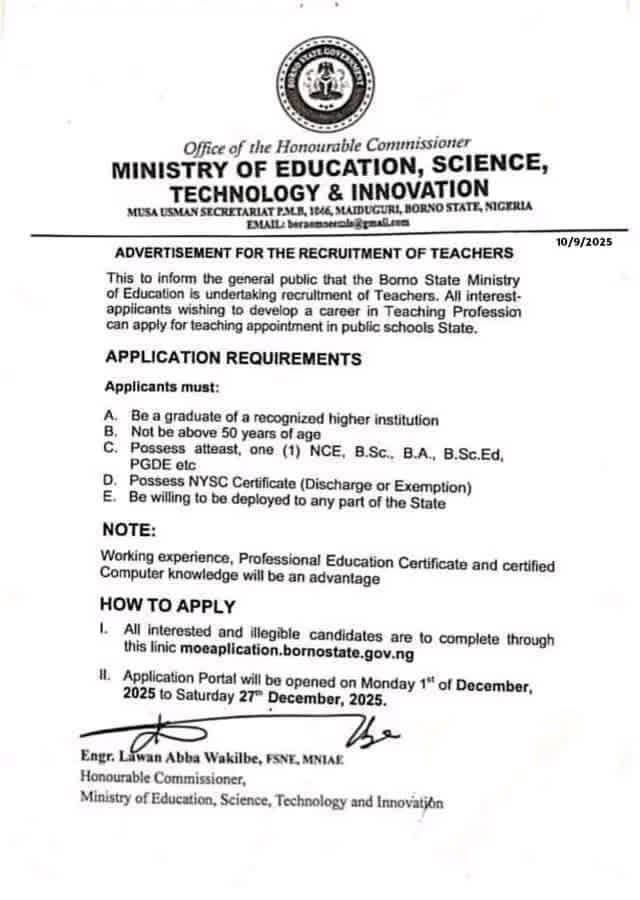
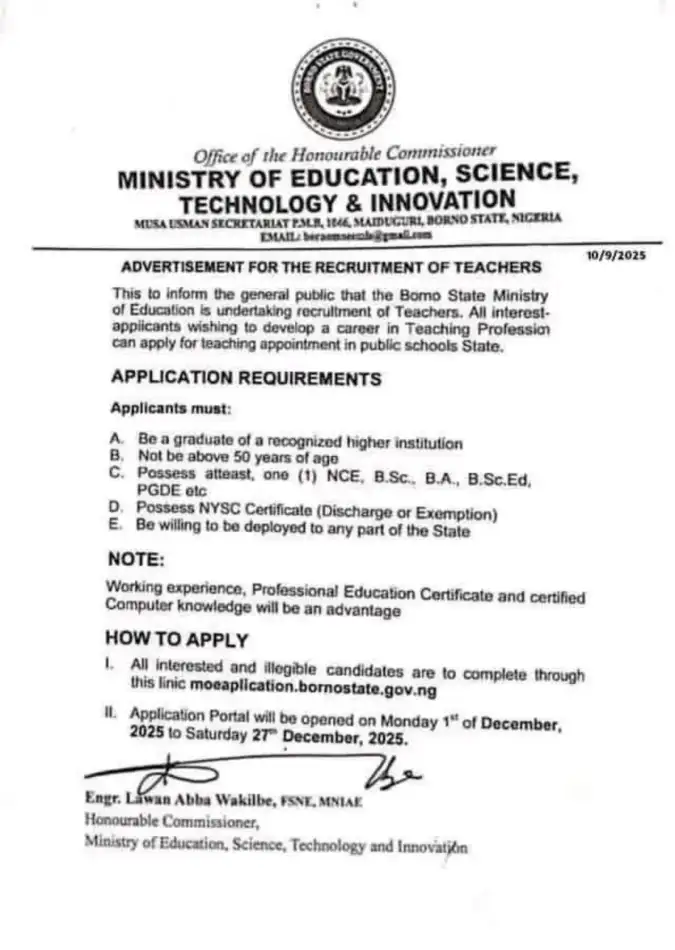
September 10, 2025 – An unconfirmed circular claims that the Borno State Ministry of Education, Science, Technology and Innovation has announced that recruitment of teachers will soon begin across public schools in the state.

According to the circular, the online application portal will open on Monday, December 1, 2025, and close on Saturday, December 27, 2025.

It claims that a statement from the Office of the Honourable Commissioner at Musa Usman Secretariat, Maiduguri, confirmed the exercise. It said, “This is to inform the general public that the Borno State Ministry of Education is undertaking recruitment of teachers. All interested applicants wishing to develop a career in the teaching profession can apply for teaching appointment in public schools in the state.”

The requirements state that applicants must be graduates of recognized higher institutions, not above 50 years of age, and must possess at least one of NCE, B.Sc., B.A., B.Sc.Ed, or PGDE. Candidates are also required to have an NYSC certificate, either discharge or exemption, and be ready for deployment to any part of the state.

The unverified advert also added that “working experience, professional education certificate and certified computer knowledge will be an advantage.”

Interested candidates are expected to apply online through the portal moeaplication.bornostate.gov.ng once it is open in December 2025.

News update (September 11, 2025):

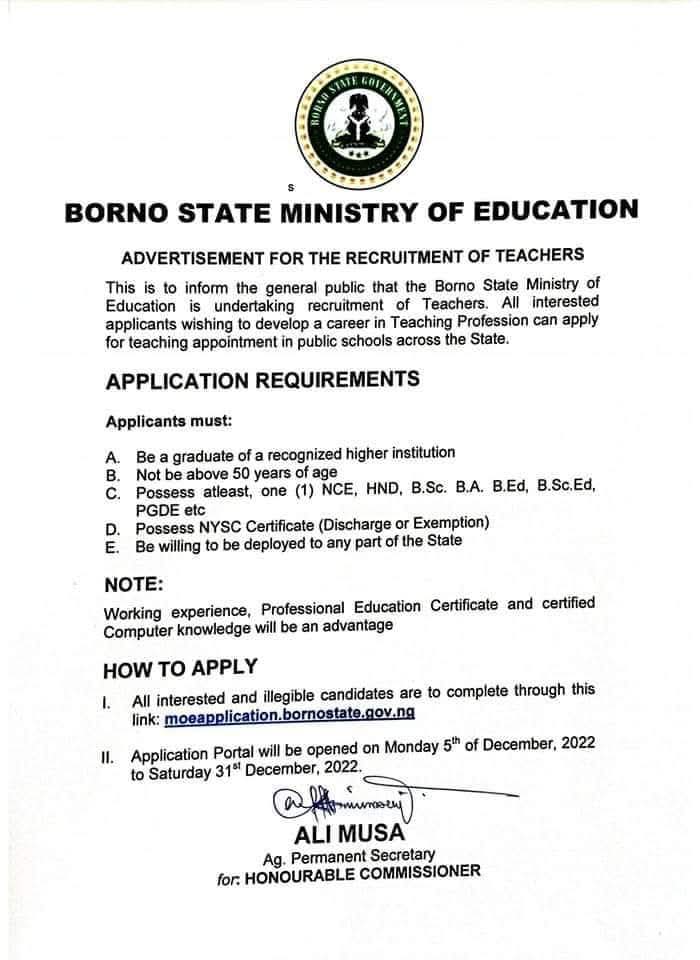
Our findings confirm that the recruitment advertisement in circulation is fake. The circular matches an old 2022 advert, suggesting it was edited to mislead the public. As of now, the Borno State Ministry of Education has not issued any official statement regarding this advert.

Attached below is the advert in circulation (Image 2 is a similar advert from 2022):

Image 1
Image 2

Lagos sets make-up indigeneship verification date 2023/2024 and 2024/2025

0

The Lagos State Scholarship Board (LSSB) has announced a make-up indigeneship verification exercise for applicants of the 2023/2024 and 2024/2025 Bursary and Scholarship Awards who missed the earlier process, as well as new applicants.

According to LSSB, the exercise will run from Monday, 22nd to Friday, 26th September 2025. The statement noted, “All affected applicants are advised to participate in this verification as it is a compulsory step for scholarship and bursary consideration.”

FG converts science and technical colleges to Federal Technical Colleges

0

The Federal Government has announced a reform in technical education aimed at securing a brighter future for Nigerian youth. The Honourable Minister of Education, Dr. Maruf Tunji Alausa, CON, and the Honourable Minister of State for Education, Professor Swaibu Sa’id Ahmad, revealed that the reform will take effect from the 2025/2026 academic year across all Federal Science and Technical Colleges.

According to the announcement, these schools will now operate fully as Federal Technical Colleges. Each college will offer between six and ten trade courses, while students will take a total of nine to ten subjects.

The subjects will include one trade course, five or six general subjects such as Mathematics, English Language, Physics, Chemistry, Biology, and Citizenship and Heritage Studies, two or three trade-related subjects, and one elective.

Dr. Alausa stated that the move was necessary to reduce overload, build stronger trade competencies, and align with global standards. “This reform is designed to prepare young Nigerians for the jobs of the future,” he explained. He added that the introduction of Citizenship and Heritage Studies, which merges Nigerian History, Civic Education, and Social Studies, will ensure students remain rooted in national values while learning practical skills.

A total of 26 trade areas have been streamlined and modernized to reflect industry demand. These trades include Solar PV Installation and Maintenance, Fashion Design and Garment Making, Computer Hardware and GSM Repairs, Livestock Farming, Beauty Therapy and Cosmetology, Creative Media, Social Media Content Creation and Management, Leather Works, and other skill areas vital to Nigeria’s economic growth.

The reform also seeks to strengthen Nigeria’s manufacturing, services, and digital economy by focusing on trades that match market needs. By equipping students with these skills, the Ministry of Education aims to boost employability, entrepreneurship, and industrial productivity.

Dr. Alausa highlighted that the reform aligns with President Bola Ahmed Tinubu, GCFR’s Renewed Hope Agenda.

He said, “This is about building a system that supports our youth to compete globally. The new curriculum is carefully designed to make sure our students are not just employable but are also contributors to national development. It is in line with the vision of growing Nigeria’s economy to one trillion dollars by 2030.”

Professor Swaibu Sa’id Ahmad further noted that the transition would be smooth as the Ministry has provided guidelines and full support for schools, parents, and students.

He assured stakeholders that the government is committed to making technical education more relevant to the realities of today’s economy.

The Ministry has also released the comprehensive list of trade areas to guide schools and stakeholders.

1. Brick Laying, Block Laying and Concreting
2. Woodwork, Carpentry and Joinery
3. Plumbing and Pipe Fitting
4. Computer Hardware & GSM Repair and Maintenance
5. Refrigeration & Air-conditioning Works
6. Mechanized Agriculture (Mechanics or Operations/ Smart Agriculture)
7. Autobody Works
8. Catering Craft Practice
9. Solar PV Installation and Maintenance
10. Fashion Design and Garment making
11. Livestock Farming/Animal Husbandry
12. Fish Farming Activity (Aquaculture)
13. Motorcycle & Tricycle Repairs
14. Painting Decoration and Finishes (Interior Design)
15. Welding & Fabrication
16. Auto-Electrical Wiring
17. Auto-Mobile Mechanics
18. Beauty Therapy & Cosmetology
19. Creative Media (Digital Media Production)
20. Electronic Systems Maintenance Craft
21. Furniture Making & Upholstery
22. Networking & System Security (Satellite TV Antenna installation and maintenance)
23. Social Media Content Creation and Management
24. Tiling & Cladding (Tilling and decorative stonework or Floor cover installation)
25. Automobile CNG Conversion and Maintenance
26. Leather Works

Zenith Bank sends account number to YEIDEP beneficiaries via SMS/Email

0

Zenith Bank has begun sending account numbers to beneficiaries of the Youth Economic Intervention and Deregulation Program (YEIDEP) through both SMS and email.

This development comes only a few days after the YEIDEP stakeholders’ implementation retreat held on Wednesday, September 3, 2025, in Abuja. Zenith Bank, a partner in the YEIDEP initiative, was in attendance at the event.

The SMS sent to participants reads, “Dear [candidate], Your Zenith Bank Acct No. is [1234567890]. Kindly visit any of our branches to get an ATM Card. Thank you for Banking with us.”

A similar message is being sent by email, introducing beneficiaries to their new banking relationship. The email reads, “Dear [Candidate],

New Banking Relationship

Thank you for choosing to start a banking relationship with Zenith Bank Plc. In line with your request a/an Savings Account has been opened for you with the following details:

Account Name:
Account Number:
Branch Name:

To ensure you maximize the benefits of being a Zenith Bank customer, here are a few things you need to do urgently:

a. Get a Zenith Bank Card at your branch.
b. Download the Zenith Mobile Banking app from the relevant app store.
c. Register for the Zenith Bank *966# Eazybanking service.”

During the retreat, Zenith Bank reaffirmed its commitment to the program. “We believe in the power of youth-led innovations and entrepreneurship to drive sustainable economic growth,” a representative said. “Zenith Bank remains a proud supporter of youth empowerment (YEIDEP) and looks forward to continuing our partnership in building a brighter future.”

However, beneficiaries should note that receiving Zenith Bank SMS or email does not automatically mean a candidate has been shortlisted. The first tranche of registration has been completed, with over 8,000 verified participants enrolled in the program.

Jigawa State approves Teacher Development Agency

0

Jigawa State Executive Council has approved the establishment of the Jigawa State Teacher Development Agency, a move aimed at improving the quality of education and learning outcomes across the state.

The resolution was reached during the State Executive Council meeting held on Tuesday, 9th September 2025, and chaired by His Excellency, the Executive Governor of Jigawa State, Malam Umar A. Namadi FCA.

According to the Council, “the Jigawa State Teacher Development Agency will focus on strengthening the quality of teaching across basic and post-basic education levels.” This decision is seen as a strategic initiative to enhance teacher training and capacity building in order to boost student performance and overall educational standards.

In line with the resolution, the Council directed that the bill for the establishment of the agency be immediately forwarded to the Jigawa State House of Assembly for legislative action and final enactment into law.

Jigawa approves N286.7m for students at Near East University Cyprus

0

Jigawa State Government has reaffirmed its commitment to the comprehensive sponsorship of students studying at Near East University, Cyprus. This was part of the major resolutions from the State Executive Council meeting held on Tuesday, 9th September 2025, and chaired by His Excellency, the Executive Governor of Jigawa State, Malam Umar A. Namadi FCA.

According to the Council, this decision follows the 100% waiver of tuition fees granted by Near East University to Jigawa State indigenes. The gesture was in recognition of the administration’s consistent focus on human capital development.

The Council approved the sum of ₦134,689,464.00 for the payment of administrative charges, VAT, acceptance fees, and accommodation for 15 admitted undergraduate and postgraduate students for the 2025/2026 fall semester.

Similarly, the Council approved an additional ₦152,086,714.00 to cover living allowance, health insurance, visa processing fees, resident permits, result authentication, yellow card, feeding allowance, local and international transportation, DTA, estacode, and return air tickets.

“The total approval for the 15 students amounts to ₦286,776,178.00 only for the 2025/2026 fall semester,” the Council confirmed.

The sponsored students will be studying medical, nursing science, and engineering courses at Near East University, Cyprus, which aligns with the government’s goal of developing skilled professionals in key sectors.

Jigawa approves N40,000 monthly allowance for J-Teach graduate teachers

0

Jigawa State Executive Council has approved an increase in the monthly allowance for 1,100 J-Teach graduate beneficiaries from ₦30,000 to ₦40,000.

The decision was reached during the council meeting held on Tuesday, September 9, 2025, and chaired by His Excellency, the Executive Governor of Jigawa State, Malam Umar A. Namadi FCA.

Speaking on the resolution, the council reaffirmed the administration’s commitment to education development. “This increment is part of our ongoing efforts to enhance teacher motivation, boost productivity, and strengthen the quality of education across the state,” the Governor stated.

The approval followed a formal request presented by the Ministry for Higher Education, which emphasized the need to support graduate teachers under the J-Teach program.

The increase is expected to encourage teachers to deliver better learning outcomes, aligning with the state government’s vision for continuous education sector transformation and youth empowerment initiatives.

Katsina Local Govt Council free computer literacy training

0

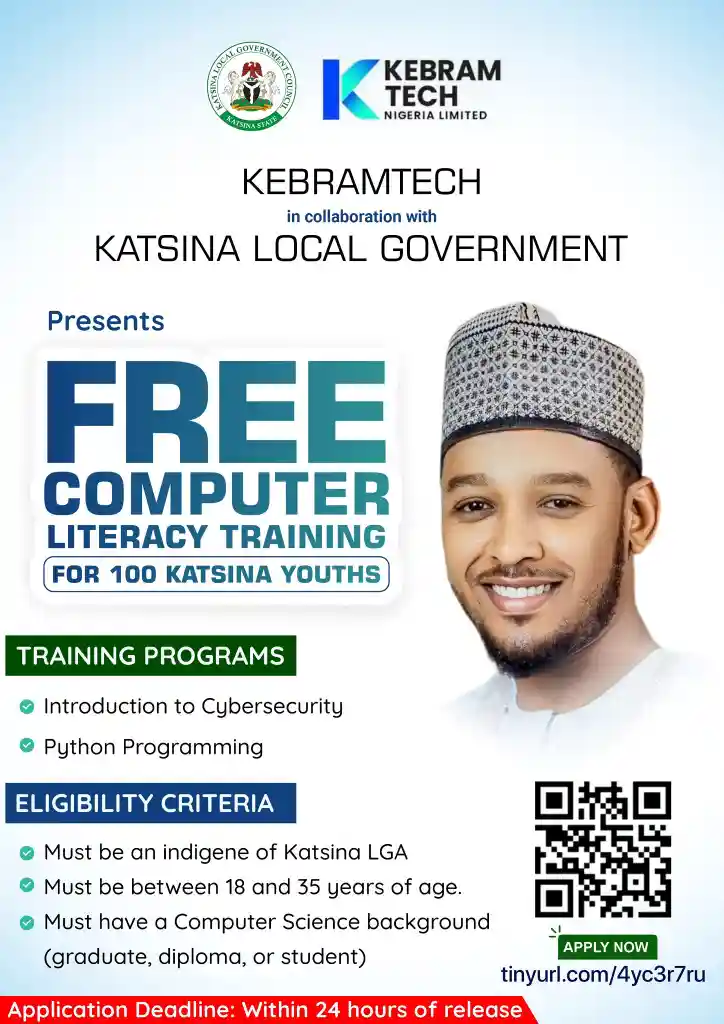
KebramTech, in collaboration with Katsina Local Government, has announced 100 free training slots for youths in Katsina Local Government Area. According to the organizers, 50 slots are available in Cybersecurity and 50 slots in Python Programming.

The training program will focus on two essential ICT areas: Introduction to Cybersecurity and Python Programming. “Participants will gain the skills needed to stay competitive in today’s rapidly evolving digital landscape,” KebramTech stated. The Council said the initiative aims to empower young people with knowledge that enhances their employability, fosters innovation, and promotes self-reliance.

Training programs:

Eligibility criteria:
1. Must be an indigene of Katsina LGA
2. Must be between 18 and 35 years of age.
3. Must have a Computer Science background (graduate, diploma, or student)

Application Deadline: Within 24 hours of release.

How to apply
The registration link below is exclusively for KTLG indigenes tinyurl.com/4yc3r7ru.

News update (September 11, 2025):

Less than 24 hours after the announcement, 1,847 people applied for the training originally intended for only 100 participants. As a result, Katsina Local Government Council has increased the available slots to 500 participants.