Home Blog Page 47

ACI, CSR-in-Action Announce Women SDG Advocates Conference 2026

The African CleanUp Initiative (ACI), in partnership with CSR-in-Action Advocacy, has announced the Women SDG Advocates Conference (WSAC) 2026 to drive the development of women across sectors.

The conference, themed “Give to Gain: Empowering Women Through Shared Action,” is expected to bring together over 200 women leaders driving SDG action across communities, business and public service. According to the organisers, the event is designed to strengthen collaboration and create practical solutions that support sustainable development goals.

As part of preparations, the organisers recently unveiled the Conference Committee, which will provide strategic direction for the programme and support stakeholder engagement ahead of the convening. The committee is chaired by Dr Bekeme Masade-Olowola, group chief executive of CSR-in-Action, and Victoria Uwadoka, corporate communications lead, Nestle Nigeria. Other members include Titilope Oguntuga, director, Sustainability, IHS Towers, and Mrs Bukola Adeoye, executive director, Corporate Services, SystemSpecs Holdings Limited.

The Women SDG Advocates Conference 2026 is designed as a strategic convening to bring together women leaders, advocates, professionals, entrepreneurs, civil society actors, development practitioners, and corporate stakeholders committed to advancing the SDGs. Convened in commemoration of International Women’s Day 2026, the conference will serve as a catalyst for shared action, partnerships, and scalable solutions.

The hybrid event will hold on Wednesday, March 11, 2026, at The Lagos Chamber of Commerce and Industry (LCCI), Commerce House, Lagos.

Speaking about the event, Dr Alexander Akhigbe, founder and chief executive of ACI, said, “Empowering women is not charity; it is a global strategy for sustainable development. As Women SDG Advocates rise together, they unlock opportunities that transform communities and nations.”

Advertisement

Minister Doro urges wealthy Nigerians to support poor

The Minister of Humanitarian and Poverty Reduction, Dr. Bernard Doro, has emphasized the need to support the underprivileged in society as a practical way to reduce poverty and strengthen social solidarity across the country.

Dr. Doro spoke on Sunday while declaring open a two-day Medical Outreach and Empowerment programme under the Renewed Hope Agenda. The event was held in Jos, Plateau State, and organized by Dr. Nasir Ajala Kabara in collaboration with the Federal Ministry of Humanitarian and Poverty Reduction.

He called on wealthy members of society to respond to the needs of the less fortunate, stressing that government alone cannot meet the demands of all citizens.

“I therefore appeal to everyone to always live in peace and harmony with one another. We all stand to achieve a lot by accommodating each other and fostering development in our state, if there is peace,” he said.

Dr. Doro also commended the convener of the Medical Outreach, Dr. Nasir Ajala Kabara, who is an aspirant for the position of National Youth Leader at the upcoming All Progressives Congress (APC) National Convention. He praised Kabara for collaborating with the Ministry of Humanitarian Affairs and Poverty Reduction to make the programme possible.

In his address, Dr. Kabara said the outreach was organized to address various health concerns, including hypertension, hepatitis, dental care, eye examinations, peptic ulcer disease, and free eye-reading classes.

He explained that the initiative is designed to reduce the financial burden on low-income individuals by providing quality healthcare services and preventing them from slipping deeper into poverty due to medical challenges.

Dr. Kabara added that the programme aligns with the Renewed Hope Agenda of President Bola Ahmed Tinubu’s administration. He noted that similar medical outreaches would be conducted across all geo-political zones and commended the President for efforts to reposition the economy, stating that the benefits of his policies are beginning to show and that he deserves a second term to consolidate the gains.

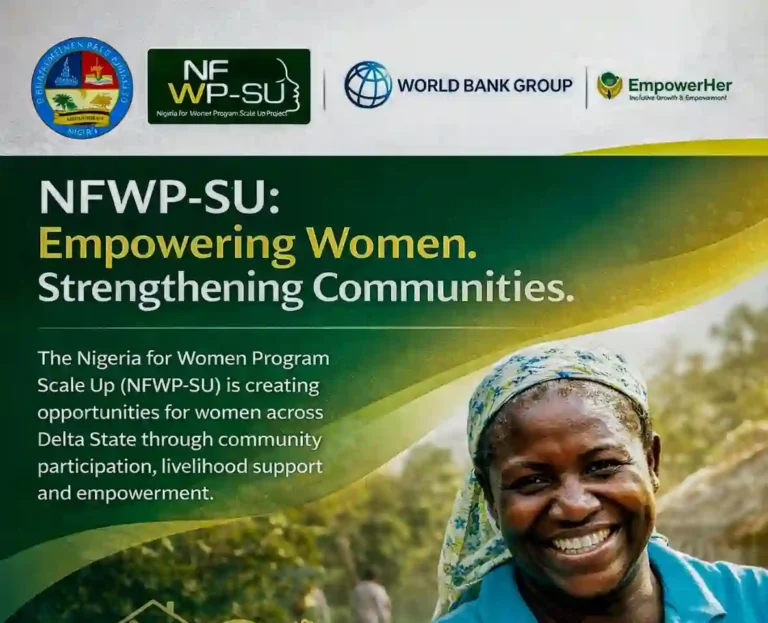
NFWP-SU Begins Recruitment of Ward Facilitators in Delta LGAs

The Nigeria for Women Program Scale Up (NFWP-SU) has commenced recruitment for Ward Facilitators in Delta State to strengthen women’s empowerment and community development efforts.

Applications are now open for qualified individuals to support programme implementation at the grassroots level. At this stage, the opportunity is limited to Ethiope East LGA, Ika North East LGA, and Warri North LGA.

The programme is seeking committed individuals who are willing to serve their communities and contribute to improving the livelihoods of women. The minimum educational requirement is a WAEC or Secondary School Certificate.

To qualify, applicants must be residents of the specific community in Ethiope East, Ika North East, or Warri North where they intend to work. Candidates must possess at least a Secondary School Leaving Certificate, demonstrate the ability to mobilise women within their communities, and be available to commit at least 10 hours per week to programme activities.

If you are passionate about community development and women’s empowerment, this is an opportunity to be part of a transformative initiative aimed at strengthening livelihoods across Delta State.

For further information, interested applicants can call 08160904860 (Ethiope East), 08035165861 (Ika North East), 08074203420 (Warri North), or the toll-free line 08000000040.

Apply: 2026 UNESCO-UNEVOC TVET Leadership Programme

0

The UNESCO-UNEVOC TVET Leadership Programme (TLP) 2026 is now open for applications. The TLP is a flagship global leadership initiative designed to strengthen the capacity of mid- to senior-level Technical and Vocational Education and Training (TVET) leaders to drive institutional and systems-level transformation.

The 2026 edition forms part of the initiative titled “Towards a Global TVET Agenda.” It is funded by the German Federal Ministry for Education, Family Affairs, Senior Citizens, Women and Youth (BMBFSFJ) through the German Federal Institute for Vocational Education and Training (BIBB). The programme aligns with the broader goal of enhancing global cooperation, policy learning, and capacity development in the TVET sector. The programme is offered exclusively in English.

As benefits, participants will strengthen their strategic, instructional, people-centred, collaborative, and adaptive leadership competencies. They will develop a results-oriented action plan for change and gain exposure to global TVET agendas as well as international good practices. Participants will also join a global network of TVET leaders to support continued learning and collaboration. Upon successful completion, participants will receive a Certificate of Completion from UNESCO-UNEVOC.

Who should apply? The programme targets mid- to senior-level TVET professionals who are committed to becoming change agents within their institutions or systems. Eligible functional roles include leadership and management of TVET, skills, or employment systems and institutions; policy framing or implementation; monitoring and evaluation; quality assurance; and networking and partnership management.

Applicants must demonstrate interest and ability to drive change in the TVET, skills development, or employment sectors. A minimum of five years of professional experience in relevant systems or institutions is required. Candidates must be proficient in written and spoken English and be committed to active participation, including the development of an action plan for change. Institutional support to participate and implement follow-up actions is also required.

Women in mid- to senior-level positions and candidates from under-represented contexts are especially encouraged to apply.

Selection will be based on leadership role, institutional relevance, feasibility of the proposed change initiative, motivation, and cohort diversity considerations.

The application form will remain open until March 2nd, 2026.

To apply for the 2026 UNESCO-UNEVOC TVET Leadership Programme, interested applicants should visit https://forms.office.com/e/BRjdf7qMUS and complete the application form.

Nigeria Tax Act 2025: No 25% Tax on Building Materials or Bank Funds

0

The Presidential Fiscal Policy and Tax Reforms Committee has issued a clarification on the Nigeria Tax Act 2025, stating that the law has already commenced and does not impose a 25 percent tax on building materials, construction funds, or bank balances.

The committee said it is aware of a recent video claiming that the new tax laws will commence in 2027 and alleging the imposition of a 25 percent tax on funds for building materials and other transactions. It described both claims as incorrect.

According to the statement, “Contrary to the misinformation seeking to create fear, panic and disaffection, the Nigeria Tax Act 2025 has already commenced and does not impose a 25% tax on construction funds, bank balances, or business expenses.” It added that the Act instead contains provisions designed to reduce the cost of housing, rent and real estate development.

Under key provisions of the Nigeria Tax Act 2025, land and buildings are now specifically exempt from Value Added Tax (VAT) under Section 185(l). The committee explained that this VAT exemption also covers rent, meaning rent is fully exempt from VAT.

Contractors can now recover VAT on their assets and overhead costs where VAT is chargeable on materials or services. This input VAT credit is expected to lower overall construction costs. In addition, a reduced Withholding Tax (WHT) rate of 2 percent applies to construction contracts, helping developers conserve cash flow and reduce financing pressure.

The law also provides a loan interest deduction under Section 30(2)(iv), allowing mortgage interest to be tax-deductible for individuals developing an owner-occupied residential house. Property owners earning rental income can deduct related expenses such as repairs, insurance, and agency fees under Section 20.

For renters and tenants, the Act introduces direct relief. Under Section 30(2)(vi), individuals can claim rent relief of up to ₦500,000, which represents 20 percent of annual rent, to increase disposable income for low-income earners. Lease agreements with an annual value below ₦10,000,000, or 10 times the annual minimum wage, are exempt from stamp duty under Section 134.

The Act also outlines incentives for investors and developers. Under Section 51(1), individuals pay no Capital Gains Tax (CGT) when disposing of a dwelling house or an interest in one. Real Estate Investment Trusts (REITs) are exempt from Companies Income Tax (CIT) under Section 162(c) when they distribute at least 75 percent of dividend or rental income within 12 months after the financial year-end.

Manufacturing of building materials such as iron, steel, and domestic appliances qualifies for specific tax exemption under the economic development incentive scheme for up to 10 years. There is also scope for reducing the Companies Income Tax rate for large businesses from 30 percent to 25 percent under Section 56.

For workers and small businesses, the taxable value of employer-provided accommodation is capped under Section 14(6). It is limited to the annual rental value and subject to a maximum of 20 percent of the employee’s annual gross employment income, excluding the rental value.

Small companies benefit from 0 percent Companies Income Tax, exemption from charging VAT, and no deduction of Withholding Tax from their invoices and payments.

The committee stressed that the Act does not tax money in bank accounts or bank balances, does not tax transfers for buying building materials, does not introduce a 25 percent construction or business cost tax, and does not delay implementation until 2027.

It described claims suggesting a new tax on building materials or bank funds as false and a misrepresentation of the law. The committee stated that the new tax law introduced measures to make housing more affordable, promote real estate development, incentivise manufacturing of building materials, and grant rent reliefs to tenants to enhance their disposable income.

In its final word, the committee said, “Fact Not Fear, evidence beats emotion. If anyone makes an alarming claim or tries to misinform you, ask them ‘Where is it in the law?’” It added, “With the new tax laws, housing should become more affordable and rent should go down NOT up!”


Akwa Ibom IRS directs all state tax payments through AkwaRemit

0

The Akwa Ibom State Internal Revenue Service has announced a change in the process for payment of all State taxes, levies and revenue payable to the Akwa Ibom State Government.

In a public notice, the Service informed “all taxpayers, employers, corporate organisation, MDAs, contractors, and the general public” about the new directive.

According to the statement, the development is part of ongoing reforms by the State Government to improve “transparency, accountability, and efficiency in revenue collection across the State.”

It added that all taxes and levies must now be paid through AkwaRemit, the State’s approved electronic payment platform, available at akwaremit.akwaibomstate.gov.ng.

Sokoto approves ₦1bn for 2026 Ramadan feeding, 34,000 daily meals

The Sokoto State Government has approved ₦1 billion for the 2026 Ramadan Feeding Programme, with plans to serve 34,000 plates of food daily to vulnerable residents across the state.

Governor Ahmed Aliyu officially flagged off the programme on Sunday at the History Bureau in Sokoto, describing it as a key social intervention aimed at easing the burden on fasting Muslims and strengthening compassion, unity and community support during the holy month.

According to the governor, the number of feeding centres has been increased from 155 to 170 following public demand, with each centre designed to cater for about 200 beneficiaries at a time.

“I can assure you all that the meals would be hygienic, well-packaged and of high quality. Ad-hoc staff have been engaged to ensure smooth operations throughout Ramadan,” Aliyu said.

He explained that the feeding initiative forms part of his administration’s broader efforts to promote Islamic values and social welfare, including the rehabilitation of mosques and schools, as well as the payment of monthly allowances to Jumu’ah mosques.

Aliyu called on religious bodies, philanthropists and members of the public to complement government efforts by supporting the less privileged, stressing that collective responsibility is key to ensuring no one goes hungry during Ramadan.

The governor noted that the programme, initiated 19 years ago during the administration of former governor Aliyu Wamakko, has continued to provide relief to thousands of residents, underscoring the state’s sustained commitment to poverty alleviation.

Chairman of the Ramadan Feeding Committee, Aliyu Attahiru, said all logistics had been put in place to guarantee transparency and effective service delivery. The Commissioner for Religious Affairs, Jabir Sani Maihulla, urged committee members to discharge their duties with sincerity, discipline and fear of Allah.

Representing the Sultan of Sokoto, Malam Boyi commended the governor’s commitment to social welfare and assured him of royal support and prayers.

The event was attended by top government officials, lawmakers, traditional rulers, Islamic scholars and community leaders, and concluded with the distribution of food items to designated centres, marking the formal take-off of the 2026 Ramadan Feeding Programme.

Bauchi distributes ACReSAL tractors to boost farming

0

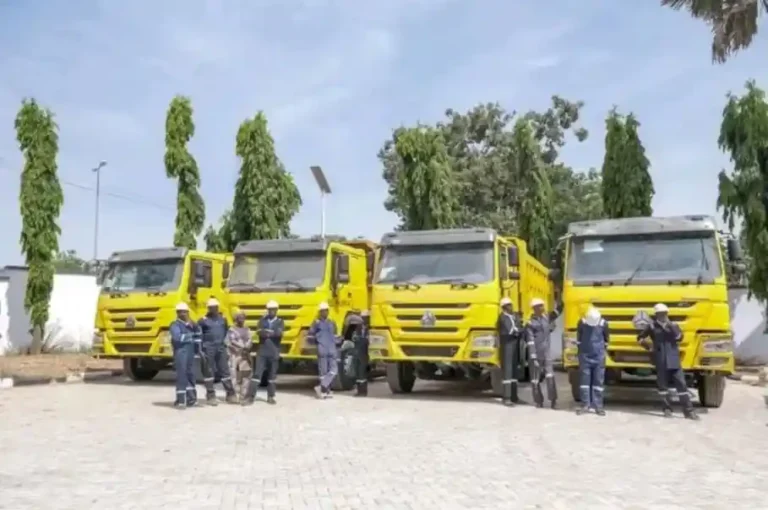
The Bauchi State Government has distributed 40 new tractors and other heavy-duty equipment to farmers under the Agro-Climatic Resilience in Semi-Arid Landscapes (ACReSAL) programme, supported by the World Bank.

Speaking during the distribution ceremony in Bauchi, Governor Bala Mohammed said the initiative underscores his administration’s strong commitment to agricultural modernization, environmental protection, and improving livelihoods in rural communities across the state.

He described the ACReSAL programme as a critical intervention designed to address pressing environmental and climate-related challenges such as unpredictable weather patterns, land degradation, prolonged dry seasons, and flooding.

According to the governor, the deployment of modern agricultural machinery will ease the burden on farmers and relevant government agencies. He added that it will also accelerate the adoption of mechanized farming and large-scale land restoration efforts throughout the State.

“The ACReSAL programme is a key step toward strengthening our agricultural sector and protecting our environment,” he said.

Governor Mohammed reaffirmed his administration’s commitment to collaborating with credible global partners and development programmes to improve living conditions and expand economic opportunities for the people.

The Bauchi State ACReSAL Project Coordinator, Ibrahim Kabir, explained that the equipment was procured to strengthen effective implementation of the programme. He noted that the machinery would boost productivity, promote environmentally sustainable farming practices, and reduce the adverse effects of climate-related challenges.

Apply: FG Empowering Women in Cybersecurity Training Programme

0

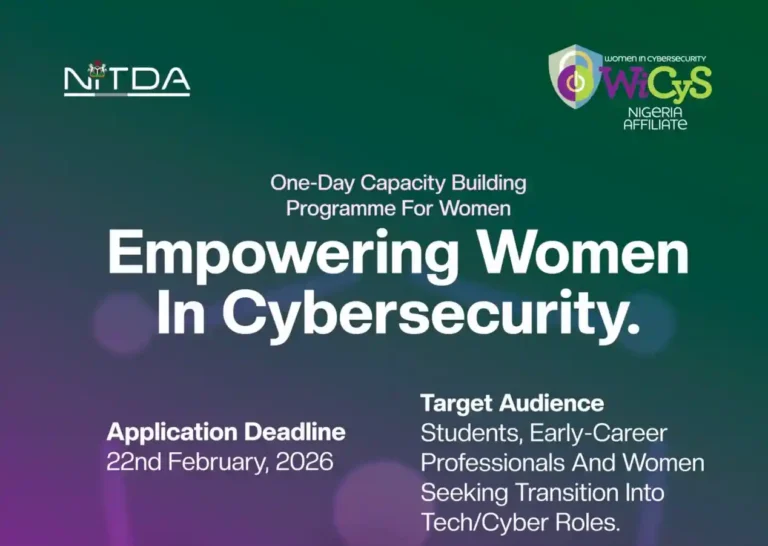
The Federal Government, through the National Information Technology Development Agency (NITDA), has opened applications for the Empowering Women in Cybersecurity Programme. The initiative is organised in collaboration with the Women in Cybersecurity (WiCyS) Nigeria Affiliate as a one-day capacity-building programme designed to equip women with the knowledge, skills, and confidence needed to thrive in the cyber and technology ecosystem.

This is a one-day cybersecurity training programme designed for Nigerian women who are in the early stages of their technology careers or seeking to transition into cybersecurity. The future of cybersecurity is female, and the future starts now.

The goal is to strengthen the capacity of Nigerian women in technology and cybersecurity so they can actively contribute to digital safety, innovation, and the overall resilience of the digital ecosystem. The programme will provide practical demonstrations and introductory experience with basic cybersecurity tools and techniques.

To be eligible, applicants can be a student, an early-career professional, or someone looking to transition into technology or cybersecurity. This programme offers an opportunity to step into the digital future with purpose and competence.

The programme is open to students, early-career professionals, and women seeking to transition into technology or cybersecurity roles.

As part of the application process, applicants will be required to explain, in 250 words or fewer, why they are interested in participating in the programme. Applications close on 22 February 2026.

To apply, interested applicants should visit https://forms.cloud.microsoft/r/hwn3WxyXU3 and complete the application form.

Lagos Ranked World’s Fastest Growing Tech Ecosystem in 2025 Index

0

Lagos has emerged as the world’s fastest growing tech ecosystem, according to the 2025 Dealroom Global Tech Ecosystem Index, which benchmarks 288 tech hubs across 69 countries.

The prestigious ranking, released by Global Statistics and supported by data from Dealroom.co, places Lagos ahead of major international hubs including Istanbul, Pune, and Mumbai.

Global Stats11, described as a world renowned organisation that specializes in creating, sharing, and ranking data, statistics and infographics in sports, economics, and job growth, backed the release.

Lagos State is Africa’s leading tech hub, having attracted over ₦9.3 trillion, equivalent to $6 billion, in startup funding between 2019 and 2024. The state hosts 65 percent of Nigeria’s startups and nurtures 70 percent of Africa’s unicorns. Key sectors driving this growth include fintech, logistics, and AI, supported by Lagos Innovates under the Lagos State Employment Trust Fund (LSETF).

The ecosystem is currently valued at over $15 billion for 2025-2026, reflecting rapid expansion and positioning Lagos as a critical hub for African digital transformation.

The state government described the achievement as “a testament to the strategic vision of the Babajide Sanwo-Olu administration under the T.H.E.M.E.S.+ Agenda,” noting that the agenda prioritises digital transformation, innovation, and an enabling environment for tech industry growth.

Lagos Innovates under LSETF supports startups through infrastructure, workspace vouchers, and talent development programmes. Lagos features a dense ecosystem of hubs in Yaba, Ikeja, and Victoria Island and Lekki, where many startups focus on digital identity, cryptocurrency, and SME growth.