Home Blog Page 496

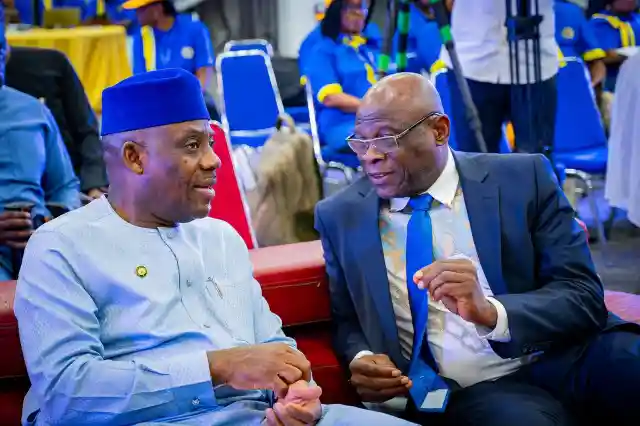
Lagos Govt unveils Skills Up Programme for youth in tourism

0

The Lagos State Government has launched a new initiative tagged “101 Days in Lagos,” created to boost tourism, strengthen the hospitality industry, and increase revenue for stakeholders in the creative economy.

The announcement was made by the Special Adviser to the Governor on Tourism, Arts and Culture, Idris Aregbe, during a meeting with the Pulse Africa team led by its Chief Executive Officer, Ms. Katharina Link, at the Ministry’s conference room.

According to Aregbe, the festival will run from September 26 to January 4, 2026. It will feature cultural, entertainment, and sporting activities across different parts of Lagos State.

He explained that the programme is designed to showcase Lagos’ cultural richness while creating more economic opportunities for industry players.

Aregbe said, “The agenda included empowering youth through robust skills development, showcasing the rich tapestry of Lagos’ cultural heritage to a global audience, fostering international sports engagement, and diversifying entertainment options to invigorate the daytime economy. These goals align seamlessly with the Ministry’s vision to promote and develop the tourism sector, highlight the State’s cultural narratives, and cultivate a lively entertainment scene.”

He noted that the “Skills Up Lagos” programme will be one of the highlights. It aims to train young people in tourism, hospitality, and event management.

Other planned events include music and fashion festivals, art exhibitions, sporting competitions, and food fairs. These activities are expected to attract both local and international visitors.

“This initiative promises an exciting array of cultural celebrations, thrilling entertainment, high-profile sports events, and a myriad of hospitality activities,” Aregbe added.

He stressed that the event will also help build international partnerships and position Lagos as Africa’s cultural and tourism hub.

Pulse Africa CEO Ms. Katharina Link described the organisation’s support for the initiative. She said, “Pulse is passionate about highlighting the energy, creativity, and opportunities that Lagos represents. We see ourselves as a platform that amplifies voices, spotlights hidden gems, and connects Lagos to audiences across Nigeria and beyond.”

Also present was Ms. Tannaz Bahnam of Awari/Lost in Lagos. She highlighted the importance of partnerships in shaping Lagos’ cultural identity.

She explained that collaborations between media platforms and government can redefine how the city is experienced globally.

The “101 Days in Lagos” festival is expected to stimulate tourism, empower youth, and expand the creative industry. It will also provide residents and visitors with opportunities to enjoy Lagos’ cultural diversity and vibrant atmosphere.


Advertisement

DMO Allots N3.3bn FGN Savings Bonds for August 2025

0

The Debt Management Office has confirmed that the Federal Government raised a total of N3.3 billion through the August 2025 issuance of the FGN Savings Bonds. The subscription period ran from August 4 to August 8, 2025, with settlement fixed for August 13, 2025.

According to details released on the DMO website, the government secured N573.31 million from the 2-year savings bond, which will mature on August 13, 2027, while the 3-year savings bond attracted N2.74 billion and will mature on August 13, 2028.

“The 2-year FGN Savings Bond was allotted at a coupon rate of 14.401 percent, while the 3-year bond was priced at 15.401 percent,” the DMO stated. Both instruments include quarterly coupon payment dates of February 13, May 13, August 13, and November 13, beginning from November 2025.

The allotment data shows that a total of 2,166 investors successfully subscribed during the August exercise. Out of this number, 892 took positions in the 2-year option, while 1,274 invested in the 3-year bond.

Despite the positive turnout, the August subscription result fell short of the July 2025 allotment, when the DMO raised N4.27 billion. In July, the 2-year bond, due on July 16, 2027, carried a coupon of 15.762 percent, while the 3-year bond, maturing on July 16, 2028, offered 16.762 percent.

The July issue attracted a total of N853.822 million in the 2-year savings bond across 1,078 investors, while the 3-year savings bond accounted for N3.4 billion and had 1,591 successful subscriptions.

The DMO explained that the bonds are issued at N1,000 per unit, with a minimum entry requirement of N5,000. Subscriptions are allowed in multiples of N1,000, up to a maximum of N50 million.

Launched in 2017, the FGN Savings Bond programme is aimed at deepening the local debt market and promoting financial inclusion by giving retail investors the chance to participate in secure and low-risk government securities.

According to the debt office, “The FGN Savings Bond qualifies as an approved investment under the Trustee Investment Act and is recognised as a government security under both the Company Income Tax Act and the Personal Income Tax Act.” This makes it eligible for tax exemptions granted to pension funds and other approved investors.

The bonds are listed on the Nigerian Exchange Limited, where they can be traded in the secondary market. They also qualify as liquid assets for banks in meeting liquidity ratio requirements.

MTN Nigeria calls for skill development to drive AI and businesses

0

MTN Nigeria has called on both the public and private sectors to collaborate in tackling the challenges and opportunities linked to Artificial Intelligence development in the country.

The company’s Chief Executive Officer, Dr Karl Toriola, made the call on Tuesday in Abuja. He presented a paper titled “Toward a United AI Strategy for Africa” during a plenary session at the 2025 Gulf Information Technology Exhibition, GITEX.

The event, with the theme “Building Continental Digital Foundations for Equitable AI Development,” is a four-day programme. The summit is holding in Abuja from September 1 to September 2, while the exhibition is taking place in Lagos from September 3 to September 4.

Toriola explained that Nigeria needs to expand data infrastructure, improve power supply, and develop skills to support AI growth. He said this would require patience, long-term planning, and stronger capacity to implement effective solutions.

“I would love to see a headline that says, Nigeria has articulated a clear strategy on how to advance artificial intelligence. I would like to read that it has harnessed the resources, both private and public, and is executing them with discipline and labour,” he said.

He identified a major data centre capacity gap in the country. According to him, Nigeria faces an estimated 90-megawatt shortfall.

Toriola also stressed that poor electricity supply remains a serious challenge. He explained that Artificial Intelligence data centres require huge energy resources. “AI data centre that are being built today are of the scale that they need one nuclear power plant per data centre. And that is where we have a huge gap,” he noted.

He further advised that Nigeria must build sovereign data ecosystems. This, he said, will demand collective investment in computing infrastructure.

“There is about a 90-megawatt gap in terms of data centre capacity today. It is estimated that data consumption from AI will be 16-fold of what we are consuming today. What we, as a nation, are going to try to do is to build sovereign data ecosystems, which requires computing infrastructure collectively. We do have some connectivity, but it is a long way to go,” he explained.

Toriola said MTN will keep investing in solutions that empower consumers, Small and Medium Enterprises, and large corporations to take advantage of AI opportunities.

Industry players from across Africa and beyond, including governments, academia, and private companies, are part of the programme.

NDDC begins oral interview for local postgraduate master’s scholarship

0

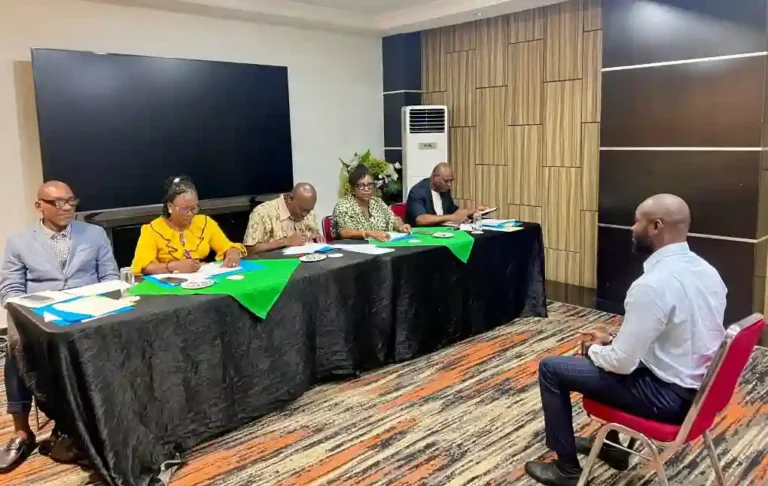
September 2, 2025 – The Niger Delta Development Commission has commenced the Oral Interview exercise for its local Postgraduate Master’s Scholarship Scheme in Port Harcourt, Rivers State.

The program is designed to promote continuous learning and human capital development across the Niger Delta region.

According to the commission, candidates who passed the Computer-Based Test conducted in Akwa Ibom, Delta, and Rivers States were invited for the interview.

“The scholarship covers all disciplines in approved Nigerian universities,” the NDDC stated.

The initiative is expected to create opportunities for young graduates while supporting education and skills development in the region.

FG to Train 100,000 Artisans Under NASAP

0

The Federal Ministry of Housing and Urban Development has signed a Memorandum of Understanding with Polaris Capital Limited to train 100,000 artisans in Nigeria through the National Artisan Skills Acquisition Programme.

The agreement, formalised under the Renewed Hope Agenda of the President, is aimed at addressing the country’s artisan skills gap and modernising the construction workforce.

Speaking at the signing ceremony, the Permanent Secretary of the ministry, Dr. Shuaib Belgore, said the initiative is a major step towards transforming the housing and construction sector. He explained that NASAP is designed to train, certify, and digitally connect artisans in priority construction trades to job opportunities across Nigeria.

“Today’s signing of the Memorandum of Understanding with Polaris Capital Limited marks a significant milestone in the launch of the National Programme. The objectives include strengthening the technical capacity in the housing and construction sector, creating sustainable employment pathways for Nigerian youth and artisans,” Belgore stated.

He further noted that the programme aims to promote inclusivity by ensuring the participation of women, youth, and persons with disabilities, while also leveraging technology through a national booking and verification system for artisans.

According to him, the initiative will run as a three-year programme with funding drawn from federal budget allocations, private sector involvement, and donor contributions.

Dr. Belgore added that a digital platform would be used to generate revenue to sustain the programme beyond the MoU period. He expressed optimism about the partnership, stressing that it will support affordable housing delivery across the country.

Chief Executive Officer of Polaris Capital Limited, Kelvin Vihishima, described the signing of the MoU as a timely and impactful step. He said, “Skills are the bedrock and cornerstone of every economy. This initiative would reduce unemployment and make skills available at the national level.”

Vihishima highlighted that the programme’s scope includes training, certifying, and onboarding artisans, reducing quackery, and reforming the housing industry.

Also speaking at the event, the Director of the Federal Public Asset Maintenance Department, Arc. Ibechile Egwudale, said the agreement reflects the ministry’s commitment to skills development, job creation, and sustainable urban growth.

He emphasised that the programme is grounded in accountability, inclusivity, and long-term economic impact, noting its relevance in shaping Nigeria’s housing and construction future.

FG YEIDEP Stakeholders to Address Youth Poverty and Unemployment

0

The Federal Government has brought together key stakeholders to address youth poverty, unemployment, and insecurity through the Youth Economic Intervention and Deregulation Programme (YEIDEP).

Speaking at the YEIDEP Implementation Stakeholders Retreat, the Minister of Youth Development, Comrade Ayodele Olawande, highlighted the urgent need to respond to growing economic hardship, violent extremism, and anti-social behavior among young people. He explained that real solutions lie in creating economic opportunities, especially through agriculture and its value chains.

The Minister called on participants to take ownership of the programme’s rollout by defining roles, setting timelines, and ensuring accountability. “YEIDEP is not just another government programme; it is a national mission vital to Nigeria’s peace, stability, and prosperity,” he said.

Represented by his Chief of Staff, Muhammed Abdullahi, Comrade Olawande assured that the Ministry is ready to work with partners to ensure YEIDEP delivers long-term benefits for Nigerian youth and contributes to economic growth.

On financial participation, the Director of Finance and Accounts, Warrens Bekearadebo Augusta, confirmed that 9 out of 20 invited banks have already joined YEIDEP. According to her, the banks are opening accounts, enrolling beneficiaries, and supporting financial operations, while 3 to 4 additional banks are preparing to join.

She revealed that more than 8,000 verified youths have been registered as first-tranche beneficiaries. To ensure transparency, banks are grouped into clusters under strict monitoring and accountability systems.

YEIDEP Coordinator, Comrade Kennedy Iyere, described the programme as a “necessary revolution” for Nigeria’s survival. He stated that the country’s challenges are linked to weak past leadership, not a lack of resources.

Iyere explained that YEIDEP aims to give young people the skills, resources, and opportunities they need to build enterprises, improve resilience, and contribute to national development.

Apply: Ekiti Aso-Oke Centre Weaving Training Programme

0

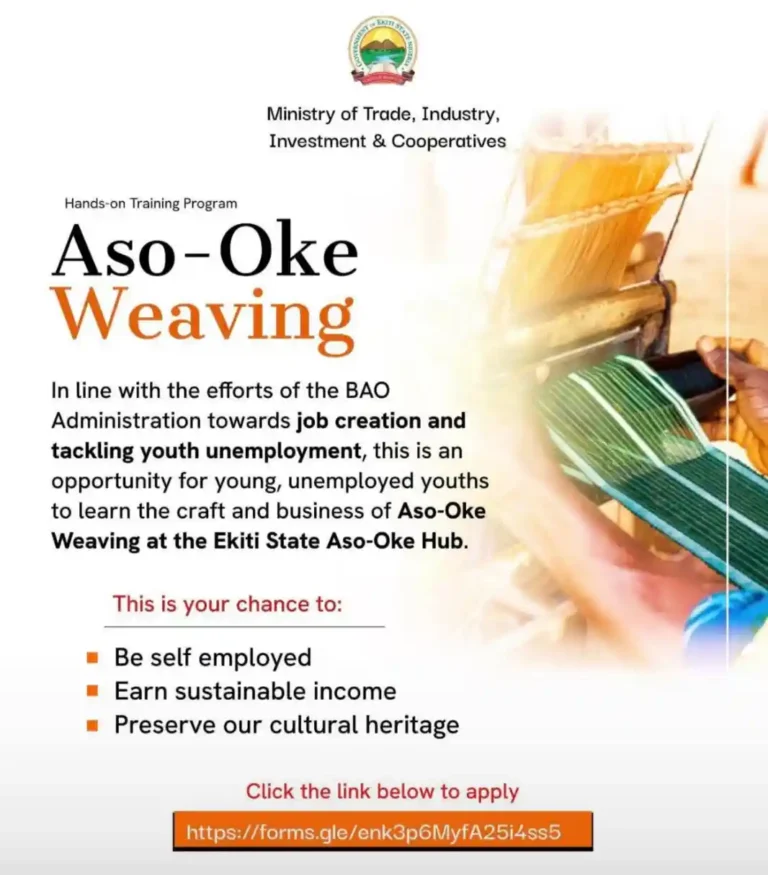
The Ekiti State Government has called on young people across the state to seize the opportunity of acquiring a timeless craft through the Aso-Oke Weaving Hands-On Training Programme.

The initiative, which is being implemented at the Ekiti State Aso-Oke Hub, is powered by the Ministry of Trade, Industry, Investment and Cooperatives as part of efforts to promote job creation, youth empowerment and cultural preservation.

The Commissioner for Trade, Industry, Investment and Cooperatives, Mrs. Omotayo Adeola, who made this known to newsmen in Ado-Ekiti, said the training is targeted at unemployed youths who are eager to learn valuable skills that can make them self-reliant, establish small businesses and contribute to the revival of the state’s renowned aso-oke heritage.

Mrs. Adeola explained that participants would receive practical training in aso-oke weaving, gain entrepreneurial knowledge and be supported to chart sustainable paths to income generation, aligning with the job creation agenda of Governor Biodun Abayomi Oyebanji’s administration.

“The programme is not only about giving our youths skills to start their own businesses, but also about reviving a cultural legacy that defines us as Ekiti people,” she stressed.

According to her, the Aso-Oke Weaving Hands-On Training Programme will equip beneficiaries with tools for entrepreneurship development, financial independence and creative innovation in textile design, thereby boosting both cultural tourism and economic growth.

How to apply:

Interested applicants are directed to apply by filling the application form through the official registration link Here, noting that slots are limited.

NDE Katsina invites public to flag-off of Second Phase RHEI

0

The National Directorate of Employment (NDE) Katsina State Office has announced the Flag-Off Ceremony of the Second Phase of the Renewed Hope Employment Initiative (RHEI). The program will take place on Thursday, 4th September, 2025, at the Educational Resources Center (ERC), opposite KCK, Katsina, starting at 10:00 am prompt.

In a statement, the NDE noted, “We are pleased to invite the general public and esteemed stakeholders to the Flag-Off Ceremony of the Second Phase of the Renewed Hope Employment Initiative, organized by the National Directorate of Employment (NDE), Katsina State Office.”

According to the agency, the initiative is designed to combat unemployment while empowering youths and women across Katsina State. “Your presence will add great value to this important event,” the statement added.

Attendance is compulsory for all beneficiaries.

1.3m apply for FME TVET: applications by State and Skills

0

The Federal Ministry of Education (FME) has announced new data on the Technical and Vocational Education and Training (TVET) initiative, showing how young Nigerians are turning to skills acquisition for better opportunities.

The program, which follows the directive of President Bola Ahmed Tinubu, is aimed at supporting the shift from a resource-based economy to a knowledge-based economy.

Minister of State for Education, Dr Tunji Alausa, said the initiative is part of a clear plan to build a stronger workforce. “TVET is the number one point on the NESRI 6-Point Agenda. We are excited to see Nigerian youth seizing this opportunity to gain life-changing skills.”

The ministry confirmed that a total of 1,329,250 applications were started across the 36 states and the Federal Capital Territory, with 963,496 completed. Kaduna recorded the highest number of applicants at 90,059, while Edo had the lowest with 4,902.

Top 5 states by number of applications
a. Kaduna – 90,059
b. Kano – 68,659
c. Yobe – 62,903
d. Katsina – 55,023
e. Gombe – 44,618

1. Abia – 10,089
2. Abuja Federal Capital Territory – 17,990
3. Adamawa – 40,055
4. Akwa Ibom – 36,157
5. Anambra – 11,528
6. Bauchi – 35,115
7. Bayelsa – 8,325
8. Benue – 29,301
9. Borno – 42,847
10. Cross River – 7,293
11. Delta – 8,406
12. Ebonyi – 8,207
13. Edo – 4,902
14. Ekiti – 8,218
15. Enugu – 8,280
16. Gombe – 44,618
17. Imo – 8,537
18. Jigawa – 36,891
19. Kaduna – 90,059
20. Kano – 68,659
21. Katsina – 55,023
22. Kebbi – 33,221
23. Kogi – 15,502
24. Kwara – 14,293
25. Lagos – 15,850
26. Nassarawa – 32,275
27. Niger – 28,132
28. Ogun – 10,728
29. Ondo – 11,741
30. Osun – 11,817
31. Oyo – 23,249
32. Plateau – 22,782
33. Rivers – 12,759
34. Sokoto – 30,274
35. Taraba – 31,296
36. Yobe – 62,903
37. Zamfara – 26,174

The summary of applications by skill also revealed the interests of participants. Fashion Design and Garment Making led with 211,179 applications, followed closely by Livestock Farming with 210,825.

Computer Hardware and GSM Repair & Maintenance attracted 95,922 applicants, showing the demand for technology-related training.

i. Fashion Design & Garment Making – 211,179
ii. Livestock Farming (Bee Keeping, Poultry & Animal Husbandry) – 210,825
iii. Computer Hardware & GSM Repair & Maintenance – 95,922
iv. Solar PV Installation & Maintenance – 72,049
v. Beauty Therapy & Cosmetology – 47,512
vi. Social Media Communications – 38,909
vii. Painting, Decoration & Finishes (Interior Design) – 35,864
viii. Electrical Installation – 35,298
ix. Network System Installation – 35,030
x. Hospitality Training – 34,090
xi. Creative Media (Digital Media Production) – 27,491
xii. Other (Option to Suggest Skill) – 24,581
xiii. Welding & Fabrication – 22,559
xiv. Mechanised Agriculture (Mechanics or Operations) – 22,220
xv. Plumbing & Pipe-fitting – 12,712
xvi. Woodwork, Carpentry & Joinery – 9,597
xvii. Furniture Making & Upholstery – 9,346
xviii. Motorcycle & Tricycle Repair – 9,148
xix. Automobile Mechanic – 8,749
xx. Brick laying, Blocklaying & Concreting – 7,658
xxi. Automobile CNG Conversion & Maintenance – 6,897
xxii. Floor Cladding, Tiling & Interlocking – 6,787
xxiii. Refrigeration & Air-Conditioning – 5,336
xxiv. Vulcanising & Tire Repair – 1,562
xxv. Auto-body Works (Panel Beating) – 1,072
xxvi. Blacksmithing – 862

Meanwhile, student allocations to training centres will begin once all accredited centres have signed the TVET Initiative contract and created their profiles to receive students.

FG Confirms WAEC Exams Move Fully to CBT

0

September 2, 2025 – Dr. Tunji Alausa, the Minister of Education, has announced a major reform in Nigeria’s education system with the introduction of Computer-Based Testing (CBT) for the West African Senior School Certificate Examination (WASSCE).

He described the development as a “historic milestone” that will strengthen the integrity of examinations, drastically reduce malpractice, and align Nigeria’s assessment system with global standards.

“For over 73 years, WAEC Nigeria has remained a dependable partner in advancing education across West Africa. With innovations such as the Digital Examiners’ Mark Sheet, WAEC Konnect, the e-Learning platform, and the Digital Certificate Platform, the Council has consistently shown its commitment to technological progress,” Alausa said.

He explained that the transition to CBT is part of broader reforms under the Renewed Hope Agenda of President Bola Ahmed Tinubu.

The government is restructuring the national basic and senior secondary education curriculum, upgrading classrooms with modern tools, and reforming federal technical colleges, tertiary institutions, and medical education.

“The adoption of computer-based examinations is a deliberate step to safeguard the credibility of our certificates and empower the Nigerian child with the skills needed for a knowledge-driven economy,” the Minister added.

Alausa assured parents, teachers, and students that the Federal Ministry of Education will work closely with schools to prepare learners for the new system.

He said the transition is aimed at creating a smooth and transformative process that benefits all stakeholders.

“Education is the greatest legacy we can give our children, and together, we are securing its future,” he stated.

The reform in the WASSCE system reflects the government’s focus on digital education, online learning, and technology-driven policies to improve standards.

With the adoption of CBT, Nigeria’s examination process is set to meet international benchmarks while giving students the digital skills required for future opportunities.