Home Blog Page 508

NADF to Fund FG-Brazil MoUs on Agriculture and Livestock Development

The Nigeria Agricultural Development Fund (NADF) Executive Secretary, Mohammed Ibrahim, joined the Minister of State for Agriculture and Food Security, Dr. Aliyu Sabi Abdullahi, and the Minister of Livestock Development, Idi Maiha, in Brazil to push forward agricultural development initiatives for Nigeria.

The visit took place during President Bola Tinubu’s recent state visit to Brazil, where discussions were held with Brazil’s Minister of Agriculture and Livestock.

According to officials, the talks resulted in an agreement to establish a joint working committee that will oversee the implementation of two memoranda of understanding signed between Nigeria’s Ministry of Agriculture and Food Security and Brazil’s Ministry of Livestock Development.

Mohammed Ibrahim stated that the Nigeria Agricultural Development Fund will provide the needed funding support for the implementation of the agreements.

The signed MOUs are designed to enhance food security, boost agricultural productivity, and drive economic growth across Nigeria.

Advertisement

Lagos Govt pushes data-driven farming to tackle antimicrobial resistance

Lagos State has restated its commitment to strengthening the agricultural sector through the adoption of data-driven farming practices and tackling the threat of Antimicrobial Resistance.

This was made known on Wednesday at the stakeholders’ meeting organised by Rid Labs, tagged “All Farmers Business Meeting (AFBM 2.0),” held at the Golden Kharis Event Centre, Ikorodu.

Speaking at the event, the Permanent Secretary, Ministry of Agriculture and Food Systems, Emmanuel Audu, commended the organisers for creating a platform where farmers, agripreneurs, scientists, regulators, and investors can come together to exchange knowledge and explore innovative solutions for growth in agriculture.

Audu, who was represented by the Deputy Director, Fisheries Department, Olorunfemi Oniyide, spoke on the theme “Numbers Don’t Lie: Turning Farm Data into Profits.” He noted that the future of agriculture depends on facts, figures, and analytics rather than guesswork. According to him, using accurate data reduces losses, improves productivity, strengthens agribusinesses, and secures greater profitability for farmers.

Highlighting the challenge of Antimicrobial Resistance in agriculture, Audu cautioned against the indiscriminate use of antibiotics in livestock and aquaculture. He explained that the effects, which include rising mortality in poultry and fish, failed treatments, and increased production costs, threaten both the economy and public health.

He assured participants that the Ministry is committed to encouraging proper diagnosis and responsible use of veterinary medicines. He added that the government will continue to drive continuous capacity building for farmers and professionals while developing policies that safeguard farm profitability and protect public health.

Reiterating the government’s support for farmers, he said Lagos State would continue to strengthen food systems, drive agricultural innovation, and ensure food security for residents. He urged stakeholders to ensure that the knowledge shared during the meeting is translated into practical outcomes that benefit farmers, the economy, and the nation.

Also speaking, the Chief Executive and Business Head of Rid Lab, Femi Dairo, said the organisation is focused on addressing the challenge of indiscriminate drug use in livestock by promoting diagnosis before treatment. He explained that many farmers rely on guesswork or inaccurate data when treating their animals, which often leads to the wrong use of drugs without proper tests.

He warned that this practice worsens animal diseases, increases losses, wastes resources, and contributes to antimicrobial resistance. In his words, “Rid Lab is working to change this culture by showing farmers that science-driven farming is not a burden, but the gateway to profitability and sustainability. If profit alone were the objective, Rid Lab would simply provide quick drug solutions without demanding proper tests. Instead, the laboratory chose the more difficult but rewarding path of accurate diagnosis. By removing guesswork and relying on scientific data, farmers can protect their animals, reduce unnecessary drug use, preserve the potency of antibiotics, and achieve measurable results.”

He added that farms that abandoned guesswork in favour of evidence-based treatment recorded higher survival rates for their livestock and greater returns on investment. Dairo stressed that with accurate data guiding treatment, the livestock industry can reduce waste, improve productivity, and ensure sustainability in the long term.

He assured the stakeholders that Rid Lab would continue to provide accurate diagnoses for farmers, scientific evidence for regulators, and sustainable solutions for agribusiness stakeholders. According to him, these measures are aimed at securing a profitable livestock sector and safeguarding public health.

In her remarks, the Managing Director of Rid Lab, Adewunmi Dairo, explained that the theme “Numbers Don’t Lie: Turning Farm Data into Profit” highlights the future of agriculture, where decisions must be guided by facts and evidence instead of assumptions. She noted that data is more than figures on paper, describing it as a tool that helps farmers achieve sustainability, growth, and profitability.

She acknowledged the support of government, regulators, partners in the pharmaceutical industry, sponsors, and industry associations, saying their policies and innovations are vital to food safety, public health, and the overall progress of the farming community.

She further said that AFBM 2.0 represents a movement that proves farming is not guesswork but a serious business. With data as power in the hands of farmers, she said the agricultural sector can achieve food security, guarantee profitability, and build prosperity for all stakeholders.

The meeting was attended by livestock farmers and other important players in the agricultural industry who discussed strategies to boost agribusiness and ensure a sustainable farming future in Lagos State.

FG Recruits and Trains NYSC Emergency Volunteers

0

The National Emergency Management Agency (NEMA), Ado-Ekiti Operations Office, has carried out a training session for the NYSC/EMV Community Development Service (CDS) group in Ikole-Ekiti, Ekiti State, on 28th August 2025. The recruitment and training exercise aimed to improve the preparedness of Emergency Management Vanguards (EMVs) in responding to emergencies across local communities.

During the training, key concepts in disaster management were explained to the corps members. According to the organisers, the session was designed to highlight their responsibilities as EMVs and enhance their preparedness capabilities in handling disaster response scenarios.

The training featured a detailed presentation titled “Disaster Management in Nigeria and the Role of NYSC EMVs.” The presentation covered the evolution of disaster management in Nigeria, disaster risk reduction strategies, emergency response strategies, and the significance of NYSC EMVs in strengthening disaster management efforts in local governments across the country.

Following the lecture, the corps members took part in a practical demonstration on First Aid and casualty handling. This aspect of the training provided hands-on experience for the EMVs, equipping them with essential life-saving skills needed during emergencies.

Speaking after the exercise, officials noted that “the session was highly interactive and informative, reinforcing the critical role of disaster management and volunteerism in National Emergency Preparedness and Response efforts.”

The event ended with a group photograph involving members of the EMV CDS group, staff of NEMA, and officials of Ekiti State Emergency Management Agency (SEMA), capturing the collaboration between institutions in building capacity for disaster management in Nigeria.

Sokoto Gov approves school fees payment for verified 2024/2025 students

0

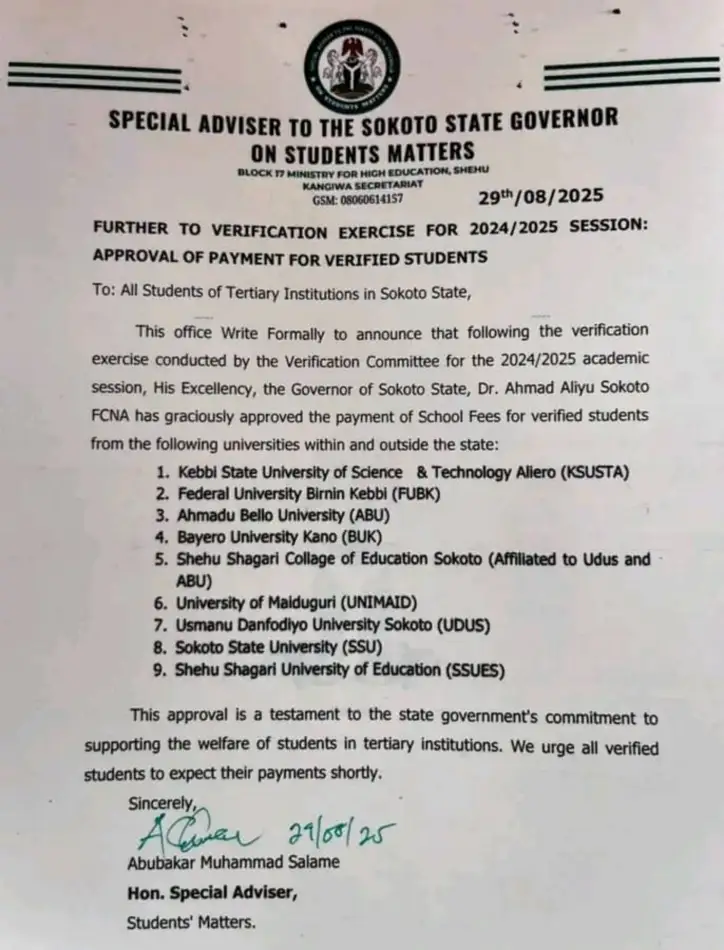
August 29, 2025 – Sokoto State Government has officially announced the approval of school fees payment for verified students in the 2024/2025 academic session.

This was confirmed in a statement issued on Friday, 29th August 2025, by the Special Adviser to the Governor on Students’ Matters, Abubakar Muhammad Salame.

According to the announcement, the approval follows the verification exercise conducted by the Verification Committee. His Excellency, the Governor of Sokoto State, Dr. Ahmad Aliyu Sokoto FCNA, has approved the payment of school fees for verified students from selected universities both within and outside the state.

The approved institutions include:
1. Kebbi State University of Science & Technology Aliero (KSUSTA)
2. Federal University Birnin Kebbi (FUBK)
3. Ahmadu Bello University (ABU)
4. Bayero University Kano (BUK)
5. Shehu Shagari Collage of Education Sokoto (Affiliated to Udus and ABU)
6. University of Maiduguri (UNIMAID)
7. Usmanu Danfodiyo University Sokoto (UDUS)
8. Sokoto State University (SSU)
9. Shehu Shagari University of Education (SSUES)

“This office writes formally to announce that following the verification exercise conducted for the 2024/2025 session, His Excellency has graciously approved the payment of school fees for all verified students,” the statement read.

The Special Adviser further explained that the approval highlights the state government’s commitment to supporting education and reducing financial pressure on students in tertiary institutions. He added that verified students should expect their payments to be processed soon.

Oando Foundation to Improve Foundational Learning in Select States

0

Oando Foundation in partnership with Teaching at the Right Level (TaRL) Africa, Quality Education Development Associates (QEDA), and Hilltrust Top Foundation, yesterday, unveiled a new learning progress report aimed at tackling Nigeria’s education challenges. The initiative, which focuses on improving foundational learning, is being implemented in Ebonyi, Plateau, Sokoto, and Adamawa States.

The report was presented at the Foundational Learning Improvement Programme (LEARNOVATE – FLIP) dissemination workshop in Abuja. It highlighted the progress of the project, which uses community-based learning hubs and localised teaching materials to improve reading and numeracy skills among pupils.

Head of Oando Foundation, Tonia Uduimoh, said urgent action was required to address Nigeria’s worsening learning crisis. She warned that 70 per cent of children cannot read with understanding or solve simple mathematics problems, while almost 9 million children remain out of school.

“Statistics remain sobering, and if left unaddressed, this crisis will continue to limit opportunities for our young people and weaken Nigeria’s competitiveness in the global economy,” Uduimoh said.

She explained that the programme had shown that innovation, collaboration, and community ownership could help reverse the situation. According to her, FLIP was introduced in Adamawa, Ebonyi, Plateau, and Sokoto States to strengthen literacy and numeracy among primary school pupils. The programme deployed Early Grade Reading (EGR) in mother tongue for pupils in Primary one to three and adopted the Teaching at the Right Level (TaRL) model for pupils in Primary four to six who had advanced without mastering basic skills.

Uduimoh said the programme had also strengthened teacher capacity, developed culturally relevant assessment tools, enhanced school support systems, and tested scalable models to improve learning outcomes. She added that the dissemination workshop offered a platform to share lessons, present results, and chart strategies for policy integration, financing, and long-term collaboration.

“We must move beyond pilots and into systemic change, ensuring that every Nigerian child has the foundation they need to learn, grow, and thrive,” she added, while expressing appreciation to all partners involved.

Founder of QEDA, Nurudeen Lawal, commended Oando Foundation for supporting education at a time when global funding was shrinking. He described the intervention as both humbling and inspiring.

“For the past 15 to 20 years, we have been working to improve learning outcomes in Nigeria and across Sub-Saharan Africa,” he said. “At a time when global support is shrinking, seeing the Oando Foundation keep the fire burning is deeply inspiring. It gives hope to other organisations that they too can play a role in transforming education in Nigeria.”

Lawal noted that commissioners, SUBEB chairpersons, and teachers in some states had shown strong involvement in the programme through teacher training, learning material development, and other initiatives. While acknowledging the early impact, he pointed out the magnitude of the challenge.

“Nigeria has nearly 40 million school-age children. In one state alone, there are almost 5 million children in primary school, about the same as the entire population of Rwanda. This reminds us that the task ahead is massive and requires home-grown, sustainable solutions,” he added.

He urged more corporate and philanthropic organisations to follow Oando Foundation’s example by investing in education. “As I look at the faces of the children, I see the future of Nigeria. If they succeed, Nigeria will succeed,” Lawal said.

The Country Director of Teach at the Right Level, Hafsatu Hamza, expressed concern about the increasing number of out-of-school children and the deepening learning poverty in Nigeria. She said greater investment in innovative approaches would bring improvements in classrooms.

“We must continue to champion foundational learning and build resilience in children so they can fully develop their potential,” she said, praising the foundation for its commitment to ensuring that no child is left behind.

Program Coordinator of Hilltrust Top Foundation, Dr. Adeyemo Adeyemi, also welcomed the initiative, noting that the resources deployed were already producing results.

Similarly, Executive Secretary of the Universal Basic Education Commission (UBEC), Aisha Garba, represented by Deputy Director, Patience Obasi, stressed the importance of collaboration with stakeholders to strengthen basic education.

“When our children acquire reading skills early, their overall learning outcomes improve,” she said.

Director of Basic Education at the Federal Ministry of Education, Dr. Folake Olatunji-David, described foundational learning as the bedrock of education, emphasising the role of well-trained teachers.

“The educational development of our children is a shared responsibility,” she stated. “This initiative has spotlighted teacher development and evidence-based policy as critical to ensuring effective learning.”

She called on all stakeholders to scale up the model, adding: “Together, we can reduce learning poverty and guarantee that no child is left behind.”


FG launches N500m MSME grant programme, targets 1,000 entrepreneurs

The Minister of State for Industry, Senator John Owan Enoh, has unveiled a ₦500 million intervention programme in Cross River State to support more than 1,000 entrepreneurs and small business owners.

Speaking at a media briefing held on Friday at the Ernest Etim Bassey NUJ Press Centre in Calabar, Enoh explained that the initiative was conceived as a personal effort to boost the Micro, Small and Medium Enterprises (MSME) sector in the state and to reduce the high dependence on government jobs.

According to him, the programme will provide grants ranging between ₦100,000 and ₦500,000 to beneficiaries in both the formal and informal sectors. He said artisans including welders, vulcanizers, and tailors will benefit from the informal category, with each receiving ₦150,000.

“This is not a loan; it is a grant,” Enoh said. “It is not Dutch money for politics, but funds strictly intended to grow our economy. My commitment in public service has always been to add to the happiness of people, and this is one way of doing so.”

The implementation of the scheme will take place in four batches. Each batch will have 150 beneficiaries drawn from the formal sector and 325 from the informal sector, spread across the 18 local government areas. Enoh clarified that selection will be based on the location of businesses and not on the local government of origin.

He noted that applicants who are selected will undergo a one-week entrepreneurship training in their senatorial districts before they can access the funds. For rural operators, printed forms have been distributed, while formal business owners can apply online through the official portal at hmindustry.ng.

The minister gave assurances of accountability, saying: “Not a dime of this money will be stolen. That is the reason we formed a credible team to manage it.”

Highlighting the national context, Enoh linked the initiative to federal government policy. He explained that President Bola Tinubu’s administration had already earmarked hundreds of billions of naira in the 2025 budget for grants and single-digit loan facilities to strengthen MSMEs across Nigeria.

“Cross River must be part of the pool of 40 million MSMEs driving Nigeria’s economy,” he stated, noting that the effort also complements Governor Bassey Otu’s ₦1 billion counterpart fund with the Bank of Industry.

He warned beneficiaries against misuse of the funds, stressing that the grants are intended to discourage dependency and foster innovation. “We can’t continue with the attitude where beneficiaries sell the equipment they are given. This fund is meant to build businesses, not to pay house rent,” Enoh cautioned.

FG showcases South-South projects under Tinubu’s administration

0

The Federal Government on Thursday outlined projects and initiatives executed in the South-South region under President Bola Tinubu’s administration.

The disclosure was made at a forum tagged “Federal Government’s South-South Milestone Under President Tinubu’s Administration” held in Uyo, Akwa Ibom State.

Speaking at the event, Minister of Information and National Orientation, Alhaji Mohammed Idris, who was represented by Mrs. Christiana Inyang, Head of the Federal Information Centre, Uyo, said the session was aimed at highlighting interventions in healthcare, infrastructure, education, and agriculture.

According to him, new cancer care facilities have been established at the University of Uyo Teaching Hospital (UUTH) and Mbribit Itam. These facilities include radiotherapy machines and in-vitro fertilisation (IVF) units. He also noted that the 65-kilometre Akwa Ibom section of the Lagos–Calabar Highway was inaugurated in April by Senator David Umahi on behalf of the President.

The Minister explained that the current administration was prioritising education, agriculture, and healthcare, which he described as critical sectors that had suffered years of neglect. In agriculture, he pointed to the cassava bio-ethanol project in Akwa Ibom, describing it as an initiative intended to support food production, create employment opportunities, and expand the agro-processing value chain.

He further disclosed that the government had rolled out palliative measures in the state under a programme tagged “Boundless Support for Persons with Disabilities.” Idris stressed that the Renewed Hope agenda was designed to achieve a fairer distribution of projects across the country, adding that the South-South region was no longer left behind in federal planning.

Delivering a keynote address at the event, Prof. Charles Obot, Head of Films and Multimedia Studies, University of Uyo, said the Presidential Loan and Grant Scheme had already reached more than 900,000 beneficiaries nationwide. He also revealed that over 300,000 students had benefited from the Student Loan Scheme introduced by the administration.

Prof. Obot added that a School of Education Administration complex had been built at the College of Education in Delta State. He also confirmed that the College of Education (Technical), Asaba, had received new equipment and furniture upgrades.

According to him, the interventions in education reflect government’s interest in both the “software” and “hardware” aspects of learning.

FG to commercialize technical volunteer scheme

0

August 29, 2025 – The Director-General of the Nigerian Technical Aid Corps (NTAC), Dr Yusuf Yakub, has disclosed that plans are underway to commercialise the technical volunteers scheme in order to serve countries in need of professionals.

Yakub made this known on Friday in Abuja during the deployment exercise of 20 Technical Aid Corps (TAC) volunteers, comprising doctors and nurses, to The Gambia.

He explained that the move would help address the challenge of unemployment in Nigeria while also creating opportunities for skilled experts to contribute globally. According to him, the decision was taken because Nigeria has an abundance of unemployed youths and professionals who are not fully engaged.

“You know we have abundant of unemployed youths in the country, a lot of experts that are not fully employed and the whole world is in need of experts to fill some gaps. That informed the need to introduce this initiative, and the corps has developed confidence of other countries because Nigerians have served very well in places that they were deployed to. Jamaica has opened the way by asking for about 400 experts,” he said.

The NTAC boss urged the volunteers to be worthy ambassadors of Nigeria. He also commended President Bola Tinubu for sustaining the deployment exercise, describing it as a key part of Nigeria’s soft power diplomacy initiative.

Yakub further stressed that the abundant human resources in Nigeria should be utilised to support other nations, particularly in Africa, the Caribbean and the Pacific. “By doing this we are contributing to the development of our sister countries and our blacks in the Caribbean and the Pacific. We are also creating partnership, culture and some numerous advantages that this programme will bring. Above all we are serving humanity, and to the glory of God this programme has been given every support by the Tinubu administration,” he said.

Ambassador Zakari Usman, the Director of Programmes, explained that the selection process for the TAC volunteers was very rigorous. He noted that only 20 candidates were chosen out of more than 10,000 applications, urging them to represent Nigeria positively.

Prof Adanlawo Isaac, a surgeon and the team lead, expressed gratitude for the opportunity, promising that the group would promote Nigeria’s image abroad.

The 20 volunteers deployed are Awumtiya Nelson, Aishatu Umar, Folake Iyogun, Salim Jaafar, Oyindamola Oladunmiye, Tula Musa, Julmucit Gwapna, Rakiya Maitama, Ndagi Yunusa, Gbadamosi Hakeem, Bala Godwin, Abba Gumsuri, Uthman Jelilat, Blessing Okure, Fatima Abdullahi, Vivian Nnemaka, Olayinka Rahman, Nwafor Precious and Sule Abdulkarim.

TVET training centres receive email to sign agreements, create admin accounts in 7 days

The National Board for Technical Education (NBTE) has begun sending out official emails to training centres under the Technical and Vocational Education and Training (TVET) initiative, urging them to formalise agreements and create Centre Admin accounts on the official TVET platform.

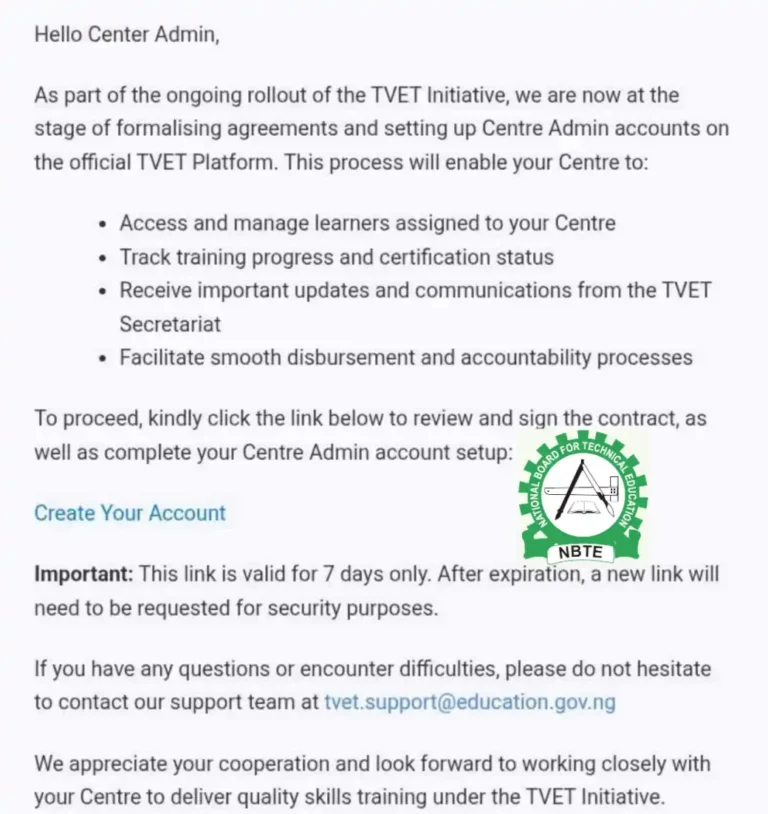
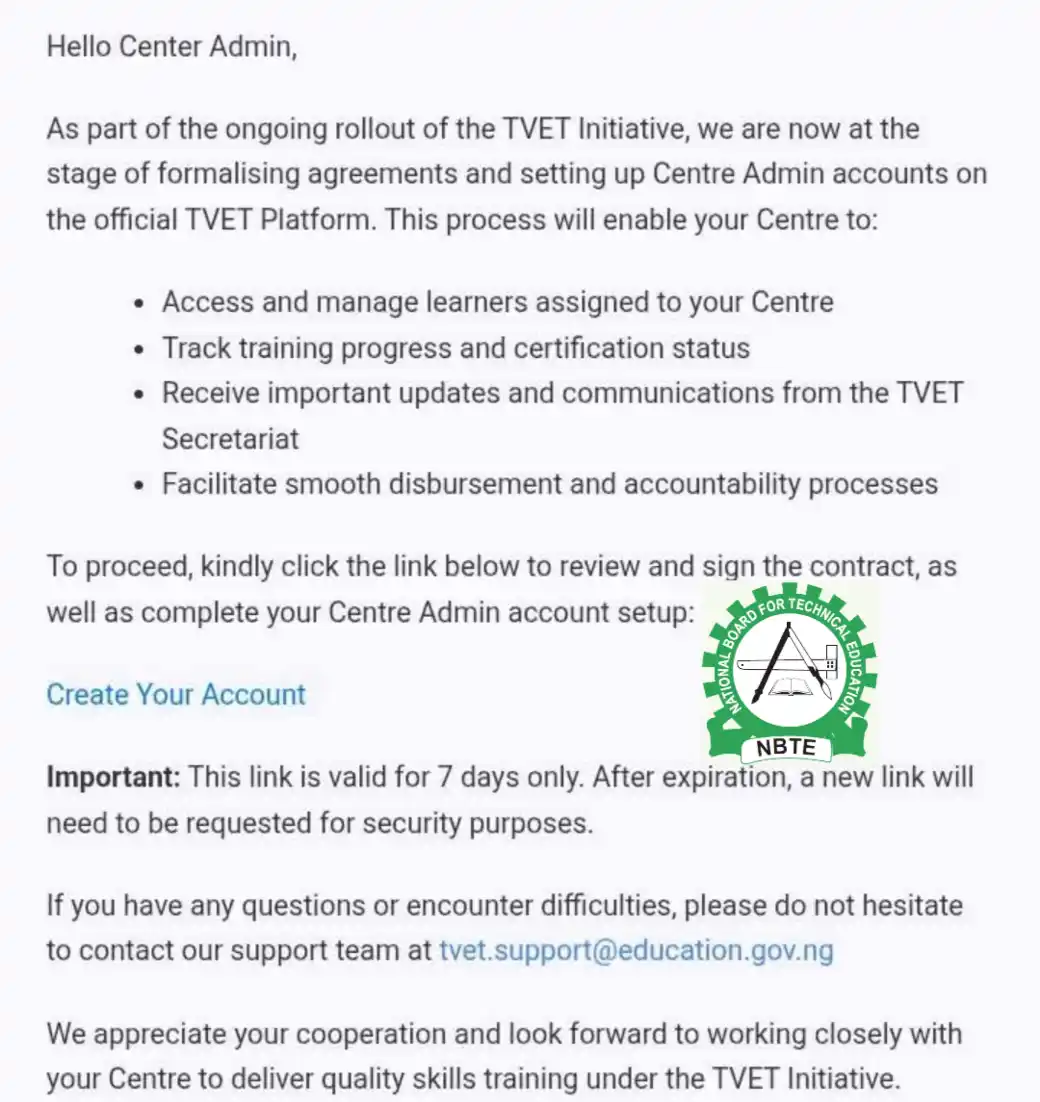
In the email sent to centres, it was stated: “As part of the ongoing rollout of the TVET Initiative, we are now at the stage of formalising agreements and setting up Centre Admin accounts on the official TVET Platform.”

The message explained that this stage of the process will enable centres to:
1. Access and manage learners assigned to your Centre
2. Track training progress and certification status
3. Receive important updates and communications from the TVET Secretariat
4. Facilitate smooth disbursement and accountability processes

Centres were further directed to take action immediately. The email added: “To proceed, kindly click the link below to review and sign the contract, as well as complete your Centre Admin account setup: Create Your Account. This link is valid for 7 days only. After expiration, a new link will need to be requested for security purposes.”

NBTE also assured centres of support if they face any issues. “If you have any questions or encounter difficulties, please do not hesitate to contact our support team at tvet.support@education.gov.ng,” the statement said.

The board emphasised the importance of cooperation from training centres, noting: “We appreciate your cooperation and look forward to working closely with your Centre to deliver quality skills training under the TVET Initiative.”

After signing the Memorandum of Understanding (MOU), centre administrators are required to set a password and then log in with their email and the new password. According to reporta from multiple training centres, this stage may sometimes require multiple attempts before successful access is granted.

All TVET training centres are urged to check their email and complete the process within the 7-day window or request a new link if it expires.

Attached below is the email messaged received by TVET trainers:

Apply: HYPREP Ogoni Postgraduate Scholarship Program

August 29, 2025 – The Hydrocarbon Pollution Remediation Project (HYPREP) has opened its application portal for the 2025 Ogoni Postgraduate Scholarship Programme today, August 29, 2025.

According to HYPREP, the scheme will provide 500 postgraduate scholarships to qualified indigenes of Ogoni from the four Local Government Areas of Eleme, Gokana, Khana, and Tai. The scholarships are targeted at indigenes who are currently enrolled in postgraduate programmes at recognised universities in Nigeria.

HYPREP noted that the initiative is part of its efforts to support education and human capacity development in Ogoniland. “This scholarship is designed to empower Ogoni youths academically and prepare them for active contributions to the socio-economic growth of their communities,” the agency stated.

The eligibility criteria were clearly outlined as follows:
1. Applicant must be an indigene of Ogoni from any of the four Local Government Areas (Eleme, Gokana, Khana and Tai) verified with proper documentation.
2. Applicant must have gained admission into a recognized Nigerian public university for a full-time postgraduate programme (MSc. or PhD.)
3. Applicant must demonstrate strong academic potential and commitment to contributing to the socio-economic development of Ogoniland.
4. Applicant must be within the age limit of (45 years for MSc) and (55 years for PhD) at the time of application.
5. Applicants who have benefited from the last postgraduate scholarship need not apply if still in the same programme.
6. Staff of HYPREP and the Federal Ministry of Environment and their immediate family members need not apply.

Applicants are reminded that a letter of attestation from their Head of Department is required during physical verification.

The deadline for submission is 6 pm on September 12, 2025.

How to apply:

To apply, candidates are to fill out the application form through the official link Here. Shortlisted candidates will be contacted via email or phone, while final awardees will be selected strictly on merit.