Home Blog Page 529

FG to Feed 20m Children Through Homegrown School Feeding Programme by 2026

August 22, 2025 – The Federal Government has announced a plan to reach 20 million children through the Homegrown School Feeding Programme by 2026, describing the initiative as both an educational investment and a national security strategy.

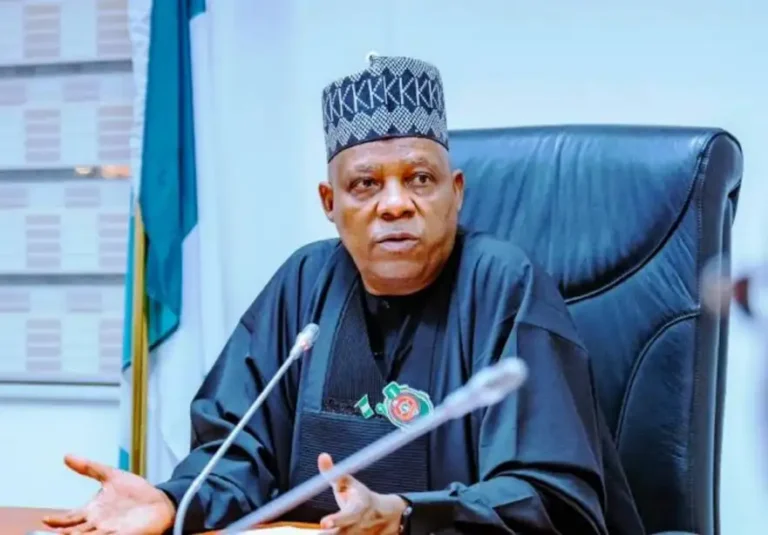
Vice President Kashim Shettima disclosed this on Friday at the National Policy Forum on the Institutionalisation and Implementation of the Renewed Hope National Home Grown School Feeding Programme, held in Abuja.

The forum was hosted by the Presidential Committee on Economic and Financial Inclusion, in collaboration with ActionAid Nigeria and other stakeholders.

Shettima, represented by the Special Adviser to the President on Economic Affairs, Office of the Vice President, Dr. Kolade Fasua, said the expansion under President Bola Tinubu’s Renewed Hope Agenda is the boldest step yet in the history of the intervention.

He explained that the programme, relaunched earlier this year, is designed to improve school enrollment and learning outcomes while creating a guaranteed daily market for smallholder farmers, women entrepreneurs, and local food processors.

“This year, the federal government relaunched the Renewed Hope National Homegrown School Feeding Programme, signalling a decisive return to scale and systemisation. The programme is designed to boost enrollment and attendance, improve academic performance, and raise smallholder incomes through stable local procurement,” he said.

The Vice President added that, alongside the core programme, the government has also inaugurated the Alternate Education and Renewed Hope School Feeding Project.

According to him, this expansion targets out-of-school and highly vulnerable children with the ambition of reaching up to 20 million beneficiaries by 2026.

With the integration of the National Identity Management Commission system, Shettima noted that transparency would be ensured. “Real pupils receive real meals, and every naira spent works twice, once for the child, and once for the local economy,” he said.

Acknowledging the financial implications, Shettima explained that sustaining nationwide coverage could cost as much as one trillion naira. However, he stressed that the initiative should not be seen as a drain on public finances.

“Ambition requires investment, and the federal government has acknowledged that sustaining national coverage may require around one trillion naira. But this is not a cost. It is a nation-building investment with high social, economic, and security return. This is why the school feeding must be understood not just as a social intervention but as a national security investment,” he stated.

He further argued that every hot meal served in a classroom strengthens the social fabric of the country. “Every meal acts as a barrier against recruitment into violent groups, a reinforcement of the state’s presence, and a source of hope in conflict-prone communities. A child with knowledge is less vulnerable to exploitation. A farmer linked to a market is less vulnerable to despair. Communities where youth are engaged are less vulnerable to insecurity,” Shettima said.

According to him, the programme also integrates financial inclusion strategies to strengthen economic resilience. “By bringing MSMEs, women, and vulnerable households into the financial system, we shrink the shadows in which insecurity grows. When local markets thrive, when farmers see guarantees in demand, when cooks receive fair and timely pay, and when women micro-entrepreneurs build assets, the drivers of conflict weaken,” he added.

Shettima called on development partners, private investors, and state governments to align with the federal government’s vision. He noted that the measure of success would not only be in hunger-free classrooms but also in safer and more resilient communities across the country.

In his keynote address, the Minister of State for Humanitarian Affairs and Poverty Reduction, Dr. Tanko Sununu, represented by the Director of Social Development, Mr. Valentine Ezulu, called for stronger legal and policy frameworks to safeguard the programme. He urged stakeholders to support the establishment of a National Home Grown School Feeding Act that would provide legal backing for the initiative.

“We must work towards enacting a National Home Grown School Feeding Act that guarantees continuity across political cycles, while clearly defining federal, state, and local roles within a cost-sharing framework,” Ezulu said.

He also recommended the development of nutrition guidelines to ensure that meals provided meet international health standards. “A National Nutrition Guideline for Home Grown School Meals, aligned with international best practices, must be developed and enforced to guarantee safe, balanced, and quality meals for every child,” he explained.
Advertisement

ICPC Says Only 7 Out of 774 LGAs Have Websites

0

August 22, 2025 – The Independent Corrupt Practices and Other Related Offences Commission (ICPC) has disclosed that only seven out of the 774 Local Government Areas in Nigeria currently operate functional websites where information on governance, projects, and financial spending can be accessed.

The anti-corruption agency said the absence of these websites across most local governments is a major transparency challenge.

Musa Aliyu, the Chairman of ICPC, made this known during a Channels TV programme anchored by former Presidential spokesman, Laolu Akande, on Friday. He explained that accountability in governance cannot thrive if citizens do not have access to information about how their local governments operate.

Aliyu said, “Recently, because of the focal decision, we have now initiated a programme we call corruption prevention programme in the local government areas. We are using five thematic areas: One, the issue of open fiscal transparency, open procurements, the issue of corruption control, human resources and citizen engagement. Also, we are now trying to say, okay, we developed that each local government should have a website so that they can put out information. What we discovered was that there are only seven local governments with functional websites in Nigeria. That is to say we have a lot of problems because we cannot go all over.”

He stressed that websites would help residents and other stakeholders monitor government projects and finances, promoting accountability and good governance.

“That’s why we say, okay, why can’t we have a website? Publish these things, so that people will know what you’re doing, otherwise, it will be difficult for us to know, so that there will be transparency,” he added.

Aliyu also pointed out that the problem of secrecy in the local government system cuts across all six geo-political zones. “All these local government areas are not from one geo-political zone. Almost all the LGAs in all the six geo-political zones don’t have a single functional website. The issue of transparency is now a challenge in the LGAs. You will see that a public officer, who is supposed to put a street light for the public to use, will now put it in his house,” he said.

The ICPC boss revealed further that corruption is not limited to local governments but is also found in sectors such as healthcare and education, where some workers divert public donations for personal benefit. He noted that such actions deny citizens quality services in essential areas like health care, schools, and social protection.

Speaking on efforts to ensure accountability in governance, Aliyu explained that the ICPC has a constituency project tracking initiative. According to him, this programme is designed to monitor government spending in areas such as education, agriculture, empowerment, and the health sector to ensure that public funds are not diverted.

“When you look at it, there is this issue of constituency projects that the National Assembly is doing, and ICPC has what we call a constituency project tracking initiative, whereby we’re following projects that are in critical areas: education, health sector, agriculture or empowerment, to see these things go down to the members of the public, the real downtrodden people. And we have been tracking all these things, and we have discovered a lot of issues. We have made a lot of recoveries, because it’s really meant for corruption prevention,” he explained.

Aliyu also said the commission is tracking budget implementation, particularly the national budget, to ensure compliance and proper use of funds. He stated that contractors are compelled to return to project sites whenever lapses or diversions are discovered.

He added that ICPC, in collaboration with the Economic and Financial Crimes Commission (EFCC), is pushing for a bill on unexplainable wealth, which, if passed into law, would help address corruption by holding public officers accountable for assets they cannot justify.

Circulating Claims FRSC 2025 Recruitment Portal Will Open Soon Unverified

0

August 22, 2025 – BREAKING: Reports are spreading on social media that the Federal Road Safety Corps (FRSC) is set to open its recruitment portal for 2025.

According to these unverified reports, interested applicants are already being advised to prepare their CVs ahead of the process. However, there has been no official confirmation from the agency, raising questions about the authenticity of the claim.

The circulating claims do not also carry sources pointing to any official announcement.

The news of the alleged FRSC 2025 recruitment surfaced at a time the agency has just commenced a high-level capacity-building workshop for its Patrol Team Leaders across the Federal Capital Territory.

This training initiative is aimed at strengthening discipline, integrity, and civility among officers during field operations.

According to a statement issued on Friday by the Assistant Corps Marshal and Corps Public Education Officer, Olusegun Ogungbemide, the new programme was specifically designed for team leaders who directly supervise patrol teams in the FCT.

He stressed that the goal is to reshape how FRSC officers conduct themselves during official duties.

“In another bold step towards entrenching integrity and transforming operational culture, the Federal Road Safety Corps has commenced a high-level capacity building workshop for all Patrol Team Leaders across the Federal Capital Territory (FCT) Sector Command and its component Units,” the statement read.

Ogungbemide further explained that the initiative was approved by the Corps Marshal, Shehu Mohammed. He described it as an intervention to reposition the FRSC as an institution of civility, discipline, and service excellence on Nigerian roads. “This intervention is aimed at sanitising field operations, eliminating corruption, and restoring public trust in road safety management,” he said.

Despite the circulating recruitment reports, the statement from the agency made no mention of new job openings. There is currently no official FRSC recruitment exercise for 2025.

Whether the rumors are true or not, the Corps is expected to issue a clear position on the matter in the coming hours.

Meanwhile, Nigerians have been urged to remain calm and avoid engaging with individuals claiming to have access to the recruitment process. Interested candidates are advised to wait for verified information directly from the FRSC before taking any action.

Bayelsa, TETFund To Empower Schools With Biomedical Engineering, Emergency Medicine

0

August 22, 2025 – The Governor of Bayelsa State, Senator Douye Diri, has urged medical institutions in Nigeria to adopt modern trends in medical science such as biomedical engineering and emergency medicine to address the rising issue of brain drain in the health sector.

Governor Diri made the call on Thursday when the Ministerial Monitoring Committee of the Tertiary Education Trust Fund (TETFUND) High Impact Intervention in Medical Sciences paid a visit to Government House, Yenagoa.

Represented by his deputy, Senator Lawrence Ewhrudjakpo, the governor described the country’s current medical practice as largely traditional. He stressed that with the right political will and collective commitment from stakeholders, Nigeria could achieve significant progress in healthcare delivery.

He noted that introducing biomedical engineering and emergency medicine into the country’s health institutions, alongside improving medical infrastructure, would help reduce the number of qualified professionals leaving Nigeria for opportunities abroad.

Underscoring the importance of both health and education, Governor Diri stated that his administration would continue to inject resources into the two sectors in order to improve the living standards of Bayelsa citizens. He also expressed gratitude to the Federal Ministry of Education and the Executive Secretary of TETFUND for supporting projects at the Bayelsa Medical University (BMU).

“We are quite excited and we extend our appreciation and gratitude to the Minister of Education, and the Executive Secretary of the TETFUND for looking towards our direction. We have been looking for partnerships such as this to enable us do better,” he said.

“We are happy you are focused on an area we have a challenge. And I think that challenge is both self-imposed and exacerbated by greed in our country. But we are happy with what you are doing to retain health manpower in the country.

“Again, I think we should start looking at modern trends in medicine. In my opinion, we are still very traditional in our medical practice. There are new areas in medicine like biomedical engineering, which is an area we really need to look at.

“Because if we have CT Scan, MRI and the rest of them, yet we don’t have the biomedical engineers needed to fix these equipment, we will not achieve the desired progress in our health sector.

“Then we also have emergency medicine. If we inject these two areas into our current practice, it will give us the latitude to take care of a lot of people who would be swallowed up by the offering we will be giving,” the governor said.

Speaking earlier, the leader of the TETFUND Ministerial Monitoring team, Professor Saad Ahmed, explained that the special high-impact project for revitalization of medical schools was initiated by the Federal Government to address the increasing emigration of health workers from Nigeria.

Professor Ahmed, who is the Chief Medical Director of the Federal Medical Centre, Abuja, said one of the strategies to combat brain drain was to expand the training and production of healthcare professionals. According to him, funds had already been allocated to 18 medical schools across the country to strengthen manpower development.

He added that the funds would be used to provide infrastructure and medical equipment, with a focus on medicine, dentistry, nursing sciences, and pharmacy. He also revealed that a separate allocation would soon be provided to improve hostel accommodation in the medical schools.

The TETFUND delegation also included the Director of the Physical Infrastructure Department, Mr. Y.M. Ashuru, and the Deputy Director, Dr. Yusuf Gamawa. They were joined by top management staff of the Bayelsa Medical University, led by the Vice Chancellor, Professor Dimie Ogoina.

Sokoto Govt Allocates N8.3bn for School Renovation, Teacher Training

0

August 22, 2025 – Sokoto State has announced that it will spend N8.3 billion on the renovation of selected basic and secondary schools, according to the Commissioner for Basic and Secondary Education, Ahmed Ala. He made this statement in Abuja on Friday while highlighting the government’s ongoing education projects.

Ala explained that the renovation works are already at 90 per cent completion in many famous secondary schools across the state. He noted that Governor Aliyu Sokoto’s administration is committed to improving the teaching and learning environment for both students and teachers.

“I am confident that things are moving in the right direction because I have the zeal and determination to change the course of history, but the most important thing is the assurance of the governor,’’ Ala said.

The commissioner revealed that 240 secondary schools are undergoing improvements under the Adolescent Girls Initiative Learning and Empowerment (AGILE) programme. He said the state government has taken steps to provide toilets, washing facilities, and water systems in these schools.

“In each of these secondary schools, there is provision for washing facilities, toilets, and other facilities. This is because we have come to realise that one of the things girls find difficult when they come to school is how to go and ease themselves. Even their parents detest the idea of allowing boys and girls to share the same toilet. So, under the AGILE programme, toilets are being constructed separately, and water provided to each of these 240 secondary schools is under construction,” he explained.

Ala also stressed that the government recognises the importance of skills development in education delivery. To improve the system, the state has embarked on retraining teachers across basic and secondary schools.

“We are also radically undertaking teacher training because we found out that so many teachers do not have the necessary knowledge, skills, and competence to teach in the secondary schools. So far, we have done two sets of training and have been able to train 2,500 teachers,” he said.

The commissioner added that Sokoto State is working with partners, including UNICEF, to provide learning resources for students.

“We are working with partners such as UNICEF and some other foundations. One of the foundations wants to establish 10 libraries in 10 schools as part of efforts to revive reading culture among students,” Ala said.

Peter Obi Slams N142 Billion Bus Terminals as Misplaced Priority

0

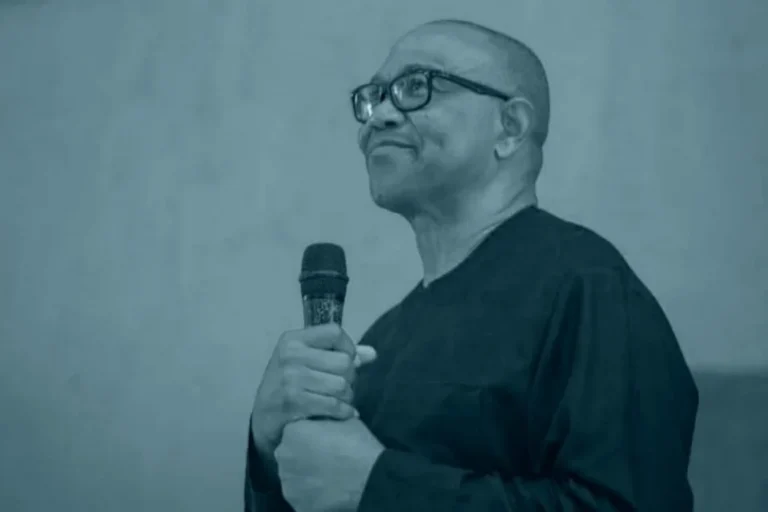
August 22, 2025 – The Labour Party’s presidential candidate in the 2023 elections, Peter Obi, has raised concerns over the Federal Government’s approval of ₦142 billion for the construction of bus terminals across Nigeria. He described the move as a clear case of misplaced priority.

“The difference between the success and failure of the development in any nation is how you prioritise your scarce resources,” Obi stated. He pointed out that while the government is channeling ₦142 billion into bus terminals, the entire budget allocated in 2024 for all federal university teaching hospitals and federal psychiatric centres is less than ₦100 billion.

According to him, this decision reflects “lack of competence, lack of focus and poor leadership.” Obi stressed that health should be a major area of investment, as Nigeria’s healthcare system is already underfunded and deteriorating.

He added that the World Health Organization recently reported that over 20 million Nigerians are currently living with mental health challenges.

“This is disturbing, considering that Health is one of the most critical areas of development, which is deteriorating and remains grossly underfunded,” he said. Obi noted that approving more money for bus terminals than the entire teaching hospital system in the country shows a serious gap in governance.

He described the action as “not only a misplaced priority but a tragic irony of our country.” Obi concluded with a call for a change in leadership direction, adding, “This is not governance. A New Nigeria is POssible.”

Sokoto, UNICEF, EU, ILO to Enroll 1M Households in Social Protection

August 22, 2025 – The Sokoto State Government has announced plans to expand social protection coverage to reach more vulnerable households, in collaboration with development partners such as the United Nations International Children’s Emergency Fund, the European Union, and the International Labour Organisation.

The disclosure was made during a stakeholders’ engagement meeting on the review of the National Social Protection Policy and the National Social Register, held on Friday at Dankani Hotel in Sokoto.

The meeting brought together policymakers, experts, and partners to discuss strategies for supporting poor and vulnerable households across the state.

Speaking at the event on behalf of the State Operation and Coordinating Unit, the State Coordinator praised stakeholders for their active role in the discussions. “We appreciate the time you have taken to share your perspectives and expertise, which will help in refining our approaches to better support vulnerable households,” the coordinator said.

He further expressed appreciation to development partners for their dedication to strengthening the National Social Register. According to him, an additional one million households will be enrolled across four pilot states, including Sokoto, Benue, Abia, and Oyo.

He explained that this expansion will improve government capacity to identify and target poor households through effective social protection programs and interventions.

The State Coordinator highlighted the role of international development support in boosting Sokoto’s capacity to deliver sustainable welfare programs. “We value this collaboration and look forward to continued partnership in advancing social protection goals,” he added.

The meeting emphasized the importance of social welfare, poverty reduction, and inclusive growth, with stakeholders noting that expanding the register will provide more households access to critical support.

Officials stressed that long-term investment in social protection is vital for reducing poverty, improving household income, and promoting sustainable development across Nigeria.

FG $190m JICA Loan to Expand Renewable Energy and Power Grid

0

Nigeria is advancing a $190 million renewable energy loan facility supported by the Japan International Cooperation Agency (JICA), aimed at expanding distributed renewable energy solutions across underserved communities.

The announcement was made by the Minister of Power, Adebayo Adelabu, during the Ninth Tokyo International Conference on African Development (TICAD 9) in Yokohama, Japan.

Adelabu explained that the government is determined to use this loan to scale renewable energy projects that will directly impact rural and urban households. “This facility is designed to provide clean energy access to communities that have remained underserved for years,” he said.

The Nigerian delegation at TICAD 9 was led by President Bola Ahmed Tinubu, who participated in a series of high-level meetings focused on power, infrastructure, and industrial transformation.

Tinubu stated that Nigeria’s presence at the summit was not for trade exhibitions but to build strategic partnerships that can drive real change. “We are deliberately shifting from planning to implementation, from agreements to delivery, and from promises to measurable results,” the President said.

At the summit, Adelabu also held talks with leading Japanese energy corporations such as Toshiba, Hitachi, Japan’s Transmission & Distribution Corporation, and Energy Exchange companies. These discussions centered on strengthening Nigeria’s transmission infrastructure, improving operational efficiency, and reducing system losses.

The Minister revealed that the loan builds on the recent Federal Executive Council approvals for counterpart funding of ₦19,083,192,805.30 to unlock $238 million in additional financing from JICA.

This funding will be used to expand the national grid through projects that include 102.95 kilometers of new 330kV double circuit lines, 104.59 kilometers of 132kV double circuit lines, four 330/132/33kV substations, two 132/33kV substations, two 330kV line bay extensions, two 132kV line bay extensions, and one 132kV substation.

In addition, Adelabu confirmed that the government had earlier launched a $750 million World Bank Distributed Access through Renewable Energy Scale-up (DARES) programme under the Mission 300 Compact. This initiative is expected to deliver reliable and clean electricity to more than 17 million Nigerians.

At the same time, three new substations funded by JICA through a $32 million grant are set for commissioning in Apo (FCT), Keffi (Nasarawa State), and Apapa (Lagos State). These substations will improve power supply to homes, businesses, industrial clusters, and key facilities such as the Lagos Port.

Partnerships with JICA also extend to human capacity development. The National Power Training Institute of Nigeria (NAPTIN) has commissioned new training equipment in Abuja with JICA’s support. This facility is targeted at building the skills of engineers who manage electricity distribution networks. According to Adelabu, the training institute is critical for long-term sustainability in Nigeria’s power sector.

Speaking during a panel session titled “HICKARE Africa: Harnessing Innovation, Co-creation, and Knowledge for Accessible and Resilient Energy for Africa,” Adelabu highlighted the country’s energy challenges. He noted that only 55 to 60 percent of Nigeria’s population of over 200 million people currently have access to electricity, and much of it is unreliable.

He stressed that the government is tackling this issue by expanding the national grid in cities while also promoting off-grid solutions like solar mini-grids and standalone systems for rural communities.

The Minister pointed out that despite the opportunities, there are obstacles such as limited access to affordable capital, high costs for rural households, and under-utilisation of renewable energy equipment.

However, he reassured that the government remains committed to overcoming these challenges by encouraging private sector investment, implementing supportive policies, and promoting local manufacturing of renewable energy components.

Adelabu praised JICA and the Government of Japan for their long-standing partnership with Nigeria. He acknowledged their contributions to infrastructure projects, renewable energy financing, technical studies, and workforce training. “We recognise JICA as a reliable partner in advancing Nigeria’s energy transition and expanding access to sustainable electricity,” he said.

Through these agreements and ongoing projects, Nigeria aims to strengthen energy security, reduce reliance on fossil fuels, and expand access to affordable electricity for millions of citizens. The partnerships struck at TICAD 9 underline Nigeria’s commitment to building an energy sector that supports industrial growth, job creation, and sustainable economic development.

Bank of Industry Notifies TISSF Loan Applicants to Verify KYC

0

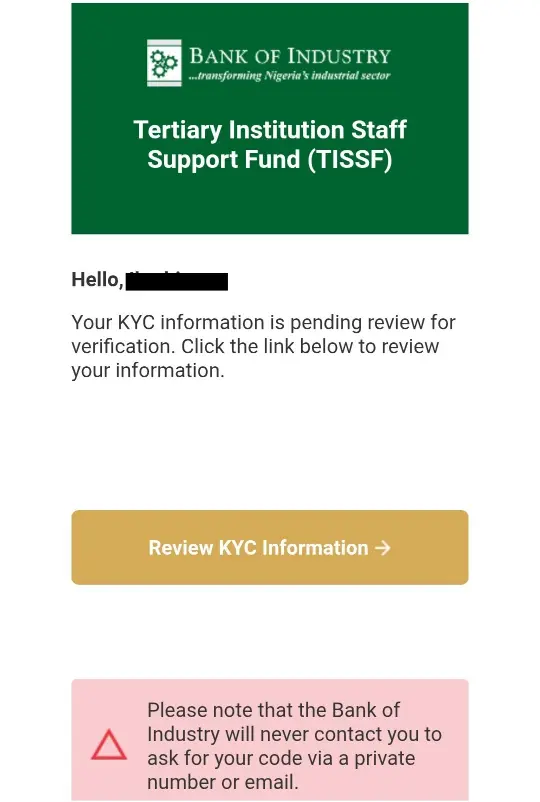
The Bank of Industry (BOI) has announced that staff who applied for the Federal Government Tertiary Institution Staff Support Fund (TISSF) loan should check their email for an important update. Both academic and non-academic staff are receiving a KYC verification message linked to their account details.

According to multiple reports, disbursement of funds is expected to begin by the end of this year, making it essential for applicants to confirm their details on time.

The email sent to applicants states, “Hello, Applicant. Your KYC information is pending review for verification. Click the link below to review your information. Review KYC Information.”

It further added, “Please note that the Bank of Industry will never contact you to ask for your code via a private number or email.”

Applicants are directed to use the official submission portal tissf.boi.ng to complete the process.

Remember that TISSF loans are to be repaid over five years with a 12-month (one-year) moratorium before repayments.

Below is the KYC email:

Kebbi State Publishes List of Over 19,000 Teacher Applicants

0

August 22, 2025 – The Kebbi State Ministry of Basic and Secondary Education has announced that last year’s teachers’ recruitment exercise recorded over 19,000 applicants.

In a statement, the Ministry explained that this figure is the official number of qualified individuals who submitted applications for the recruitment.

The clarification was issued to counter misinformation and speculations circulating about the process.

According to the Ministry, “This is the official figure, and we find it necessary to set the record straight.” The statement stressed that the exercise was conducted to ensure transparency and fairness in the selection of qualified teachers for schools across Kebbi State.

In response to questions raised by the public regarding pictures circulating online, the Ministry confirmed that the images represent the official applicant lists.

These lists have been released in batches on the Ministry’s official Facebook page. The published batches cover applicants from 1–80, 80–120, 120–200, 200–280, 280–320, 320–400, and 400–480.

The lists can be accessed directly through the Ministry’s social media posts via the following links:
www.facebook.com/share/p/1BUeNJcpUk
www.facebook.com/share/p/16wqTnQvna
www.facebook.com/share/p/1NaysZbaHz
www.facebook.com/share/p/19d9gyqsdw
www.facebook.com/share/p/14HwHqCyAFa
www.facebook.com/share/p/1BewQB92Lv

The Ministry emphasized that the publication is part of its commitment to transparency, accountability, and merit-based recruitment.

It also reaffirmed the vision of His Excellency, Comrade Dr. Nasir Idris, Kauran Gwandu, to uplift education standards in Kebbi State through fair recruitment and improved teacher quality.

NigeriaStartupAct.ng’ concern

We are worried about the method used to release the names as it violates the privacy of applicants.

Public release of emails and phone numbers exposes applicants to spammers and scammers. We urge the Ministry to withdraw the list and adopt safer methods that protect candidate information.