Home Blog Page 534

FG, SEC Partnership to Empower Nigerian Youth as Entrepreneurs, Investors

0

August 21, 2025 – The Federal Government has reaffirmed its commitment to practical and innovative solutions that will deliver real impact in the lives of young Nigerians.

This came as the Honourable Minister of Youth Development, Comrade Ayodele Olawande, signed a Memorandum of Understanding (MoU) with the Securities and Exchange Commission (SEC), led by its Director-General, Dr. Emomotimi Agama.

Speaking at the signing ceremony, Comrade Olawande stressed that meaningful legacies are built through action and collaboration rather than bureaucracy. He explained that the new initiative is focused on creating access for Nigerian youth to participate in the capital market.

“This initiative is about breaking barriers and opening doors,” Olawande said. “For too long, the capital market has been seen as a space reserved for the wealthy. Today, we are saying clearly that Nigerian youth deserve access too. We want to empower them not just to seek jobs, but to create them, to become entrepreneurs, investors, and employers of labour.”

The Minister also highlighted the Nigerian Youth Academy (NIYA) as a central platform designed to provide financial education and practical skills to young people across the country, regardless of background or location.

He emphasized the importance of strong collaboration between government agencies and private sector players to ensure that no youth is excluded from opportunities.

“Our goal is to raise a generation of financially savvy, empowered young Nigerians who will shape the future prosperity of this nation. With partners like the SEC, we are proving that it is possible,” Olawande stated.

He expressed gratitude to the SEC for its leadership role in this initiative and urged other stakeholders to contribute to building pathways of opportunity for young Nigerians.

“This is about the future of our country. Together, we can ensure that every young Nigerian has the tools, knowledge, and opportunities to thrive,” he added.

On his part, the Director-General of the SEC, Dr. Emomotimi Agama, described the collaboration as a strategic move toward youth empowerment through financial inclusion and innovation.

He commended the Honourable Minister for his youthful and action-driven leadership, noting his ability to dismantle bureaucratic barriers in favor of impactful solutions.

Dr. Agama further affirmed the SEC’s dedication to working with the Ministry to expand access to funding, financial education, and investment opportunities.

According to him, the partnership will serve as the foundation of a meaningful legacy, with programs targeted at empowering young Nigerians from all walks of life, thereby ensuring sustainable socio-economic growth and long-term national prosperity.

Advertisement

FG, Kano to Create 40,000 Jobs with End-of-Life Vehicle Regulations

0

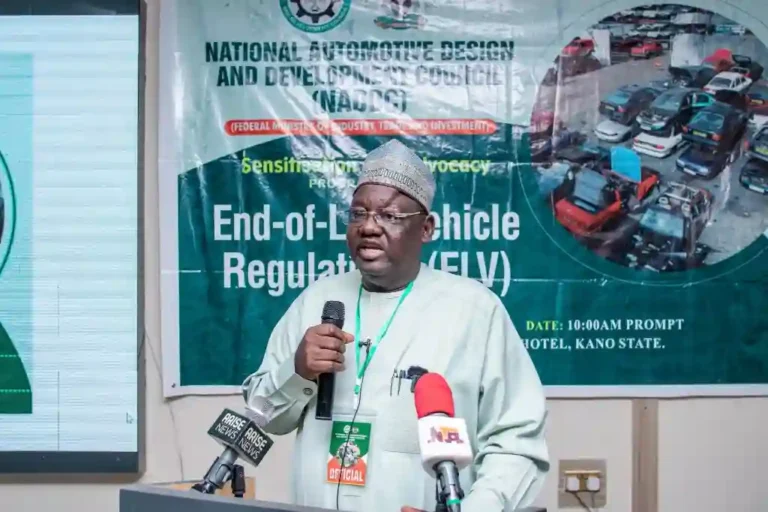
August 21, 2025 – The National Automotive Design and Development Council (NADDC), under the Federal Ministry of Industry, Trade and Investment, has reaffirmed its commitment to repositioning Nigeria’s automotive sector with the successful hosting of a Sensitisation and Advocacy Programme on End-of-Life Vehicle (ELV) Regulations at Hilton Palace Hotel, Kano State, on August 21, 2025.

Representing the Director General of NADDC, Mr. Oluwemimo Joseph Osanipin, the Council’s Director of Policy, Planning and Statistics, Mr. Musa M. Sani, said the initiative would transform the automotive sector while advancing economic growth.

“The ELV Regulation is more than just waste management; it is a strategic blueprint for economic diversification, environmental protection and industrial renewal,” he stated.

According to Mr. Sani, the policy is expected to create over 40,000 direct and indirect jobs nationwide, promote recycling, and support the development of greener cities across Nigeria. He also recalled the official launch of the ELV Regulations by the Minister of State for Industry, Senator John Owan Enoh, on March 5, 2025.

He noted that the sensitisation in Kano followed an earlier programme held in Abuja on July 3, 2025, which provided the foundation for collaboration among stakeholders in the automotive and environmental sectors.

The NADDC also announced plans to set up a multi-stakeholder Steering Committee made up of government agencies, industry professionals, and environmental organizations.

The committee will be responsible for guiding the implementation of the ELV policy, which is being modeled after international standards from countries such as Japan and the Netherlands.

Through his representative, the Director General expressed appreciation to Senator John Owan Enoh for leading the regulation’s adoption and to Hon. Terseer Ugbor for strengthening the legal framework to support environmental sustainability and automotive reforms.

Delivering a keynote address, Dr. Fyneray Mbata, Managing Director of the Recycling and Environmental Development Initiative of Nigeria (REDIN), and representative of Hon. Terseer Ugbor, Deputy Chairman of the House Committee on Environment, described the ELV policy as a pathway to a circular economy.

“This initiative will reduce pollution, attract private investment, generate revenue, and create thousands of job opportunities across Nigeria,” Dr. Mbata explained.

REDIN, which has been selected as a recycling partner for the regulation, pledged to work with NADDC, relevant government institutions, and private stakeholders to create a sustainable system for ELV collection, dismantling, and recycling.

The programme concluded with goodwill messages from stakeholders who promised continuous collaboration to ensure the ELV Regulations achieve their goals of job creation, safer mobility, environmental protection, and industrial growth.

Apply: Cross River 2025 Students Financial Support Program

0

August 21, 2025 – Cross River State Government through the Ministry of Education has opened applications for the 2025 Students Financial Support program.

The announcement was made by the Cross River State Scholarship Board and signed by the Chairman, Prof. Paul Itara, calling on all eligible students to take advantage of the opportunity to ease the burden of tuition and academic costs.

According to the official release, applicants must ensure that their file size does not exceed 250kb when uploading documents. The required documents are listed as follows:
i. Admission Letter
ii. Certificate of Origin (original copy)
iii. Passport photograph
iv. Last result

The deadline for submission is Wednesday, 27th August 2025.

How to apply:

Interested candidates are advised to visit the official application form link provided by the Board, fill out the form, and upload the necessary documents Here.

In addition, hard copies of documents should be submitted at the Scholarship Board office in Calabar.

The release added that students can visit a cybercafe to complete the registration and print the application form for submission.

Applicants seeking more guidance can alternatively reach out to the Chief Press Secretary to the Speaker of the Cross River State Youth Parliament 3rd Assembly for assistance with registration.

FirstBank FirstMobile Cash-Out Promo 3.0 (N40m Reward)

FirstBank has announced the launch of the FirstMobile Cash-Out Promo 3.0, giving customers a chance to share in over N40 million in rewards. The bank confirmed that both new and existing users of the FirstMobile app stand a chance to win.

“It’s time to cash out with FirstMobile Cash-Out Promo 3.0. Whether you’re a new user or already on the app, this is your chance to win big,” the bank stated.

Customers can win through simple transactions like recharges, bill payments, and money transfers on the FirstMobile app. Rewards include:
1. N10,000 weekly (200 winners)
2. N20,000 monthly (200 winners)
3. N50,000 for top 25 transfers
4. N5,000 (airtime/data) for first-time users
5. Up to N2M for top 3 users

The promo runs until November 9, 2025.

How to Participate:

Download FirstMobile from the App Store or Google Play, transact, and qualify. Terms and conditions apply.

Oyo Govt Releases N600m Compensation for Ibadan Circular Road Project

0

Oyo State Government has released another ₦200 million compensation fund to property owners affected by the ongoing Circular Road project in Ibadan, bringing the total payment so far to ₦600 million. The disbursement was made today at the office of the Commissioner for Lands, Housing and Urban Development, Hon. Williams Akin Funmilayo.

“With this exercise, we are gradually approaching the ₦1 billion mark. Today, beneficiaries will receive between ₦3 million and ₦5 million each, with payments to be credited immediately,” Akin Funmilayo stated. He added that the full ₦1 billion compensation will soon be completed.

The commissioner explained that the Circular Road corridor was first acquired in 2006 and later expanded in 2018 before Governor Seyi Makinde assumed office. He said the project had witnessed different forms of encroachments over the years. Despite the expansion not taking place under his administration, Governor Makinde directed that both legal and illegal property owners should be compensated.

Akin Funmilayo also warned beneficiaries to avoid fraudsters and report any official demanding kickbacks. “Beneficiaries must be cautious and report immediately if any government worker requests unauthorized payments,” he cautioned.

The Commissioner for Information, Prince Dotun Oyelade, described the project as one with divine significance. “If you look at it very well, it would appear that this is a project the Lord had ordained because the concept started 20 years ago by former Governor, Chief Rashidi Ladoja, who incidentally is being coronated as the Olubadan of Ibadanland 20 years after, and after which the Circular Road has been named,” Oyelade said.

Representatives of beneficiaries, Alawiye Adebayo and Iyafin Abigeal Opelopeoluwa, praised Governor Makinde for fulfilling his promises and showing compassion in governance.

BudgIT Faults FG for Not Publishing Quarterly Budget Reports

0

August 21, 2025 – BudgIT, a civic-tech organisation focused on promoting transparency and accountability in Nigeria’s public finance system, has raised serious concerns over the refusal of the Federal Ministry of Finance, through the Budget Office, to publish the Quarterly Budget Implementation Reports.

The organisation described the action as a violation of statute, a disregard for established practice, and an erosion of the transparency reforms introduced by previous administrations.

According to BudgIT, the refusal of the finance ministry to make available quarterly reports on budget implementation runs against provisions of the Fiscal Responsibility Act, 2007. The law is clear under Part V, Budgetary Execution and Achievement of Targets, section 30, which states that: “The Minister of Finance shall cause the report (on the Implementation of the Annual Budget) prepared pursuant to subsection (1) of this section to be published in the mass and electronic media and on the Ministry of Finance website, not later than 30 days after the end of each quarter.”

BudgIT pointed out that previous administrations consistently adhered to this requirement by publishing at least three Budget Implementation Reports per fiscal year. However, under the current government, nearly four reports remain pending from the second quarter of 2024 to the second quarter of 2025. This marks almost a full fiscal year without a single publication of the reports.

Budget Implementation Reports are considered vital not only as a legal requirement but also as a benchmark for transparency and accountability. They provide proof of government spending, allowing stakeholders to assess the quality of budget implementation and the effectiveness of public service delivery. Public sector accounting standards emphasise the need for timely dissemination of financial information to ensure accountability and public engagement.

BudgIT criticised the decision of the Ministry of Finance and the Budget Office to withhold this crucial public document, noting that it undermines Nigeria’s commitment to transparent governance. The organisation argued that the current administration should have built on the progress of previous governments by expanding the publication of budgetary information. This could include making available the Federal Cash Plan Disbursement Schedule, which is required under section 26 of the Fiscal Responsibility Act.

The civic-tech group stressed that the failure to publish the reports is particularly troubling given that the federal government has concluded spending on the 2024 Appropriation. It remains unclear whether the supplementary budget for 2024 is still being implemented. Without the release of performance reports, private sector operators are denied important data for planning, civil society organisations and academic researchers lack information for advocacy and analysis, and the international community is unable to verify Nigeria’s compliance with accepted global standards in public finance management.

BudgIT further noted that the current administration’s disregard for transparency goes beyond the Quarterly Budget Implementation Reports. The organisation highlighted that Open Treasury.gov, which used to be the main platform for tracking federal government expenditure on a daily, weekly, monthly, quarterly and yearly basis, has not been updated since January 2025.

While Open Treasury was not without its flaws, such as missing data from certain Ministries, Departments and Agencies, broken links and machine readability issues, it was widely considered an important tool for transparency. The decision not to update the platform raises fresh concerns about the government’s commitment to accountability in public spending.

Commenting on the development, BudgIT’s Group Head of Research and Policy Advisory, Vahyala Kwaga, said the non-compliance of the Ministry of Finance and the Budget Office with established law and practice is discouraging.

“The ability of a government to hold itself accountable to its laws is not only to be expected of a democracy such as ours but is an indication of adherence to the rule of law. The non-publishing of crucial information by the Ministry of Finance and the Budget Office of the Federation should not be augmented by ‘pronouncements’ by the Minister/Director General in the media. It should be done by publishing financial information according to existing laws. Citizens and the general public have a right to know and a right to be informed,” Kwaga stated.

BudgIT emphasised that transparency and accountability are not optional but fundamental to the effective management of public funds. By failing to comply with the Fiscal Responsibility Act, the finance ministry and the budget office risk undermining confidence in Nigeria’s financial governance.

The organisation therefore called on the Ministry of Finance, the Budget Office of the Federation, and the President of the Federal Republic of Nigeria, Bola Ahmed Tinubu, to prioritise legal compliance, accountability and transparency in handling the nation’s finances.

It also urged civil society organisations, private sector stakeholders, academia and the international community to demand the urgent publication of expenditure performance reports for the 2024 budget. BudgIT noted that Nigerians have a legal right and civic responsibility to insist on access to financial information that directly affects public services, infrastructure delivery, and economic stability.

The organisation stressed that Nigeria’s credibility in international financial markets and global governance platforms depends heavily on its ability to meet basic standards of public finance disclosure. The withholding of financial reports and the neglect of transparency platforms, according to BudgIT, project Nigeria as a government unwilling to respect its own laws or global best practices.

BudgIT’s demand comes at a time when citizens are facing growing economic pressure from inflation, subsidy reforms and rising living costs. The organisation noted that transparency in government spending would help Nigerians better understand how public resources are being managed and provide evidence for holding leaders accountable.

“The public deserves access to financial information in order to evaluate how funds are allocated and utilised. This is not only a statutory duty of the government but also a moral responsibility to the people,” BudgIT added.

The civic-tech group concluded by stressing that the government should immediately release all pending Budget Implementation Reports and resume regular updates on public finance platforms.

It warned that the continued withholding of statutory financial information could further erode public trust and deepen the perception of weak governance structures in Nigeria.

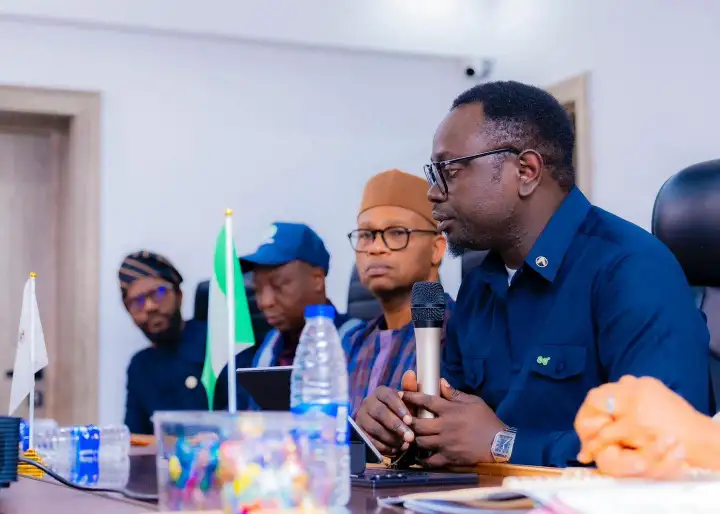
Enugu LGA Enrols 100 Youths in Mario Institute Skills Training Programme

Igbo-Eze South Local Government Area of Enugu State has commenced a new vocational and skills acquisition training programme for youths in the area.

The chairman of the council, Mr Ferdinand Ukwueze, approved the enrolment of 100 young people from the LGA into the first batch of the training at the Mario Institute of Hospitality Management and Entrepreneurship Education, Uhunowerre.

The initiative, fully funded by the council under its Special Committee on Bursary and Scholarship, aims to provide practical and marketable skills that can help participants build sustainable careers. The Special Committee Chairman of the scheme, Mr Chimezie Mama, said in a statement on Thursday that the programme is already recording success stories.

According to him, “The training is designed to be both intensive and practical. It has already begun to produce success stories, equipping beneficiaries with sustainable skills to thrive in a competitive economy.”

He explained that the scheme reflects a policy direction of the council chairman to reduce unemployment, tackle youth vulnerability and strengthen entrepreneurship within Igbo-Eze South.

“The initiative reflects a policy thrust of the chairman to combat unemployment, reduce youth vulnerability and foster a culture of entrepreneurship and self-reliance across Igbo-Eze South. By investing in human capacity building, the local government is not only addressing immediate socio-economic challenges, but also laying a solid foundation for long-term prosperity, innovation and productivity within the community,” he added.

Mr Ukwueze also reaffirmed his administration’s commitment to making human capital development a central pillar of governance. He noted that the empowerment programme aligns with the vision of Governor Peter Mbah, who has consistently promoted investments in human capacity and economic growth across Enugu State.

“The initiative is strategically aligned with the vision of Gov Peter Mbah whose administration champions investments aimed at repositioning Enugu as a hub for economic growth and human resource excellence,” Ukwueze said.

He further stressed that “empowering the youth is the most sustainable pathway to curbing poverty, reducing crimes and stimulating inclusive development.”

Gov Sule Distributes 100 Electric Vehicles to Youths in Nasarawa

Nasarawa State Governor, Abdullahi Sule, has distributed 50 electric cars and 50 electric tricycles to 100 youths in the state as part of efforts to boost economic growth and support sustainable development.

Speaking during the distribution ceremony in Lafia on Thursday, Sule said the initiative was designed to empower the beneficiaries to run the vehicles as commercial businesses, creating new sources of income and reducing unemployment.

He explained that the vehicles are powered by electricity instead of petrol or Compressed Natural Gas, making them cheaper to maintain and more environmentally friendly.

The governor revealed that a charging centre had already been established at the newly constructed state secretariat in Lafia.

“We are going to build one charging centre each in Akwanga and Keffi Local Government Areas to serve the Nasarawa North and West Senatorial Districts, respectively,” Sule said. He also noted that additional charging centres would be developed across the remaining local government areas in due course.

According to him, the first batch of the electric cars and tricycles will be deployed in Lafia, Akwanga, and Keffi to provide transport services for civil servants and help cushion current economic realities.

“They will also serve tertiary institutions in the three locations, including the Federal University of Lafia, College of Education, Akwanga, and the State University in Keffi,” he added.

Sule further explained that all the vehicles are air-conditioned and can operate for an entire day once fully charged. He expressed optimism that the project would give beneficiaries sustainable livelihoods while also promoting green energy and environmental protection.

The Emir of Lafia and Chairman of the Nasarawa State Council of Chiefs, Retired Justice Muhammad Sidi-Bage, praised the governor for the intervention, describing it as a timely step to ease the economic hardship faced by residents.

He encouraged beneficiaries to use the vehicles responsibly, saying the initiative could help reduce the high cost of local transportation and provide relief to commuters.

The emir assured that traditional rulers would continue to support government policies and programmes.

He also pledged that royal fathers would remain non-partisan, while offering prayers and blessings to all political candidates, regardless of party affiliation.

Benue Supplementary Entrance Exam for Students Exchange Programme

0

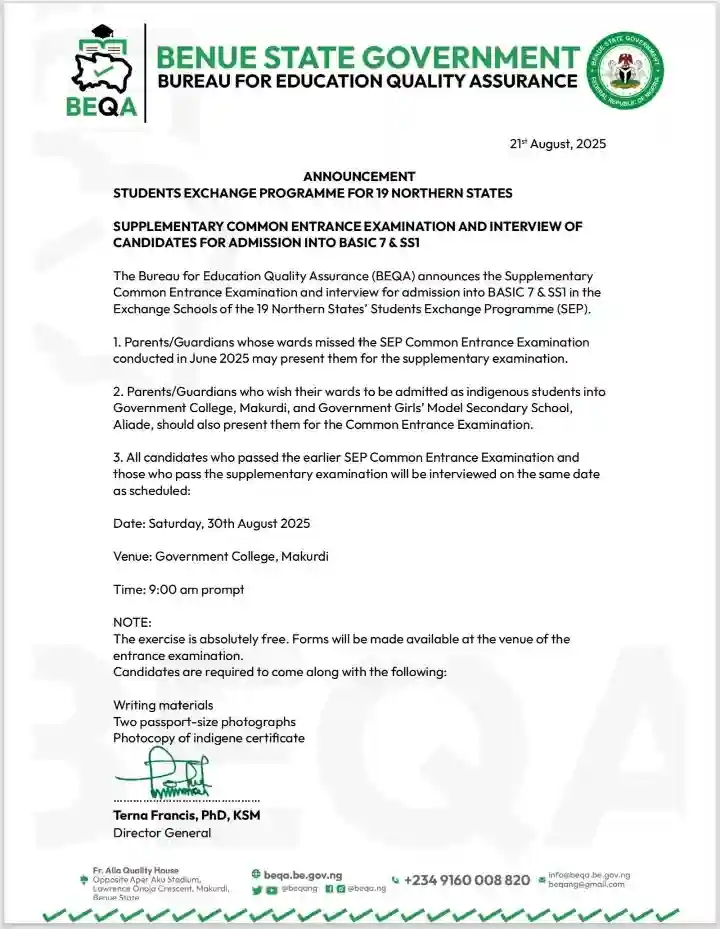
August 21, 2025 – Benue State Government through the Bureau for Education Quality Assurance (BEQA) has announced a supplementary common entrance examination and interview for admission into Basic 7 and SS1 in the 19 Northern States’ Students Exchange Programme (SEP).

The announcement, signed on 21 August 2025, states that the exercise is open to candidates who missed the earlier test in June.

According to the Bureau, parents and guardians whose wards missed the June examination are advised to present them for the supplementary test.

The Director General of the Bureau, Terna Francis, PhD, KSM, explained that the programme also covers indigenous students seeking admission into Government College, Makurdi, and Government Girls’ Model Secondary School, Aliade. He said, “Parents and guardians who wish their wards to be admitted as indigenous students into these schools should also present them for the Common Entrance Examination.”

The Bureau confirmed that all candidates who had earlier passed the SEP examination and those who succeed in the supplementary test will be interviewed on the same date.

The details of the examination are as follows:
a. Date: Saturday, 30th August 2025
b. Venue: Government College, Makurdi
c. Time: 9:00 am prompt

Officials further stressed that the exercise is completely free of charge, and forms will be available at the examination venue.

Candidates are expected to come with the following items:
i. Writing materials
ii. Two passport-size photographs
iii. Photocopy of indigene certificate

FG Launches RH GEEP 3.0 Micro-Credit for 5m Nigerians by 2027

August 21, 2025 – The Federal Government has officially launched the third phase of its Government Enterprise and Empowerment Programme, known as Renewed Hope GEEP (RHGEEP 3.0), with a target of five million beneficiaries by 2027.

Speaking at the national stakeholders’ roundtable in Abuja on Thursday, the National Coordinator and Chief Executive Officer of the National Social Investment Programme Agency (NSIPA), Badamasi Lawal, said the new phase marks a recalibration of the scheme, anchored on trust, consistency, and accountability.

“This gathering reflects our collective commitment to deepen financial inclusion, expand access to credit for small businesses, and empower our people, particularly women, youth, artisans, petty traders, and smallholder farmers, who form the backbone of Nigeria’s informal economy,” he said.

He explained that the roundtable was convened to formally launch the strategy for RH GEEP 3.0, under the theme “Building Trust, Strengthening Transparency, and Scaling Impact through Financial Inclusion.”

According to him, the programme was not just about policy but about addressing access to affordable credit for underserved Nigerians.

Lawal highlighted that the programme, which started under the National Social Investment Programmes, was designed to provide micro-credit and financial support to millions at the base of the economic pyramid.

He recalled that through schemes such as TraderMoni, MarketMoni, and FarmerMoni, GEEP has helped expand micro-enterprises, restore dignity, and offer opportunities to those excluded from formal financial systems.

While acknowledging the progress made under GEEP 1.0 and 2.0, the NSIPA boss stressed that RHGEEP 3.0 represents a deliberate shift. “Distinguished stakeholders, RHGEEP 3.0 is not a mere continuation; it is a recalibration. It represents a conscious shift in how we approach microcredit, anchored on: trust, re-establishing confidence with beneficiaries, the wider public, and stakeholders; consistency, ensuring equity in access and fairness in process; and accountability, clear enforcement of obligations, particularly repayment. Our goal is to reach five million beneficiaries by 2027, with a strong and positive repayment culture. This is ambitious, but it is achievable if we work in alignment,” he stated.

He added that lessons from earlier phases show the need to strengthen transparency and accountability, improve repayment mechanisms, expand digital inclusion through fintech partnerships, and deepen collaboration with state and local governments.

Lawal commended the National Programme Manager of GEEP and his team, as well as technical partners System Strategy and Policy Lab and Sydani Group, for their role in shaping the new strategy.

He said the success of RHGEEP 3.0 would depend on strong partnerships between government, financial institutions, and civil society, alongside effective communication with the public.

“This administration, under the Renewed Hope Agenda of His Excellency, President Bola Ahmed Tinubu, GCFR, recognises both the urgency and the opportunity to transform GEEP into a more accountable, impactful, and sustainable intervention,” he added.