Home Blog Page 543

FG to Empower IDPs with Farming and Cash, Remove Them from Camps

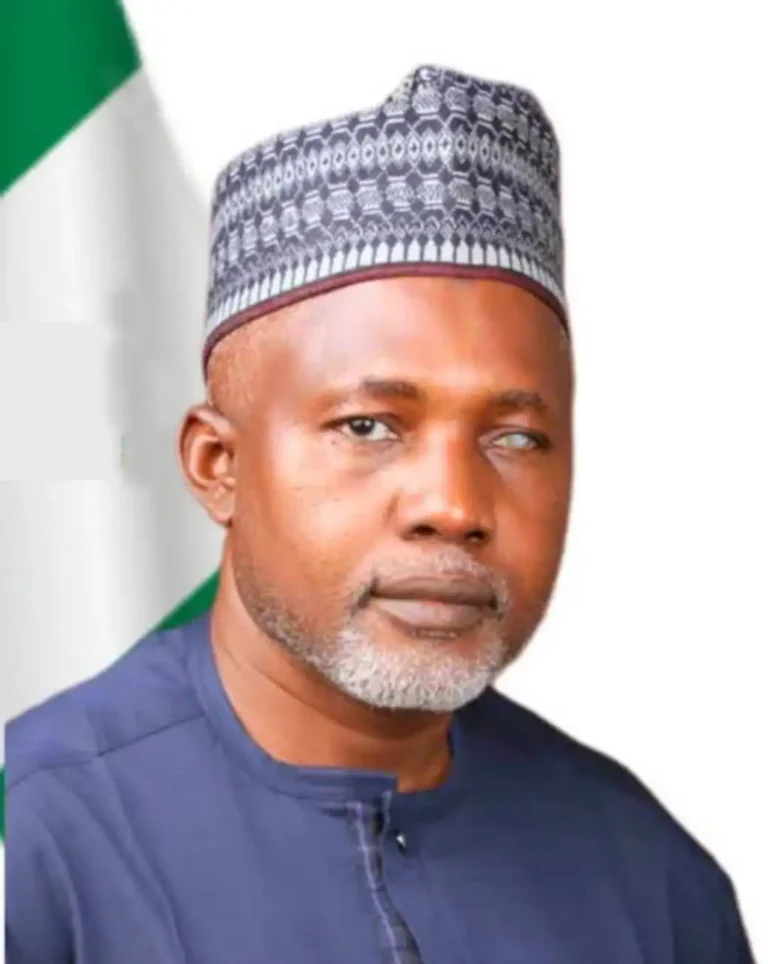
August 18, 2025 – Tanko Sununu, the Minister of State for Humanitarian Affairs and Poverty Reduction, has assured Nigerians that the administration of President Bola Tinubu remains committed to addressing poverty through durable solutions that will empower internally displaced persons (IDPs).

Speaking as a guest on Channels Television’s Sunrise Daily, Sununu explained that the government is focused on practical approaches to make displaced persons self-reliant instead of depending solely on palliatives.

“We are working seriously to ensure that some of the durable solutions, which we have started last year, we try to duplicate,” the minister said.

“What is that durable solution? The people in the IDPs. We have had a joint partnership between the Ministry of Agriculture, Ministry of Internal Affairs, NALDA, and our commission, National Commission for Refugees, where we are working hand in hand to put a very good understanding between internally displaced persons and their host community.”

According to him, one of the strategies has been the use of farmland offered by host communities, which has allowed displaced persons to engage in farm diversification. He highlighted that this approach has helped many IDPs become actively involved in agriculture while also building peaceful coexistence with host communities.

“I flagged off the harvesting season of the one that was in Plateau State. The Minister, the current Chairman of the All Progressive Congress, when he was in the ministry, he was in Borno and Benue State. When we have said that, what we did is a good sharing formula,” Sununu said.

He explained that the sharing formula allows IDPs to receive both food and cash benefits. “The IDPs will take 30% of it and their food component. The 70% will be uptaken and purchased by government and will be given to the IDP to serve as their cash component. Because if you give them food alone without cash component, it doesn’t make sense. They will sell the food to get other ingredients. So we are giving that.”

The minister stated that the food procured is also distributed to other displaced persons to ensure wider support. He noted that the scheme has developed interest among many IDPs in agriculture, with several of them eager to continue farming activities.

Sununu stressed that the overall plan is to make displaced persons independent, as relying on aid is not sustainable. “So what we are planning now, as soon as we do, we quickly exit them. What we are trying to do and what the global community is teaching now is not for you to keep people and continue to give them palliatives so that they will be palliative dependent. No. Globally, there is cutting, there is gap in terms of funding. So the idea is to make them independent,” he said.

He further described the long-term stay of some individuals in IDP camps as unacceptable. “There are people who have been for the past 8–10 years in IDP camps. That shouldn’t be allowed. That should not be allowed,” he said.

The minister also pointed to the suspension of funding by the United States and other international partners to United Nations agencies as part of the reason why sustainable approaches are now necessary.

According to him, all parties, including the UN, have agreed on the need to create an environment where security agencies can provide safe ground for displaced persons to resettle and thrive.

“What we need fast is to see how to create atmosphere through our security agencies to provide safe staying ground that those people in IDP, we can give them durable solutions that they can stand on their own in terms of farming or any other handwork that they can do to develop their skills. So that they can move out of IDP,” Sununu concluded.

Advertisement

FG Secures €1.5m EU Support for Poverty Reduction

The Minister of State for Humanitarian Affairs and Poverty Reduction, Tanko Sununu, has said that the President Bola Tinubu-led administration is committed to addressing poverty and improving support for vulnerable communities across Nigeria.

Speaking during an interview on Channels Television’s Sunrise Daily, Sununu explained that transparency and accountability in the ministry have attracted foreign partners willing to support Nigeria’s poverty reduction efforts.

According to him, “Because of improved transparency and accountability, we have received a lot of foreign partners now ready to partner with us. European Union is bringing 1.5 million euros, which will also be taking care of some areas in the northern part of the country and also in Benue.”

He noted that the International Organization of Migration (IOM) will also be visiting Nigeria to strengthen partnerships. “On the 20th, the Deputy Director General of International Organization of Migration is coming to Nigeria and we are visiting other conflict-prone areas to see what measures can we put,” the minister stated.

Sununu further revealed that Nigeria will be joining the United Nations in marking World Humanitarian Day on August 19. He said the focus of the event is to protect humanitarian workers and support community empowerment.

“What is the emphasis there? To see how we can do much in terms of reducing attack to humanitarian workers and also trying to empower local communities with durable solutions so that they can stand on their own,” he said.

The government’s poverty reduction strategy continues to draw international attention as foreign aid, humanitarian support, and community-based solutions remain key in addressing Nigeria’s social challenges.

World Food Programme Suspension Puts 300,000 Borno Children at Risk – FG

0

August 18, 2025 – Tanko Sununu, the Minister of State for Humanitarian Affairs and Poverty Reduction, has raised concerns about the suspension of key activities of the United Nations World Food Programme (WFP) in Nigeria.

Speaking as a guest on Channels Television’s Sunrise Daily, Sununu said the President Bola Tinubu-led administration remains committed to addressing poverty and hunger challenges facing millions of Nigerians.

According to the minister, the World Food Programme is struggling with a funding gap that has placed over 300,000 children in Borno State at risk of starvation. He explained that the agency requires 130 million dollars before December to stabilize the situation.

“About 300,000 children are currently at risk of starvation in Borno State due to the cancellation of that World Food Programme support,” Sununu stated.

The minister further clarified that the crisis extends beyond the 300,000 children at immediate risk. “It’s not only 300,000. Yes, that’s true. But the whole thing is the World Food Programme has 10 activities in Nigeria with five outcomes. One of the major activities is the emergency transfer of food and prevention of malnutrition or even treatment. That is considered 70 percent of the activities and that is what they are suspending. And that is also another serious funding gap,” he said.

Sununu noted that 1.3 million Nigerians are in urgent need of food and humanitarian support. He added that if funding is secured, the programme could provide relief not only to those 1.3 million but also to an additional 575,000 Nigerians.

He stressed that the federal government, under the leadership of President Tinubu and in partnership with the Office of the Vice President, is working with the World Food Programme to find a lasting solution.

“We have acted and we are working on definitely getting things sorted out together with the World Food Programme,” Sununu assured.

FG Explains Suspension of Blind School Training After Lagos Airport Protest

0

August 18, 2025 – The Minister of State for Humanitarian Affairs and Poverty Reduction, Tanko Sununu, has said that the President Bola Tinubu administration remains strongly committed to addressing poverty and improving the lives of vulnerable Nigerians.

Speaking as a guest on Channels Television’s Sunrise Daily, Sununu explained the federal government’s position following the recent protest by students of a federal school for the blind in Lagos, which led to the closure of access roads to both the international and local wings of the airport.

“Yes, I think I was in Lagos. It was a really unfortunate situation. I was in Lagos that day. It was really hectic. The commander of the commissioner of police, director, everybody was there because they are really vulnerable people and they blocked the access to both international and local wings,” the minister said.

Sununu explained that as soon as the ministry was informed, he and the Managing Director of the Federal Airports Authority of Nigeria (FAAN), Olubunmi Oluwaseun Kuku, quickly moved to Lagos to address the crisis.

“As soon as I heard that, we flew together with the MD of FAAN and we were in Lagos. I sat with them and God knows in less than one hour, we were able to understand ourselves and unblock the road and then access was established.”

The minister noted that the main concern was the condition of the school, which doubles as a skill acquisition center for persons with special needs. He revealed that the school had serious challenges that made the suspension of training necessary.

“What is the issue? The issue is the fact that really there were three issues or two I can say. One, the college was training, it’s a skill acquisition center so that they can also be empowered to act this thing. We realized that we asked our Permanent Secretary, who is now in education, to go for a visit. He visited the school. The condition of the school for people of special need, most especially blind people, is really not really acceptable. We are afraid that something more terrible may happen,” Sununu explained.

He added that the government had decided to suspend the training program at the school until better measures were put in place to upgrade both the training facilities and the living conditions.

“So we said, okay, in that case, we suspend the training until we put in measures to upgrade the standard in terms of what we have for training and even living conditions of the institution. We factored this into the 2025 budget,” he said.

According to him, while the decision was necessary for safety and improvement, the group that protested did not reach out to the ministry before staging their demonstration.

“Unfortunately, they’ve all agreed that they haven’t come to the ministry to confirm what has happened. They have not had any discussion with us. In fact, they called themselves alumni. I said, okay, all right. As alumni, you have the right to protect your institution. I can also do that. But the only thing we differ is your approach of blocking roads, denying other people rights,” Sununu said.

The minister also addressed concerns raised by the protesters about the conditional cash transfer program. He explained that many of them were not enrolled in the scheme due to lack of proper registration.

“There was a time when conditional cash transfer was being disbursed and they went and they were out. I said, okay, you see, the whole issue is doing this to understand it. And I told them, you did not get yourself enrolled. And your leadership did not tell them. And I said, okay, what do we do now? Get yourself enrolled and you’ll be given. And I will also have a grant coming,” Sununu explained.

He assured that the ministry had agreed to prioritize the enrollment of the affected persons in upcoming programs, including grants and other poverty reduction schemes.

“So we have agreed that definitely, we’ll give them, we’ll look at them closely, we’ll put it in order, we’ll prioritize them in the enrollment of whatever we are going to do. And every one of us are happy and they really realized that they couldn’t come to the ministry. And if they had come to the ministry and got things explained to them. Probably they wouldn’t have argued or acted,” he said.

Sununu expressed regret over the disruption caused to travelers at the Lagos airport during the protest. “And immediately the road was opened and I came back to Abuja. I want to apologize please to all the commuters of that day who suffered unnecessary hardship because of what happened. Please bear with the situation. And as a responsible ministry, we will always be up to the task in terms of acting immediately when we had challenges like that. We pray the challenges may not also occur,” the minister said.

He stressed that the Tinubu administration is fully committed to poverty alleviation, social investment, and welfare programs that protect vulnerable groups across the country.

FG GEEP to Give N300,000 Interest-Free Loans to 21,000 Farmers

0

August 18, 2025 – The Minister of State for Humanitarian Affairs and Poverty Reduction, Tanko Sununu, has said that the President Bola Tinubu-led administration remains committed to tackling poverty in Nigeria.

He made this known while speaking as a guest on Channels Television’s Sunrise Daily.

Sununu explained that the government is not only focused on poverty reduction but is also working on providing durable solutions that address challenges facing communities. According to him, one of the key areas is supporting farmers who have been affected by flooding and other natural disasters.

He said, “Just recently also we are around concluding our other programs in terms of providing durable solutions, where we intend to, because we have seen flooding all over, so we are now going to reach over 21,000 farmers through the Government Enterprises and Empowerment Program (GEEP).”

The minister added that the GEEP initiative will offer soft loans that are free of interest and collateral. Each farmer will receive 300,000 Naira to support dry season farming and strengthen food security in the country.

FG to pay N75,000 to 2.1 million households under RCCT programme

August 18, 2025 – The Minister of State for Humanitarian Affairs and Poverty Reduction, Tanko Sununu, has said that the administration of President Bola Ahmed Tinubu is determined to strengthen social safety nets and reduce poverty across Nigeria.

Speaking on Channels Television’s Sunrise Daily, Sununu explained that President Tinubu’s reforms are aimed at restoring hope and protecting vulnerable Nigerians from economic shocks.

He recalled that from the beginning of his tenure, the President had already warned that some reforms would bring discomfort but emphasized that the government was equally putting measures in place to reduce the impact.

“President Bola Ahmed Tinubu at inception promised reforms in Nigeria to renew the hope. And then during that reform, definitely, even President said there is going to be some pain. The pain must be also mitigated. And that is what exactly the President of the World Trade Organization (WTO) is talking about, instituting a social safety net that will be able to absorb shock, that will also be able to protect the vulnerable and then develop a sustainable and durable solution that will make them stand on their own and contribute significantly to Nigerian GDP,” Sununu said.

He added that the Ministry is working hand in hand with state governments, local governments, and international development partners to ensure that poverty reduction efforts protect the dignity of the average Nigerian and assure citizens of a better future.

As part of these efforts, the Ministry developed a national social register to identify vulnerable households.

According to the Minister, the register currently contains almost 18.9 million households, which translates to more than 75 million individuals across Nigeria. He explained that the social register was created through a step-by-step approach, starting with the poorest Nigerians, to ensure that the system is fair and inclusive.

The register also reflects the distribution of poverty in the country. Sununu pointed out that the northern region has the highest burden, with about 65 percent of Nigerians in the north living in poverty, compared to 35 percent in the south. Within the north, the north-west has the heaviest poverty levels with 64 percent of the population living in hardship.

“We have a register that is acceptable to all because it was systematically connected, generated and reviewed. But only thing that is short in the register, which the ministry has worked hard to ensure that a lot has been done, is the issue of national identity. So as to make sure that you institute transparency and accountability in your disbursement. And that national identity is for each person in the register to have a digital identity of his NIN, BVN, account number and even telephone number,” Sununu explained.

He further noted that this system now allows the Ministry to disburse funds more effectively while ensuring accountability. The social register also matches findings from the 2022 Multidimensional Poverty Index report, which was jointly published by the National Bureau of Statistics and Oxford University.

Sununu highlighted that the old approach to poverty assessment in Nigeria was mainly based on monetary poverty, which showed that about 40 percent of Nigerians were poor. However, the new multidimensional method considered several components.

1. Education
2. Health
3. Standard of living
4. Works
5. Shock (such as attack and many other things, employment, how close are you to school, this and that).

With these factors, the percentage of Nigerians considered poor increased to 65 percent. According to the Minister, the social register confirms this finding, showing that the burden of poverty is heavier in regions identified by the multidimensional poverty index.

He stressed that the President has insisted that the fight against poverty should be guided by facts and figures, ensuring no bias in distribution.

“Yes, 64.8% of people residing in the northern part of the country are poor. That’s what the multidimensional poverty index has stated. And even in our own distribution, it confirms this,” Sununu said.

The Minister also revealed the government’s immediate plans for more disbursements to Nigerians.

“So far, in the next few days to come, before the end of August, we are going to reach out to 2,119,000 households. The process is all set,” he said.

He added that the National Social Safety-Nets Coordinating Office (NASSCO) will oversee the program, ensuring that the most vulnerable Nigerians in the national social register benefit from the Rapid Conditional Cash Transfer scheme.

Providing details, Sununu said, “For those Nigerians, it is a Rapid Conditional Cash Transfer (RCCT). Of which I mentioned in one of my interviews, so far we have disbursed 419 billion to 5,000,968 Nigerians.

And the distribution, just like the National Social Register, we have distributed 71% in the northern part of the country because they have the highest burden, and then 29% in the southern part. And I’m now telling you that another 54 billion, 911,850,000 will be disbursed at the end of August to almost 2,119,000 Nigerians’ households.”

Sununu said this next phase of payments would be done more transparently to strengthen public trust. He stressed that the Ministry will no longer make transfers quietly but would openly publish details and invite the media to monitor.

“And this one, we are going to make it in such a way that we are shifting from just making transfer anonymous. It will be done publicly, we’ll address people, we’ll address the press, we’ll also call on the press to witness, and we’ll give data. We’ll even go into the extent of giving each state the numbers of the beneficiaries from that state and amount they are disbursing,” he said.

He acknowledged that lack of openness had been a problem in the past, but assured that the new approach would bring transparency and accountability.

“You see, I think where we had problems prior to now was the fact that things are not being made public. And now as part of transparency and accountability, we will tell each state, this is the amount we are giving, we are disbursing to that state, and these are the beneficiaries. You can confirm, and anybody who wants to confirm can even confirm with World Bank,” the Minister explained.

Beneficiaries of the current scheme are to receive 75,000 naira each, spread across three tranches of 25,000 naira. The Minister said the payments would be made within a short period so that people can access the support quickly.

“To each, the whole, you know there are three tranches of 25,000 each, and that’s making it 75,000 beneficiaries. They’re going to get it in three times? Yes, three tranches. And then the interval, there’s no going to be a long interval within short periods so that we can easily add this. People will say 75,000 is nothing. But 75,000 is a big money to a lot of people in Nigeria,” Sununu explained.

He emphasized that the objective of the Rapid Conditional Cash Transfer is not only to provide immediate relief but also to empower households to meet basic needs such as food, health, and education. He said such programs have long-term economic benefits because they support families to be productive and reduce the risk of falling deeper into poverty.

Beneficiaries are required to have a National Identification Number, a Bank Verification Number, an account number, and a working phone number to ensure transparency in the process.

The government believes that this approach will not only reduce leakages but also improve Nigeria’s ability to track and monitor poverty alleviation programs. It also strengthens confidence among international development partners, such as the World Bank, which supports several social protection programs in the country.

Sununu said the administration is committed to building a strong accountability framework for poverty reduction initiatives. He explained that the Ministry will continue to publish data on beneficiaries, amounts disbursed, and states covered, while allowing independent verification.

UBA N5bn BOI Loan to Fund MSMEs, Women-Owned Businesses, Others

0

United Bank for Africa (UBA) Plc has secured a N5 billion loan facility from the Bank of Industry (BOI) to strengthen key sectors of the Nigerian economy and support the growth of sustainable and viable businesses across the country.

The fund is particularly aimed at boosting micro, small, and medium enterprises (MSMEs), with a strong emphasis on women-owned businesses.

The loan, which is disbursed through the Federal Government’s MSME Fund, is structured to provide affordable financing that will stimulate the economy.

According to UBA, the major sectors targeted for the facility include Green Energy, Education, Healthcare, and Women-Owned Enterprises. This initiative is seen as part of wider efforts to drive inclusive growth and ensure long-term business sustainability.

UBA’s Group Managing Director and Chief Executive Officer, Oliver Alawuba, expressed the bank’s determination to support entrepreneurship and innovation across Nigeria. He described MSMEs as the “livewire of any developing economy” and stressed their importance to national growth.

“At UBA, we recognize the pivotal role MSMEs play in driving economic development, and how they make up a sizeable portion of what drives our economic growth.

It is in this vein that we have decided not to rest on our oars by facilitating initiatives dedicated to empowering businesses with the financial support they need to thrive,” Alawuba said.

Highlighting the favourable terms of the facility, he noted, “By offering loans at a competitive 9% interest rate with a three-year tenor, we are removing the traditional barriers that hinder SME growth in Nigeria and Africa. And by this, our message to business owners is simple: Don’t let this once-in-a-lifetime opportunity elude you.”

The loan arrangement allows a maximum of N5 million per obligor, with a three-month moratorium on principal repayments. This means businesses will have time to stabilise operations before starting loan repayments.

UBA’s Group Head of Retail and Digital Banking, Shamsideen Fashola, pointed out the strategic importance of the selected sectors, stressing their relevance to financial inclusion and long-term growth.

He explained that the initiative was in line with UBA’s mission to empower more Nigerians and expand access to financial services.

“We are structuring this facility to align with our broader mission of financial inclusion and economic empowerment. For us at UBA, we will be targeting Green Energy, Education, Healthcare, and Women-Owned Enterprises, which are critical to Nigeria’s sustainable development,” Fashola stated.

He further added, “This facility is structured to ensure that businesses in these sectors can access affordable funding, expand their operations, and contribute meaningfully to the economy. We are excited to partner with BOI to make this a reality.”

Speaking at the unveiling of the loan facility, Group Head, Marketing and Corporate Communications, Alero Ladipo, emphasised the accessibility of the program. She highlighted the role of government backing in making the terms affordable and urged business owners to take full advantage.

“What sets this program apart is its accessibility and affordability. We have worked closely with stakeholders to ensure the terms are business-friendly because we understand the challenges entrepreneurs face. I urge eligible businesses to visit any UBA branch or the bank’s official website to begin their application process right away,” Ladipo said.

United Bank for Africa is recognised as one of the largest employers in Africa’s financial sector, with 25,000 employees across its network. The bank serves over 45 million customers globally and operates in 20 African countries, as well as the United Kingdom, the United States, France, and the United Arab Emirates.

Through its retail, commercial, and institutional banking services, UBA continues to push financial inclusion, promote innovative banking solutions, and support economic growth across multiple markets.

Npower Accounts Submitted for September Payments, Circulating Report Alleges

August 18, 2025 – There is currently a circulating claim suggesting that the Npower Acting Program Manager has submitted Npower accounts to the office of the Minister of Finance for the release of funds from the Central Bank of Nigeria, with payments expected to begin from September 2025.

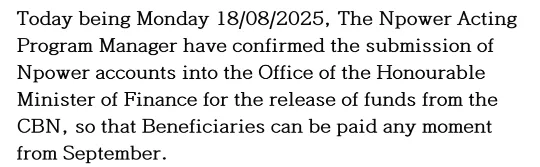
The claim reads: “Today being Monday 18/08/2025, the Npower Acting Program Manager, Dr. Zarmalulun Garba have confirmed the submission of Npower accounts into the Office of the Honourable Minister of Finance for the release of funds from the CBN, so that Beneficiaries can be paid any moment from September.”

However, several concerns have been raised about the authenticity of this information.

N-Power is a part of the National Social Investment Programme Agency (NSIPA), and as of now, NSIPA has not issued any statement regarding the matter.

Instead, the agency has been focusing on the upcoming GEEP 3.0 initiative, which is designed to empower more than 21,000 smallholder farmers across the country, including participants in Niger State.

The unverified statement circulating online on social media, particularly on Facebook, has also drawn attention because, while it names Dr. Zarmalulun Garba as the Acting Program Manager, there is no verified video, official post, or government press release directly quoting him.

Garba, who was appointed about a year ago, has not been confirmed as the source of this reported announcement.

Similarly, the Minister of Finance, Adebayo Olawale Edun, has not confirmed the claim. Neither the Federal Ministry of Finance nor its official channels have issued any Npower update linking the ministry to such a decision or submission of accounts.

Nonetheless, the claim states that the submission took place today, August 18, 2025. If the information is true, it is possible that an official clarification may come later today, tomorrow, or in the coming days from the concerned agencies.

In the meantime, Npower beneficiaries are urged to remain calm, hopeful, and avoid making any payments to individuals claiming to facilitate disbursement. NigeriaStartupAct.ng investigations are also ongoing to trace the source of this report. If we can confirm that it is true, official communication will be provided for Npower beneficiaries.

Attached is the viral claim as obtained from Facebook:

Benue SUBEB Warns Teachers Against Illegal Documentation Fees

0

August 18, 2025 – The Benue State Universal Basic Education Board (SUBEB) has issued a disclaimer raising concerns after receiving reports from newly recruited teachers that money is being demanded for documentation at various Local Government Education Authorities (LGEAs).

The Board has clarified that such demands are not authorised and warned teachers against making any payments.

“No staff of SUBEB or any LGEA has been authorized to collect money for the recruitment process. As it is completely free of charge,” the statement read.

The Board further advised the new teaching staff to resist giving money to anyone under any guise during the documentation exercise. This move is part of efforts to protect teachers and ensure fairness in the recruitment process.

According to SUBEB, transparency and accountability remain central to its operations, with a strong commitment to delivering quality basic education across Benue State.

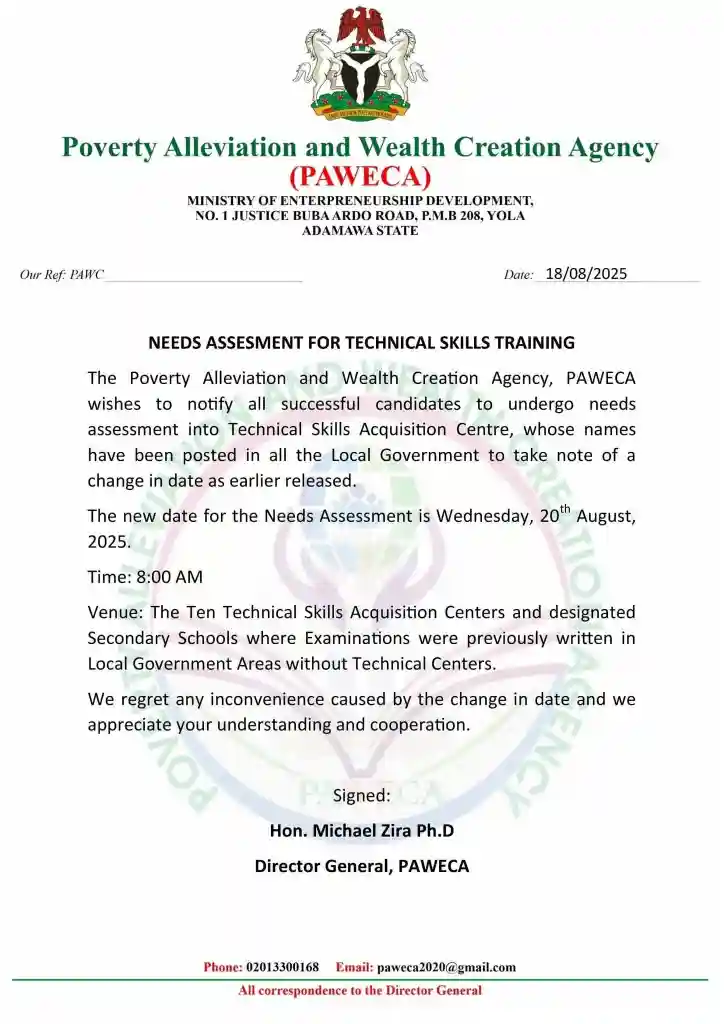
PAWECA Reschedules 2025 Needs Assessment Date for Candidates

August 18, 2025 – The Poverty Alleviation and Wealth Creation Agency, PAWECA, under the Ministry of Entrepreneurship Development, Yola, Adamawa State, has announced a shift in the scheduled needs assessment for candidates into the Technical Skills Acquisition Centre.

According to the agency, the new date for the exercise is Wednesday, 20th August, 2025.

In a statement signed by the Director General, Hon. Michael Zira, Ph.D, PAWECA explained that all successful candidates should take note of the change and prepare accordingly. The agency said the names of shortlisted candidates have already been posted in all Local Government Areas.

“The new date for the Needs Assessment is Wednesday, 20th August, 2025. Time is 8:00 AM, and the venue will be the Ten Technical Skills Acquisition Centers as well as designated Secondary Schools where examinations were previously written in Local Government Areas without Technical Centers,” the statement read.

The Director General added, “We regret any inconvenience caused by the change in date and we appreciate your understanding and cooperation.”