Home Blog Page 551

Industrial Training Fund Denies Plan to Relocate Headquarters from Jos

0

The Industrial Training Fund has refuted claims suggesting an alleged plan to move its headquarters from Jos, Plateau State, to Abuja.

In a statement released on Friday, the Head of Press and Public Relations, Thomas Ngor, clarified that there is no proposal to relocate the headquarters. According to him, “There is no proposed relocation of the ITF headquarters from Jos, despite the Honourable Member’s claims.”

The clarification followed a resolution passed by the Plateau State House of Assembly during its plenary on Thursday, rejecting the alleged relocation plan. The House, led by Speaker Naanlong Daniel, unanimously agreed that such a move would negatively affect the state’s economy and cultural heritage.

The resolution came after a motion of urgent public importance raised by Theodore Bala Maiyaki, representing Quaan-Pan South Constituency. The lawmaker argued that relocating the ITF headquarters could undermine Plateau State’s position as a key centre for industrial training and economic growth.

In its statement, the ITF stressed its longstanding connection to Jos, noting that the headquarters was moved from Lagos to the city in 1976.

“The ITF deeply values its longstanding historical ties and socio-economic contributions to Plateau State, which have been integral to its identity since 1976,” the statement read.

The Fund further assured that neither its management, governing council, nor the supervising ministry had discussed or considered the relocation. It also pledged openness to discussions with the Plateau State government and other stakeholders to resolve any concerns.

“The Fund welcomes dialogue with the state government and relevant stakeholders to address concerns and strengthen collaborative efforts for mutual benefit,” it said.

Calling for calm, the ITF urged Nigerians to ignore any speculation about moving its headquarters. “In light of the above, the ITF reaffirms its commitment to its heritage and responsibilities in Jos and urges the public to disregard rumours of relocation as unfounded and misleading,” the statement concluded.

This public clarification comes as interest grows around federal agency locations, with attention on how such moves could influence regional economies and job opportunities.

Advertisement

Nigeria Police to Start 2025 Recruitment as New Portal Ready

0

Friday, 15th August 2025 – The Police Service Commission (PSC) has announced plans to decentralise police recruitment ahead of the 2025 exercise.

This decision follows a meeting held yesterday, August 14, 2025, in Abuja with representatives from the 36 states and the Federal Capital Territory. The move will give state recruitment desk officers key roles in the process.

According to the Commission, all stakeholders, including the Ministry of Police Affairs, the Nigeria Police Force, and the Federal Character Commission, will have access to the recruitment portal.

This, it explained, is to promote transparency, inclusiveness, and prevent corruption and nepotism.

The Commission revealed that its newly acquired recruitment portal, designed for both the hiring of its staff and all categories of police officers, is now ready for use. This portal will be deployed during recruitment periods to ensure efficiency and fairness.

Yesterday’s consultative meeting was the first of its kind with officers in charge of recruitment from all the states and the FCT. The session focused on improving and consolidating a more transparent, accountable, and equitable recruitment system across Nigeria.

To make this possible, the Commission will dedicate the new portal to managing both its personnel recruitment and that of the Nigeria Police.

It also confirmed that future police recruitments will be done exclusively through the Commission’s portal, with state officers playing significant roles in the selection process.

The Commission stated that the portal will be activated immediately once preparations for the 2025 recruitment exercise are complete.

Speaking on the development, Commission Chairman, DIG Hashimu Argungu (rtd) mni, said, “The Commission is happy to partner with the State Desk Officers who are the immediate beneficiaries of Police recruitment to ensure that the interests of all parties are protected.”

He added, “We will continue to do our best to give the nation a Police Force it will be proud of.”

The Commission urged members of the public to take note of the new process and prepare for the upcoming recruitment, which will now be handled with enhanced transparency and fairness.

NDE Sends Nomination Email for 2025 DBN Entrepreneurship Training Programme

The National Directorate of Employment (NDE) has sent email notifications to applicants who registered for the NDE RHEI in Phase One, informing them of their nomination for the Development Bank of Nigeria’s Annual Entrepreneurship Training Programme (ETP 2025).

In the notification, candidates received the following message:

“Dear (Candidate name), You have been nominated by the National Directorate of Employment (NDE) to participate in the Development Bank of Nigeria’s Annual Entrepreneurship Training Programme (ETP 2025). To get started, please login to DBN’s learning platform with the details provided below: Login: Password: Once you are logged in, enrol and complete at least the following four (4) courses: Credit Management and Access to Finance, Marketing and Sales Technique, Accounting and Bookkeeping, Sustainability for Small Businesses. Upon completion, ensure you take the final quizzes and score over 85% to be eligible to be considered for a 3-day in-person workshop in your region. At the workshop, you have the opportunity to pitch your business and win a grant funding ranging from N500,000 to N1,000,000.”

A total of 300 businesses will be shortlisted for the training, which will take place in Lagos, Abuja, and Port Harcourt. The mandatory courses are:
i. Accounting & Bookkeeping,
ii. Sustainability for MSMEs
iii. Marketing and Sales Techniques,
iv. Credit Management/Access to Finance

Eligibility requirements are:
1. Owner of business must be 18 years and above
2. Business owner must be a citizen or legal resident of Nigeria
3. The business must be based in Nigeria
4. The business must be for profit from any sector
5. Applicant must be available to commit to the training schedule once accepted

Applications can be submitted via https://bizaid.devbankng.com/ before the registration deadline on September 6, 2024.

The NDE stated that nominated applicants will be screened and shortlisted after the close of registration, based on the eligibility criteria provided.

Apply: ActionAid Nigeria Vendors to Supply Start-Up Kits for Vocational Trainees

0

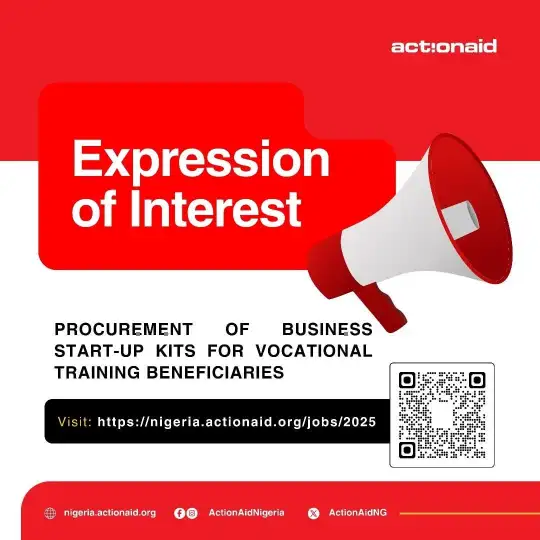
August 15, 2025 – ActionAid Nigeria has announced a call for qualified vendors to supply business start-up kits for 400 vocational training beneficiaries across Edo, Lagos, and FCT, Abuja.

The organisation said the beneficiaries are currently being trained in market-driven skills such as fashion design, hairdressing, catering and hotel management, baking and confectionary, textile and adire making, and shoe making.

According to ActionAid Nigeria, the initiative aims to boost the sustainability of the beneficiaries’ livelihoods after their training. “We are seeking vendors to procure, package, and deliver high-quality start-up kits tailored to each trade,” the statement read.

The primary objectives include:
i. Procure and deliver complete start-up kits for each vocational trade in line with approved specifications.
ii. Ensure timely and quality supply of kits to support the beneficiaries’ transition into entrepreneurship or self-employment.
iii. Provide documentation, receipts, and warranty support (where applicable) for all items supplied.

The vendor is expected to deliver:
a. Complete start-up kits per trade and per beneficiary, packaged and labelled.
b. Delivery notes and supporting documentation (receipts and warranty certificates where applicable).
c. A final supply report confirming full delivery in good condition.

The procurement and delivery process must be completed within two to three weeks from the contract signing date.

The selected vendor(s) will be responsible for:
i. Sourcing and supplying start-up kits as per the approved list of trades and specifications (provided by ActionAid Nigeria).
ii. Packaging and labelling kits per beneficiary allocation for easy distribution.
-Delivering the kits to the designated ActionAid distribution points in Edo, Lagos, and FCT, Abuja.
-Providing warranty and after-sales support for applicable equipment.
-Submitting delivery notes, receipts, and a final supply report (all delivery costs shall be borne by the vendor).

Qualification and requirements are as follows:
1. Be a legally registered business in Nigeria with CAC and Tax Identification Number.
2. Demonstrate previous experience in the supply of vocational or business start-up kits (attach evidence such as past contracts or LPOs).
3. Have the financial and technical capacity to deliver all items within the required timeframe.
4. Provide proof of after-sales support/warranty where applicable.
5. Agree to comply with ActionAid Nigeria’s procurement and ethical standards.

The vendor will report to the Procurement Unit, with all deliveries jointly inspected by the project and procurement teams before acceptance.

Applications close on August 28, 2025.

How to apply:

Interested vendors should submit the following documents via email to Procurement.Nigeria@actionaid.org on before 28th of August 2025 using the subject line “Business Start -Up Kits For Vocational Training Beneficiaries Under The RECONNECT Project:

a. Company profile and registration documents (CAC, TIN)
b. Evidence of similar past supplies (contracts, LPOs, references)
c. Detailed quotations with unit costs, total amount, delivery timelines, and warranty details(please refer to the annex pages for the Specification Table)
d. Evidence of financial capacity
e. Audited accounts for at least the year 2023

Only successful applicants will be contacted for the next stage of the procurement process. Female applicants are strongly encouraged to apply.

Interested vendors can also visit the application link Here.

Payment will be made in two instalments: 50% upon contract signing and 50% after delivery and inspection. All payments will be via bank transfer to the vendor’s registered business name, with taxes deducted according to the law.

Apply: Benue State Primary Health Care Board JCHEWs CBHWs Recruitment

0

August 15, 2025 – The Benue State Government has announced the recruitment of health workers to strengthen rural healthcare delivery. In partnership with the National Primary Health Care Development Agency (NPHCDA), the Benue State Primary Health Care Board is inviting applications for the positions of Junior Community Health Extension Workers (JCHEWs) and Community Based Health Workers (CBHWs).

According to the announcement, the recruitment will cover all 276 wards in the state under the Service Scheme of the NPHCDA. The board stated, “Candidates are required to fill vacant positions in all Rural Primary Health Care services across the State.”

Eligibility requirements:

Interested applicants must meet the following conditions:
i. Must have obtained a Certificate of the Junior Community Health Extension Worker and a practicing License
ii. Individuals should be within the age range of 25-60 years
iii. Must be residing in the Local Government ward/community he or she is applying to
iv. Have a minimum of secondary education
v. Must be ready to work in rural areas
vi. Should be able to read and write in English or the local language

The management emphasized that the recruitment aims to improve access to essential healthcare services in rural areas. “This opportunity is for qualified and committed individuals who are ready to serve their communities,” the statement read.

Applications must be submitted on or before 25 August 2025.

How to apply:

Candidates are to apply using the provided online forms according to their qualifications. The JCHEWs application form link Here, while the CBHWs form link is Here.

Details of the oral interview will be communicated to applicants at a later date, the management confirmed.

JAMB to Open Direct Entry Data Correction After A-Level Results Release

0

August 15, 2025 – The Joint Admissions and Matriculation Board has announced that the correction of data for Direct Entry (DE) candidates, including change of course and institution, will be available soon.

In a statement, JAMB said, “Dear DE Candidates, this is to notify you that correction of data, particularly change of course and institution for Direct Entry applicants, will be available soon. This service is not typically activated before the release of A-level results by the issuing authorities.”

The board explained that this is a logical step since candidates’ details, except for those awaiting results, have already been collected during registration.

JAMB also reminded applicants to stay updated through its official channels to avoid misinformation that could affect their admission process and university application plans.

Meanwhile, just yesterday, the examination body confirmed the temporary closure of the 2025 WASSCE result upload portal, a move that has attracted attention from students and education stakeholders.

Lagos Inspects Matori Leather Hub for Artisan Empowerment, MSME

0

The Lagos State Government, through the Ministry of Wealth Creation and Employment, has carried out an inspection of the newly completed Leather Hub in Matori ahead of its official commissioning.

The inspection, conducted in collaboration with the Ministry of Works and Infrastructure, was aimed at confirming the facility’s readiness and ensuring it aligns with the state’s industrial development goals.

The Leather Hub is a modern centre designed for leather processing, footwear production, and skills training. It represents a significant investment targeted at empowering artisans, boosting Micro, Small, and Medium Enterprises (MSMEs), and promoting local manufacturing in Lagos State.

Leading the inspection, the Honourable Commissioner for Wealth Creation and Employment, Hon. Akinyemi Bankole Ajigbotafe, was joined by the Special Adviser, Office of Works, Dr. Adekunle Olayinka, and the Special Adviser, Office of Infrastructure, Engr. Olufemi Daramola. The team toured the production floors, training rooms, and administrative offices.

They also met with project contractors to assess progress and make necessary adjustments for smooth operations.

Speaking during the visit, Hon. Akinyemi Ajigbotafe stated, “The Leather Hub, Matori, is not just an industrial facility; it is a bold statement of our administration’s commitment to skill development, economic diversification, and job creation. Its commissioning will mark a new chapter in the growth of Lagos’ manufacturing sector.”

The inspection also focused on post-commissioning strategies to ensure the project’s long-term success.

These strategies include improving market access for leather products, integrating modern technology into production, and establishing continuous training programmes to make Lagos artisans globally competitive.

Once operational, the Leather Hub is expected to strengthen Lagos State’s position as a leader in innovation, craftsmanship, and industrial growth. It will provide entrepreneurs and MSMEs with a world-class platform to grow their businesses and create more employment opportunities for the youth.

Apply: Brain Builders Budget Literacy Workshop

0

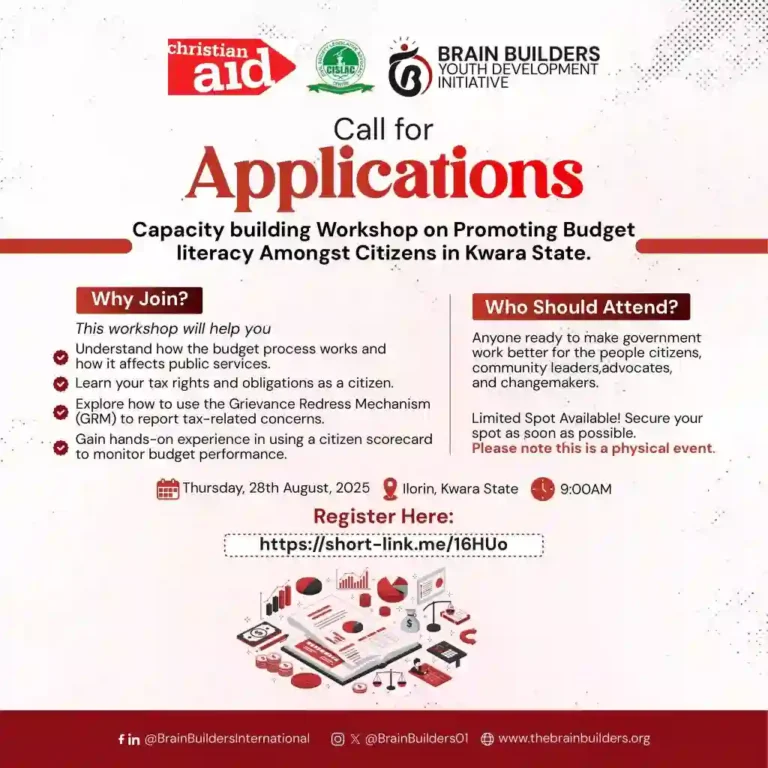
August 15, 2025 – Brain Builders Youth Development Initiative has announced the call for applications for its Capacity Building Workshop on Promoting Budget Literacy Amongst Citizens in Kwara State.

The organisation is inviting residents and individuals committed to improving governance to participate in the programme.

The workshop is supported by the Civil Society Legislative Advocacy Centre and Christian Aid in Nigeria. It is designed to help participants understand how the budget process works, its effect on public services, and how to protect their tax rights. “We want citizens to know their obligations, learn to use the Grievance Redress Mechanism to report tax-related concerns, and gain practical skills in budget monitoring,” the statement said.

Why Join?
i. Understand how the budget process works and how it affects public services.
ii. Learn your tax rights and obligations as a citizen.
iii. Explore how to use the Grievance Redress Mechanism (GRM) to report tax-related concerns.
iv. Gain hands-on experience in using a citizen scorecard to monitor budget performance.

Who Should Attend?
Anyone ready to make government work better for the people citizens, community leaders, advocates, and changemakers.

The workshop will take place physically in Ilorin, Kwara State, on Thursday, 28th August 2025, at 9:00AM.

Due to venue capacity, attendance will be limited.

How to apply:

Applicants can register through the Google form Here.

Participants will be encouraged to take follow-up actions in their communities or organisations by applying the citizen scorecard to assess budget performance.

Edo, Google to Train 800 Students in Advanced Digital Skills

The Edo State Government has announced its plan to boost digital education and prepare youths for opportunities in the global technology sector, targeting a share in the 37 million jobs expected to be created in the digital industry.

In collaboration with Google, the state will train 800 students in advanced technology skills to enhance their employability and competitiveness worldwide.

Speaking in Benin City, the Commissioner for Education, Dr. Paddy Iyamu, said the initiative, called the Advanced Job Ready Tech Programme, is designed to position Edo students for success in the global workforce.

According to him, “We are introducing the Advanced Job Ready Tech Programme in partnership with Google. This initiative aims to provide Edo students with opportunities in the global workforce and strategically prepare them for the digital landscape.”

He explained that the program will cover a range of high-demand areas including Data Science, Data Analysis and Visualization, Data Architecture, Geospatial Data Science, Computer Vision, Natural Language Processing, and Advanced Machine Learning Techniques. “This initiative serves as a gateway to economic opportunities,” he added.

Dr. Iyamu revealed that the government will also organize career fairs, offer internship placements, and connect students to direct job opportunities. He noted that the skills gained will enable participants to earn income, secure employment, and progress in their careers.

The program also offers the possibility of earning in foreign currency while working remotely.

The Commissioner stressed that the opportunity is open to Edo students both within and outside the state, with remote learning options available for those not physically present. For participants without laptops, the Digital Hub in Benin City is equipped with adequate devices to ensure full participation.

This digital skills initiative is part of the government’s broader strategy to strengthen the state’s human capital development and expand access to the global digital economy.

FG Launches Initiative to Support 10,000 Women-Owned Businesses by 2030

The Federal Government has introduced a new initiative aimed at empowering 10,000 women-owned export-ready businesses in Nigeria by 2030, while also creating international market access for 3,000 women-led small and medium-sized enterprises by 2027.

The announcement was made during the official launch of the Women in Export Development Initiative in Abuja, where First Lady Senator Remi Tinubu, represented by the wife of the Vice President, Hajiya Nana Shettima, addressed participants.

In her keynote speech, the First Lady described the event as more than just a programme launch, saying, “We are igniting a beacon that will illuminate the path for thousands of Nigerian women entrepreneurs determined to take their rightful place on the global trade stage.”

She explained that the initiative, launched in collaboration with the World Trade Organisation, the International Trade Centre, the Nigerian Export Promotion Council, and the Federal Ministry of Industry, Trade and Investment, will focus on boosting women’s participation in global markets through capacity building, export literacy, and linkages to international value chains.

She noted that grassroots export literacy will be delivered through cluster hubs in all 36 states and the Federal Capital Territory, with global connections supported by platforms such as the African Continental Free Trade Area, ECOWAS Trade Hub, ITC SheTrades, and UN Women partnerships.

Emphasising the economic importance of women’s participation, she said, “Closing gender gaps in economic participation could grow Nigeria’s GDP by up to 23 per cent. Women own 41 per cent of micro-businesses and contribute close to 29 per cent of our GDP, yet only 15 per cent participate in formal export trade.”

Highlighting the population statistics, she added, “Women represent 49.3 per cent, or 115.01 million, of the country’s population. That is a compelling call to action. Women are half the power, half the potential, and more than half the promise of this great nation.”

She praised Nigerian women for their impact in sectors such as agribusiness and technology and commended the NEPC for hosting the SheTrades Nigeria Hub for over eight years, connecting more than 4,000 women entrepreneurs to global markets.

She also acknowledged the Minister of Industry, Trade and Investment, Dr Jumoke Oduwole, referring to her as “the SheTrades Champion.”

The First Lady listed other federal initiatives to support women, including the Nigeria for Women Programme, a national women e-market portal, digital skills training for over 20,000 women, and the Naija Save Nigeria financial literacy scheme.

“When a woman exports, she does more than earn. She empowers. Studies show that women reinvest up to 90 per cent of their earnings into their families, healthcare, and education. That is not just business growth.

That is nation-building,” she said. Quoting former UN Secretary-General Kofi Annan, she added, “There is no tool for development more effective than the empowerment of women.” She urged government bodies, the private sector, development partners, and civil society to ensure that the initiative becomes a lasting turning point.

Speaking at the event, the Director-General of the World Trade Organisation, Dr Ngozi Okonjo-Iweala, announced the rollout of the Women Exporters in the Digital Economy Fund in Nigeria, a $50 million initiative jointly established by the WTO and the International Trade Centre to create opportunities for women in digital trade.

According to her, 146 women entrepreneurs have been selected to benefit from the scheme. Sixteen entrepreneurs in the Booster Track will receive up to $30,000 each along with 18 months of technical assistance, while 130 in the Discovery Track will receive up to $5,000 each and one year of business support.

Minister Oduwole praised the WTO and ITC for their partnership, stressing that digital trade offers Nigerian women opportunities to reach international customers, integrate into global value chains, and promote their products and services worldwide.

She reaffirmed the Federal Government’s commitment to aligning the programme with national digital economy and trade strategies, improving export processes, reducing trade barriers, and expanding financing options for women-led businesses.

She also linked the initiative to President Bola Tinubu’s eight-point agenda and the goal of building a $1 trillion economy by 2030, saying, “We want Nigerian women to export not just products, but also ideas, culture, and innovation. Let today mark the beginning of a new era where our women rise, export, and lead on the global stage.”

The Managing Director and Chief Executive Officer of the Nigerian Export Promotion Council, Nonye Ayeni, described the launch as a major milestone for women entrepreneurs and a recognition of their resilience and capacity to compete globally.

She expressed appreciation to the First Lady for her commitment to women’s progress, to the WTO Director-General for initiating the WEIDE Fund, and to Pamela Coke-Hamilton, Executive Director of the International Trade Centre, for her consistent advocacy for women in trade.

Ayeni revealed that the application process received 68,000 entries from all six geopolitical zones, showing the strong entrepreneurial spirit of Nigerian women.

The 146 beneficiaries will gain not only financial support but also training in digital trade, capacity building, access to finance, and digital skills to compete in international markets. “The WEIDE Fund is not just about grants. It is about unlocking the immense potential of our SMEs, particularly women-led businesses,” she stated. She stressed that women remain central to driving digital trade and economic growth.

The launch highlighted the combined efforts of global organisations, the Nigerian government, and trade agencies to enhance women’s capacity in export trade and digital entrepreneurship.

The event also underscored the role of high-level collaboration in promoting economic development, gender equality, and inclusive growth. This initiative is seen as a strategic move to increase Nigeria’s competitiveness in global trade while ensuring that women are at the forefront of economic transformation.

By linking local women entrepreneurs to platforms like AfCFTA, ECOWAS Trade Hub, ITC SheTrades, and UN Women, the programme seeks to position Nigerian women as major contributors to international trade.

The speeches at the event reflected a strong consensus that empowering women in trade is not just an economic necessity but a social imperative. The First Lady’s message, along with remarks from the WTO, ITC, NEPC, and the Ministry of Industry, Trade and Investment, set a tone of determination to close gender gaps and create sustainable opportunities for women in business.

The integration of high-value keywords such as women entrepreneurs, export trade, digital economy, and global markets throughout the event’s discussions further underlined the economic significance of the launch.

By 2030, the government expects the programme to have created a strong base of export-ready women entrepreneurs, positioned Nigeria as a hub for women-led trade in Africa, and contributed significantly to national GDP growth.

The launch of the Women in Export Development Initiative and the Women Exporters in the Digital Economy Fund represents a coordinated approach to tackling existing barriers to women’s participation in international markets and the digital economy.

The programme’s emphasis on capacity building, access to finance, and integration into global trade systems is aimed at creating a lasting impact on Nigeria’s economic landscape.