Home Blog Page 560

Lagos Sets N8.5 Million Initial Deposit for 2026 Hajj

0

The Lagos State Muslim Pilgrims Welfare Board has announced the start of sales of forms and collection of initial deposits for the 2026 Hajj Holy Pilgrimage. This was made known by the Board Secretary, AbdulHakeem Ajomagberin, in a statement issued on Tuesday.

He confirmed that the cost of the Hajj form is N20,000, while the initial deposit for the pilgrimage is N8,500,000, pending the conclusion of contract negotiations with service providers.

Ajomagberin explained that the amount is in line with the official announcement made by the National Hajj Commission of Nigeria during a post-Hajj strategic meeting held last week in Abuja. The meeting brought together Chairmen and Executive Secretaries of States Pilgrims Welfare Boards to review the 2025 operations and begin early preparations for the 2026 exercise.

He revealed that the Board has introduced a flexible payment plan, allowing intending pilgrims to pay in three instalments. According to him, this step is designed to ease the financial burden and encourage more participation in the spiritual journey.

“The Board has put in place measures to ensure transparency and accountability in all its dealings,” Ajomagberin said. “It is essential to note that payments should not be made to any individual.

Instead, payment for both the form and the Hajj initial deposit must be made through a bank draft raised in favour of the Lagos State Muslim Welfare Board from any commercial bank and submitted to the Accounts Department of the Board for an official receipt.”

He also reaffirmed the Lagos State Government’s dedication to ensuring that every intending pilgrim enjoys a comfortable and spiritually enriching experience both in Nigeria and the Kingdom of Saudi Arabia.

The welfare packages include accommodation close to the Haram in Makkah and Madinah, visits to historical sites, regular spiritual counselling, daily provision of local delicacies, medical services, and other support.

Ajomagberin assured that these packages would meet the expectations of the pilgrims and provide them with maximum comfort throughout the exercise.

He further noted that the initiatives are in line with the T.H.E.M.E.S Plus Agenda of Governor Babajide Olusola Sanwo-Olu’s administration, which places strong emphasis on the welfare of citizens.

He encouraged intending pilgrims to begin the payment process early and take advantage of the flexible plan to secure their place for the 2026 Hajj.

Advertisement

Lagos Launches Digital House Numbering System for Property Identification

0

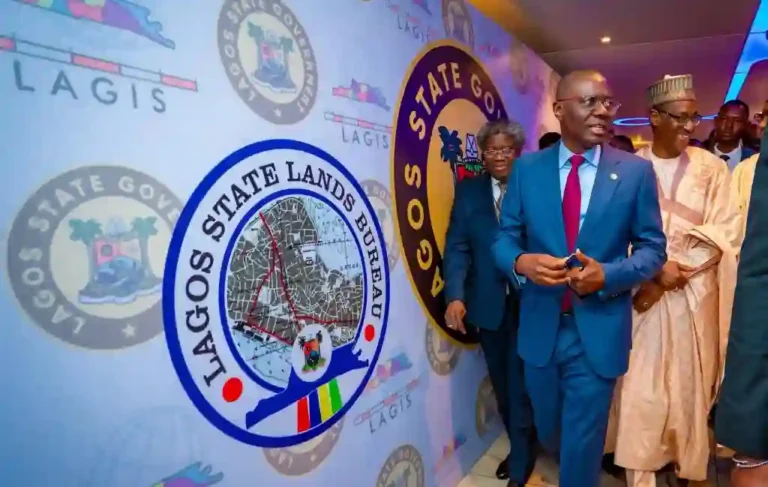
August 12, 2025 – Lagos State Government has launched the pilot phase of its new digital house numbering system called the Identifier project, aimed at transforming property identification and service delivery in the state.

The project, which begins next week in Ikeja, was unveiled by Governor Babajide Sanwo-Olu during the Nigeria Land Titling, Registration and Documentation Programme organised by the Lagos State Office of Electronic Geographic Information System and Urban Development, in collaboration with the Federal Ministry of Housing and Urban Development, at Victoria Island.

The digital house numbering system will assign a unique digital identity to each building in Lagos State. The system is designed to make navigation easier for emergency services, utility companies and residents, while improving the speed and quality of service delivery.

Governor Sanwo-Olu explained that the project is focused on using technology to solve land administration problems and improve urban management.

He said, “Lagos digital house numbering system is a novel idea. It is about technology, and that is one of the things that we are trying to achieve: using technology as a strong enabler to be able to resolve all our land issues, where from the comfort of your house you can access and resolve land title issues. It is still a journey, and we are not there yet, but this digital house numbering system is really more about ensuring that if you can get the address of a property, all the information that is needed on that property can be accessed, and people will see it.”

He also praised the Federal Government for the Renewed Hope Agenda to unlock the economic potential of land through the Nigeria Land Titling, Registration and Documentation Programme, adding that electronic land documentation is the best way forward to reduce physical interference and protect land rights.

Special Adviser to the Governor on e-GIS and Urban Development, Dr Olajide Babatunde, said the Identifier project includes QR codes and local government-specific colour codes for easy identification of properties.

He described it as a major step towards modernising Lagos infrastructure and improving living conditions.

According to Dr Babatunde, the initiative will also strengthen security, increase revenue generation and improve service delivery.

He said, “House numbering and documentation has to do with ownership. So one of the byproducts of titling and documentation in land administration is also house numbering and digital addressing systems. So this is a digital addressing system. The digital house numbering is part of technology, and at the back end, we have all the information that we can share with the public. You can scan the QR code to get the information about a land, particularly bills and some other important information that we may need to know whether a building has an approval or not. We are now in the age of technology. We need to embrace technology.”

Minister of Housing and Urban Development, Arc. Ahmed Dangiwa, speaking at the event, announced plans to improve the percentage of titled land in Nigeria from the current 3 per cent to 50 per cent over the next decade.

He said this goal is part of wider reforms aimed at modernising land administration and making land a viable asset for wealth creation, housing delivery and inclusive growth.

The minister noted that the lack of formal land titles limits property owners’ ability to use land as collateral for loans and reduces the value of property transactions. He added that the new measures will allow states to retain control over land administration while encouraging the adoption of global best practices in land management.

According to Dangiwa, over 97 per cent of land in Nigeria remains untitled. He stressed that the new initiative will encourage digitisation of land registries, integration of geographic information systems and application of methods already implemented in Lagos State.

The Identifier project, according to Lagos State officials, represents a strategic move to unlock the full economic potential of land in Nigeria, enhance transparency in property ownership and improve governance in land management.

With a unique QR code embedded on each property’s plate, residents, government agencies and businesses will be able to access relevant details instantly, ranging from approval status to billing records.

Governor Sanwo-Olu emphasised that the project would create an environment where property-related information becomes easily accessible to both government and the public, reducing disputes and enhancing confidence in real estate transactions.

The state government also expects the digital addressing system to improve security monitoring and make it easier to track and respond to emergencies. By linking digital house numbers with geographic information systems, officials say the system will also help identify and address illegal constructions, manage urban growth more effectively and improve infrastructure planning.

The launch of the Identifier project marks a significant milestone for Lagos State in its bid to integrate advanced technology into public administration, streamline property identification and set the pace for other states to follow.

It reflects a shift towards data-driven urban planning, where property identification is tied to economic development and better service delivery.

This pilot phase in Ikeja will serve as a test for the wider rollout across the state, with authorities confident that the system will bring measurable improvements in how properties are managed, identified and utilised for economic growth.


NADI Sends SMS to Applicants to Complete Farmers Enterprise Survey

0

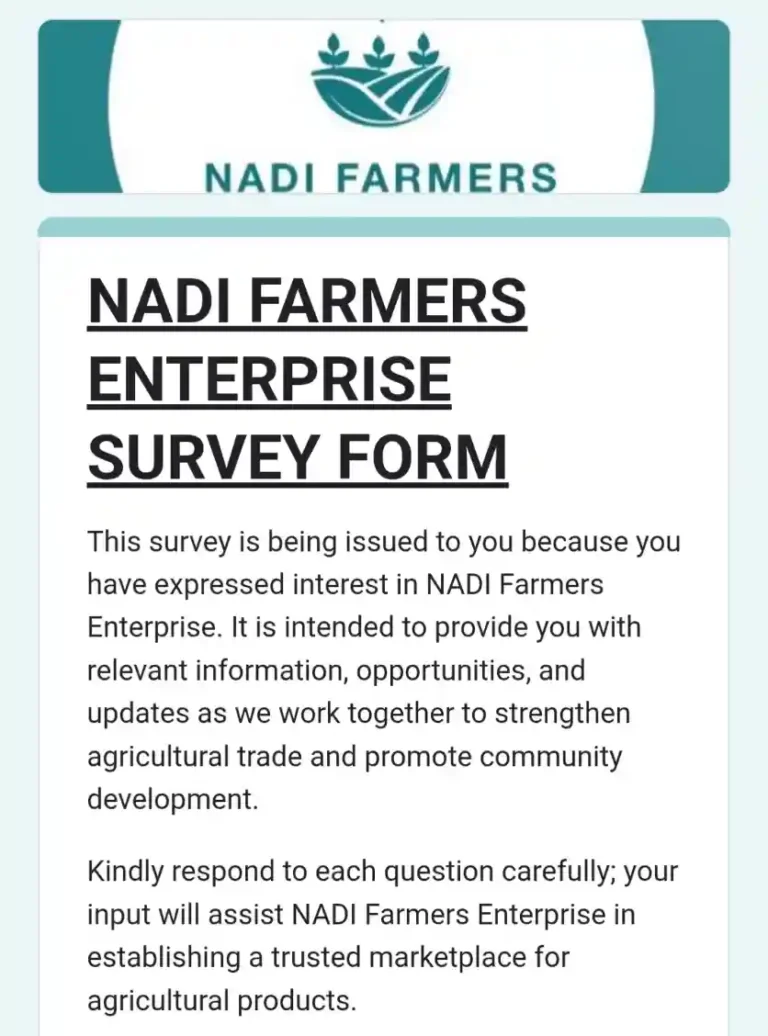
August 12, 2025 – NADI Farmers Enterprise has sent a survey form to applicants who earlier expressed interest in joining its agricultural platform.

In a message sent to participants, the organization stated, “We appreciate your interest in NADI Farmers Enterprise. Please take a few moments to complete this survey. Link: https://forms.gle/XthmRoG8e9PDUaNXA.”

The survey aims to collect feedback that will guide the development of a trusted marketplace for agricultural products.

According to the form, “Kindly respond to each question carefully; your input will assist NADI Farmers Enterprise in establishing a trusted marketplace for agricultural products.”

NADI Farmers Enterprise is a structured agribusiness platform with registration number 8597916. It focuses on making farming more efficient, profitable, and accessible to both farmers and agri-entrepreneurs. The company emphasizes that it operates as a business, not a charity organization.

“Our goal is to provide a reliable marketplace where farmers and agri-entrepreneurs can seamlessly buy and sell farm products, tools, and inputs,” the statement read. “By connecting you directly with verified buyers and sellers, we simplify transactions, reduce costs, and open the door to new business opportunities.”

The survey also highlights NADI’s commitment to strengthening agricultural trade and promoting community development through verified online and offline transactions.

Bauchi to Train 100,000 in Digital Skills, 500 Cybersecurity Experts by 2027

August 12, 2025 – Governor Bala Abdulkadir Mohammed of Bauchi State has announced three major initiatives aimed at boosting technology, job creation, and data protection in the state. Speaking during the unveiling, he described them as “a new digital dawn for Bauchi State.”

The initiatives include the Digital Literacy and Skills Framework, the CyberNation Programme, and the Bauchi State Data Protection Policy.

The governor explained that under My Bauchi Project 2.0, the state is committed to making digital literacy a right for all residents while leveraging technology to create jobs and reduce poverty.

In partnership with the National Information Technology Development Agency (NITDA), the government will train over 100,000 citizens in basic digital skills and 2,000 youths in advanced fields such as software development, cloud computing, and data analytics by 2027.

He noted that the CyberNation Programme, developed with Protexxa Inc., is the first of its kind in Nigeria and the second in Africa.

The programme will train 500 certified cybersecurity experts for both local and international opportunities, boosting the state’s position in the global digital economy.

On the Bauchi State Data Protection Policy, created with the Nigeria Data Protection Commission (NDPC), the governor said it will protect citizens’ digital rights and ensure all government institutions comply with national data protection laws.

Governor Mohammed appreciated the support of NITDA, NCC, Galaxy Backbone, NIGCOMSAT, Almuhibbah Open University, and other partners, stating that these efforts will help build a secure, inclusive, and globally competitive digital economy for Bauchi State.

Bauchi Launches Cybernations Program, Digital Literacy Framework

0

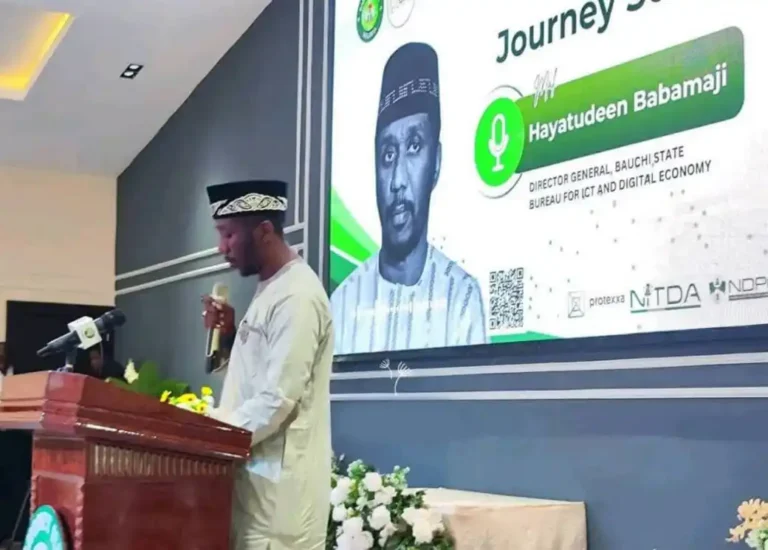
August 12, 2025 – The Bauchi State Government, led by His Excellency Senator Bala Abdulkadir Mohammed, has launched the Cybernations Program, the Digital Literacy and Skills Framework, and signed a landmark Memorandum of Understanding with the Nigeria Data Protection Commission (NDPC).

The event, organized by the Bureau for ICT and Digital Economy (BICTDE), took place in Bauchi with top state and national officials in attendance.

Present were the Deputy Governor of Bauchi State, Alhaji Auwal Jatau, the Speaker of the Bauchi State House of Assembly, Hon. Abubakar Y. Suleiman, the Secretary to the State Government, Hon. Aminu Hammayo, and the Chief of Staff, Dr. Aminu Hassan Gamawa.

Various Commissioners, the Emir of Bauchi, the Emir of Dass, and representatives from the Nigerian Communications Commission (NCC), the National Information Technology Development Agency (NITDA), Nigerian Communications Satellite Limited (NigComSat), NDPC, Galaxy Backbone, and the Canadian cybersecurity firm Protexxa also attended.

Speaking at the event, Senator Bala Mohammed described the initiatives as “a major step towards securing the state’s digital future and empowering citizens with skills to thrive in a connected world.”

The Cybernations Program, developed in partnership with Protexxa, is designed to provide advanced cybersecurity training and equip residents with tools to defend against cyber threats. The Digital Literacy and Skills Framework will help expand ICT knowledge, bridge the digital divide, and promote technology-driven economic growth in Bauchi State.

Hon. Abubakar Y. Suleiman noted, “With these projects, we are preparing our youth for global opportunities in the digital economy.”

The MoU with the Nigeria Data Protection Commission strengthens compliance with national data protection laws, ensuring privacy and secure handling of digital information.

Officials emphasized that the projects align with national digital policies and reflect Bauchi State’s vision to be a leader in ICT development and cyber resilience in Nigeria.

Apply: Katsina State Model Schools Teachers Recruitment 2025

0

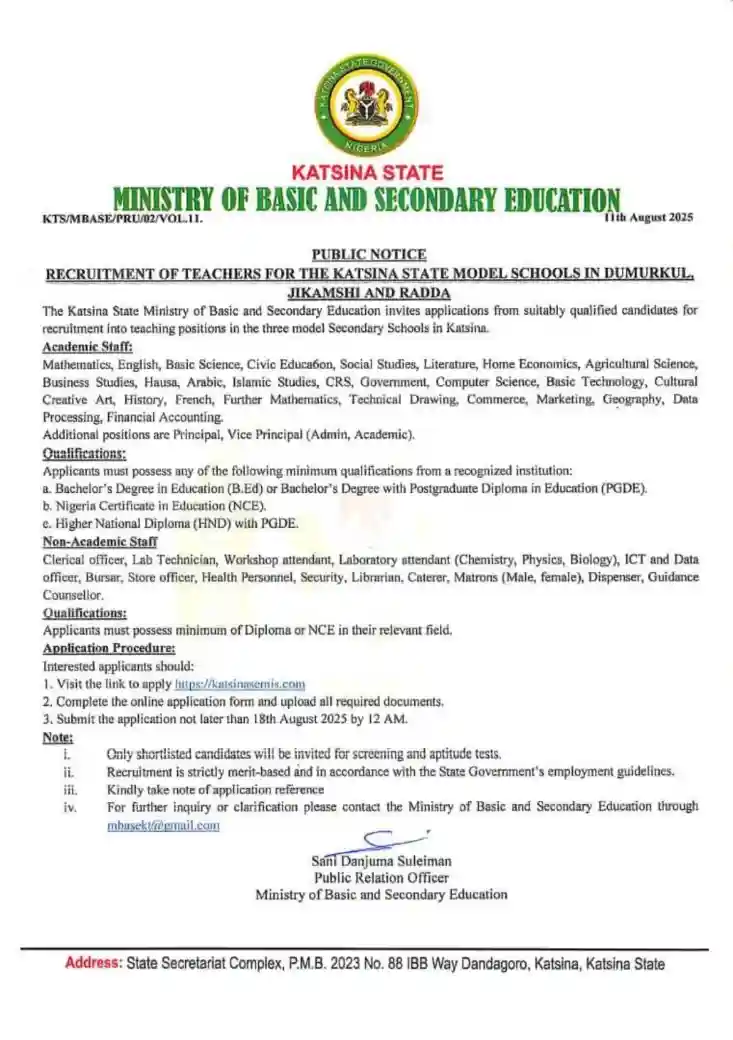
Katsina State Ministry of Basic and Secondary Education has announced the massive recruitment of teachers and non-academic staff for its three model secondary schools located in Dumurkul, Jikamshi, and Radda.

The ministry stated that the exercise will be strictly merit-based and in line with the state government’s employment guidelines.

According to the Public Relations Officer, Sani Danjuma Suleiman, “Applications are invited from suitably qualified candidates for recruitment into teaching positions in the three model secondary schools.”

Academic staff positions include:
1. Mathematics
2. English
3. Basic Science
4. Civic Education
5. Social Studies
6. Literature
7. Home Economics
8. Agricultural Science
9. Business Studies
10. Hausa
11. Arabic
12. Islamic Studies
13. CRS
14. Government
15. Computer Science
16. Basic Technology
17. Cultural Creative Art
18. History
19. French
20. Further Mathematics
21. Technical Drawing
22. Commerce
23. Marketing
24. Geography
25. Data Processing
26. Financial Accounting

Additional positions: Principal, Vice Principal (Admin, Academic).

Qualification requirements:
a. Bachelor’s Degree in Education (B.Ed) or Bachelor’s Degree with Postgraduate Diploma in Education (PGDE)
b. Nigeria Certificate in Education (NCE)
e. Higher National Diploma (HND) with PGDE

Non-academic staff positions include:
1. Clerical officer
2. Lab Technician
3. Workshop attendant
4. Laboratory attendant (Chemistry, Physics, Biology)
5. ICT and Data officer
6. Bursar
7. Store officer
8. Health Personnel
9. Security
10. Librarian
11. Caterer
12. Matrons (Male, female)
13. Dispenser
14. Guidance Counsellor

Qualification requirements:
a. Minimum of Diploma or NCE in relevant field

How to apply:

Interested applicants are to visit https://katsinasemis.com, complete the online application form, and upload all required documents.

Submission closes by 12 AM on 18th August 2025.

The ministry stated that only shortlisted candidates will be invited for screening and aptitude tests, urging applicants to “kindly take note of the application reference.”

Bayelsa PPSB to Announce New Date for Teachers Appointment Letters

0

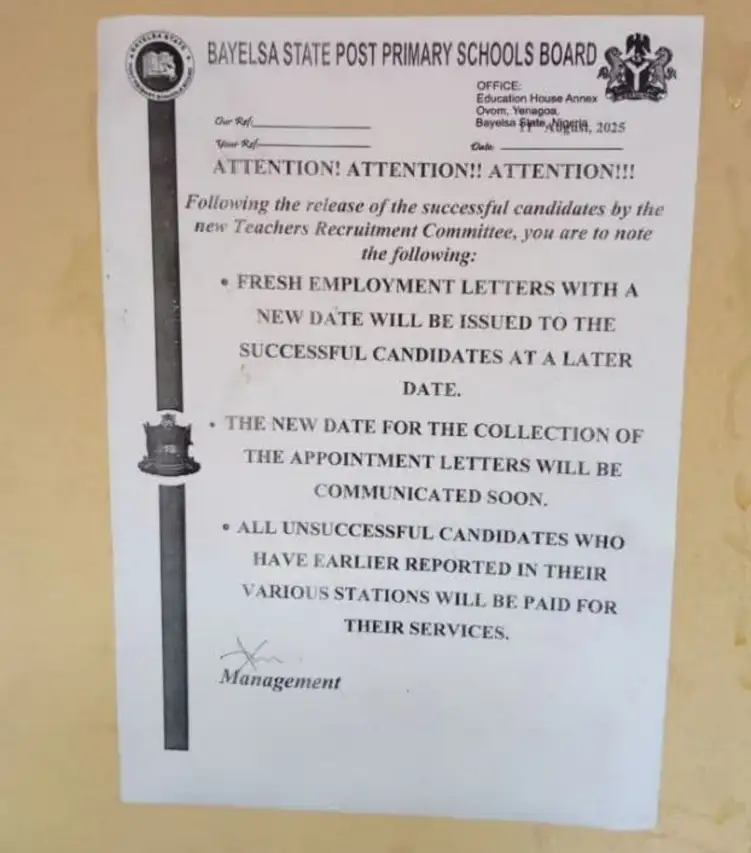
The Bayelsa State Post Primary Schools Board (PPSB) has announced updates regarding the recent teachers recruitment exercise. In a statement, the Management said, “Following the release of the successful candidates by the new Teachers Recruitment Committee, fresh employment letters with a new date will be issued to the successful candidates at a later date.”

The board added that “the new date for the collection of the appointment letters will be communicated soon.”

It further stated that all unsuccessful candidates who had earlier reported at their various stations “will be paid for their services,” ensuring transparency and fairness in the recruitment process.

FCE Okene Sends Aptitude Test Invitations to Shortlisted Applicants

0

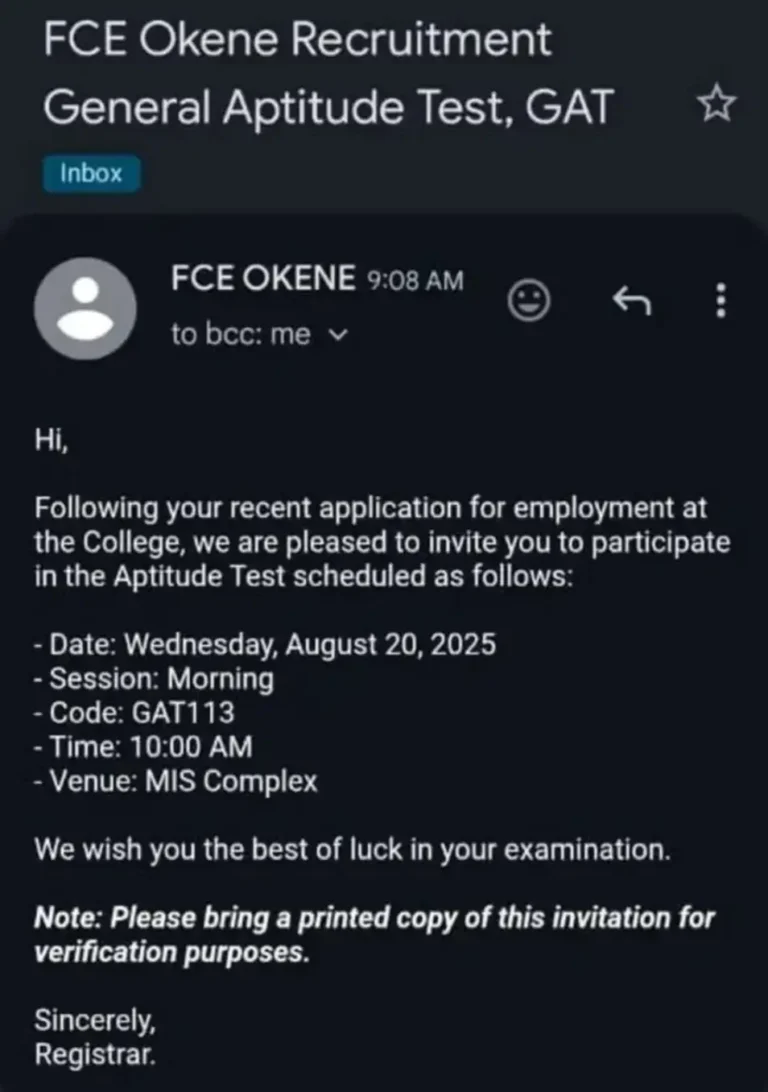
The Federal College of Education (FCE) Okene has begun sending emails to candidates shortlisted for its general aptitude test. Applicants are advised to check their inbox for the invitation.

The message states, “Following your recent application for employment at the College, we are pleased to invite you to participate in the Aptitude Test scheduled as follows: Date: [August] 2025. Session: Morning. Code: GAT113. Time: 10:00 AM. Venue: MIS Complex. We wish you the best of luck in your examination.

Note: Please bring a printed copy of this invitation for verification purposes. Sincerely, Registrar.”

The aptitude test date is not the same for all the applicants.

GAT stands for “General Aptitude Test.”

The recruitment process continues as the institution moves forward with assessments for employment opportunities in the education sector.

FG Pushes Nationwide Skills Development Policy to Boost Employability

0

The Federal Government has reaffirmed its commitment to equipping Nigerians with practical, industry-relevant skills through the implementation of the National Policy on Skills Development in Formal and Non-Formal Education.

The policy, described as a major pillar of the Nigerian Education Sector Renewal Initiative (NESRI), focuses on reforming the curriculum, enhancing teacher training, revitalising Technical and Vocational Education and Training (TVET), expanding non-formal education, and strengthening public-private partnerships.

Championed by President Bola Tinubu, the initiative was the main subject at a sensitisation and dissemination workshop held in Lagos to mobilise stakeholders for nationwide adoption.

Declaring the workshop open, the Minister of Education, Dr Olatunji Alausa, said the policy targets learners across all education levels, including basic, secondary, tertiary, and non-formal education.

He explained that it will integrate hands-on training, critical thinking, digital literacy, and vocational skills into the curriculum to boost employability.

Dr Alausa, represented by the Director of Technology and Science Education in the Ministry, Muyibat Olodo, urged Commissioners of Education, SUBEB Chairmen, and other stakeholders to “take ownership of the policy and drive its implementation at the grassroots level.”

In a presentation titled “National Policy on Skills Development: Implementation through the Technical Education Lens,” the Executive Secretary of the National Board for Technical Education (NBTE), Professor Idris Bugaje, stressed the need to integrate skills development from an early stage.

He noted that this approach would help tackle issues such as skills mismatch, limited training opportunities, inadequate labour market data, and weak industry engagement. Professor Bugaje, represented by Suleiman Yusuf, called for “stronger collaboration among government, industry, NGOs, and development partners to ensure the delivery of high-quality, relevant, and competency-based training that meets labour market needs.”

UNICEF’s Chief of Education, Vanessa Lee, represented by Ms Yetunde Oluwatosin, reaffirmed the organisation’s support for the rollout of the policy nationwide, stating that it will help build a skilled and competitive workforce for Nigeria’s future.

FG Launches Council for Creative Technology Futures (CCTF)

0

The National Council for Arts and Culture (NCAC), with full approval from the Federal Ministry of Art, Culture, Tourism and Creative Economy (FMACTCE), has officially launched the Council for Creative Technology Futures (CCTF), a new national initiative aimed at positioning Nigeria as a global leader where culture meets technology.

As Nigeria’s creative economy is projected to surpass $25 billion by 2025, the sector continues to shape global narratives in music, film, fashion, gaming, and digital content.

The CCTF will act as a high-level policy, strategy, and implementation platform for harnessing emerging technologies such as Artificial Intelligence, Augmented and Virtual Reality, Web3, and blockchain across more than 49 creative industry sectors.

“This Council is about merging culture and code, storytelling and smart contracts, heritage and innovation,” said Obi Asika, Director General of NCAC. “We are not just reacting to global change we are leading it from Africa.”

Core Mandates of the CCTF:
a. Guide Nigeria’s creative industries into a digitally empowered future that drives job creation and economic growth.
b. Equip creators with global tools, platforms, and market access.
c. Enhance Nigeria’s position as a cultural and technological powerhouse.

The CCTF will deliver the National Creative-Tech Framework & Roadmap (2025-2030) in alignment with the National AI Strategy, Executive Order 005, the Digital Economy Policy (2020-2030), and NCAC-led programs such as ICE Hubs and Discover Naija.

It will also receive memorandums from stakeholders, work closely with NCAC sister agencies in culture and tourism, and advance global advocacy to elevate Nigeria’s creative sector on the world stage. The initiative will seek best-in-class solutions to drive economic growth and foster innovation.

Membership of the Council is pro bono, demonstrating a national service spirit and collective dedication to building a digitally empowered creative industry. In its first phase, the Council will establish foundational frameworks and deliverables, setting the stage for the creative and cultural industries to thrive and boost the creator economy.

Strategic partnerships will be formed with global organizations such as the British Council, University for the Creative Arts UK, UNESCO, Google, Meta, African Development Bank, GIZ, the European Union, Netflix, and other major development and technology partners.

These collaborations aim to mobilize investment, technical expertise, and international exposure for Nigeria’s creative-tech ambitions.

“The launch of the Council for Creative Technology Futures is a milestone,” Asika added. “We are building the foundation for Nigeria’s creative future where our stories, music, art, and innovation are protected, monetized, and celebrated globally.”

Inaugural Council Members:
1. Charles Emembolu – TechQuest, Talent Development (Chairman)
2. Misan Harriman – Director & Photographer
3. Dayo Elegbe – Sponge Group, Digital Marketing
4. Bizzle Oshikoya – The Plug, Music & Talent Management
5. Kemi Awodein – MD, Chapel Hill Denham
6. Osas Peter – Founder, BlackAt
7. Malik Afegbua – AI Storytelling & Creative Visual Futurism
8. Sandra Oyewole – IP Lawyer, Olajide Oyewole LLP
9. Judith Okonkwo – Imisi 3D, AR & New Technology Leader
10. Dr. Dahiru Sani – Founder, Kaduna Business School
11. Dr. Chinedu Odoala – Head, NCAC Secretariat

With this strategic move, Nigeria is taking a bold step into the future by unlocking millions of jobs, increasing intellectual property exports, attracting venture capital, and empowering a new generation of creators, technologists, and entrepreneurs.