
Home Blog Page 657

Just In: VDM Released on Bail from EFCC Custody

0

Popular social media activist and influencer, Martins Vincent Otse, better known as VeryDarkMan (VDM), has been released on bail following his arrest by the Economic and Financial Crimes Commission (EFCC). The arrest happened on Friday at a branch of Guaranty Trust Bank (GTBank) in Abuja.

VDM’s legal representative, Deji Adeyanju, confirmed his release, stating that the EFCC granted bail after days of engagement with the commission.

According to Adeyanju, special thanks go to Marvin Omorogbe, head of their legal firm, and all Nigerians who spoke out in support. He also appreciated high-profile supporters such as Peter Obi, Atiku Abubakar, Davido, and other opposition figures who demanded VDM’s release.

The arrest of VDM sparked massive public attention and stirred up controversy across digital platforms. Young Nigerians and influencers voiced their concerns about what they saw as an abuse of power, further fueling the public conversation around freedom of speech and the responsibilities of law enforcement.

On Monday, the EFCC officially confirmed VDM’s arrest. Their spokesperson, Dele Oyewale, explained that the commission was acting on petitions received from members of the public. He emphasized that EFCC must protect the identities of those who file such complaints and clarified that the case would proceed to court once bail conditions had been met.

Following his detention, several youths protested in Abuja, demanding justice and his immediate release. The protestors labeled his arrest as unfair and accused the agency of silencing a voice that speaks out for the people.

This incident has once again brought national focus to issues surrounding digital rights, legal activism, and public accountability.

The attention from influential voices and political figures has highlighted the growing power of online advocacy in Nigeria. With VDM now out on bail, many Nigerians are watching to see how the case develops.

Advertisement

Gov. Sanwo-olu Launches (LASMECO) Lagos State Access to Finance for SMEs Through Cooperatives Programme

The Lagos State Access to Finance for SMEs through Cooperatives (LASMECO) programme was officially launched on May 7, 2025, by Governor Babajide Sanwo-Olu.

The event took place at the Adeyemi Bero Multipurpose Hall in Alausa, Ikeja. This initiative is designed to support the growth of Small and Medium Enterprises (SMEs) in Lagos State by improving access to affordable loans.

The programme is a collaboration between the Lagos State Government, the Ministry of Commerce, Cooperatives, Trade and Investment (MCCTI), the Bank of Industry (BOI), and Sterling Bank. LASMECO offers loans of up to ₦10,000,000 at a low interest rate of 9%, with a flexible repayment period of 2 to 3 years. This makes it an attractive option for small business owners looking for business funding in Nigeria.

By working through cooperatives, the programme ensures that micro, small, and medium enterprises can apply more easily and access funding faster. LASMECO is aimed at helping entrepreneurs empower their businesses, create jobs, and support the local economy.

It is part of the broader effort by the Lagos State Government to drive economic growth, encourage youth entrepreneurship, and promote financial inclusion in the state.

Also Read: FG Leep Program Portal Registration Open

The LASMECO programme provides an opportunity for many Lagos-based SMEs to thrive and expand through reliable and affordable business loans.

NELFUND Student Loan Complaints: MD Promises Faster, Fraud-Free Process

Many Nigerian students have faced difficulties while trying to access loans through the Nigerian Education Loan Fund (NELFUND). From application delays to lack of transparency, complaints about the student loan system have become more common. These student loan complaints have raised concerns about how accessible and effective the loan process really is, especially for low-income students who need urgent financial aid for their education.

To address these growing concerns, NELFUND recently announced a major update to its student loan application system. The goal is to reduce fraud and make the application process faster and more transparent. One of the most important changes is the deployment of IT teams to institutions across Nigeria.

These teams will work closely with schools to set up direct student loan payment options on school portals. This move is expected to eliminate many of the delays and confusion that students previously faced when applying for loans.

The Managing Director of NELFUND, Akintunde Sawyerr, emphasized that the success of the student loan program depends on strong cooperation between institutions and the fund. He highlighted that institutions must avoid introducing fraudulent practices and instead help build a system that students can trust. The focus is now on developing a technology-driven student loan system that improves user experience and delivers results quickly and fairly.

In the past, some students complained about being left stranded due to delays in disbursement. With this new update, NELFUND is aiming to change that. They are working to create a trusted platform that not only improves access to student financing but also encourages transparency and accountability throughout the process.

For students searching for education funding in Nigeria or easy student loans with low interest, NELFUND is positioning itself as a reliable solution. As the system becomes more streamlined, students can expect faster processing times and better communication.

With education costs rising, finding student loans without stress in Nigeria is becoming a top priority for many young people.

Also Read: Ministry of Education Probes Nigerian Universities for Diverting NELFund Student Loans

NELFUND’s update shows they are listening to complaints and are serious about fixing the issues. Their aim is to build a future where access to education is not limited by financial barriers.

Just In: Nimc Nin Verification Service Portal Now Open

0

The Federal Government of Nigeria has launched the NIMC NIN Authentication Service (NINAuth) to make identity verification more secure, seamless, and accessible. This move is part of President Bola Ahmed Tinubu’s Renewed Hope Agenda to strengthen Nigeria’s digital identity system. The NINAuth service is now the official way to verify identities across all government platforms, helping people easily access essential services.

The NINAuth application is a secure system that works with the National Identity Management Commission’s backend infrastructure. It gives Nigerians and legal residents more control over their personal data. Before any information is shared, users must give their clear permission. This builds trust and protects privacy while ensuring smooth Know Your Customer (KYC) processes.

With the NIN verification service, users can easily access and complete tasks such as sim registration, renewing driver’s licenses, processing passports, and applying for government programs. It also helps with tax filing, financial transactions, and other important activities tied to one’s digital identity.

A key advantage of this service is its high-level data security, which helps prevent identity theft and unauthorized access. It also makes it easier for people to use one secure sign-on to connect with different government services. This improves service delivery and ensures only verified individuals can access sensitive platforms.

NINAuth’s API and mobile integration features make it easier for businesses and government departments to perform real-time identity checks. This helps reduce delays and supports better decision-making across sectors. Financial institutions, for example, can quickly verify identities, helping with faster approvals and reducing fraud—a top priority in the digital finance industry.

The NINAuth application is now the exclusive platform for all identity verification and authentication processes in Nigeria. This means all Ministries, Departments, and Agencies (MDAs) must use it for any identity-related service. It also promotes database harmonization, which supports Nigeria’s goal of having a unified identity system for better planning and governance.

To get started, individuals must download the NINAuth app from the Google Play Store or Apple iOS App Store. The full implementation guide and process flow are available on the official NIMC website at https://ninauth.nimc.gov.ng.

Also Read: NIMC’s Self-service Modification Portal is Open

This move supports the growing need for secure identity verification services, which are essential for accessing mobile banking, online transactions, and various high-demand government services in Nigeria.

Nigeria Immigration Service Tells Public to Beware of FAKE e-VISA Websites

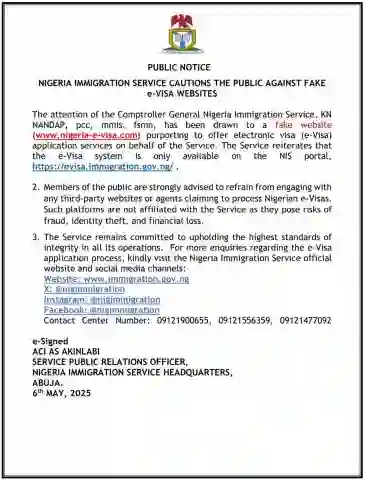
The Nigeria Immigration Service (NIS) has warned the public about a fake e-Visa website claiming to offer visa application services. The Comptroller General, KN NANDAP, has clarified that the site www.nigeria-e-visa.com is not authorized and poses serious risks such as fraud, identity theft, and financial loss.

The only official platform for Nigeria’s electronic visa (e-Visa) application is the NIS portal at https://evisa.immigration.gov.ng. Any third-party visa websites or self-proclaimed agents are not connected to the government and should be avoided.

For anyone planning to travel to Nigeria, it is important to use only the official Nigeria Immigration website or their verified social media channels for updates. This helps protect your personal information and supports secure travel processes.

To report suspicious websites or learn more, visit www.immigration.gov.ng or contact NIS directly through their helplines or social media. The NIS released its contact details as follows:

X: @nigimmigration

Instagram: @nigimmigration

Facebook: @nigimmigration

Contact Center Number: 09121900655, 09121556359, or 09121477092

Also Read: Nigeria Customs Launches B’Odogwu Trade Portal for Faster Form M Processing

JAMB Releases 2025 UTME Results with New Checking Methods

The Joint Admissions and Matriculation Board (JAMB) has officially released the 2025 UTME results, and candidates across Nigeria can now check their scores. This announcement is important for students looking to gain admission into universities, polytechnics, and colleges of education. Knowing your UTME result early helps you prepare for the next admission steps.

JAMB has updated the result-checking process to make it easier and faster. You can now access your JAMB results online through the eFacility portal or by using SMS. Both methods are simple and reliable, even if you’re using a mobile phone.

How to Check JAMB 2025 UTME Result

To check your results online, first open your browser and visit the official JAMB eFacility portal at https://efacility.jamb.gov.ng/login. Log in using the email address and password you used during UTME registration. After logging in, click on “Check UTME Results” to see your subject scores. This method is best if you have access to the internet and want to print or screenshot your JAMB 2025 score for reference.

If you don’t have internet access, you can check your result via SMS. Simply open your messaging app and type RESULT followed by your JAMB registration number. Send this message to 55019 or 66019.

Within a few minutes, you’ll get a reply SMS with your scores. This is a great option for candidates in remote areas or with limited internet service.

Read Also: JAMB Publishes Statistical Analysis of 2025 UTME Result

If there are issues or delays while checking, you can contact JAMB support or visit the nearest CBT center for help. Understanding your UTME performance early can guide your next step in securing admission into Nigerian universities.

WAEC and NECO to Start CBT Exams by 2026

The Federal Government has directed WAEC and NECO to fully adopt Computer-Based Testing (CBT) for all exams by 2026. According to the Minister of Education, Dr. Tunji Alausa, starting November 2025, WAEC and NECO will begin using CBT for their objective tests.

This move follows the success of JAMB, which already uses CBT for its UTME exams.

By May/June 2026, both objective and essay sections of WAEC and NECO exams will go fully digital. The shift to CBT aims to boost exam security, cut down on cheating, and make the process faster and more efficient. Dr. Alausa stressed that this is a major step in digital education in Nigeria.

Read Also: JAMB Publishes Statistical Analysis of 2025 UTME Result

Students, schools, and exam bodies are urged to prepare early for this change. This digital upgrade supports better exam delivery and reflects Nigeria’s growing interest in education technology, online learning, and computer-based exams—topics that attract high interest and advertising revenue.

EFCC Publishes Case Against VDM (Martins Innocent Otse)

0

The Economic and Financial Crimes Commission (EFCC) has officially released its statement on the case involving Martins Innocent Otse, popularly known as VDM. According to the commission, the case began after receiving several petitions accusing him of various financial crimes.

These allegations were serious enough to trigger a formal investigation under the EFCC’s mandate to fight economic and financial crimes in Nigeria.

Despite multiple invitations sent to VDM through known channels, he reportedly refused to appear before the EFCC. This led to increased concerns about financial misconduct. The Commission emphasized that the issues raised in the petitions are significant and cannot be overlooked.

While VDM has been critical of the EFCC on social media and other platforms, the agency insists that his arrest was not influenced by those attacks. Rather, they are focused strictly on the allegations of fraud and economic crime, which are now under investigation by the appropriate authorities.

VDM is currently in EFCC custody, with a legal Remand Order obtained for his detention. However, he has been granted administrative bail and will be released once all conditions are met. This follows due legal process, which is part of how the EFCC handles financial crime cases.

Read Also: Gt Bank SMS Fee Hike: What to Do Next

The Commission thanked the public for its strong interest but urged Nigerians to stop making negative assumptions about its motives. The EFCC promised to file charges as soon as the investigation is complete, in line with the law.

JAMB Publishes Statistical Analysis of 2025 UTME Result

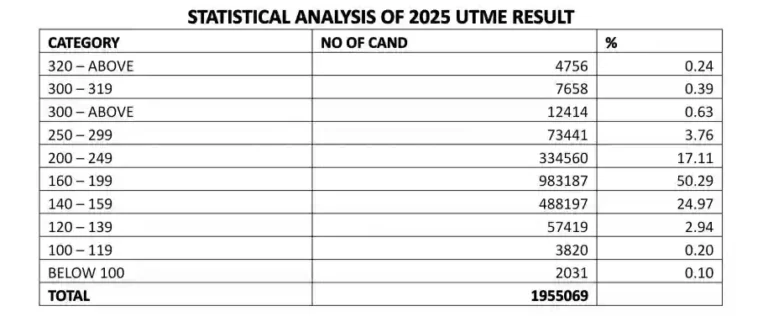
The Joint Admissions and Matriculation Board (JAMB) has released the 2025 UTME result, offering insight into candidate performance across various score ranges. Out of 1,955,069 registered candidates, only 0.24% scored 320 and above, while 0.39% scored between 300 and 319.

Combined, only 0.63% scored 300 or more, which may affect admission chances into competitive courses like Medicine and Law.

A larger group, 3.76%, scored between 250 and 299—still within a range suitable for high-demand university programs. The highest percentage, 50.29%, scored between 160 and 199, which reflects the average performance level in this year’s UTME result analysis. Meanwhile, 17.11% scored between 200 and 249, while 24.97% fell between 140 and 159.

Notably, 40,247 underage candidates participated, but only 1.16% met the exceptional performance mark. Cases of exam malpractice were minimal, with 97 confirmed and 2,157 under investigation. Additionally, 71,701 were absent, and candidates with biometric issues will be rescheduled.

Some results, including those of blind and JEOG candidates, are still being processed. A press conference will soon be held for result checking updates.

FEC approves ‘Nigeria First’ Policy to Boost Goods Made in Nigeria

Today, a major step has been taken to boost local business in Nigeria and strengthen the country’s economy. The Federal Executive Council, led by President Bola Ahmed Tinubu, has approved the Nigeria First Policy, a bold move to prioritize goods made in Nigeria for all federal government purchases.

From now on, Nigerian-made products will be given first consideration in federal procurement. This means more opportunities for local manufacturers, Nigerian suppliers, and homegrown businesses. To ensure full compliance, government institutions must stick to this policy unless they have a written waiver from the Bureau of Public Procurement (BPP), backed by strong justification.

This high-impact policy also focuses on skills development in Nigeria, local capacity building, and penalties for violations. It’s a win for businesses looking to invest or expand in Nigeria’s manufacturing and supply industries.

Contractors and vendors are strongly encouraged to understand the policy and take advantage of the economic empowerment opportunities in Nigeria it offers.

Read Also: Link to GCSS – Garment And Textile Cluster Growth Support Scheme

This aligns perfectly with the Renewed Hope Agenda, putting Nigeria first and building a stronger national economy.